
The most popular advice about AI visibility is also the least useful: “Just create better content.” Better than what, and in a format an answer engine can retrieve? A well-written page can still be ignored if its answer is buried, its structure is ambiguous, its facts are stale, or the surrounding web contains no independent evidence that the brand deserves to be trusted.
Getting cited by AI is closer to retrieval engineering than traditional copywriting. You need a page that matches the question precisely, exposes usable passages, gives machines clear technical signals, and earns recognition in the ecosystems that answer engines already draw from. The work still overlaps with SEO, but the success test has changed. You're not only trying to win a blue link. You're trying to become a source an AI system can confidently select, summarize, and attribute.
Rethinking Search Rankings for AI Answers
Ranking first in Google doesn't guarantee that an AI answer engine will cite you. Ahrefs found that 76% of Google AI Overview citations come from Google's top 10, while 86% come from pages somewhere in the top 100, yet another Ahrefs analysis found that only 12% of AI-cited URLs rank in the top 10 for the queried topic. These findings point to a more useful conclusion: classic rankings help with discovery, but they aren't the complete citation rule. See the analysis of ranking and AI citations for the underlying comparison.
AI systems often expand a prompt into related questions before producing an answer. A query about the best project management software might trigger research into pricing, integrations, user type, security, and alternatives. A page that ranks well for the broad topic may not contain the clearest answer to each sub-question. A deeper page on your site, or even a relevant external page that mentions your brand, can enter the source pool instead.
Semantic fit beats broad topical coverage
The strongest citation opportunity usually sits at the intersection of query match, extractability, and trust. In a 2025 study of AI answer engines, topical relevance and list position were the strongest drivers of being cited first. Explicit price information and a recent timestamp also improved citation likelihood, while completeness and trust cues provided secondary support. The researchers examined six models and identified topic match, price, recency, and position as the dominant gatekeepers in their dataset. The study's full findings make one point especially clear: a broad article can lose to a narrower page that answers the exact question more directly.
That changes how I plan content. Instead of assigning one page to a huge keyword theme, I map the questions an answer engine might fan out into, then give each important question a clearly labeled home. Pricing, limitations, implementation requirements, alternatives, and use cases shouldn't be scattered across vague marketing copy.
Practical rule: Treat every important sub-question as a potential citation target, not as a detail you can hide several scrolls below the introduction.
Traditional SEO still matters, particularly for Google AI Overviews. Google says its AI Overviews include embedded reference links, and academic research describes those links as the evidentiary basis for generated claims. That means you still need crawlable, indexable pages with strong search relevance. But the practical target is broader than “rank number one.” Build a site that answer engines can discover, decompose, and reuse passage by passage. The guide to ranking in AI Overviews is useful as a companion to that broader retrieval mindset.
Structuring Pages for Machine Retrieval
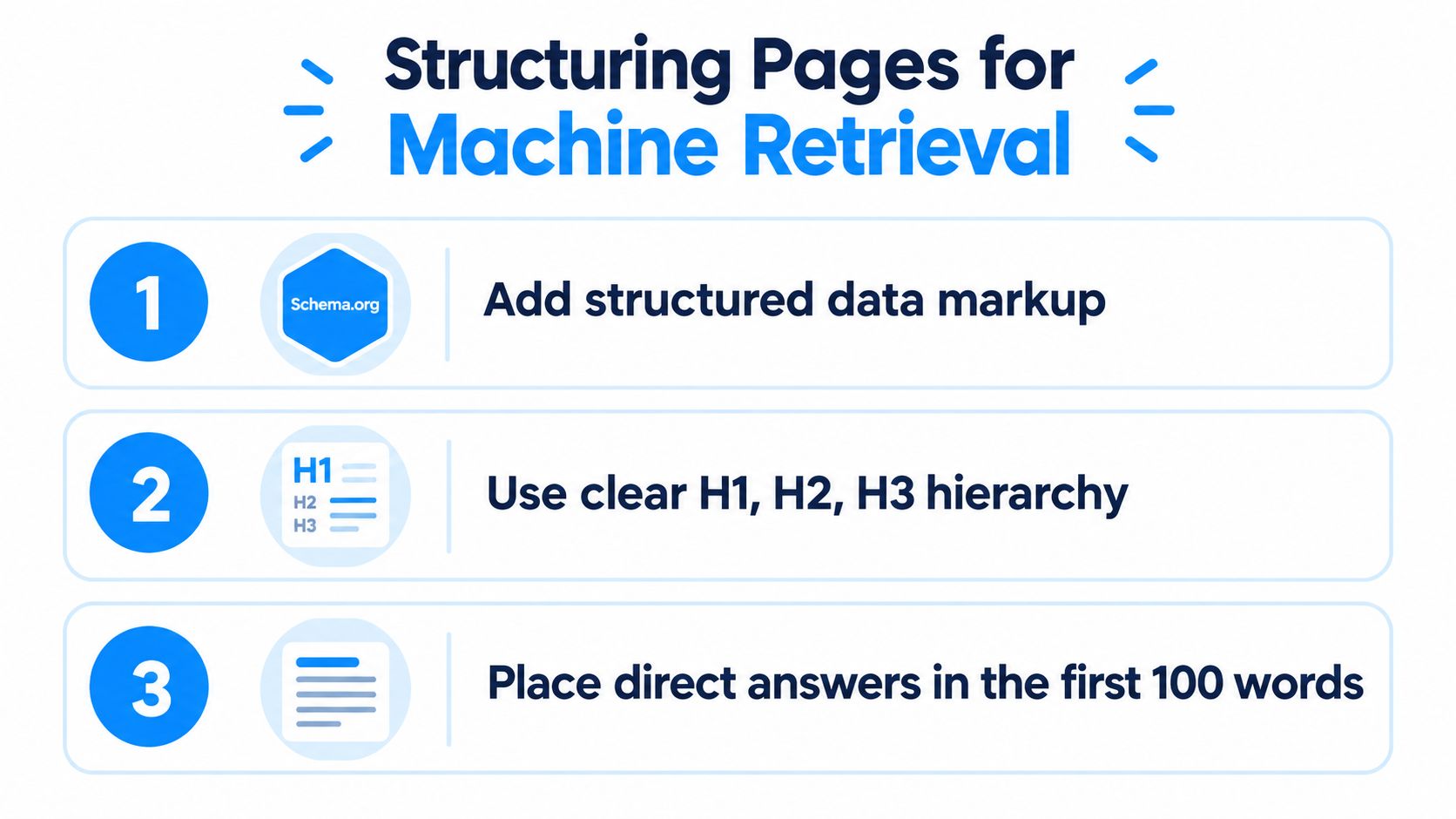
A machine-readable page gives each important answer a clear boundary. Put the core response near the top, use semantic HTML to explain relationships between sections, and keep supporting facts close to the claim they qualify. In a major empirical analysis, Metadata and Freshness, Semantic HTML, and Structured Data showed the strongest associations with citation, which makes technical clarity a publishing responsibility, not a developer afterthought. The page-level quality analysis also found that overall page quality predicted citation better than any isolated tactic.
Put the answer where retrieval starts
Open each page with a direct answer to its primary question. Don't begin with brand history, a dramatic anecdote, or three paragraphs of scene-setting. If the page targets “how to choose accounting software for a small business,” the opening should define the selection criteria and identify the relevant trade-offs before moving into background.
A clean hierarchy helps both people and parsers:
Use one descriptive H1: Make the page topic unmistakable rather than clever.
Write specific H2 and H3 headings: “How accounting software handles payroll” gives more context than “Key considerations.”
Keep paragraphs self-contained: A passage should make sense when extracted without requiring six preceding paragraphs.
Use lists for criteria and processes: Lists expose discrete facts and reduce interpretive work.
Surface prices and dates: If the query involves cost or recency, put those details in visible text, not only in an interactive widget.
Decorative redesigns rarely solve a retrieval problem. A page can look polished and still hide its main answer inside tabs, client-side components, or images that don't expose equivalent text. The same empirical research found that formatting had negligible impact compared with semantic fit and retrieval position. Design should support comprehension, but it can't compensate for missing specificity.
Make the technical layer legible
Use semantic elements such as article, header, main, section, nav, and footer where they accurately describe the page. A logical HTML hierarchy makes relationships clearer than styling generic containers to look like headings. Check the rendered and raw page to confirm that critical copy, pricing, author details, and update dates are available without depending entirely on client-side JavaScript.
Add relevant structured data, but don't treat schema as a magic citation switch. Article, Organization, Product, BreadcrumbList, and FAQPage markup can clarify what a page is about, who published it, and how its questions and answers are organized. The visible page must support every marked-up claim, and the markup should reflect the current content.
Freshness needs more than a changed date. Review facts, prices, product details, screenshots, and references. Keep datePublished and dateModified accurate, and show meaningful updates to readers. The cited study found that a quality score of at least 0.70 combined with at least 12 pillar hits aligned with substantially higher citation rates in its dataset. Those are operating signals from one analysis, not universal thresholds, but they reinforce the practical sequence: improve the whole page, then inspect its technical and structural completeness.
Adapting Content for Different AI Surfaces
There isn't one AI citation algorithm to optimize for. Google AI Overviews, Google AI Mode, Perplexity, and conversational systems can retrieve different source types for the same question, so a page that performs well on one surface may be absent from another. A useful strategy starts with the query and surface combination, not with a generic “AI optimization” checklist.

Google AI Overviews and AI Mode
Google's surfaces share a search context, but they don't draw from identical source mixes. One industry analysis found that AI Overviews leaned more on YouTube and core web pages, while AI Mode cited Wikipedia more and used about 3.5 times more Quora and roughly twice as many health sites. The same report found that only 3% of AI Mode responses lacked sources, compared with 11% of AI Overviews. The comparison of Google's AI citation patterns shows why a single Google strategy is too blunt.
For AI Overviews, strengthen the pages already aligned with organic search. Answer the question early, preserve a clear heading hierarchy, support claims with original or authoritative references, and keep pages current. For AI Mode, expand the source ecosystem. Community explanations, Wikipedia coverage where appropriate, and specialist sites may matter more for certain query categories.
Perplexity and conversational systems
Perplexity's source-label system offers a concrete trust signal. Its shield icon can identify a domain as Government, Academic, or Trusted after a review of the whole website, including whether the site corrects mistakes, names authors, and separates news from advertising and opinion. Perplexity's explanation of source labels is a useful reminder that trust is a site-level practice, not just a page-level phrase.
For Perplexity, publish clearly dated material, answer narrow research questions, and make the source trail visible. For ChatGPT-style research, prioritize durable explanations, entity clarity, and factual consistency across your site and external mentions. Don't assume a recent blog post alone will establish authority. The page needs to be useful in isolation, while the brand needs a coherent footprint elsewhere.
The trade-off: One universal page can reduce production effort, but surface-specific assets usually give you better coverage. Reuse the underlying research, not necessarily the same format or emphasis.
Building Authority in Trusted Ecosystems
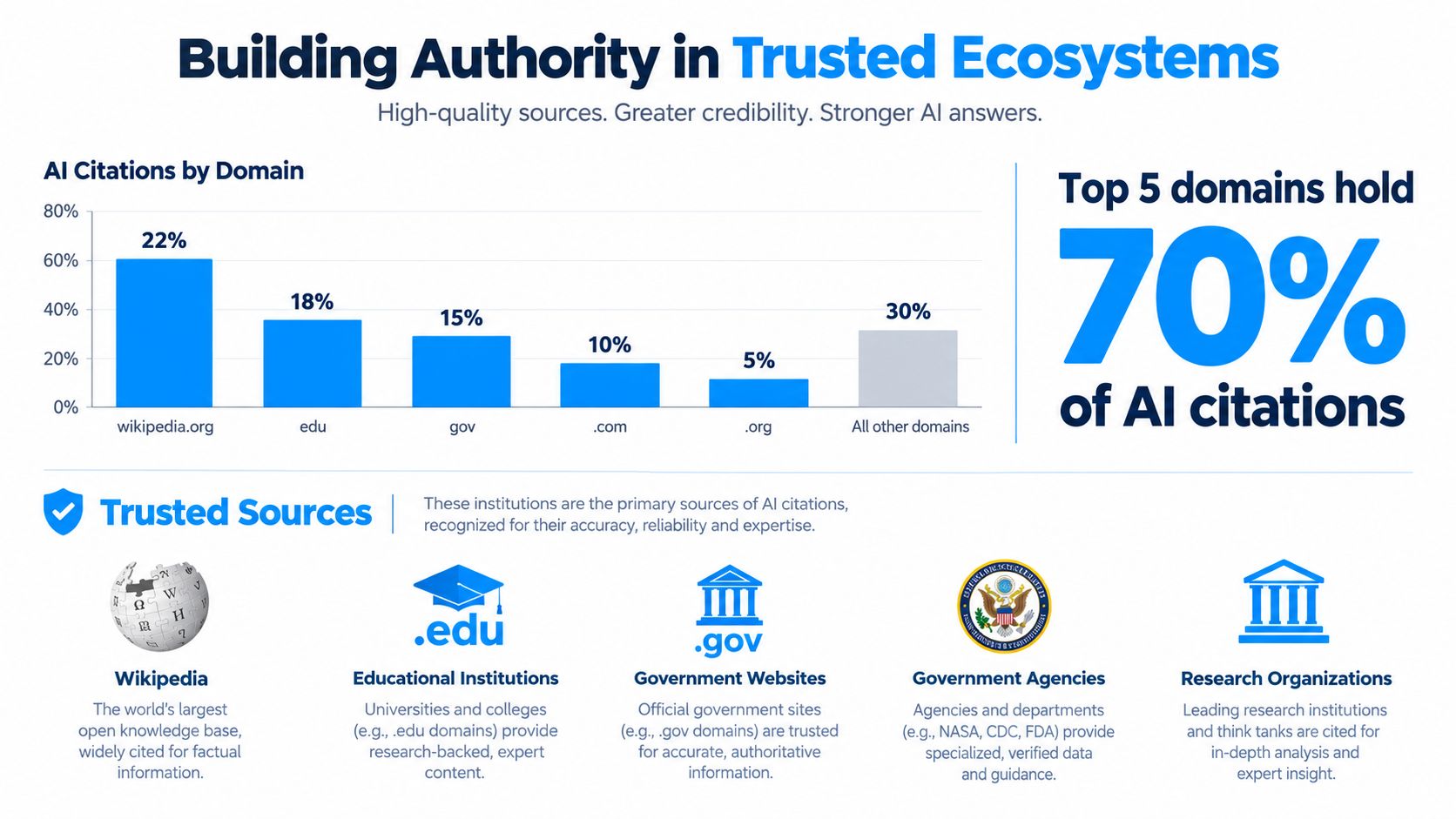
Your own website is only one part of the evidence an AI system uses. Citation patterns are concentrated around a relatively small group of high-signal platforms. A large synthesis covering more than 680 million AI citations reported that Reddit, Wikipedia, YouTube, LinkedIn, and Forbes together captured roughly 68% of citations across the sampled engines. The broader analysis of AI citation sources supports a strategy many brands resist: build authority where trusted information already circulates, not only on your own domain.
Earn references instead of manufacturing mentions
Off-page authority doesn't mean filling forums with promotional comments or asking every contact for a generic backlink. Those tactics create noise and can damage the credibility you're trying to build. The useful work is more specific:
Publish evidence others can use: Original research, transparent benchmarks, technical documentation, and clear definitions give journalists and practitioners a reason to reference you.
Contribute expert context: Answer relevant questions in professional communities without forcing a product mention. A useful explanation can create a durable association between your brand and a problem category.
Keep profiles accurate: Make sure company descriptions, product names, founders, authors, and category labels match across review sites, social profiles, and publisher pages.
Pursue editorial relevance: A mention on a respected industry publication is more useful when it explains your expertise or findings, rather than just repeating a brand slogan.
Correct outdated information: If an external page misrepresents your product, offer precise evidence and a calm correction. Accuracy compounds more effectively than aggressive promotion.
Think in source neighborhoods
AI systems often validate claims through multiple related references. That makes the surrounding “neighborhood” important. If your product is discussed alongside credible research, specialist commentary, and recognized organizations, the model has more context for interpreting what you do. If every mention is self-published marketing copy, the evidence is thinner.
Perplexity's source labels make this logic especially visible. A domain-level review can examine correction practices, author identification, and separation of editorial content from advertising. Build those habits before you need a trust label. A clear corrections policy, named authors, transparent editorial standards, and useful external contributions all strengthen the same underlying signal.
Link acquisition still has a place, but the objective is not volume for its own sake. Focus on relevant, attributable references that explain your brand's role in a topic. Llumo's overview of link-building services is relevant here as a reminder that authority work should connect technical content, editorial outreach, and the pages you want AI systems to understand.
Tracking Visibility and Measuring Impact
You can't improve AI citations from occasional searches made in a browser. Build a prompt set, run it consistently across the surfaces that matter, and record the full response, not just whether your brand appeared. A useful record includes the prompt, model, date, cited URLs, brand description, competitors mentioned, and the page or passage that earned attention.
Start with a small set of commercially important prompts and divide them by intent: category discovery, comparison, problem solving, pricing, implementation, and alternatives. Keep wording stable for longitudinal tracking, then add query variants when you want to understand how fan-out changes the result. A citation that appears for one exact prompt but disappears for every close variation isn't the same as durable visibility.
Track four practical measures:
Prompt visibility: Whether your brand is cited, mentioned without a link, or absent.
Share of voice: How often your brand appears compared with defined competitors across the same prompt set.
Citation quality: Which domains and pages are cited, and whether they describe your brand accurately.
Change after updates: Whether a content, technical, or outreach intervention changes the source pattern over time.
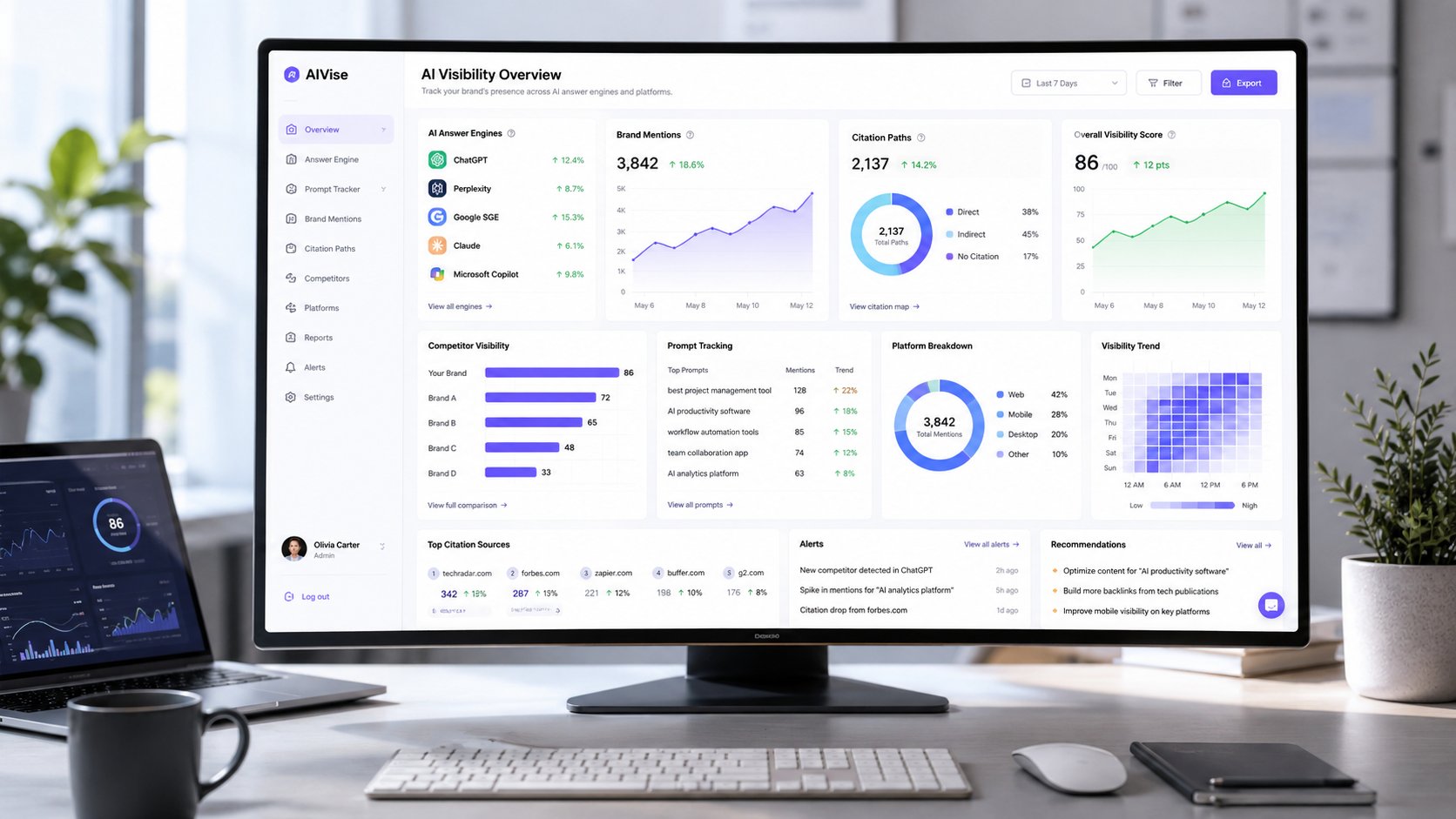
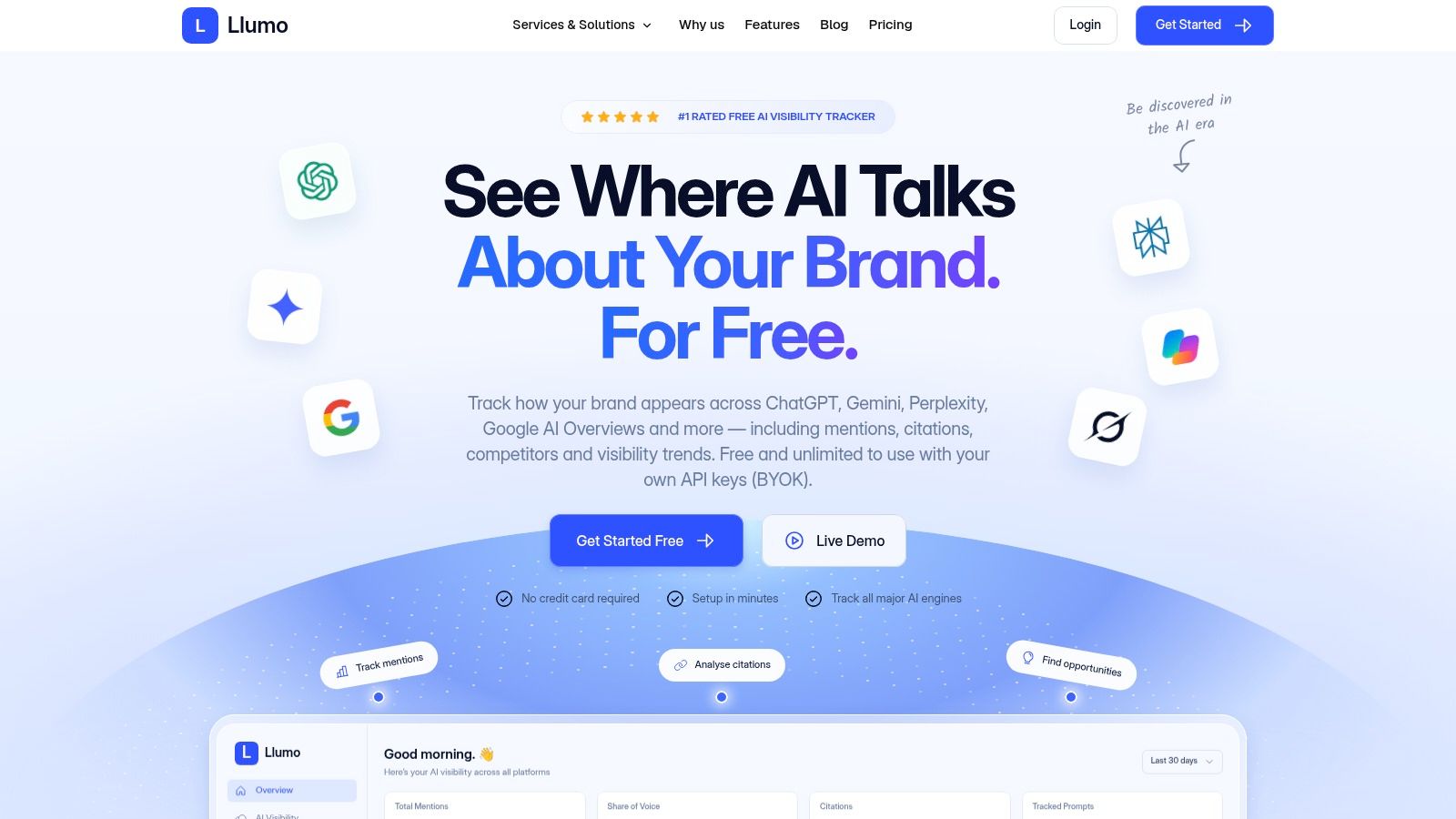
Llumo is an AI visibility platform for Answer Engine Optimization that measures how AI answer engines mention and cite a brand across models such as ChatGPT, Gemini, Perplexity, Copilot, and Google AI Overviews. It provides per-prompt visibility, citation sources, share of voice, and competitive trends, while teams can connect their own provider API keys and pay underlying costs directly. Its AI citation tracking workflow fits teams that need response archives and source analysis rather than a conventional rank report.
Don't treat the dashboard as the strategy. When a competitor wins a prompt, inspect the cited passage and ask what made it usable. Was the answer more direct? Was the page more current? Did a third-party source validate the claim? Change one meaningful variable at a time where possible, then preserve the response history so a temporary fluctuation doesn't look like a breakthrough.
A short visual review can help stakeholders understand what the data represents. Use it alongside the recorded prompts and cited pages, not as a replacement for them.
Your Action Plan for AI Citations
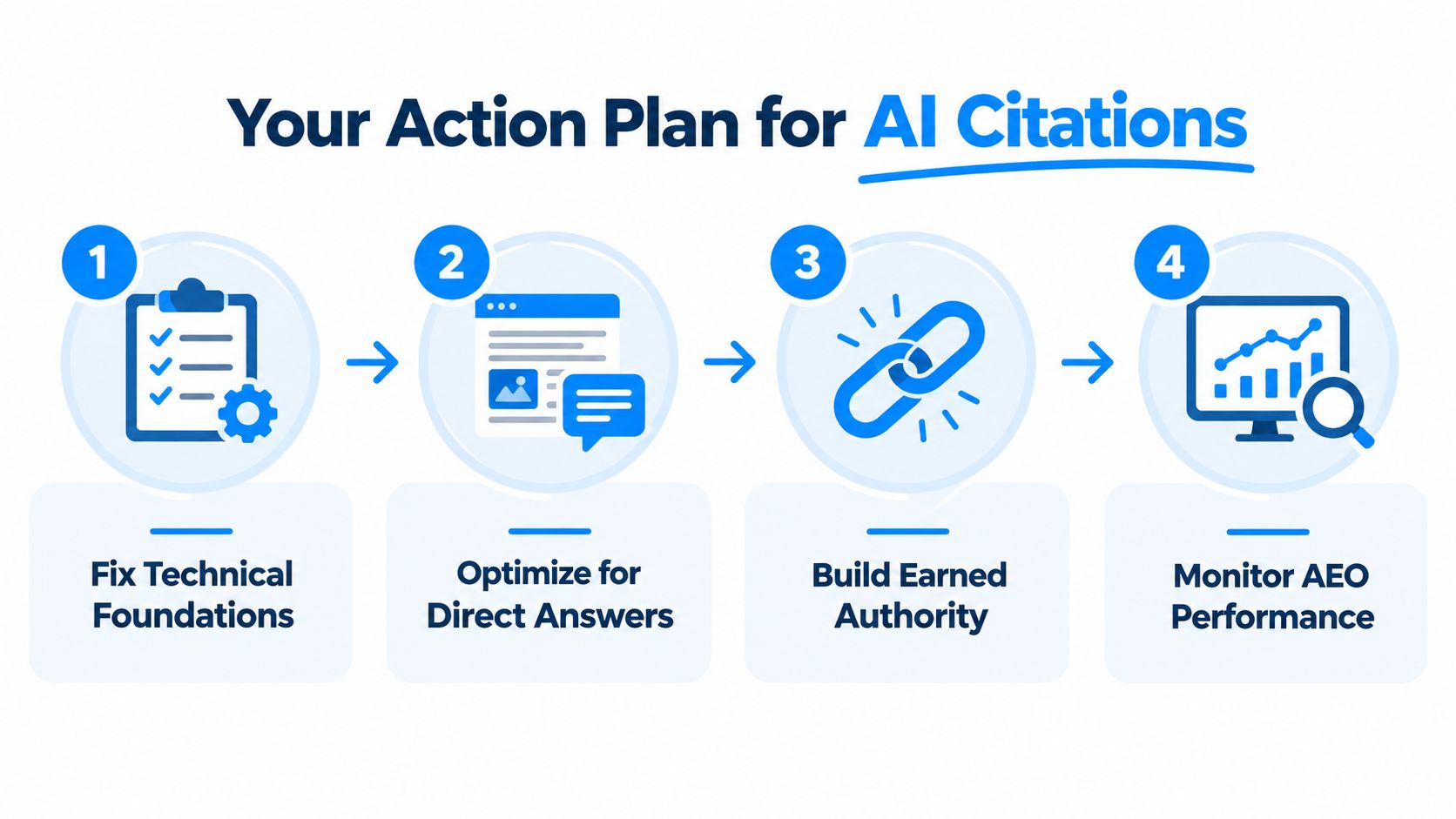
The practical route to AI citations is a loop, not a single content sprint. Fix access and structure first, create pages that answer defined questions, earn corroborating references, then measure which prompts and surfaces respond. That order prevents a common waste of time: promoting a page that machines can't parse or optimizing a page for queries no one in your market asks.
Start with a focused audit
Choose a set of priority prompts tied to products, services, and customer problems. Test them across the AI surfaces that influence your audience, then save the answers and cited sources. This gives you a baseline for both visibility and accuracy.
Next, inspect the pages that should be cited:
Check accessibility: Confirm that important text, prices, dates, author information, and product details are available in crawlable HTML.
Improve answer placement: Put the direct response near the top and give every major sub-question its own descriptive heading.
Add structured context: Use accurate schema, internal links, breadcrumbs, and clear entity information.
Refresh substance: Update facts, examples, references, screenshots, and claims, not only the visible update date.
Compare cited passages: Study competitors and third-party sources for specificity, evidence, and extractable wording.
Build the external layer
Once the page works on its own, look for the missing authority around it. Which trusted sites discuss the category? Which communities answer the same customer questions? Which independent pages could verify your claims? Prioritize useful contributions and editorially justified references over low-quality volume.
Finally, schedule the monitoring work. Review priority prompts regularly, tag changes by cause, and keep lost citations in the same archive as new ones. AI visibility moves at the passage and source level, so a page can gain a citation for pricing while losing one for implementation. That detail tells you what to improve next.
The working standard: A citation program should tell you which question you won, which page earned it, which external sources support it, and what changed afterward.
Use this workflow to create a durable feedback loop. Technical clarity makes your content retrievable, direct answers make it usable, trusted ecosystems make it credible, and prompt-level measurement shows whether the work is changing how models represent your brand.
Llumo helps teams track brand mentions, citations, cited pages, share of voice, and competitive movement across major AI answer engines. Use its prompt-level visibility data to find retrieval gaps, prioritize content and authority work, and monitor changes over time, then visit Llumo to see how the platform can support your AI citation program.