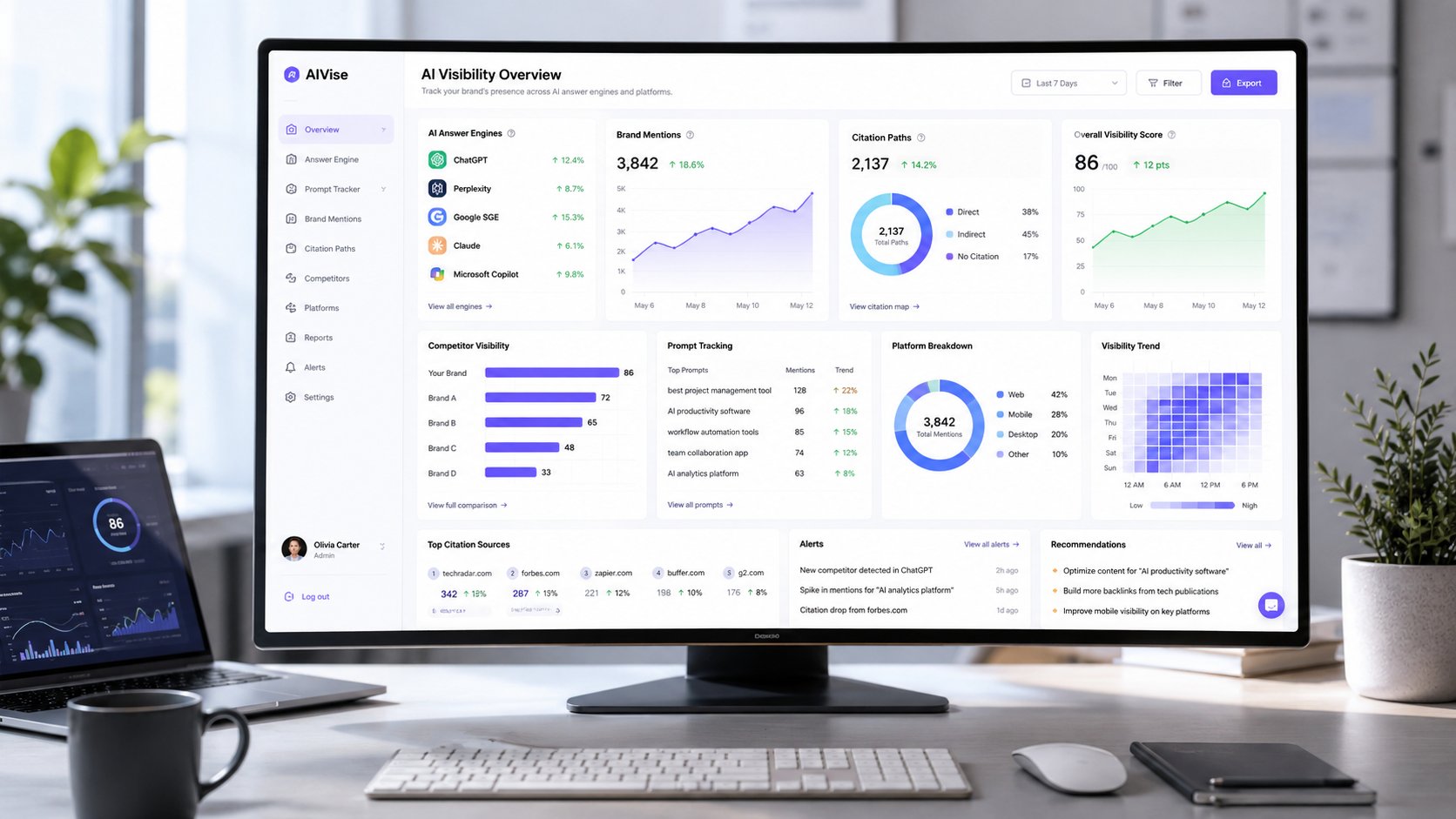
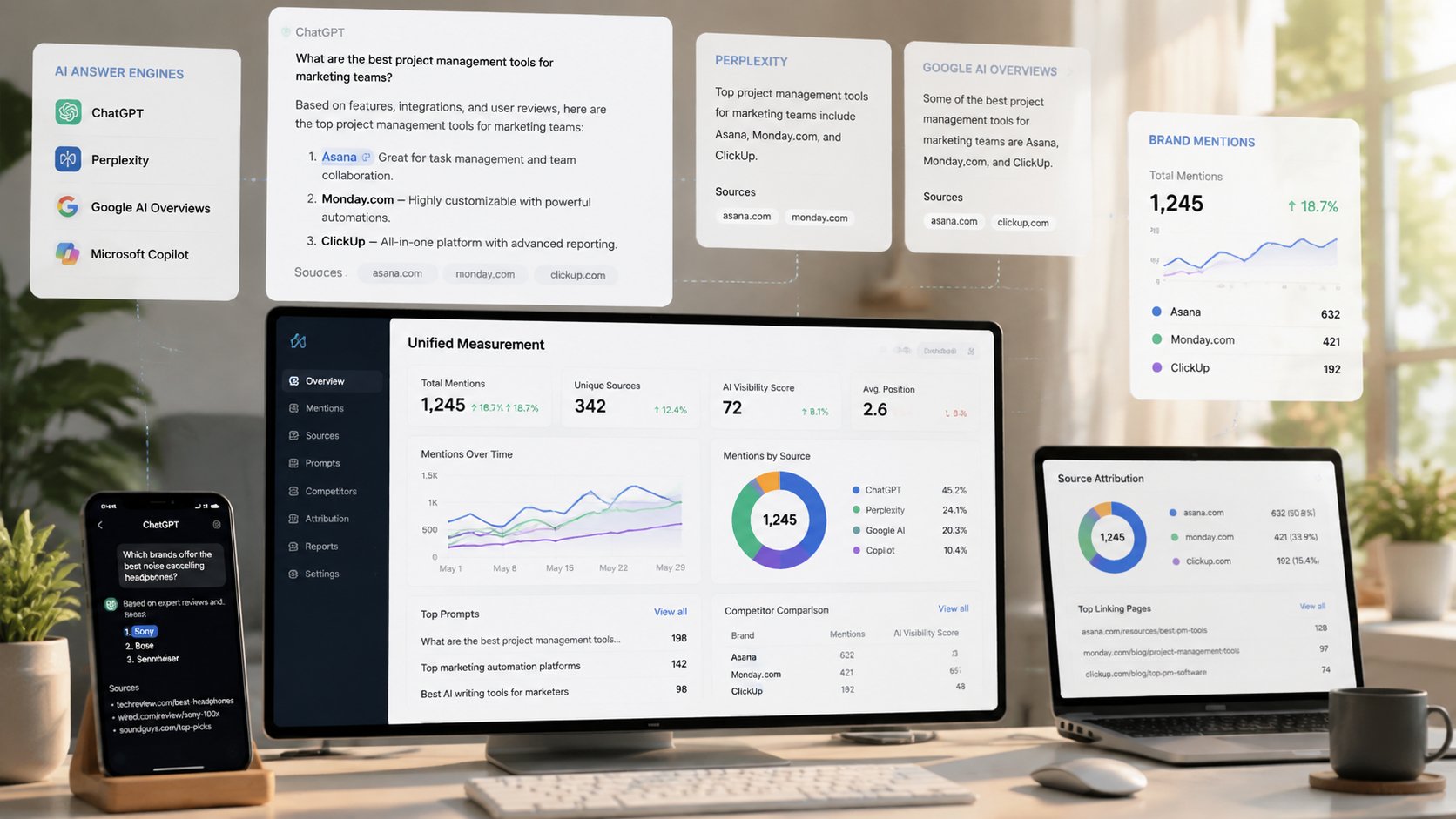
A marketer searches a product category and sees competitors named in Google AI Overviews. Their own brand appears in ChatGPT, but a familiar rank tracker shows only a modest organic position, and Google Search Console offers no clear explanation. The team has plenty of SEO data, yet it still can’t answer the practical question: which sources are answer engines using, and how often is the brand being credited?
That gap is where AI citation tracking earns its place. It measures visibility inside generated answers, not just placement in a list of search results. A useful program connects prompt-level mentions to cited URLs, source quality, competitors, and changes over time, so AEO work becomes a measurable operating process rather than a collection of guesses.
When AI Answers Beat Your Rank Tracker
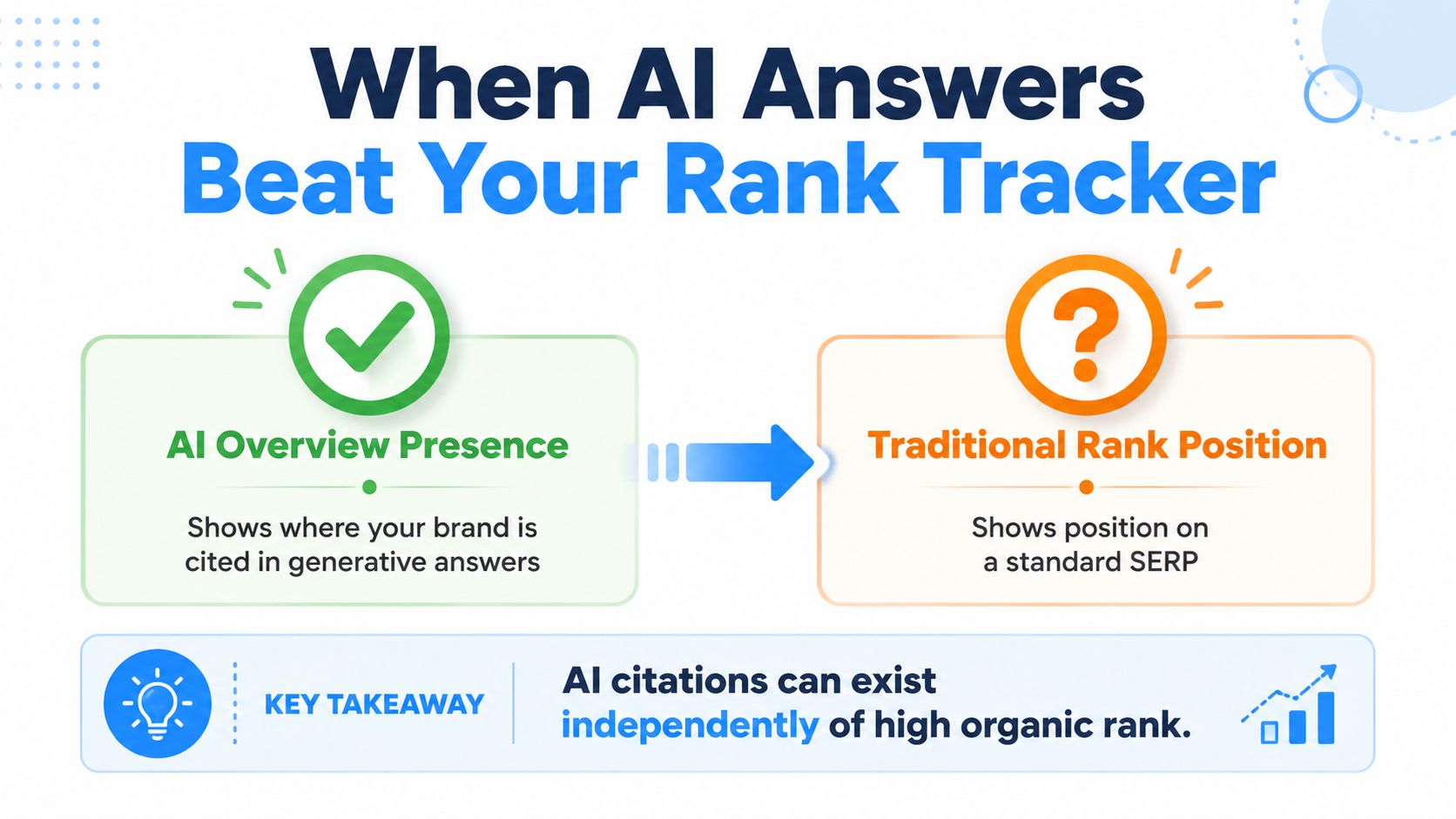
The marketer’s first assumption is usually straightforward: if the brand ranks well, it should appear in the answer. That assumption breaks quickly. A brand can appear in ChatGPT but not Google AI Overviews, while a competitor with a weaker traditional position gets linked as supporting evidence. The two surfaces may answer a similar question, but they don’t select sources in the same way.
Answer engines assemble responses from retrieved pages, model knowledge, licensed material, and other inputs. They may cite some sources, mention a brand without linking it, or provide no visible attribution. AI citation tracking observes what the answer references, rather than treating organic rank as a proxy for inclusion.
A longitudinal panel study tracked 60 commercial-intent prompts across six answer engines over 29 weekly snapshots, producing 1,275 AI answers, 11,131 citations, and 1,872 unique domains. The researchers refreshed the figures after every weekly sweep, demonstrating why citation measurement works better as continuous monitoring than as a one-time audit. The dataset also separates source presence from source frequency, which helps teams distinguish a domain that appears once from one that repeatedly earns attribution. The longitudinal citation-tracking research provides a useful model for repeatable measurement.
The citation versus rank gap
A rank report answers, “Where did this page appear in the results?” A citation report answers several different questions:
Brand presence: Was the company or product named?
Source attribution: Did the answer link to the brand’s intended domain or page?
Competitive position: Which alternatives received the visible citations?
Prompt coverage: Across a controlled prompt set, how often did the brand appear?
Source context: Was the page used for a definition, comparison, recommendation, or supporting fact?
That difference creates the citation-versus-rank gap, the measurable distance between search placement and answer-engine attribution. It can reveal opportunities that ordinary rank reports hide, such as improving a page’s source clarity, earning references on third-party sites, or separating product entities more clearly.
Practical rule: Treat organic rank as one input to citation analysis, not as a prediction of citation share.
The useful comparison is not “rank tracking or AI tracking.” Teams need both. Organic data shows how a page competes in conventional search, while citation data shows whether answer engines select it as evidence. Measuring them side by side exposes where classic SEO gains are translating into AI visibility, and where they aren’t.
What AI Citation Tracking Actually Measures
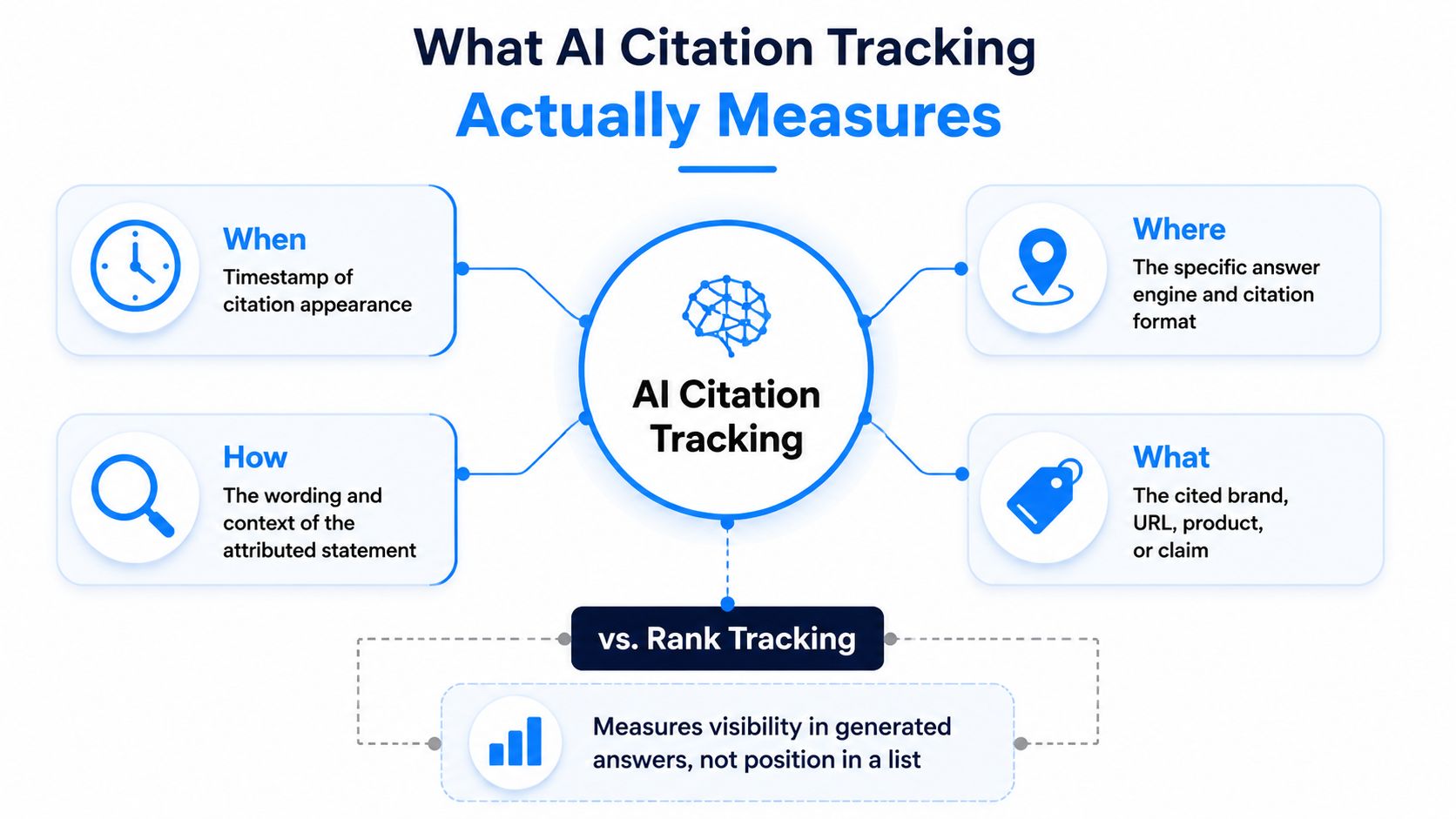
AI citation tracking is the systematic measurement of when, where, and how a brand, URL, product, or claim appears in a generated answer. Its unit of analysis is the response, not the search-result position. That change sounds small, but it affects the entire reporting model.
A reliable tracker records three layers. Presence asks whether the brand is named or accurately described. Attribution asks whether the answer links to the intended domain, page, or approved source. Quality asks whether the cited page is accessible and supports the wording or claim attached to it.
Build the measurement set
Start with a controlled prompt library. Separate prompts by intent instead of mixing every question into one score:
Navigational prompts test whether users can find or identify the brand.
Category prompts test discovery when the user hasn’t named a vendor.
Comparison prompts reveal how the brand is positioned against alternatives.
Use-case prompts connect the product to a problem, role, or workflow.
Commercial prompts test recommendations, buying guides, and selection criteria.
Run those prompts across the answer engines that matter to the audience, then preserve the complete response, not just the extracted URL. The archive should include the engine, timestamp, market context, prompt tags, answer text, cited links, brand mentions, and competitors.
Report more than a visibility score
A single score can hide important differences. A brand might be named frequently but rarely linked, or earn several citations from pages that don’t support the generated claim. Track prompt share, citation share, brand inclusion rate, source coverage, and mention accuracy separately.
A 2026 empirical analysis of 70 product-intent prompts collected 1,702 citations across Brave Summary, Google AI Overviews, and Perplexity, while auditing 1,100 unique URLs. Its models associated citation outcomes most strongly with metadata and freshness, semantic HTML, structured data, and overall page quality. The study also reported that a GEO score of at least 0.70 combined with at least 12 pillar hits aligned with substantially higher citation rates in its sample. The empirical citation analysis is useful because it connects answer visibility to page attributes teams can inspect.
Compare results by engine, location, language, account context, and time where those variables affect the experience. The goal isn’t to celebrate one isolated citation. It’s to identify repeatable patterns, connect them to specific pages and sources, and decide what to improve next.
The Building Blocks of a Citation Signal
A citation signal forms when four elements align: a realistic question, a retrieval process, a generated answer, and a source that supports the answer. Weak tracking usually skips one of those elements. It tests vague prompts, captures only the final answer, or counts every linked URL without checking what the source contributed.
Start with prompts that resemble buying decisions
Prompt design determines the usefulness of the dataset. Include real customer language, intent stages, comparisons, entities, and locations, but don’t lead the model toward a preferred brand. Keep branded and non-branded prompts separate. A branded question measures recognition, while a category question measures discovery.
Query fan-out adds natural variations and related questions. For example, a category cluster might include a definition question, a shortlist request, a comparison, an implementation question, and a problem-specific use case. That structure helps reveal whether a brand is visible only when named or can earn a place in open discovery.
Capture the complete response
For every run, store the prompt, engine, date, model context, full response, visible citations, linked URLs, and answer wording. Extraction should identify direct brand mentions, indirect references, sentiment, factual accuracy, competitors, and whether each citation supports the associated statement.
Source mapping then adds page type, author or publisher, structured data, topical relevance, and canonical URL. Teams often find that a cited domain points to a directory entry, an outdated article, a product page, or a page unrelated to the answer’s wording.
Measure layers instead of collapsing them
Suppose a controlled audit finds that the brand is mentioned in one group of prompts, its domain is cited in a smaller group, and a specific product page appears only occasionally. Those layers answer different questions:
Is the brand known?
Is the domain trusted as evidence?
Is the right page retrievable for the right intent?
Are competitors receiving the source credit instead?
Does the result stay stable when the same prompt is repeated?
Layer | Metric | What It Reveals |
|---|---|---|
Presence | Brand inclusion rate | How often the brand appears in generated answers |
Attribution | Domain citation share | How often the brand’s domain receives source credit |
Precision | Page-level citation rate | Whether the intended URL is selected |
Competition | Prompt share | How the brand compares with named competitors |
Reliability | Citation volatility | How often sources or mentions change between runs |
Quality | Claim support rate | Whether the cited page supports the answer’s wording |
Volatility matters because answer engines can select different URLs for similar answers. A stable-looking aggregate can conceal churn at the prompt level, so preserve raw outputs and compare repeated runs rather than relying only on monthly averages.
Why Citations No Longer Track Organic Rankings
A page can rank near the top of conventional search results and still receive little source credit in an AI answer. In a 55,393-query longitudinal study of Google AI Overviews, only 38% of cited pages also ranked in the top 10 organic results, leaving 62% of citations from pages ranked 11th or lower or outside the top 100. The analysis of AI Overview citations and organic rankings shows why rank improvement alone cannot explain citation performance.
Organic visibility still matters because it can support discovery and credibility. Citation tracking measures a separate outcome: whether an answer engine can retrieve, understand, and attribute a page as evidence for a specific response.
Compare the signals side by side
Consider two pages competing for the same category question. One may hold a stronger organic position but bury its answer in long prose. The other may rank lower while presenting a clear definition, structured question-and-answer blocks, comparison fields, and explicit entity relationships. The second page may be easier for an answer engine to extract and cite.
The same study reported that pages using Schema.org markup were 3.2 times more likely to be cited, with Article, HowTo, and FAQ formats performing better than pages with identical rank but no structured data. The cited-page markup analysis supports treating semantic structure as one citation variable alongside relevance, source quality, and page clarity.
Page | Organic Rank | AI Citation Share | Markup Used |
|---|---|---|---|
Page A | 3 | 4% | Minimal page markup |
Page B | 9 | 22% | Explicit answer structure and schema |
The example illustrates a measurement problem rather than a universal benchmark. A rank tracker records Page A winning the conventional contest. A citation tracker records Page B earning more answer-level source credit.
Optimize for retrieval clarity
Practical improvements tend to be page-level:
Put a concise answer near the beginning of the page.
Define the entity, category, or process in unambiguous language.
Use semantic HTML for headings, lists, tables, and question blocks.
Add relevant structured data that accurately describes the page.
Keep evidence, dates, authorship, and source references visible.
Match the format to the intent, such as an explainer for informational prompts or a buying guide for commercial prompts.
Citation selection is a retrieval and attribution decision, not a reward for maximizing dwell time. A page that resolves the question cleanly can earn source credit despite a weaker conventional position. Track both outcomes, then improve the specific page signals that separate organic visibility from AI mention share.
Running a Citation Audit From Prompt to Source
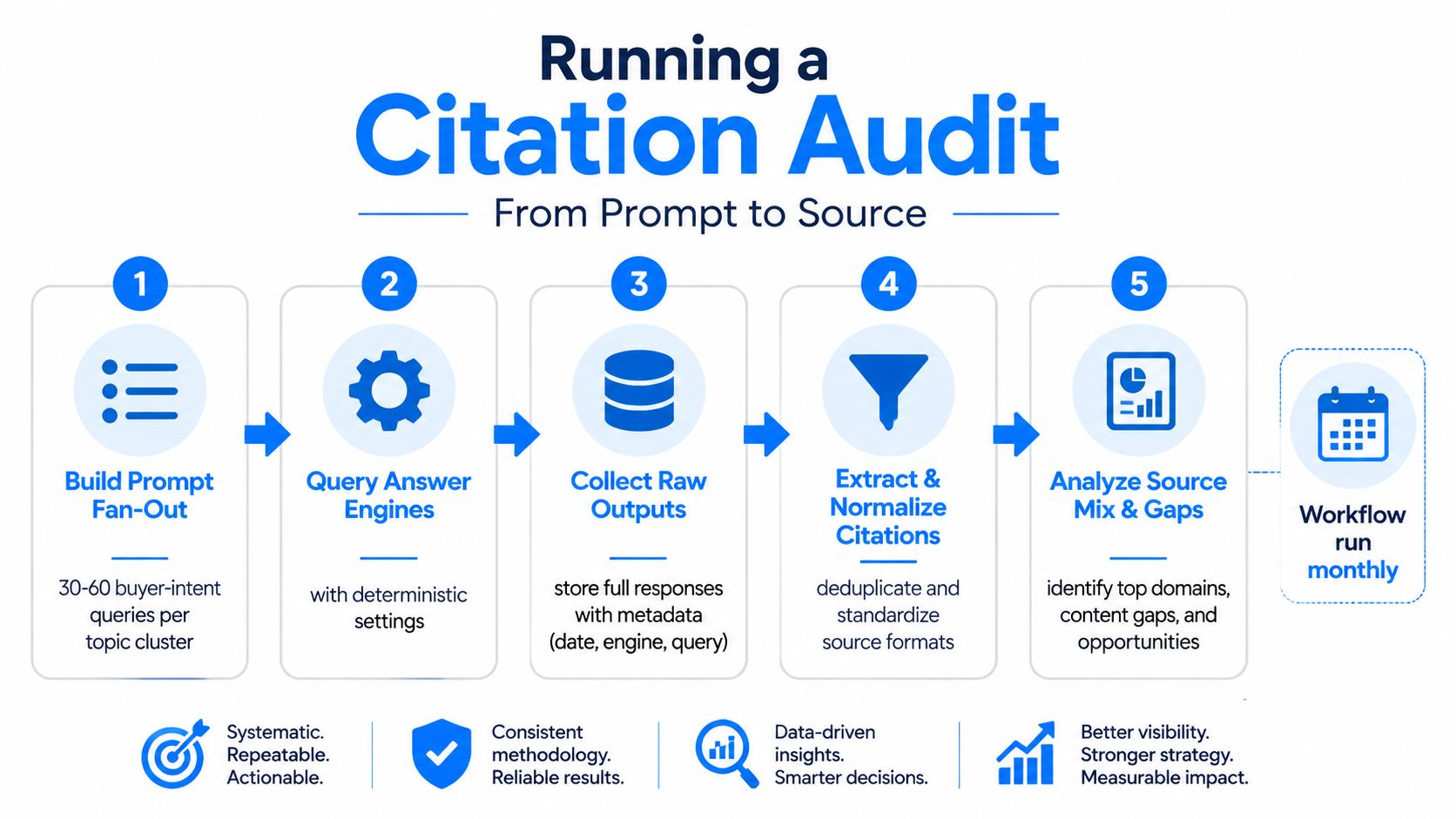
A practical audit should be repeatable enough to run monthly and detailed enough to support page-level decisions. Start with a controlled prompt set, consistent engine conditions, and an archive of raw outputs. Without those controls, changes in answer wording can look like performance changes when they are measurement noise.
Use a five-step workflow
Build a prompt fan-out. Create 30 to 60 buyer-intent queries per topic cluster, covering category, comparison, problem, proof, and use-case language. Keep branded and non-branded groups distinct. This guide to building a meaningful prompt set offers a useful way to connect prompt selection to real customer questions.
Query each answer engine consistently. Use stable settings and record the engine, model, language, location, and account context. Exact reproducibility is difficult, but consistent conditions make directional comparisons more defensible.
Collect raw outputs. Save the entire answer, visible citations, source cards, footnotes, and any generated query expansions. A URL list without surrounding text can’t show whether the source supported a recommendation or merely appeared in a reference panel.
Extract and normalize citations. Canonicalize URLs, remove tracking parameters, group duplicate domains, and distinguish direct citations from text-only mentions. Flag brand mentions with no link, competitor citations on prompts where the brand ranks organically, and URLs that redirect to an unexpected destination.
Validate and analyze. Check whether every cited URL loads, whether the page supports the claim, and whether schema and visible page structure remain intact. Log prompt-level mention share and source-mix changes, then map the results to owned pages, third-party sources, and conceded prompt clusters.
A monthly audit should produce a source-coverage map. That map shows which entities and topic clusters the brand owns, which sources repeatedly support competitor answers, and which pages need content, technical, or outreach work.
The most common failures are mundane but consequential. A scraped URL may return a dead page. A brand can be named without receiving attribution. A competitor can earn the citation even when the brand outranks that competitor organically. Those cases belong in the audit, not in a footnote.
A recorded demonstration can help teams understand how answer outputs and sources fit together:
Citation Quality and Provenance in Practice
A visible link isn’t proof that an answer is well sourced. A citation can lead to an accessible page that doesn’t support the generated statement, or to a source whose entity doesn’t match the brand discussed in the answer. Citation quality requires claim-level verification, not just URL collection.
A 2026 evaluation of deep-research agents found link validity above 94% and topical relevance above 80%, while factual accuracy of the cited support ranged from 39% to 77%. The evaluation also found that increasing tool calls from 2 to 150 caused fact-check accuracy to drop by about 42% on average across two frontier models. The evaluation of citation fidelity in research agents shows why more retrieval doesn’t automatically mean better provenance.
Run three checks on every citation
Link liveness: Does the URL resolve, and does it resolve to the intended page rather than a redirect, copy, or error?
Source-to-claim alignment: Does the page support the exact claim, not merely the general topic?
Entity consistency: Does the cited page refer to the same company, product, person, or concept across model versions and answer formats?
A citation from a high-authority domain can still create a credibility liability if the page no longer matches the query. A smaller set of verifiable citations is more useful than a larger set of ambiguous ones because it gives the content team a defensible remediation path.
Source-quality rule: Don’t report raw citation volume without a confidence field that records whether the source is live, relevant, and claim-supporting.
Signal | High Quality | Medium Quality | Low Quality |
|---|---|---|---|
Link status | Live, canonical destination | Redirect or partial access issue | Dead, fabricated, or wrong URL |
Claim support | Directly supports the answer | Supports the topic but not the wording | Doesn’t support the generated claim |
Entity match | Correct brand, product, and context | Related entity with some ambiguity | Wrong or misattributed entity |
Freshness | Current and relevant page | Usable but aging information | Stale page or obsolete context |
Attribution | Clear, visible source credit | Indirect or incomplete credit | Brand mentioned without traceable source |
Some answer engines may cite AI-generated or copied material, which makes provenance even more important. A large-scale study of Google AI Overviews found that AI-generated documents were cited more frequently than human-authored ones after controlling for retrieval rank, driven mainly by non-retrieved citations. The study of AI-generated documents in search citations reinforces the need to record source origin and not treat every citation as an independent authority signal.
For a practical reading workflow, this guide to reading the citations behind an AI answer is a useful reference. The tracker should preserve enough context for a reviewer to reproduce the provenance decision.
Turning Citation Data Into AEO Decisions
A citation dashboard becomes valuable when each pattern leads to an action. The operating rhythm can stay simple: review prompt share weekly, compare source mix monthly, and inspect volatility quarterly. That cadence separates immediate anomalies from broader changes in how answer engines retrieve and attribute sources.

Match the signal to the sprint
If the brand is mentioned but the intended page isn’t cited, refresh the owned page for clarity. Put the direct answer earlier, improve headings and semantic structure, clarify the entity, and add accurate structured data. The measurable problem is attribution, so the fix should make the source easier to retrieve and quote.
If competitors repeatedly appear on third-party pages, don’t respond by publishing another generic article automatically. Classify the source first. It may be a review site, comparison page, directory, specialist publication, community, or reference source. Each category requires a different action, from improving your own page to pursuing inclusion or correcting outdated information.
If a page receives citations but the claims are weakly supported, prioritize evidence and provenance. If citations disappear after content changes, inspect the exact page, its canonical version, visible answer blocks, freshness signals, and structured data before changing the entire topic strategy.
Use a decision map
High prompt visibility, low domain citation: strengthen source attribution and page structure.
Low visibility, strong competitor source coverage: identify the missing topic or third-party inclusion path.
Good domain citation, poor page precision: improve internal information architecture and intent matching.
High citation volume, low provenance confidence: audit source quality before reporting a gain.
Large week-to-week swings: increase repeated observations and segment results by engine or prompt type.
Stable organic rank, falling citation share: investigate retrieval signals instead of assuming a ranking problem.
The most useful prioritization targets high-impression, low-citation prompts first, then pages where a small structural or entity change can address a repeated gap. This practical AEO guide provides additional context for connecting answer-engine observations to optimization work.
A mid-level SEO should be able to turn one finding into one sprint. “Our product page is absent” becomes a page brief. “Competitors appear on a trusted comparison source” becomes an outreach target. “The answer changes by market” becomes a segmented prompt set. Citation data matters because it narrows the decision, not because it adds another dashboard.
Your First Month of Citation Tracking
The first month should establish a baseline, expose source-quality problems, and produce a short list of changes. Don’t begin by tracking every possible question. Choose a focused prompt set that represents the brand, its category, its competitors, and the decisions customers make.
Week one, capture the baseline
Run a baseline sweep across ChatGPT, Gemini, and Perplexity using 50 brand-relevant queries. Record mentions, linked citations, cited URLs, competitors, answer context, and the engine used. Keep the prompts unchanged during the initial comparison so the results remain interpretable.
Week two, validate sources
Open every cited URL and classify it as live and supporting, live but weakly aligned, stale, inaccessible, or misattributed. This step often changes the interpretation of the visibility report. A citation that looks valuable in a count may not be useful if it points to a copy, an unrelated page, or a claim the source doesn’t support.
Week three, benchmark competitors
Compare prompt share and source mix against two competitors. Note where competitors earn citations from third-party pages, where your brand is only mentioned, and which topic clusters produce no presence at all.
Week four, write the decision memo
Summarize the baseline, source-quality findings, citation-versus-rank gaps, and three optimization targets. Each target should name the page or external source, the observed problem, and the action owner.
Use the available benchmarks carefully. For a mid-sized brand, typical prompt share sits between 8% and 22%, source overlap with organic top-10 results ranges from 30% to 60%, and week-over-week citation volatility is around 12% to 18%, according to the provided AI visibility research context. Treat those figures as directional comparison points, not promises or universal thresholds.
The important output is a repeatable baseline. Once the team can connect a prompt to an answer, a citation, a source-quality decision, and an optimization task, AI citation tracking becomes part of the AEO workflow rather than a one-off experiment.
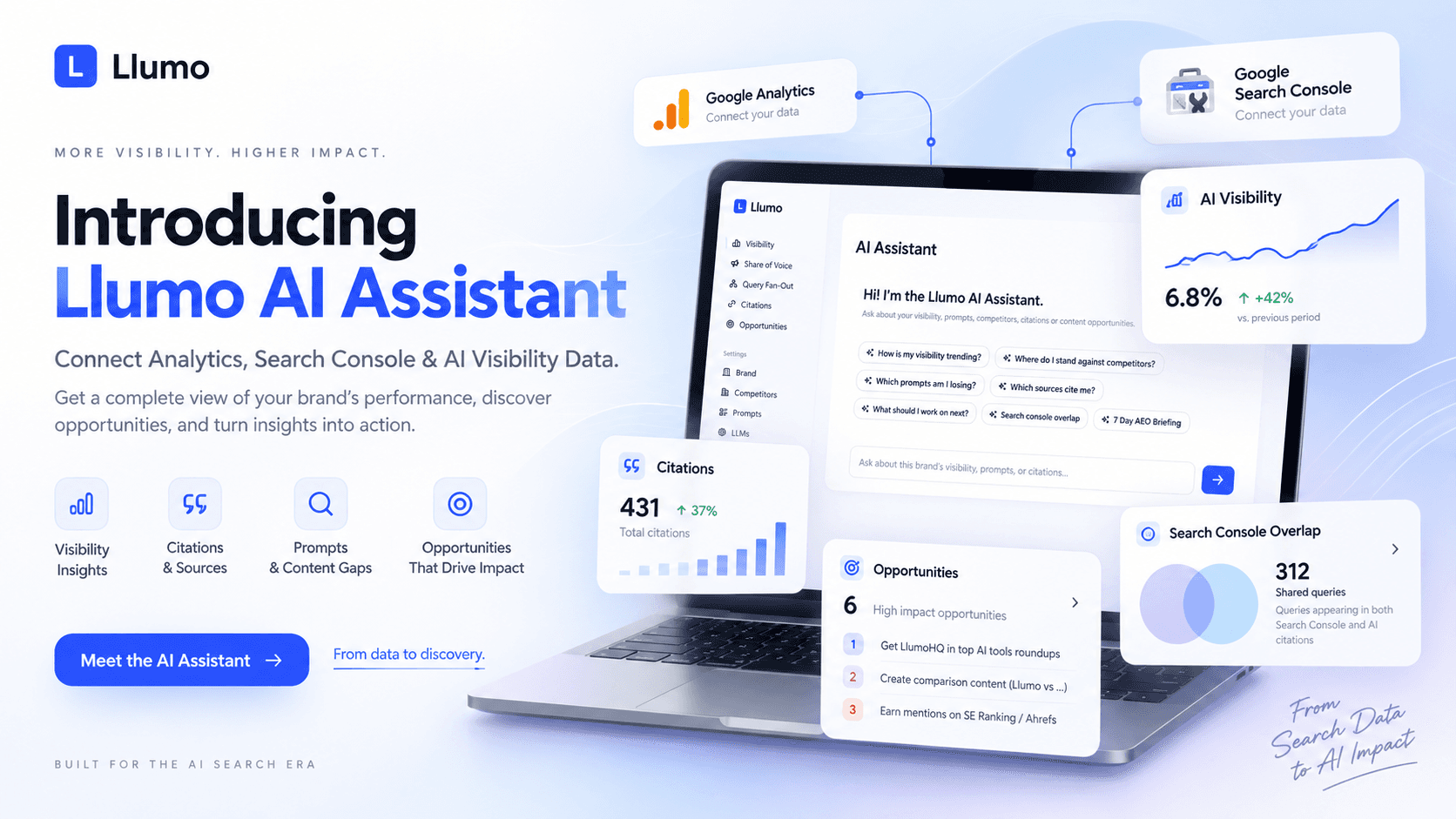
Llumo measures per-prompt visibility, share of voice, cited sources, competitor trends, and response archives across major answer engines, including ChatGPT, Gemini, Perplexity, Copilot, and Google AI Overviews. Visit Llumo to organize your citation data, identify source gaps, and turn answer-engine observations into specific content and AEO actions.