
A growth lead opens the weekly dashboard and sees the AI visibility score climbing. More answers mention the brand, more citations point toward its category, and the trend line looks healthy. Then the rest of the dashboard tells a less comfortable story: referral sessions remain flat, qualified leads haven't moved, and sales calls reveal that prospects believe the company offers features it doesn't sell.
That situation is becoming common. AI visibility is real exposure, but exposure isn't the same as accurate positioning, qualified traffic, or revenue. Google began testing AI-generated summaries in its main search results on March 22, 2024, then publicly launched AI Overviews in the United States on May 14, 2024, creating a search surface where a brand can be included in a synthesized answer without winning a conventional ranking. Independent analysis of AI Overview activity found that visibility varied sharply by query type, search volume, and source authority.
The practical question isn't only, “How often does the model mention us?” It's, “Does it mention us correctly, prominently, and in the situations that influence a buyer?” That distinction turns the AI visibility score from a vanity metric into a diagnostic scorecard.
When the Score Goes Up but the Traffic Does Not
The growth lead doesn't celebrate for long. The brand now appears in more answers from ChatGPT and Perplexity, yet referral traffic from those engines barely changes. On support calls, customers refer to capabilities copied from an outdated review page, not from the company's current product documentation.
A raw mention count treats both situations as wins. It counts a prominent recommendation beside an accurate citation in the same way it counts a passing reference based on obsolete information. That makes the dashboard look better while the brand loses control of its own story.
The problem is especially visible in answer-engine environments because users often receive enough information without visiting a source. Pew Research Center's browsing analysis found that users clicked a traditional result on only 8% of visits when a Google AI summary appeared, compared with 15% of visits without one. The same analysis found that browsing sessions ended on 26% of AI-summary pages, versus 16% of conventional-result pages.
Practical rule: A rising score without stronger accuracy, prominence, or business outcomes is a signal to investigate, not a reason to increase the budget.
A brand can gain zero-click exposure while sending fewer people to its website. It can appear in a comparison answer while being positioned behind a competitor. It can earn citations from aggregator pages that omit its latest pricing or describe an old product version. The visibility is real, but its commercial value is uncertain.
That is why a useful scorecard separates presence, prominence, citation quality, accuracy, intent, and downstream action. The score should help a team find where the narrative breaks, which prompts create risk, and which sources influence the answer. It shouldn't become a progress bar that no one challenges.
What an AI Visibility Score Actually Measures
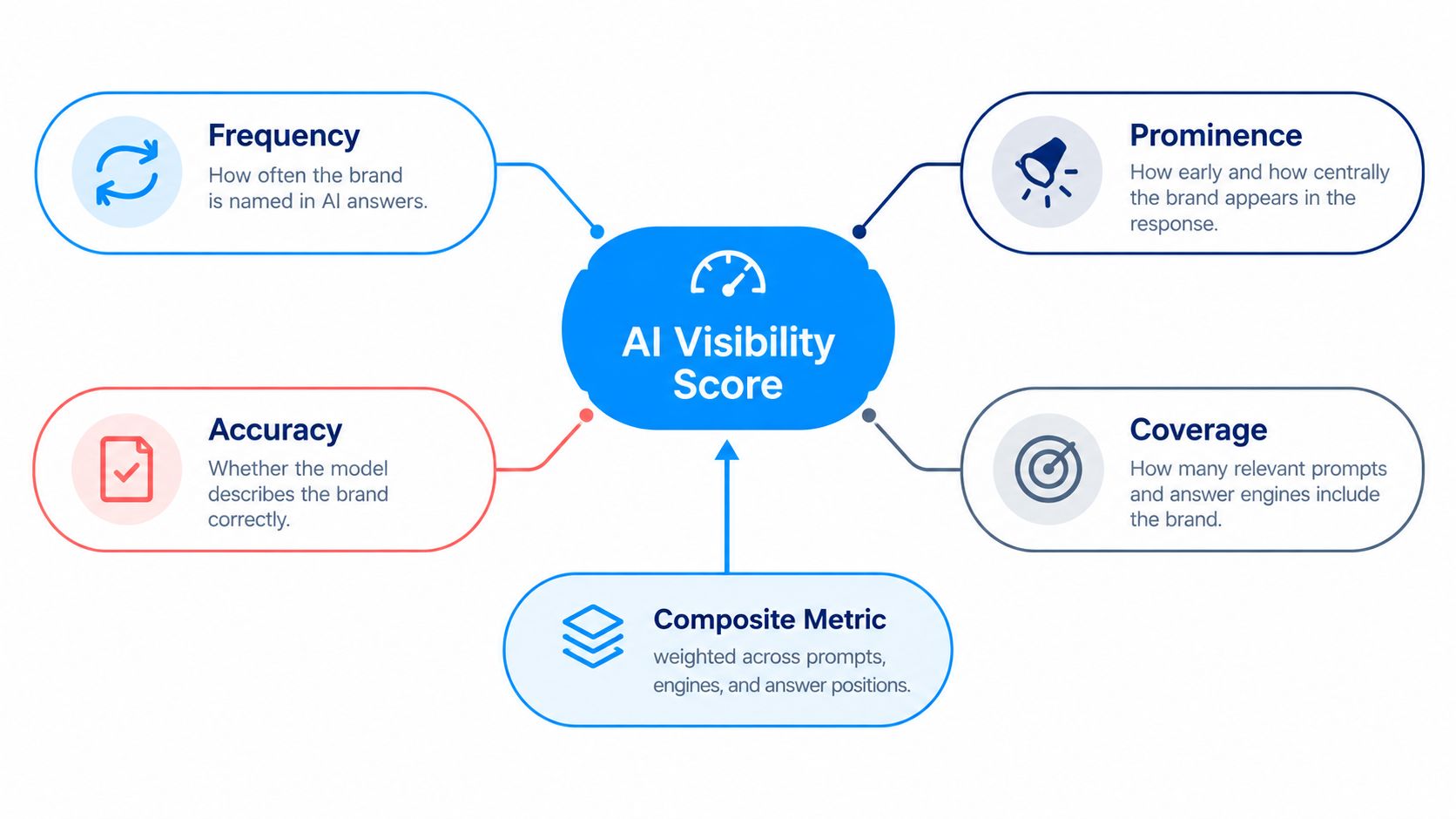
An AI visibility score is a composite measure of how often, how prominently, and how accurately a brand appears in AI-generated answers. It isn't a number pulled directly from a model API. A measurement system creates a defined prompt set, runs those prompts across selected answer engines, extracts observable signals from each response, and aggregates them into an index.
The basic components are straightforward:
Mention rate measures the share of valid responses that mention the brand at all.
Share of voice measures the brand's proportion of relevant brand mentions compared with competitors.
Prominence records where the brand appears, such as an early recommendation, a ranked position, or a passing reference near the end.
Sentiment captures whether the surrounding description is favorable, neutral, or unfavorable.
Citation quality evaluates whether the answer links to a relevant, current, authoritative source and whether that source supports the associated claim.
A sound framework should calculate those signals at the prompt level, then segment them by model, market, intent, and time period. Research summarized in this measurement framework for AI answer engines describes more than 110,000 responses evaluated across four production AI systems, using 23 metrics in eight signal categories. The practical lesson is that brand detection, URL matching, list position, sentiment, and named-entity recognition require separate checks.
A score needs a stable denominator
The denominator matters more than most dashboards admit. A practical formula starts with brand mentions divided by valid completed responses for a defined prompt set. Failed, blocked, timed-out, or non-comparable responses should be logged separately rather than being allowed to lower or raise the score.
Citation presence also isn't citation usefulness. A cited page may substantiate the answer, merely mention the brand, or have no meaningful relationship to the claim. Stanford's definition of citation precision, as discussed in the measurement research above, treats precision as the proportion of generated citations that support their associated claims. That makes qualified visibility more useful than raw visibility.
A qualified observation might require the brand to be mentioned, favorably framed, and supported by a relevant cited source. Teams can still publish a headline score, but they should expose the underlying components so a high mention rate can't hide weak accuracy or poor source relevance. For a deeper framework on evaluating the signal itself, see the guide to accurate AI visibility metrics.
How the Score Gets Calculated Behind the Scenes
Every credible score sits on a measurement pipeline. The first stage is prompt-set design. A team defines queries across category discovery, problem research, comparisons, alternatives, branded questions, and high-intent recommendations. The set should reflect how real buyers ask questions, not only the keywords already tracked in a conventional SEO platform.
The second stage is model querying. The system runs those prompts across selected answer engines and preserves the conditions of each observation. Model, retrieval mode, timestamp, locale, prompt version, complete response, and cited URLs all matter because answer-engine output changes with context.
The third stage is response parsing. Extraction systems identify brand mentions, competitor mentions, linked domains, citation positions, sentiment, and claim-to-source relationships. The final stage is aggregation, where the platform assigns weights and produces a composite score.
Weighting changes the meaning of the score
Two tools can process the same responses and rank brands differently because they reward different signals. A mention-focused system favors breadth. A citation-focused system gives more credit to owned or authoritative sources that support the answer. An outcome-focused system favors prompts and appearances connected to commercial intent or measurable actions.
Component | Mention-Focused Weight | Citation-Focused Weight | Outcome-Focused Weight |
|---|---|---|---|
Brand mention rate | Primary signal | Supporting signal | Supporting signal |
Share of voice | Strong competitive signal | Strong competitive signal | Strong competitive signal |
Answer position | Moderate adjustment | Moderate adjustment | Strong adjustment |
Citation relevance | Limited adjustment | Primary quality signal | Strong quality signal |
Sentiment and accuracy | Secondary signal | Strong quality signal | Strong quality signal |
Intent and downstream action | Usually absent | Usually secondary | Primary business signal |
These labels describe measurement philosophies, not universal industry standards. Ask a vendor for its formula, denominator, exclusions, and weighting logic. If the answer is opaque, you can't tell whether an improvement came from better content, easier prompts, more model coverage, or a change in scoring.
Google's documentation explains that AI Overviews and AI Mode can use query fan-out, running multiple related searches across subtopics and data sources before producing an answer. That means the original prompt may not be the only input shaping visibility. A tracker that records only the wording entered by the user can miss the expanded questions and source paths behind the final response.
Citation analysis deserves its own review rather than being folded into a single number. Reading the citations behind an AI answer helps teams inspect whether a source supports the claim, merely appears nearby, or introduces a competing interpretation.
Why the Same Brand Scores Differently Across Models
The same prompt set can produce materially different results across ChatGPT, Perplexity, Gemini, and Google AI Overviews. That isn't necessarily a tracking error. Each surface uses its own retrieval stack, source selection behavior, answer length, citation treatment, and freshness signals.
Perplexity may expose more source links and place greater practical emphasis on recent publisher coverage. ChatGPT's browsing results can favor widely recognized and authoritative domains. Gemini may reflect signals from Google's broader index and video ecosystem. Google AI Overviews often compress several sources into a short synthesis, which can make a third-party reference less prominent even when it influenced the answer.
A cross-model average hides those differences. It can tell an executive whether the overall direction changed, but it can't tell the practitioner where the problem lives.
Model | Mention Rate | Average Position | Citation Quality | Composite Score |
|---|---|---|---|---|
ChatGPT | Track separately | Track separately | Review source support | Report model-level result |
Perplexity | Track separately | Track separately | Review source support | Report model-level result |
Gemini | Track separately | Track separately | Review source support | Report model-level result |
Google AI Overviews | Track separately | Track separately | Review source support | Report model-level result |
The table is intentionally diagnostic rather than numerical. A defensible system shouldn't invent comparability where the surfaces don't provide it. Report each model's raw mention rate, share of voice, prominence, and citation quality before calculating an executive summary.
Retrieval failure can look like authority
Independent testing of eight AI search engines found incorrect answers on more than 60% of tested queries, according to the Columbia Journalism Review analysis. That finding doesn't mean every brand score is unreliable. It does mean a single observation can reflect retrieval or citation failure rather than durable authority.
Repeat prompts over time, preserve complete responses, and compare stable prompt versions. Segment by intent, because a brand may perform well for educational discovery while disappearing from product recommendations. Keep model-level scores visible even when a cross-model average is used for board reporting.
The Uncomfortable Truth About Visibility and Business Outcomes
Higher AI visibility doesn't automatically produce more clicks, pipeline, or revenue. An answer engine can resolve a question so completely that the user has no reason to open the cited page. The brand receives exposure, but the website receives no measurable visit.

That trade-off is clearest for definitional questions, basic informational queries, and answers that summarize a comparison without requiring further research. It also appears when the engine cites a source but places the brand beside several competitors. A high share of voice may indicate influence, but it doesn't identify which mention changed a buying decision.
Pew's analysis of Google users found that users clicked a link inside an AI summary in only 1% of visits where a summary appeared. That figure is a useful warning for anyone treating ordinary referral sessions as the complete value of an answer-engine appearance.
Measure the exposure and the consequence
The score belongs beside outcome metrics, not above them. A useful reporting view includes:
Answer presence: Did the brand appear for the relevant prompt?
Prominence: Was it recommended early, or buried in the response?
Citation validity: Did the cited page support the model's claim?
Intent: Was the prompt educational, navigational, comparative, or commercial?
Traffic: Did the response produce a visit, and did the session continue?
Business action: Did the interaction assist a conversion, demo, trial, or pipeline event?
A citation can also damage authority when it supports incorrect specifications, outdated pricing, or an inaccurate description of the product. That is why teams should inspect the response archive and compare model language with current first-party pages.
Track branded-search lift, direct traffic, answer-engine referrals, assisted conversions, and pipeline-attributed sessions alongside visibility. The score can reveal influence before a user clicks, but attribution needs first-party analytics, conversion paths, and careful interpretation.
How to Read Your Score Without Fooling Yourself
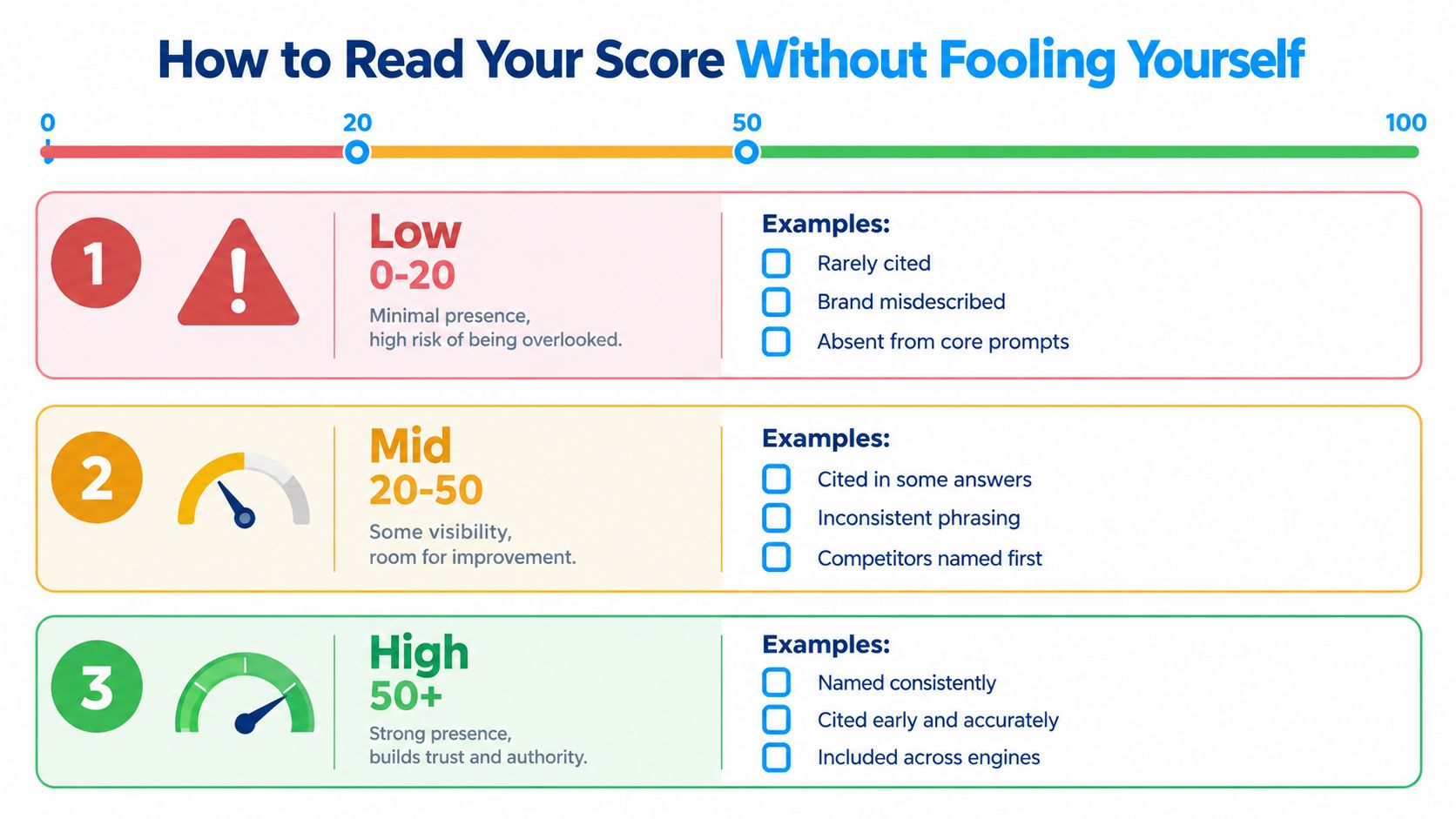
Score bands help teams talk about movement, but they aren't universal grades. A low score may reflect weak authority, poor prompt coverage, or an unrealistic query set. A high score may reflect genuine presence, or it may come from prompts that are too easy, too narrow, or unrelated to commercial value.
Use the bands as starting points for investigation:
Low, 0 to 20: The brand is rarely cited, absent from core category prompts, or described inaccurately. Competitors may dominate branded and comparison questions.
Mid, 20 to 50: The brand appears for some relevant answers, often on long-tail or educational prompts. Citations may be accurate but inconsistent, and competitors may still appear first.
High, 50+: The brand appears consistently across the tracked set. The remaining questions concern prominence, source ownership, accuracy, intent alignment, and persistence across engines.
Four questions belong on every score review
Is the prompt set representative? Include category, problem, comparison, branded, and recommendation prompts. Remove queries that don't reflect the audience or market you serve.
Are citations attributed correctly? Confirm that the cited URL is the actual source, not a similarly named page or a domain that merely mentions the brand. Check whether the page supports the specific claim.
Does the trend hold across at least three models? A one-engine increase may reflect a retrieval change, a temporary source preference, or a model update. Cross-model consistency gives the movement more meaning.
Does the score correlate with business metrics? Compare visibility with branded searches, qualified sessions, assisted conversions, and pipeline signals. A score that never aligns with any meaningful outcome still has diagnostic value, but it shouldn't be treated as a growth KPI.
A score of 45 with high citation accuracy can be more useful than a score of 80 built on irrelevant prompts and weak sources. The number only becomes meaningful when the underlying observations are trustworthy.
Practical Steps to Move the Score in the Right Direction
Start with the prompts that matter commercially, not the prompts that are easiest to win. Map the questions buyers ask before they know your brand, the comparisons they make when they shortlist vendors, and the branded questions that expose positioning gaps. The prompt set should be stable enough to measure change, while still expanding when query fan-out reveals new language.

Prioritize the work by leverage
Map prompts and entities. Audit the priority prompt set, then define the brand, products, features, use cases, alternatives, and customer problems in consistent language. This work takes judgment because the goal isn't keyword coverage alone. It's making the entity easy to identify across sources.
Clarify the source pages. Give each important question a page with a direct answer, clear definitions, comparison context, current dates, and evidence. Tables, concise answer blocks, FAQs, author information, and structured headings make claims easier to extract and review.
Create citation-worthy assets. Original research, transparent methodology, product documentation, and practically useful comparisons give other sources something specific to reference. Digital PR matters here because answer engines often retrieve third-party pages, not just the brand's own site.
Fix technical access and structure. Review crawl permissions, canonical answers, schema markup, rendering, and internal links. Google says its AI features can identify additional supporting pages while generating an answer and show a broader, more diverse group of links, so source-level monitoring is useful alongside prompt tracking. Don't assume one technical file will solve a weak entity signal.
Measure on a fixed cadence. Rerun the same prompt versions on the same models and preserve the full response, citations, locale, and timestamp. Use AI visibility optimization guidance to connect score changes to specific content and source improvements rather than changing everything at once.
Some improvements can appear quickly, especially when a page contains a wrong product description or a citation points to an obsolete URL. Building authority through trusted third-party references takes longer and depends on sustained publishing, useful evidence, and credible mentions.
Cost control belongs in the measurement design too. OpenAI's API pricing documentation separates model usage from web-search usage, with web search priced at $10 per 1,000 calls and search-content tokens billed at the selected model's rates. A bring-your-own-key setup can let a team pay the underlying provider directly and manage spend through quotas, budgets, and model choices.
Treating the Score as a Compass, Not a Trophy
The AI visibility score is most useful when it points toward a decision. A rising number with accurate citations and stronger presence on high-intent prompts deserves attention. A rising number with flat qualified traffic, weak source support, or incorrect product descriptions deserves an investigation.
Run a simple review each month:
Choose one outcome metric, such as assisted conversions, branded-search lift, or citation-driven sessions.
Place it beside raw visibility, qualified visibility, share of voice, and citation quality.
Compare the result by prompt intent and model, not only in aggregate.
Open the underlying responses before approving a major content or outreach change.
Answer engines will keep changing their retrieval paths, prompt expansions, source mixes, and presentation formats. Google describes query fan-out as a process that can run multiple related searches before generating an answer, so the score will always be a moving measurement of a moving surface.
The practitioner's job is narrower and more useful than chasing a perfect headline number. Keep the brand accurate, prominent, relevant, and supported by trustworthy sources, then test whether that influence reaches the next buyer. The score is a compass heading, not a trophy on the shelf.
If you need to connect prompt-level mentions, citations, competitor share of voice, query fan-out, and model-specific trends in one workflow, explore Llumo. It helps teams archive AI responses, inspect the sources shaping answers, and connect visibility changes with the content and business signals that matter.