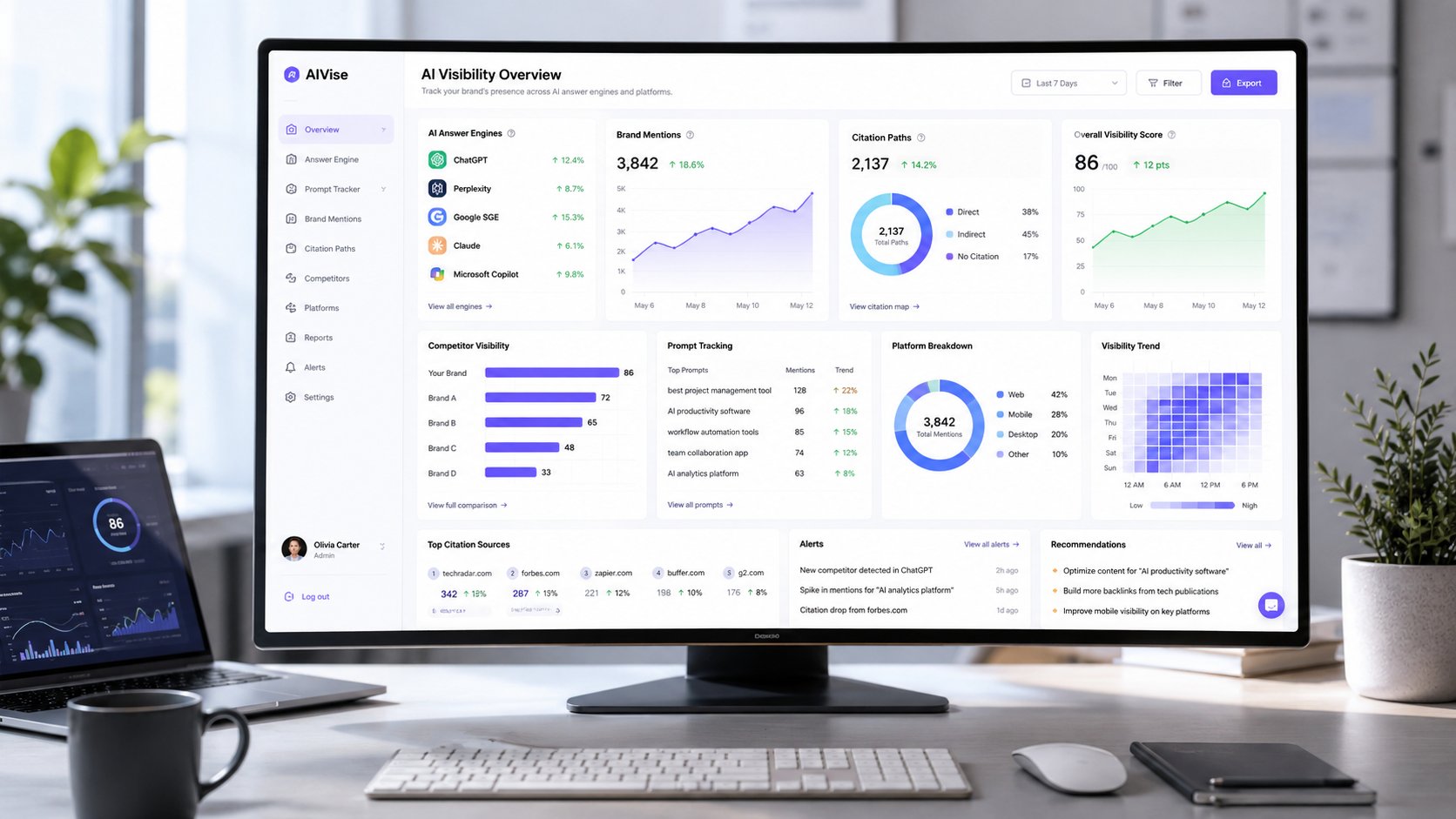

13.14% of desktop searches in the United States showed Google AI Overviews by March 2026, up from 6.49% in January, while later assessments reported 25.11%. The most precise artificial intelligence visibility measurement software depends on the AI surfaces you need to analyse and its ability to review the prompt, model output, citations, competitors, and the repeatability of each score.
Common wisdom is that the best tool has the most features and the highest visibility number. That approach doesn’t work without traceability from the number to a defined prompt, a specific model output, an exact citing page, and a repeatable collection process. Accuracy depends on transparency in the collection process, relevance of model coverage, prompt-level evidence, comparability, and historical context.
The difference is that Google AI Overview trackers and more general AEO platforms measure different surfaces. The Google-centric tools may be great for presence and citation tracking within the Google environment. Multi-assistant tools should explain differences in models used, generated query expansion, citation sources, and competitors’ movement across different answer engines. This review compares the options against these criteria, with Llumo as the best for multi-model, prompt-level visibility.
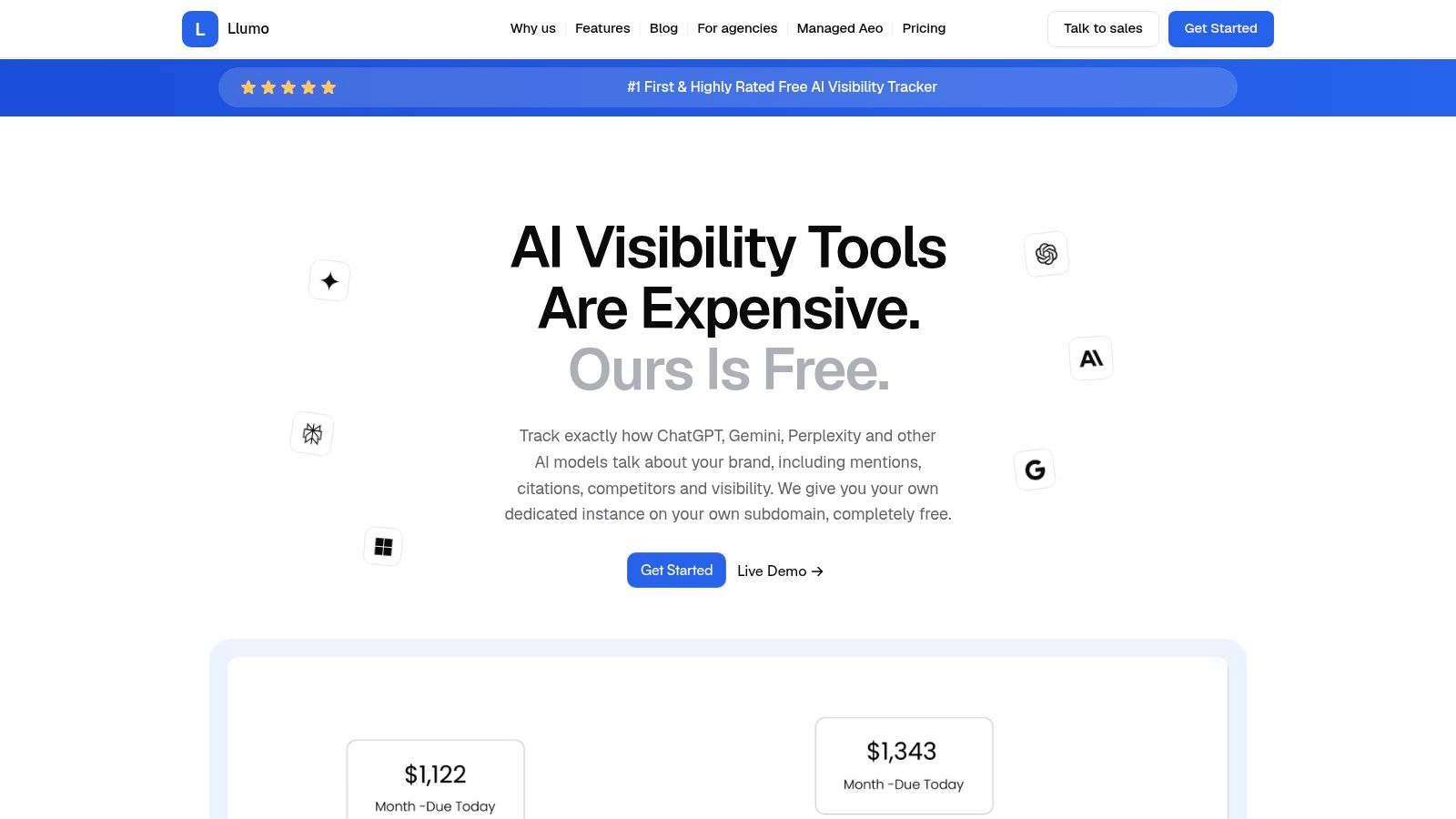
1. Llumo
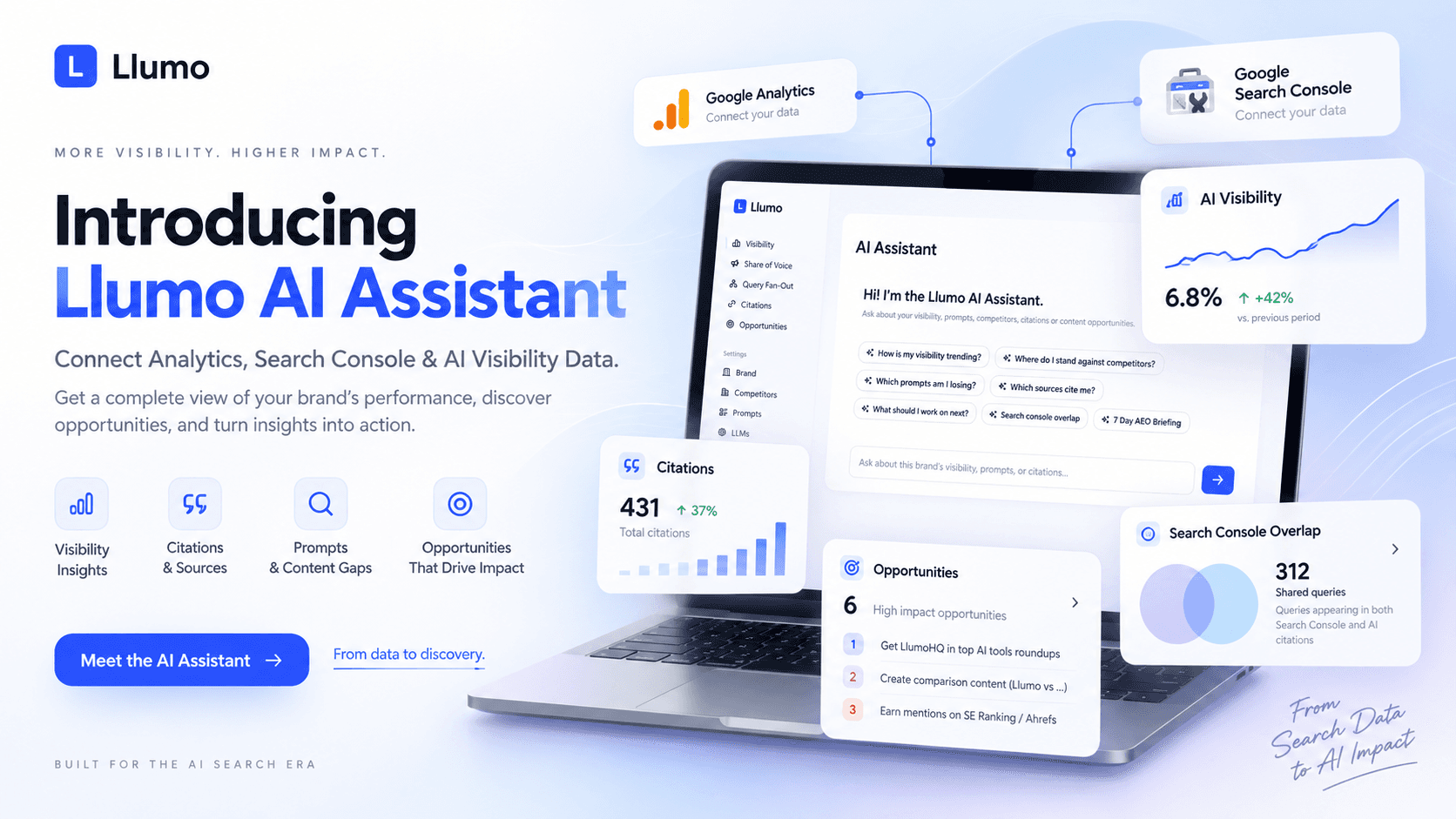
Llumo suits teams that need to verify why a brand appears in an AI answer, not just record presence. It monitors ChatGPT, Gemini, Claude, Perplexity, Copilot, Google AI Overviews, and other answer-engine surfaces, organising results by prompts, mentions, citations, competitors, and trends. This model coverage aligns with Supermetrics’ AI search visibility KPI framework, which distinguishes exposure, citation share, referral activity, and prompt-level presence instead of reducing visibility to one score.
Evidence at the prompt and citation level
Llumo archives prompt responses, identifies mentioned brands and cited sources, records query fan-outs, and examines domains and individual pages, including newly gained and lost references. Teams can trace a visibility change to a specific prompt, model response, cited URL, or competitor movement. Prompt search, tagging, filtering, longitudinal tracking, share of voice, and competitor trend lines make the evidence easier to review over time.
This granularity matters because AI citations do not consistently mirror organic rankings. One analysis found that only 17% to 38% of AI-cited pages also ranked in Google’s organic top 10. Another reported that 84% of AI citations came from earned media rather than brand-owned or paid pages. The cited AEO statistics analysis documents these findings. They support evaluating citation sources separately from conventional SERP position.
Practical rule: Treat a visibility score as a starting signal. Defend it with the underlying prompt, response, cited source, and comparison set.
Llumo connects findings to content updates, new pages, and outreach opportunities. Its core platform has no software license fee. Customers supply their own provider API keys, pay providers directly, and avoid Llumo usage markup. That arrangement makes provider costs visible, while leaving buyers responsible for separate billing, quotas, and variable usage.
Model coverage and prompt evidence are strong, but implementation requires more operational ownership than a fixed, all-in-one subscription. We didn’t provide public subscription tiers, testimonials, awards, or certifications, so buyers should request a trial or evidence pack before committing.
Best for: SEO and AEO professionals, agencies, digital marketing teams, growth leaders, and competitive intelligence practitioners that need multi-model evidence and a clear path from measurement to action.
2. Semrush AI Visibility Toolkit
Semrush is the practical choice for teams that already manage SEO, keyword research, auditing, and content planning in one environment. Its AI visibility functions connect Google AI Overview detection to Position Tracking and Sensor, allowing users to filter tracked keywords affected by AI Overviews and inspect brand mentions or citations alongside conventional rankings.
That integration reduces implementation burden. An agency can keep familiar reporting workflows, while an in-house SEO team can compare AI Overview presence with organic performance, technical findings, and content opportunities without moving data between separate systems. Semrush also supports competitor-oriented visibility views, which makes it useful for market reporting.
The trade-off is measurement breadth. Semrush is better suited to Google-centred visibility than to deep, specialist analysis across ChatGPT, Perplexity, Claude, or other assistants. If you need archived model responses, query fan-outs, page-level citation histories, or cross-model explanations, please compare its evidence layer directly with a dedicated platform. A comparison of AI visibility trackers for agencies is useful context, but the decision still depends on the surfaces and prompts a team will monitor.
Best for: Agencies and established SEO departments that value unified reporting and already use Semrush.
Accuracy trade-off: Strong operational consistency inside a mature SEO suite, but potentially less granular than a purpose-built AEO platform for multi-assistant research.
3. Ahrefs Brand Radar and Free AI Overviews Tracker
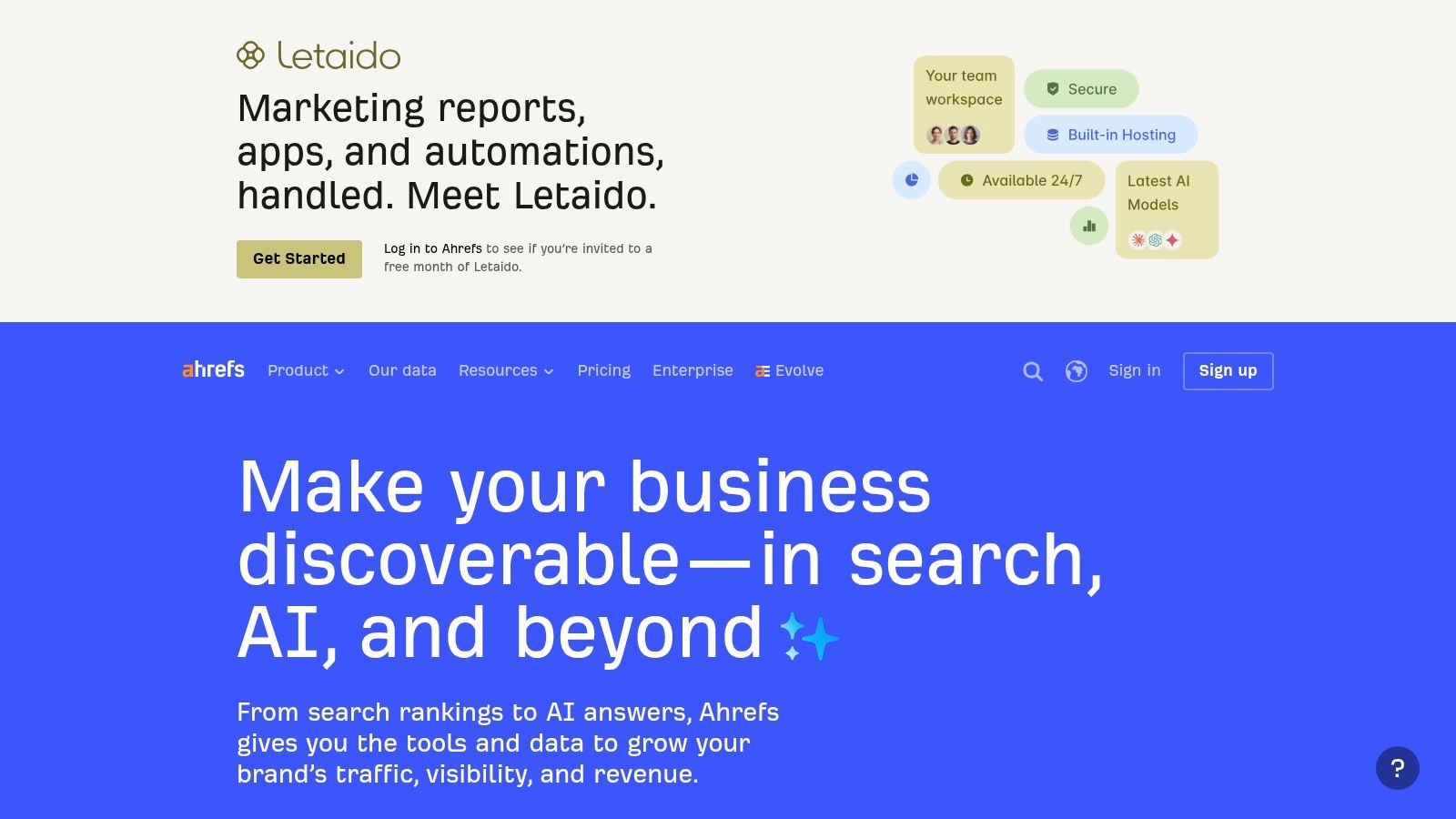
Ahrefs combines a low-friction validation tool with a broader Brand Radar product. The free AI Overviews Checker helps a marketer verify whether and where Google AI Overviews cite a brand. That makes it useful for a first diagnostic, especially when a team needs to confirm a specific result before building a larger monitoring program.
Brand Radar extends the scope with daily monitoring, mentions, citations, competitor comparisons, share of voice, and custom prompts across AI Overviews or AI Mode, ChatGPT, Perplexity, Copilot, and Gemini. Ahrefs also publishes methodology and volatility notes, which improve interpretability. That transparency matters because repeated searches can produce different citations. A study reported that Google changed at least one cited source for 52% of keywords when the same search was repeated, as described in this analysis of AI Overview citation sources.
Where Ahrefs is most defensible
Ahrefs is strongest when buyers want a quick Google-focused check and a recognisable SEO ecosystem for ongoing competitor monitoring. Its methodology disclosures help teams avoid treating a daily visibility figure as a permanent truth. However, deeper capabilities require Brand Radar, and vendor documentation indicates that coverage is strongest in English.
Use the free checker for validation, not as a substitute for a controlled prompt program. For teams building a dedicated Google measurement process, a specialised Google AI Overviews Tracker can provide a useful comparison point.
Best for: SEO teams that want fast citation validation and marketers already invested in Ahrefs.
Accuracy trade-off: Clear methodology and useful cross-platform coverage, but deeper evidence depends on the paid Brand Radar layer.
4. BrightEdge
BrightEdge is for enterprise SEO teams who want AI-driven measurement integrated with market analysis and content planning. It measures AI Overview presence, citations, and market analysis, and integrates AI filters into its Share of Voice report. The topic discovery feature helps teams identify topics that could support AI Overview activation and citations.
The tool’s strength is organisational, not just diagnostic. Larger teams can compare AI visibility with other SEO metrics, topic planning, and executive reports. Additionally, BrightEdge conducts longitudinal research on AI Overview activation and citations, offering interpretive insights without relying on a single snapshot.
The disadvantage of the platform is the implementation difficulty. For enterprise software, we expect a clear strategy, stakeholder buy-in, and a more elaborate purchasing process. Pricing of individual features is not openly provided, and it will be necessary to verify what surfaces, markets, prompts, exports, and reporting are included in a purchase proposal.
The evidence suggests that AI citation measurement needs its own layer. One study of 1,000 Google AI Overviews found that the top 1% of cited domains, about 12 sites, captured 47% of citations, while the average Overview contained 4.2 citations, typically ranging from 2 to 9. Those figures appear in the citation pattern study, and they illustrate why enterprise teams need domain concentration and competitor context, not just a count of triggered Overviews.
Best for: Enterprise SEO and content organisations that need AI Overview reporting integrated with broader planning.
Accuracy trade-off: Strong enterprise measurement and historical context, with higher implementation and commercial complexity.
5. Conductor AI Search Performance
Conductor helps enterprise teams connect AI visibility data to content execution. Its AI Search Performance features monitor brand mentions, citations, share of voice, competitors, and prompt-level results across AI assistants and Google surfaces. Mentioned-brand tables show which companies appear for tracked prompts, while dashboards support daily and weekly trend analysis.
Its main advantage is workflow continuity. Teams can move findings into content recommendations and connect them with Conductor Creator, reducing the manual work required to turn visibility evidence into an editorial backlog. That workflow is more valuable for established content organisations than for analysts who primarily need unrestricted response archives.
Accuracy still depends on measurement access. Assistant coverage may differ by feature and region, and enterprise pricing is available through a demo. Before purchasing, buyers should inspect the prompt-level evidence behind share-of-voice and citation results. They should also confirm how Conductor handles repeated runs, changing answers, citation changes, and competitor comparisons.
A defensible benchmark requires a consistent prompt set, competitor tracking, and repeated measurement over time, as described in independent benchmarking guidance. Conductor is most useful when teams can standardise those inputs and act on the resulting recommendations.
Best for: Enterprise content teams that need measurement and execution in one workflow.
Accuracy trade-off: Strong operational handoff, with coverage, evidence granularity, and implementation requirements that buyers should verify before purchase.
6. SISTRIX AI Overviews and Prompt Monitoring
SISTRIX combines Google AI Overview analytics with a growing prompt monitoring layer. Its Google-focused reporting covers Overview activation, cited URLs, and weekly domain-level trends. Prompt Monitoring extends brand-presence tracking to Google AI Overviews, AI Mode, ChatGPT, and Perplexity.
That combination suits teams that want familiar SEO visibility analysis without abandoning broader assistant monitoring. The API, documented feature set, and changelogs also help technical users assess what the product currently supports rather than relying on ambiguous vendor language. Its European footprint and multi-country coverage make it relevant for international teams that need market-specific monitoring.
SISTRIX remains more granular on Google surfaces than on every assistant. The cross-model layer is expanding, so a buyer that needs response archives, query fan-out logs, or detailed page-level citation explanations should test those workflows directly. Don’t assume that a platform’s mention count has the same meaning across every model.
Google citation selection also favors content placement. In a study of 100 AI Overviews, 55% of citations came from the first 30% of page content, compared with 24% from the middle 30% to 60% and 21% from the bottom 40%, according to CXL’s analysis of citation sources. SISTRIX can help identify cited URLs and trends, but teams still need page-level analysis to understand why a passage was selected.
Best for: European and international SEO teams that want transparent Google tracking with growing assistant coverage.
Accuracy trade-off: Strong documentation and Google time series, with less assistant-level depth than specialist AEO tools.
7. Similarweb Rank Tracker
Similarweb’s Rank Tracker, originating from Rank Ranger, adds AI Overview detection to keyword tracking and competitive market intelligence. It flags tracked keywords that trigger AI Overviews, provides historical trend context, and places those signals alongside market-share and click-potential views.
This is useful for teams that still organize their reporting around keywords and competitors. A search leader can see where AI Overviews alter the visibility profile without adopting an entirely separate AI monitoring workflow. API support also makes the product suitable for organizations that need to automate reporting or combine rank data with internal dashboards.
The scope is narrower than a dedicated AEO platform. Similarweb’s in-product emphasis is Google AI Overviews, so teams that need ChatGPT, Gemini, Claude, or Perplexity response evidence should verify whether the required assistant data exists in their package. The product also uses custom pricing, and feature availability may vary by plan.
The key analytical caution is that organic ranking and AI citation aren’t interchangeable. One analysis found that only 38% of cited pages also ranked in Google’s top 10, while another found 33.2% of cited URLs in the organic top 10 and a domain-rating correlation with citation frequency of just 0.15, as reported by The STACC’s AI Overview citation analysis. Similarweb is therefore most useful when AI Overview detection supplements, rather than replaces, broader market analysis.
Best for: Competitive intelligence and SEO teams already using Similarweb’s market and rank data.
Accuracy trade-off: Strong keyword history and API utility, but limited assistant coverage beyond Google surfaces.
8. SE Ranking AI Overviews and AI Results Tracker
SE Ranking is most useful when the measurement question starts with Google, a tracked keyword set, and a need for quick evidence. Its interface detects AI Overviews, identifies cited sites, and monitors relative placement within AI panels. Filters can isolate affected queries, while its AI Results or Toolkit documentation describes coverage of Google AI Overviews, AI Mode, and other assistants.
The practical advantage is implementation burden. SEO teams can add AI-result monitoring to an existing rank-tracking process without adopting an enterprise platform. Keyword, location, and SERP-feature workflows also make onboarding relatively direct for practitioners who already report on search visibility.
Accuracy still depends on the selected plan, region, and surface. Google AI results receive the clearest emphasis, while cross-assistant measurement is less established. Before purchase, teams should verify whether their package records the exact prompt, response text, citation URL, competitor set, and historical interval required for analysis.
An AI Results label alone cannot establish citation accuracy. A defensible benchmark should treat the prompt set as the unit of analysis and separate mention rate, citation rate, and share of answers. SE Ranking fits teams with modest measurement requirements, especially when Google is their primary surface. Teams studying several models or needing granular response archives may need a dedicated AEO platform or additional validation.
Best for: Budget-conscious SEO teams that want straightforward Google AI result monitoring.
Accuracy trade-off: Accessible and easy to understand, but cross-model evidence and advanced citation analysis may be less developed.
9. AccuRanker AI Overview Tracking
AccuRanker measures AI visibility through a familiar rank-tracking lens. It records AI Overview presence at keyword level, supports report segmentation, and offers exports and API access for agency workflows. Its accuracy advantage is operational: frequent updates and clear keyword records. Its measurement scope is narrower than platforms built for assistant-level research.
Agencies can identify tracked queries that trigger an AI Overview, then compare that result with organic rankings and the likely click environment. Exportable data supports repeatable client reporting. Analysts must label the field precisely, because an AI Overview presence does not prove a brand mention, citation, or referral session.
The evidence remains concentrated on Google surfaces. AccuRanker cannot, by itself, establish how ChatGPT, Gemini, Claude, or Perplexity describe a brand, which prompts produce those answers, or which pages assistants cite. Costs can also rise with project volume, making fast rank data more valuable for large reporting programs than for small keyword sets.
For defensible measurement, teams should separate prompt-level presence, citation share, AI impressions, and AI referral sessions, as outlined in the Supermetrics framework for measuring AI search visibility. AccuRanker covers the presence and keyword dimensions well. It does not replace a system that archives model responses, compares assistants, or evaluates citation granularity over time.
Best for: Agencies and SEO operations teams that need fast, exportable Google AI Overview signals.
Accuracy trade-off: Strong rank-tracking operations, but limited multi-assistant analysis and citation context.
10. Advanced Web Ranking
Advanced Web Ranking extends a mature rank-tracking environment with AI Overview detection and AI Keyword Performance reports. Those reports cover AI visibility, mentions, citations, and share of voice, while traditional capabilities add historical SERP timelines, segmentation, scheduled reporting, and white-label agency delivery.
AWR is therefore a sensible option for agencies that want to add AI visibility without replacing their existing reporting system. Broad country coverage can support international programs, and the combination of AI Mode, AI Overview, and standard SERP history helps analysts compare conventional ranking movement with answer-surface presence.
The interface has depth, but new users may need time to understand the reporting layers. Assistant coverage outside Google AI Overviews and AI Mode varies, so buyers with ChatGPT or Perplexity requirements should confirm the exact scope during evaluation. They should also ask whether the platform stores complete responses or only extracted visibility fields.
The need for that question is clear from independent research showing that citation rankings can shift across repeated samples, citation distributions can follow a power-law, and single-run visibility figures can appear more precise than the underlying evidence supports. AuthorityTech’s analysis of AI visibility score accuracy argues that repeatability, variance, and confidence should matter more than a single headline score.
Best for: Agencies and SEO teams that need mature reporting, global tracking, and historical SERP context.
Accuracy trade-off: Flexible Google visibility reporting, but teams must validate assistant depth and account for a learning curve.
Top 10 AI Visibility Tools, Accuracy & Feature Comparison
Product | Core Capabilities ✨ | UX / Quality ★ | Value & Pricing 💰 | Target Audience 👥 |
|---|---|---|---|---|
🏆 Llumo | Multi‑model AEO (ChatGPT, Gemini, Claude, Perplexity, Copilot, Google AIO); per‑prompt visibility, share‑of‑voice, citation & query fan‑out, prompt archives, opportunity discovery; hosted custom subdomain | ★★★★★, model‑level clarity, dashboards & longitudinal tracking | 💰 No core license; BYO API keys (pay providers directly); transparent response‑based costs | 👥 SEO/AEO pros, agencies, digital marketing, growth/product, competitive intel |
Semrush, AI Visibility Toolkit | AI Overviews detection inside Position Tracking; brand mentions & competitor bench; ties to audits/briefs | ★★★★, mature reports & collaboration | 💰 Subscription tiers (can be pricey for small teams) | 👥 Agencies & in‑house SEO teams |
Ahrefs, Brand Radar + Free AI Overviews Checker | Free AIO checker; Brand Radar for daily mentions, cross‑platform custom prompts; published methodology | ★★★★, transparent methodology, reliable snapshots | 💰 Free checker; Brand Radar paid add‑on | 👥 Marketing teams, SEOs wanting quick checks & methodology clarity |
BrightEdge | AIO activation tracking; share‑of‑voice with AIO filters; topic discovery & longitudinal research | ★★★★, enterprise‑grade data ops & studies | 💰 Enterprise pricing (custom) | 👥 Large enterprises & enterprise SEO teams |
Conductor, AI Search Performance | Share‑of‑voice, mentions, citation tracking; prompt‑level reporting; integration to Conductor Creator for execution | ★★★★, strong content‑to‑action workflows | 💰 Enterprise/demo pricing | 👥 Content teams, enterprises needing execution workflows |
SISTRIX, AI Overviews + Prompt Monitoring | AIO analytics (activation, cited URLs); prompt monitoring across AIO/AI Mode/ChatGPT/Perplexity; API access | ★★★, transparent docs, strong EU coverage | 💰 Paid plans (regionally priced) | 👥 European agencies & SEO teams |
Similarweb, Rank Tracker (Rank Ranger) | AI Overview detection for tracked keywords; competitive visibility & historical trends; API | ★★★, market intelligence integration, mature APIs | 💰 Custom / enterprise pricing | 👥 Market intelligence teams & enterprises |
SE Ranking, AI Overviews / AI Results Tracker | Detects AIO presence & placement; AI Results toolkit; granular keyword filters & KB guides | ★★★, clear UI; budget‑friendly rollout | 💰 Budget‑friendly plans vs enterprise suites | 👥 SMBs, small agencies, cost‑sensitive teams |
AccuRanker, AI Overview Tracking | Keyword‑level AIO presence; high‑frequency updates; exportable data & APIs | ★★★★, fast, fresh rank data for scale | 💰 Usage/pricing can rise at scale | 👥 Agencies managing many projects, data‑heavy teams |
Advanced Web Ranking (AWR), Rank Tracker | AIO detection with visibility, citations & share‑of‑voice; global coverage; agency reporting & historical SERP timelines | ★★★★, mature rank‑tracking + AI layers | 💰 Agency/enterprise pricing (custom) | 👥 Agencies & teams needing historical/white‑label reporting |
Choose the Measurement Standard You Can Defend
But the ideal solution isn’t the one with the highest number of scores. Instead, it’s the platform whose evidence gathering process aligns with the questions you have to answer and that evidence is replicable in case a stakeholder wants to challenge the outcome.
In terms of multi-model prompt evidence, Llumo is clearly the winner in this comparison list. It captures responses to prompt-level queries, query fan-out, brands being mentioned, source citation, competitor trends, and new or lost references. Additionally, its bring-your-own-key infrastructure ensures buyer visibility into provider’s usage costs, though API key management, quotas, and separate billing come with it. In turn, Ahrefs Brand Radar is a good choice for teams willing to get cross-platform monitoring within the SEO ecosystem, while Semrush is more appealing to those who require Google AI Overviews to sit next to their SEO processes.
In relation to Google AI Overview depth, there’s a good selection of solutions here with BrightEdge, SISTRIX, Similarweb, SE Ranking, AccuRanker, and AWR providing useful query or domain monitoring capabilities. It’s all about what team needs: enterprise research, internationality, API, budget, rank freshness, or agency. A tracker focused on Google should not be scored down for the lack of assistant capabilities that a multi-model AEO platform provides. However, it should be evaluated by citation visibility, historical consistency, location settings, and prompt/keyword-level evidence.
When it comes to enterprise reporting capability, the leaders here are BrightEdge and Conductor due to the connection between AI visibility and content and executive workflow. Semrush and Similarweb are good options for organizations looking to get AI insights within the larger SEO and/or competitive intelligence framework. In terms of API-based processes, the above-mentioned tools except Ahrefs and Conductor provide suitable options for automation. Buyers, however, should check response retention, extraction fields, rate limits, and regions support.
Implementation effort creates the clearest trade-off:
Lowest workflow disruption: Semrush, Ahrefs, SE Ranking, AccuRanker, and AWR suit teams already operating conventional SEO platforms.
Strongest evidence depth: Llumo is better suited to teams willing to manage prompt libraries, provider connections, model comparisons, and citation analysis.
Enterprise process fit: BrightEdge and Conductor make more sense when governance, reporting, and content execution are already formalized.
Technical transparency: SISTRIX is attractive when documentation, changelogs, API access, and international coverage matter.
Before buying, run the same controlled test across shortlisted platforms. Use the same prompt set, competitor group, locations, models, and reporting interval. Keep the comparison inside each platform’s methodology, because vendor scores aren’t automatically interchangeable. Then inspect the raw evidence: Does the tool show the response? Does it distinguish a mention from a citation? Can it identify the cited page or domain? Does it preserve historical observations? Can it explain why two models produced different results?
The need for that discipline is reinforced by research presented at the FAccT conference, which separates presence, accuracy, and competitive positioning and shows why mentions and citations should not be treated as the same outcome. A single blended score hides those distinctions.
Choose Llumo when your team prioritizes cross-model visibility, citation sources, query fan-outs, prompt archives, competitor movement, and transparent provider-based costs. Choose a Google-focused tracker when your measurement question is narrower and your primary need is AI Overview detection inside an existing SEO reporting system. In either case, buy the platform whose evidence your analysts can defend, not the one whose feature page looks longest.
Llumo gives SEO, AEO, agency, and competitive intelligence teams prompt-level visibility across major answer engines, with share of voice, citation sources, query fan-outs, competitor trends, and archived responses. Visit Llumo to evaluate multi-model visibility with your own provider keys and connect AI findings to specific content and outreach opportunities.