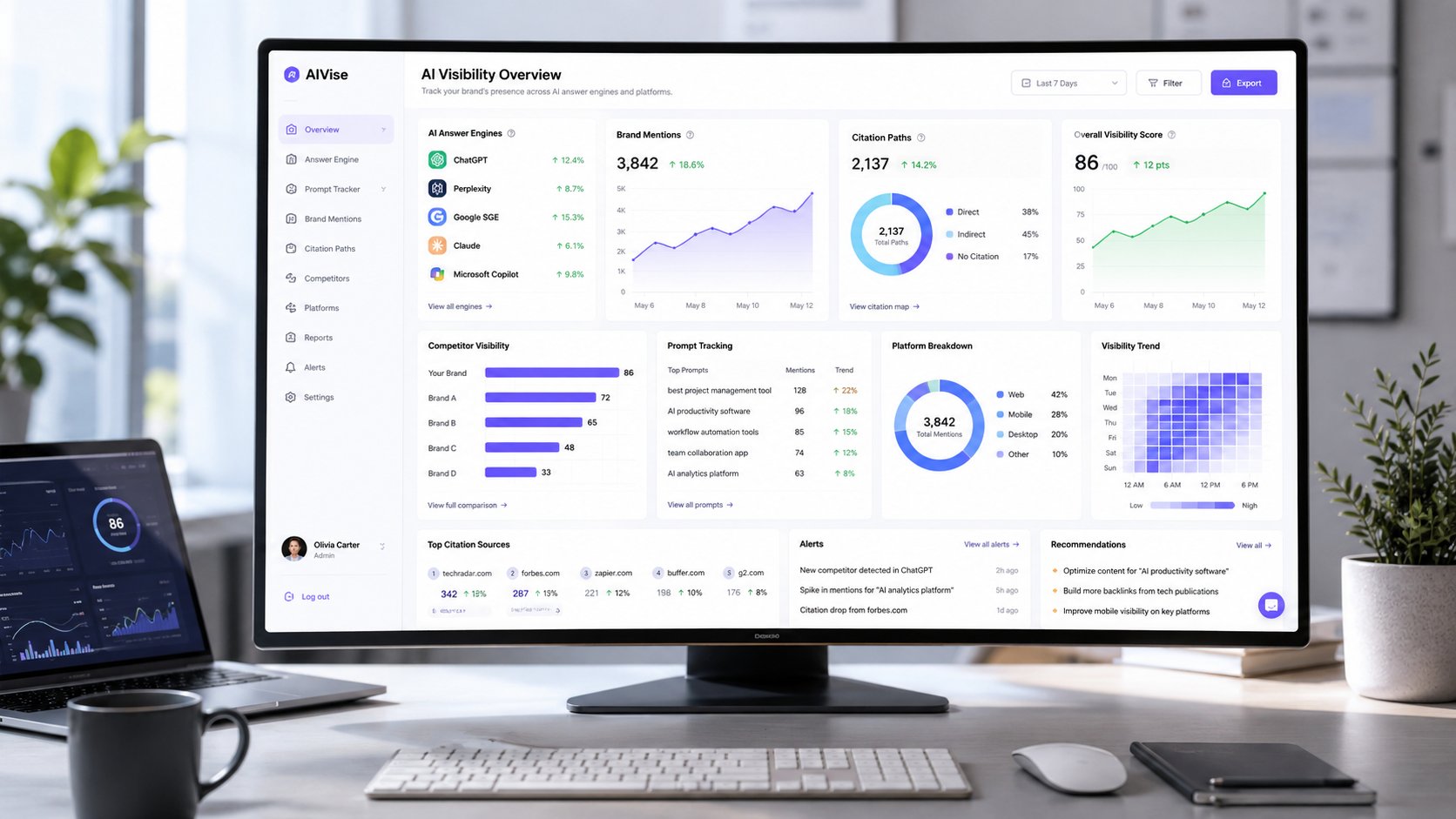
Traditional rankings no longer tell the whole visibility story. A page can rank well in Google and still disappear when ChatGPT, Gemini, Perplexity, Copilot, or Google AI Overviews assemble an answer. The important questions are different now: Does the engine mention your brand? Does it cite your page? Which competitors appear instead? Which external sources shape the response?
That makes the best software for AI visibility enhancement a measurement problem, not a single-score contest. This comparison evaluates tools by the signal they expose, including prompt-level mentions, citation evidence, query fan-out, competitor share of voice, and Google AI Overview presence. It also considers multi-engine coverage, monitoring depth, implementation effort, scalability, and cost transparency. Llumo stands out for teams that need actionable visibility across models, especially when they want to inspect the prompts, sources, and competitors behind each result.
Google AI Overviews appeared on about 47% of qualifying Google queries in Q1 2026, compared with 32% in Q1 2025, according to independent AI Overview usage tracking. The same source reports an average of 4.6 source citations per Overview, making source-level evidence more useful than a generalized visibility score.
1. Llumo
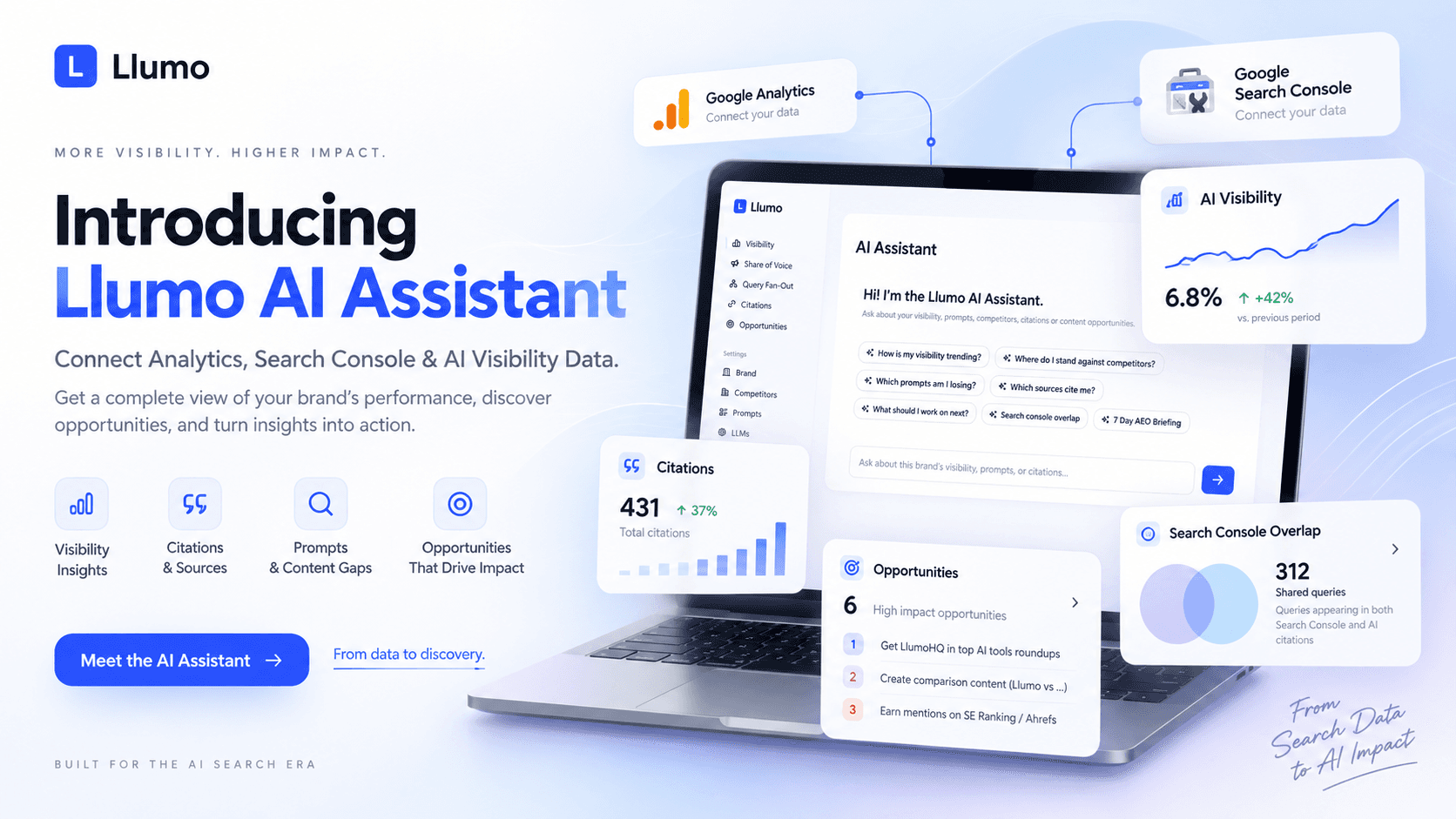
Llumo is built specifically for Answer Engine Optimization, rather than adapting a traditional rank tracker to generative search. It monitors how AI answer engines mention and cite a brand across ChatGPT, Gemini, Perplexity, Copilot, and Google AI Overviews, then connects those observations to practical optimization work.
The strongest signal is per-prompt visibility. Teams can archive the exact response, review the cited domains and pages, compare share of voice with competitors, and identify new or lost references. Llumo also logs query fan-out, so analysts can inspect the searches and keyword expansions that sit behind an answer instead of treating the final response as a black box.

Why its signal is more actionable
Llumo's opportunity discovery ranks content updates, new pages, and brand-mention outreach by expected impact. Dashboards support tagging, filtering, competitor trend lines, and longitudinal prompt tracking, which helps teams distinguish a temporary answer change from a sustained visibility pattern.
Practical rule: A citation is a useful lead, not proof that the cited page materially influenced the answer.
That distinction matters because recent generative engine optimization research separates citation selection from citation absorption. A page may appear in the source list without significantly shaping the final response, as explained in this framework for measuring generative engine optimization. Llumo's prompt archives and source analysis give buyers the evidence needed to investigate that difference.
Trade-offs and buyer fit
Llumo removes a traditional software license fee for the core platform. Customers connect their own provider API keys and pay underlying provider costs directly, without Llumo usage markup. That model offers transparent response-based cost comparison and can support large monitoring programs without forced enterprise pricing tiers.
The trade-off is operational. Your team manages API keys, quotas, and variable usage costs, and Llumo's public materials don't list packaged per-seat pricing. Customer testimonials and awards also aren't listed publicly, so buyers should validate model coverage and expected costs for their own prompts.
Pros: Actionable prompt-level visibility, share of voice, citation analysis, query fan-out logging, opportunity prioritization, hosted custom subdomains, custom branding, unlimited projects and brands, and direct provider billing.
Cons: API-key setup shifts quota and usage management to the customer, while pricing, testimonials, and awards require direct validation.
Best for: SEO and AEO teams, agencies, SaaS companies, growth leaders, and competitive intelligence practitioners that need to understand not only whether AI mentions a brand, but why.
2. Similarweb Gen AI Intelligence
Similarweb's Gen AI Intelligence is best suited to enterprise teams that need stakeholder-ready benchmarking rather than a lightweight prompt checker. It measures brand appearance in AI-generated answers across ChatGPT, Gemini, Perplexity, and Google AI Mode or AI Overviews, then ties mentions to underlying citations and sources.
Its central signal is topic-level brand visibility and mention share. Marketing leaders can compare a brand with competitors across defined topics, markets, or product lines. Analysts can also move from a tracked prompt to the answer and then to the domains and URLs that influenced it, creating a reporting chain that executives can understand.
The platform's maturity is its main advantage. Similarweb already serves organizations that need market, location, and campaign scoping, so AI visibility can sit alongside broader competitive intelligence workflows. That reduces the need to explain a new dashboard in isolation to non-specialist stakeholders.
The limitation is attribution. Similarweb doesn't precisely attribute traffic from AI Overviews, and that isn't a problem unique to this product. AI answers can expose a brand without generating a measurable click, while citations may influence an answer without producing a clean referral path.
Pros: Mature reporting workflows, competitor benchmarking, topic-level visibility, and clear prompt-to-answer-to-citation mapping.
Cons: Enterprise-oriented contracting and interface design can be excessive for smaller programs, and AI Overview traffic attribution remains limited.
Best for: Large marketing and insights teams that need defensible competitive reporting across markets and topics.
3. BrightEdge AI Catalyst and AI Hyper Cube
BrightEdge combines traditional enterprise SEO with generative search analysis. Its AI Catalyst and AI Hyper Cube capabilities track mentions and citations across Google AI Overviews, ChatGPT, Gemini, Perplexity, and related generative research modules.
The platform's distinctive signal is market-level AI Overview intelligence. Rather than focusing only on whether a single prompt mentioned a brand, BrightEdge helps teams study where AI Overviews activate, how citation patterns vary by category and intent, and how those signals relate to existing SEO planning.
That makes it useful for organizations with established SEO governance. Content teams can bring generative visibility into the same planning environment as rankings, demand analysis, and market trends. The unified workflow is valuable when SEO and AEO are managed by different specialists who still need shared priorities.
Where the detail can vary
BrightEdge's depth depends on the product module and research workflow being used. Some views provide broad market insight, while hands-on prompt-level detail may be less central than it is in a specialized AEO platform. Buyers should ask to see the exact prompt archive, citation evidence, and export options they'd use during weekly optimization.
Google AI Overview volatility makes this validation important. One study of 227 root domains found that Google changed at least one source for 52% of keywords when the same search was repeated, as reported in an analysis of AI Overview citation behavior. A platform that shows only a static snapshot won't fully explain that instability.
Pros: Strong AIO research, market-level planning, and integration with established enterprise SEO workflows.
Cons: Pricing and implementation are enterprise-oriented, and prompt-level detail varies by module.
Best for: Large organizations that want AI visibility inside an existing SEO operating system.
4. Conductor AI Search
Conductor AI Search focuses on per-prompt and per-engine tracking within an enterprise SEO environment. It includes Google AI Overviews and uses API-based collection where available, with multiple checks designed to improve detection reliability.
The practical advantage is operational clarity. Teams can create topic and prompt groups, monitor share-of-voice-style trends, configure collection cadence, and receive notifications without building a separate monitoring process. Conductor also provides implementation guidance, which helps teams avoid treating every answer fluctuation as a strategic change.
Setup still requires care. Prompt selection, geography, engine configuration, and collection schedules influence what the dashboard means. A poorly curated prompt set can produce a polished report that doesn't represent the questions buyers ask.
The best prompt set is not the largest one. It's the one you can interpret, reproduce, and connect to a business decision.
The measurement discipline behind that principle is described in repeatable AEO benchmarking guidance, which recommends 75 to 150 prompts for a focused program and 250 or more prompts for mature tracking. It also advises logging engine, interface, login state, geography, device class, and prompt sequence. Those variables should be recorded regardless of the platform you choose.
Pros: Strong enterprise dashboards, notifications, implementation guidance, API-based collection, and multi-check scheduling.
Cons: Contracts and pricing aren't publicly listed, while configuration takes time before the results become representative.
Best for: Enterprise SEO teams that need controlled monitoring and reporting. Teams developing a broader AEO program may also benefit from guidance on how to rank in ChatGPT search.
5. seoClarity AI Overviews Tracking
seoClarity is strongest when the required signal is Google AI Overview presence at scale. Its tracking sits alongside conventional rank and SERP data, showing where Overviews appear for large keyword sets and which related details matter to enterprise reporting.
That focus makes seoClarity a sensible choice for search teams whose immediate question is, “Which tracked queries now contain an AI Overview, and how does that change our SERP?” It can also support ongoing education and planning as Google's AI search surfaces evolve.
The product is less clearly designed as a complete cross-model brand intelligence system. Teams that need detailed ChatGPT, Gemini, or Perplexity prompt archives, competitor answer comparisons, and source influence analysis may need a complementary specialist platform.
This distinction is important because AI visibility isn't confined to Google. The historical development of AEO moved from ChatGPT's mainstream adoption through Perplexity's growth and Google's launch of AI Overviews in May 2024. By the time answer engines expanded across more than 200 countries and 40 languages, organizations needed measurement beyond conventional SERP tracking, as outlined in the history of answer engine optimization.
Pros: At-scale Google AIO detection, enterprise reporting, established rank-tracking integration, and ongoing AIO-focused updates.
Cons: Google is the center of gravity, while broader multi-engine brand detail may require another product. Pricing is handled through enterprise sales.
Best for: Large SEO departments that primarily need Google AI Overview monitoring. For a wider tool evaluation, see this comparison of AI Overview tracking tools.
6. Semrush AI Visibility and AI Overviews in Rank Tracking
Semrush gives existing SEO users a familiar route into AI visibility. Its position tracking can flag AI Overview presence and whether a tracked result appears, while its enterprise AI Visibility layer adds broader market research and benchmarking context.
The main signal is AI Overview detection connected to standard ranking data. That's useful for teams that already organize work around keyword positions, SERP features, content performance, and competitor research. They don't need to replace the reporting habits their teams already understand.
Semrush's published AI Visibility Index research can also help executives frame the issue at market level. However, the platform's AI visibility depth may be lighter than a specialized AEO tool when the requirement is a prompt-by-prompt archive of answers, citations, query fan-out, and source changes.
The difference is one of workflow. Semrush helps answer whether AI visibility is becoming part of a broader search performance picture. A specialist platform helps answer which exact source was selected, which competitor displaced the brand, and which content or outreach task should follow.
Pros: Familiar SEO workflows, AI Overview detection, enterprise visibility research, and a broad content and market ecosystem.
Cons: Deeper AI visibility features may be limited to enterprise tiers, and prompt-level attribution can be less central than in dedicated AEO platforms.
Best for: Existing Semrush customers that want to add AI Overview and AI visibility signals without changing their core SEO stack.
7. SISTRIX AI Overviews and Prompt Monitoring
SISTRIX combines global Google AI Overview tracking with prompt monitoring across ChatGPT and Perplexity. Its differentiator is transparent methodology, supported by documentation and API access for teams that need to integrate AI tracker data into their own reporting.
The platform can show whether URLs cited in AI Overviews also rank organically. That comparison is valuable because traditional rankings don't fully predict AI citations. An analysis of 863,412 search queries found that 38% of AI Overview citations came from traditional top-10 results, 44% came from pages ranked 11 to 100, and 18% came from pages outside the top 100, according to research on AI search citations and organic rankings.
SISTRIX therefore works well for analysts asking whether Google's generative source selection is extending beyond the first page. It can expose opportunities that a conventional rank report would overlook, particularly when a cited page has modest organic visibility.
The trade-off is breadth. Chat engine coverage is handled through prompt monitoring rather than continuous crawling, so teams must curate prompt sets that reflect their target markets, personas, and locations. That adds effort, but it also makes the measurement scope explicit.
Pros: Documented methodology, API access, global AIO coverage, and useful comparison between cited URLs and organic rankings.
Cons: Google remains the strongest focus, while broader chat monitoring depends on carefully maintained prompts.
Best for: SEO analysts and international teams that value transparent data collection and Google-focused visibility analysis.
8. SE Ranking AI Overviews Tracker and AI Visibility Toolkit
SE Ranking occupies the practical middle ground between a traditional SEO platform and a broader AI visibility product. It tracks AI Overviews and AI Mode, detects whether a site is cited, and monitors brand mentions and citations across ChatGPT, Gemini, and Perplexity.
Its value comes from combined rank and answer-engine visibility. Agencies and in-house teams can keep conventional keyword projects while adding AI-search projects, rather than buying a highly specialized enterprise suite for every client or brand.
The multi-engine layer makes SE Ranking more useful than a pure Google AIO tracker, especially when the team wants to compare whether a brand appears in different answer environments. API access also supports reporting workflows, although governance and custom analytics are lighter than those found in top-end enterprise suites.
A trial can reduce the risk of choosing based on a feature list alone. Coverage may vary by plan, prompt volume, geography, and project configuration, so buyers should test the exact engines and questions that matter to their market before committing.
Pros: Accessible combination of traditional rank tracking and AI visibility, multi-engine brand and citation monitoring, API access, and a 14-day trial.
Cons: Enterprise governance and custom analytics are lighter, while plan limits and pricing need verification for larger projects.
Best for: Agencies and growing brands that want usable AI visibility features without moving immediately to an enterprise contract.
9. Advanced Web Ranking AI Search and Brand Visibility
Advanced Web Ranking is a rank tracker first, with AI search and brand visibility capabilities layered into its reporting. It detects Google AI Overviews and AI Mode, identifies brand references across ChatGPT, Perplexity, and Gemini, and provides historical SERP timelines for agencies and analysts.
The strongest signal is granular historical reporting. Location-level analysis, competitor comparisons, API integrations, and long-running SERP timelines support teams that need to show how visibility changes over time rather than inspect isolated answer samples.
AWR is especially useful when an agency's existing reporting system is already built around rank data and APIs. It can add AI mentions and citations to a familiar analytical workflow. It won't necessarily replace a full AEO operations platform, however, because its center of gravity remains monitoring and reporting rather than content opportunity management or managed citation acquisition.
The buyer fit is therefore straightforward. Choose AWR when reliable tracking, historical context, and integration matter more than a guided optimization workspace.
Pros: Detailed agency reporting, historical timelines, location analysis, competitor data, API and MCP integrations, and predictable options for large keyword volumes.
Cons: It may not replace broader SEO or AEO operations tooling, and its feature set emphasizes visibility measurement over end-to-end optimization.
Best for: Agencies, analysts, and SEO teams that need dependable rank and brand-reference reporting. Its positioning is also relevant to teams comparing AI visibility trackers for SEO and marketing agencies.
10. STAT Search Analytics
Moz STAT is designed for enterprise SERP intelligence, and its AI Overview capability extends that strength into generative search monitoring. It flags when AI Overviews appear for tracked queries and identifies the URLs cited, while allowing segmentation by topic, device, and location.
STAT's primary signal is at-scale Google AIO presence within an enterprise rank-tracking stack. Teams with large keyword portfolios can aggregate results, segment markets, and connect AI Overview changes to existing SERP reporting practices.
Its SERP parsing lineage is an advantage for organizations that value stable data handling and established aggregation workflows. The limitation is equally clear. STAT focuses primarily on Google AI Overviews, so teams that need continuous prompt-level monitoring across ChatGPT, Gemini, Perplexity, Copilot, and other answer engines will likely need a complementary platform.
That doesn't make STAT a weak choice. It makes it a specialized one. Its strength lies in answering where Google's AI surface appears and which URLs receive citations, not in explaining the complete cross-model information ecosystem around a brand.
Pros: Enterprise-grade SERP data handling, topic, device, and location segmentation, large-scale aggregation, and integration with established rank-tracking stacks.
Cons: Broader multi-engine chat coverage is limited, while contracts and pricing are handled through sales.
Best for: Enterprise SEO teams that need reliable Google AIO monitoring across extensive keyword sets.
Explore STAT Search Analytics.
Top 10 AI Visibility Tools: Features Comparison
Product | ✨ Core capabilities | ★ Quality / UX | 💰 Value & pricing | 👥 Target audience |
|---|---|---|---|---|
🏆 Llumo | ✨ Per‑prompt visibility, multi‑model tracking, citation & query fan‑out, opportunity discovery, hosted custom subdomain | ★★★★★ Dashboards, prompt archives, daily backups | 💰 BYO API keys, no Llumo license/markup; transparent response‑based costs | 👥 SEO/AEO teams, agencies, product & competitive intel |
Similarweb – Gen AI Intelligence | ✨ Topic‑level brand visibility, prompt→answer→citation mapping, market scoping | ★★★★ Executive‑ready reports & benchmarks | 💰 Enterprise pricing; stakeholder reporting focus | 👥 Enterprises, marketing leaders |
BrightEdge – AI Catalyst | ✨ AIO tracking, “AI Hyper Cube” research, AIO presence & volatility analysis | ★★★★ Deep research dashboards for planning | 💰 Enterprise pricing; research‑centric value | 👥 Enterprise SEO & strategy teams |
Conductor – AI Search | ✨ Per‑prompt/per‑engine tracking, API collection, multi‑check schedules | ★★★★ Strong dashboards, notifications, implementation guides | 💰 Enterprise contracts; configuration effort | 👥 SEO teams, large marketing orgs |
seoClarity – AI Overviews Tracking | ✨ At‑scale AIO detection, rank/SERP integration, strategy resources | ★★★★ Steady updates; research & education | 💰 Enterprise sales; focused on Google AIO | 👥 Large enterprises, enterprise SEO teams |
Semrush – AI Visibility + AIO | ✨ Rank tracking with AIO flags, AI Visibility Index & market studies | ★★★ Familiar SEO workflows & research ecosystem | 💰 Mid→Enterprise tiers; advanced features enterprise‑locked | 👥 Agencies, in‑house SEO teams |
SISTRIX – AI Overviews + Prompt Monitoring | ✨ AIO detection, prompt monitoring (ChatGPT/Perplexity), API & multi‑country coverage | ★★★★ Transparent methodology & docs | 💰 Mid→Enterprise; transparent methods | 👥 International SEO teams, analysts |
SE Ranking – AI Overviews Tracker | ✨ AIO presence detection, multi‑engine mention/citation tracking, project setup | ★★★ Combines rank tracking & AI visibility | 💰 Mid‑market pricing; 14‑day trial | 👥 Agencies, SMBs |
Advanced Web Ranking (AWR) | ✨ AIO/AI Mode detection, historical SERP timelines, competitor analysis | ★★★★ Granular reporting & API integrations | 💰 Predictable pricing for large keyword volumes | 👥 Agencies, analysts |
STAT Search Analytics (Moz STAT) | ✨ Flags AIO appearances & cited URLs, segmentation by topic/device/location | ★★★★ Enterprise SERP parsing lineage & aggregation | 💰 Enterprise pricing via sales | 👥 Large teams, enterprise rank tracking |
Choose the Signal You Need to Improve
There isn't one universal winner among the best software for AI visibility enhancement because the tools measure different stages of the answer journey. A rank tracker tells you whether Google shows an AI Overview and which URLs appear. An enterprise SEO suite adds reporting, market context, and governance. A specialized AEO platform shows the prompt, answer, cited sources, competitor presence, and sometimes the generated searches that shaped the response.
Start with the primary job:
Cross-model prompt and citation intelligence: Choose Llumo when your team needs per-prompt archives, share of voice, citation changes, query fan-out, and prioritized content or outreach opportunities across multiple models.
Enterprise benchmarking: Consider Similarweb or BrightEdge when executives need market-level comparisons, topic reporting, and integration with established enterprise workflows.
Google AI Overview monitoring: seoClarity, SISTRIX, and STAT are stronger fits when Google AIO presence, cited URLs, geography, and SERP integration are the central requirements.
Integrated rank tracking: Semrush, SE Ranking, Conductor, and AWR make sense when your team wants AI visibility alongside existing keyword and SERP operations.
The most important comparison isn't the number of engines in a product brochure. Check whether the platform gives you prompt volume, exact response evidence, citation URLs, location controls, device or login-state controls, API access, collection cadence, and historical archives. Ask whether it distinguishes a brand mention from a citation, and a citation from meaningful influence on the answer. That two-stage distinction is often more useful than a single visibility score.
Cost also needs a wider definition. Include platform licensing, provider API charges, scraping or response limits, analyst time, implementation, exports, and the effort required to maintain prompt sets. Llumo's bring-your-own-keys model makes provider costs visible, but it also means your team owns quotas and usage controls. Enterprise suites can centralize governance, but sales-led pricing and setup may make small programs inefficient.
A practical rollout can stay simple:
Define the prompt universe: Include branded, unbranded, informational, commercial, comparison, and competitor questions.
Record the baseline: Log engine, interface, geography, device class, login state, prompt sequence, answer text, mentions, citations, and competitors.
Review the sources: Separate owned pages from external domains, new references from lost references, and citations that visibly shape the response from citations that merely appear.
Prioritize work: Update pages, create missing content, improve structure, or pursue relevant external mentions based on the observed source gaps.
Recheck consistently: Keep the prompt set and collection conditions stable enough to identify genuine movement rather than measurement noise.
External channels deserve particular attention. A benchmark covering 75,000 brands found that YouTube mentions correlated more strongly with AI brand visibility than any other measured metric, while link volume and total page count showed weak correlation, according to the Ahrefs benchmark report. That doesn't prove YouTube will be the decisive lever for every industry, but it does show why software should inspect off-site ecosystems rather than only owned-site citations.
Choose the tool that exposes the signal your team can act on. If the next decision is a content update or outreach campaign, a dashboard that only reports AIO presence won't be enough. If the immediate need is Google SERP governance, a full prompt-intelligence platform may be more than you need.
Llumo gives SEO, growth, agency, and competitive intelligence teams prompt-level visibility across major AI answer engines, with share of voice, citation sources, competitor trends, query fan-out, and prioritized opportunities. Connect your own provider API keys, inspect the evidence behind AI answers, and visit Llumo to evaluate whether its cross-model workflow fits your visibility program.