
Eighty-one percent of brands cited by ChatGPT don’t rank in Google’s top ten for the same query, according to a 2026 analysis of SaaS brands reported by Angelina Yang. That single finding changes the question. You aren’t trying to force a blue-link ranking into an answer engine. You’re trying to become a source ChatGPT can retrieve, understand, trust, and cite.
ChatGPT Search moved from the SearchGPT prototype in July 2024 to broad availability by December 2024, after OpenAI launched it for Plus and Team users on October 31, 2024, then expanded access to free users on December 16 and 17, 2024, as reported by TechCrunch. It automatically searches the web for queries and provides inline source attribution, so visibility now depends on more than technical indexing or organic clicks.
This playbook explains Answer Engine Optimization, or AEO, as a separate operating discipline. The work centers on prompt coverage, citation quality, source diversity, and repeatable measurement in an environment where answers can change between runs.
Why Ranking in ChatGPT Search Is a Different Game
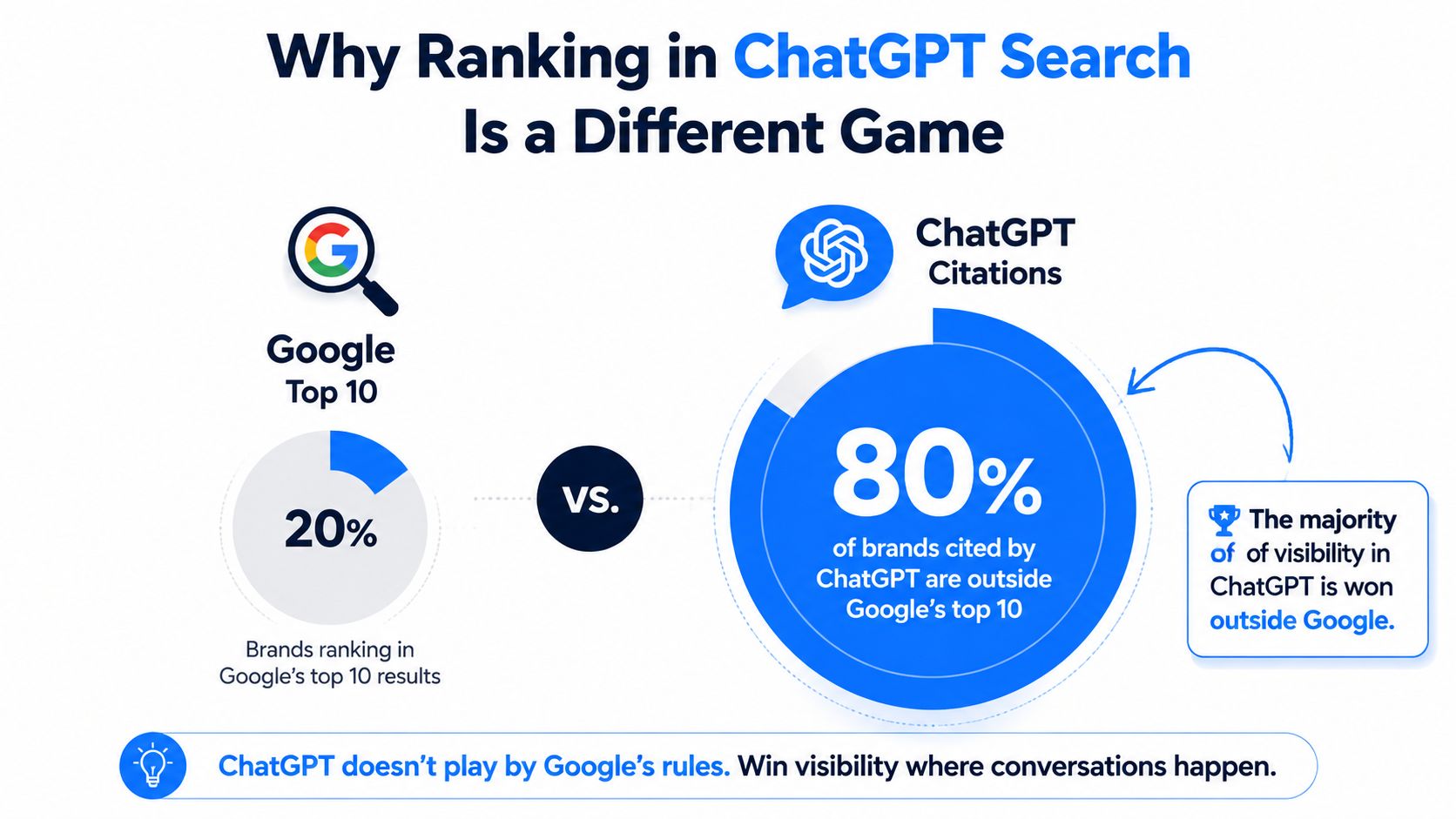
Eighty-one percent of brands cited by ChatGPT did not rank in Google’s top ten for the same query, according to the 2026 SaaS analysis reported by Angelina Yang. The finding exposes a decoupled search reality. Google visibility can support discovery while leaving your brand absent from ChatGPT’s answer.
Google and ChatGPT may assess the same query yet surface different companies. Conventional SEO rewards crawlability, indexing, ranking, and clicks. Answer Engine Optimization, or AEO, must earn retrieval, citation, and accurate reuse inside a generated response. A page can rank well in Google and still lack the concise claims, third-party context, or clear entity signals ChatGPT needs before citing it.
Treat ChatGPT visibility as a separate operating program. Define the prompts that matter, identify the sources appearing in answers, strengthen the claims those prompts require, and test results across repeated runs. The guide to Answer Engine Optimization in 2026 provides a useful framework for that work.
AEO needs its own scorecard
Organic traffic cannot stand in for ChatGPT visibility. Track these measures directly:
Prompt share of voice: How often your brand appears against a defined competitor set.
Citation source diversity: Whether answers use your site, review platforms, publishers, forums, or other third-party domains.
Mention velocity: Whether authoritative references accumulate over time.
Prompt-level position: Where your brand appears in recommendation answers, with position recorded across repeated tests.
Citation accuracy: Whether ChatGPT links to the correct page and represents the claim correctly.
Google usually presents an ordered results page. ChatGPT generates an answer shaped by query interpretation, retrieval, model behavior, and source selection. A July 2026 study found that the top brand changed in 52% of repeated ChatGPT prompts, while only 8% of prompts remained locked, according to Writesonic’s AI search ranking stability study.
Practical rule: Stop promising a permanent “number one” position. Build a source footprint that keeps your brand eligible across prompt variations.
Target citation eligibility, not blue-link rank alone. Measure the prompts, sources, and claims that determine whether ChatGPT includes your brand.
How ChatGPT Search Picks and Cites Sources
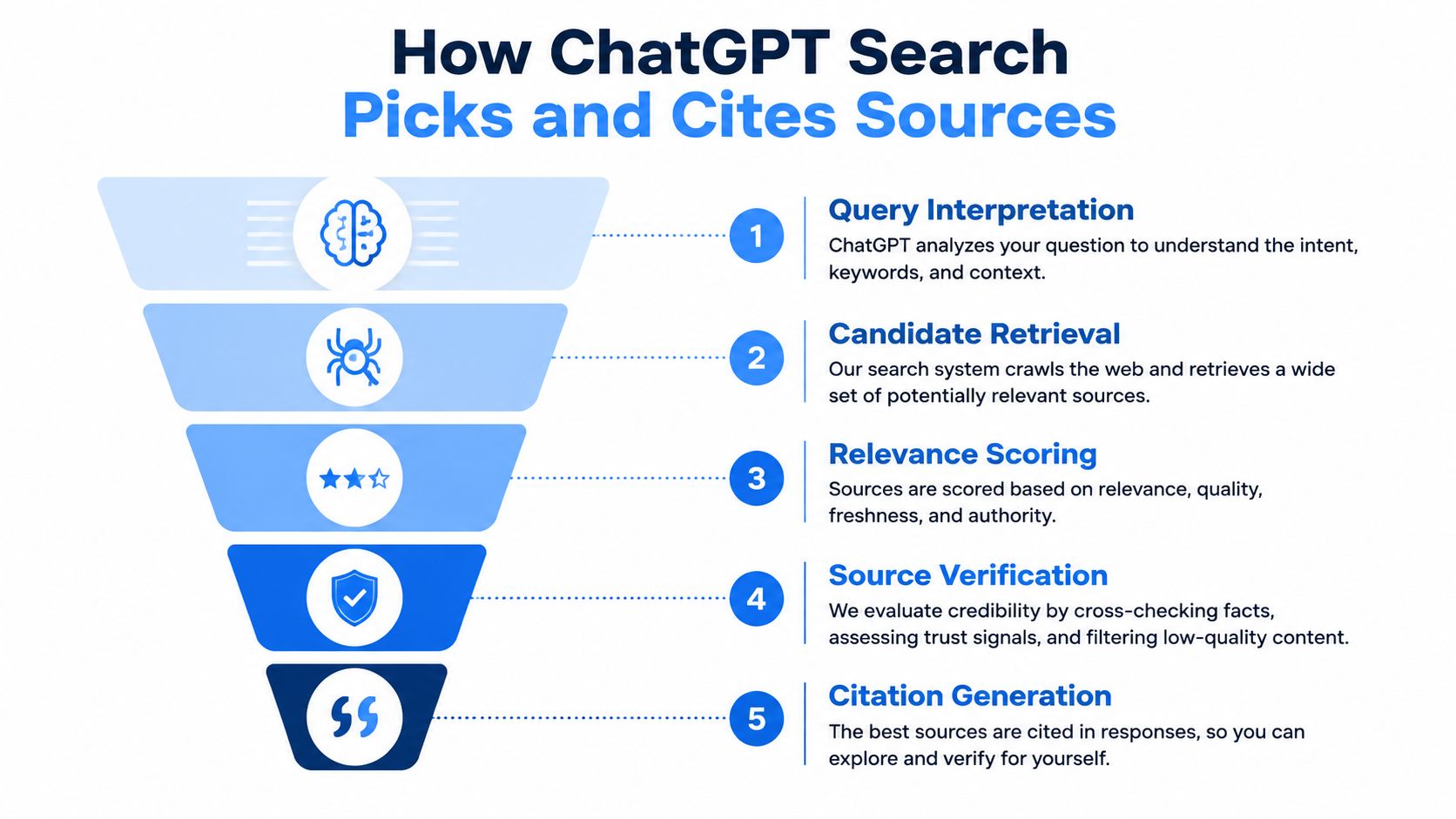
ChatGPT Search does not assign a permanent rank. It builds each answer through a search-to-citation funnel: interpreting the prompt, searching the web, evaluating passages, and selecting references. The practical GEO model in Llumo’s methodology for ranking in ChatGPT describes visibility as a pipeline rather than a stable results page. A strong Google position can help discovery, but it does not guarantee a ChatGPT mention.
The five stages
Query interpretation: ChatGPT identifies intent and may split a broad request into narrower searches. “Best CRM for a small consultancy” can generate separate questions about usability, pricing, integrations, and fit for a small team.
Candidate retrieval: Search systems gather potentially relevant pages from the live web and indexed sources. Crawlability, topical relevance, recognizable entities, and a clear page purpose affect whether content enters the candidate set.
Reranking: The answer model compares retrieved passages with the interpreted query. A passage explicitly addressing “CRM for solopreneurs” can beat a broader CRM page, even when that page has stronger conventional SEO signals.
Citation generation: The model connects factual statements with source pages. Clear subject-verb-object sentences, named products, dates, definitions, and sourced claims give it easier citation targets than vague promotional copy.
Source selection: ChatGPT decides which references appear beside the answer and in its sources interface. Domain reputation matters, but so does metadata clarity. A Tow Center study summarized by Nieman Lab found incorrect citation information in more than 60% of tests across 1,600 query attempts, exposing continued problems with title, date, publication, and URL identification.
Match the optimization to the stage
Structured data can help parsers identify an article, product, or organization. It cannot compensate for a page without a reusable passage. The reverse also applies: a useful passage may remain invisible if robots rules, rendering, or canonicalization block retrieval.
Put the definition or recommendation immediately beneath its relevant heading. Use descriptive titles and bylines, and make important claims attributable to a specific page. To audit which references support a generated response, follow this guide to reading the citations behind an AI answer.
Content Moves That Earn ChatGPT Citations
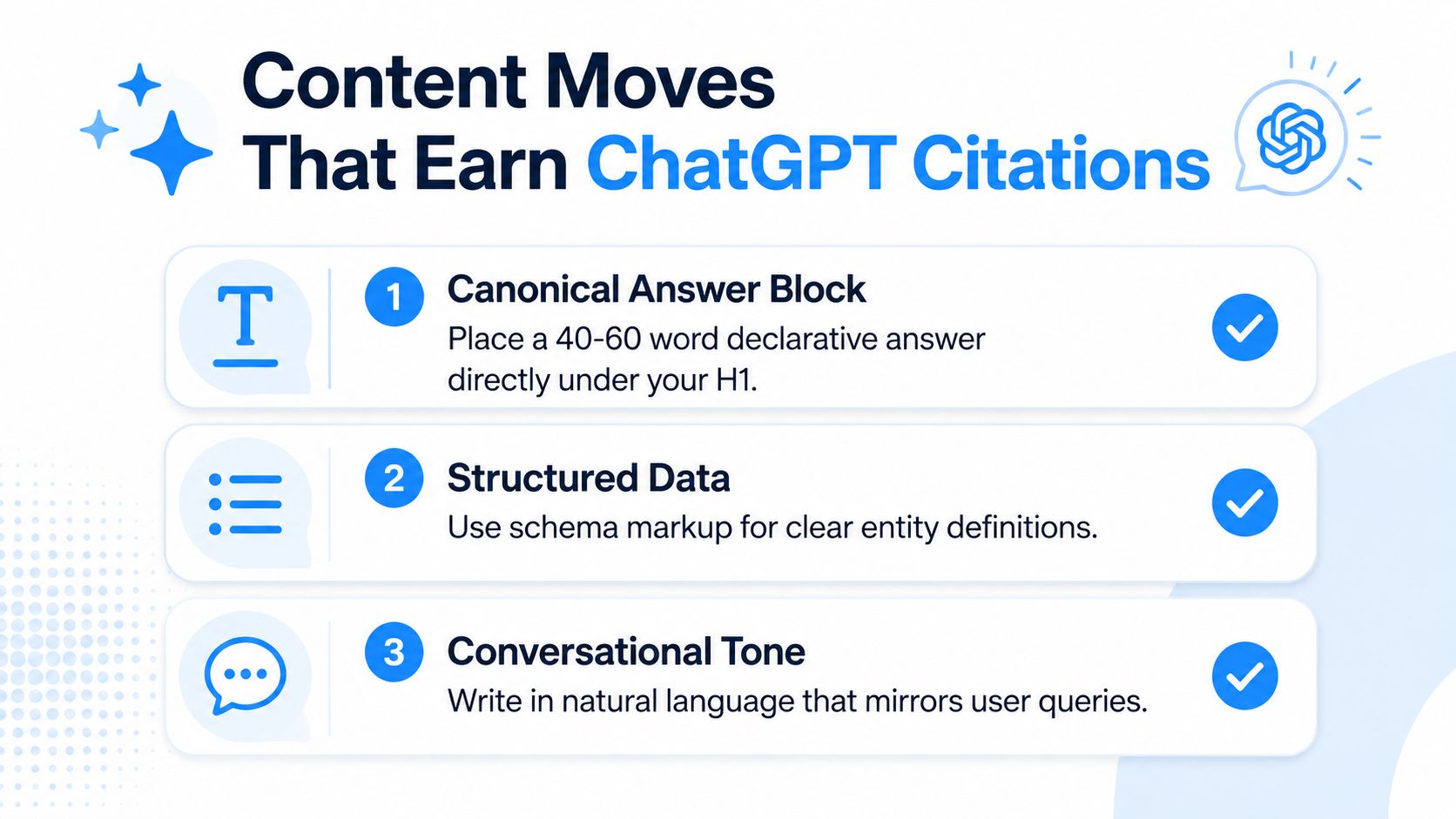
ChatGPT cites pages that offer reusable answers, clear evidence, and identifiable entities. Start with a canonical answer block, a concise response placed directly beneath the relevant heading. State the conclusion first, define the subject, and include the distinctions a reader needs. Sourced statistics and authoritative quotations can strengthen a passage, but only when the page makes their origin clear.
Build passages for extraction
Use a declarative, third-person voice. Name the subject, state its function, and remove the warm-up.
Weak:
There are many useful options for project management software, and the right choice depends on your team’s needs.
Stronger:
Asana, Monday.com, and ClickUp are project management platforms for teams that need task tracking, collaboration, and workflow automation. Asana suits teams that prioritize structured project planning, Monday.com emphasizes configurable workflows, and ClickUp combines project management with broader work-management features.
The stronger passage gives ChatGPT named entities, category context, and meaningful differences in a self-contained form. Do not add market-share claims or customer outcomes that the page cannot support.
Add evidence and attribution
Use original research, transparent methods, dated findings, and authoritative quotations when available. Put an inline source beside every statistic. Attribute expert quotations to a real speaker, include relevant credentials, and link to the page containing the exact wording. If attribution cannot be verified, paraphrase the idea or remove it.
Format information so retrieval systems can separate the parts:
Comparison tables: Put products, criteria, and distinctions in explicit cells.
Definition lists: Define each technical term in one sentence before expanding.
Numbered steps: Assign one action and its rationale to each step.
FAQ blocks: Answer natural-language questions directly instead of repeating keyword variants.
Named bylines: Show the author, publisher, review process, and update date.
Run a citation-readiness check
Before publishing, verify the page against these questions:
Does each major heading begin with a direct answer?
Can readers understand key passages without the surrounding context?
Does every important claim have an identifiable source?
Are titles, dates, authors, and publisher names clear?
Does the page distinguish the brand from similarly named entities?
Does the FAQ reflect real user phrasing?
Can a crawler reach the answer without fragile interface elements?
Keyword stuffing cannot replace evidence. A benchmark summarized by Funklevis reports positive lift for citations, statistics, direct quotations, and schema markup, while keyword stuffing showed negative impact. Use those elements to make claims easier to retrieve, verify, and quote.
Mapping the Prompts ChatGPT Actually Answers
Treat prompts as the primary unit of AEO work. A keyword describes a search term, but a prompt exposes the decision ChatGPT must help the user make. Mine customer-support tickets, sales-call notes, Reddit discussions, Google People Also Ask results, internal search logs, and conversations with account teams.
Group the raw questions by intent:
Definitional: What is usage-based billing?
Comparative: Product A versus Product B.
How-to: How do I migrate from one platform to another?
Opinion: Which approach works for a regulated team?
Recommendation: What tool should a small agency choose?
Then evaluate each cluster across three dimensions. Retrieval fit asks whether ChatGPT needs an external, citable answer. Commercial intent asks whether appearing could influence a buying decision. Competitive density asks how often credible competitors already appear.
Prompt Prioritization Matrix
Prompt Cluster | Retrieval Fit (1-5) | Commercial Intent (1-5) | Competitive Density (1-5) | Priority Score |
|---|---|---|---|---|
Best CRM for solopreneurs | 5 | 5 | 4 | High |
What is CRM software | 4 | 2 | 5 | Medium |
How to clean a CRM database | 5 | 3 | 3 | High |
CRM versus spreadsheet workflows | 4 | 4 | 3 | High |
CRM implementation history | 2 | 2 | 2 | Low |
Use a simple rule for the score: prioritize high retrieval fit and high commercial intent, then favor prompts where competitors have weak, incomplete, or poorly attributed answers. Don’t create several pages for one question. Assign one canonical URL to each priority prompt, mirror the user’s wording in the H1 and opening, then add a concise FAQ answer.
For the cluster “best CRM for solopreneurs,” the page should open with a direct answer such as: “The best CRM for a solopreneur is a platform that combines simple contact management, follow-up reminders, and affordable automation without requiring administrative overhead.” The supporting FAQ can then answer, “What should a solopreneur look for in a CRM?” in a separate, self-contained passage.
Use this prompt-set building guide to turn those questions into a tracked test set. Record the exact prompt, region, model, date, brands mentioned, URLs cited, and answer position. A prompt map without repeatable observation is just a content backlog.
Earning Third-Party Mentions That Travel
Your own website can’t supply every trust signal. ChatGPT often needs external context to understand whether a brand is a recognized provider, a credible product, or a relevant recommendation. Recent evidence summarized by Angelina Yang found brand-mention prevalence correlated with AI ranking more strongly than backlinks in a volatility study, so an unlinked, accurate mention can still matter.
Start with sources that already publish buying guidance. For SaaS, that can include G2, Capterra, TrustRadius, specialist newsletters, industry publications, podcasts, and relevant community discussions. Finance and healthcare brands need stricter editorial standards, but the motion is similar: earn clear descriptions from publishers whose audiences already ask the questions you’re targeting.
Match the pitch to the source
A review platform needs a complete product profile, accurate categories, and real customer feedback. A journalist needs a timely angle, original data, or a qualified expert. A podcast host needs a useful point of view and a topic that fits the audience.
A practical outreach sequence looks like this:
Identify a page or program that already ranks or gets cited for your target prompt.
Offer one specific asset, such as original research, a benchmark, a technical explanation, or an expert source.
Give the editor a concise description of your brand and the exact problem it solves.
Follow up with a new piece of information, not a repeated request.
Record whether the final mention names the brand accurately and describes the relevant category.
Don’t buy vague “AI authority” placements or spray identical guest posts across low-quality domains. Those tactics create noise, not a dependable entity footprint.
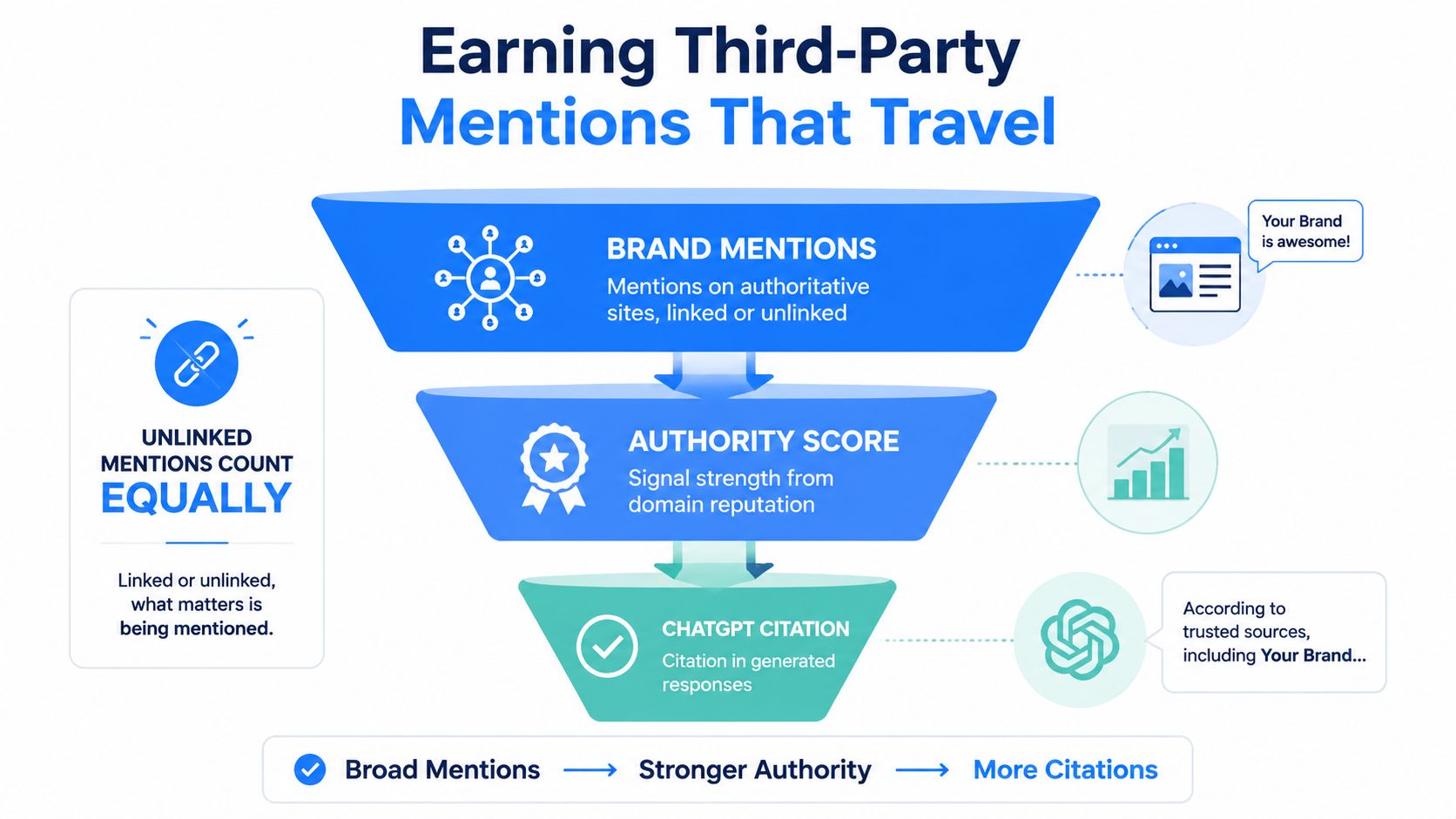
Track the resulting coverage with Brandwatch for listening, Ahrefs Content Gap for publisher discovery, and manual prompt checks for actual model behavior. The important output isn’t the number of placements. It’s whether relevant sources repeatedly describe your brand in the language your priority prompts require.
Technical Foundations for AI Crawlability
A page that a crawler can’t access won’t become a reliable citation. Enterprise sites still lose visibility through render-blocking scripts, JavaScript-only content, faceted navigation, accidental noindex tags, unclear canonicals, and templates that hide the answer behind tabs or interactive controls.
Start with the basics:
Render the core answer in accessible HTML: Don’t make the definition, product specifications, or comparison dependent on a client-side request.
Control faceted URLs: Prevent filter combinations from creating an uncontrolled set of near-duplicate pages.
Inspect index directives: Check that important commercial and editorial pages don’t carry accidental noindex instructions.
Strengthen internal links: Orphaned pages lack a clear path for crawlers and users.
Resolve soft 404s: A page returning a successful status while showing “not found” content creates a misleading retrieval candidate.
Make meaning explicit
Use semantic HTML for headings, lists, tables, author details, dates, and quotations. Add schema that reflects the page’s actual purpose, such as Article, Organization, Product, FAQPage, or HowTo. Speakable markup can support voice-derived answers where appropriate, but it can’t compensate for inaccurate or hidden content.
An llms.txt file can act as a curated guide to the pages you most want language-model systems to understand. Keep it selective and useful. Point to canonical documentation, product pages, research, policies, and definitions, while excluding duplicate archives, thin parameter pages, and obsolete material. Treat it as supplementary guidance, not a replacement for normal crawlability and access controls.
Audit the common failure points
Check robots.txt for unintended restrictions affecting GPTBot and OAI-SearchBot. Review rendered source, not just the HTML your CMS initially outputs. Test canonical tags, redirects, status codes, sitemap inclusion, internal links, and structured-data validation from a fresh crawl.
A one-hour technical checklist should answer:
Can a crawler reach the page from a normal internal link?
Is the main answer visible without JavaScript?
Does the page return the intended status?
Is the canonical URL correct?
Are title, author, publisher, and date unambiguous?
Does schema match visible content?
Are important sections duplicated across parameter URLs?
Do robots directives permit the intended AI search access?
Technical hygiene earns eligibility. It doesn’t create authority by itself, so pair it with the page-level and third-party work described above.
Measuring AI Visibility and a 90-Day Rollout Plan
Google rankings no longer guarantee ChatGPT mentions. AI visibility requires longitudinal measurement because one generated answer is not a stable ranking snapshot. Repeated prompts can produce different leading brands, so a single manual check can misrepresent performance.
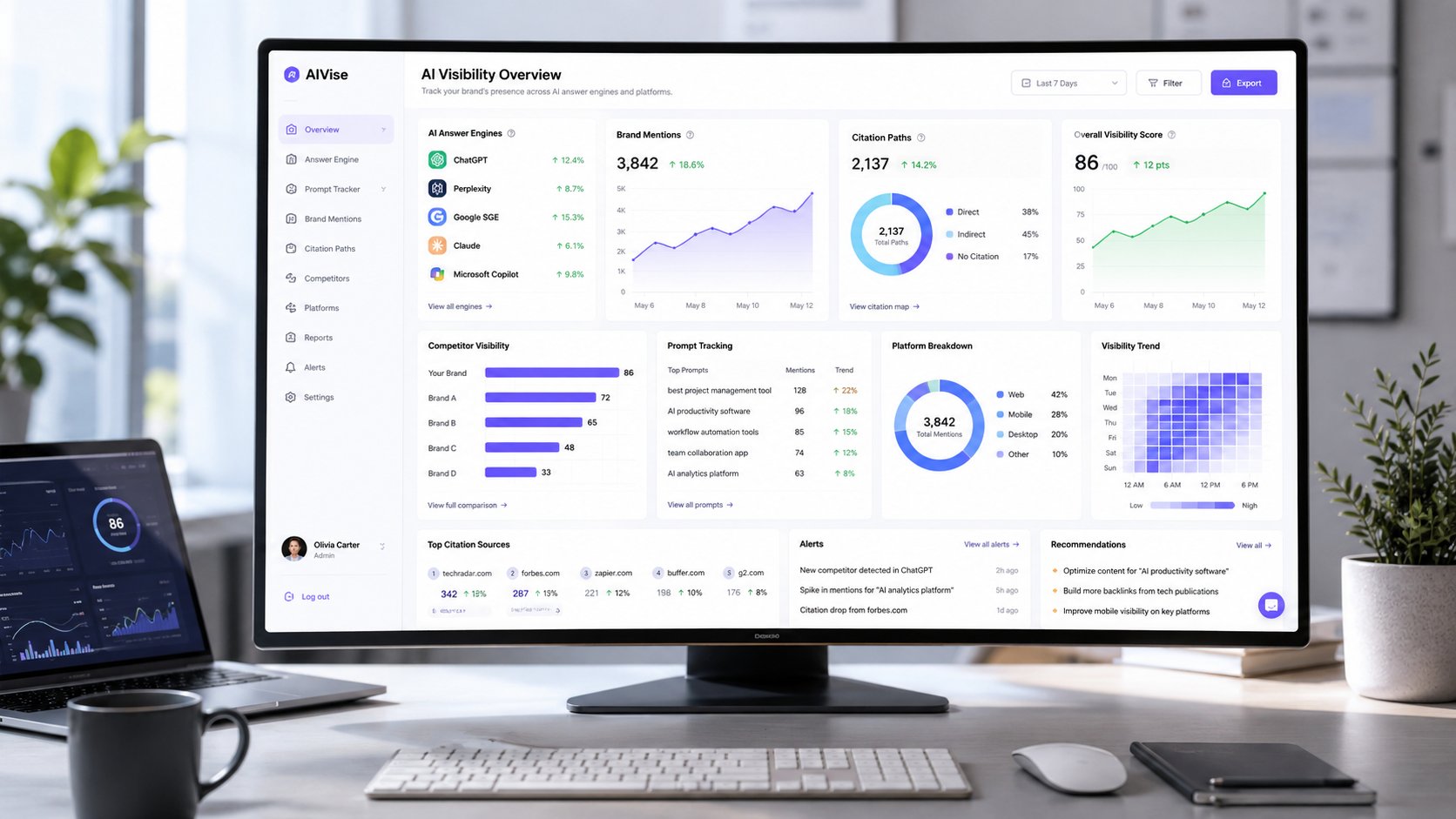
Build a fixed prompt set and rerun it across ChatGPT, Perplexity, Gemini, and other relevant answer engines on a consistent schedule. Store the complete response, mentioned brands, cited URLs, source types, answer position, model, region, and date. Calculate share of voice against a defined competitor set, then segment results by prompt intent and market.
What to put in the dashboard
Track metrics that expose both visibility and durability:
Citation count: Responses that cite your owned or earned pages.
Unique prompt winners: Prompts where your brand appears while competitors do not, or where your source supplies a key answer.
Source-type split: Owned content, industry publications, review sites, forums, documentation, and other references.
Citation accuracy: Whether the cited page supports the generated claim.
Lost and new sources: Domains that began or stopped influencing answers.
Prompt-level trend lines: How each target question changes across repeated runs.
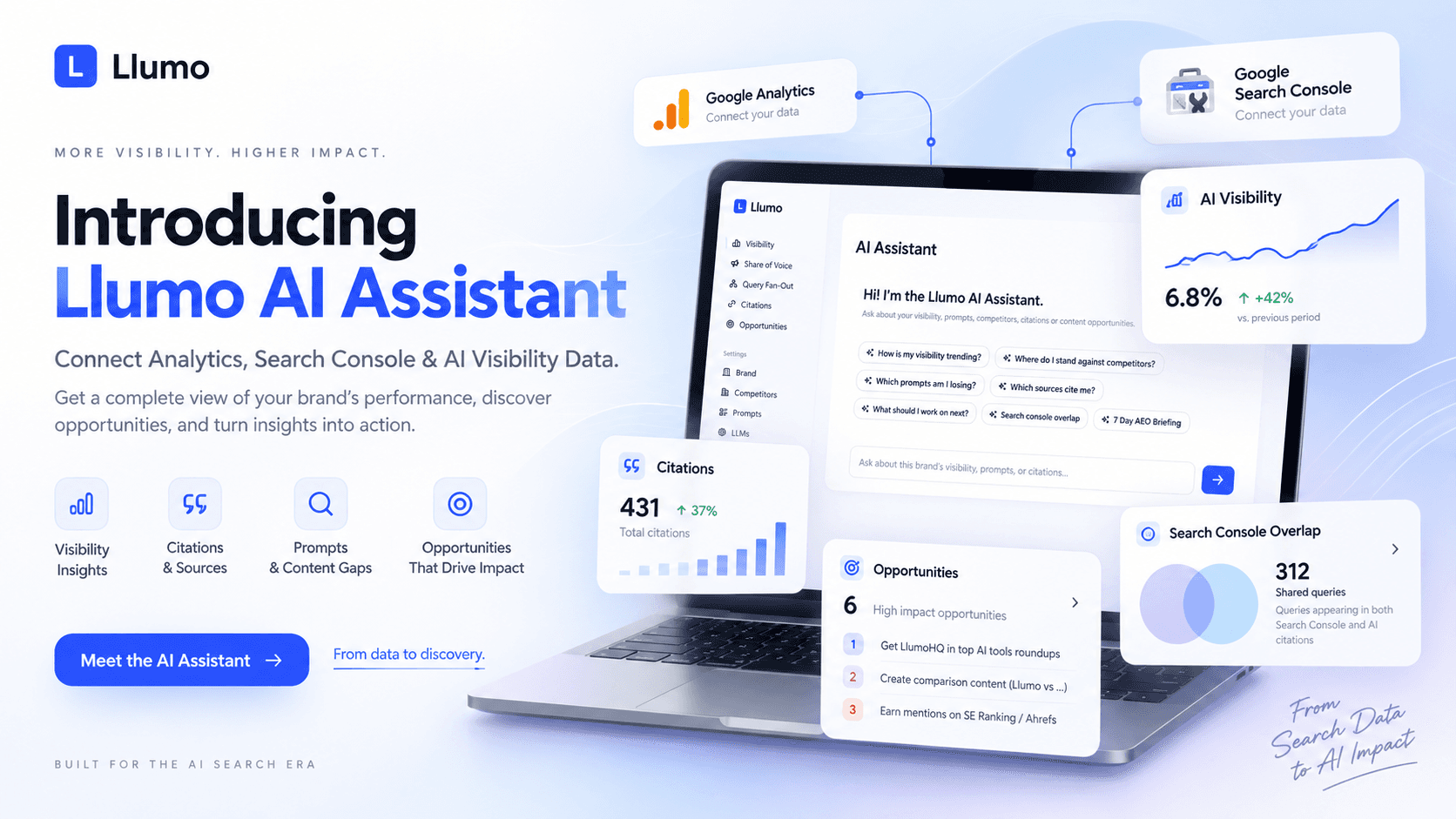
Llumo can centralize prompt-level responses, share of voice, competitor trends, query fan-out, and citation sources across ChatGPT and other AI answer engines. It also supports connected provider API keys, allowing teams to monitor usage while paying the underlying provider costs directly.
A focused 90-day sequence
Sprint | Days | Key Deliverables | Success Metric |
|---|---|---|---|
Foundation | 1-30 | Audit current citations, create the prompt set, instrument tracking, publish one canonical answer block for each priority prompt | Baseline visibility and initial prompt coverage |
Authority | 31-60 | Earn relevant third-party mentions, improve schema, publish or refine | More diverse citation sources |
Expansion | 61-90 | Add high-value prompt variants, prune low-yield pages, strengthen sources that already surface | More unique prompt winners and stronger share of voice |
Review results weekly. Separate genuine gains from rerun noise by checking repeated appearances across prompt variants and source types. The two leading indicators I trust most are new prompt winners and source diversity. A brand that wins one prompt through one page remains exposed. A brand appearing across distinct questions and credible domains has built a wider retrieval footprint.
Keep the dashboard tied to work. Every lost citation should produce an action, such as rewriting an answer block, correcting an entity description, improving a source page, or pitching a publisher. Every new citation should reveal the passage and external reference that made inclusion possible.
Llumo helps teams measure how ChatGPT and other answer engines mention brands, which pages they cite, and how visibility changes by prompt and competitor. Visit Llumo to track priority prompts, identify citation gaps, and turn AI visibility findings into specific content and third-party mention work.