
A marketing lead notices a rival being recommended in ChatGPT answers while their own brand never appears. The website ranks well, the content calendar is busy, and nobody can explain why the answer engines keep choosing someone else. The question isn't whether to act anymore. It's who can do the work without turning AI visibility into another vague retainer.
The best generative engine optimization services should make four things clear before you sign: what the work costs, how much scoping it requires, how thoroughly the provider tracks answers and citations, and what you receive at the end of the month. A dashboard showing mentions is useful. A list of content recommendations is better. Neither is enough if nobody can show which prompts changed, which sources influenced the answer, and whether your brand earned durable visibility.
1. Llumo
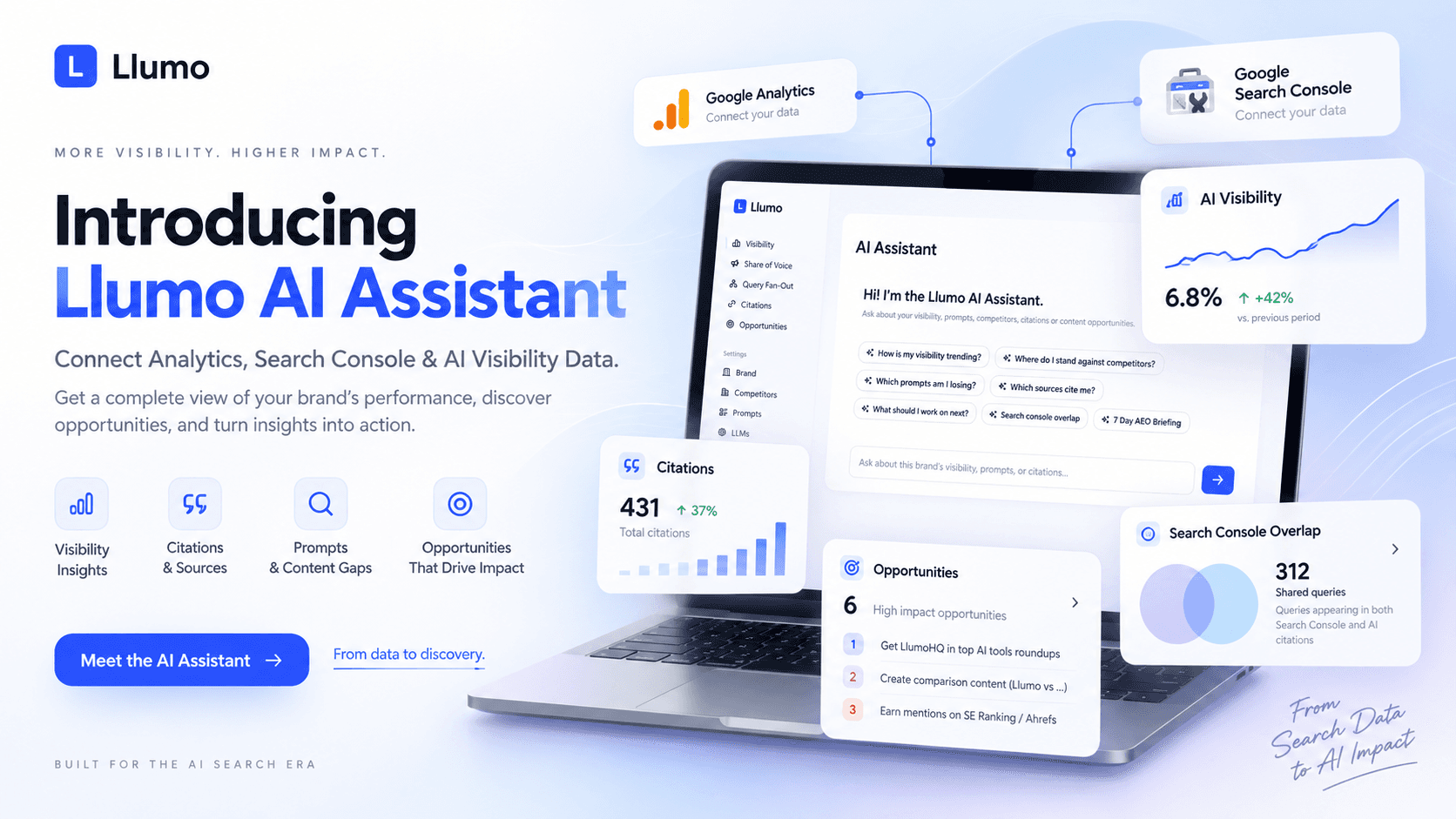
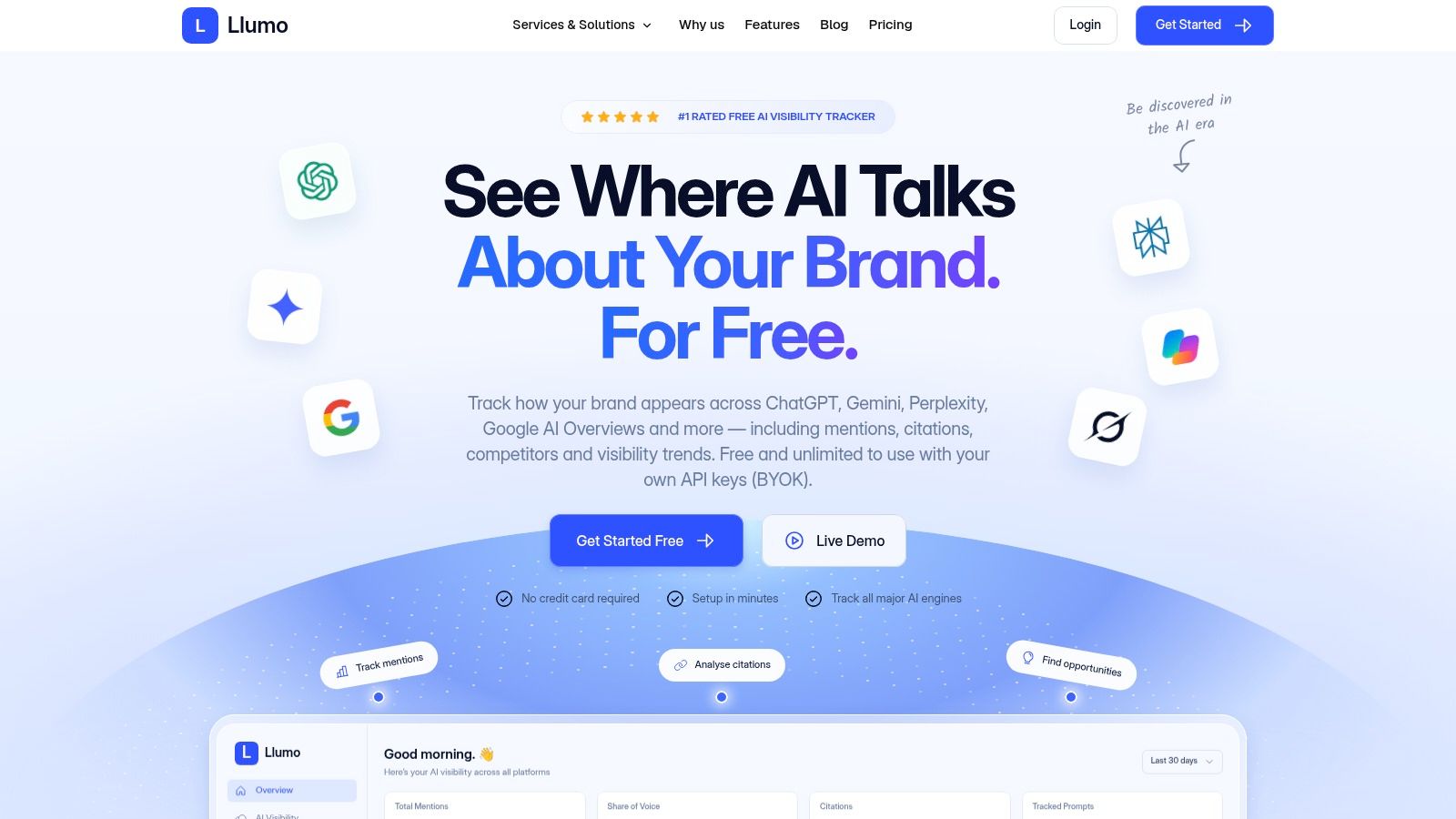
Llumo is the most practical option here for teams that want to measure AI visibility themselves rather than hand the entire problem to an agency. Its core platform has no software license fee. You connect your own provider API keys, pay those providers directly, and avoid a Llumo usage markup. That makes the buying decision unusually clear, although “free” doesn't mean that high-volume monitoring has no provider cost.
The platform tracks per-prompt visibility, share of voice, competitor trends, cited domains, cited pages, and newly won or lost references across ChatGPT, Gemini, Perplexity, Copilot, Google AI Overviews, Grok, Claude, Mistral, and other answer engines. It also archives responses, so you can inspect what the model said instead of relying on a single score.
Practical rule: A citation count without the response, prompt, page, and source context is a reporting shortcut, not a dependable optimization system.
Llumo's strongest feature is the link between measurement and action. Query fan-out logs show the related searches an engine used to build an answer, while opportunity discovery points teams toward content updates, new pages, or off-site mention work. Agencies can manage multiple brands and projects, use tagging and prompt search, and provide clients with a hosted instance on a custom subdomain and branded environment.
Where the trade-off sits
The BYOK model gives you control and scale, but your costs depend on response volume, model choice, and provider billing. OpenAI explains that API charges are based on input and output tokens, with roughly 1,000 tokens equaling about 750 words. That makes budget planning a usage exercise, not a simple seat purchase. Llumo also offers managed AEO services if you don't want to manage keys, billing, audits, recommendations, and execution internally.
For teams that want transparent measurement, direct provider costs, and actionable citation research, Llumo is the strongest self-run choice in this comparison.
2. Jumpstart GEO
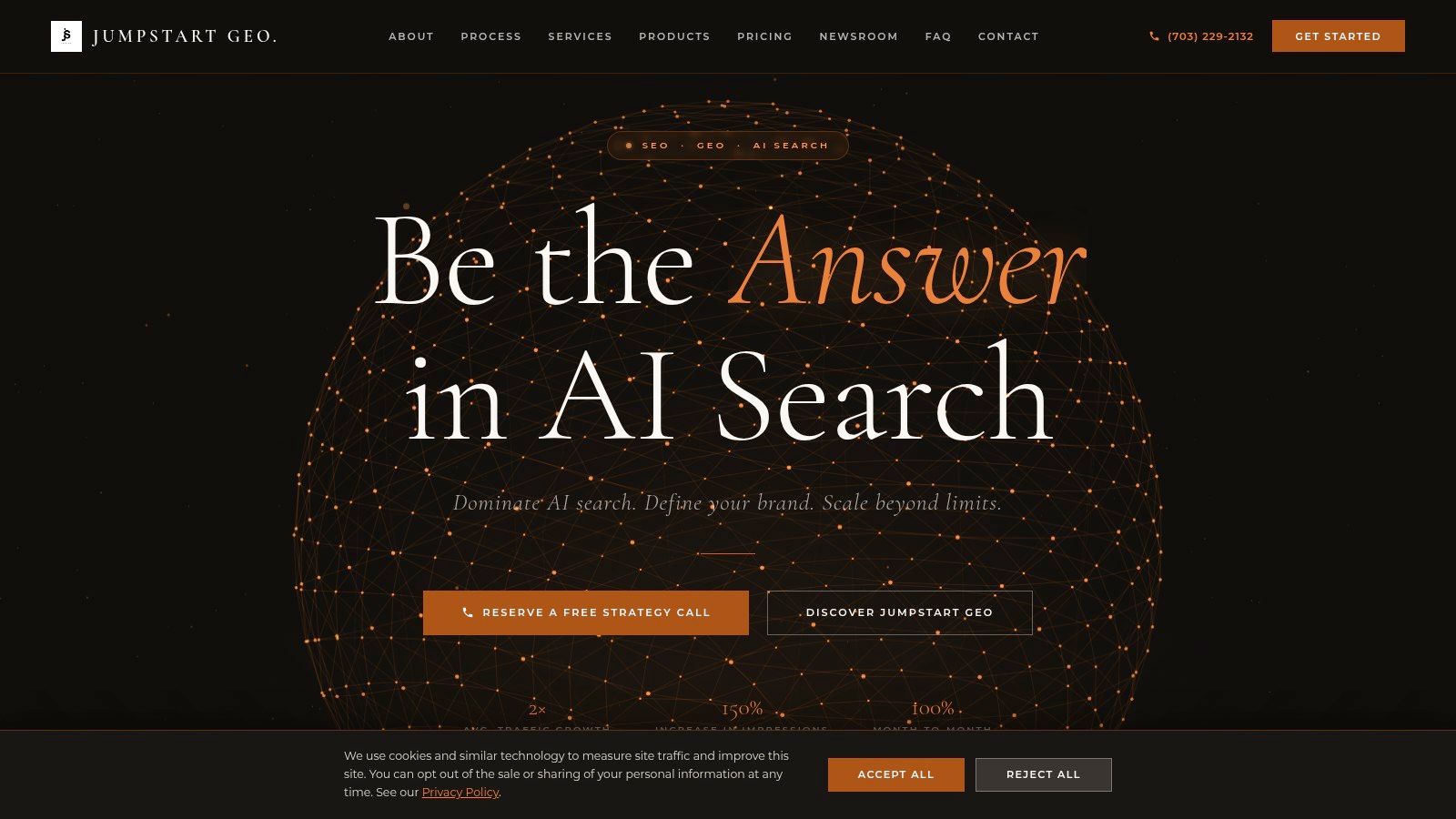
Jumpstart GEO takes a specialist-agency approach. It focuses on getting brands cited and recommended inside ChatGPT, Google AI Overviews, Perplexity, Gemini, Copilot, and Claude rather than presenting GEO as a small add-on to a conventional SEO package.
The buying experience is its clearest advantage. Jumpstart publishes tiered plans, deliverables, and pricing, which removes much of the awkward pre-sale exchange where a team has to explain its entire business before seeing whether the provider fits. The plans range from foundational monitoring to broader authority work, with reporting or a live dashboard depending on the package.
What you get for the commitment
Jumpstart also publishes its methodology and research artifacts, including an AI visibility report and dataset. That gives a prospective client more to inspect than a polished service page. You can judge whether its approach matches your market before committing to a long discovery process.
The limitation is capacity and complexity. A smaller GEO-first shop may be a good fit for a focused brand that needs a clear monthly program, but an organization with many markets, product lines, and approval layers may quickly outgrow an entry package. Public pricing helps with initial comparison, yet the deliverables still need careful review. “Tracking” can mean a recurring report, while another provider may preserve every prompt response and cited URL.
Jumpstart is worth considering when pricing clarity matters as much as specialist knowledge. It makes the shortlist quickly, but ask how much execution is included beyond reporting. For a broader explanation of the discipline, see this guide to how to do generative engine optimization.
3. AI Search Consultancy
AI Search Consultancy is built for companies that need a senior operator to connect technical changes, content, entities, and third-party authority. Its positioning separates GEO from traditional SEO, which can help when internal stakeholders keep treating AI answers as another ranking report.
The service focuses on citation-ready content, structured data, entity consistency, and external authority building. It works across ChatGPT, Claude, Perplexity, Gemini, and Google AI Overviews, with applications for both local and non-local brands. That distinction matters because a local business needs consistent location and service facts, while a national or software brand may need stronger product, category, and author associations.
A consultancy, not a productized checkout
The downside is buying friction. There's no published pricing, so the team has to scope the market, source needs, content workload, and reporting expectations through a call. That isn't automatically a weakness. Senior consulting often needs context before anyone can estimate the work. It does mean you can't compare the service cleanly against a fixed monthly plan at the start.
I'd ask for a written baseline before approving the engagement. It should identify the prompts being tracked, the competitors appearing in answers, the domains being cited, and the actions the consultancy controls. Otherwise, the engagement can drift toward recommendations that your content or PR teams must execute without an agreed measurement loop.
AI Search Consultancy suits a company that wants hands-on strategic involvement and has someone available to implement changes. It's less suitable for a lean team looking for instant self-serve reporting or a fully transparent menu of deliverables.
4. 7aeo
7aeo packages Answer Engine Optimization as a full service rather than a single audit. Its remit covers on-page optimization, off-page authority, content publishing, outreach, and listening across ChatGPT, Perplexity, Google AI Overviews, Claude, and Gemini.
That end-to-end coverage is useful for teams that don't want to separate technical SEO, content production, digital PR, and AI visibility into different vendors. The agency also positions AEO as a layer on top of SEO, which is the sensible operational model. AI systems still need accessible pages, coherent entities, useful evidence, and external signals. A separate AI label won't fix weak fundamentals.
Where the scope needs pressure testing
7aeo starts with a discovery call and a review of current search and AI visibility. That's a reasonable first step, but there are no public case studies or prices on the service page. The buyer has to do more work to understand what the monthly engagement contains and how progress gets reported.
Ask whether outreach is included, how sources are prioritized, and whether the team measures citation quality or only brand mentions. A citation from an independent, relevant source may be more useful than several low-context references. Google describes query fan-out as a process where AI features run related searches across subtopics and data sources before composing an answer. A provider that only checks the original prompt may miss the retrieval paths that create actual citation opportunities.
7aeo is a credible fit for brands seeking combined SEO and AEO delivery. It's not the easiest option for procurement teams that need public pricing or fixed deliverables. For a wider agency comparison, review this guide to the best AEO agency.
5. JenQ Global
JenQ Global approaches GEO through the digital footprint around a brand. The work centers on entities, semantics, citations, machine-readable facts, schema, digital PR, and model visibility analytics. That makes it a strong match for organizations whose problem isn't a lack of content, but inconsistent information across the web.
The agency works across ChatGPT, Gemini, Perplexity, Copilot, Grok, and Claude. Its emphasis on entity grounding and knowledge-graph clarity is particularly relevant for brands with multiple products, locations, names, or overlapping categories. If one page describes a product differently from a partner listing or industry profile, an AI system has more room to produce an incomplete or inaccurate answer.
The authority work matters most
JenQ's “nudge optimization” positioning is aimed at creating quotable assertions and improving the signals models can interpret. The useful part isn't the label. It's the combination of fact engineering, structured knowledge, citation PR, and continued maintenance.
The buying concern is familiar. Pricing isn't public, and an enterprise-style engagement may require substantial onboarding before execution begins. Independent proof is also limited on the service page, so the sales process needs to carry more of the burden. Ask for examples of the source types they prioritize, how they validate third-party claims, and what happens when a cited page is inaccurate or disappears.
JenQ Global makes sense when the brand needs a full-funnel GEO program and can support a longer engagement. It's less appealing for a small team that only needs prompt tracking and a short list of content actions.
6. Anderson Collaborative
Anderson Collaborative brings AEO into a broader marketing-agency environment. Its work includes audits, content improvements, structured data, authority support, and citation tracking through its in-house Rank Prompt platform. The agency tracks ChatGPT, Perplexity, Google AI Overviews, Claude, and Gemini.
The advantage is integration. If your SEO, paid media, analytics, and growth work already sit with one team, AEO can be connected to the wider acquisition picture instead of becoming an isolated dashboard. Monthly reports and scope-based pricing also give larger clients a familiar agency operating model.
A good fit for integrated growth teams
The trade-off is that the service isn't narrowly optimized for teams seeking a boutique GEO specialist. Anderson Collaborative has a wider remit, so the buyer should confirm how much senior attention the AEO work receives and whether the platform is used for active optimization or mainly for reporting.
Pricing is custom and isn't published. That means the proposal needs to specify engines, prompt sets, reporting cadence, source analysis, content work, technical changes, and outreach responsibilities. If the final deliverable is only a report, the agency hasn't solved the operational problem.
AEO works best when it feeds decisions across marketing. Pew Research Center observed that Google users clicked a traditional result in 8% of visits when an AI Overview appeared, compared with 15% when no Overview appeared in its analysis of Google searches from U.S. adults. The result isn't universal across every market, but it explains why an integrated team should measure AI exposure alongside organic clicks rather than treating rankings as the complete picture.
For teams that want broader marketing support, Anderson Collaborative is worth a serious scope review. For a specialist tracking alternative, compare the Llumo AEO services.

7. Kern Media
Kern Media is a founder-led SEO and GEO consultancy for teams that want technical execution tied to buyer prompts. Its approach tracks a defined prompt set by persona and engine, then connects the results to crawlability fixes, content, schema, and entity work.
The specificity is useful. Rather than saying “improve AI visibility,” Kern Media can frame the work around mention rate, competitive presence, cited sources, and prompt-level changes. Its technical scope includes robots rules for AI bots, JavaScript rendering, schema, and indexation. That gives the engagement a practical path when the brand's content exists but engines can't reliably access or interpret it.
Strong detail, limited scale
Kern Media also brings research artifacts and outcome snapshots to the sales conversation. That's more helpful than broad claims because a prospective client can ask how prompts were selected, what counted as a mention, and whether citations were validated.
The main drawback is the consultative buying model. Pricing isn't listed publicly, and a founder-led consultancy may have limited bandwidth for several large enterprise programs at once. The cited prompt-set range in the service description should be treated as a scoping example, not a universal standard. Your own set should reflect buyer roles, markets, commercial intent, and the engines customers rely on.
Kern Media is a good choice for hands-on SEO and AEO work where technical fixes matter as much as content. It may not be the best fit if you need a self-serve platform, many brands managed in parallel, or a large production team.
Top 7 Generative Engine Optimization Services
Service | Implementation Complexity 🔄 | Resource Requirements ⚡ | Expected Outcomes ⭐📊 | Ideal Use Cases 💡 | Key Advantages ⭐ |
|---|---|---|---|---|---|
Llumo | Low–Medium, self-setup to connect provider keys and configure projects. | Low platform cost; you pay third‑party API usage (scales with volume). | Centralized multi‑model visibility, per‑prompt scores, citation tracking. | In‑house SEO/AEO teams or agencies wanting scalable, low‑cost monitoring. | Free core BYOK model, multi‑model coverage, unlimited projects. |
Jumpstart GEO | Low, agency‑managed, fixed monthly deliverables; turnkey execution. | Predictable monthly fees for chosen tier; limited internal lift. | Earned citations/recommendations across prioritized engines. | Teams seeking a GEO‑specialist with transparent pricing and deliverables. | GEO‑first specialist, published methodology, clear pricing. |
AI Search Consultancy | Medium, bespoke consulting with hands‑on senior work and scoping. | Consultant fees (custom); requires stakeholder alignment and input. | Entity alignment, citation‑ready content, improved model recommendations. | Companies wanting senior expertise to separate GEO from SEO strategy. | Clear GEO framing vs SEO; senior, hands‑on delivery. |
7aeo (AEO agency) | Medium–High, end‑to‑end program spanning on‑page, off‑page, outreach. | Full‑service agency costs (scoped); integrates with existing SEO efforts. | Integrated AEO + SEO coverage and increased brand citations across engines. | Brands wanting a packaged AEO program layered on SEO. | Purpose‑built AEO packaging and multi‑engine remit. |
JenQ Global | High, engineering digital footprint, schema and ongoing maintenance. | Enterprise‑style engagement and longer onboarding; sustained investment. | Strong entity grounding, machine‑readable facts, improved model selection. | Enterprises needing knowledge‑graph coherence and continuous maintenance. | Full‑funnel GEO engineering, emphasis on machine‑readable facts and “nudges.” |
Anderson Collaborative | Medium, agency scope with audits plus in‑house tracking platform. | Scope‑based pricing; access to in‑house Rank Prompt reporting. | Audits, structured data fixes, citation tracking and monthly reporting. | Teams wanting AEO integrated with paid media and broader agency services. | Established agency, in‑house platform for ongoing tracking and reporting. |
Kern Media | Medium, technical LLM optimization, prompt tracking and fixes. | Consultative fees; requires technical SEO support for implementation. | Improved AI crawlability, prompt‑mapped content and measurable mention rates. | Practical, technical teams seeking research‑driven GEO execution. | Research‑backed methodology, practical technical fixes and KPIs. |
Shortlist Two, Ask for Scope, and Test Before You Commit
Don't choose a provider because its landing page uses the newest AEO language. Choose the option that can show how the work moves from an observed answer to a controlled action. If a rival appears in a buying prompt, the provider should be able to identify the cited sources, inspect the related searches, assess your own evidence, and recommend work that your team can publish or earn.
Start with two options that match your team size, budget, and operating model. Llumo is the logical self-run benchmark because you can connect provider keys, track prompts and citations, and keep the platform cost separate from response consumption. An agency may be the better choice when you need content, digital PR, technical implementation, or ongoing strategy delivered by people outside your team. The decision depends on whether your bottleneck is measurement or execution.
Ask both providers for a written scope covering engines tracked, prompt volume, response archiving, reporting cadence, citation validation, competitor monitoring, content changes, outreach responsibilities, and what counts as a completed deliverable. Don't accept “improve visibility” as the outcome. Define whether success means a mention, a citation to a relevant page, a stronger share of voice, qualified referral traffic, or a combination of those signals.
Run a short baseline of your key buyer prompts across the engines your customers use before signing anything. Pew Research Center found that 18% of the Google searches in its March 2025 study produced an AI-generated summary, while approximately 58% of respondents encountered at least one summary during that month. The finding reflects that study's browsing panel and search sample, not every market, but it shows why a baseline should include AI surfaces inside established search behavior.
Finally, treat citation quality as part of the result. A large experiment covering approximately 80,000 real-time generative-AI and traditional search results found that clickable references increased trust and willingness to share, even when some references were invalid or broken. A citation that looks persuasive but points to an irrelevant or inaccurate page isn't a durable marketing asset. Test whether the source is correct, relevant, independent, prominent, and still present after prompt variations and model changes.
Llumo gives SEO, content, and growth teams a practical way to track mentions, share of voice, query fan-out, competitors, and cited pages across major answer engines without a separate platform license for its core product. Connect your own provider keys, establish a baseline, and use the findings to guide content and authority work. Start measuring the gap between being recommended and being ignored with Llumo.