
You're probably seeing some version of this right now. A page ranks well, earns links, and brings in steady search traffic, yet when someone asks ChatGPT, Gemini, Perplexity, or Google AI Overviews the exact question that page answers, your brand barely shows up. Or it gets cited once, without shaping the answer in any meaningful way.
That gap is where teams get stuck. They treat generative engine optimization like SEO with new labels, then wonder why broad rewrites and keyword work don't change much. In practice, how to do generative engine optimization comes down to a different operating model. You're not trying to rank a page in a list. You're trying to get selected as a source, then get your evidence, wording, and framing absorbed into the answer.
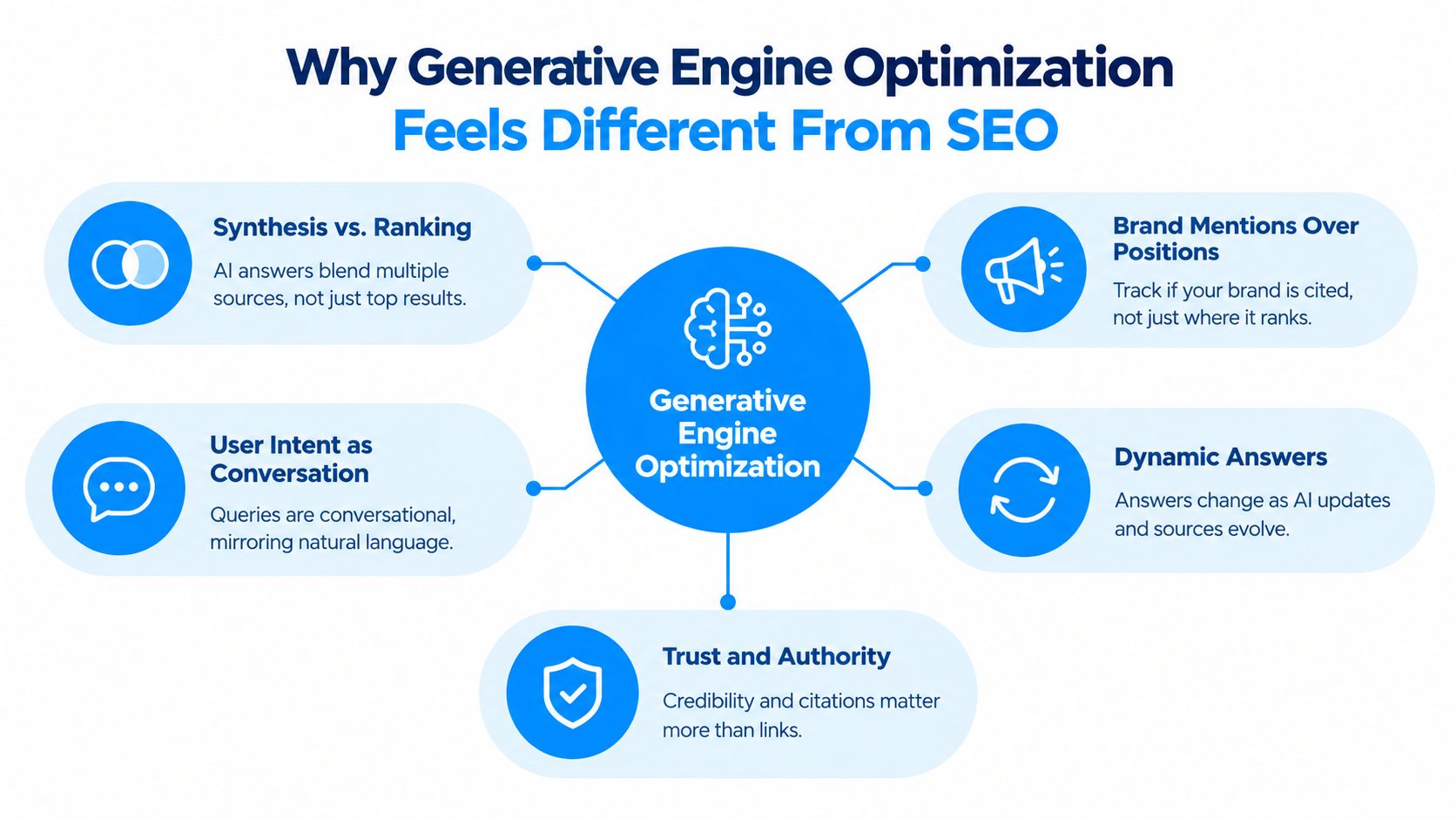
Why Generative Engine Optimization Feels Different From SEO
A lot of frustration with GEO starts with the wrong scoreboard.
In classic SEO, a high rank usually gives you a clear line of sight. You can see position, CTR, sessions, and conversions. In AI answers, the path is messier. A page can rank well and still be absent from the answer layer. It can also show up in citations even if it isn't dominating the SERP.
Visibility now means selection and absorption
The most useful mental model I've found is to split GEO into two jobs.
The first job is citation selection. That's the moment the system decides your page is worth pulling in as a source. The second is citation absorption. That's when your page contributes language, evidence, structure, or factual support to the final response. A GEO measurement framework formalizes that split and shows why it matters operationally: a page can be selected without visibly shaping the answer, and a page can influence the answer more than the citation display suggests, as outlined in this research on citation selection and citation absorption.
Practical rule: If you only track whether you were cited, you'll miss whether your content actually influenced the answer.
That's why rank tracking alone doesn't cut it. Traditional tools won't tell you whether your product category definition got reused by Gemini, whether Perplexity sourced your comparison framework, or whether Google AI Overviews cited a competitor page that doesn't even rank top ten for the head term.
AI answers break the old click assumptions
There's also a traffic reality people don't like talking about. Winning the citation doesn't guarantee the click.
Independent studies cited by Ahrefs show the risk is real: AI Overviews were associated with a 34.5% lower CTR for the top-ranking page in a 300,000-keyword sample, and later reporting showed a 58% CTR drop for position-one content. Pew found that when an AI Overview appears, users click a traditional result 8% of the time versus 15% without one. Ahrefs also highlights that AI Overviews now appear on a substantial share of queries, with reported observations including 41% and 43% of searches, while outbound organic clicks fall around 40% when triggered, as summarized in Ahrefs' analysis of AI Overviews and click decline.
So the game isn't just “get mentioned.” It's “get mentioned in a way that still creates demand, preference, and visits.”
If you need a clean baseline on the broader discipline, Llumo's overview of answer engine optimization is a useful primer. But in day-to-day work, the shift is simple. You stop asking “Where do we rank?” and start asking “Which prompts select us, which answers absorb us, and which citations still send users our way?”
What doesn't work anymore
Three habits carry over poorly from SEO-first thinking:
Broad rewrites without diagnosis usually waste time. If the issue is missing evidence or poor passage extraction, more copy won't help.
Head-term obsession misses how models expand prompts into related sub-questions.
Single-model checks create false confidence. A page can surface in one engine and disappear in another.
That's why GEO needs prompt-level measurement. Not vague “AI visibility,” but saved prompts, archived responses, citation logs, and side-by-side model comparisons.
Audit How AI Answers See Your Brand Today
Before changing content, run a baseline audit. Keep it lean. You don't need a giant dashboard on day one. You need a prompt set, a response archive, and a way to compare what each model says about you versus everyone else.

Start with a prompt set that reflects buying behavior
Auditing the wrong prompts is a common mistake. Picking a few vanity terms, asking one model once, and calling it research tells you almost nothing.
Build a set of prompts from actual buyer language. Include:
Comparison prompts like best tool for a use case, vendor vs vendor, or alternative-style questions
Definition prompts where the model explains a category, workflow, or concept
Problem-solution prompts where the user describes a pain point without naming vendors
Validation prompts such as “is X worth it for Y” or “what should I look for in Z”
Implementation prompts where users ask how to do the work itself
Keep the wording natural. AI systems respond differently to “best enterprise CRM” and “what CRM is good for a mid-market sales team with a long buying cycle.”
Log each answer like an analyst, not a browser user
For every prompt, capture the full response in each model you care about. Save the date, prompt text, model, brands mentioned, cited domains, and the exact wording around your brand if it appears.
A basic spreadsheet works at first. For larger teams, use a tracker that stores responses over time and lets you tag by intent, geography, funnel stage, or product line. The important part is consistency. You want to spot patterns, not collect screenshots forever.
A useful audit record includes:
Prompt and intent tag
Model used
Whether your brand was mentioned
Whether your site was cited
Which competitors appeared
What sources were used
What subtopics the answer covered
What looked missing or weak
A clean prompt archive becomes your changelog. When visibility shifts, you can compare language, citations, and source substitutions instead of guessing.
Look for fan-out clues in the answers
This part matters more than expected. AI systems often expand one user question into several related searches or sub-questions. You can infer that fan-out from the answer itself.
If a prompt about “best onboarding software” keeps producing sections on setup time, integrations, security, templates, and employee adoption, those are likely subtopics feeding source retrieval. If your page only covers one of those cleanly, you're asking to lose citations to a competitor with broader passage coverage.
Audit for:
Repeated subtopics across multiple answers
Cited domains that win across different prompt phrasings
Competitors cited for angles you don't address
Prompts where your brand is known but your site isn't sourced
Prompts where your site is cited but your framing doesn't appear in the answer
Build a practical baseline
You should leave the audit with a short list, not a giant research deck.
Use these buckets:
Present and shaping the answer
Present but weakly absorbed
Absent despite relevant content
Absent because no page fits
Beaten by a competitor with better evidence or structure
If you want to operationalize this across prompt sets and models, tools in this category can help. That includes trackers that log prompt-level visibility, competitor mentions, and citation sources over time, such as Llumo for multi-model monitoring. But the method matters more than the software. A good audit gives you a baseline you can revisit every month without rebuilding it from scratch.
How AI Engines Choose and Use Sources
The pages that win citations usually don't just “cover the topic well.” They answer several related sub-questions clearly, in passages that are easy to retrieve and reuse.
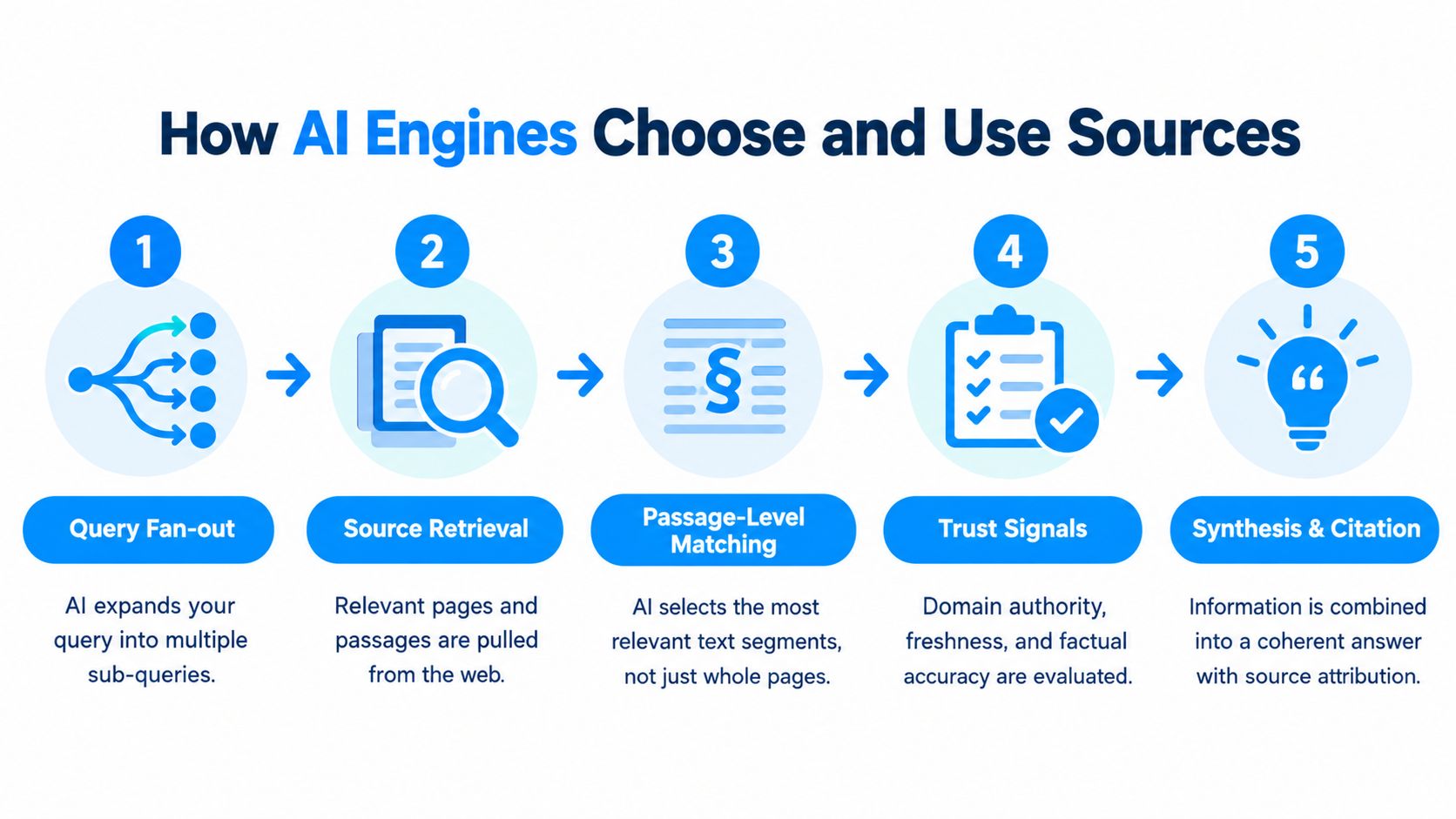
Google AI Overview source-selection explanations consistently emphasize query fan-out and passage-level matching, not page popularity alone. In that model, the system decomposes a search into sub-queries, retrieves documents for each, then ranks passages by semantic relevance and trust signals before assembling citations, as explained in this breakdown of how Google AI Overviews work.
Query fan-out changes what a good page looks like
This is why one strong page often beats several thin ones.
A user asks one question. The engine branches it into several narrower checks. It may look for definitions, examples, comparisons, steps, objections, and supporting evidence. If your page answers only the headline query but ignores those side angles, it's fragile in AI retrieval.
One independent analysis found that only 37.9% of AI Overview citations came from pages already ranking in the top 10, down sharply from about 76% a year earlier. The takeaway is clear: AI Overviews don't mirror top organic rankings, and query fan-out increasingly shapes source choice, according to this analysis of AI Overview citation patterns.
Passage quality matters more than page prestige
A lot of teams still optimize at the page level only. They ask whether the article is thorough, whether the title is strong, whether the domain is authoritative. Those factors still matter, but they don't explain why one paragraph gets reused and another gets ignored.
What tends to work better:
Direct answer blocks near the top of a section
Passages that define terms without fluff
Tightly grouped evidence, where a claim sits beside its support
Subsections that can stand alone if extracted from the full page
Coverage of adjacent subtopics inside the same document
What tends to underperform:
Long scene-setting intros
Opinion-heavy sections without support
Buried definitions
Thin comparison tables with no explanation
Pages split into too many separate URLs with overlapping intent
If you want to get better at reading why one passage was selected over another, this guide to reading the citations behind an AI answer is worth keeping around. It's easier to improve source selection once you've trained yourself to inspect the answer at the passage level.
The winning unit in GEO often isn't the page. It's the paragraph cluster that answers a sub-question clearly enough to be lifted into synthesis.
Structure for reuse, not just reading
Write for humans first, but structure for extraction.
That means each important section should answer a real sub-question in plain language, then support it with evidence, specifics, and examples. If a model lifts only that section, the passage should still make sense on its own.
Many “good SEO pages” fail GEO. They're useful when read top to bottom, but weak when sampled in pieces.
Make Small Precise Fixes That Earn Citations
Most GEO gains don't come from rewriting everything. They come from repairing the exact reason a page wasn't usable as a source.
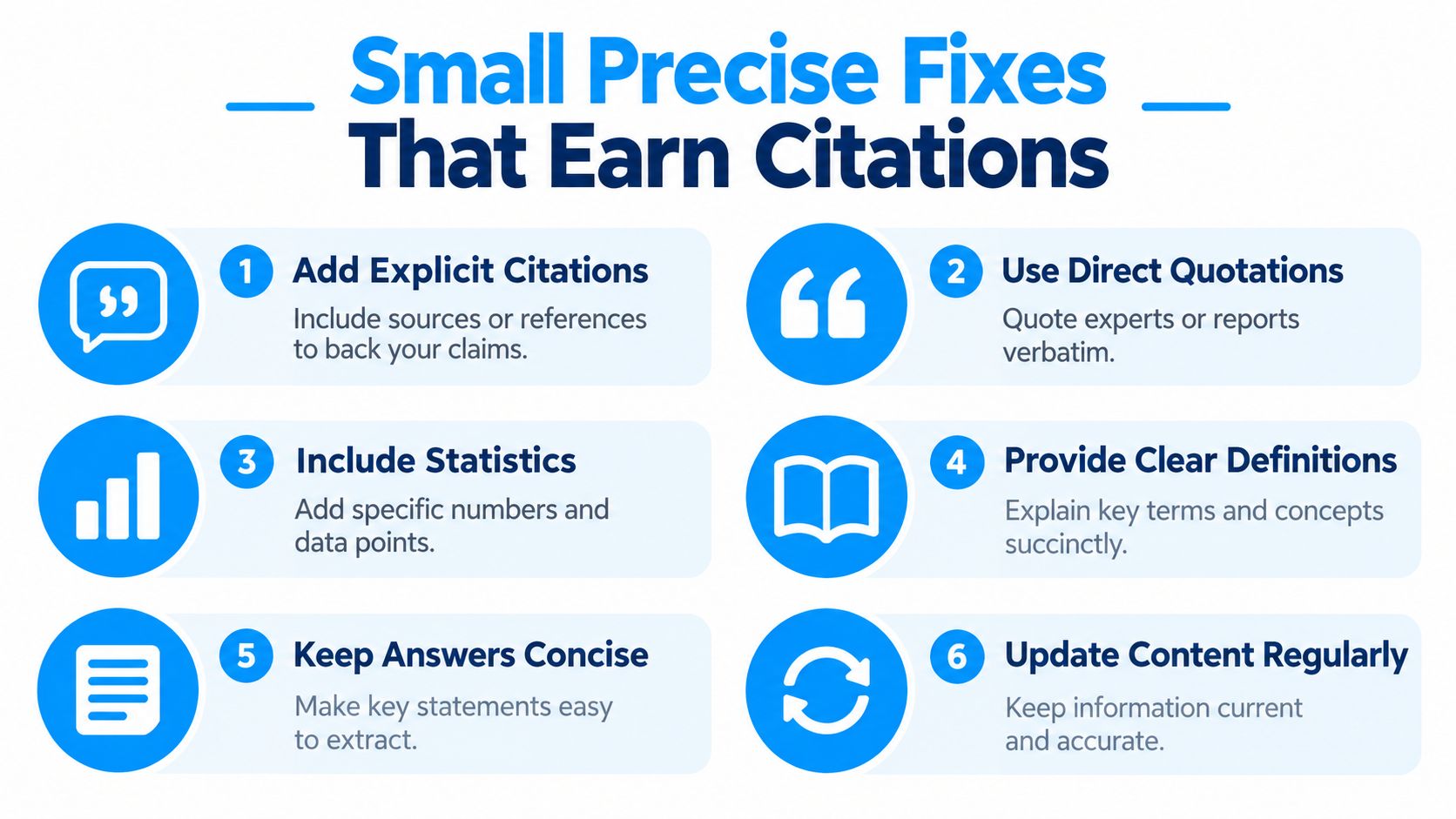
A controlled GEO benchmark found that adding citations, direct quotations, and statistics to source content produced about a 30–40% relative improvement on a visibility metric, with the strongest methods named as Cite Sources, Quotation Addition, and Statistics Addition, according to the original GEO benchmark paper.
Start with failure diagnosis, not copy expansion
When a page misses citations, the cause is usually one of a few things:
The answer is implied, not stated
The evidence is missing
The page covers the topic, but not the sub-question
The useful section is too buried or too wordy
The passage can't stand alone when extracted
A competitor has a cleaner, more quotable block
Practitioners waste the most time here. They assign a full rewrite because a page “feels thin,” when the problem is that the claim isn't explicit enough to cite.
The edits that actually move things
A later diagnostic system for GEO reported over 40% relative improvement in citation rates while changing only 5% of content, compared with 25% for baselines. The method was to diagnose why a page failed to be cited, apply targeted repairs from a failure taxonomy, and iterate until citation occurred, as described in this diagnostic GEO research paper.
That's the model I'd follow. Make fewer edits, but make them sharper.
Here are the repairs I use most often.
Add explicit evidence where the model expects it
If a section makes a claim, back it up in the same passage. Don't force the system to connect a vague sentence in one paragraph to a supporting reference somewhere else on the page.
Good repair moves include:
Adding a cited sentence after a broad claim
Turning “many teams do X” into a specific, sourced statement
Placing supporting evidence directly under the section header
Replacing generic summaries with named methods or frameworks
Field note: Evidence density beats article length more often than teams expect.
Create quotable blocks
Models like clean extraction targets. Give them some.
That can look like:
a short definition paragraph
a crisp “when to use this” explanation
a tight comparison of two approaches
a short quote block from a credible source
a bullet list with clear, non-overlapping items
Here's a before-and-after pattern that works well.
Before:
A long paragraph says companies should align content with user intent, authority, freshness, and structure, then circles through a few examples.
After:
A short opening sentence defines the principle. The next sentence names the specific criteria. A third sentence adds evidence or a reference. Then a bullet list breaks out the implications.
That second version is easier for both humans and models to reuse.
Tighten definitions and answer blocks
If you're targeting a category term, process, or capability page, add a clean definition near the top. Then follow it with the common sub-questions buyers ask.
A workable pattern looks like this:
Definition first. One short paragraph that answers “what is it?”
Use case next. Who needs it and when?
Decision criteria. What distinguishes one option from another?
Proof layer. Evidence, references, examples, or direct quotes.
Objections. What makes buyers hesitate?
This short explainer on AI citation tracking is useful if you need a better feel for what to monitor after these edits go live.
A quick walkthrough helps here:
Don't over-optimize the page into something unreadable
There's a bad version of GEO where teams stuff every section with awkward source references, robotic questions, and chopped-up mini paragraphs. That may increase extractability for a moment, but it usually weakens the page for actual buyers.
The balance is simple. Keep the argument human. Make the evidence explicit. Place your clearest answer where a retrieval system can find it without effort.
Build Your Prioritized Testing and Roadmap
Once you've audited prompts and repaired weak pages, the next problem is sequence. Teams usually have too many candidate fixes and not enough time. You need a roadmap that rewards small wins first, then expands into bigger content bets.
Score opportunities by impact, effort, and coverage
I like a plain matrix because it forces trade-offs.
Opportunity | Expected Impact | Effort | Priority |
|---|---|---|---|
Add citations, quotes, and supporting evidence to already-relevant pages | High | Low | High |
Rewrite weak opening sections so they answer the target prompt directly | High | Low to Medium | High |
Expand pages to cover missing sub-questions found in prompt fan-out | High | Medium | High |
Consolidate overlapping thin pages into one stronger source page | Medium to High | Medium | Medium |
Create net-new pages for prompt gaps where no relevant asset exists | Medium to High | Medium to High | Medium |
Rebuild an entire content hub without prompt-level evidence of need | Unclear | High | Low |
This keeps the team from burning a month on a big editorial project when a few targeted repairs could shift citations faster.
Test at the prompt level
GEO work gets sloppy when people test pages instead of prompts.
A page may improve for one class of question and still fail everywhere else. So tie every content change to a set of prompts. Re-run those prompts across the same models, save the responses, and compare:
whether your brand is mentioned
whether your page is cited
whether the answer wording now reflects your framing
whether a competitor lost ground
whether source substitution happened
The original GEO research showed visibility lifts of up to 40% from specific edits such as quotations, statistics, and source citations, while later academic discussion argued the field is still an evolving optimization layer rather than a settled ranking system. That's one reason I prefer ongoing testing to one-time “AI optimization” claims, as summarized in this roundup on GEO measurement and volatility.
Tag prompts so trends mean something
Don't throw every query into one bucket. Tag them.
Useful tags include:
Intent type such as informational, comparative, evaluative, or implementation
Audience such as SMB, enterprise, technical buyer, or executive
Product line
Market or language
Model family
Prompt theme such as pricing, alternatives, migration, setup, compliance
This is how you find model-specific drift. Sometimes your pages are fine, but one engine starts favoring different domains, different subtopics, or more direct evidence.
Set a review cadence you'll actually keep
A simple operating rhythm works better than an ambitious one nobody follows.
Try this:
Weekly: review newly tested prompts and obvious citation wins or losses
Monthly: compare share of voice and citation changes by prompt cluster
Quarterly: revisit prompt sets, retire low-value ones, and add new buyer language
You don't need perfect attribution. You need a stable prompt set, disciplined reruns, and enough history to see whether your edits changed source selection.
That's what turns GEO from a side project into a repeatable system.
Keep Your Visibility Resilient as AI Answers Evolve
Getting cited is useful. Keeping that visibility, while still earning visits and demand, is the harder part.
The mistake I see most often is treating AI answer inclusion as the finish line. It isn't. A synthetic answer can absorb the click, flatten brand differences, and leave your site with less traffic even when your content informed the response. That's why resilient GEO work includes click protection, not just citation wins.
Build pages that still earn the visit
Three things help here.
First, make your pages visibly distinctive. Clear frameworks, named methodologies, strong examples, and recognizable brand language give users a reason to click through when they see your citation.
Second, tighten the on-page answer layer. If your page opens with a strong definition, a practical comparison, or a memorable framework, the model is more likely to preserve your framing instead of reducing you to a generic source.
Third, watch for source substitution. If another page starts answering the same sub-questions with cleaner evidence or sharper passage structure, you can lose absorption before you notice traffic shifts.
A monthly review checklist that holds up
Keep this simple enough to repeat:
Re-run core prompts across the models that matter to your buyers
Check new and lost citations at both domain and page level
Inspect answer wording to see whether your framing still shows up
Review prompt clusters where competitors are gaining share
Refresh high-value pages when evidence, examples, or definitions feel stale
The teams that do well with GEO don't treat it like a campaign. They treat it like search governance for a new answer layer.
If you were looking for a shortcut, there isn't one. But there is a workable path. Audit prompts. Separate selection from absorption. Fix passages, not just pages. Then keep measuring the shifts that matter.
Llumo helps teams measure this work where it happens: at the prompt level across AI answer engines, with visibility, citations, competitive mentions, and trend tracking in one place. If you want a clearer view of which prompts select your brand, which sources shape answers, and where to focus next, visit Llumo.