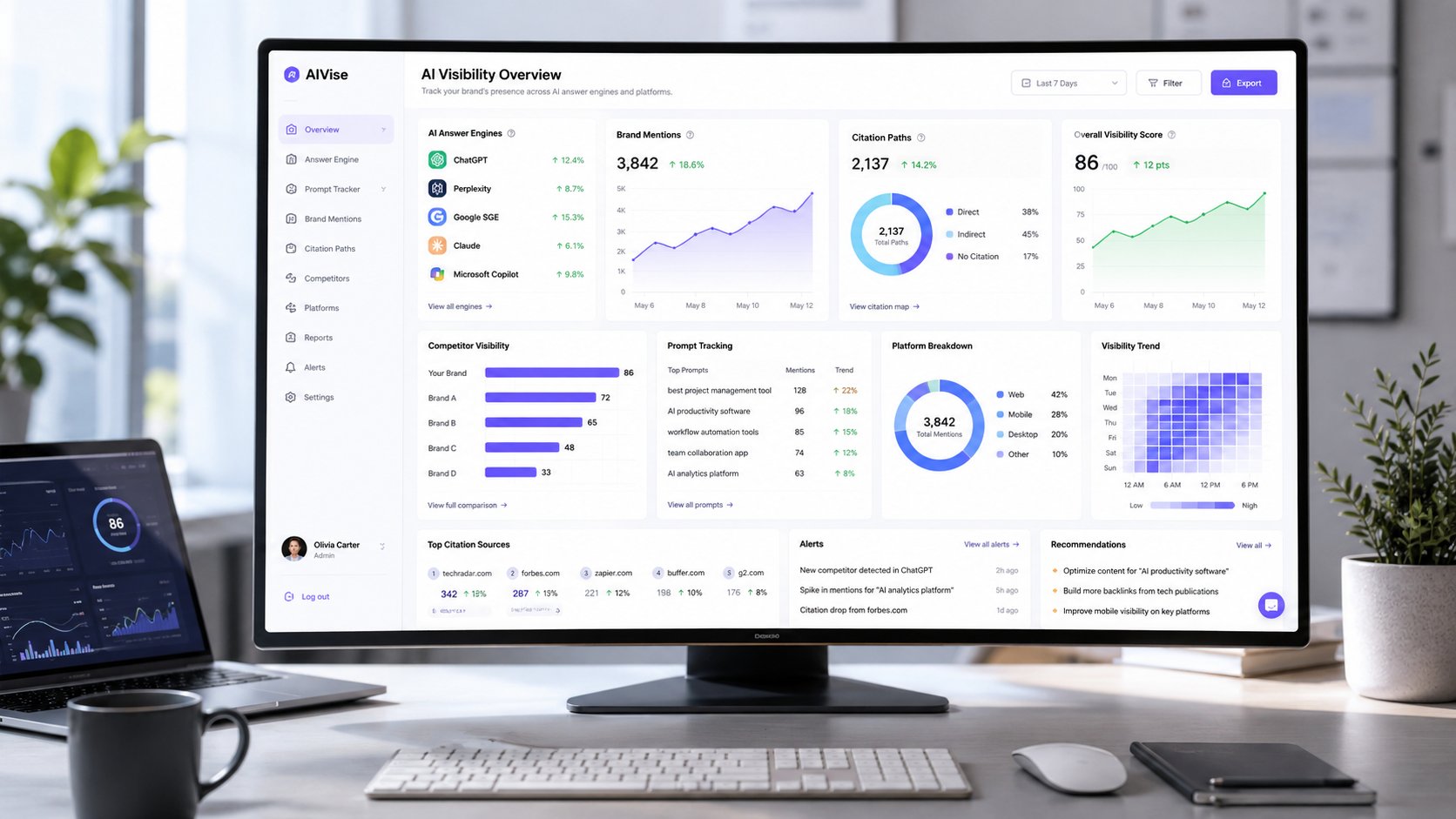

58% of U.S. adults encountered at least one search query with an AI-generated summary in March 2025, and AI visibility measures whether your brand appears inside those answers, not merely whether your page ranks. The three signals to watch are mentions, citations, and the generated queries that AI systems use to build a response.
You may already know the uncomfortable version of this problem. A colleague asks ChatGPT or Gemini to recommend a product in your category, and your brand is missing. Your SEO report still shows strong rankings, your content team has published consistently, and your analytics account looks normal. Yet the answer a potential buyer reads contains a competitor instead.
That gap is what AI visibility describes. It's the measurable presence of a brand, organization, product, or source inside answers produced by AI-powered search and conversational systems. The question isn't only whether your page ranks. It's whether an AI system mentions your brand, describes it accurately, recommends it, or cites your website as evidence.
Why AI Visibility Is a New Discipline
Traditional SEO gives you a familiar scoreboard. You can track a query, a ranking position, a result page, and the click that follows. AI answers change the shape of that journey. A chatbot, Google AI Overview, or AI Mode may combine information from several pages and present one synthesized response before the user decides whether to visit a website.
A marketer might therefore see two different realities. Their product page ranks well for a conventional query, but an AI answer recommends another provider. Or the brand appears in the answer, but the model attaches a source that doesn't support the description. Ranking is still useful, but it no longer describes the whole discovery experience.
Practical rule: Treat an AI answer as its own search surface, not as a decorative layer on top of a results page.
AI visibility has several dimensions:
Presence: Does the answer mention the brand at all?
Position: Is the brand prominent, or buried among alternatives?
Representation: Does the answer describe the offer accurately and favorably?
Evidence: Does the system cite a relevant page or domain?
Coverage: Does the brand appear across the prompts and markets that matter?
The audience for these answers is already broad. A Pew Research Center analysis of web browsing data found that 58% of 900 U.S. adults encountered at least one search-engine query producing an AI-generated summary in March 2025. The same research found that 65% encountered an AI reference somewhere on a results page, while only 13% visited an AI chatbot website during the month. That last figure matters because visibility doesn't live only inside standalone chatbots. It also appears inside conventional search interfaces.

The practical shift is from asking, "Where do we rank?" to asking, "How does an answer engine represent us when someone asks a relevant question?" That makes AI visibility closely related to Answer Engine Optimization, but the two ideas aren't identical. AEO describes the work of improving your chances of appearing in answers. AI visibility describes the measurement of what happened.
The Retrieval-to-Citation Funnel Explained
Think of an AI answer as the work of a librarian and an editor. The librarian searches a large collection and selects potentially useful documents. The editor reads some of those documents, writes a concise answer, decides which sources deserve attribution, and may still fail to represent one source correctly.
That process creates a retrieval-to-citation funnel. Each stage can lose your brand, which is why a conventional ranking report can't diagnose every failure.
Five stages from eligibility to evidence
First, retrieval eligibility. A retriever searches an external index and selects candidate passages or pages. If your page isn't indexed or relevant to the system's search, it may never enter consideration. Google states that pages must be indexed and eligible to appear in Search to be used as links in its AI features, so crawlability and indexation remain basic prerequisites.
Second, context inclusion. The system passes some retrieved material into the language model's context. A page can be found but excluded from the context used for generation. This is the first important distinction between being discoverable and being visible in the final answer.
Third, brand mention. The model synthesizes its response and may name your company, product, or source. It might also describe your category without naming anyone. At this stage, a competitor can appear even when your page was among the retrieved candidates.
Fourth, citation selection. The answer engine chooses whether to attach a source link and which page to display. A mention without a citation gives you recognition but not visible evidence. A citation without a meaningful mention can send a user to your page while giving the brand little prominence.
Fifth, claim support. The cited page should support the statement beside it. A source can be relevant to the topic but fail to substantiate the exact claim. That distinction matters for brand accuracy, compliance, and trust.
A 2024 analysis of retrieval-augmented answer systems found that the systems studied retrieved an average of 4.31 sources but cited only 3.0 in the final response, as reported in the analysis of retrieval and citation behavior. Retrieval therefore isn't the same as attribution.

You can inspect this funnel in responses from ChatGPT, Perplexity, and Gemini, although each interface exposes different evidence. A response archive that preserves the prompt, answer text, cited URLs, and extracted claims gives your team something concrete to review instead of a single opaque score. Reading the citations behind an AI answer becomes a diagnostic exercise, not a guessing game.
The Three Core Signals You Need to Track
Most visibility dashboards eventually answer three questions. Did the brand appear? Which sources supported the answer? What searches did the system run underneath the user's prompt?
A mention is the simplest signal. It tells you that the model included the brand in its generated response. But a mention can be brief, outdated, inaccurate, positive, neutral, or negative. Counting mentions without reading their surrounding language can turn a useful measure into a vanity metric.
A citation is more specific. It shows that the system attached a source link to a portion of the answer. Citation analysis should identify the domain and page, then check whether the page supports the associated claim. A brand can be mentioned without a citation, cited without being named prominently, or cited through a page that doesn't explain the product being discussed.
Generated queries reveal the hidden retrieval path. Google documents that AI Overviews and AI Mode can use query fan-out, issuing related searches across subtopics before composing a response. Gemini's search-grounding documentation also describes generated search queries, resulting citations, and annotations attached to portions of generated text. These records help explain why an answer included one source and ignored another.
Signal | What it tells you | Where you see it |
|---|---|---|
Mention | Whether and how the model represents your brand | Generated answer text and response archives |
Citation | Which page or domain the system uses as evidence | Inline links, URL annotations, and cited-source reports |
Generated query | How the system expanded the prompt to retrieve information | Grounding-query logs and provider response fields |
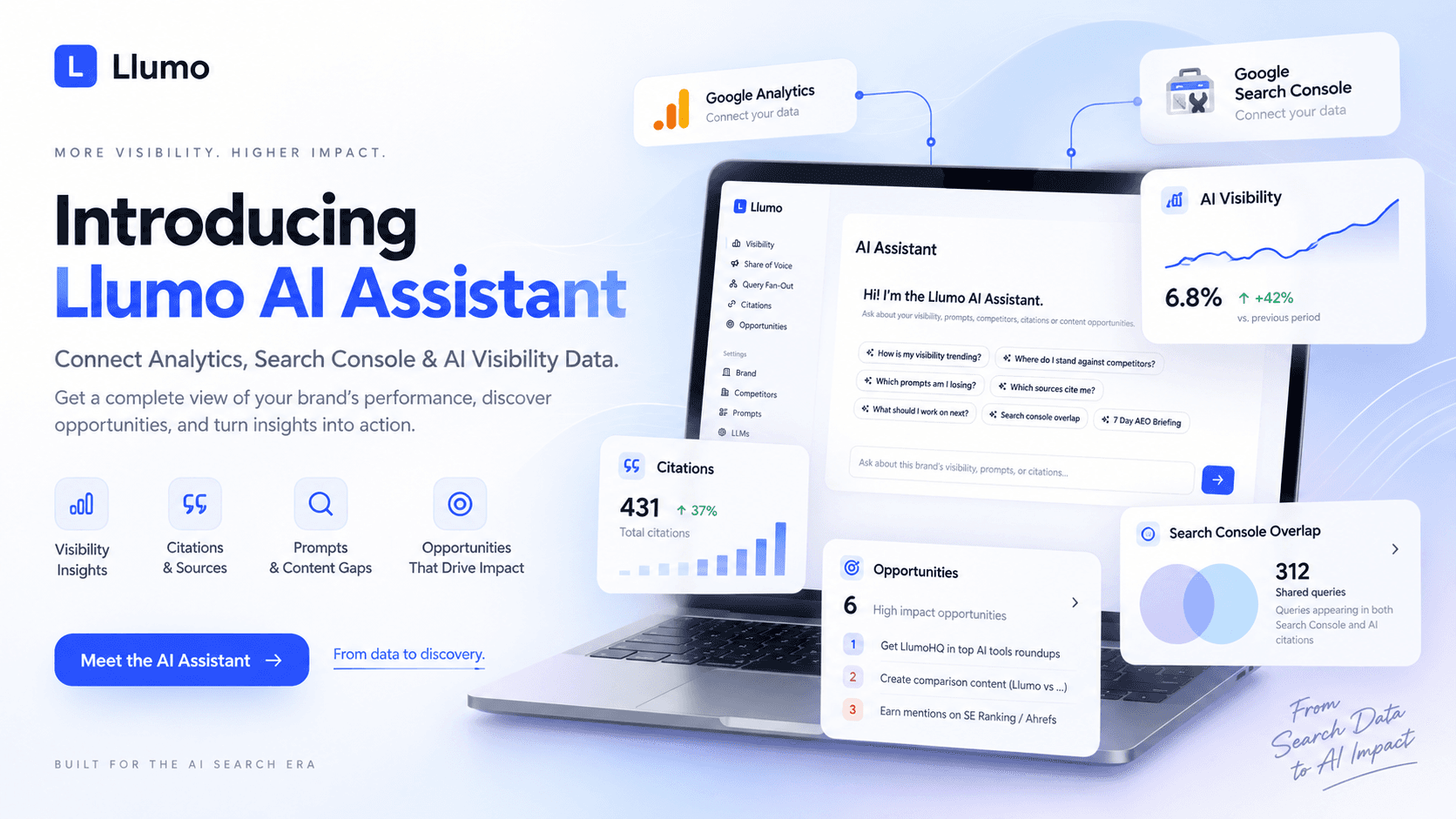
For a practical review, start with the raw response rather than a blended score. Highlight every brand mention, record the exact cited page, classify the claim as supported or unsupported, and capture the generated queries when the provider exposes them. A per-prompt archive, such as the type used in Llumo dashboards, makes those observations comparable over time.
The three signals answer different operational questions. Mentions guide brand and message monitoring. Citations guide content and digital PR work. Generated queries reveal the missing subtopics that your existing prompt list may never have included.
Why Query Fan-Out Changes the Unit of Analysis
A user may enter one question, while an answer engine divides it into several retrieval tasks. A request for the right CRM for a mid-sized B2B company with a long sales cycle could lead to searches about B2B CRM platforms, mid-market solutions, long-cycle customer management, implementation, and comparisons.
That process is query fan-out. Google describes AI Overviews and AI Mode as using related queries across subtopics before retrieving relevant pages from the Search index to ground a response. Gemini documentation also exposes generated search queries and citations. The intermediate retrieval layer therefore becomes something a team can inspect and measure. For a closer explanation, see how query fan-out works.

The unit of analysis must become more specific. A broad-prompt visibility score can conceal the point where your brand disappeared. Your company may appear for the main question, then vanish from the implementation subquery. A competitor can earn the citation by publishing a narrow, well-supported page that answers that part of the buyer's need.
The actionable path is prompt, subquery, citation. A score shows that visibility changed. The path shows what to fix.
Record four elements whenever the data is available:
The original prompt: Preserve its exact wording, market, language, and model.
The generated queries: Capture the subtopics used to retrieve supporting evidence.
The winning sources: Compare domains and pages that recur across responses.
The unsupported gaps: Identify questions the answer addresses without a strong source from your brand.
Two models can produce different source mixes for the same prompt because their indexes, retrieval choices, ranking systems, and citation behavior may differ. Treating them as one search engine creates false precision.
A prompt archive with fan-out logging turns “we lost visibility” into a usable diagnosis: “we are absent from the implementation subquery, while a competitor owns the citation.” That finding can guide a content update, comparison page, product explanation, or evidence-building effort.
Why Visibility and Traffic Are Not the Same Thing
A citation can be valuable without producing a click, but that doesn't make every citation a business success. AI visibility is an exposure signal, not a revenue report. Teams that treat citation frequency as a direct proxy for acquisition risk investing heavily in appearances that never influence a decision.
Pew's analysis of nearly 69,000 Google searches from 900 U.S. adults found that conventional-result clicks fell from 15% when no AI Overview appeared to 8% when one did. Clicks on links inside the AI Overview occurred only 1% of the time, according to the reported findings on AI Overview click behavior.
Those figures don't prove that visibility has no commercial value. They show that the path from exposure to measurable referral traffic is narrower than many dashboards imply. A person may remember a recommended brand, search for it later, visit directly, ask a colleague, or convert through an offline sales process.

Separate the outcomes instead of collapsing them into one KPI:
Mention without citation: The brand appears in the answer, but the user receives no direct source link.
Citation without click: The brand earns an evidence link, but the user stays inside the answer interface.
Referral visit: The person follows the citation and arrives on the website.
Assisted conversion: The exposure influences a later branded search, direct visit, sales conversation, or offline decision.
The last-click model is poorly suited to the fourth outcome. It can record the final visit while missing the earlier answer that introduced the brand. A more defensible measurement setup pairs prompt-level visibility with branded-search changes, direct traffic, assisted conversions, and post-exposure surveys. It won't produce perfect attribution, but it gives leaders a more honest view of influence.
The tradeoff is important. Improving citation frequency alone may improve representation while organic traffic declines because the answer engine satisfies the user before the click. Measure the exposure, the referral, and the downstream behavior separately.
How Teams Actually Measure AI Visibility
A spreadsheet audit is a sensible starting point. Choose the prompts that matter, run them across the surfaces your audience uses, and record the answer, mentions, citations, competitors, and obvious accuracy issues. Manual checks are inexpensive and useful for learning, but they become inconsistent as prompt coverage and review frequency grow.
Traditional rank trackers solve a different problem. They remain valuable for conventional search visibility, yet they won't reliably capture whether ChatGPT recommends your brand, whether Gemini cites a product page, or which source appears in a Google AI Overview. Adding AI answers to an old rank report can also obscure the difference between a position and a generated representation.
Dedicated AEO platforms automate prompt execution, response storage, citation extraction, and competitive comparisons. They can examine many models and surfaces, but teams should inspect how each provider defines a response, handles personalization, records citations, and exposes raw evidence. Coverage matters more than a polished score if you can't trace the score back to an answer.

The economics also change at scale. OpenAI's published pricing lists web search at $10 per 1,000 calls, with search-content tokens billed at applicable model rates. It also lists web-search-preview at $10 per 1,000 calls for reasoning models and $25 per 1,000 calls for non-reasoning models, while noting that API charges are separate from ChatGPT subscriptions. See the OpenAI API pricing documentation for the provider's current terms.
A bring-your-own-keys model, used by platforms such as Llumo, places provider consumption costs with the customer rather than hiding them inside a bundled license. That can make response-based budgeting clearer, provided the team tracks model calls, search calls, and token usage.
Before choosing a measurement stack, ask:
Does it cover the AI surfaces and markets that matter to your audience?
Can you inspect the full prompt, response, citations, and generated queries?
Does it compare your brand with a defined competitor set?
Are provider consumption costs visible and controllable?
Can the findings create specific content, technical, or digital PR actions?
First Steps for Building Your AI Visibility Practice
Start small enough to learn the system, but structured enough to create a baseline. Write down the ten prompts that matter most to your category, including discovery questions, comparison questions, recommendation questions, and prompts that describe the problem your product solves.
For each prompt, save the exact response and mark the following:
Brand presence: Record whether your brand appears and how prominently.
Message accuracy: Note what the answer gets right, omits, or misstates.
Source evidence: Capture every cited domain and page.
Competitor presence: List the brands that appear beside or instead of yours.
Actionable gap: Identify the missing page, proof point, or subtopic.
Don't change prompts casually. Exact wording affects the answer, so a baseline only becomes useful when future tests preserve the original inputs. Repeat the same checks across the models and answer surfaces that your customers use, then add new prompts when sales calls or support conversations reveal fresh questions.
Once the baseline is stable, move from presence to competitive share of voice. Define the competitor set before you measure it, and keep the comparison consistent across markets. A visibility percentage without a clear prompt set and competitor set can sound precise while hiding a weak sample.
The next layer is action. If a competitor repeatedly earns citations for implementation questions, improve or create content that answers those questions directly. If models describe your product inaccurately, strengthen the pages that define the product, terminology, use cases, and supporting evidence. If your pages are retrieved but rarely cited, inspect their structure, specificity, freshness, and claim support.
AI visibility rewards the same discipline that made classic SEO durable: clear priorities, controlled inputs, evidence-based content, and repeated measurement. The difference is that the outcome isn't a blue-link position. It's the answer a person reads before deciding what to do.
Llumo tracks AI visibility across answer surfaces by preserving per-prompt responses, mentions, citations, competitors, and query fan-out data in one workspace. Visit Llumo to connect your measurement process to the prompts and sources that shape AI answers about your brand.