
Answer Engine Optimization (AEO) is the practice of optimizing content to be mentioned and cited in AI-generated answers from ChatGPT, Gemini, Perplexity, and Google AI Overviews, rather than focusing only on ranking blue links. The field became measurable when the foundational GEO research found that adding 2–3 well-placed statistics increased citation rate by a relative 41%, while direct quotations from named experts increased it by 28% (GEO paper summary).
You've probably seen the shift firsthand. You ask an AI tool for the best project management software, a useful definition, or a shortlist of vendors, and it gives you a polished answer before you visit a single website. Several brands may appear in the wording, but only a few sources receive citations. For marketers who've spent years watching rankings, impressions, and clicks, that creates an uncomfortable question: how do you become part of the answer itself?
Introduction to Answer Engine Optimization
A buyer asks ChatGPT, “Which analytics platform is best for a growing SaaS company?” The answer may combine product documentation, comparison pages, industry explanations, and brand information into one recommendation. Your page can rank well for related keywords and still remain absent. Another page might be mentioned in the wording, while a different source receives the visible citation.

Answer engine optimization addresses that gap. It helps your content become clear, credible, extractable, and useful enough for an answer engine to understand, mention, summarize, or cite when someone asks a related question.
Traditional SEO aims to earn a strong position among links. AEO aims to place your information inside a generated response. The practices overlap because both depend on discoverable, trustworthy content, but they measure different moments in the customer journey. A link shows that someone visited your page. A mention shows that your brand or idea entered the answer, even when no link appeared.
That distinction shapes how you evaluate performance. If an engine names your company without citing it, referral traffic will not show the full effect. Track mentions and citations separately across the answer engines your audience uses, then compare those signals with visits, branded searches, and conversions.
Why this matters for marketers
Google introduced Search Generative Experience at Google I/O in May 2023, renamed it AI Overviews, and launched it to U.S. users in May 2024. By late October 2024, Google had expanded AI Overviews to more than 100 countries, and Google said it expected the feature to reach over one billion people by the end of 2024 (AI Overviews history and rollout).
That reach changes discovery. A prospect may encounter your category, competitors, and product before opening a traditional result. AEO gives marketers a way to compete in that new layer while keeping the SEO foundations that help engines find and interpret their pages.
The rest of the guide explains how answer engines gather sources, why passages get mentioned or cited, how AEO differs from SEO, and how to measure both forms of visibility.
How Answer Engines Work Behind the Scenes
A buyer asks, “How should a small business choose accounting software?” A traditional search engine mainly returns pages to review. An answer engine acts more like a research assistant. It interprets the question, gathers evidence from several directions, and composes a response with supporting citations.

From one question to several searches
The first step is often query fan-out. Google AI Overviews can split one question into related sub-queries, retrieve results in parallel, and combine the findings into one answer (explanation of query fan-out).
For the accounting software example, the engine might investigate:
Core category: What accounting software does.
Audience need: Which features matter to small businesses.
Decision criteria: Pricing models, integrations, reporting, and support.
Trust signals: Which sources explain the category accurately.
Alternatives: Which products appear repeatedly across relevant sources.
Your page may address only one branch of that research. A focused passage can still supply the answer if it states a clear claim and gives the engine enough context to interpret it.
Retrieval, evaluation, and synthesis
The engine must first find and interpret your page. It does not require special AI-only markup for eligibility. Your content still needs to be indexable and meet ordinary search quality expectations (Google AI search mechanics).
Next, the system looks for passages that can support specific claims. Clear definitions, concrete evidence, descriptive headings, semantic HTML, structured data, and visible authorship make those passages easier to understand and verify. The engine may mention your company while citing another page if your information is difficult to extract or substantiate.
Practical rule: Write each important section so it remains clear when separated from the rest of the page.
Informational searches often trigger this process because users ask answer engines to explain, compare, define, and research. Industry analysis has reported frequent AI Overview appearances for informational queries, along with broad availability in U.S. search results (AI Overviews analysis). Those findings describe a particular analysis, not a fixed rule for every query or market.
Watch the process in action here:
Your page enters the process during retrieval, then competes for inclusion during synthesis. Make each important claim easy to find, understand, and attribute.
Answer Engine Optimization Versus Traditional SEO
SEO and AEO aren't opposing strategies. They're two ways of earning visibility at different points in the search experience.
Dimension | Traditional SEO | Answer Engine Optimization |
|---|---|---|
Primary goal | Rank pages among search results | Appear inside generated answers |
Main success signal | Rankings, impressions, and clicks | Mentions, citations, and answer inclusion |
Content unit | Page and keyword topic | Extractable claim, passage, or answer |
Editorial focus | Relevance, coverage, links, and usability | Factual density, clarity, authority, and structure |
User journey | Searcher opens a result | User may learn without clicking |
Technical emphasis | Crawlability and page experience | Crawlability, semantic HTML, and structured data |
A page that ranks well has a better chance of being retrieved. One industry analysis reported that roughly 75% of AI Overview links came from pages already ranking within the top 12 organic results (AI Overview citation analysis). That makes conventional SEO a valuable entry ticket, but it doesn't guarantee that an engine will use your wording, cite your URL, or mention your brand.
The goal changes from position to presence
SEO asks, “Where does this page rank?” AEO asks, “Did the answer include this brand, and which source supported the claim?” You might lose the click while still influencing the buyer through a mention, or you might earn a citation that sends a small number of highly informed visitors to your site.
The distinction is especially important in zero-click environments. Pew Research found that users clicked a traditional result in only 8% of visits when a Google AI summary appeared, compared with 15% when no summary appeared (Pew Research findings). Citation visibility therefore has value, but citation volume alone isn't a complete business metric.
For a more detailed side-by-side discussion, see AEO versus SEO.
The practical overlap
Keep investing in crawlable pages, useful internal links, authoritative backlinks, and strong user experience. Then add AEO-specific work:
Lead with answers: Put a direct definition or conclusion near the top of each relevant section.
Support claims: Use original findings, named sources, and concise expert commentary.
Clarify entities: State what your company, product, method, or category is and how it relates to adjacent concepts.
Measure differently: Track mentions and citations instead of relying on rankings and sessions alone.
What Makes Content Get Mentioned and Cited
An answer engine may mention your brand without linking to it. That mention still shapes the answer a buyer reads, while a citation gives the claim a visible source. The two outcomes overlap, but they are not interchangeable. To improve AEO, study both across engines and across the related questions an engine generates from one prompt, a process often called query fan-out.
Answer engines need content they can interpret, verify, summarize, and attach to a specific claim. A 2025 empirical analysis examined Brave Summary, Google AI Overviews, and Perplexity, reviewing 1,702 citations, 70 product-intent prompts, and 1,100 unique URLs. Metadata and Freshness, Semantic HTML, and Structured Data ranked among the strongest citation correlates (empirical citation analysis).
Evidence gives content a usable shape
The original GEO framework found that optimization could increase visibility by up to 40% in generative engine outputs (original GEO research). The finding does not promise the same result for every page. It shows that editorial and structural changes can affect whether an engine selects and presents a source.
Use evidence that supports a specific conclusion. A well-placed figure can clarify scale, while a named expert quotation can explain why a recommendation works. The GEO findings suggest that numeric evidence and direct expert commentary can strengthen citation potential, but they are editorial guidance, not permission to add decorative numbers or invented quotes (GEO paper summary).
Structure helps engines separate claims
Semantic HTML distinguishes headings, definitions, lists, tables, authors, and explanations. Structured data adds machine-readable context, while freshness helps signal whether information reflects current conditions. Page quality still matters. The analysis found that a GEO score of at least 0.70 together with at least 12 pillar hits aligned with much higher citation rates (empirical citation analysis).
A page can repeat a keyword and remain difficult to cite if it never defines the subject, supports its conclusions, or identifies the responsible source. Write each answer clearly, then connect its claims to evidence.
Core principle: Answer engines prefer evidence-rich content that humans can trust and machines can parse.
To examine how a generated answer connects claims with sources, read how to interpret citations behind an AI answer.
A Practical Playbook for Answer Engine Optimization
AEO works best as an editorial workflow, not as a final polish applied after publication. Start with the pages and questions that already matter to your business, then make each answer easier to retrieve and support.
1. Structure pages for machines and people
Use a clear heading hierarchy, short paragraphs, descriptive lists, comparison tables, and FAQ-style questions where they help readers. Add appropriate schema markup, but don't treat schema as a substitute for visible, useful content.
A product page should identify the product, its purpose, audience, capabilities, limitations, and evidence. A definition page should answer the term immediately, then explain examples, distinctions, and practical implications.
2. Add specific evidence
Include original research, documented observations, and sourced figures when you have them. A paragraph such as “Teams can improve reporting with better processes” is broad. A stronger passage identifies the process, the outcome it supports, and the evidence behind the recommendation.
Never manufacture data to make a page look authoritative. If you don't have a defensible number, explain the relationship qualitatively.
3. Make expertise quotable
An expert contribution should contain a clear point, not a vague endorsement. For example, a named SEO lead might explain why a brand tracks citations separately from mentions, then connect that observation to a documented workflow.
Keep the quote concise, identify the person's role, and provide context around it. The engine should be able to understand the insight without interpreting a long interview transcript.
4. Refresh claims and show authority
Review dates, product details, research references, authorship, and broken links. Add author biographies and primary sources where they clarify expertise. Build external authority through legitimate editorial coverage, partnerships, and useful contributions, rather than manipulating anchor text or publishing thin guest posts.
One 2025 study also identified a “big brand bias,” especially for niche players, which means authority beyond the page can influence visibility (language-aware GEO research). Small teams should focus on narrow subjects where they can demonstrate real knowledge instead of trying to sound broadly authoritative.
5. Adapt across engines and languages
ChatGPT, Gemini, Perplexity, Copilot, and Google AI Overviews can surface different sources for the same prompt. Language also changes the available evidence, terminology, and model behavior. Keep your core facts consistent, but test the actual questions your audience asks in each important market.
A useful workflow looks like this:
Collect prompts: Use sales calls, support questions, search data, and customer interviews.
Map sources: Identify which pages, competitors, and third-party domains appear in answers.
Update priority pages: Improve structure, evidence, freshness, and authority signals.
Recheck responses: Archive the answers and compare new mentions and citations over time.
Feed the findings back: Turn citation losses into content, digital PR, or technical tasks.
How to Measure AEO Performance Across Engines
AEO measurement starts by separating two signals that often get grouped together: mention share and citation share.
A mention means the answer names your brand. A citation means the engine associates a source link with the information it used. Those events can happen together, but they don't have to. One research note reported that ChatGPT mentions brands 3.2 times more often than it cites them (mentions versus citations).
Build a prompt-level record
Track the same prompts across engines and over time. For every response, record:
Brand presence: Was your company mentioned?
Citation presence: Did the answer link to your domain?
Competitor presence: Which alternatives appeared?
Source details: Which pages and domains supported the answer?
Answer accuracy: Did the model describe your company correctly?
Change history: Was the citation new, retained, or lost?
This gives you a much sharper diagnosis than a single visibility score. A brand with strong mentions but weak citations may need clearer source pages. A brand with citations but little mention share may need stronger entity and authority work.
Follow the fan-out trail
Query fan-out logs show the related searches an engine may use behind a user's original question. Compare those expansions with your existing content. If the engine repeatedly explores “implementation,” “alternatives,” and “security,” but your site answers only the broad category question, you've found a content gap.
Track share of voice by prompt, market, language, and engine. Archive full responses so your team can inspect not just whether you appeared, but why you appeared and which competitor displaced you.
Tools can support this workflow, but the dashboard should serve decisions. For a practical comparison of tracking approaches, see AEO tracking tools.
Putting Answer Engine Optimization Into Practice
AEO becomes manageable when you treat it as systematic tuning rather than a mysterious new version of SEO. Start with a small set of valuable questions, inspect the answers across the engines your audience uses, and identify where your brand is mentioned, cited, omitted, or described incorrectly.
Use this priority order:
Strengthen the foundation: Keep important pages indexable, useful, and technically clear.
Improve answerability: Put direct definitions and conclusions near the relevant headings.
Add proof: Support claims with named sources, original evidence, and concise expert input.
Build external trust: Earn credible references beyond your own website.
Track both signals: Separate brand mentions from source citations.
Review consistently: Look for new and lost citations, changing competitors, and query fan-out patterns.
Don't optimize for citations alone. A citation can build trust without producing a visit, while a mention can influence a buyer without offering a clickable source. Your real objective is durable visibility across the answers that shape awareness, evaluation, and demand.
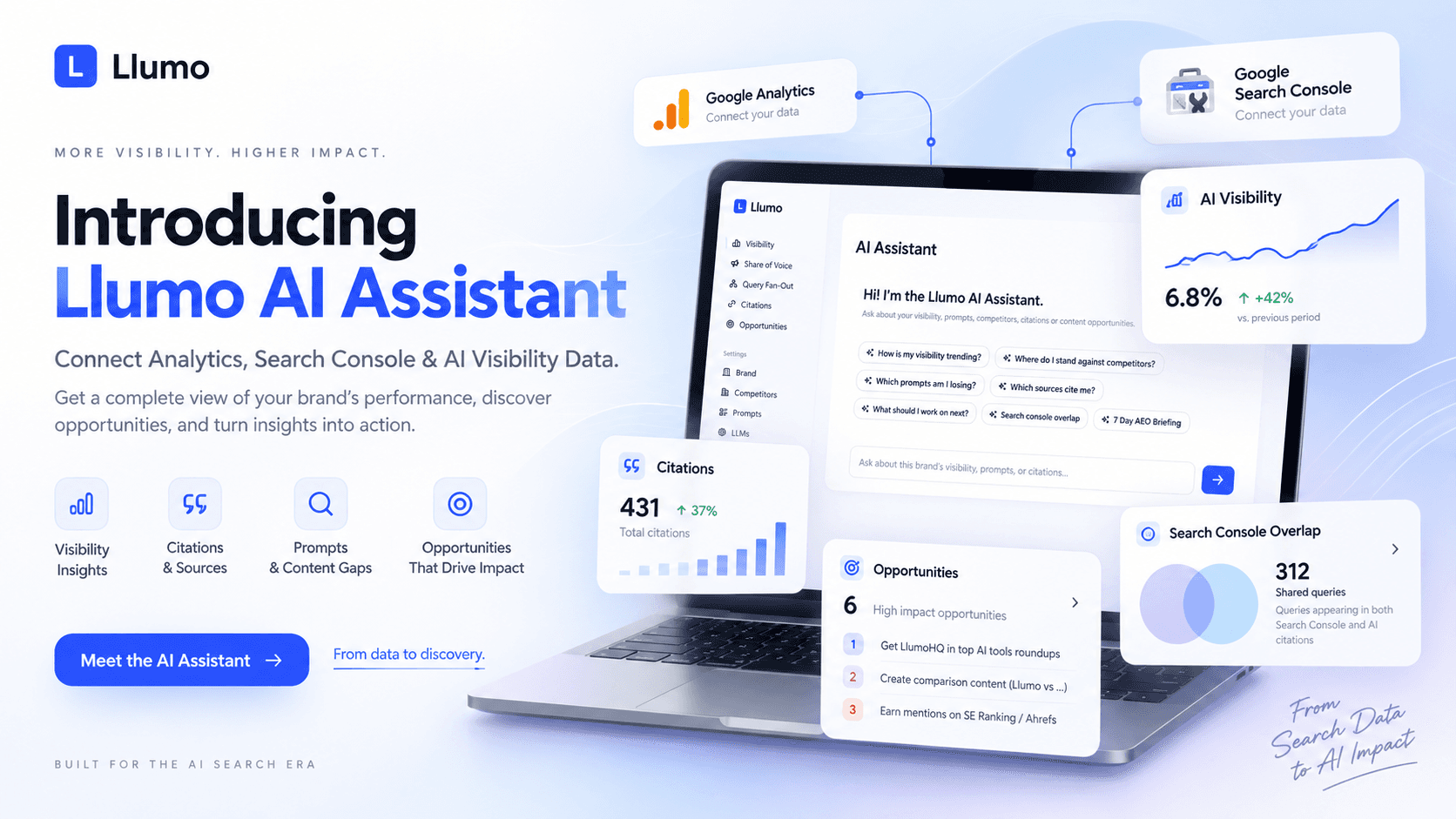
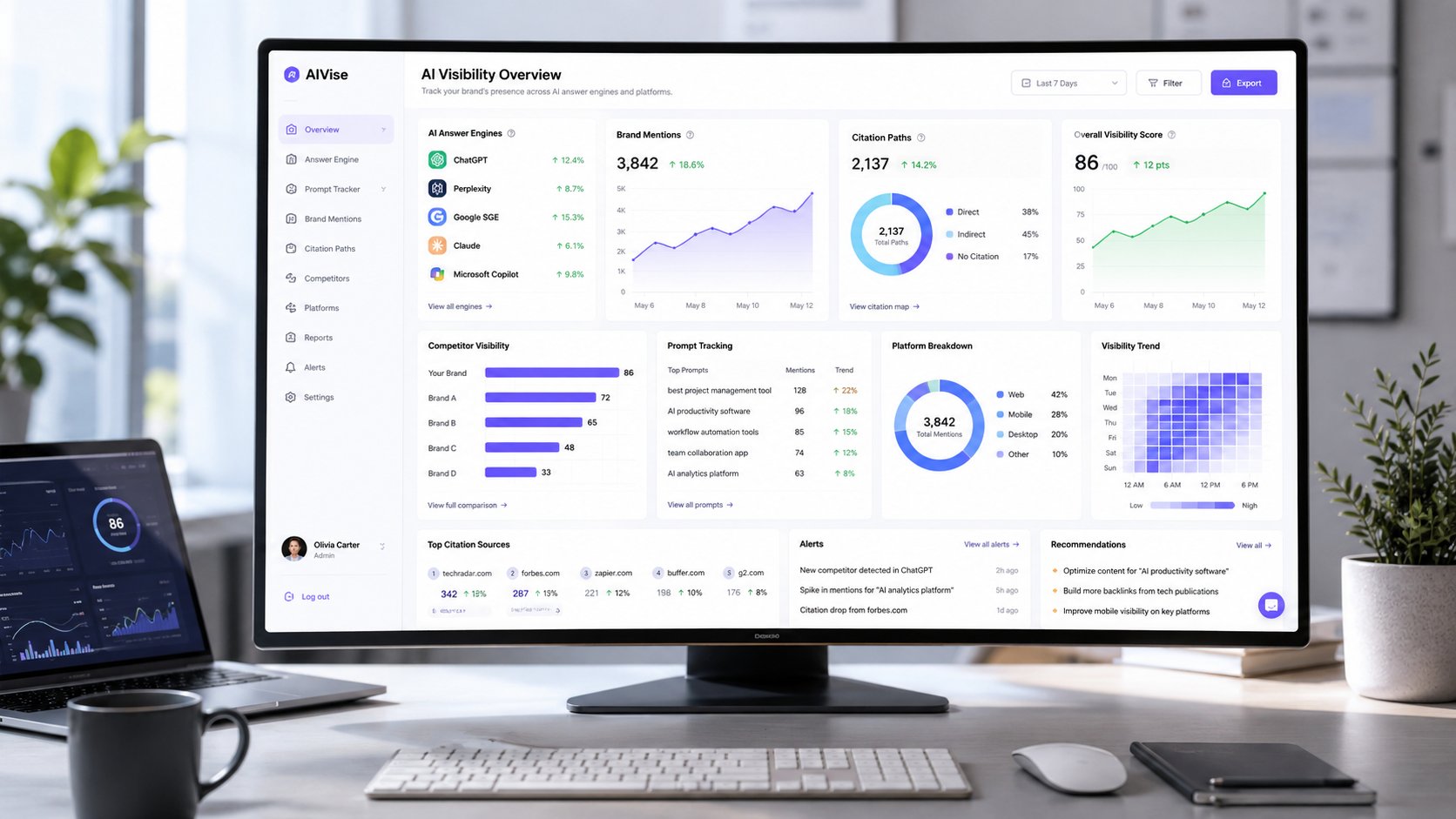
If you want to monitor those signals in one place, Llumo tracks brand mentions, citations, competitor visibility, query fan-out, and source changes across AI answer engines. Visit Llumo to see how its AEO visibility platform can help you turn answer-level observations into a repeatable measurement and optimization workflow.