
When I first started out over 2 decades ago SEO was my forte, now Google AI Overviews can occupy nearly half of a mobile results screen, and that space can expand further when a featured snippet appears. One independent study found Overviews in 47% of Google results, taking up to 48% of mobile screen space, or 76% when paired with featured snippets. It also found that 75% of AI Overview mentions came from pages already ranking in Google’s top 12 organic results, which exposes the central tension in AEO vs. SEO: rankings still influence source selection, but AI answers increasingly control whether users notice or visit those sources. Search Engine Journal’s analysis of the study documents that relationship.
SEO visibility is usually shown through rankings, impressions, clicks, and traffic. AEO visibility requires a different measurement layer, one that captures mentions, citations, answer position, source selection, and share of voice across AI-generated responses. A brand can rank well and remain absent from an answer, or appear in an answer without receiving a single click.
The information described below turns that difference into an operating system by helping you to define a competitor set, choose the priority prompts, count the responses consistently, calculate the AI share of voice, check the citation sources, and turn visibility gaps into content, technical or outreach work.
1. The Full Guide to AEO Basics
Answer Engine Optimization starts with a different question from traditional SEO. Instead of asking whether a page ranks for a keyword, teams ask whether an AI system uses the brand, page, or domain while answering a natural-language prompt. That distinction applies across ChatGPT, Gemini, Perplexity, Claude, Copilot, Google AI Overviews, and other answer surfaces.
SEO still provides the essential foundations. In order for an answer engine to be able to reliably retrieve or cite a page, it must be crawlable, indexable, relevant, and authoritative. However, AEO introduces a problem relating to presentation. The system has to identify a clear answer, link it to the correct entity, and locate evidence that it can use, without requiring the user to interpret a long page.
The fundamentals guide should therefore be regarded as a reference work for use throughout the process, not as a single definitive statement. You should first identify the models that are important to your audience, after which test the same prompts on each of these models. Make a note of which competitors appear, what sources they cite, and whether the answer gives a direct recommendation or merely provides a neutral explanation.

Build pages for extraction and verification
The content should include clear headings, use consistent terminology, provide concise answer sections, cite specific sources and include supporting evidence so that its claims can be found and verified. The advice regarding how to organize pages for AI citation stresses the importance of giving direct answers, using consistent labels, and selecting pages that are publicly indexed rather than those that require access through gated forms or inaccessible PDFs.
A useful audit asks:
Which pages already answer priority questions: Review AI responses to find topics where your existing material could supply a stronger source.
Which models cite competitors: Model-specific citation patterns reveal where your distribution or authority work is incomplete.
Which claims need evidence: Add verifiable data, original research, and clear attribution before pursuing broader visibility.
Which prompts deserve monitoring: Tag queries by customer journey stage so discovery, comparison, and branded visibility don’t get mixed together.
The result in practice is that the two teams end up using the same vocabulary; the SEO teams keep looking after discoverability and rankings, while the AEO teams assess how the answer systems select and present the discoverable material.
2. The Llumo platform for tracking AI visibility
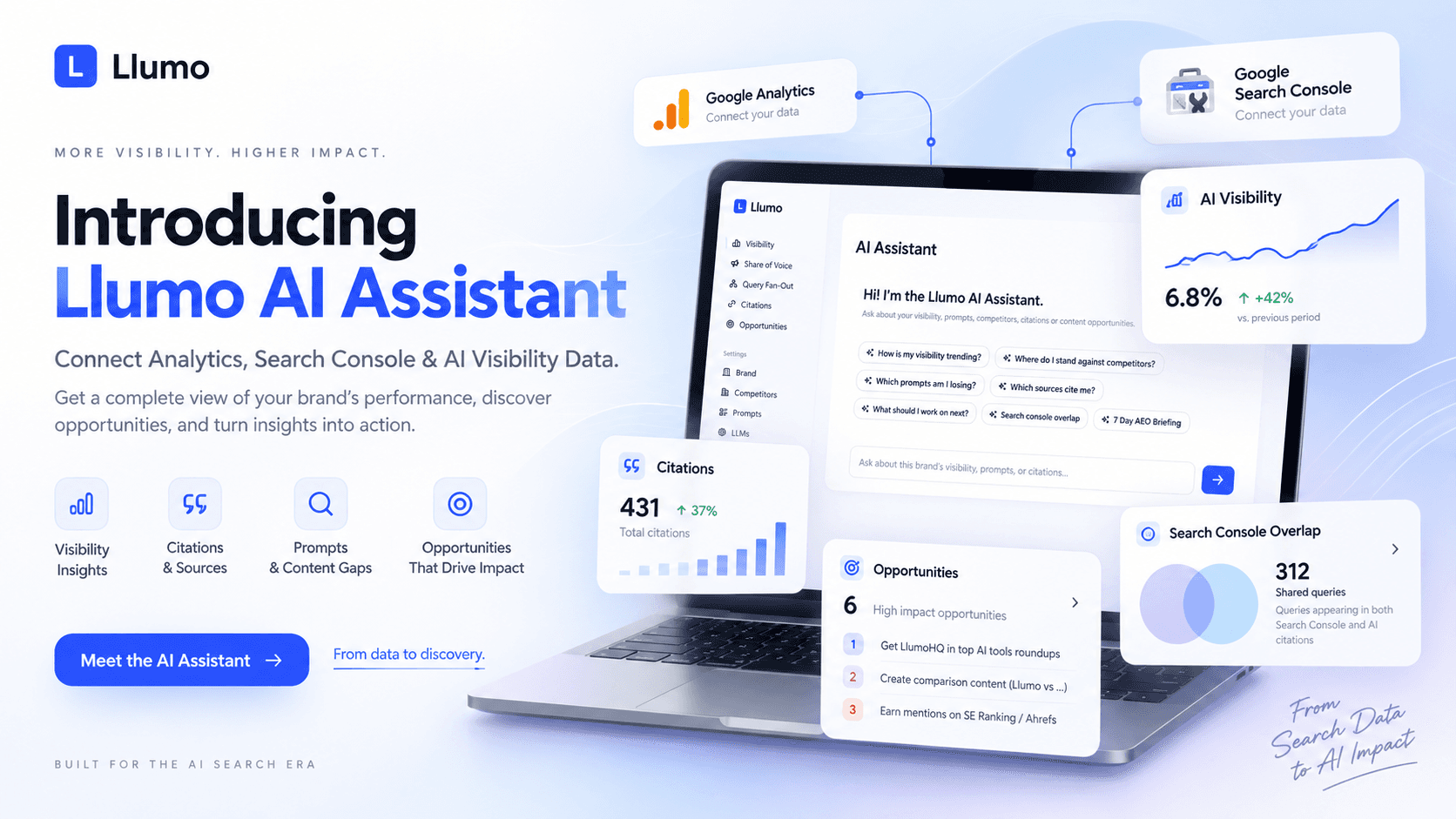
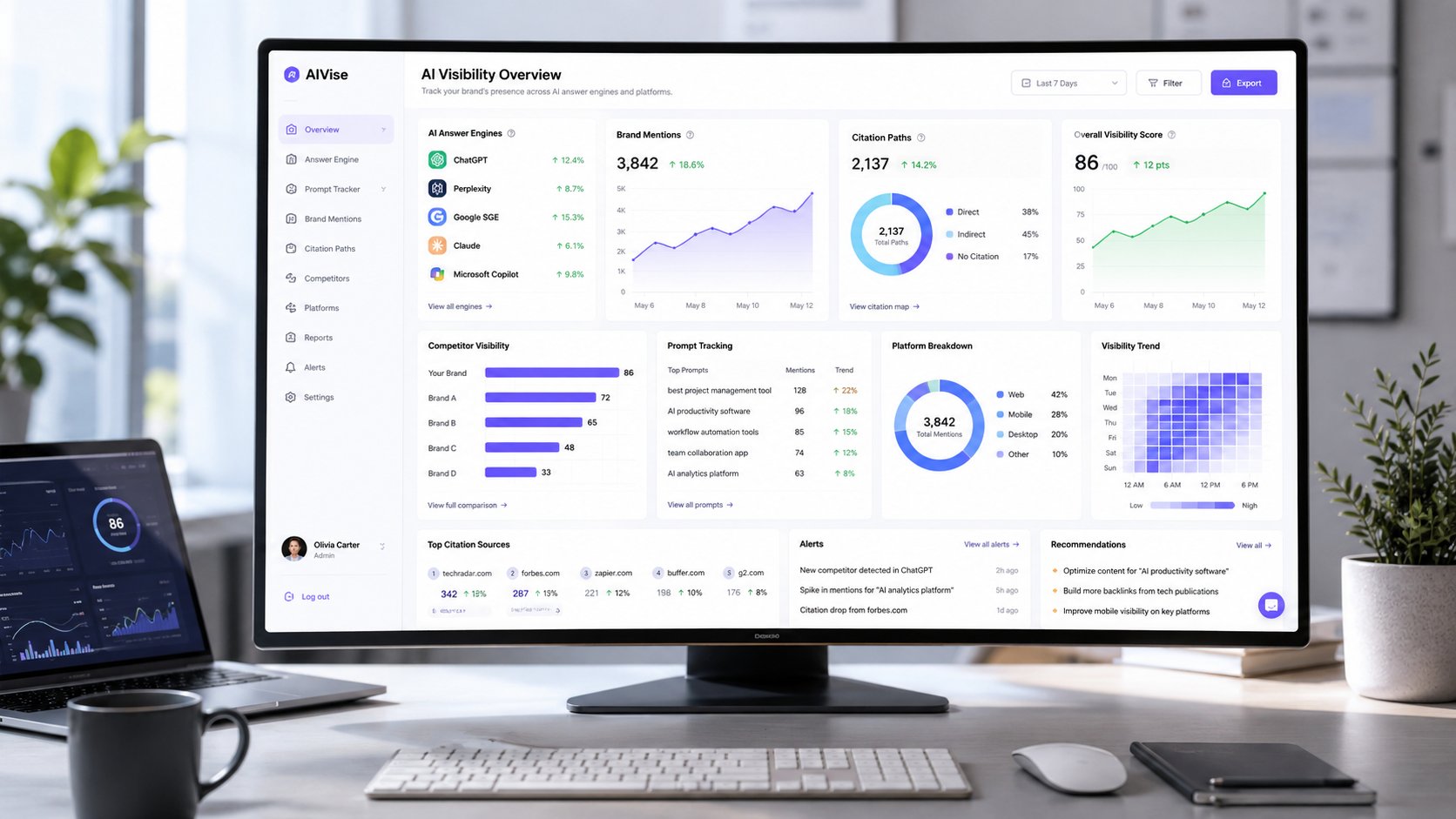
Llumo is built around the measurement gap between SERP rankings and AI responses. It tracks per-prompt visibility, share of voice, competitor trends, and citation sources across surfaces including ChatGPT, Gemini, Perplexity, Copilot, Google AI Overviews, Claude, Grok, Mistral, and DeepSeek. That lets a team ask not only whether its brand appears, but also which page or external domain supports the answer.
A sensible starting set is 20 to 50 high-intent prompts, selected from category, comparison, problem, and branded queries. Tag each prompt by funnel stage, market, product line, and model. The resulting archive gives teams a stable unit of analysis, instead of relying on occasional manual searches that can’t show whether visibility is improving or merely fluctuating.
Llumo also allows for competitive benchmarking against a specific group of brands. Agencies can arrange several client projects, while the SaaS and content teams can spot the pages which receive citations and those that need updating. By linking opportunity discovery to an action, it is possible to carry out tasks such as refreshing an existing article, publishing a new comparison page, or creating references around a topic.
Use model differences as an insight
AI systems don’t draw from identical source ecosystems. A large citation analysis summarized 30 million citations collected from August 2024 through June 2025 and found that ChatGPT leaned toward Wikipedia and major media, while Google AI Overviews drew more from Reddit, LinkedIn, Quora, and YouTube. Perplexity showed stronger preferences for community-heavy sources such as Reddit, Yelp, and TripAdvisor. Eyeful Media’s citation analysis explains why one universal outreach strategy can miss model-specific opportunities.
Teams can compare those patterns over time using Llumo, record the query fan-out, examine new and lost references, and store the exact responses that underlie each score. Furthermore, agencies that are assessing Llumo’s AI visibility tracker for agencies are able to enter their own provider API keys, thus separating access to the platform from the costs associated with consuming the provider’s services.
The most effective workflow is straightforward—keep a set of focused prompts, check out the way competitors cite their sources, prioritize the gaps that will have the greatest impact, carry out the content or outreach work, and then later compare the responses with the archived baseline.
3. A framework for comparing AEO and SEO strategies
SEO rankings and AI citations are indicators of different types of visibility. SEO determines if a page attains a prominent position one that can draw a click, while AEO checks whether the answer engine chooses the brand or source when producing a response which may solve the user’s question without the need for a visit to the website.
The way in which this distinction is made affects how teams assess pages; a marketing homepage for example can still convert successfully upon users arriving at it even though it provides too little specific information for an AI system to extract, and a technical guide, an original dataset, or a page that is clearly labelled as a comparison page may be cited even if it was not designed as a traditional landing page.
A combined model is more useful than replacing SEO with AEO. Research on AI Overviews found that they appeared for 51.5% of representative real-user queries and above organic results. Another analysis found that 52% of cited sources also ranked in Google’s top 10. The empirical study supports keeping ranking data in the measurement system, while treating it as only one indicator of AI visibility.
Compare the optimization signals
Classify each priority page across four dimensions:
Visibility target: SEO tracks rankings and organic clicks. AEO tracks brand mentions, citations, and inclusion in generated answers.
Content design: SEO emphasizes relevance, depth, and titles that encourage clicks. AEO also requires extractable answers, explicit entities, and claims supported by identifiable sources.
Authority evidence: SEO analysis often focuses on backlinks and domain strength. AEO analysis examines citation frequency, reference quality, and the source types each model tends to select.
Journey outcome: SEO commonly moves from query to result to website. AEO can move from question to generated answer, with a citation click only when the user wants additional detail.
Practical rule: Do not treat the highest-ranking page as the strongest citation candidate. Test priority pages against the prompts buyers actually use.
A software company may find that its homepage ranks first but receives no AI citations, while a detailed implementation guide earns repeated mentions. That result does not indicate that either channel failed. It shows that the pages support different stages of the journey. Preserve the homepage’s SEO role, then improve AI-answer coverage through pages that provide clearer, source-backed explanations.
4. Citation Strategy and Link Building for AI Answer Engines
Traditional link building and AI citation building overlap, but they aren’t interchangeable. A backlink can support a page’s authority and referral potential, while a citation places the brand or source inside the answer itself. AEO teams therefore need to ask which evidence an answer engine can retrieve, understand, and confidently attribute.
The strongest candidates are often public, specific, and independently useful. Original research, benchmark reports, surveys, product documentation, and tightly focused explainers give models concrete material to summarize. A page that says exactly what happened, how it was measured, and where the evidence came from is easier to cite than a broad page filled with unsupported positioning language.
The GEO benchmark study tested 10,000 queries across 25 domains. Its authors found that rewrites adding citations, statistics, and quotations increased visibility in generative answers by up to 40% on the Position-Adjusted Word Count metric, while keyword stuffing didn’t improve performance. The Princeton GEO benchmark offers a direct operational lesson: add evidence and quotable specificity, not repetition.
Build a citation footprint
A practical citation program combines publishing with distribution:
Create primary evidence: Publish research, data, methodology, and findings on accessible pages that others can inspect.
Develop a narrow authority position: Become a dependable source for a specific question instead of producing generic content across every topic.
Earn external references: Build relationships with analysts, journalists, and industry publishers whose material appears in the source ecosystems used by answer engines.
Inspect competitor sources: Record the domains and pages cited for winning prompts, then compare their evidence, structure, and distribution.
Keep content crawlable: Avoid putting the most important facts behind forms or inaccessible assets.
A research report might become a repeated source after analysts reference it in independent coverage. A product guide might gain citation potential when it includes clear definitions, original testing, and links to supporting documentation.
For a practical method of interpreting source patterns, use this guide to reading the citations behind an AI answer. It helps connect a visible mention to the underlying pages and domains that shaped the response.

5. Measuring AEO Success With Metrics and KPIs
AEO measurement becomes unreliable when a dashboard counts brand mentions without assessing their context. A mention can be positive or negative, prominent or buried, cited or uncited, accurate or misleading, and associated with a competitor comparison. Each condition changes its value. Effective measurement therefore combines volume and quality.
Use a fixed prompt set and a defined competitor group. For each response, record whether the brand appears, its position, whether a source is cited, and which domain and page receive attribution. Classify the answer’s framing too: recommendation, available option, warning, or irrelevant example. Then calculate share of voice consistently:
Brand AI share of voice = brand appearances across tracked responses ÷ total competitor appearances across those responses.
The formula supports comparison only when the prompt set, model mix, and competitor definitions stay stable. Changing all three can create an apparent gain that reflects the measurement design rather than improved visibility.
Separate exposure from business impact
Google AI Overviews affect click behavior. Pew reported that 58% of respondents performed at least one Google search in March 2025 that produced an AI-generated summary. Analysis cited by Fortune found that only 8% of users clicked a traditional result link when an AI summary appeared, while searches without a summary were clicked nearly twice as often. The pattern reflects a broader shift from selecting links to consuming answers, as described in The arXiv reporting on AI-mediated search behavior.
Track these KPI groups separately:
Presence: Mention rate, citation rate, and answer inclusion by prompt.
Position: Whether the brand is the first recommendation, a supporting option, or a late citation.
Source quality: The pages and external domains used to substantiate the answer.
Competitive position: Share of voice against a defined competitor set, rather than an undefined market.
Business impact: AI referral sessions, assisted conversions, qualified leads, and pipeline influence where attribution is available.
Seer Interactive reported that brands cited in an AI Overview received 35% more organic clicks and 91% more paid clicks than when they weren’t cited. Its AI Overview CTR analysis shows why citation status belongs beside traffic metrics. A measurement system that reports only sessions can miss whether the brand is being selected as evidence inside the answer itself.
6. Building an Integrated Content Strategy for AEO and SEO
A page can serve both channels when the team separates shared foundations from channel-specific outcomes. Technical accessibility, useful information, clear entities, accurate claims, and strong internal linking help search engines and answer engines. The presentation layer still differs. SEO needs a result that earns a click, while AEO needs information that can be extracted and attributed inside an answer.
Begin with a four-way content audit. Label pages as SEO strong and AEO strong, SEO strong and AEO weak, AEO strong and SEO weak, or weak in both. This classification prevents teams from rewriting every page with the same template.
A how-to guide that ranks first but earns no citations may need clearer answer blocks, stronger evidence, or more consistent terminology. Comparison content that earns AI mentions but attracts little organic traffic may need a better search target, stronger title language, or improved internal links. The correct fix depends on the failed signal.
Create one brief with two success paths
A dual-channel brief should include:
Search objective: The query family, intended ranking page, internal links, and organic conversion path.
Answer objective: The exact questions an AI system should answer, the claims it can quote, and the sources it should be able to verify.
Authority plan: Original insights, named contributors, data, references, and distribution targets.
Measurement plan: Separate SEO KPIs from AEO KPIs, with a shared business outcome where possible.
Structured data belongs in the technical layer, but it shouldn’t be treated as a shortcut. Google says structured data doesn’t directly improve rankings. It can make pages eligible for rich results, and that richer presentation may affect visibility and clicks, as explained in this structured data analysis. Markup describes the content. It doesn’t replace evidence, relevance, or authority.
A strong integrated page answers the user, supports the claim, exposes the entity, and gives both the crawler and the reader a clear route to the next step.
Content teams can use this guide to Answer Engine Optimization to align standards, while keeping page-level decisions grounded in observed prompt and ranking data.
7. Competitive Intelligence for AI Answer Engine Visibility
Traditional competitive analysis asks where rivals rank and which keywords send them traffic. AI competitive intelligence asks a more volatile question: which brands do answer engines select when buyers ask category, comparison, and problem-based questions?
That distinction can reveal threats that ranking reports miss. One study of Google AI Overview citations found that 76.10% of cited pages ranked in the top 10, but 9.50% ranked between positions 11 and 100, while 14.40% ranked below position 100. Ahrefs’ analysis of AI citations demonstrates that classic rankings remain influential without defining the entire citation pool.
A lower-ranking competitor can therefore earn disproportionate AI visibility through a particularly useful research page, discussion thread, documentation resource, or media reference. Your monitoring system should capture the cited page, not just the competitor’s domain.
Turn competitor observations into decisions
Select direct competitors and emerging alternatives, then use the same prompt set for every brand. Track the answer text, citation sources, model, prompt category, and sentiment. Review the results on a recurring schedule so a one-off response doesn’t become a strategic conclusion.
Useful analysis questions include:
Where does a competitor appear first: Does it lead recommendations, receive a supporting mention, or appear only in citations?
What type of page earns the reference: Compare research, documentation, reviews, comparison pages, and community discussions.
Which domains repeat: A recurring external source may be a stronger outreach opportunity than the competitor’s own website.
Where are you absent: Group missing prompts by topic, journey stage, and customer value.
Is the positioning favorable: A high mention count doesn’t help if the model associates the brand with limitations or poor fit.
Google’s query fan-out mechanic adds another layer. One study reported that pages ranking for the main query and at least one related fan-out query were 161% more likely to be cited, with a Spearman correlation of 0.77 between fan-out coverage and citation likelihood. Search Engine Land’s fan-out analysis suggests that competitors may win because they cover the connected question set, not merely the visible keyword.
That insight changes the response from “publish a page for the missing prompt” to “map the whole query cluster and close the evidence gap.”
8. AEO Implementation Playbook From Strategy to Execution
AEO implementation works best as a measurement loop, not a large content launch. Establish a baseline, define the prompt and competitor set, identify the pages or references behind current answers, make targeted changes, and compare later responses against the original record.
Start with 20 to 30 high-intent, high-value queries, then assign owners for strategy, content, monitoring, technical work, and outreach. The first stage should establish how often the brand appears, which models matter, which competitors lead, and which sources answer engines already trust. Quick wins often come from updating authoritative pages with clearer answers, current evidence, consistent labels, and accessible citations.
Run the operating cycle
A practical playbook includes these actions:
Baseline the market: Archive responses for priority prompts across relevant AI surfaces and record brand, competitor, citation, and sentiment data.
Prioritize gaps: Separate missing pages, weak pages, missing external references, and technical accessibility problems.
Execute in small batches: Update existing assets before commissioning an entirely new content library.
Review on a fixed cadence: Compare share of voice, citation sources, lost references, and competitor movement during recurring reviews.
Document learning: Record which structures, evidence types, and distribution channels correlate with improved inclusion.
Report by audience: Give executives business impact and competitive position, while giving operators prompt-level evidence and assigned tasks.
AEO also has a measurement limitation that teams must accept. Google’s AI Overview presence has varied by query set, from 6.49% of keywords in January to nearly 25% in July, before settling at 15.69% in November in one study. The same research reported CTR declines of about 58% for the top result in one analysis and roughly 61% across millions of queries in another. Semrush’s AI Overview study shows why static targets can mislead. Visibility depends on query type, model behavior, and the presence of an answer feature.
Use monthly reviews to revise the prompt set, not to erase inconvenient results. If a citation disappears, inspect the response and source change before assuming the content failed.

AEO vs SEO: 8-Resource Comparison
Resource / Tool | Core focus & features | Value / Pricing (💰) | Target audience (👥) | Unique selling point (✨) | Quality / Ease (★) |
|---|---|---|---|---|---|
The Complete AEO Fundamentals Guide | Explains AEO vs SEO, retrieval architecture, citation tactics | 💰 Low, educational primer | 👥 Content teams, SEO newcomers | ✨ Foundation-level theory for AEO strategy | ★★★★ |
🏆 Llumo Platform: AI Visibility Dashboard and Tracking Tool | Multi‑model, per‑prompt visibility, citation analysis, dashboards, BYO API keys | 💰 No license, pay provider API costs; scales to thousands | 👥 SaaS, agencies, CI teams, enterprises | ✨ Real‑time per‑prompt SOV + hosted custom subdomain; transparent costs | ★★★★★ |
AEO vs. SEO Strategy Comparison Framework | Side‑by‑side tactics, metrics, content & authority mapping | 💰 Medium, strategic framework | 👥 Strategy leads, SEOs, content directors | ✨ Decision matrix to allocate AEO vs SEO effort | ★★★★ |
Citation Strategy and Link Building for AI Answer Engines | Earn citations: content attributes, PR, research publishing | 💰 Medium, requires PR/content investment | 👥 PR, content, comms teams | ✨ Actionable citation tactics & outreach methods | ★★★★ |
Measuring AEO Success: Metrics and KPIs for AI Answer Engines | Mention frequency, share‑of‑voice, sentiment, attribution models | 💰 Medium, tracking + analytics setup | 👥 Analytics, execs, performance marketers | ✨ Framework to tie AEO visibility to business KPIs | ★★★★ |
Building an Integrated Content Strategy for AEO and SEO | Dual‑channel audit, templates, content structure & roadmap | 💰 Medium, efficiency gains across channels | 👥 Content teams, SEO/AEO managers | ✨ Templates balancing extractability + engagement | ★★★★ |
Competitive Intelligence: Tracking AI Answer Engine Visibility | Competitor SOV, citation frequency, sentiment, trend reports | 💰 High, ongoing monitoring value | 👥 Competitive intelligence, market research teams | ✨ Early‑warning CI and competitor gap analysis | ★★★★ |
AEO Implementation Playbook: From Strategy to Execution | Audits, roadmap, team roles, phased rollout, testing | 💰 Medium‑High, implementation resource needs | 👥 PMs, agencies, implementation teams | ✨ Practical step‑by‑step execution playbook | ★★★★ |
Turn AI Mentions Into a Repeatable Measurement System
AEO becomes actionable when teams stop treating an AI mention as a novelty and start treating it as a measurable market position. The first step is a focused prompt set that reflects real buying questions. Include category prompts, comparison prompts, problem prompts, branded prompts, and questions that reveal how customers evaluate alternatives. Keep the initial set narrow enough to review manually, then expand only when the team can explain what each new prompt contributes.
Define the competitor set before calculating share of voice. Include direct rivals, established alternatives, and emerging brands that appear in answers even when they don’t rank strongly in traditional search. The competitor list should remain stable during each measurement period, otherwise the denominator changes and the trend becomes difficult to interpret.
Separate the KPIs. SEO should continue to track rankings, indexed pages, impressions, organic clicks, and conversions. AEO should track mention rate, citation rate, answer position, source domains, page-level references, sentiment, query fan-out coverage, and share of voice. Business reporting can connect both channels to leads, sales, assisted conversions, and referral activity, but visibility metrics shouldn’t be replaced by traffic metrics. An answer can influence a buyer without producing a direct click, while a click can occur without proving that the AI answer changed the decision.
Citation inspection is the bridge between measurement and action. If a competitor appears, identify the exact page, external reference, evidence type, and query relationship behind the inclusion. If your brand appears without a citation, improve the accessible source material. If your page is cited but the answer misrepresents it, clarify the page structure, terminology, and supporting evidence. If a competitor wins across related fan-out questions, expand the content cluster instead of editing one isolated paragraph.
Model variation also needs to remain visible in reporting. ChatGPT, Google AI Overviews, Perplexity, Gemini, Copilot, Claude, and other systems can favor different source types and produce different answers. A single blended score may hide a valuable opportunity in one model or an emerging weakness in another.
Llumo can support this operating model through per-prompt archives, multi-model tracking, competitor trend lines, citation analysis, query fan-out logging, opportunity discovery, and dashboards. Its bring-your-own-key approach lets teams connect provider accounts and monitor usage directly, while the platform focuses on answer-engine signals rather than traditional SERP positions.
The most important discipline is consistency. Run the same prompts, preserve the same competitor definitions, archive the responses, inspect the sources, and assign every material gap to a content, technical, PR, or distribution action. That turns AEO vs. SEO from a conceptual debate into two connected visibility systems with different evidence, different KPIs, and a shared commercial purpose.
Llumo measures how brands appear and are cited across AI answer engines, with per-prompt visibility, share of voice, citation sources, competitor trends, and response archives. Visit Llumo to evaluate multi-model AI visibility and connect observed gaps to practical AEO actions.