
A buyer asks ChatGPT for a shortlist in your category, compares the recommendations, and never sees your brand. Your conventional rank tracker shows healthy positions, so the omission is easy to miss. Search rankings and AI answers are different discovery surfaces, and a standard keyword report can't tell you which brands ChatGPT mentions, which pages it cites, or whether your competitors appear in answers where you don't.
That gap is why a separate ChatGPT visibility tracker exists. The tools below include dedicated AI visibility platforms and established SEO suites that have added AI Overviews or assistant monitoring. They aren't equal substitutes. Some preserve the full prompt response and cited URL, while others reduce visibility to a score or a Google-focused presence metric.
I've judged them on what they record for ChatGPT, how useful the evidence is for a client report, and where the public documentation becomes vague. The important question isn't who has the longest feature list. It's whether the tool gives you enough raw evidence to decide what to change.
1. Llumo
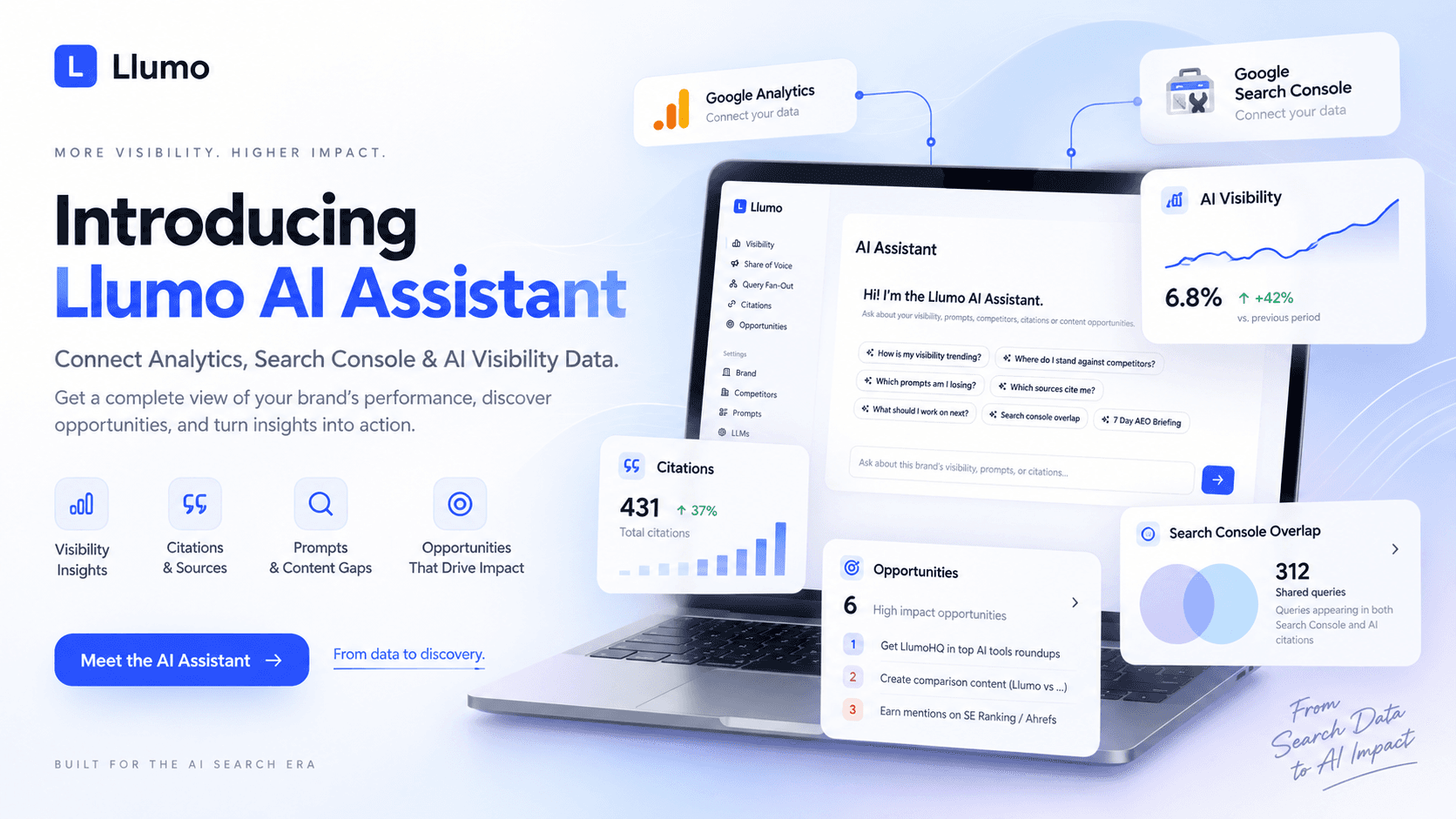
Llumo is the strongest fit when ChatGPT tracking is part of a wider Answer Engine Optimization workflow rather than a one-off visibility check. It records selected prompts, stores the resulting answers, identifies brand mentions and cited sources, and lets you compare visibility with competitors over time. That combination matters because a score without the underlying response is difficult to audit.
The platform covers ChatGPT alongside Gemini, Perplexity, Copilot, Google AI Overviews, Grok, Mistral, Claude and other answer surfaces. You can inspect visibility at prompt level, review share of voice, trace cited domains and pages, and use query fan-out data to see the related searches generated behind an answer.
What makes Llumo practical
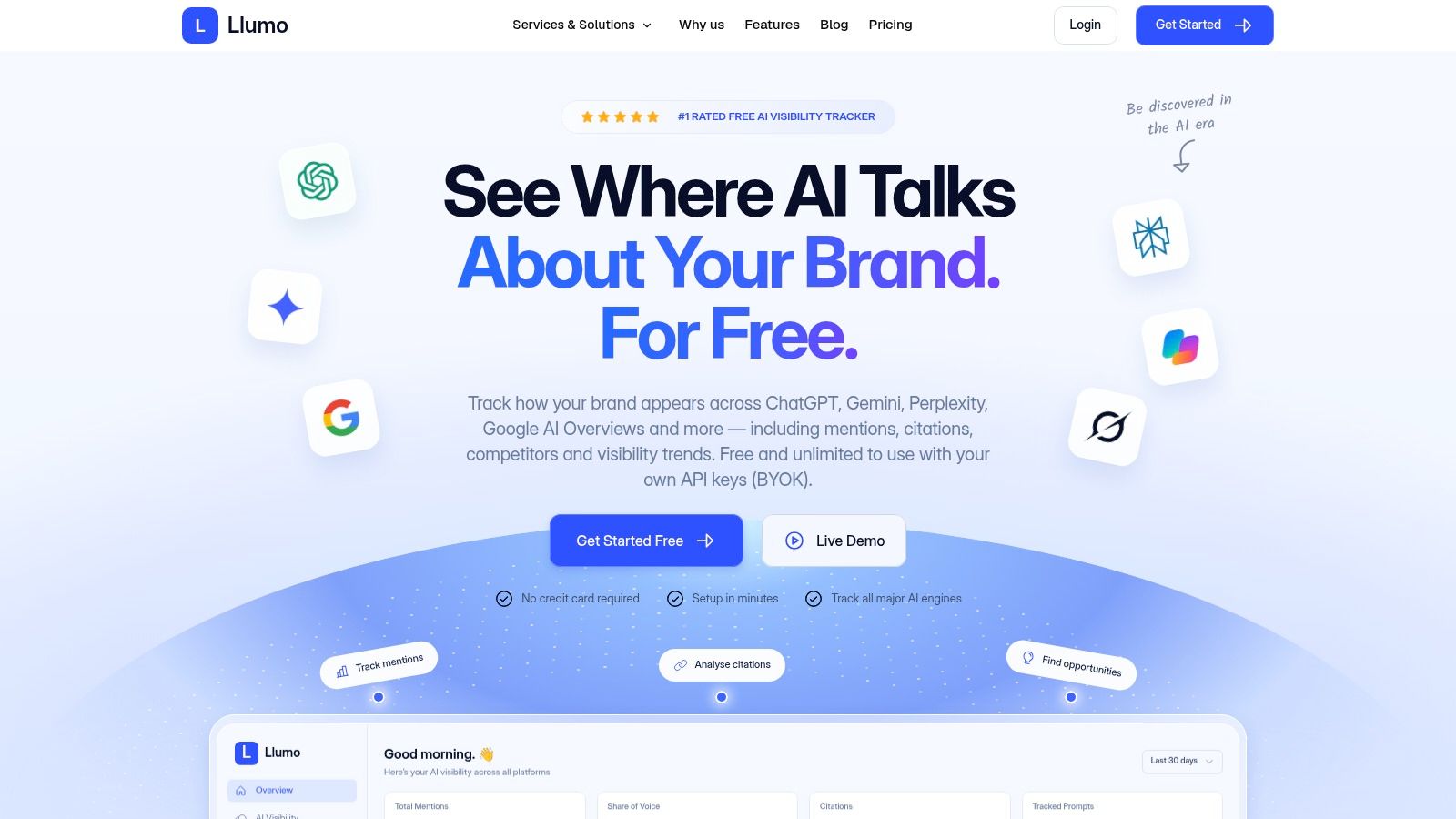
The cost model is the unusual part. The core platform has no software licence fee, and customers can connect their own provider API keys and pay providers directly, without a Llumo usage markup. That gives teams control over model selection, quotas and response volume, although it also means someone must manage API credentials and provider billing.
Llumo is useful when the work needs to move beyond reporting. Its opportunity discovery can turn missing mentions and weak citation coverage into content updates, new pages or outreach priorities. Prompt tagging, archives, dashboards, competitor benchmarks and citation analysis make it easier to explain a change to a client without relying on a black-box trend line.
Practical rule: Keep the full response, cited URL, model condition and retrieval date for every important prompt. A mention alone doesn't show whether the answer was favourable or whether the citation supported the claim.
The main limitation is operational. BYOK is efficient, but it isn't as simple as buying a bundled subscription and forgetting about provider quotas. Coverage can also vary by API availability, scraping method and model format. For agencies, SaaS teams and competitive intelligence work, that trade-off is usually worthwhile because the platform is built around answer-engine evidence rather than traditional SERP positions.
Visit Llumo to see the ChatGPT tracker and broader AEO platform.
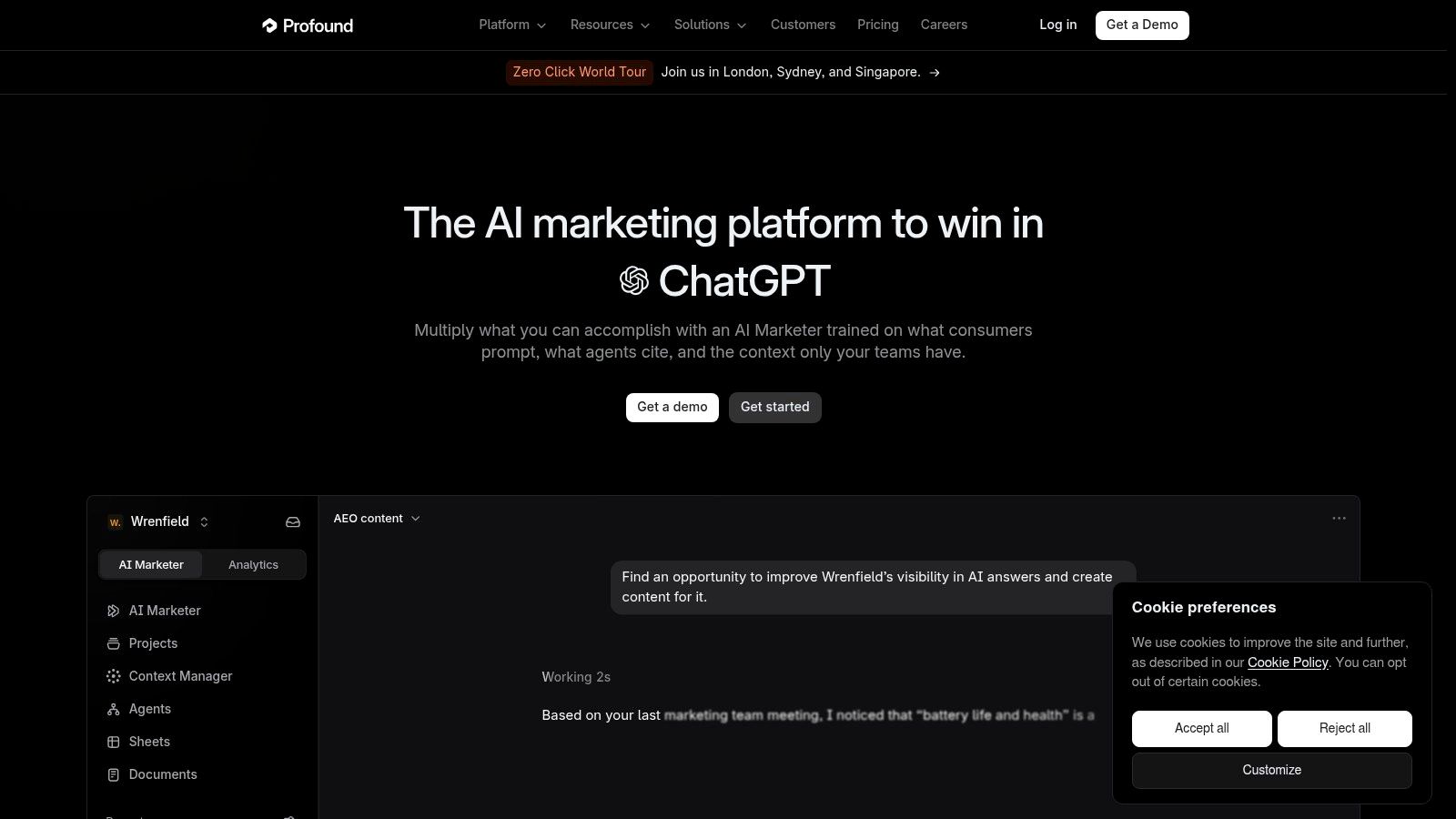
2. Profound
Profound is a dedicated AI visibility platform for teams that want broad assistant coverage and deeper context around how AI discovery works. It tracks brand mentions, citations, position among mentioned brands and visibility across ChatGPT, Perplexity, Claude, Gemini, Copilot, Google AI Overviews, Grok and DeepSeek.
The useful distinction is that Profound isn't limited to a manually curated prompt list. Its Prompt Volumes datasets help teams understand demand around topics, while Agent Analytics adds server-side information about how AI agents access a site. That makes it a good option for organisations that want visibility measurement connected to content and site behaviour.
For ChatGPT reporting, check whether the selected plan exposes the response-level evidence you need, not just aggregate visibility and share-of-voice metrics. Profound has a heavier platform footprint than a basic tracker, and its current pricing structure has moved toward trials and enterprise or custom plans. That may be appropriate for a larger marketing operation, but it makes procurement less straightforward.
The platform's broader approach is its strength and its possible distraction. It can support prompt research, citations, sentiment, agent activity and opportunity work, but a small team that only wants to archive ChatGPT answers may find more surface area than it needs. For a detailed comparison of the product's positioning and alternatives, see this Profound alternatives guide.
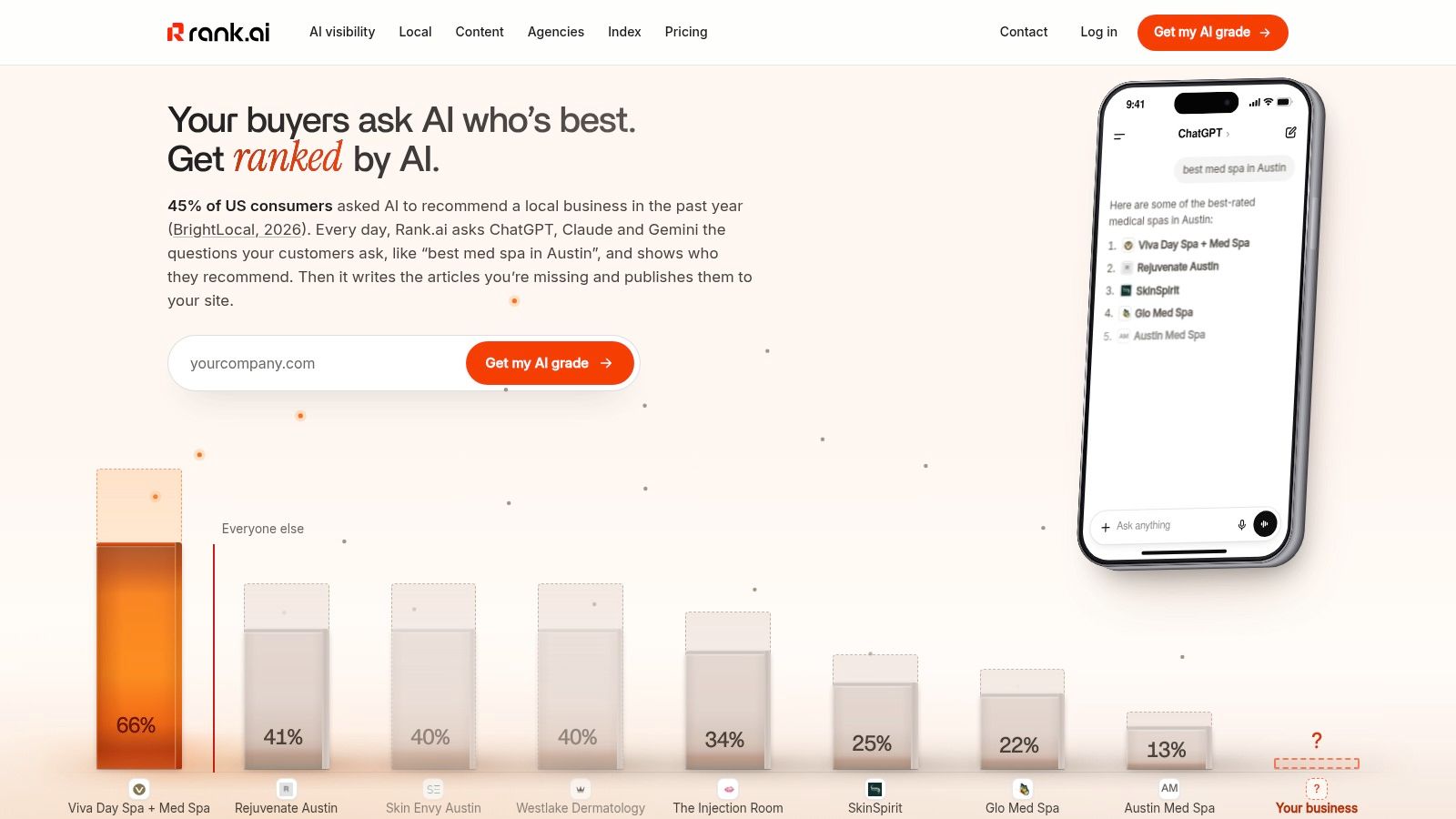
3. Rank.ai
Rank.ai takes a prompt-first approach that feels familiar to anyone who has prepared daily SEO monitoring reports. It runs buyer-style prompts across several assistants, records brand mentions and citations, and breaks results down by engine. The Conversation Explorer is the most useful part for investigation because it exposes run history, citation snippets, sentiment and model variation at the individual prompt level.
That evidence makes it easier to answer a client's practical question: “Why did we lose visibility?” You can inspect whether the brand disappeared, moved lower in the answer, lost a citation, or appeared under one model but not another. The free visibility check also gives teams a low-friction way to test whether the workflow matches their market before committing to a larger setup.
The fastest way to judge a tracker is to compare its stored answer with the answer you can see yourself.
Rank.ai is a sensible choice for SMBs and agencies that want daily monitoring without the weight of a broad enterprise SEO platform. Its reporting and sharing workflows are useful when several people need to review the same prompt set.
The limitation is coverage depth. Public positioning has focused mainly on ChatGPT, Claude and Gemini, so teams tracking a wider collection of answer engines should confirm availability before building a reporting process around it. Publishing and SEO features may also feel tangential if your only requirement is AI response monitoring.
See Rank.ai's AI visibility tool for the current prompt and reporting options.
4. Ahrefs Brand Radar and AI Overviews Tracker
Ahrefs Brand Radar is the natural option for teams already using Ahrefs and wanting AI visibility beside their established SEO datasets. It tracks mentions and citations across ChatGPT, Perplexity, Gemini, Copilot and Google AI Overviews or AI Mode, with share of voice, historical trends and API access for exporting data.
The advantage is context. A large search-backed prompt and response index can help you compare classic organic performance with AI presence instead of treating the two reports as unrelated projects. The free AI Overviews Tracker is also useful for quick spot checks, although it shouldn't be confused with a complete ChatGPT monitoring programme.

Ahrefs documents its methodology more clearly than many traditional SEO vendors, which helps when you need to explain how a visibility metric was assembled. Still, Brand Radar pricing and plan structure aren't publicly listed in the same way as a simple self-serve tracker. Smaller brands may also find that low-demand prompts produce thinner coverage than broad, frequently searched topics.
For teams comparing a dedicated answer-engine product with a search-led suite, this Ahrefs Brand Radar alternative is a useful counterpoint. The decision comes down to whether integrated SEO data or granular response archives matter more to your workflow.
Visit Ahrefs Brand Radar for the current product details.
5. Semrush AI search visibility
Semrush makes sense when your organisation already relies on Semrush One for keyword research, competitor reporting and client dashboards. Its AI search visibility work brings organic results and AI Overviews into a single reporting environment, with monitoring for page appearance in AI summaries described in its enterprise materials.

The benefit is operational simplicity. SEO managers don't have to introduce an entirely separate system for every new search surface, and existing reporting, support and training processes can carry across. If the primary question is how your pages appear in Google AI Overviews, that unified approach may be enough.
ChatGPT is where I would ask more questions before buying. Public information on exact multi-model coverage, response sampling, archives and citation-level detail is limited compared with dedicated AI visibility platforms. A large suite can also mean paying for functions the team won't use.
Ask the vendor to show a real ChatGPT response record, including the prompt, cited URL and refresh history. If the demo only shows a score, you won't know whether it can support the investigation work that follows a visibility change. This Semrush AI alternatives guide provides another view of the trade-off.
Explore Semrush's AI search visibility offering before comparing plans.
6. seoClarity
seoClarity is built for organisations that need large-scale SEO operations, configurable reporting and long-running visibility programmes. Its AI search work sits alongside technical SEO, content intelligence and rank tracking, with a clear emphasis on AI Overviews and enterprise deployment.
That setup suits a team managing many markets, keyword groups and stakeholders. You can connect AI visibility trends to existing SEO workflows instead of asking analysts to maintain another disconnected reporting stack. For an enterprise client, that governance can matter more than a lightweight interface.
The weakness is the public detail around ChatGPT and other assistants. The platform communicates more clearly about scalable AI search and AI Overviews monitoring than it does about exact assistant coverage, response archives or citation-level fields. That doesn't mean the data isn't available, but it does mean buyers should validate it directly.
Where it fits
seoClarity is a better fit for a mature SEO department than for a small team looking for a focused ChatGPT visibility tracker. Its higher starting position in the market and configurable deployment model can be justified when multiple teams need consistent reports, but they add friction for a narrow use case.
Request sample exports before signing. Confirm whether each row contains the raw answer, model, prompt, cited page, market and refresh condition. Without those fields, a trend report may show that visibility changed without giving the analyst enough evidence to explain why.
See seoClarity's AI search visibility platform.
7. SEOmonitor AI Search Tracking
SEOmonitor adds AI Search Tracking to a rank-tracking and forecasting workflow. It reports brand visibility and citations across ChatGPT, Google AI Overviews or AI Mode and Perplexity, with methodology that explains how present-versus-absent logic contributes to its visibility metric.

The cadence is split by surface. Assistant checks are described as weekly, while AI Overviews mentions and citations are checked daily. That distinction matters when clients expect every dashboard to refresh at the same speed. SEOmonitor also offers a free instant visibility snapshot, which is useful for qualifying an opportunity before setting up a full account.
Its MCP connector is a practical addition for teams automating reports or sending visibility data into AI-assisted workflows. The platform's advantage is transparency about how it turns observed responses into a Visibility metric, particularly for users who already understand rank tracking and forecasting.
The trade-off is breadth. Pureplay AI visibility vendors may offer more assistant surfaces, more detailed prompt archives or more extensive opportunity analysis. Full pricing is also sales-led and not fully public, so budget comparisons require a direct conversation.
Don't compare refresh labels without comparing the unit being refreshed. A daily Google check and a weekly ChatGPT check answer different reporting questions.
Review SEOmonitor's AI Search Tracking if organic forecasting and AI monitoring need to live together.
8. Nightwatch AI and LLM Tracking
Nightwatch is a rank-tracking platform that has added AI and LLM monitoring to its existing SERP workflow. Its dashboards show prompt-level visibility, mentions, position, entities and the latest refresh, while AI Overviews monitoring sits beside conventional rank data.
That combination is appealing for agencies and smaller teams that don't want separate tools for rankings and AI presence. Analysts can place a client's traditional positions and assistant visibility in the same account, then report both without building a new data pipeline.
Nightwatch's public product detail is lighter than what dedicated AI visibility platforms publish. It describes cross-model visibility and prompt refreshes, but gives less information about sampling volume, response retention and citation verification. Those omissions matter if you're trying to determine whether a cited page supports the answer, rather than counting a URL.
I would use Nightwatch for directional monitoring and a combined rank report, then test it against manually reviewed prompts before treating the numbers as an authoritative ChatGPT benchmark. Its lower entry position can make sense for an SMB or agency, provided the reporting question is simple and the team doesn't need extensive forensic analysis.
View Nightwatch's AI and LLM tracking.
9. BrightEdge AI Overviews tracking
BrightEdge is primarily an enterprise SEO and AI Overviews platform. It focuses on when and where AI Overviews appear, which sources they cite, and how those patterns interact with traditional SERP features. Its research and reporting are useful for large sites that need trendlines across industries, markets and substantial keyword sets.
That Google focus is also the boundary. If the buying question is specifically, “How often does ChatGPT mention our brand and which pages does it cite?”, BrightEdge isn't the obvious first tool based on its public product detail. It may help explain AI search exposure at enterprise scale, but it doesn't present the same dedicated assistant evidence as a ChatGPT-first tracker.
The platform is strongest when executives need a consolidated view of AI Overviews, rankings and SERP behaviour across a large programme. It is less suitable when an analyst needs to inspect prompt-by-prompt assistant responses or compare ChatGPT with several other models.
Pricing is not publicly listed and enterprise contracts are part of the buying process. Ask for a demonstration using your own prompts, not a generic category example. That will reveal whether the product answers your actual reporting question or mainly provides Google-centric trend analysis.
Explore BrightEdge AI Overviews tracking.
10. STAT Search Analytics by Moz
STAT extends enterprise rank tracking into AI Overviews monitoring. It records which keywords trigger AI Overviews, how often they appear, which sources are cited and how ownership changes across locations and devices. Daily SERP HTML archives add useful forensic context for teams that need to investigate historical changes.

For Google-heavy programmes, that is a solid proposition. STAT's established collection and enterprise reporting can show whether a page gained or lost AI Overview presence alongside conventional ranking and SERP features. The archived HTML is particularly valuable when a current result no longer explains what happened earlier.
ChatGPT is not the centre of the product's public positioning. Teams looking for multi-assistant tracking, raw ChatGPT response archives or broad citation comparisons should treat STAT as a Google AI Overviews tool first. It can complement a dedicated ChatGPT visibility tracker, but it shouldn't automatically replace one.
The pricing is enterprise-style and not publicly listed. Before purchase, ask whether the plan includes the markets, devices, archive depth and export fields your team needs. If your dashboard is mainly about AI Overviews presence and source ownership, STAT may fit well. If the main deliverable is a cross-model assistant report, the scope is narrower than the title “AI visibility” might suggest.
Visit STAT Search Analytics for current enterprise details.
Top 10 ChatGPT Visibility Tracker Comparison
Product | ✨ Core features & USP | ★ UX / Quality | 💰 Pricing & Value | 👥 Ideal users |
|---|---|---|---|---|
🏆 Llumo | ✨ Multi‑model AEO, per‑prompt visibility, citation analysis, query fan‑out, opportunity discovery, hosted subdomain | ★★★★☆ Prompt archives, dashboards, priority support | 💰 Core platform free; BYOK (pay providers directly); optional PAYG/managed billing, very cost‑efficient | 👥 SEO/AEO pros, agencies, product & growth, competitive intel |
Profound, Answer Engine Insights (AEI) | ✨ Multi‑engine coverage, "Prompt Volumes" datasets, Agent Analytics, public methodology | ★★★☆☆ Broad engine coverage, AI‑specific metrics (SOV, sentiment) | 💰 Trial → enterprise/custom plans (verify tiers) | 👥 Teams needing breadth of assistant coverage & AI metrics |
Rank.ai, AI Visibility Tool | ✨ Daily prompt runs, Conversation Explorer, citation snippets & sentiment | ★★★★ Practical per‑prompt forensic views; easy start | 💰 SMB/agency‑friendly; free visibility check available | 👥 SMBs, agencies, ops teams needing prompt‑level evidence |
Ahrefs, Brand Radar & AI Overviews Tracker | ✨ Massive prompt/response index, Brand Radar, API, free AIO tracker | ★★★★ Strong docs, historical archives, SEO integration | 💰 Likely enterprise/add‑on pricing; not fully public | 👥 SEO teams wanting deep historical + SEO data |
Semrush, AI search visibility (Semrush One) | ✨ Unified SEO + AI Overviews reporting within Semrush One | ★★★ Familiar UI, support, training ecosystem | 💰 Part of Semrush One, may incur suite cost (pay for extra features) | 👥 Teams already using Semrush seeking unified workflow |
seoClarity, AI search visibility | ✨ Large‑scale AI Overviews monitoring, configurable enterprise workflows | ★★★★ Scalable, longitudinal visibility integrated with SEO | 💰 Higher starting price; enterprise‑oriented | 👥 Mid‑market & enterprise SEO teams |
SEOmonitor, AI Search Tracking | ✨ Weekly assistant checks, clear methodology, MCP connector, free snapshot | ★★★ Transparent metrics, integrated organic+AI tracking | 💰 Sales‑led pricing; free instant check for qualification | 👥 Agencies & companies combining rank + AI visibility |
Nightwatch, AI/LLM Tracking & AI Overviews | ✨ Prompt‑level dashboards + SERP/rank integration, entity detection | ★★★ Affordable UI; integrated rank & AI metrics | 💰 Lower entry price for SMBs & agencies | 👥 SMBs, agencies needing rank + prompt tracking |
BrightEdge, AI Overviews tracking | ✨ Trendlines on AIO presence, citation research, SERP pairing | ★★★★ Enterprise reporting, research updates | 💰 Enterprise contracts; pricing not public | 👥 Large enterprises, research & executive reporting teams |
STAT Search Analytics (by Moz), AI Overviews tracking | ✨ Daily SERP archives, AIO presence by keyword, cited source inspection | ★★★★ Mature forensic SERP data & enterprise workflows | 💰 Enterprise‑style pricing; not public | 👥 Google‑heavy enterprise SEO programs |
Choosing the Tool That Fits How You Actually Work
Start with the question, not the vendor. If you need ChatGPT answers specifically, check each provider's public detail on ChatGPT before comparing dashboards. You need to know whether it records the full prompt response, brand mentions, cited URLs, source pages, model conditions and refresh history. If the main concern is Google AI Overviews, an established SEO suite may already cover the workflow without adding another platform.
Reliability matters because an AI answer isn't a fixed rank. OpenAI explains that ChatGPT Search can retrieve current web information and attach citations, but it also warns that results and citations can be incomplete, outdated or incorrect. A tracker should therefore separate citation presence from citation correctness, preserving the answer text and checking whether the cited page supports the claim. The OpenAI explanation of ChatGPT Search is a useful reference for that distinction.
Compare evidence, not just scores
Ask vendors these questions before you treat a dashboard metric as a KPI:
Prompt sampling: Are prompts supplied by you, discovered from a dataset, or sampled from live usage?
Run conditions: Can you separate country, language, model, location, session and web-search conditions?
Response records: Can analysts open the exact answer behind a mention or visibility change?
Citation fields: Are the URL, page title, domain, retrieval date and support status retained?
Refresh cadence: Does the product check ChatGPT and Google surfaces at the same frequency?
Cost controls: Can you see model choice, input tokens, output tokens and search-related usage?
That last question is more important than it sounds. API use is billed separately from ChatGPT subscriptions, and token charges depend on the selected model's input and output rates, as described in OpenAI's API pricing. For some models using the non-preview web-search tool, search content is billed as a fixed block of 8,000 input tokens per call, so repeated checks can cost more than the visible answer suggests. The developer pricing documentation explains why response counts alone aren't enough for budgeting.
Finally, compare plans directly with each vendor because several don't publish complete tiers. Ask how prompts are sampled and refreshed, then run your own prompt set during a short trial. Compare the platform's records with the answers you see manually, including citations and competitor mentions. That exercise tells you more about fit than a feature table.
Llumo gives you a focused way to record ChatGPT prompts, brand mentions, cited sources, competitor visibility and changes over time, while extending the same workflow across other answer engines. If you want evidence you can investigate rather than another opaque score, visit Llumo and test its AI visibility tracker with your own prompts.