
Explore 7 profound alternatives by nuance, register, collocations, examples, antonyms, and SEO intent for choosing the right phrase.
1. Llumo
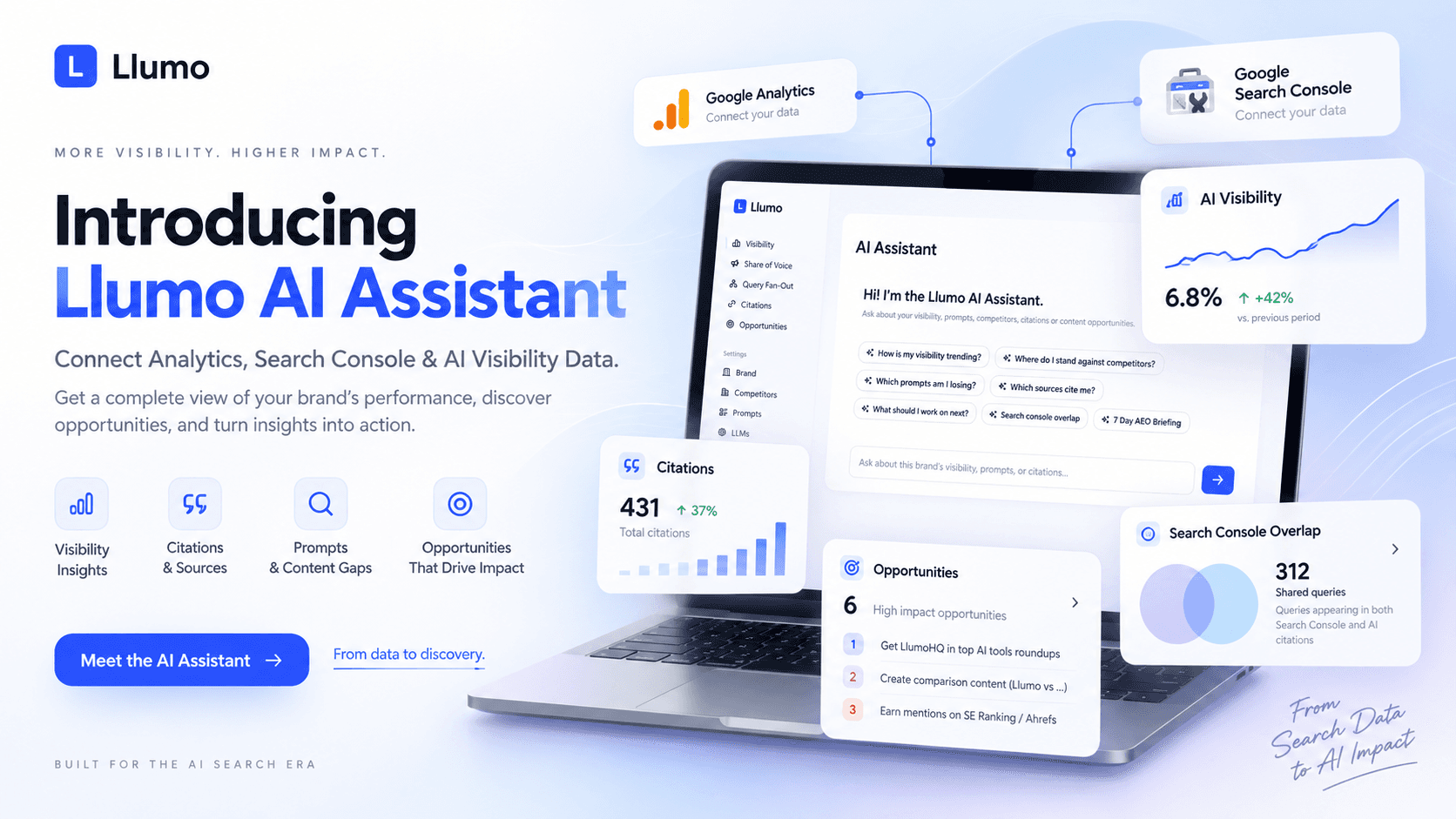
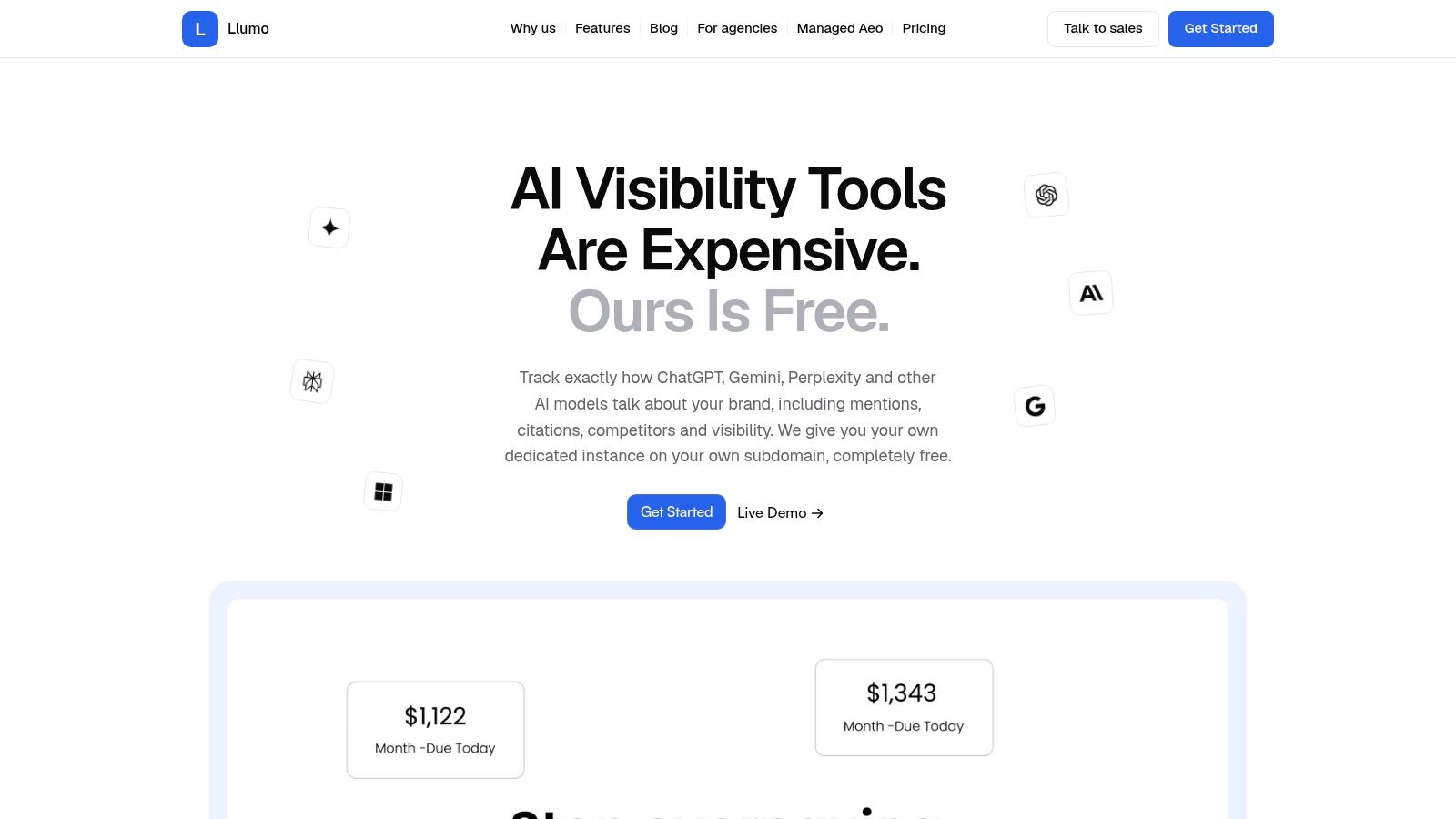
Llumo is an AI visibility platform for Answer Engine Optimization, or AEO. It tracks how brands appear across ChatGPT, Gemini, Perplexity, Copilot, Grok, and Google AI Overviews, then preserves responses at the prompt level so teams can review what each engine said and cited. That makes it useful when the question isn’t only “Was the brand mentioned?” but “Which wording, source, and competitor appeared in the answer?”
Why teams choose it
Llumo combines share of voice, visibility trends, competitor benchmarking, citation analysis, prompt search, tagging, and response archives. Its opportunity discovery features help teams prioritize content updates and brand-mention work rather than treating every missing citation as equally urgent. The platform also supports query fan-out logging, which can reveal the related searches an answer engine generates while building a response.
The cost model differs from bundled tools. Customers can connect their own provider API keys and pay the underlying provider costs directly, without a Llumo usage markup or a core platform license fee. That gives agencies and analytics teams more control, although they still need to configure providers and forecast usage across their prompt mix.
Practical rule: Track citation position and source quality, not just whether a brand appears somewhere in an answer.
That distinction matters because AI answer visibility is unstable and attention is uneven. A Google AI Overviews study of 70 U.S. searchers found median scroll depth inside the overview was 30%, citation clicks reached 19% on mobile and 7.4% on desktop, and desktop CTR fell by half when an overview appeared. The user-behavior findings support prompt-level citation analysis as a more useful planning signal than raw mention counts.
For teams comparing platforms, Llumo’s comparison with Profound explains where its prompt archives, citation sources, and bring-your-own-key approach fit. Visit the Llumo platform when you need measurement built around AI answers rather than traditional rankings.
2. Ahrefs Brand Radar
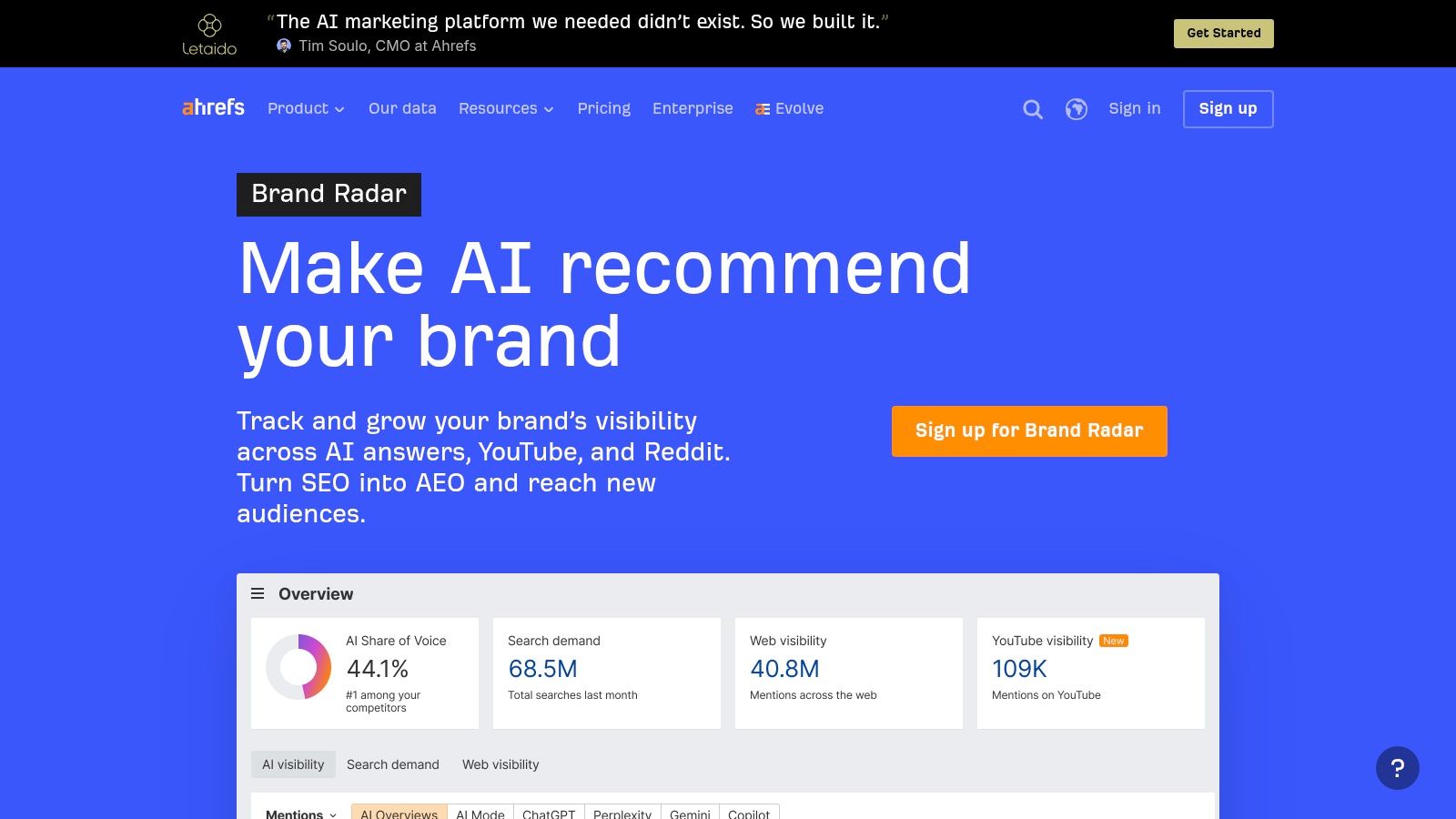
Ahrefs Brand Radar suits teams that want AI visibility inside a mature SEO environment. It maps how brands appear across a large, search-backed prompt dataset and connects those findings with web, video, and social signals. The result is less of a standalone AI monitor and more of a research layer for marketers already working with organic search, backlinks, content, and competitors.
Best fit for an established SEO workflow
Brand Radar supports discovery, custom prompt tracking, competitor comparisons, trend analysis, integrations, and an API. Ahrefs also provides methodology and training documentation, which helps teams understand how modeled prompt data should inform decisions instead of treating visibility scores as direct measures of demand.
Its strongest advantage is context. A content strategist can investigate a visibility gap, inspect competing pages and links, and move into familiar SEO workflows without changing platforms. That matters for organizations with shared reporting, established permissions, and existing Ahrefs expertise.
The trade-off is breadth. Plan and add-on inclusions vary, and usage-based overage can affect budgeting. A team that only wants lightweight AI monitoring may find the broader suite more substantial than necessary, while an Ahrefs-centered department may see that same breadth as the main reason to choose it.
The underlying dataset is a major part of the product story. Ahrefs describes Brand Radar as using a 400M+ modeled, search-backed prompt dataset, a quantitative claim documented on its Brand Radar product page. That scale supports category exploration, not only a fixed list of brand prompts.
Choose Brand Radar when you need to connect AI visibility with conventional SEO research and competitive analysis. Choose a focused tracker when your immediate requirement is prompt archives, citation inspection, or daily answer monitoring without a larger SEO suite.
3. Semrush AI Visibility Toolkit
Semrush’s AI Visibility Toolkit places AI search monitoring alongside its established SEO and competitive tools. It reports on AI mentions, citations, and sentiment across ChatGPT, Google AI Overviews and AI Mode, Gemini, and Perplexity. For an organization already using Semrush for rankings, audits, content, and traffic analysis, that shared environment can simplify reporting.
A practical choice for integrated reporting
The toolkit’s Visibility Overview and Brand Performance reports help teams compare brand presence and competitors in one reporting workflow. Enterprise users can also use AI Visibility Index assets for trend tracking and executive communication, which is useful when leadership wants a concise view of how answer engines describe the company.
Semrush’s value comes from combination. A team can identify an AI citation gap, inspect related organic performance, review content health, and assign work within the same broader marketing stack. That connection makes the platform appropriate for departments where SEO, content, and competitive intelligence already share dashboards and processes.
However, the AI features can involve add-ons, and total pricing may become harder for smaller teams to justify. Historical retention and share-of-voice interpretation have also received mixed user feedback, so buyers should test the exact reports, engine coverage, retention rules, and export options they need before committing.
The useful comparison isn’t “AI tool versus SEO tool.” It’s whether your team needs one reporting system or a more specialized visibility instrument.
Semrush fits the first case. If an agency wants more focused prompt-level work, this AI visibility tracker for agencies provides a useful alternative perspective on organizing prompts, competitors, and citations. Review the Semrush AI Visibility solution for current capability details and package structure.
4. OtterlyAI
OtterlyAI follows a clear path from prompt research to monitoring to optimization. It covers ChatGPT, Perplexity, Google AI Overviews and AI Mode, Gemini, and Copilot, while offering tools for content audits, briefs, crawlability checks, exports, and reporting. That workflow makes it approachable for marketers who are starting to learn GEO or AEO and want more than a simple visibility chart.
Where it earns attention
The platform’s prompt research tools help users turn ordinary search questions into AI-search monitoring opportunities. Its content audit and prediction features then connect those questions to page quality and crawlability, creating a practical bridge between research and content work.
OtterlyAI is often a sensible starting point for budget-conscious teams because it offers entry-level tiers, trials, product education, and a straightforward feature path. A small content team can begin with a manageable prompt set, learn how engines represent its brand, and expand its monitoring only when the workflow proves useful.
The limits are mainly about scale and plan boundaries. Lower tiers may restrict particular engines or prompt volumes, and prompt caps can become a problem for agencies, large sites, or teams monitoring several markets. Buyers should map their desired prompts, refresh frequency, export needs, and engine list against the exact plan rather than assuming all coverage is available at entry level.
The broader market context makes monitoring worth taking seriously. A consumer study reported that 70% of consumers use AI tools for search more than they did a year ago, while 3% use them less, but perceived helpfulness declined from 82% to 54% over the same period. The study and its trust findings suggest that visibility alone isn’t enough. Teams need to watch whether answers cite reliable sources and present the brand in a trustworthy context.
Explore OtterlyAI if you want an accessible way to connect prompt discovery with ongoing AEO work.
5. Promptwatch
Promptwatch combines AI visibility monitoring with automated optimization, earned-media tracking, and agent analytics. It monitors ChatGPT, Gemini, Perplexity, Google AI Overviews, and other listed engines, then adds features such as bot access logs, AEO article generation, API and MCP access, and Looker Studio connectors.
Monitoring plus action
This product is designed for teams that don’t want to stop at measurement. A marketer can monitor prompts, inspect AI bot activity, identify content opportunities, generate material, and send reporting into an analytics workflow. That combination can appeal to agencies and in-house teams with enough operational capacity to manage automated actions responsibly.
Promptwatch’s agent model is its defining feature. Instead of presenting visibility as an isolated metric, it connects monitoring to tasks that may improve discoverability, including content creation and analysis. The platform’s blog and how-to resources also support teams learning how GEO and AEO practices work across different answer engines.
The same design creates complexity. Credits and agents require careful sizing, especially when a team runs frequent research, generation, or reporting tasks. An organization that only needs a clean archive of prompts and citations may find the broader automation layer unnecessary.
Citation measurement should remain central even when automation is available. One Google AI Overviews analysis found that the top 1% of domains captured 47% of citations, while an average overview contained 4.2 citations, with a range from 2 to 9. The citation concentration analysis supports tracking source share and concentration rather than celebrating a single isolated mention.
Review Promptwatch when your team wants monitoring connected to content operations. For a direct platform comparison, Llumo versus Promptwatch highlights differences in citation analysis, prompt archives, and usage models.
6. Peec AI
Peec AI focuses on clear, operational AI visibility tracking for brands and agencies. It compares presence across ChatGPT, Gemini, Perplexity, and Google surfaces, with views for engine, position, sentiment, and citations. Its project and competitor structures help teams organize prompts for longitudinal monitoring rather than treating every answer as a disconnected observation.
Clear metrics for recurring work
Peec AI’s documentation is a practical strength. Teams new to AEO often struggle to define visibility, citation presence, position, sentiment, and competitor comparisons consistently. Clear metric explanations make it easier to build a repeatable process for reporting and optimization.
The project model also suits agencies managing several brands or markets. Users can organize prompts with tags, allocate them across projects, and compare results by country or language. That flexibility matters when a translation isn’t a direct substitute for the original query and when the same brand may receive different treatment across markets.
Peec AI is less focused on execution than tools with agentic content workflows. It can show where a brand appears, which sources answer engines cite, and how competitors perform, but teams may need a separate content planning or production system to act on those findings.
A visibility score becomes useful only after everyone agrees on what the score includes.
That principle is especially important because citation sources don’t always align with traditional rankings. One independent analysis found that 38% of AI Overview citations came from pages in the traditional top 10, while 44% came from pages ranked 11 to 100 and 18% came from sources outside the top 100. The ranking and citation comparison shows why ordinary SERP tracking can miss content that answer engines cite.
Choose Peec AI when transparent metric definitions, prompt organization, and agency-friendly monitoring matter more than built-in content generation.
7. Rankscale
Rankscale is an AI visibility tracker built around broad engine coverage, credit-based usage, and agency reporting. It monitors ChatGPT, Perplexity, Google AI Overviews and AI Mode, Gemini, Claude, DeepSeek, Grok, Copilot, and other listed surfaces. Paid plans use credits with rollover, giving cost-conscious teams a way to adjust monitoring without committing to a fixed prompt structure.
Useful for agencies and lean teams
Rankscale supports shareable and white-label dashboards, REST API access, page audits, prompt research, and exports to Looker Studio, CSV, and Sheets. Those features make it practical for agencies that need to present visibility findings to clients without rebuilding every report manually.
Its credit calculator and transparent plan matrices can also help with planning. The important word is forecasting. Credit systems provide flexibility, but teams must understand how prompts, engines, refreshes, audits, and exports consume the allowance. Without that discipline, an apparently affordable plan can become difficult to manage.
Advanced analytics may require higher tiers or API work, so Rankscale is best evaluated against a specific reporting requirement. If you need simple multi-engine visibility and client-facing dashboards, it may be a strong fit. If you need deep source analysis, automated content execution, or extensive historical archives, compare those workflows directly before choosing.
Citation volatility adds another reason to review results over time. A ChatGPT web-search study examined 150 runs, found web consultation in 32 runs, or 21%, and recorded an average of 7.8 sources per answer when search occurred. It also found that 85% of cited URLs did not recur across three identical runs. The run-to-run citation study demonstrates why one snapshot shouldn’t determine a content strategy.
Visit Rankscale if broad model coverage, rollover credits, white-label reporting, and export flexibility are central to your monitoring plan.
Profound Alternatives: 7-Tool Comparison
Platform | 🔄 Implementation complexity | ⚡ Resource requirements | 📊 Expected outcomes | 💡 Ideal use cases | ⭐ Key advantages |
|---|---|---|---|---|---|
Llumo | Medium, BYO provider API setup and cost planning | Pay-as-you-go provider costs; higher prompt headroom | Deep prompt-level visibility, citation analysis, SOV trends | Measurement-focused teams & digital PR needing prompt-level insight | No SaaS license fee; detailed citation/source analysis |
Ahrefs Brand Radar | Medium, integrated into existing Ahrefs stack | Requires Ahrefs subscription/add-ons; large dataset compute | AI visibility tied to web/video/social signals and SEO context | Organizations already standardized on Ahrefs | Massive modeled dataset; mature SEO integrations & docs |
Semrush AI Visibility Toolkit | Medium, integrated; some features as add-ons | Semrush subscription; enterprise resources available | Combined AI mentions with SERP, traffic, and content analytics | Brands wanting unified SEO + AI reporting and executive assets | All-in-one SEO+AI environment with enterprise reporting |
OtterlyAI | Low, quick onboarding and entry-level tiers | Budget-friendly plans; lower tiers may limit engines/volume | Prompt research → monitoring → briefs with day-one coverage | Budget-sensitive teams starting AEO/GEO monitoring | Fast to onboard; clear research-to-optimization workflow |
Promptwatch | Medium–High, credits/agents model and connector setup | Credits/agents consumption; sizing required for automation | Monitoring plus automated content generation and agent analytics | Teams wanting monitoring paired with automated optimization agents | Combines visibility with prescriptive/on‑platform content creation |
Peec AI | Low–Medium, project/tag setup with clear metrics | Usage/prompt-based pricing; regional sales for tiers possible | Side-by-side engine comparisons, sentiment, citations | Agencies and multi-brand teams needing operational clarity | Strong metric definitions and practical operational documentation |
Rankscale | Low–Medium, credit-based metering to configure and monitor | Low entry price; credit roll-over; white-label/reporting exports | Broad engine coverage, exports and white‑label dashboards | Cost-conscious teams/agencies monitoring many engines | Transparent pricing matrix; wide model coverage at low entry cost |
For AEO teams, wording research and visibility measurement belong together. Track whether question-based pages earn mentions, which sources receive citations, and whether your brand appears in the most useful answer contexts. Llumo can archive responses at the prompt level, compare competitors, and analyze citation sources across AI engines, giving editors evidence for deciding which language and pages deserve another revision.
Llumo helps teams measure how AI answer engines mention and cite their brands across platforms, with per-prompt archives, share-of-voice trends, competitor comparisons, and citation analysis. If you’re turning precise language and question-based content into an AEO program, visit Llumo to evaluate the visibility signals behind those answers.