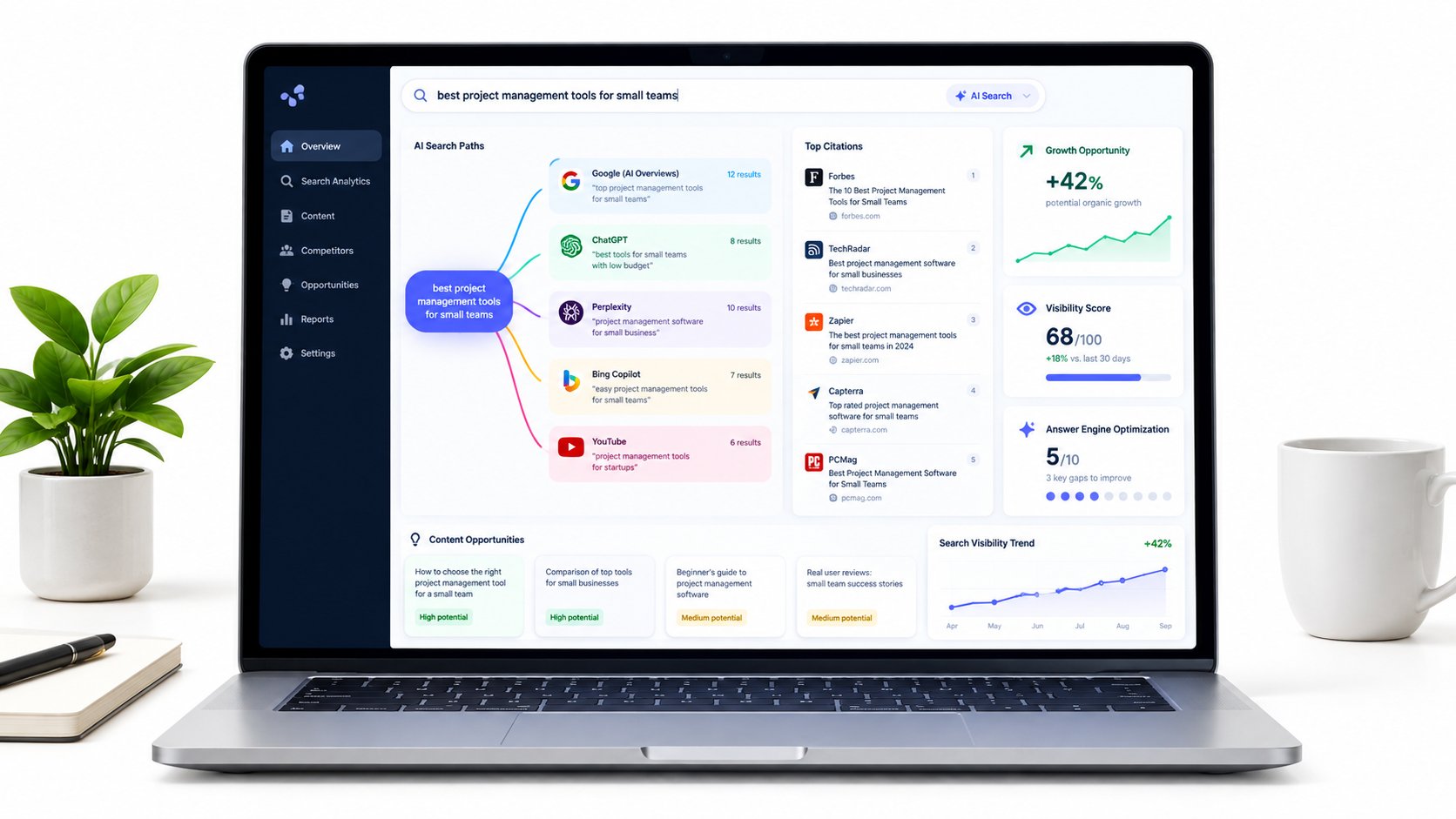
You ask an AI search tool a complicated question, and the answer comes back neatly organized. It compares options, anticipates follow-up concerns, adds context, and cites several sources. It feels like the system understood one question. In reality, it may have treated your prompt as a research assignment and searched several smaller questions before writing the response.
That process is known as query fan-out. For SEO and AEO teams, it changes the unit of analysis. You're no longer studying only the phrase a person types. You're studying the related intents an answer engine may retrieve, the sources it selects, and the specific places where your brand can earn a mention or citation.
I've found that fan-out logs are especially useful as a keyword discovery engine. They reveal questions traditional keyword tools often miss, including the hidden searches that have no measurable search volume. They can also expose translated and regional variations that English-only research leaves untouched.
Introduction Why One Prompt Triggers Many Searches
Say you ask Google AI Mode, “What's the best project management software for a distributed product team that needs reporting, integrations, and predictable pricing?”
A conventional search might return pages targeting “best project management software.” An AI search system has more work to do. It may look separately at software for distributed teams, reporting features, integration support, pricing models, implementation concerns, and perhaps comparisons between recognizable products. It then combines those findings into one answer.
Google's documentation for AI features says that AI Overviews and AI Mode may use query fan-out, issuing multiple related searches across subtopics and data sources before constructing a response. Google also stated that, in its biggest markets, AI Overviews drove over a 10% increase in Google usage for the types of queries that show AI Overviews, as of May 20, 2025. That makes fan-out more than an interesting retrieval technique. It's part of a mainstream search experience that's influencing how people explore information.

The visibility challenge follows naturally. Your page might rank well for the head term but fail to address the supporting questions the engine uses to build its answer. Another page might appear in the final response because it clearly handles one narrow sub-intent, even if it isn't the traditional top result for the original phrase.
Independent measurement cited in industry coverage found AI Overviews on 13.14% of search results in one Semrush-based analysis. Ahrefs' study of 300,000 keywords reported a 34.5% lower click-through rate at position one when an overview was present, later updating that figure to a 58% reduction in February 2026. Those figures point to a shift in how visibility and traffic are allocated, not just a new label for old keyword research.
The practical question is simple: What did the engine search behind the prompt, and where could your content become useful?
What Query Fan Out Really Means in Plain English
Think of a research assistant who receives one broad assignment: “Help me choose a laptop for university, long battery life, and video editing.”
The assistant probably won't search that sentence once and stop. They'll split the assignment into smaller errands:
Audience: Which laptops suit university students?
Constraint: Which models have long battery life?
Capability: What supports video editing?
Decision: Which options balance all three needs?
They'll gather findings from different sources, compare the evidence, resolve conflicts, and return one recommendation. Query fan-out works in much the same way.
A generative search engine starts by interpreting the prompt. It identifies the subject, constraints, implied comparisons, missing context, and likely follow-up questions. It then creates several distinct sub-queries, often runs them in parallel, and merges the useful results into a synthesized answer. Conductor's explanation of query fan-out describes this as decomposing one complex prompt into multiple sub-queries, retrieving evidence for each, and combining the result.
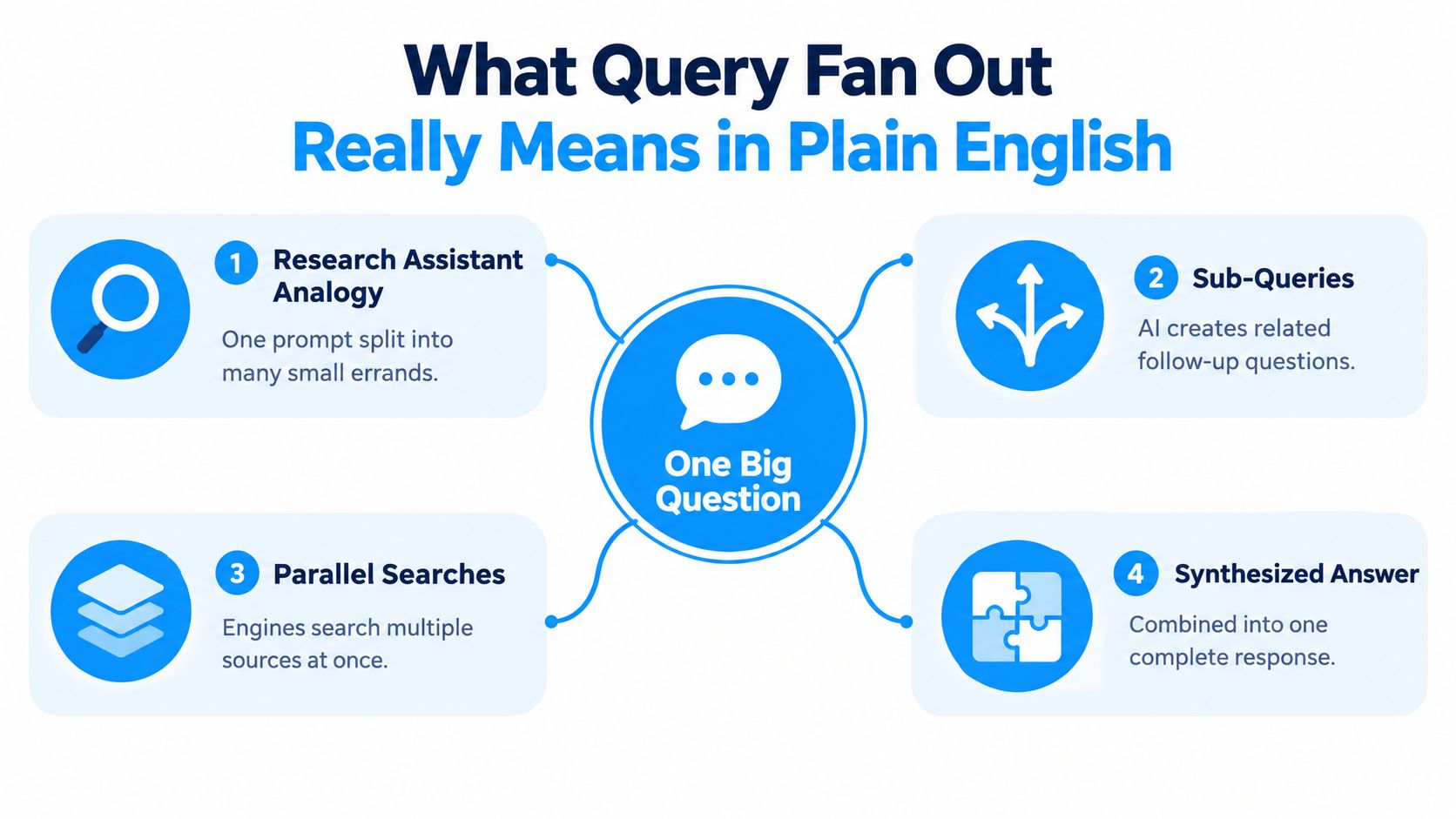
A useful definition: Query fan-out is when an AI search system turns one complex prompt into several related searches, gathers evidence from each, and synthesizes the findings into one answer.
That definition also clarifies what fan-out isn't. It isn't merely rewriting “best CRM for startups” as “top startup CRM.” A rewrite may preserve one intent in different wording. Fan-out explores several connected intents, such as onboarding, integrations, reporting, pricing, support, and suitability for a particular team.
The benefit is broader coverage. A system can retrieve evidence that a single literal search might miss. The risk is synthesis quality. Every additional result set creates another opportunity for conflicting claims, weak sources, mismatched context, or an answer that blends details incorrectly.
For an AEO practitioner, the mental model is:
One prompt expresses a need.
The system identifies the smaller questions inside that need.
Each question becomes a retrieval opportunity.
The engine selects and combines evidence.
The final answer reflects the strongest usable sources it found.
That's why a page should answer the decision, not just repeat the wording of the original prompt.
How Generative Engines Expand Queries Behind the Scenes
The process usually starts with intent analysis. A prompt such as “Which accounting platform should a growing ecommerce business choose?” contains several possible retrieval paths. The engine may need product comparisons, ecommerce integrations, inventory support, reporting, pricing context, and implementation information.
Google's Search Central documentation confirms that AI Overviews and AI Mode may use fan-out across subtopics and data sources. The wider industry also uses the term for similar behavior in systems such as ChatGPT and Gemini, although platforms may describe the mechanics differently.
SEER Interactive reported an average of 10.7 fan-out queries per prompt in one analysis, with 11,029 unique fan-outs across 1,300 total prompts. It also found that 95% of fan-out queries had zero monthly search volume, which is one of the most important findings for content teams. Traditional keyword platforms can't provide a complete picture of searches that produce no measurable volume.
Another published sample summarized in industry reporting found that 36.4% of ChatGPT prompts produced two searches and 52.9% produced three, meaning 89.3% of prompts expanded into two or three underlying searches in that dataset. A separate industry claim describes complex prompts as often producing roughly 8 to 12 parallel sub-queries. These observations vary by system, prompt, and workflow, but they all support the same conclusion: one visible prompt can represent a cluster of retrieval paths.

The scale matters for visibility. Industry writeups have described fan-out assumptions where a keyword with 1,000 monthly searches could create 8,000 to 12,000 retrieval opportunities in AI Mode. That isn't a forecast of traffic or guaranteed exposure. It's a way to understand why a head-term ranking can represent only a small part of the surface area an answer engine evaluates.
Fan-out can also include localization. The system may look for a city, market, local provider, translated source, or region-specific policy. Public guidance discusses translation as a possible fan-out type, but the available material doesn't quantify how often systems use translated or locale-specific sub-queries. That uncertainty matters. A brand may be relevant in English but absent from the regional sources an engine selects.
Visibility follows coverage: If the answer requires several sub-intents, your brand needs useful evidence across several of them.
If you're building a repeatable prompt set, keep it organized by user intent and business decision rather than by isolated keywords. This guide to building a prompt set can help you structure that starting point.
How to Log and Analyze Fan Out Without Guesswork
The most useful fan-out data comes from actual prompt runs, not assumptions about what an engine might search. Start with a focused prompt set that reflects real customer tasks. Include discovery prompts, comparison prompts, problem-solving prompts, commercial prompts, and location-sensitive prompts where they matter.
Run each prompt consistently, then save more than the final answer. A useful record includes:
Original prompt: The exact question submitted.
Expanded searches: The visible or captured sub-queries.
Answer text: The complete response, not a clipped excerpt.
Citations: Domains and individual pages used as evidence.
Brand presence: Whether your brand appeared, where it appeared, and how it was described.
Competitor presence: Which alternatives appeared alongside or instead of you.
Market context: Language, country, city, or audience constraint.
Run details: Model, search surface, date, and prompt version.
Organize logs around intent clusters
Don't create a spreadsheet where every row is treated as an independent keyword. Group related expansions under a practical intent cluster, such as “implementation,” “pricing,” “security,” “local availability,” or “alternatives.” This makes patterns easier to spot when the wording changes but the underlying need remains stable.
Tag each expansion by role. A comparative query asks the engine to weigh options. An implicit query reveals a concern the user didn't state directly. A contextual query adds geography, company size, industry, or personal circumstances. A next-step query reflects what the user may ask after receiving the first answer.
This resource on uncovering hidden search terms with AI offers a useful parallel: the valuable insight often sits beneath the obvious query label.
Review the log for patterns
Look for recurring sub-intents, repeated cited domains, missing brand references, and differences between markets. Archive responses rather than overwriting them. AI answers can change as retrieval results, source selection, and prompt context change, so a historical record helps you distinguish a persistent gap from a one-off variation.
Track coverage, citation share, source diversity, and brand positioning. Don't treat the number of generated sub-queries as a success metric by itself. More expansion creates more data, but it doesn't automatically mean stronger visibility or better recommendations.
Turning Fan Out Into Keywords and Content Opportunities
Fan-out logs become useful when they change what you publish. The hidden 95% of fan-out queries with zero monthly search volume, reported by SEER Interactive's query fan-out analysis, shouldn't be dismissed as useless. These queries are intent signals. They show the questions an answer engine considers relevant, even when traditional tools can't estimate demand.
Start by normalizing wording without flattening meaning. “Best expense software for remote teams” and “expense management for distributed companies” may belong in one cluster, while “does it support approval workflows?” represents a separate product requirement. Preserve those distinctions because they point to different content jobs.
Then compare the fan-out cluster with your existing pages. A sub-query may reveal:
A missing section on a strong page.
A comparison that deserves its own article.
A product detail that belongs on a commercial page.
A regional question requiring localized content.
A source or mention gap that content alone won't solve.
Use a simple prioritization model
Prioritize opportunities using the likely visibility value and the work required. The table below is intentionally qualitative. Fan-out data helps you judge opportunity, but it doesn't guarantee citation or traffic.
Signal in Fan Out | What It Suggests | Best Next Move |
|---|---|---|
The same sub-intent appears across several prompts | The need is structurally important, not an isolated wording choice | Add a clear section to a relevant authority page |
A competitor answers the sub-intent and your brand doesn't | The engine has evidence for the category, but not for your position | Publish a direct comparison, explanation, or proof point |
The query concerns a product attribute | Buyers need concrete information before choosing | Add precise, easy-to-extract details to the product or service page |
The expansion includes a city or region | Source selection may depend on local relevance | Create localized content and strengthen regional references |
A translated expansion retrieves different domains | English content may not represent your authority in that market | Review native-language pages, local citations, and regional entities |
A zero-volume query repeats but has weak coverage | Traditional demand estimates are hiding a retrieval opportunity | Treat it as a content hypothesis and test it in prompt tracking |
Several queries point to one broad topic | A cluster may need a connected content system | Build or refine a pillar page with supporting pages |
Don't publish English pages by default
Multilingual fan-out is one of the least measured parts of this topic. Explainers mention translation and locale-specific expansion, but public data doesn't establish how often these variants occur or which content attributes consistently win citations in non-English markets.
That uncertainty is a reason to inspect the logs, not to ignore the issue. If translated searches repeatedly surface local publications, directories, community pages, or regional experts, adding more English copy may not address the underlying gap. Regional authority and localized entity signals can matter more than page count.
Putting Fan Out Insights Into Your AEO Workflow
A useful fan-out program needs a clear operating rhythm. Give one person responsibility for maintaining the prompt set, another for reviewing content or citation gaps, and a named owner for each resulting task. Keep prompts tied to important markets, audiences, and buying situations, then schedule reviews across the answer engines your organization cares about.
Turn observations into assigned work
Set a review cadence that matches how quickly your market changes. A weekly check can catch new competitors or source shifts, while a monthly planning session gives content, SEO, PR, and regional teams time to act on recurring findings. Keep the cadence consistent so a quiet period does not look like a permanent improvement.
Use a shared board with four fields:
Owner: Name the person or team accountable for the task.
Action: State the change clearly, such as revising a comparison page, adding a regional example, or pursuing a third-party citation.
Priority: Rank the task by business relevance, recurrence, and effort.
Check date: Set when the team will review the affected prompts again.
A dashboard should make those decisions easy. Include prompt search, tags, filters, model comparison, market segmentation, citation analysis, and response archives. Add status fields for newly cited pages, lost sources, unresolved tasks, and completed tests. The point is to turn a retrieval observation into work that someone can finish and verify.
Review changes with the people who can act on them. Content owners can update missing explanations. Product or commercial teams can confirm details. Regional specialists can assess translated or local-market needs. PR and partnerships can address repeated reliance on external authority that your site cannot create alone.
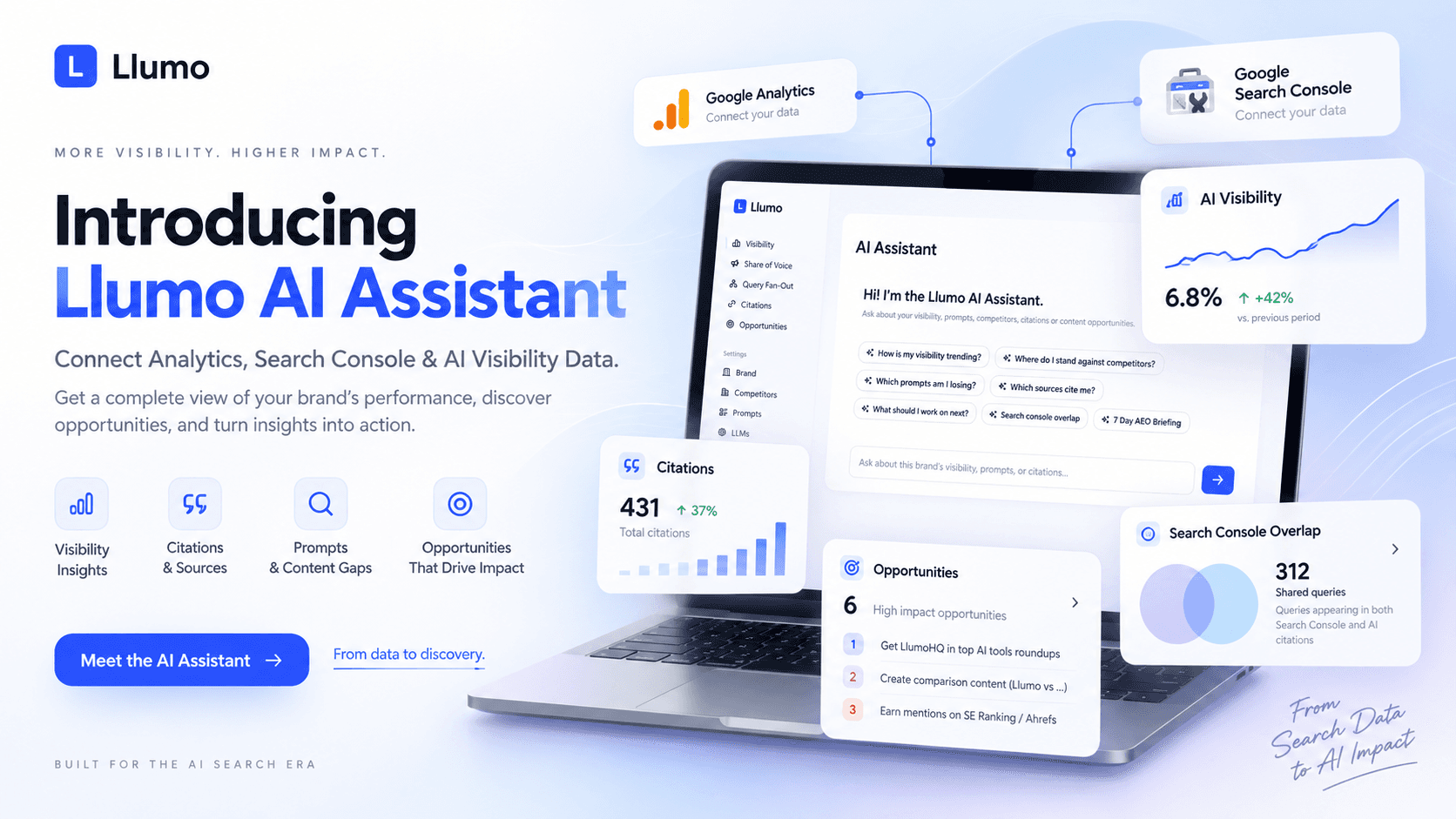
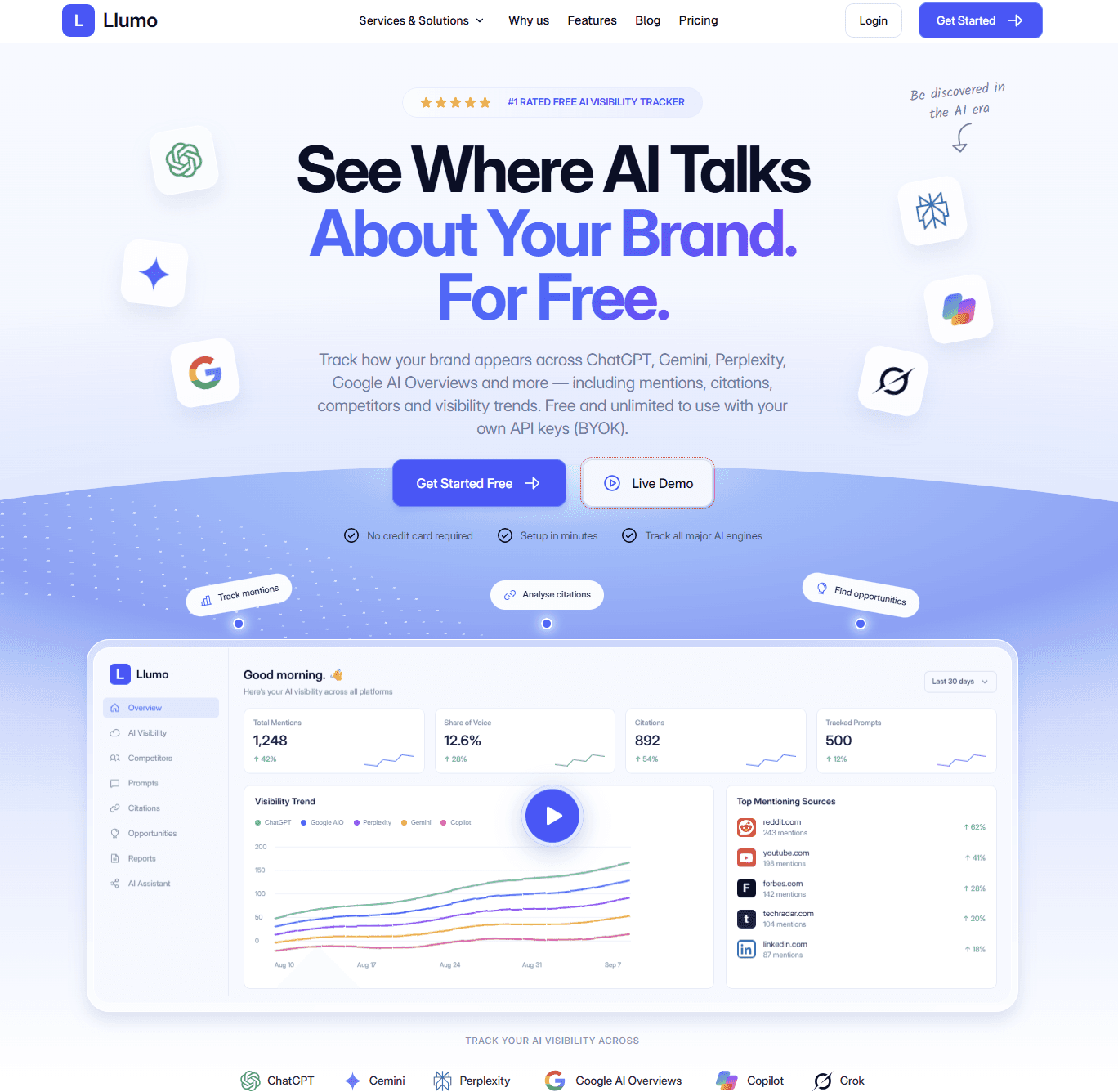
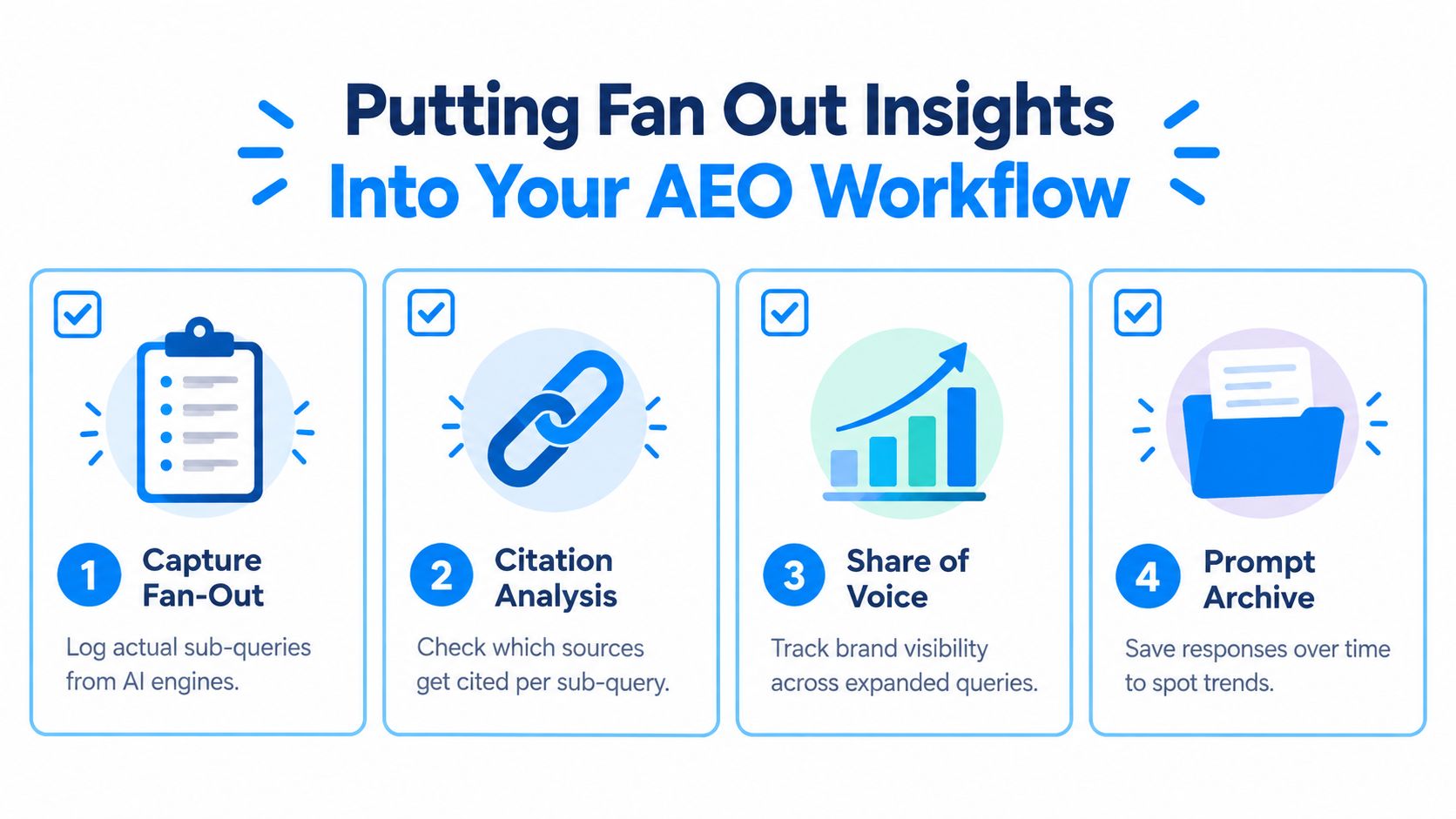
Llumo logs AI-generated searches and expansions behind prompts, with per-prompt visibility, share of voice, citation sources, competitor trends, and archived responses across multiple AI surfaces. That type of workspace can connect a hidden sub-query to a specific content, citation, or brand-mention task.
For the wider operating model, see this guide to answer engine optimisation in 2026. Before adopting a platform, check how it handles provider access and usage. Transparent fan-out records are easier to audit than a single score that conceals the searches behind it.
Key Takeaways and Your Next Steps With Query Fan Out
Query fan-out changes the question you ask about search visibility. Instead of asking only, “Do we rank for this keyword?” ask, “What related questions does the engine retrieve, and which sources does it trust for each one?”
Three habits will take you a long way:
Log consistently: Save the original prompt, expanded searches, response, citations, and market context.
Cluster by intent: Group different wordings that express the same need, while keeping distinct concerns separate.
Prioritize by impact: Fix repeated coverage gaps first, then address citation and regional authority gaps that require broader work.
You don't need a massive research program to begin. Choose a small prompt set for one important customer journey, run it across the answer engines you care about, and mark every expansion your existing content doesn't answer clearly. Then ship one specific improvement, such as a missing comparison section, a localized explanation, or a better product detail, and monitor whether the relevant prompts begin to cite or mention your brand.
The most valuable fan-out query may never appear in a keyword planner. That doesn't make it irrelevant. It may be the exact retrieval path connecting a customer's question to the source an AI engine chooses.
Start next week by exporting your first fan-out log, tagging its intent clusters, and assigning one content improvement to your team. Measure the change through prompt-level mentions, citations, source coverage, and competitor visibility, not vanity keyword counts.
If you want to see the searches behind your AI answers, visit Llumo to explore query fan-out logging, citation analysis, prompt archives, and cross-model visibility tracking. Use the first workspace to turn hidden sub-queries into specific content and AEO actions.