
Google Ads gives advertisers a Search Terms report, but it does not necessarily show every individual query that generated traffic. That creates an uncomfortable question: what are you actually paying for inside the search terms Google does not show you?
Google explains that some lower-activity queries may be omitted from the Search Terms report for privacy reasons. Search Term Insights can still account for those queries by grouping them into themes, subthemes or “other queries”, but the individual searches themselves are not necessarily exposed. Google Ads Help
So I built a Google Ads Script to attack the problem from a different direction. It does not claim to bypass Google’s privacy controls or extract suppressed search strings. Instead, it measures the missing traffic mathematically, analyses everything Google does reveal, and then uses AI to reconstruct the most likely search behaviour sitting inside that hidden portion of spend.
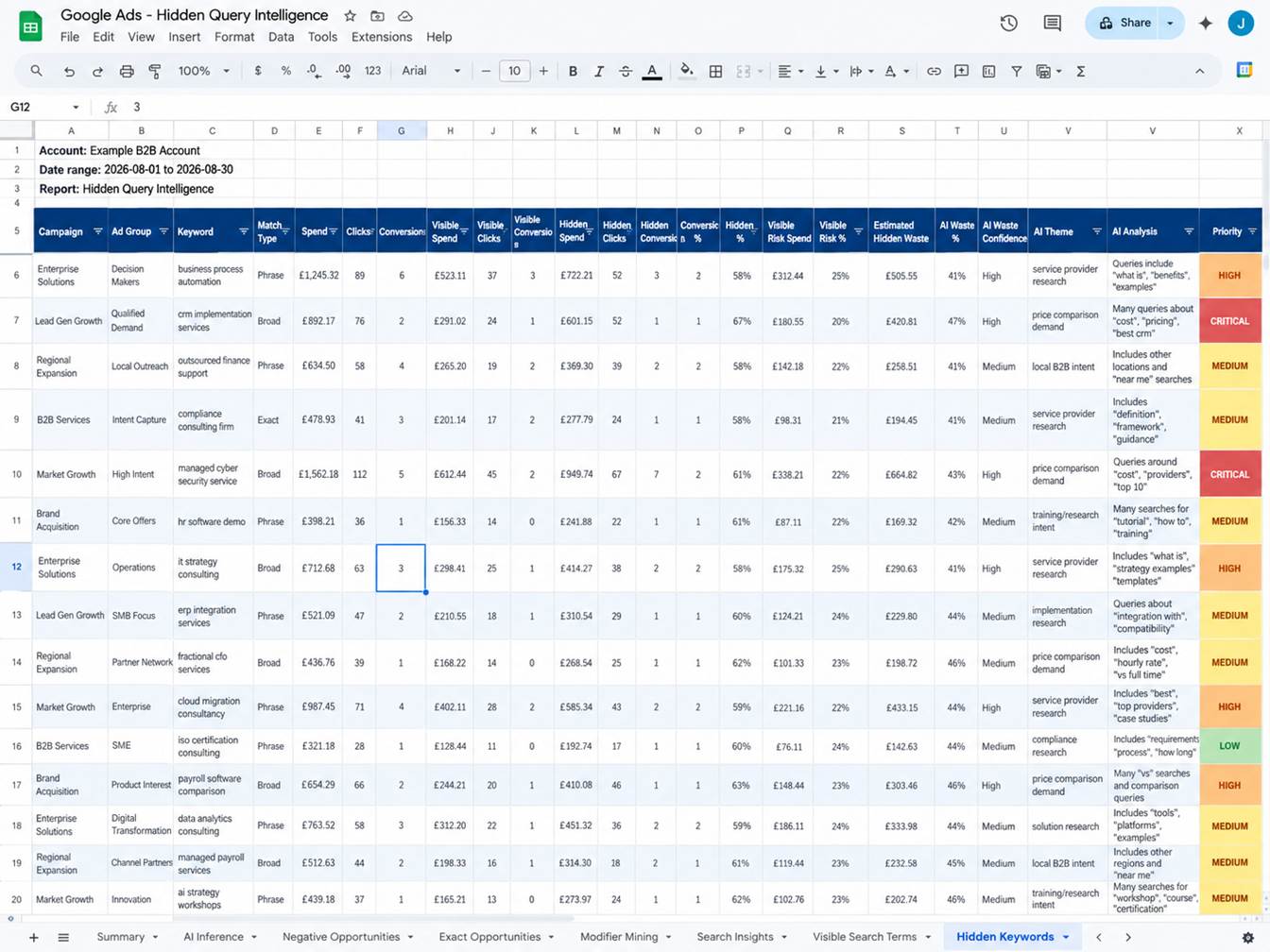
Example Google Sheets output from the Hidden Query Intelligence script. Data shown is illustrative.
What Are “Hidden” Search Terms in Google Ads?
A search keyword and a search term are not the same thing. The keyword is what the advertiser targets. The search term is what the person actually typed or searched for.
Google’s Search Terms report is designed to help advertisers understand which searches triggered their ads, and the report can also show which keyword was responsible for matching that query. Google Ads search terms guidance
But not every query necessarily appears individually. Google states that some queries with insufficient activity are omitted from the Search Terms report to meet its privacy standards. Those searches may still contribute to aggregated reporting and Search Term Insight categories.
Keyword spend: £1,000
Visible search-term spend: £720
-------
Unaccounted spend: £280
You know the £280 happened. You know which keyword generated the overall traffic. But you do not necessarily know the individual searches responsible for every penny of that £280. That difference is the starting point for the script.
Step One: Calculate the Hidden Search-Term Gap
The first part requires no AI at all. The script retrieves performance at keyword level and compares it with all visible search terms associated with that keyword.
Calculated Hidden Spend =
Keyword Spend - Visible Search-Term Spend
Hidden Clicks =
Keyword Clicks - Visible Search-Term Clicks
Hidden Conversions =
Keyword Conversions - Visible Search-Term Conversions

Illustrative example showing how total keyword spend can be reconciled against the search terms visible in reporting.
This immediately tells us where the biggest visibility gaps exist. A keyword with a 3% hidden-spend gap is usually less urgent than one where a large share of spend cannot be reconciled against individually visible search terms.
The script therefore prioritises keywords by both the amount of hidden spend and the percentage of total spend that is hidden.
Step Two: Work Backwards From the Queries Google Does Show
The next question is whether visible queries can teach us anything about those Google does not expose individually. Often, they can.
If a keyword repeatedly attracts visible searches containing commercial modifiers such as:
company provider quote pricing
local specialist service cost
that tells us something about how Google is matching that keyword. Likewise, repeated appearances of low-commercial-intent modifiers can reveal another pattern:
jobs salary training course
free definition template how to
The script breaks visible search terms into tokens and modifiers, then measures the spend, clicks and conversions associated with each pattern. This creates a behavioural fingerprint for each keyword.
A keyword whose visible traffic frequently contains research-oriented searches has a different matching profile from one whose visible traffic is dominated by strong commercial searches.
Step Three: Add Google Search Term Insights
There is another useful source of evidence: Search Term Insights. Google says Search Term Insights create intent-based categories and subcategories using the searches that generated traffic. Those categories can include searches that are not individually exposed in the standard Search Terms report because of privacy-related thresholds. Read Google’s Search Term Insights documentation
That makes the categories useful for this kind of analysis. For example, a campaign might show grouped themes around price comparison, local suppliers, implementation, training or career research even when the individual hidden strings are not available.
The script therefore combines three evidence layers: keyword-level totals, visible search behaviour, and Google Search Term Insight themes. Only after those layers are assembled does AI become involved.
Step Four: Use AI to Reconstruct Likely Hidden Search Behaviour
For keywords with meaningful hidden spend, the script sends a controlled set of information to an AI model: the triggering keyword, campaign context, visible search terms, modifier patterns, Search Term Insight categories and the calculated hidden totals.
The AI is explicitly instructed that it does not know the literal hidden queries. Its job is to produce plausible candidates supported by the available evidence.
Inferred query | Confidence | Intent | Recommendation |
service provider quote | 92% | Commercial | ADD_EXACT |
local specialist near me | 88% | Local commercial | ADD_EXACT |
business installation cost | 76% | Commercial research | MONITOR |
jobs | 71% | Employment | ADD_NEGATIVE |
training course | 64% | Training | ADD_NEGATIVE |
Notice the terminology: Inferred Query, not Actual Search Term. That distinction is essential. AI can make the available data more useful, but it cannot magically reverse Google’s privacy filtering.
How the Confidence Score Works
The model is not simply asked to “guess some searches”. Candidate confidence can be grounded in evidence such as:
· Similarity to the triggering keyword and campaign intent.
· Recurring modifiers found in actual visible queries.
· Alignment with Google Search Term Insight categories.
· Commercial or local intent signals.
· Observed conversion behaviour in related visible searches.
· Whether the candidate resembles strong converting patterns or known low-value patterns.
This creates a useful distinction between high-confidence opportunities, medium-confidence hypotheses that deserve investigation, and low-confidence ideas that should only be monitored.
This matters especially for negative keywords: automatically excluding traffic because an AI model imagined a query would be reckless.
Finding Hidden Waste
One of the most useful outputs is an estimate of potential waste sitting inside the hidden portion. The estimate should be conservative and treated as an optimisation signal, not an accounting statement.
Hidden spend: £500
Visible low-value traffic rate: 20%
Estimated hidden waste: £100
Confidence: Medium
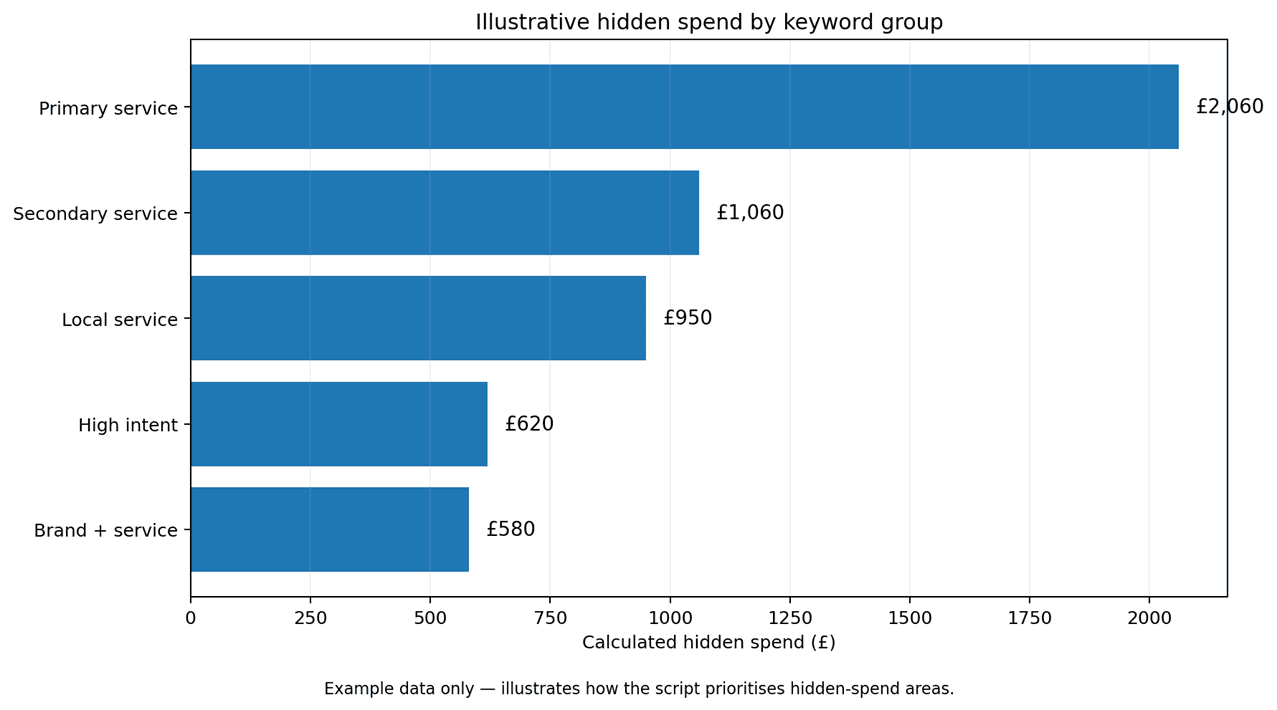
Illustrative example showing how the script can rank keyword groups by calculated hidden spend so the largest opportunities are investigated first.
The goal is to tell the advertiser “this keyword deserves investigation” — not “we know exactly what every hidden search was.”
Finding New Exact-Match Opportunities
Hidden traffic is not necessarily bad traffic. Some of it may represent valuable commercial searches. The script therefore analyses visible converting queries as well as inferred high-commercial-intent patterns.
If a phrase repeatedly demonstrates strong intent but is currently being captured through a broader keyword, it can be surfaced as an exact-match opportunity. For visible searches, this is particularly useful because the recommendation is based on a query Google actually disclosed.
That turns the script into more than a waste finder. It becomes a query discovery engine.
Finding Better Negative Keywords
Google itself recommends using the Search Terms report to identify irrelevant searches that could be added as negative keywords. Google Ads negative-keyword guidance
The script extends that workflow by automatically flagging visible non-converting searches containing undesirable intent patterns, then looking for related patterns inside the inferred hidden-query layer.
A negative based on an actual visible query has hard evidence behind it. A negative based on an inferred query remains a hypothesis and should be reviewed carefully before anything is excluded.
Why the Spreadsheet Has So Many Tabs
The output is intentionally auditable rather than a single black-box AI recommendation.
Sheet | Purpose |
Summary | Overall visible spend, hidden spend, hidden clicks and estimated waste. |
Hidden Keywords | Keywords ranked by calculated hidden traffic. |
AI Inference | Likely hidden-query candidates, confidence, intent and recommended action. |
Negative Opportunities | Potential exclusions requiring manual review. |
Exact Opportunities | High-intent terms worth considering as exact keywords. |
Modifier Mining | Recurring commercial, informational and irrelevant query modifiers. |
Search Insights | Categories supplied by Google Search Term Insights. |
Visible Search Terms | The actual search queries Google disclosed. |
An advertiser should always be able to tell whether a recommendation came from Google data, a mathematical calculation or AI inference.
What This Script Cannot Do
It cannot reveal search queries that Google has deliberately chosen not to expose. No Google Ads Script, prompt or external AI model changes that.
What it can do is much more defensible: measure the missing traffic, understand visible matching behaviour, analyse Google’s grouped query themes, identify recurring modifiers, reconstruct plausible query families, assign confidence and investigate the highest-value opportunities.
Measure the missing traffic
↓
Understand visible matching behaviour
↓
Analyse Google query themes
↓
Identify recurring modifiers
↓
Reconstruct plausible query families
↓
Assign confidence
↓
Investigate the highest-value opportunities
What About Performance Max?
The version described here focuses primarily on standard Search campaign keyword analysis. Google’s developer documentation notes that search-term reporting for Performance Max uses campaign-level search-term reporting rather than the standard Search `search_term_view`. Google Ads API search term view documentation
A future version could treat Performance Max separately and run similar theme and opportunity analysis against the data Google makes available there.
The Bigger Point: Search Marketing Is Becoming an Inference Problem
This experiment highlights something broader than one Google Ads report: marketers increasingly operate with partial visibility.
· In paid search, not every individual query is necessarily exposed.
· In organic search, attribution is incomplete.
· In AI search, brands can appear inside generated answers without the neat keyword-to-click reporting marketers became accustomed to.
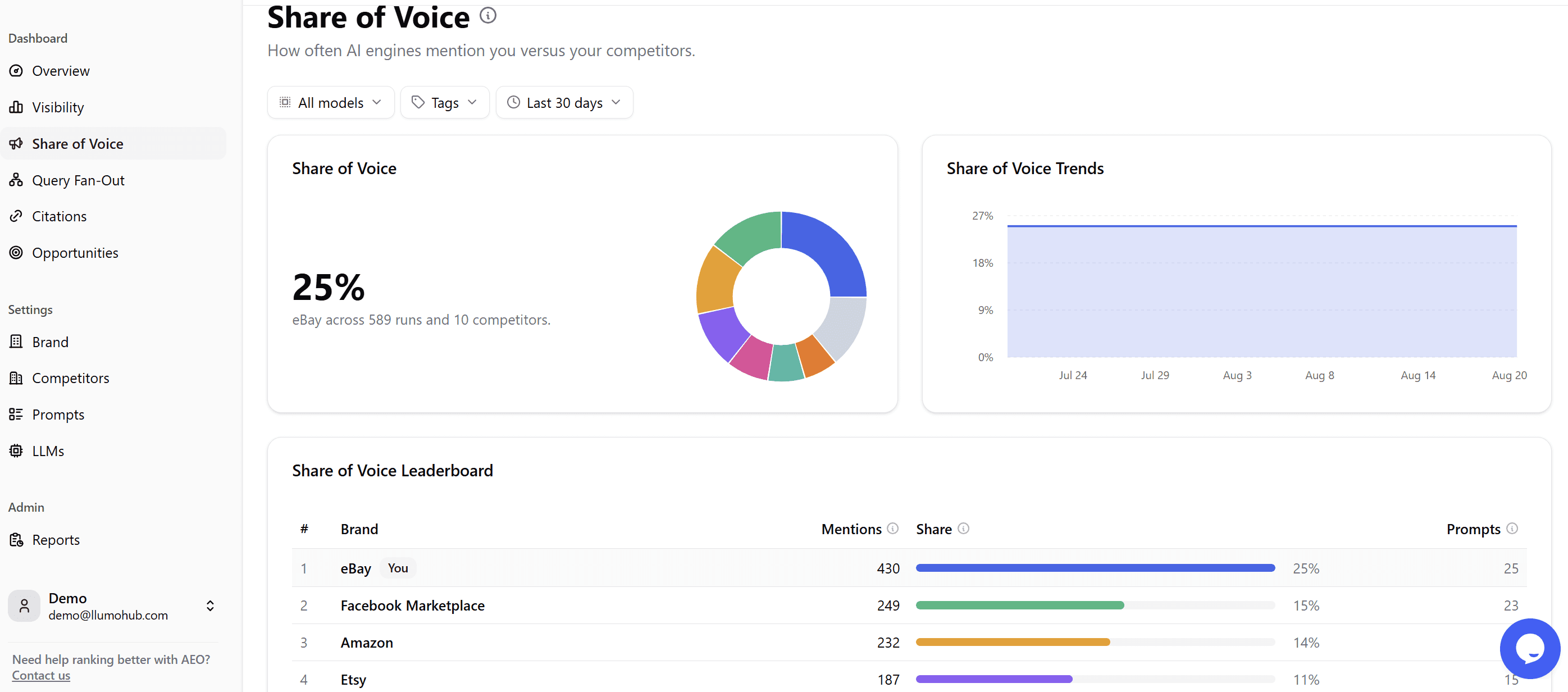
That is one reason we built LLumo. LLumo focuses on another visibility gap: understanding how brands appear across AI-driven search and answer engines, which competitors are being recommended, which sources are being cited and where visibility opportunities exist. Explore LLumo
The underlying philosophy is similar: do not stop at the metric the platform gives you. Build enough context around it to understand what is actually happening.
Should You Use AI to Optimise Google Ads?
Yes — but use AI for interpretation, not for inventing the underlying numbers.
The script lets Google Ads remain the source of truth for spend, clicks, conversions, keywords and visible queries. AI sits above that data. Its role is to classify, cluster, reconstruct and prioritise.
Google provides the facts.
Code performs the calculations.
AI helps interpret the patterns.
The advertiser makes the final decision.
Final Thoughts
You may never get every individual Google Ads search query back. But that does not mean the hidden portion of the account has to remain a complete black box.
By reconciling keyword-level performance against visible search terms, analysing Search Term Insights, mining query modifiers and using AI as an inference layer, you can build a much clearer picture of where hidden spend is likely going.
The objective is not to pretend we can see data Google has withheld. It is to extract more intelligence from the data we still have.
Want to understand the other side of modern search visibility? LLumo helps brands track how they appear across AI-driven search experiences, identify citation and content gaps, benchmark competitors and understand where they are - and are not - being surfaced by AI. Paid search has hidden queries. AI search has hidden visibility. Both require a better intelligence layer. Visit LLumo |