68.01% of Google searches in the United States ended without an external click in the first four months of 2026, so the best AEO agency is the one that can prove where your brand appears inside answers, not just where it ranks. For teams seeking measurable, multi-model visibility with managed execution, Llumo is the strongest fit, while the other agencies suit enterprise consulting, integrated performance, content and PR, reputation, thought leadership, or entity work.
Traditional SEO reports can show rankings while missing the more important question, whether ChatGPT, Gemini, Perplexity, Copilot, or Google AI Overviews mention and cite your brand. That gap changes how buyers should assess an AEO partner. The right evaluation should cover prompt-level measurement, citation evidence, technical relevance, entity clarity, content authority, execution capacity, scalability, and the engagement model.
The market context is substantial. Mordor Intelligence estimates AI search visibility services at USD 4.39 billion in 2026, up from USD 3.71 billion in 2025, with a projection of USD 10.72 billion by 2031, implying a 19.55% CAGR from 2026 to 2031 (market data on AI search visibility services). Buyers are no longer testing a fringe service. They’re choosing how to measure and improve brand presence in an answer-first search environment.
1. Llumo for AEO, GEO and LLMO services
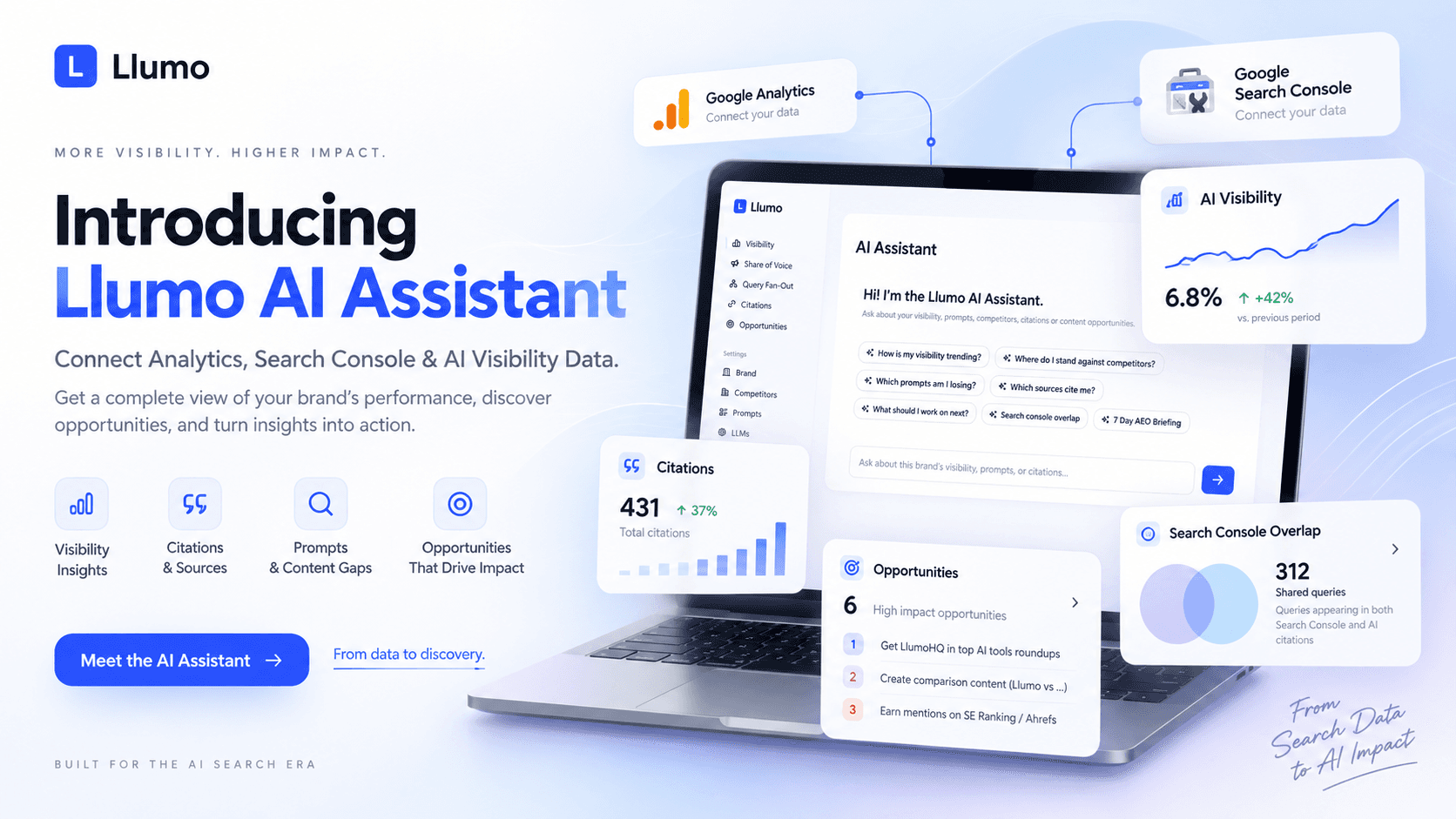
Llumo is the strongest fit for teams that need multi-model AI visibility measurement connected directly to prioritized action. Its managed AEO service combines prompt intelligence, content gap analysis, AEO auditing, competitor intelligence, citation analysis, and ongoing tracking across AI answer engines.
The practical advantage is visibility at the prompt level. Teams can see which exact questions generate a brand mention, which competitors appear instead, which pages and domains receive citations, and how those responses change over time. Llumo’s platform tracks ChatGPT, Claude, Gemini, Grok, Mistral, DeepSeek, Perplexity, Copilot, and Google AI Overviews through APIs, OpenRouter, and web scraping.
That makes it more than a monitoring dashboard. Llumo connects findings to work, including content updates, new pages, technical recommendations, and brand-mention opportunities. Its guide to Answer Engine Optimisation explains the broader operating context, while the managed service helps teams execute instead of stopping at a strategy deck.
Practical rule: If an agency can’t show the prompt, response, cited source, and recommended action, its visibility reporting is incomplete.
Strengths and limitations
Multi-model measurement: Per-prompt visibility scores, share of voice, competitor trends, query fan-out logs, response archives, and citation sources reveal how models form answers.
Citation intelligence: Teams can identify new and lost references by domain and page, then prioritize content or digital PR work around evidence.
Cost control: Bring your own provider API keys, pay underlying providers directly, and avoid Llumo usage markups.
Operational control: Dedicated hosted instances, custom branding, unlimited projects and prompts, dashboards, backups, and specialized Google AI Overviews and ChatGPT trackers support ongoing programs.
Managed execution: Audits, recommendations, and implementation support suit teams without deep internal AEO expertise.
The main limitation is that performance depends on connected provider APIs, quotas, and budgets. Coverage can also vary by model, and teams may need extra integrations or scraping for complete parity. Llumo focuses on AI answer signals, so it complements rather than replaces traditional SEO measurement.
Ideal client: SEO teams, agencies, SaaS companies, and growth leaders that want measurable AI visibility, citation analysis, competitive intelligence, and execution in one operating system. Visit Llumo’s AEO services to assess whether its managed model matches your workflow.
2. iPullRank for technical relevance engineering
iPullRank is the strongest option for organizations whose AI visibility problem starts with technical relevance, retrieval, information architecture, and complex enterprise systems. Its AEO and GEO work sits inside a broader AI Search and Relevance Engineering practice, rather than operating as a narrow content package.
The agency’s approach connects prompt mapping, retrieval, embeddings, synthesis, entity-centric SEO, and technical roadmaps. That matters for large sites where the main problem isn’t just a missing article. Product catalogs, international structures, duplicated content, disconnected entities, and unclear relationships can prevent AI systems from assembling a reliable picture of a brand.
iPullRank combines executive-level advisory with hands-on consulting. Enterprise teams can therefore use it for strategic alignment while involving technical SEO, content, data, and engineering stakeholders in implementation. Its research-driven positioning also suits organizations that need a partner capable of explaining why a recommendation should affect retrieval or citation behavior.
For teams comparing platforms, an AI visibility tracker for agencies can provide a useful measurement reference point for measurement, even when the main agency engagement is technical and consultative.
Trade-offs and best fit
Strengths include deep technical expertise, original AI search thinking, and the ability to operate across complex, multi-team enterprise environments. The agency is particularly appropriate when AEO must align with existing SEO architecture, data systems, and governance processes.
Limitations are equally clear. This isn’t a low-cost tactical provider, and engagements are custom-scoped without a public rate card. Teams looking for a quick content sprint or a lightweight monitoring subscription may find the operating model too consultative.
Ideal client: Mid-market and enterprise brands with complex architectures, internal SEO resources, and a need for technical AI search strategy that can survive organizational scrutiny.
3. Amsive for integrated performance programs
Amsive suits brands that don’t want AEO to be isolated from the rest of their marketing. Its strength is integrated performance, with AEO embedded in a wider stack spanning organic search, paid media, creative, content, analytics, and data science.
That model is useful when AI visibility changes how several teams work at once. A content team may need to restructure answers, a creative team may need to reinforce brand language, an analytics team may need new reporting, and paid media leaders may need a shared view of the customer journey. Amsive can coordinate those disciplines under a larger performance relationship.
The agency explicitly addresses visibility across AI Overviews, large language models, and generative platforms. It also positions its work around enterprise programs, continued search education, and adaptation as AI surfaces evolve. The value isn’t a standalone AEO audit. It’s a broader operating relationship where AI visibility becomes part of organic and performance planning.
Where Amsive fits
Amsive’s strongest advantage is organizational. A brand with several disconnected marketing partners may gain more from one integrated performance team than from a narrowly specialized AEO vendor. Its analytics and data science capabilities can also help connect visibility observations with wider marketing decisions.
The limitation is scope. If you only need prompt monitoring, citation analysis, or a focused set of content fixes, a full-service performance agency may add unnecessary coordination and cost. Pricing and engagement details are custom and proposal-based, with no public AEO rate card.
Ideal client: Enterprise brands seeking one partner for paid, organic, creative, analytics, and AI search work. Amsive is especially relevant when leadership wants AEO embedded in an existing transformation of the broader performance program.
4. Siege Media for content and digital PR
Siege Media solves an authority problem. If your brand needs stronger content, original research, digital PR, and third-party references, its GEO service is designed to create assets that AI systems can reuse and cite.
The agency combines data, engineering, content creation, and PR. That mix is important because citation visibility doesn’t come only from changing a page’s headings. It can also depend on whether the page contains distinctive evidence, clear entities, original analysis, and signals that other authoritative sites recognize.
Siege Media’s work is therefore content-heavy by design. It creates entity-rich, citability-ready material and connects publication with distribution. This approach aligns with citation research showing that articles earned 23.7% of citations, listicles 19.6%, and product pages 16.3% across 25,337 citations from ChatGPT, Perplexity, Gemini, Google AI Overviews, and Google AI Mode (AI citation format study). The evidence supports format engineering, but it doesn’t mean every brand should publish more content without first identifying its prompt gaps.
Strengths and limitations
Siege Media’s main strength is the combination of creative production and digital PR. It’s a strong choice where brand authority must be built through research-backed assets, links, mentions, and citations at scale. Published sector examples and AI visibility outcomes can also help buyers evaluate its experience.
The trade-off is technical depth. Teams may need another partner for deep architecture, schema remediation, entity systems, or specialized AI visibility measurement. Pricing is custom, and content-led programs can require a substantial commitment.
Ideal client: Enterprise and large B2B or B2C brands with meaningful content budgets, strong subject-matter access, and a need to become a frequently cited source in their category. Siege Media is less suitable for a brand that primarily needs a measurement platform or a narrowly defined technical sprint.
5. Terakeet for enterprise research and reputation
Terakeet suits organizations where AI visibility affects brand reputation, risk, and enterprise research. Its Generative AI Optimization offering addresses AI Overviews, ChatGPT, Gemini, and other AI experiences while connecting that work with organic growth and reputation management.
The fit is strongest in sectors where an incomplete or inaccurate AI summary can create regulatory, trust, or customer-acquisition problems. Financial services, healthcare, and other reputation-sensitive organizations need to monitor how AI systems describe the brand, identify the sources shaping those descriptions, and assess whether the wider web supports the intended identity.
Terakeet brings internal data science and engineering research to this work. Its public technical analysis examines the links between AI Overviews and traditional SEO, giving teams with a research-led planning option instead of isolated content recommendations.
AI citation concentration reinforces the case for an enterprise program. The top 1% of domains capture 47% of all AI citations, according to an analysis of AI Overview citation sources. Enterprise teams therefore need coordinated authority and reputation work, alongside page-level optimization.
The operational trade-off
Terakeet combines research, engineering, reputation, and organic growth. Engagements run long and require multi-quarter coordination, which disqualifies small tactical projects, immediate one-page refreshes, and teams unable to align multiple internal stakeholders.
Programs are custom, and no public rate card is available. Buyers should request the measurement model, data sources, responsibilities for reputation work and content execution, and milestones for judging progress. They should also confirm how findings become changes to content, technical systems, and brand information across external sources.
Ideal client: Enterprise organizations in reputation-sensitive sectors that need AI search visibility managed alongside brand perception, data science, engineering, and organic growth.
6. First Page Sage for editorial authority
First Page Sage suits B2B organizations that need thought leadership and a consistent editorial engine to support AI visibility. Its AEO and GEO services build on an established SEO and editorial framework, prioritizing authoritative content that can earn LLM citations.
Its process-oriented delivery model fits teams that value predictable production, subject-matter depth, and a sustained publishing cadence. The agency also publishes guidance on GEO and AEO planning, giving buyers with clearer language for defining deliverables, responsibilities, and engagement scope of engagement before sales discussions.
Editorial authority and technical remediation address different bottlenecks. The former builds citation-worthy content, while the latter fixes retrieval pathways. In informational AI Overview queries, educational articles accounted for 70.2% of citations. Listicles and buying guides led commercial searches at 37.6% of commercial searches, according to AI Overview citation source analysis. These patterns support a content-led program, while also requiring buyers to match the format with query intent rather than reuse one template across topics.
Strengths and limitations
First Page Sage provides a structured editorial operation for B2B teams that need repeatable thought leadership. Its published guidance can make planning and scoping easier than with agencies that describe AEO only in broad terms.
The main constraint is its content-centered delivery model. Technical implementation, entity graph work, and detailed visibility monitoring may require another specialist or internal resources. Pricing is custom retainer-based, so buyers should confirm who writes, edits, publishes, implements, and measures each asset.
The operating fit depends on execution capacity. Teams should establish approval workflows, subject-matter access, publishing ownership, and reporting definitions before signing.
Ideal client: B2B brands that value expert content and need a dependable editorial partner to build AI citation potential over time. It is less suitable for teams whose primary bottleneck is technical relevance or entity disambiguation.
7. Kalicube for entity clarity
Kalicube addresses the foundational problem many AEO programs overlook: AI systems need to understand what a brand is before they can describe it accurately. Its specialty is entity clarity across Brand SERPs, Knowledge Panels, structured data, web profiles, and knowledge graph relationships.
The Kalicube Process combines consultancy with Kalicube Pro software. This gives brands a way to improve how their identity is represented across the web, then monitor whether that identity remains coherent. The work is particularly relevant when AI assistants confuse similarly named companies, merge products with parent brands, or present outdated information.
Entity work also helps explain why traditional rankings don’t tell the whole story. One analysis found that only 33.2% of the cited URLs were also in Google’s organic top 10 (AI Overview citation analysis). AI citation selection can therefore depend on how well a source clarifies the brand and topic, not only on its conventional search position.
The fit and the gap
Kalicube’s strength is specialization. It offers deep expertise in entities, Knowledge Panels, Brand SERPs, and the identity signals that support accurate AI summaries. It also publishes pricing for some Knowledge Panel programs, giving buyers more clarity than many custom enterprise providers.
The remit is narrower than a full AEO program. Large-scale content production, digital PR, and broad technical remediation may require partners. Corporate pricing varies, and higher-tier work can be costly.
Ideal client: Brands with unclear or inconsistent entity information, Knowledge Panel issues, reputation confusion, or a need to establish a reliable identity foundation before investing heavily in content and PR. For a broader view of AI brand presence, see how to rank in ChatGPT search.
Top 7 AEO Agencies Comparison
Service | Implementation Complexity 🔄 | Resource Requirements ⚡ | Expected Outcomes 📊⭐ | Ideal Use Cases 💡 | Key Advantages ⭐ |
|---|---|---|---|---|---|
Llumo: AEO, GEO & LLMO Services | Moderate, multi-model API integrations and tracking | Medium, BYO API costs + technical setup and analyst time | Actionable prompt-level visibility and prioritized AEO opportunities; measurable AI mentions (⭐⭐⭐) | Brands that need granular prompt/page-level AI mention tracking and execution | Multi-model prompt visibility, BYO keys/no markup, managed AEO audits & execution |
iPullRank | High, technical research and relevance engineering | High, consultative retainers and cross-team technical effort | Strategic AI search roadmaps and relevance engineering to influence citations (⭐⭐⭐) | Complex, mid-market to enterprise organizations needing a technical AI search strategy | Deep technical expertise, research-driven frameworks, executive advisory |
Amsive | High, integrated cross-channel program design | High, full-service media, creative, content, and analytics commitments | Holistic organic + paid performance improvements with AEO layered in (⭐⭐) | Enterprises seeking one partner for paid/organic/creative/data around AI search | Integrated media + content + data science at enterprise scale |
Siege Media | Moderate, content, and digital PR workflows | Medium–High, content production and PR resources | Increased LLM citations via authoritative, entity-rich content (⭐⭐) | Brands prioritizing creative/PR-driven authority to earn AI citations | Strong creative and PR capabilities with documented citation case examples |
Terakeet | High, research-led, cross-team enterprise programs | High, multi-quarter, multi-team commitments | Reputation and visibility gains in AI Overviews and LLMs (⭐⭐⭐) | Reputation-sensitive industries (finance, healthcare) and large enterprises | Data science & engineering depth, integrated reputation management |
First Page Sage | Moderate, process-driven editorial and SEO workflows | Medium, ongoing editorial resources and planning | Predictable thought-leadership content aimed at LLM citability (⭐⭐) | B2B teams wanting process-oriented, repeatable editorial delivery | Clear methodology, public guidance on tiers and deliverables |
Kalicube | Low–Moderate, entity/schema-focused processes and SaaS | Low–Medium, Kalicube Pro + advisory for Knowledge Panels | Improved entity clarity, Knowledge Panels and Brand SERP presence (⭐⭐⭐) | Brands needing entity/knowledge-graph fixes and Knowledge Panel control | Proven entity/knowledge-graph expertise, SaaS monitoring, transparent pricing for some packages |
Choose the Agency That Matches Your AEO Bottleneck
The best AEO agency isn’t automatically the largest, most technical, or most content-focused provider. It’s the agency whose delivery model matches the constraint preventing your brand from appearing in useful AI answers.
Start by defining the surfaces that matter. List the models, answer engines, markets, and prompt groups your buyers use. Include ChatGPT, Gemini, Perplexity, Copilot, Google AI Overviews, or other relevant surfaces only when they matter to your audience. A serious partner should show how it will archive responses, monitor changes, identify citations, and distinguish a brand mention from a meaningful recommendation.
Next, separate measurement from execution. A platform can tell you that a competitor appears more often. An agency should explain what it will change, whether that means rewriting a page, publishing a buying guide, building original research, correcting entity data, improving structured information, or pursuing digital PR. Ask for the handoff between insight and action.
Use the agency match below as a practical starting point:
Choose Llumo when you need multi-model visibility, per-prompt scores, citation analysis, competitive trends, prioritized opportunities, and managed execution in one operating system.
Choose iPullRank when technical relevance, retrieval, embeddings, information architecture, and enterprise SEO complexity are the main obstacles.
Choose Amsive when AEO must sit inside a larger paid, organic, creative, analytics, and performance relationship.
Choose Siege Media when original research, content engineering, digital PR, and authority are the primary route to citation gains.
Choose Terakeet when reputation, research, data science, and enterprise governance matter as much as visibility.
Choose First Page Sage when a predictable thought-leadership and editorial program is your central growth lever.
Choose Kalicube when entity clarity, Knowledge Panels, Brand SERPs, and identity consistency are blocking accurate AI descriptions.
Ask every finalist how it proves mentions and citations, what it controls directly, which technical, content, PR, and entity capabilities are included, and which require another provider. Clarify custom pricing, provider API costs, usage limits, reporting ownership, and implementation responsibilities before signing. A provider that uses connected model APIs may pass underlying usage costs to you, while an agency may bundle tooling into a broader retainer, so compare the operating economics rather than just the headline fee.
Finally, establish reporting milestones that connect visibility to business outcomes. Citation counts are useful, but they should lead to prompt coverage, source quality, share of voice, qualified visits, assisted conversions, and influenced pipeline where your analytics setup supports those measures. AI Overviews cite an average of 4.2 sources per response, with cited counts ranging from 2 to 9 depending on query intent, according to AI Overview citation research. That makes citation coverage a measurable output, not a vague substitute for rankings.
For teams that need multi-model measurement, citation intelligence, prioritized opportunities, and managed work together, Llumo is the most direct fit. Enterprise technical, integrated performance, content-led, reputation, editorial, and entity-specific needs should go to the agencies built around those strengths.
Llumo combines AI visibility tracking with managed AEO services, so you can monitor per-prompt mentions, competitor share of voice, query fan-out, and citation sources, then turn those findings into prioritized content, technical, PR, and entity actions. Visit Llumo to see how a measurable, multi-model operating system can support your AEO program.