How to Rank in AI Overviews: Top 10 Strategies
To rank in Google AI Overviews, earn a strong organic position (the top 20 results feed almost every citation), then structure your pages so a model can lift a clean, self-contained answer straight from them.
There is no separate "AI Overviews algorithm", Google confirmed AI Overviews run on its core Search ranking systems. The ten strategies below are what actually move citations, plus the tactics Google told you to skip.
What are Google AI Overviews, and why do they matter?
Google AI Overviews are the AI-generated summaries that appear above the traditional blue links, answering a query directly on the results page. They now reach billions of users across more than 200 countries and 40 languages, and they have quietly rewritten the economics of search.
The traffic impact is real, and it is measurable:
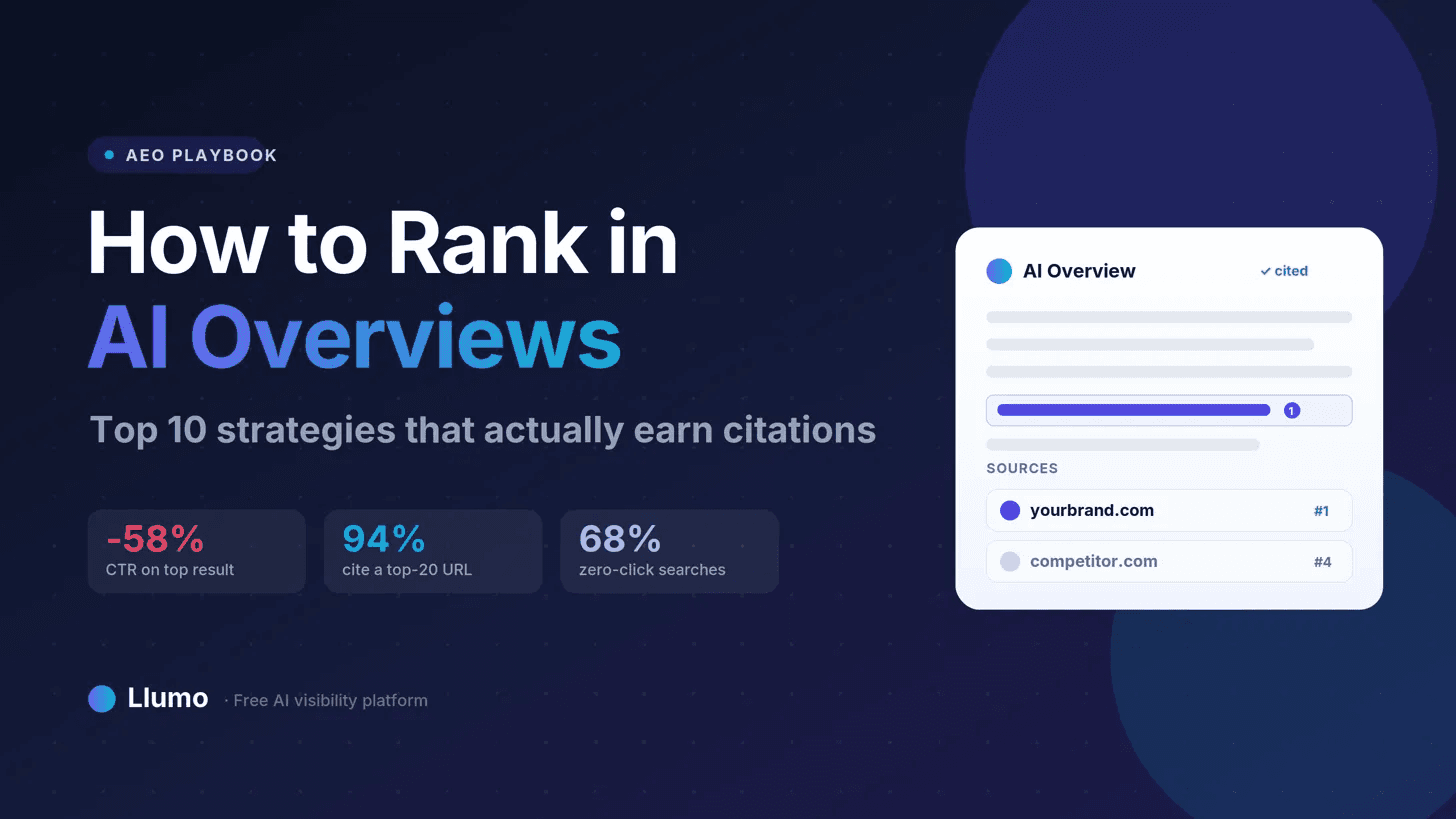
Ahrefs, using December 2025 data, found that when an AI Overview appears, click-through rate on the top-ranking result drops by roughly 58%, up from a 34.5% drop measured in early 2025.
Pew Research found users clicked a result in only 8% of visits when an AI Overview was shown, versus 15% without one, nearly half.
SparkToro reported that 68% of US Google searches ended without a single click in early 2026.
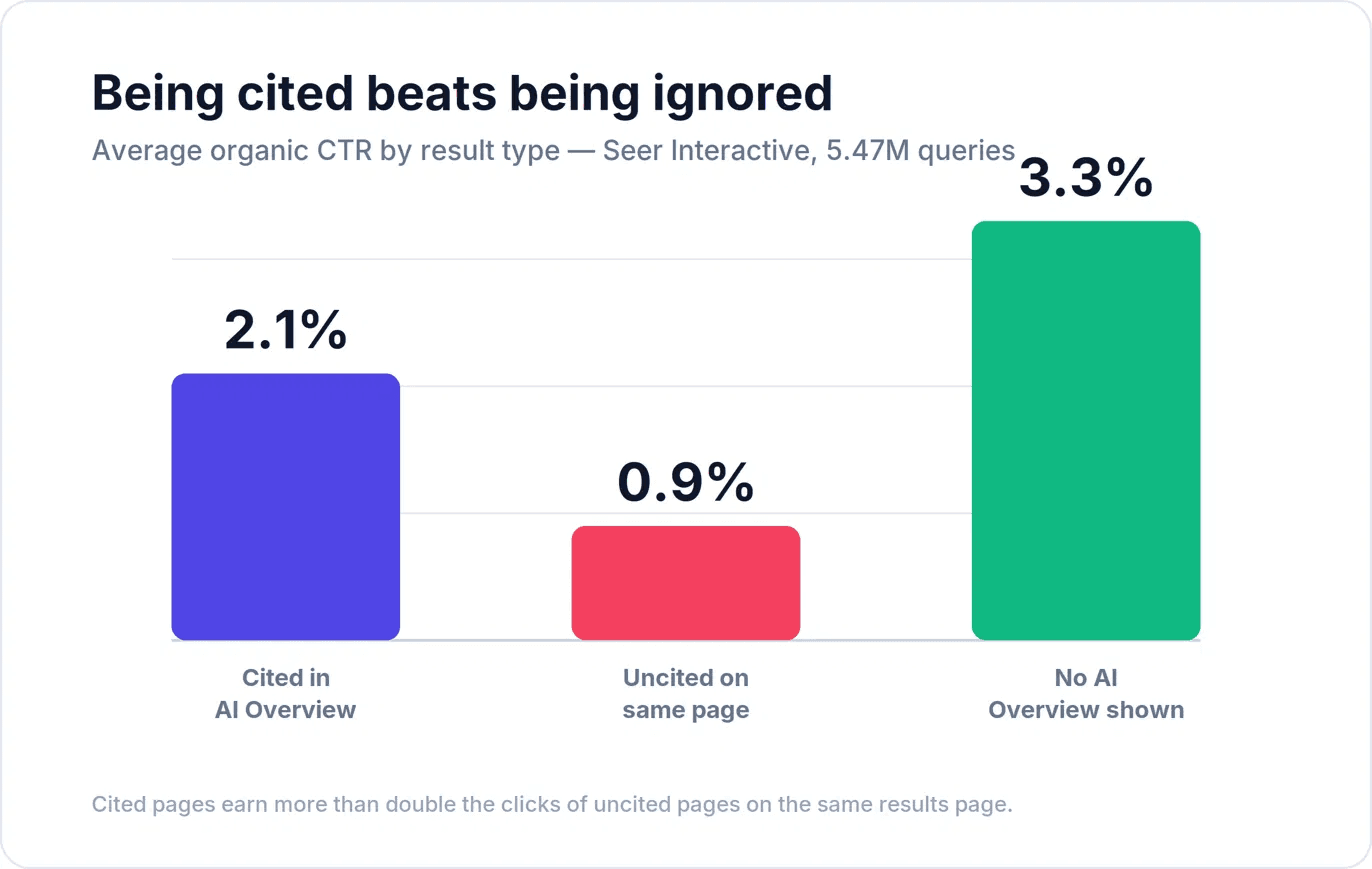
The takeaway is not "traffic is dead." It is that the click now goes to whoever gets cited inside the answer. Seer Interactive, tracking 5.47 million queries, found that a page cited inside an AI Overview earns about 2.1% CTR, while an uncited page on the same results page earns about 0.9%. Being named in the answer is the new front page.
Can you actually optimize for AI Overviews?
Yes, but not with tricks. In May 2026, Google's Search Central team published its first official guidance on generative AI features and was blunt about it: AI Overviews and AI Mode are "rooted in our core Search ranking and quality systems." There is no separate AI index, no AI-only crawler, and no special markup that unlocks citations. Optimizing for AI Overviews is optimizing for Search, done with the answer, not the click, as the goal.
That reframes everything below. These are not hacks. They are the fundamentals that earn a blue link, sharpened so an answer engine can extract from your page.
1. Rank in the top 20 organic results first
Ranking in the top 20 is the price of entry for AI Overview citations. Research from seoClarity found that 94% of AI Overviews cite at least one URL that already ranks in the top 20 organic results. AI Overviews are generated with retrieval-augmented generation, the model pulls from pages Google's core systems already rank highly, then synthesizes an answer. If your page is not ranking, it is not in the candidate pool, and no amount of formatting will get it cited.
Everything else on this list assumes you have done the traditional SEO work: crawlable pages, topical authority, quality backlinks, and content that satisfies the query. AEO does not replace SEO, it sits on top of it.
2. Lead every page with a direct, self-contained answer
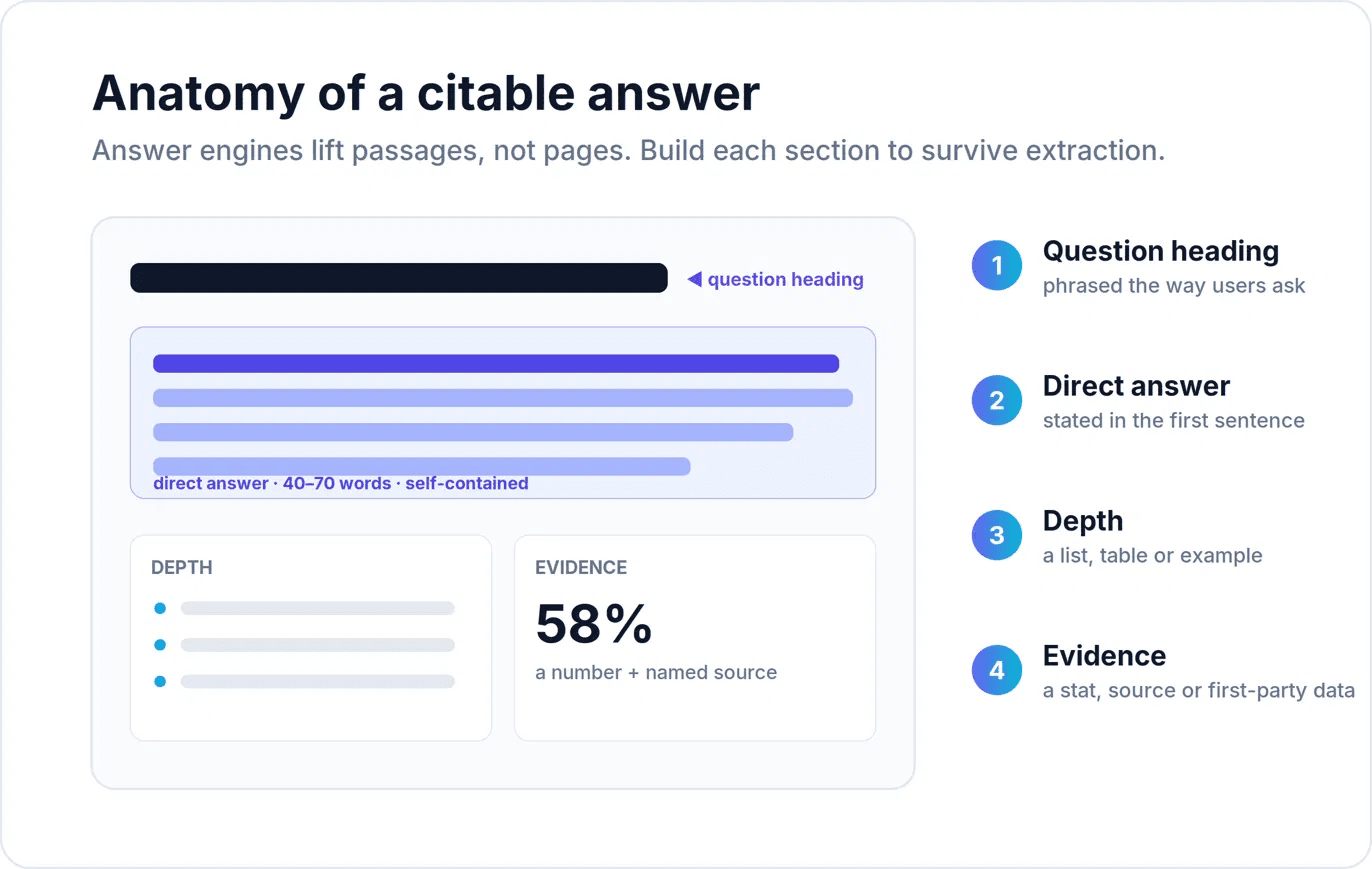
Answer the page's core question in the first 40–70 words, before any setup or story. Answer engines do not cite pages; they lift passages. If your answer only makes sense after three paragraphs of preamble, a model cannot extract it cleanly, so it moves to a source that states the answer up front.
Write the opening so a reader who reads only that paragraph leaves satisfied. Use precise numbers and repeat the subject noun instead of leaning on "it" or "this," so the passage survives being pulled out of context. A vague, hedged opening ("results vary," "it depends") gives a model nothing to quote.
3. Use headings that mirror how people ask
Turn statement headings into the exact question a user would type or speak. "Our Approach" becomes "How does X work?"; "Pricing" becomes "How much does X cost?" Question-shaped headings match the sub-queries an engine generates, and they let each section stand alone as a citable chunk.
Under each question heading, follow the same pattern: a direct answer first, then a list, table, or example for depth. Every heading you convert is another independent passage that can be cited on its own.
4. Publish original data and first-hand experience
Original statistics, first-party data, and genuine hands-on experience are the content most likely to be cited. Google's guidance states that content demonstrating first-hand experience, subject-matter expertise, and authoritative sourcing is preferred by the AI Overview system, the E-E-A-T signals it has emphasized for years.
Concrete beats abstract every time. "Programs run 8 to 12 weeks" is citable; "programs vary in length" is not. If you have proprietary numbers, survey results, benchmarks, internal test data, publish them clearly. That is the kind of specific, sourced claim an answer engine reaches for, and it is something competitors reusing the same generic points cannot match.
5. Cover the whole question tree, not just one keyword
Answer the full fan-out of a topic, what it is, why it matters, how it works, how much it costs, who it is for, and how it compares, rather than aiming a page at a single keyword. Google AI Mode decomposes a query into multiple sub-questions and runs each against the index, so pages that demonstrably cover the entire topic get pulled into more answers.
Map the sub-questions before you write, and give each one its own answer-first section. Breadth of genuine coverage signals to an engine that your source understands the whole subject, not just the headline term.
6. Build off-site presence, especially on Reddit and YouTube
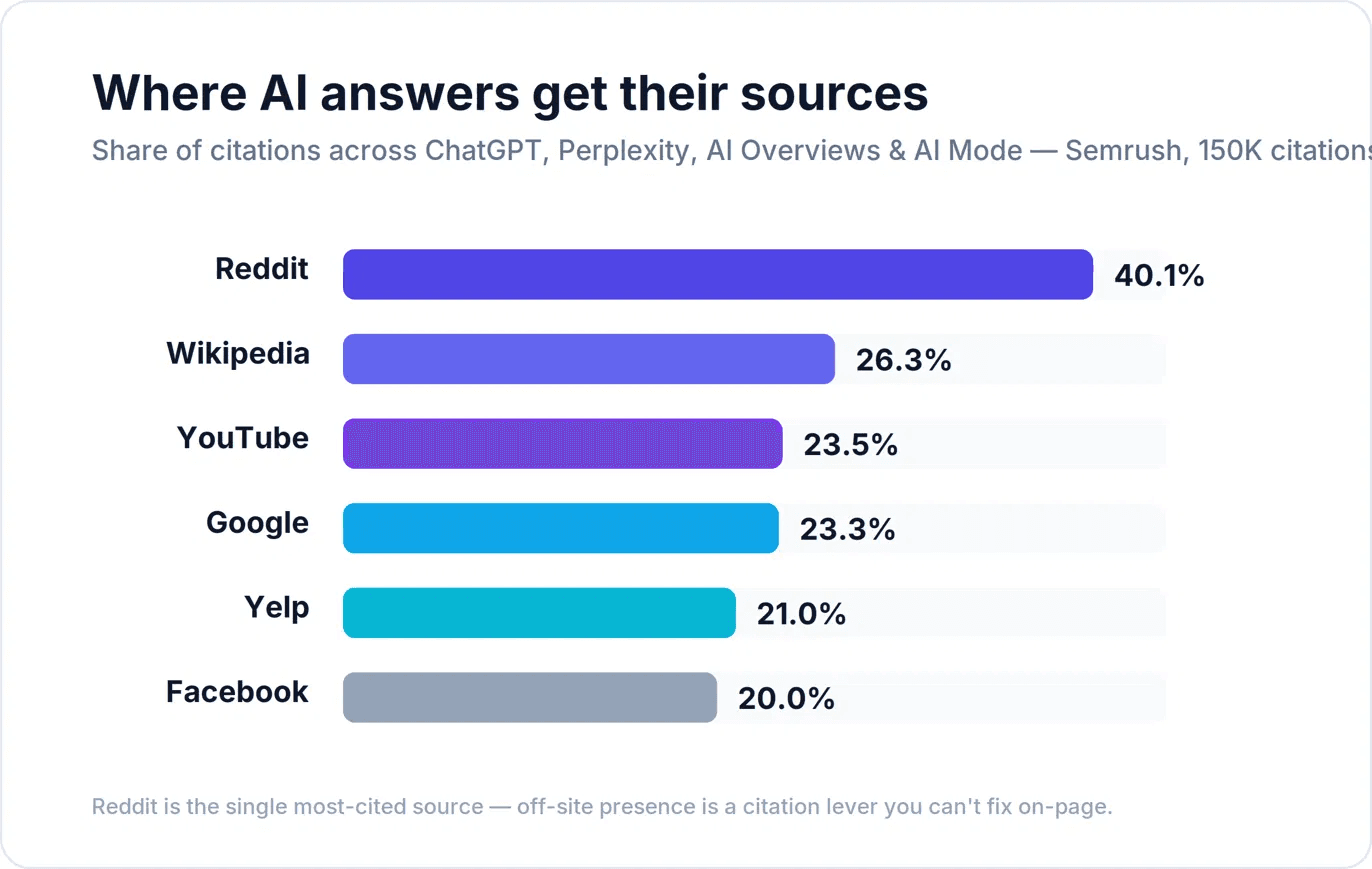
A large share of AI citations come from third-party platforms you do not own, and Reddit leads by a wide margin. A Semrush analysis of 150,000 citations found Reddit was the single most-cited source at about 40%, ahead of Wikipedia, YouTube, and Google itself. SE Ranking found that domains with heavy brand mentions on Reddit and Quora were roughly four times more likely to be cited by AI systems than those with little community presence.
You cannot fix this with an on-page edit. Show up authentically where your audience already discusses your category, helpful, specific Reddit answers; genuinely useful YouTube content; a real LinkedIn footprint. Off-site authority is slow to build and impossible to fake at scale, which is exactly why it moves citations.
7. Keep your content fresh and updated
Answer engines favor current sources and quietly drop stale ones, so a recent, accurate update date is a real ranking signal. Refresh your highest-value pages on a schedule, update the numbers, re-verify claims, add newly relevant sub-questions, and make sure the modified date reflects genuine changes rather than a cosmetic timestamp bump.
This is especially true in fast-moving categories like AI search itself, where a stat from eighteen months ago actively undermines your credibility. Freshness is not about churning out new posts; it is about keeping the pages that already earn citations correct.
8. Make sure your content is crawlable and server-rendered
If a page cannot be crawled and rendered, it cannot be retrieved, cited, or ranked. Confirm crawling is allowed in robots.txt and at the CDN or hosting layer, keep important content in server-rendered HTML rather than hidden behind client-side scripts, and use internal links so your key pages are easy to discover.
One nuance worth knowing: Google offers a separate Google-Extended control that governs whether your content is used for Gemini model training and grounding, but it has no effect on Google Search, including AI Overviews and AI Mode. Blocking it does not remove you from AI Overviews, and allowing it does not boost you.
9. Structure content for extraction
Format your content so the most useful units, definitions, comparisons, steps, and ranges, can be lifted whole. Comparison tables, clean one-sentence definitions, short ranked lists, and step-by-step procedures are consistently the formats answer engines reuse, because each one is self-contained and unambiguous.
Structured data (schema) is worth using as part of a broader SEO strategy because it supports rich results in standard Search, just do not expect it to be an AI Overviews cheat code (more on that below). The structure that matters most for citation is the readable kind: a table a human appreciates is also a table a model can parse.
10. Track your AI visibility and measure citations
You cannot improve what you do not measure, and traditional rank trackers do not tell you whether an AI answer named your brand, cited your URL, or ignored you entirely. Start with Google Search Console's Generative AI performance report to see how content performs inside AI features, then layer on a dedicated AI visibility platform to track citations and competitors across every engine, not just Google.
This is where Llumo fits. Llumo is a free AI visibility platform for Answer Engine Optimization that shows how ChatGPT, Google AI Overviews, Perplexity, Gemini, and Copilot mention your brand, which competitors appear alongside you, and which sources each model cites. Unlike tools that charge steep monthly fees, Llumo runs on a bring-your-own-tokens model: you connect your own API keys and pay providers directly, with no licence fee and no markup, so the same budget tracks far more brands, prompts, and terms. You can even self-host it and keep full ownership of your data. It turns "are we showing up in AI answers?" from a guess into a dashboard.
Which AI Overview tactics should you skip?
Google's May 2026 guidance explicitly debunked several tactics the AEO industry had been selling. Skip these:
Special schema for AI Overviews. There is no AI-specific markup. Google confirmed no structured data is required for generative features; use schema for standard rich results, not as an AI Overviews unlock.
llms.txtas a ranking lever. Google may crawl anllms.txtfile like any other page, but it is not treated specially for Search, and creating one has no effect on rankings either way.Chopping content into tiny chunks. Google stated there is no ideal page length and no need to break content into fragments, its systems understand multiple topics on one page. Structure for readers, not for imagined parsers.
Trusting tools that claim "internal" Google metrics. Google warned that no third-party tool has access to its internal ranking or AI systems. Use tools that help your workflow, but treat any "secret Google score" as marketing.
The pattern is consistent: the shortcuts do not work, and the fundamentals do. Answer engines reward the same things good SEO always has, clarity, evidence, authority, and freshness, just packaged so a machine can extract them.
How do you know if you're being cited in AI Overviews?
Check three places. First, Google Search Console's Generative AI performance report shows how your content performs inside AI features on Google. Second, a dedicated AI visibility tracker records, per query, whether your brand is cited, mentioned without a link, or absent, across Google AI Overviews and other engines. Third, spot-check manually by running your priority questions and seeing who gets named.
Manual checks do not scale past a handful of queries, which is why most brands treating AI visibility seriously monitor it continuously. Tracking citations over time is also the only way to tell whether the ten strategies above are actually working for you, and to catch a competitor pulling ahead in the answers that matter.
Frequently asked questions
Is ranking in AI Overviews different from SEO?
No. Google confirmed in May 2026 that AI Overviews and AI Mode run on its core Search ranking and quality systems, drawing from the same index. The work that earns a citation in an AI answer is the same work that earns a blue link: strong rankings, clear answers, real evidence, and authority. AEO supplements SEO; it does not replace it.
Can you pay Google to appear in AI Overviews?
No. There is no paid placement inside AI Overviews and no way to buy a citation. Overviews are generated from organic content that Google's ranking systems already surface. The only way in is to earn a strong organic position and structure your content so it is easy to extract and cite.
Do you need structured data to rank in AI Overviews?
No. Google stated that no structured data or special schema is required for AI Overviews or AI Mode. Schema is still worth using because it helps you qualify for rich results in standard Search, but it is not an AI Overviews requirement and will not, on its own, earn you a citation.
How long does it take to show up in AI Overviews?
There is no fixed timeline, because it depends on ranking in the top 20 first, which can take weeks to months for a new page. Once a page ranks well and answers a query cleanly, it becomes eligible for citation, and AI Overview results can shift week to week as the index and answers refresh.
Why isn't my top-ranking page being cited?
Ranking is necessary but not sufficient. A page can rank yet still get skipped if the answer is buried under preamble, hedged, or hard to extract. Check that your target question is answered directly in the first 40–70 words, that headings match real queries, and that the page offers specific, sourced facts a model can lift.
Start Tracking Your AI Overview Visibility
Ranking in AI Overviews starts with better content, but improvement is difficult if you cannot see where your brand is actually appearing. Llumo helps you track mentions, citations, competitors, and source visibility across Google AI Overviews, ChatGPT, Perplexity, Gemini, and Copilot from one dashboard.
With a free platform, bring-your-own-tokens pricing, and self-hosting available, you can monitor more prompts and brands without adding another expensive monthly SEO subscription.