
You've probably seen the disconnect already. Your B2B SaaS site is gaining impressions in Google Search Console, a few pages are moving up the rankings, and organic sessions look healthy. Yet when your team asks ChatGPT, Perplexity, or Google AI Overviews about the category you serve, your brand barely appears.
That gap is the practical reason people ask what is generative engine optimization. GEO is the discipline of making your content useful to the systems that retrieve sources, synthesize answers, and decide which sources to cite inside those answers. It doesn't replace SEO, but it changes the visibility target from a position on a results page to a place inside the response itself.
The Moment Classic SEO Stopped Being Enough
A marketing lead at a growing SaaS company notices the pattern during a weekly review. Search impressions are climbing, branded queries are stable, and the content team has published several pages targeting high-value keywords. But when the team runs buyer prompts through ChatGPT, Perplexity, and Google AI Overviews, competitors appear repeatedly while the company's name is absent or mentioned without a supporting source.
Nothing is necessarily wrong with the rankings. The pages may be indexed, technically sound, and attracting clicks. The problem is that a ranked page and a cited source are not the same thing. Traditional search presents a list that the user can inspect. A generative engine selects information, combines it into prose, and may show only a handful of supporting sources.
Practical rule: If your content can rank but cannot be retrieved, understood, or quoted cleanly, it can still disappear from the answer.
A useful mental model separates three jobs:
Retrieval finds potentially relevant pages, passages, entities, or documents.
Synthesis combines selected information into a response that sounds coherent.
Citation connects parts of that response to sources the engine considers relevant and credible.
GEO works across that pipeline. It asks whether a page can be crawled and parsed, whether its key claims match the user's prompt, whether the claims can stand alone when extracted, and whether the page gives an engine enough context to identify the brand accurately.
The shift affects how teams work:
Keyword targets become prompt targets. You still need search demand, but you also need to model the questions buyers ask in natural language.
Rank tracking expands into citation tracking. Position is useful, but it doesn't tell you whether an engine uses your page in a generated answer.
Link authority becomes entity authority. Engines need to understand what your company, products, authors, and categories represent.
On-page tricks give way to source credibility. Clear writing, verifiable evidence, and strong attribution matter more than forcing a phrase into every heading.
The rest is less glamorous than most vendor pitches suggest. GEO is an audit of how information moves from your page into an answer. The useful questions are concrete: which prompts trigger your brand, which URLs get cited, which passages get selected, where attribution goes wrong, and what changes after an update.
Where GEO Actually Comes From
GEO became a named discipline when the Princeton-led paper “GEO: Generative Engine Optimization” formalized the problem as improving visibility inside generative answer engines rather than only traditional rankings. The paper first appeared as an arXiv preprint on November 16, 2023, and was later presented at KDD 2024, giving the field a research-backed starting point rather than leaving it as a loose marketing label. The original GEO research paper frames the work around optimizing content for citation in AI-generated responses.
That origin matters because GEO sits between familiar information retrieval and newer retrieval-augmented generation systems. Search engines traditionally return documents for a person to inspect. Generative engines retrieve supporting material, allocate context, produce a response, and decide how to represent sources in that response. The content still needs to be relevant and accessible, but the final consumption unit may be a sentence or passage rather than a blue-link result.
A discipline with real limits
The original paper established an important vocabulary and experimental direction. It didn't prove that one optimization recipe works across every answer engine, industry, or content type. The field has moved into a messier environment where engines use different retrieval systems, browsing behaviors, ranking logic, context limits, and citation conventions.
A later survey of GEO research and methods describes GEO as a stochastic, partially observable process. It covers search activation, crawling and indexing, retrieval and reranking, context allocation, citation, and user behavior. Its practical conclusion is uncomfortable but valuable: topical relevance and context position are more reproducible levers than generic formatting rules, and a tactic that helps one system may transfer poorly to another.
That's why GEO shouldn't be treated as a new checklist pasted on top of SEO. It's a way to inspect the path from a user's prompt to the source material behind an answer. A page can have excellent prose and still miss the retrieval context. It can be retrieved and still lose the citation decision. It can be cited and still be represented inaccurately.
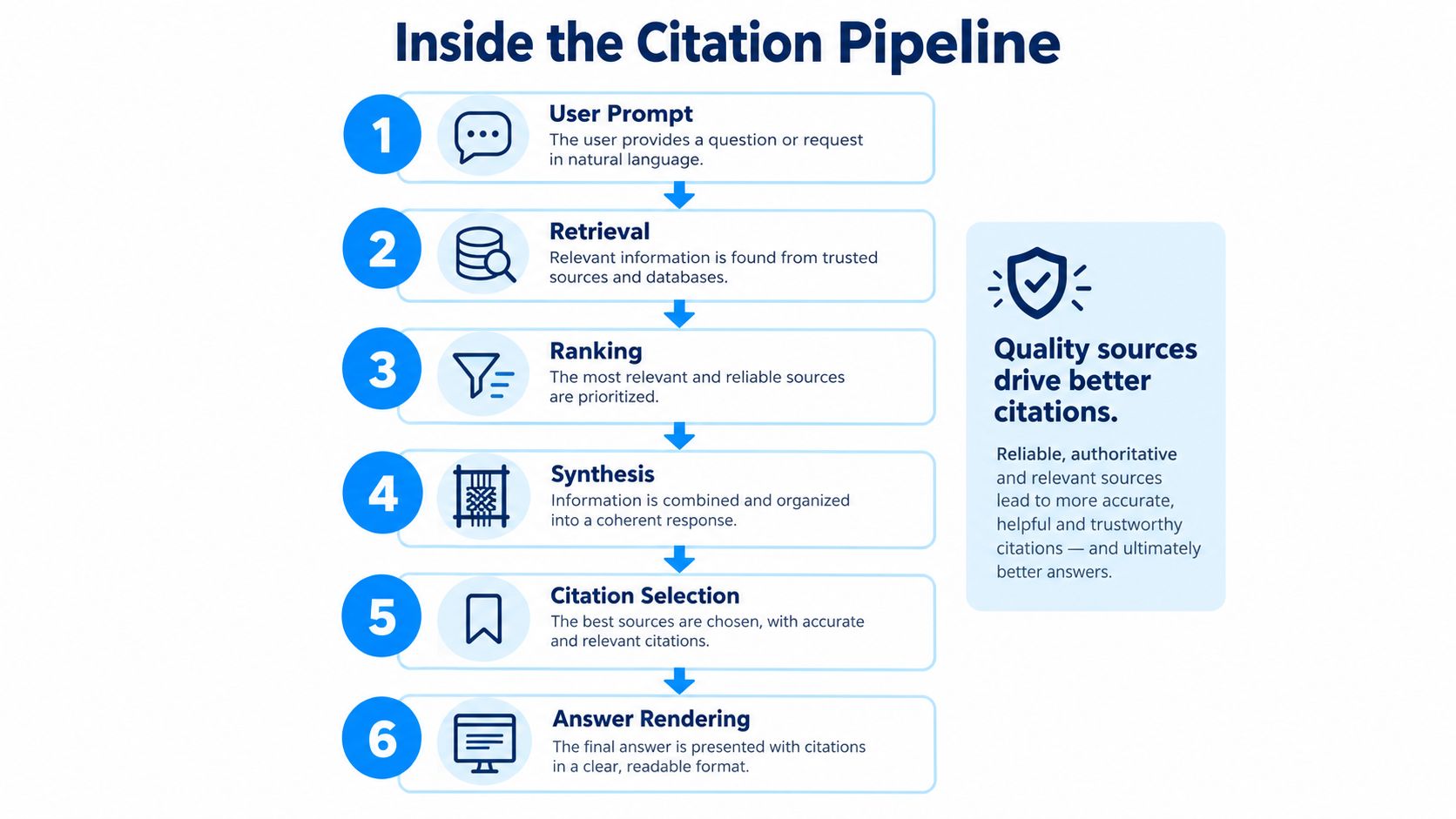
Inside the Citation Pipeline
A user asks, “What is the best CRM for solopreneurs?” The answer engine does not start by writing. It first decides what counts as evidence, then decides which evidence survives into the final answer.
1. The prompt activates a search
The system interprets the request and may expand it into related searches. “Best” can imply price, ease of use, integrations, support, or fit for a one-person operation. A CRM page that only repeats the category phrase is often less useful than one that states who the product suits and where it falls short.
2. Retrieval finds candidate material
The engine looks for pages, passages, and entities that could answer the request. Retrievability matters here. A crawler needs access to the content, and the system needs to parse the text without losing the relationship between headings, claims, tables, and qualifiers.
A product page that hides the answer behind a client-side interaction may offer less usable material than a plainly rendered comparison page. Technical hygiene is a prerequisite, not an afterthought.
3. Ranking and reranking narrow the field
Candidate sources are evaluated for relevance and likely usefulness. A controlled study of citation selection across 252,000 trials found that topic match, price, recency, and position were the largest drivers of being cited first in its competitive setting. Completeness and trust cues had secondary effects, while formatting had negligible impact.
That does not make formatting irrelevant. It means visual polish will not rescue weak topical coverage or stale information.
4. Synthesis turns sources into an answer
The engine combines selected material into a response. It may say one CRM is easier for beginners, another has stronger automation, and a third fits a tighter budget. Each statement needs enough context to avoid distortion when it is pulled out of the original page.
Quotability matters at this stage. A citable passage makes a complete claim, names the subject clearly, and includes the relevant condition. “It's affordable” is weak. “This CRM is designed for solo operators who need contact management without advanced sales automation” is easier to absorb accurately.
5. Citation selection decides what to show
The engine does not cite every page it used. Citation behavior differs by surface. Perplexity cited the most sources per prompt on average in the framework, while ChatGPT cited fewer but showed higher average citation influence among fetched pages. That split matters because selection and absorption are separate decisions, a source can be retrieved and still lose the citation slot, or it can be cited while contributing only a small part of the final wording.
If you want to audit that behavior, use a guide to reading the citations behind an AI answer. Check the exact URL, the passage represented, the entity named, and whether the answer attributes the claim correctly.
6. Answer rendering shapes perception
The final response may include inline links, a comparison table, a recommendation, or no visible citation for a particular sentence. A page is therefore either useful feedstock for synthesis or effectively invisible for that prompt. The editorial test is simple, can a reader understand the claim if an engine extracts only the paragraph containing it?
How GEO Differs From Traditional SEO
GEO and traditional SEO share a foundation. Both need accessible pages, useful information, clear topical coverage, trustworthy signals, and a site that search systems can understand. The difference appears in what happens after the system discovers the page.
Dimension | Traditional SEO | GEO |
|---|---|---|
Primary goal | Earn visibility and clicks from ranked results | Earn mentions, citations, or quotations inside generated answers |
Main input | Keywords, search intent, links, page-level relevance | Prompts, entities, topical coverage, source reputation, extractable passages |
Content unit | The page and its position in a result set | The page, passage, claim, entity, and citation context |
Technical surface | Crawlability, indexation, rendering, performance | Retrieval eligibility, parseable structure, chunk-level clarity, machine-readable context |
Authority signal | Links, topical authority, author credibility | Entity clarity, credible references, consistent mentions, verifiable expertise |
Core metrics | Rankings, impressions, organic traffic, conversions | Prompt visibility, citation frequency, share of voice, source and passage audits |
Main failure | Ranking for the wrong intent or losing clicks | Being retrieved but not cited, cited inaccurately, or omitted from the answer |
A ranking position remains useful. It can indicate that a search system understands your page and that users can find it. But ranking data is a lagging indicator of citation health, not a replacement for citation observation. A page can rank well and fail to provide a clean answer segment. Another page can be cited for a narrow claim without producing much measurable referral traffic.
The content brief also changes. Keyword clusters still help define a topic, but GEO requires entity clarity. Name the product, category, audience, limitations, alternatives, and relevant relationships directly. A page should make it difficult for an engine to confuse your brand with a similarly named company or mistake a feature for the entire product.
Technical work shifts in emphasis rather than disappearing. Crawl controls, rendering, structured data, internal linking, and page performance still support discovery. GEO adds a passage-level question: if the engine extracts one section, does the meaning survive without the navigation, surrounding sales copy, or a missing table?
The practical comparison of GEO and SEO is useful for aligning teams, but the operating principle is straightforward. Keep the SEO fundamentals. Drop the assumption that keyword placement and page-level ranking explain every form of visibility.
Tactics That Move the Needle and Ones That Don't
The strongest GEO work improves the information itself before it tries to decorate the page. A definition should define the subject directly. A comparison should state its criteria. A statistic should identify its source. A quotation should identify the speaker and preserve the relevant context.
The original GEO research gives practitioners a reason to favor evidence and clarity, but it shouldn't be turned into a promise of guaranteed lift. Current evidence is more useful as a prioritization guide:
Use clear source attribution. Link a claim to a credible, relevant source rather than presenting borrowed information as house knowledge.
Add verifiable statistics where they clarify the point. A number without provenance creates uncertainty. A sourced number gives the engine a stronger attribution path.
Use expert quotations carefully. Identify who said the words, why that person is relevant, and what the quotation supports.
Write structured quotations and claims. Keep the subject, action, qualification, and source close together so an extracted passage doesn't become ambiguous.
Keep the prose fluent. Engines need to absorb information into a generated sentence. Awkward keyword-heavy copy makes that harder for both systems and people.
The controlled evidence is less kind to popular shortcuts. In the citation-selection study, formatting had negligible impact compared with topical match, price, recency, and position. That doesn't justify publishing an unstructured page. It does mean a new font hierarchy, decorative FAQ block, or extra bold text isn't a serious substitute for better evidence and coverage.
Keyword stuffing is another weak bet. Repeating a phrase in headings, image text, and opening sentences can make a page less readable without resolving the user's question. FAQ schema spam has the same problem. Structured data can clarify content for machines, but it can't manufacture relevance, credibility, or a useful answer. Artificial citation counts also fail when the linked sources are irrelevant, low quality, or incapable of supporting the claim.
What I'd add during an audit
Some practical moves aren't cleanly captured by one controlled experiment, but they repeatedly make pages easier to evaluate:
Disambiguate entities. State the company's full name, product names, category, geography, audience, and relationship to parent or sister brands.
Rewrite extraction spans. Inspect the paragraphs most likely to answer a target prompt. Replace vague pronouns and sales language with self-contained claims.
Build definition assets. Create pages that answer “what is,” “how does it work,” and “who is it for” without forcing the reader through a product pitch.
Create comparison assets. Explain evaluation criteria, meaningful differences, trade-offs, and exclusions. A table is useful when the underlying facts are clear, not because tables have magical GEO properties.
Maintain old pages. A study of 4,124 cited pages found that 72% had been updated within the past year, while 42% had been published within the past year, based on observations across ChatGPT, Gemini, and Perplexity in the freshness analysis of cited pages. The operational lesson is direct: maintenance may be a more dependable lever than publishing volume alone.
A Monday audit can stay small:
Select ten priority URLs tied to revenue-relevant prompts.
Mark the passages that answer each prompt directly.
Add verifiable evidence and primary attribution where claims are thin.
Remove sections that repeat the same idea without adding information.
Assign each page a prompt family it should plausibly win.
Record whether engines cite the page, another page on the domain, or a competitor.
Measuring GEO Without Fooling Yourself
A buyer asks an AI engine for three vendors, and your brand appears in the answer. A dashboard reports strong AI visibility, yet the cited URL does not support the product claim. Another response names your company but assigns a competitor's feature to it. GEO measurement must expose those differences, not collapse them into one reassuring score.
Three measures that belong together
Prompt-level visibility records how often your domain or brand appears for a defined prompt set. Build prompts around category questions, customer stages, use cases, comparisons, and objections. Run the same wording across the answer engines your audience uses, and retain each response so changes can be audited rather than recalled.
When you put this into practice, use tooling carefully. A comparison of AI visibility metrics software shows how per-prompt scores can differ from generic visibility numbers.
Share of voice compares your citation or mention frequency with named competitors for the same prompts. It stops a team from celebrating occasional appearances while competitors dominate recommendation answers.
Citation audits examine what sits behind the counts: which URL appeared, which passage or entity the answer used, whether the citation supported the claim, and whether the engine confused your product with a competitor. A mention without accurate attribution is a measurement failure, not a win.
Citation quality matters because generated answers can sound authoritative while citing poorly. A Tow Center test of eight generative search tools found that the tools failed to retrieve and accurately cite news content more than 60% of the time across 1,600 test queries. The test covered news retrieval rather than every commercial category, but it is a useful warning against treating a visible source link as proof of accuracy.
A separate study examined more than 24,000 conversations and 65,000 responses, reporting over 366,000 embedded citations. Only 9% pointed to news sources, and those citations concentrated heavily among a small group of outlets, according to the study of citation behavior across AI conversations. Citation volume can therefore conceal concentration and omission.
The dashboard I'd build first
Prompt taxonomy: Group prompts by category, use case, audience, comparison, and buying stage.
Engine matrix: Record identical prompts across selected engines, separating logged-out and logged-in experiences.
Visibility trend: Track presence over time while preserving the underlying answers.
Top cited URLs: Find which pages earn citations and which important pages never appear.
Misattribution queue: Log incorrect entities, unsupported claims, competitor substitutions, and stale references.
Watch for false positives. An engine may mention your brand only to explain why another option is preferable. A rank-tracking platform may report strong search visibility while measuring none of the generated surfaces your buyers use. Benchmark on a consistent cadence, then investigate changes that persist instead of reacting to every answer variation.
A Practical Starting Point for Next Week
Don't begin with a sitewide rewrite. Start with a small sprint that produces evidence.
First, pick five revenue-relevant prompts. Use questions buyers typically ask, such as category definitions, product comparisons, implementation concerns, and “best for” recommendations. Keep the wording stable so you can compare results.
Next, audit the current answers. Record which brands appear, which domains are cited, what claims the engines make, and whether your company is absent, misrepresented, or represented without a supporting URL. Look for the pages that competitors earn citations from repeatedly.
Then rewrite one weak page. Choose a page that should logically support one of your prompts but currently offers no clean extraction span. Put the direct answer near the relevant heading, clarify entities, add verifiable attribution, remove repetition, and state important limitations.
Finally, instrument the prompt set. Store the prompt, engine, date, response, cited URLs, mentioned brands, and correction notes. The record matters more than a single visibility score because it shows whether the source selection changed.
Over a longer working cycle, keep the scope narrow. Add structured data where it accurately describes the page, build topical authority around one commercially important cluster, and run a recurring citation-gap review against two named competitors. Focus each review on a decision: update an existing page, publish a missing definition or comparison, strengthen an entity reference, or correct a source that engines repeatedly misunderstand.
GEO has honest limits. It can't rescue a weak product or make unsupported claims credible. Citation rates can move when engines change their retrieval or rendering behavior, and no tool offers deterministic lift from a particular rewrite. The disciplined approach is to improve the source, measure the prompt, inspect the citation, and repeat.
Llumo helps teams measure how brands appear and are cited across AI answer engines, with per-prompt visibility, share of voice, citation sources, and competitor trends in one workspace. If you want to turn GEO from occasional manual checks into a repeatable audit and improvement process, visit Llumo.