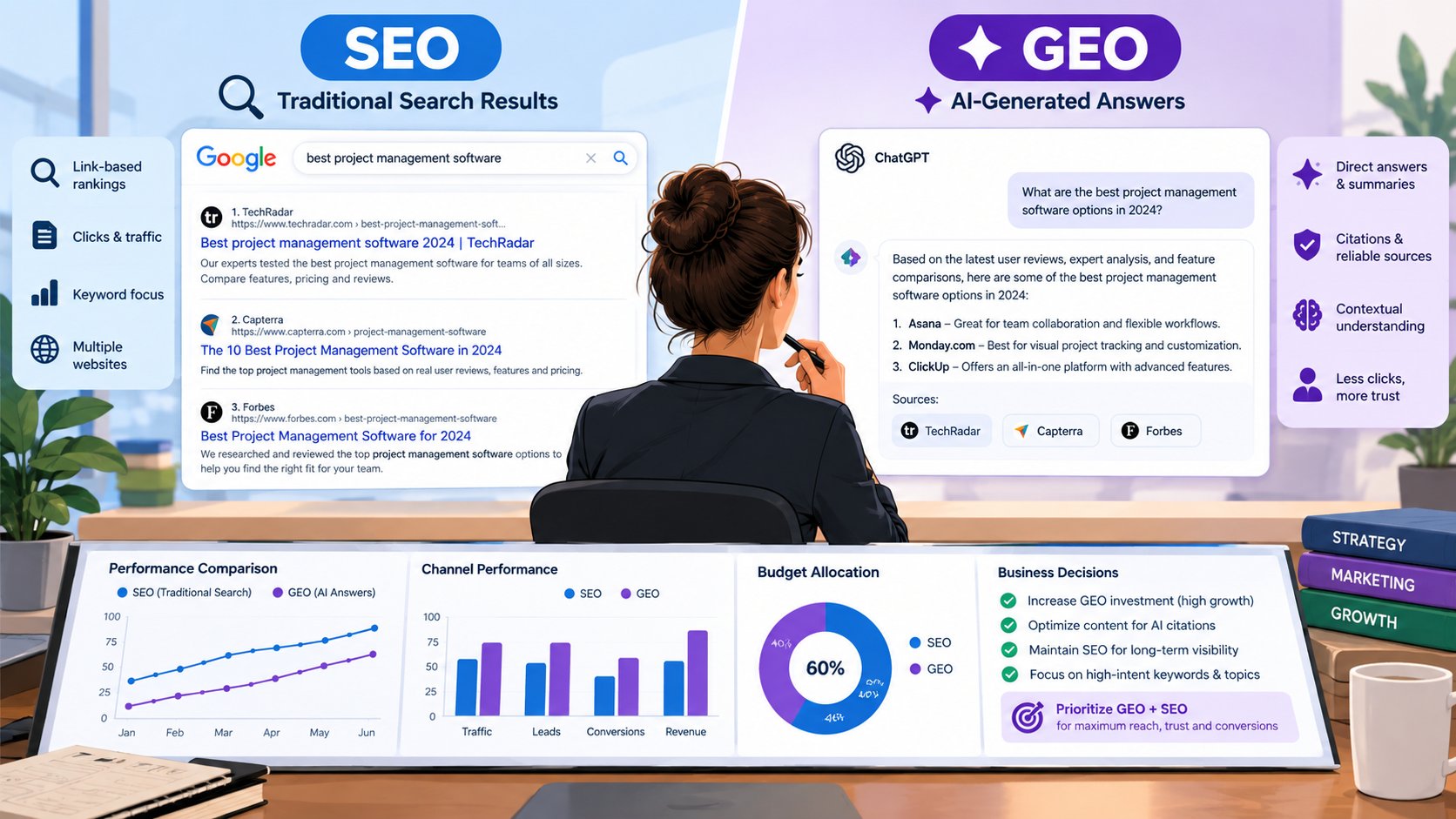
The most popular advice about GEO vs SEO is also the least useful: choose the channel that represents the future. That framing turns a practical marketing decision into a prediction contest. SEO still earns clicks from traditional search, while GEO earns mentions and citations inside AI-generated answers, so the key question is not which channel wins. It's where the next unit of budget has the stronger business payoff.
The distinction matters because AI answer experiences can satisfy a search without sending a visitor to your site. Pew's analysis found that users clicked a traditional result in 8% of searches with an AI summary, compared with 15% without one, while only 1% clicked links inside the summary. Search Engine Land's coverage of the study also reports that 26% of sessions ended after an AI summary, compared with 16% without one. GEO can improve visibility, but visibility and traffic aren't interchangeable.
Dimension | SEO | GEO |
|---|---|---|
Primary objective | Rank pages in traditional search results | Earn mentions and citations in AI-generated answers |
Main success unit | Ranking, clicks, organic sessions | Citation frequency, prompt coverage, share of model voice |
Content destination | A page the user visits | A passage an answer engine can extract or synthesize |
Core signals | Crawlability, links, relevance, technical quality | Clarity, source authority, entity consistency, citation likelihood |
Business payoff | Direct traffic and on-site conversions | Brand visibility, trust, assisted demand, and occasional referral traffic |
Best use | Search journeys that need a destination | Research and answer journeys that may end in the interface |
Why the GEO vs SEO Debate Is Really a Budgeting Question
SEO and GEO aren't competing channels in the clean sense implied by most comparison articles. They're layers in the same discovery system, with different costs, signals, and payoff curves. SEO helps a brand become findable through ranked pages. GEO helps that brand become selectable when an AI system assembles an answer from several sources.
That difference should change how teams approve work. “GEO is the future” isn't a budget case. A stronger case identifies the prompts where competitors appear, measures whether the brand is cited, checks whether those answers influence a valuable journey, and compares the opportunity with the cost of improving established SEO assets.
Practical rule: Don't move money from SEO because AI search sounds inevitable. Move it when your target prompts show a persistent visibility gap and the commercial journey is important enough to justify testing.
The opportunity is already measurable, but it isn't stable. One industry summary reports AI Overviews appearing on roughly 15–20% of Google searches, with stronger presence on informational and complex queries, while an analysis of 13,770 domains across 10 industries found AI referral traffic represented 1.08% of total web traffic. The GEO statistics summary puts those figures in context: GEO is becoming a measurable layer, not a replacement for SEO.
The volatility makes premature reallocation risky. Semrush found U.S. AI Overview coverage moved from 6.49% of keywords in January to nearly 25% in July, then fell to 15.69% in November. Its AI Overviews study shows why a snapshot can mislead a planning team. Before shifting a large SEO budget, track the same prompt set over time, compare answer visibility with organic performance, and separate durable demand from interface experimentation.
A sensible program usually protects technical SEO, content quality, and authority building as the base. GEO work then starts as a targeted layer around high-value prompts, especially where AI answers already appear and where a competitor's citation is taking attention that your ranked page fails to capture.
What Each Channel Actually Optimizes For
SEO optimizes a page for discovery and selection in a ranked result set. The working unit is usually a URL attached to a keyword cluster. Teams watch impressions, click-through rate, average position, organic sessions, assisted conversions, and revenue from landing pages.
A useful SEO statement sounds like this: “The position-three cluster for enterprise knowledge-base software drives 12% of demo signups.” The number in that example is a measurement format, not a universal benchmark. It connects ranking performance to a business outcome, which is more useful than celebrating an isolated position change.
GEO has a different unit of success. The system may use a sentence, paragraph, table, product description, review, or third-party mention as evidence inside an answer. The page can rank well and still be absent from the response. Conversely, an answer engine can select a source that wasn't visible in the co-displayed first-page results. An academic paper on Google AI Overviews found that nearly 30% of cited domains didn't appear in those first-page results, according to the paper's findings.
The page versus the passage
SEO asks, “Can the search engine rank this destination for the query?” GEO asks, “Can the answer engine confidently use this source when constructing a response?” That changes the editorial brief. SEO often rewards a complete page aligned to intent, while GEO benefits from concise definitions, explicit comparisons, clearly attributed facts, and passages that make sense when removed from their surrounding context.
A GEO performance statement might be: “The brand appears in 8 of 20 priority prompts for category research.” That dashboard needs prompt coverage, citation count, source accuracy, and share of model voice. It shouldn't be substituted with average organic position.
Dimension | SEO | GEO |
|---|---|---|
Optimization target | Search result ranking | Inclusion in generated answers |
Primary asset | Indexable URL | Extractable or attributable passage |
User action | Click to a site or destination | Read, remember, compare, or continue asking |
Core metrics | Impressions, CTR, position, sessions, conversions | Visibility rate, prompt coverage, citations, model share |
Content emphasis | Intent alignment, topical depth, internal linking | Direct answers, factual precision, quotable structure |
Main risk | Traffic loss from poor ranking or weak SERP presentation | Visibility without a click or consistent attribution |
The overlap is substantial. Both channels need accessible pages, clear information architecture, authoritative content, and trustworthy brand entities. The mistake is assuming one dashboard can represent both. A page can be a strong SEO asset and a weak GEO source, particularly if its key answer is buried beneath marketing language or split across ambiguous sections.
The practical implication is simple. Keep SEO conversion paths intact, then add answer-ready elements where they support a real prompt set. Don't rewrite every page into a conversational FAQ, and don't judge GEO experiments solely by sessions.
Side-by-Side on Tactics, Signals, and Content Shape
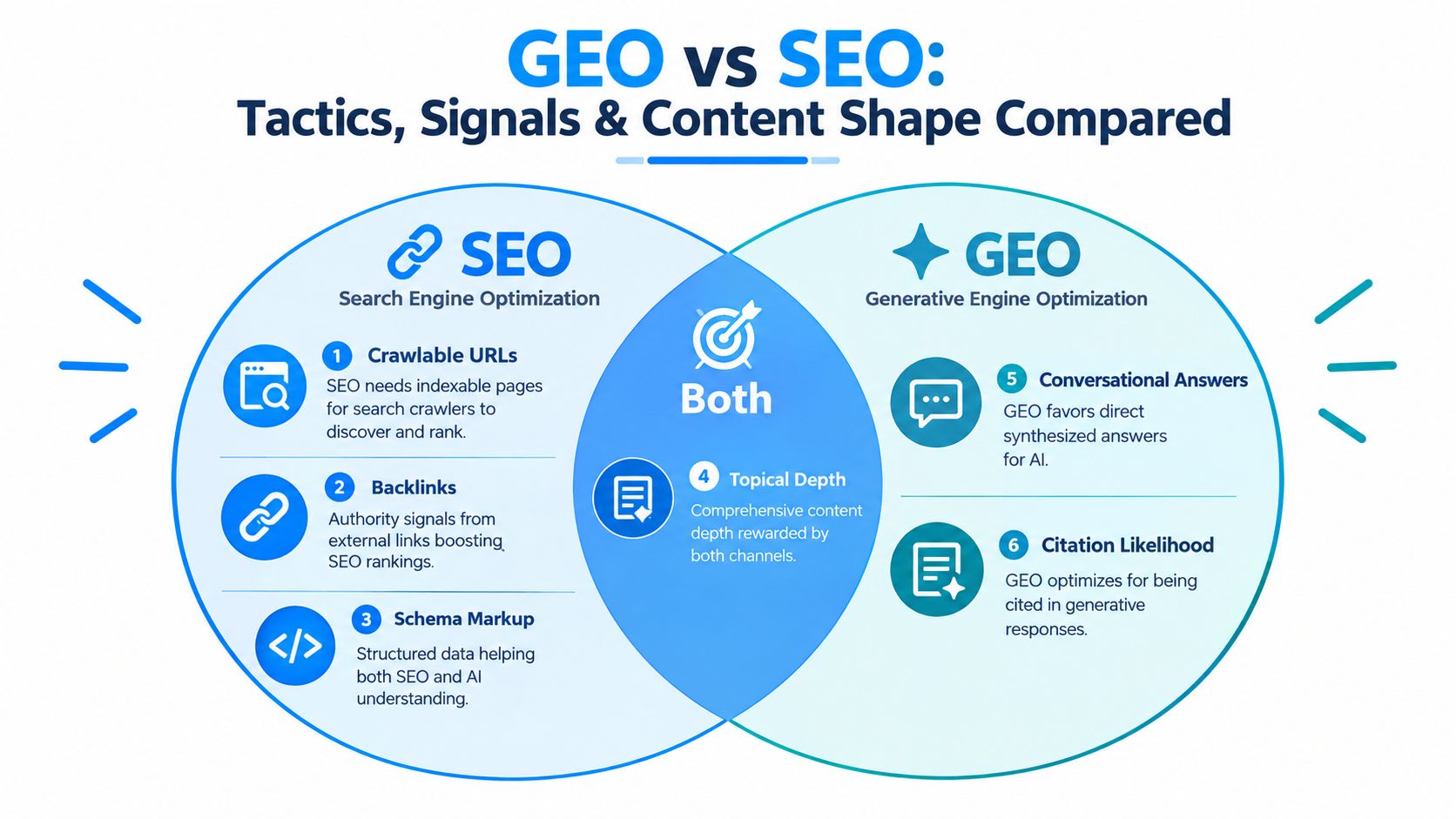
SEO and GEO share a foundation, but they look for different evidence once content enters the discovery system. SEO needs crawlable, indexable URLs, sensible internal links, relevant page titles, useful headings, and authority that search engines can interpret. Backlinks, technical accessibility, schema markup, and topical depth remain important parts of that foundation.
GEO adds a selection problem. An answer engine needs to understand who the brand is, what it offers, where it operates, and which statements can be safely used in a response. That makes entity consistency, third-party references, clear authorship, review context, and concise factual passages especially valuable.
Where the tactics overlap
Clean schema can help both search engines and AI systems interpret an organization, service, product, location, or author. Strong internal linking can establish topical relationships for SEO while giving retrieval systems a clearer path through related information. Experience and expertise signals also matter in both channels, particularly for content where accuracy and trust affect the user's decision.
The shared layer includes:
Technical accessibility: Make important content discoverable, indexable, and usable.
Structured information: Use accurate organization, service, product, breadcrumb, and relevant FAQ markup.
Topical coverage: Answer the main question and the supporting questions that shape the journey.
Trust signals: Identify authors, explain methodology, and support important claims with credible sources.
Where the content shape diverges
A long-form guide can perform well in SEO because it covers a topic in great detail, yet fail in GEO if the answer is hard to extract. A short summary, FAQ block, comparison table, or definition may be easy for an answer engine to reuse, but it won't create organic demand by itself if the page lacks depth, authority, or technical support.
That's why a TL;DR, a direct answer beneath a question heading, and concise supporting bullets are useful GEO additions, not substitutes for a well-built SEO page. The same principle applies to third-party mentions. A brand's own page can rank, but models may also look for corroboration across reviews, communities, publishers, and specialist directories.
For a deeper treatment of the relationship between answer optimization and search optimization, see this comparison of AEO and SEO. The operational takeaway is to build one strong source, then shape its important passages so both systems can understand and reuse them.
Localizing Content and Signals for GEO Wins
Local GEO work starts with entity clarity, not a pile of city pages. A location page should make the relationship between the provider, service, and place obvious in its opening sentence. “Austin Plumbing provides emergency residential plumbing services in Austin, Texas” gives a system a cleaner entity relationship than a vague introduction about dependable help in the local community.
That sentence doesn't replace useful detail. It creates a precise starting point for the hours, service area, qualifications, process, customer questions, and local proof that follow.
Start with the answer
Take a page titled “Plumbing in Austin.” If the first 600 words are general brand copy, visitors and answer engines have to work to find the service definition. A stronger version opens with a 40-word direct answer, then adds supporting detail about emergency repairs, drain work, water heaters, neighborhoods served, and how customers request service.
Those quantities describe a practical rewrite example, not a universal formula. The principle is to lead with the answer, then earn attention with evidence.
Use a page structure that exposes the local entity:
Entity definition: State the company, service, and city together.
Service scope: Separate residential, commercial, emergency, and specialist work.
Local context: Explain the actual area served rather than inserting a city name into a national template.
Proof and process: Add qualifications, reviews, response details, and what happens after contact.
Questions: Reflect the natural questions customers ask about cost, timing, availability, and suitability.
Add structured local signals
Implement accurate LocalBusiness and Service structured data where they describe the page. Keep the business name, address, phone number, service area, opening information, and map references consistent across the site and important third-party profiles. NAP consistency still matters, but it's only a baseline. It doesn't demonstrate that the business has genuine expertise in a specific location.
Build an internal cluster around the geographic entity. A central Austin service page can link to focused pages about emergency plumbing, water heater repair, commercial plumbing, and local maintenance guidance. That is stronger than publishing thin pages for every nearby city with nearly identical copy.
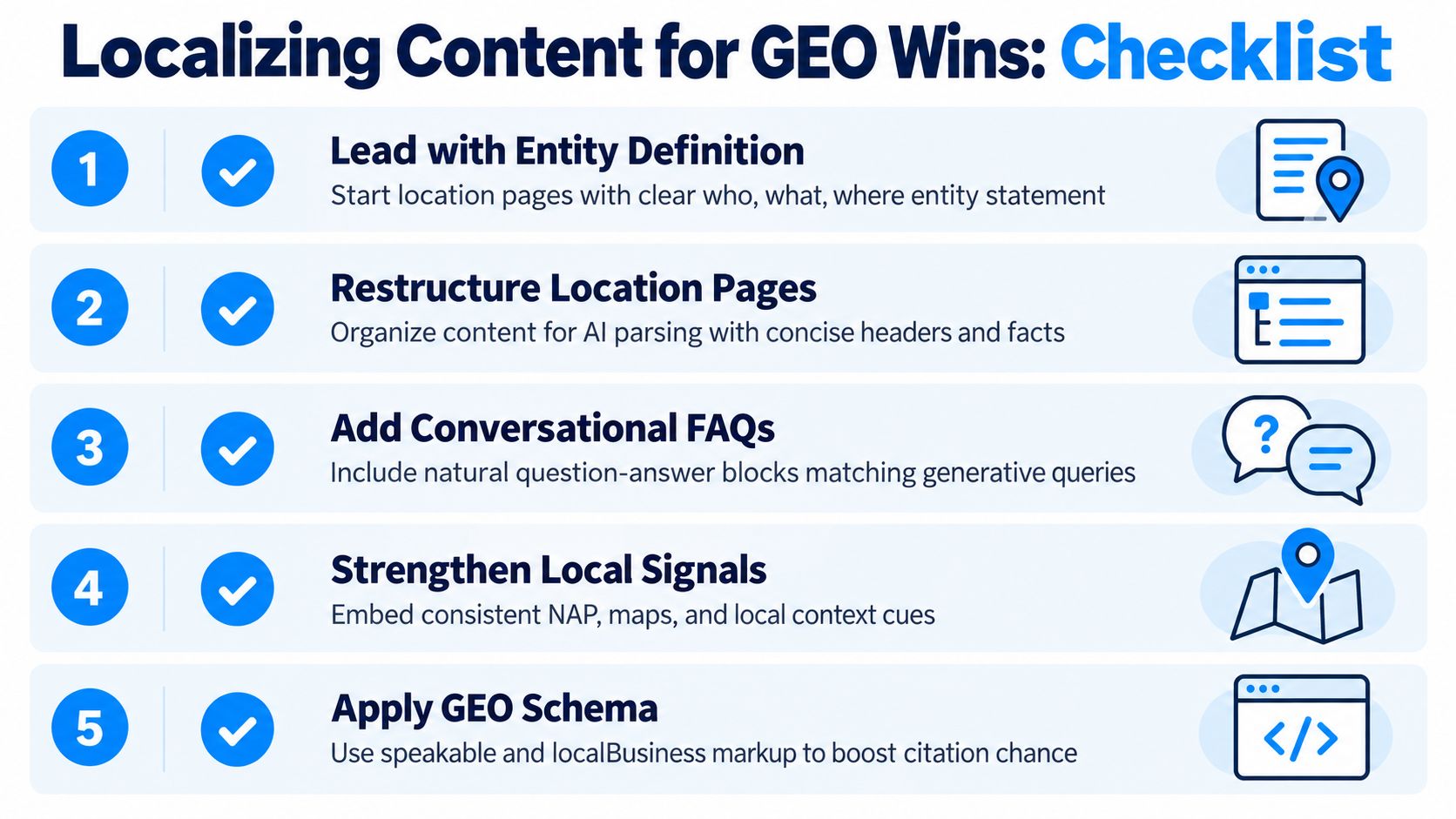
Natural FAQ blocks help when they answer real local prompts rather than padding the page. Questions such as “Do you handle emergency pipe leaks in Austin?” or “Which Austin neighborhoods do you serve?” give the content a conversational shape while keeping the facts specific. Author and publisher signals should also be clear, especially for regulated or high-trust services.
Why Ranking Number One Does Not Guarantee Citations
A top organic ranking is valuable, but it isn't a guaranteed invitation into an AI answer. Answer engines can assemble a response from sources that serve different roles: an authoritative definition from one domain, current user experience from another, and local context from a directory or community discussion.
The concentration is real. An independent study of 1,000 queries found that the top 1% of domains captured 47% of citations, with Wikipedia at 24.3% and Reddit at 21.6%. The citation-source analysis shows both concentration and fragmentation. A small set of domains receives a large share, but the winners aren't the pages holding the highest traditional rankings.
That selection pattern changes the work. Search visibility establishes one form of authority. Citation visibility requires the brand to appear in the information environment that models draw from, including relevant publishers, review platforms, forums, and specialist directories. The goal isn't to chase every mention. It's to earn accurate, contextually relevant references where buyers and answer engines already look for corroboration.
A directional diagnostic
The table below is a diagnostic model, not a verified benchmark. The available research demonstrates that organic rank and AI citation selection can diverge, but it doesn't provide a universal average position or citation rate for each source type.
Source Type | Avg Organic Position | Share of AI Citations |
|---|---|---|
Top-ranking brand page | Varies by query | Can be high or absent |
Review or community source | Often varies widely | Can be selected for experience signals |
Specialist directory | Often varies widely | Can support entity and category context |
Independent publisher | Often varies widely | Can provide authority and corroboration |
A useful audit compares the sources cited for your priority prompts with the sources ranking in the corresponding SERP. If the lists barely overlap, traditional rank tracking won't explain your GEO performance. You need citation monitoring and source analysis, as discussed in this guide to reading citations behind AI answers.
The practical response isn't to abandon ranking. It's to treat citation share as a separate distribution problem. Improve the owned page, then examine which external sources models repeatedly use and whether your brand is represented there accurately.
Measuring GEO and SEO With Different KPI Stacks
A unified search report should have two columns, not one blended score. SEO measurement follows the path from query to result to click to on-site action. GEO measurement follows the path from prompt to generated answer to mention or citation, then asks whether that visibility changes brand demand or assisted conversion behavior.
The SEO column typically includes:
Search impressions and CTR: Visibility and response in traditional results.
Average position: Ranking movement across tracked queries.
Backlinks and referring domains: External authority indicators.
Organic sessions: Visits attributed to search.
Conversions: Leads, purchases, signups, or other defined outcomes in analytics.
The GEO column needs a different vocabulary. Track visibility rate inside target prompts, share of model voice against a defined competitor set, citation count, citation accuracy, brand sentiment in the answer, prompt coverage, and the domains that appear as sources. Industry reporting commonly uses visibility bands of below 20%, 20–40%, and above 40%, and model-share bands of below 15%, 15–35%, and above 35%. The GEO measurement framework treats the lowest bands as underperforming signals that deserve investigation.
Keep the overlap visible
Some signals belong in both dashboards, but they shouldn't be counted twice. Brand search volume, direct traffic, branded conversions, assisted pipeline, and survey-based recall can reflect the combined effect of SEO, GEO, public relations, advertising, and offline activity. Use them as shared business indicators, not as proof that one channel caused the change.
A practical reporting cadence looks like this:
KPI | Channel | Primary Tool Category | Cadence |
|---|---|---|---|
Impressions, CTR, position | SEO | Search Console and rank trackers | Weekly |
Organic conversions | SEO | Analytics and CRM | Weekly or monthly |
Backlinks and referring domains | SEO | Link intelligence platforms | Monthly |
Prompt visibility | GEO | AI visibility suite | Monthly |
Citation count and accuracy | GEO | Citation analysis tools | Monthly |
Share of model voice | GEO | Multi-model monitoring platform | Monthly |
Brand demand and pipeline | Both | Analytics, CRM, and research | Monthly or quarterly |
Rank trackers remain useful for SEO. AI visibility suites, prompt archives, model comparisons, and citation databases support GEO. AI citation tracking is particularly useful when a team needs to see not only whether it was mentioned, but which page or domain shaped the response.
A peer-reviewed GEO study found that adding GEO tactics improved Position-Adjusted Word Count by 30–40%, indicating more attributable content in generated answers than baseline strategies. The study supports measuring answer inclusion, not just rank. Still, AEO tracking is early-stage and noisy. Models change, prompts vary, and identical questions can produce different outputs, so evaluate trends across a consistent prompt set rather than reacting to one response.
When to Prioritize Each Channel in Practice
Budget allocation should follow intent, existing authority, and the likelihood that an answer interface will resolve the journey without a click. SEO remains the default for broad awareness queries where the user wants to explore sources, compare viewpoints, or reach a destination. GEO deserves more weight when buyers ask compact evaluation questions and competitors are already being named in the answers.
The strongest operating model is staged rather than ideological:
Funnel Stage | SEO Weight | GEO Weight | Category Override |
|---|---|---|---|
Awareness and broad information | High | Lower | Increase GEO when answer visibility is persistent and commercially relevant |
Mid-funnel comparison and how-to | 70% | 30% | Keep technical SEO and authority work while optimizing priority sub-questions |
Bottom-funnel transactional | Lower relative weight | Higher relative weight | Require existing authority, accurate product information, and review momentum |
YMYL, legal, and medical | Balanced foundation | Earlier investment | Trust, authorship, corroboration, and factual accuracy are non-negotiable |
B2B SaaS with long sales cycles | Balanced foundation | Earlier investment | Track research prompts, competitor mentions, and assisted demand |
Commodity ecommerce | SEO-dominant | Test selectively | Reallocate only when category-level AI citations cross 20% of category searches, based on the stated planning threshold |
For mid-funnel work, a 70/30 split is a useful starting framework, not a universal rule. Keep improving crawlability, internal linking, and authority while optimizing the four to six sub-questions a serious buyer asks during evaluation. Those passages can support both the organic page and the AI answer.
Bottom-funnel GEO deserves heavier weighting only when the brand has enough topical authority and review momentum to be selected credibly. Otherwise, rewriting product pages for answer extraction won't solve the underlying trust gap.
The clearest reallocation threshold is operational. Review prompt coverage and citation accuracy monthly. Prioritize GEO updates when visibility is below 20% or share of model voice is below 15%, because those are the underperforming bands identified in the measurement framework cited above. Keep SEO as the larger investment when AI coverage is unstable, AI referrals remain marginal, or the page still has obvious ranking and conversion weaknesses.
The business value of a citation may also be indirect. Pew's click data shows that users often don't visit cited sources, so measure branded search, direct demand, assisted conversions, sales feedback, and recall alongside referral traffic. A citation can function more like share of voice and trust signaling than a conventional click campaign.
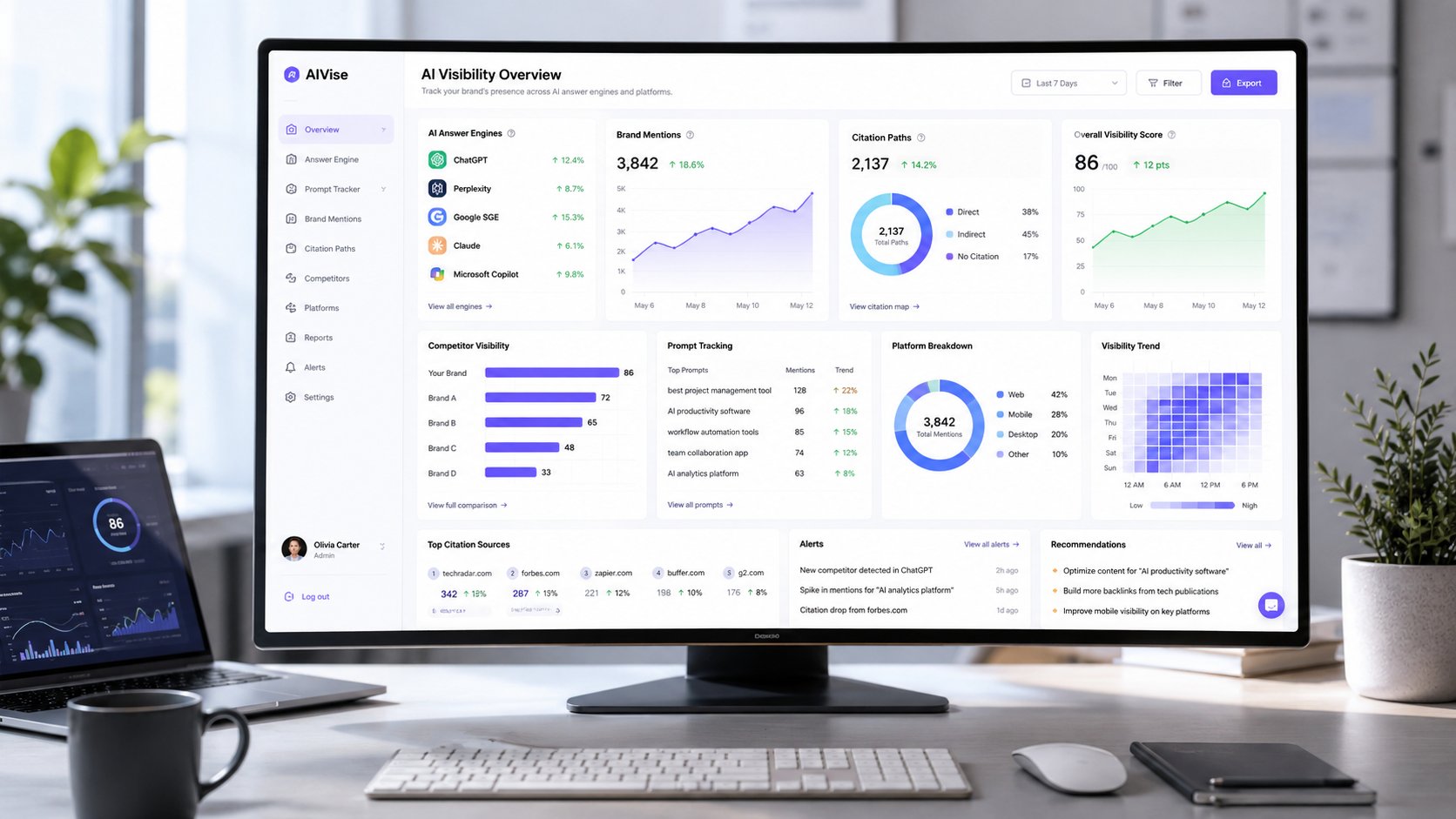
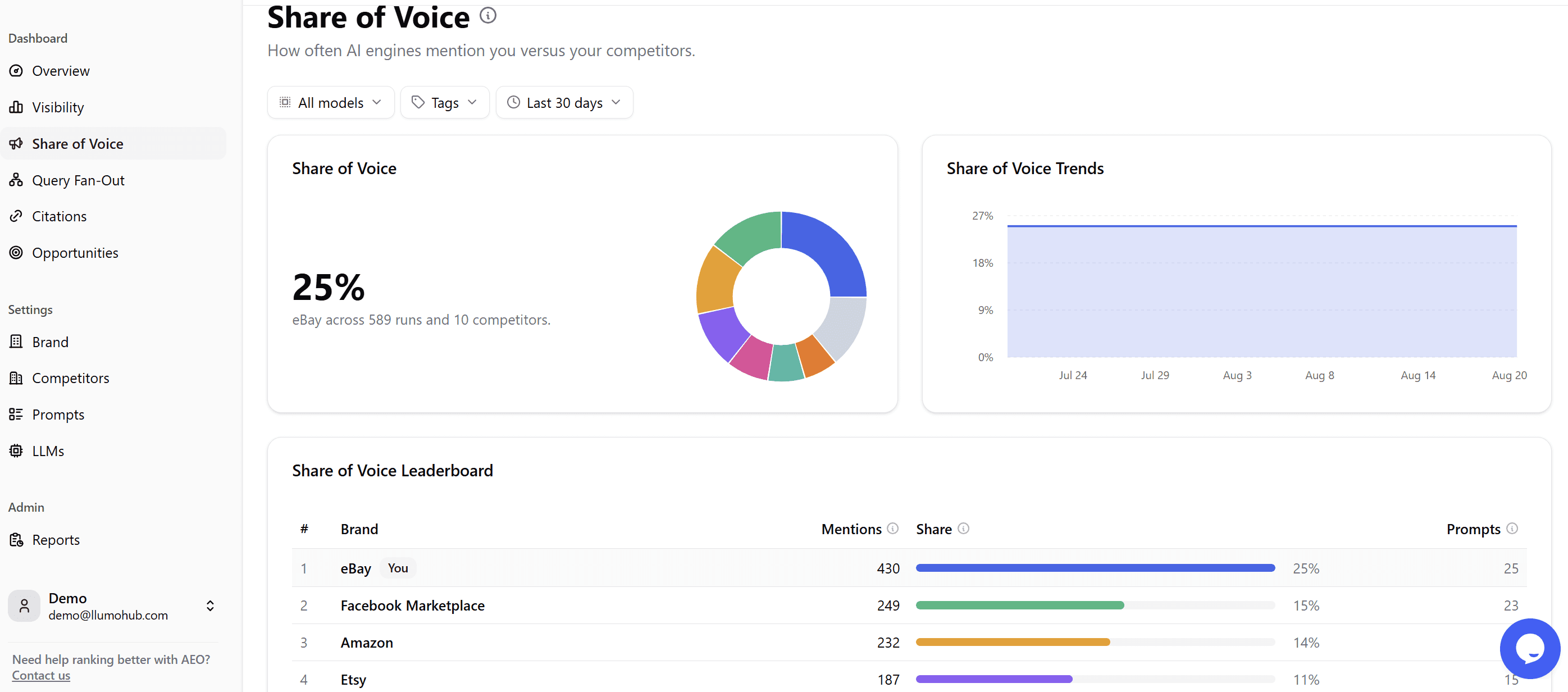
Llumo helps teams measure the GEO layer across AI answer engines with per-prompt visibility, share of voice, citation sources, and competitor trends. If you need to compare GEO performance with your existing SEO program, visit Llumo to assess the prompts, models, and sources shaping your brand's visibility.