Llumo is the strongest fit for teams that want broad AI visibility measurement and transparent provider-based costs, while other tools make more sense for narrower workflows. Promptwatch launched on April 1, 2025, reached its first 100 customers within its first week, and later added coverage for ChatGPT, Claude, Perplexity, and Gemini, so the best alternative depends less on novelty and more on how your team will use the data.
The popular advice is to compare AI visibility tools by platform count and dashboard polish. That's too shallow. A traditional rank tracker can show where a page appears in Google, but it can't reliably tell you whether a brand is mentioned, cited, displaced, or described favorably inside an AI answer. It also won't show which source shaped the response or whether that source changes across engines.
A useful PromptWatch alternative should be judged by engine coverage, prompt-level evidence, citation detail, competitive comparison, actionability, and the cost of repeated checks. Cross-engine volatility makes this especially important. Independent research reports month-over-month cited-domain drift of roughly 40% to 59%, with a cited-source half-life of about 4.5 weeks. The same analysis reports only 11% overlap between ChatGPT and Perplexity citation domains.
Llumo is the reference point here because its bring-your-own-key model separates software access from provider consumption. You can compare response-based costs directly instead of accepting a bundled quota without understanding what each check costs. That doesn't make it the right choice for everyone, but it creates a useful baseline for comparing the ten tools below.
1. Llumo
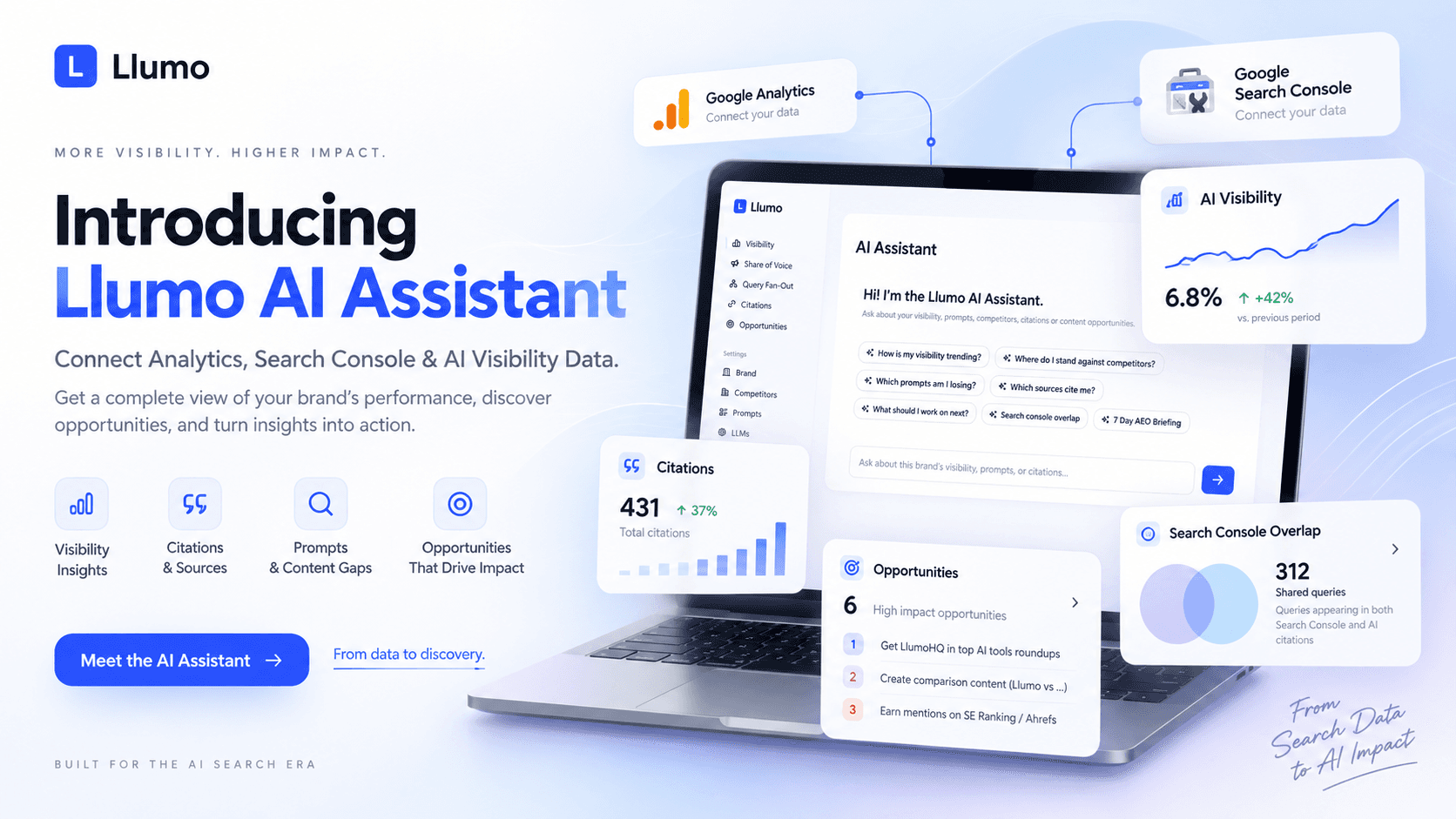
Llumo is the best all-round PromptWatch alternative for teams that need to measure AI visibility and then investigate what caused it. It tracks visibility across ChatGPT, Gemini, Perplexity, Copilot, Google AI Overviews, Claude, Grok, Mistral, DeepSeek, and other AI surfaces, with results organized at the prompt level rather than reduced to a single sitewide score.
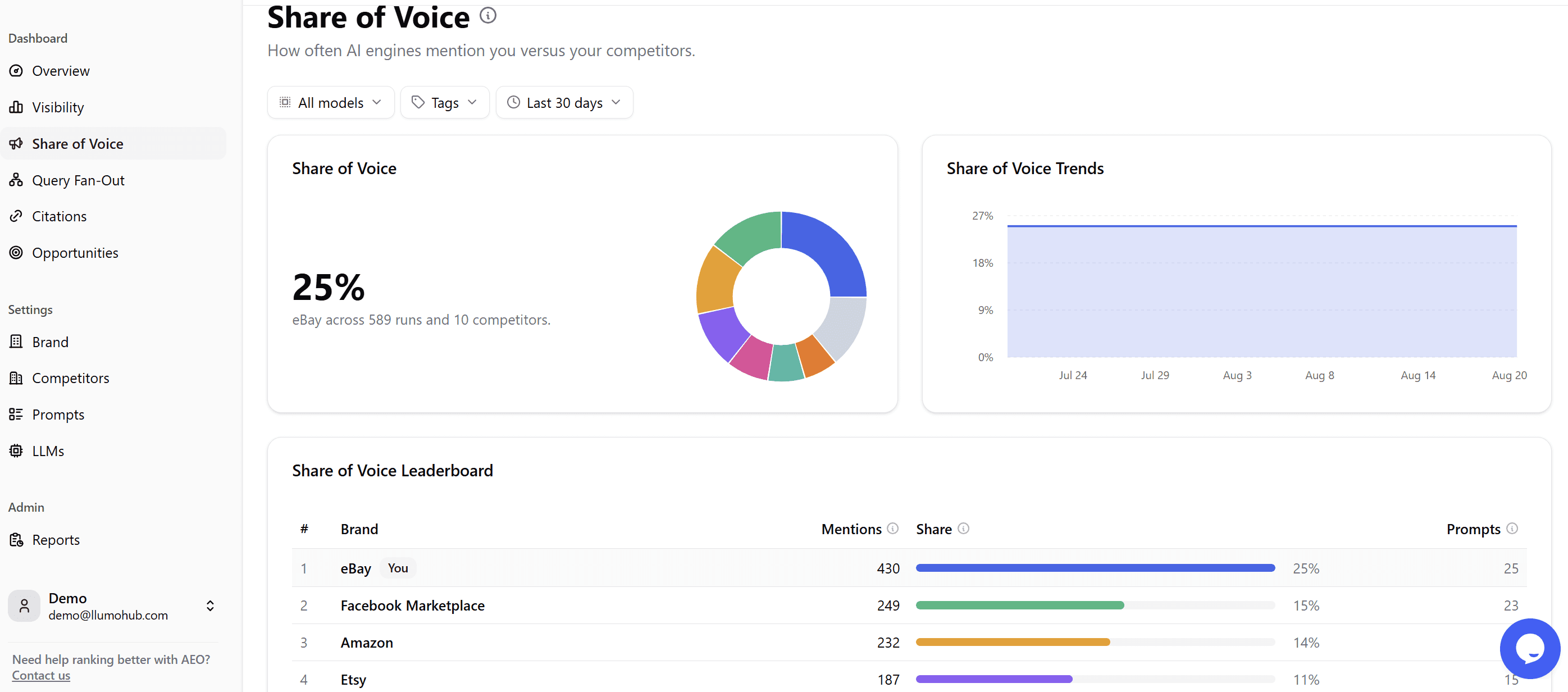
That distinction matters in day-to-day SEO work. A team can archive the exact response, see which brands appeared, inspect cited pages and domains, compare competitors, and follow visibility trends for a tagged prompt set. Query fan-out logging adds another useful layer by showing the searches and expansions behind an answer, which helps explain why a page was cited or overlooked.

Best for evidence and cost control
Llumo's strongest practical advantage is its no-core-license-fee model. Customers connect their own provider API keys and pay providers directly, without Llumo usage markup. That makes costs variable, so someone must monitor provider quotas and budgets, but it also makes response-based comparisons easier and avoids forced enterprise tiers.
The platform supports unlimited projects and brands, dashboards, prompt search, tagging, daily backups, usage analytics, custom subdomains, and custom branding on a dedicated hosted instance. Its opportunity discovery features connect findings to content updates, new pages, and brand-mention or outreach work.
Practical rule: Don't judge an AI visibility platform by whether it produces a score. Judge it by whether a strategist can turn a lost citation into a specific content or outreach task.
Llumo doesn't publish standard per-seat pricing, testimonials, or awards in the provided materials. That can make procurement and ROI justification harder, especially for buyers who want a fixed monthly quote. For teams comfortable managing provider keys and variable usage, the flexibility is compelling. See the detailed Llumo versus PromptWatch comparison before testing representative prompts.
Website: Llumo
2. Ahrefs Brand Radar
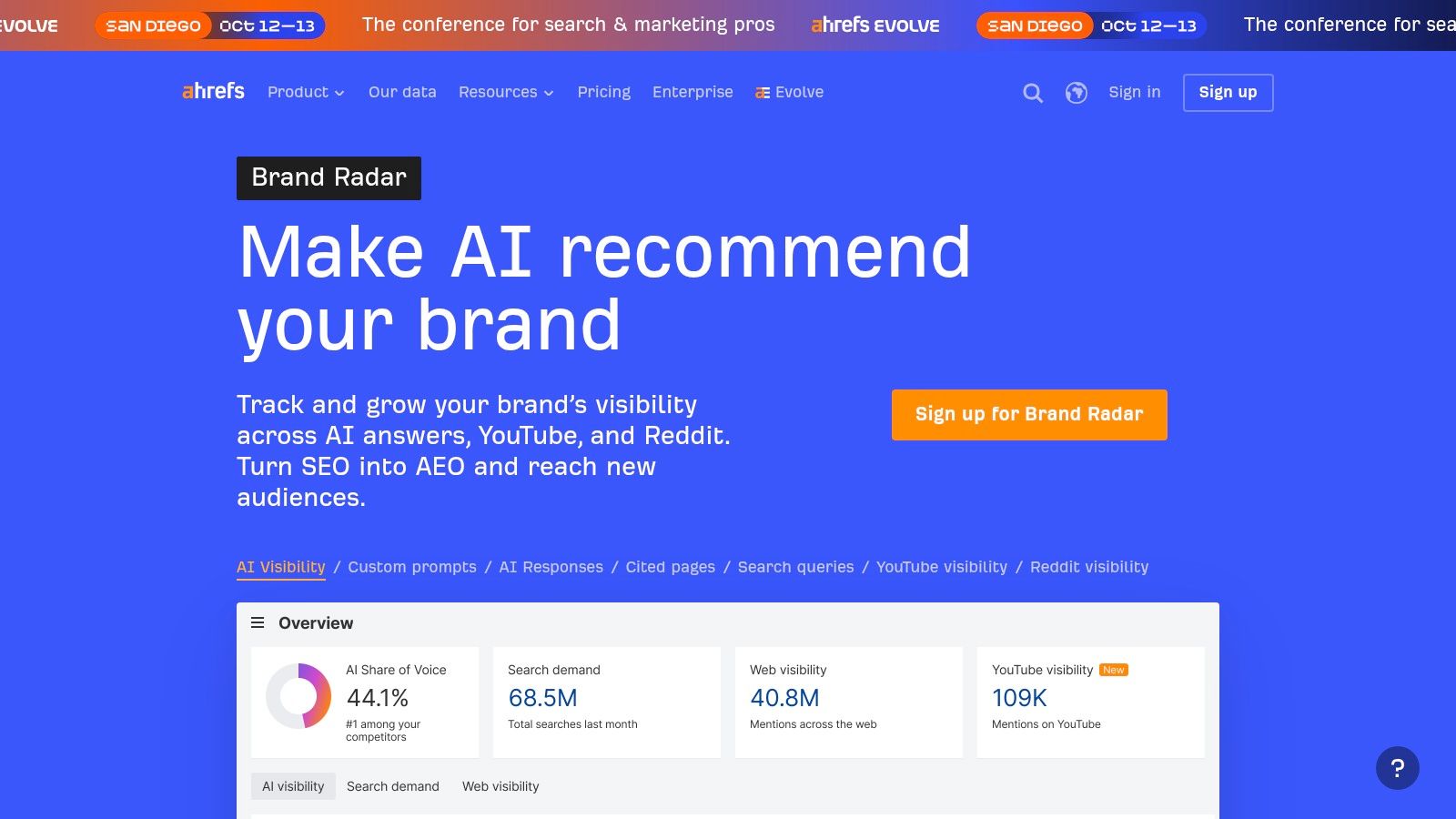
Ahrefs Brand Radar makes sense when AI visibility needs to sit beside a mature SEO research workflow. It models search-backed prompts from large keyword datasets and tracks brand presence across multiple AI assistants, then places those findings alongside Ahrefs data for search, YouTube, Reddit, and TikTok.
That context is useful for an SEO team that already works from keyword universes and wants to extend familiar research into AI answers. You can review mentions, share of voice, and impressions, while adding custom prompts when the modeled set misses an important buyer question. The onboarding and methodology material also gives teams a clearer explanation of how the product gathers data than many newer platforms provide.
Where the trade-off appears
The main drawback is commercial and methodological rather than cosmetic. Pricing can be difficult to compare with prompt-based tools, especially when add-ons apply. A buyer needs to understand whether the plan covers the prompt volume, engines, and reporting depth the team needs.
Ahrefs' search heritage is also both an advantage and a limitation. It gives strong keyword and market context, but an AI answer may rely on sources outside conventional Google-centered discovery. Teams should therefore compare Brand Radar's output against real response archives and citation evidence before assuming search visibility represents AI visibility.
Use Ahrefs Brand Radar when: your existing SEO data is the starting point and you want AI monitoring attached to that broader research system.
Pros
Search context: Connects AI visibility with established SEO, YouTube, Reddit, and TikTok data.
Custom prompt control: Lets teams add prompts beyond the modeled keyword-derived set.
Documentation: Provides methodology and onboarding material that supports internal adoption.
Cons
Plan complexity: Add-on costs can make prompt-based comparisons less direct.
Source bias risk: Search-led modeling may be less representative for engines drawing heavily from non-Google sources.
3. Profound
Profound is built for teams that want a packaged AI visibility program rather than a lightweight monitoring layer. Its browser-level capture is the key differentiator. Instead of relying only on API sampling, it aims to show what users see in live interfaces, which can matter when browser behavior, citations, or presentation differ from a provider response.
The platform tracks prompt-level visibility, rank, share of voice, and citations for each engine. It also adds content workflows, integrations, and agent-style features that help marketers move from an identified gap toward a recommended action. Reporting is polished enough for non-technical stakeholders, which reduces the work required to explain AI visibility to brand, content, or executive teams.
Browser capture versus API simplicity
Browser-level monitoring can offer stronger fidelity, but it usually introduces more operational complexity than a clean API workflow. Sessions, rendering, interface changes, and access conditions all need consideration. API-based collection is often easier to standardize and automate, while browser capture may better reflect the experience a user encounters.
Profound's public pricing isn't fully transparent, so buyers should expect a sales-led evaluation. Cost concerns can become more significant as brands, markets, and prompt libraries expand. That doesn't make the platform poor value, but it means a pilot should include the full reporting scope, not just a polished demonstration.
Read this practical Profound alternatives guide if you're deciding whether browser-level evidence or provider-based scale matters more.
Pros: Strong presentation, browser-level capture, per-prompt metrics, citation analysis, and workflow support.
Cons: Sales-led pricing, potentially higher multi-brand overhead, and more operational complexity than a straightforward API monitor.
4. Peec AI
Peec AI is a sensible choice for agencies and brands that want familiar marketing KPIs applied to AI visibility. It tracks mentions, position, sentiment, and share of voice across major AI platforms, then packages those metrics for teams that already report on competitive presence and category performance.
The agency orientation is practical. Volume-based plans and support options give agencies a way to think about multiple clients, while the reporting format is easier to bring into growth and conversion conversations than a raw archive of model responses. If a client asks whether its brand appears more often than a competitor, Peec's metrics provide a direct answer.
A good agency interface still needs methodological clarity
The trade-off appears when teams compare usage units. SEO suites often price around projects, keywords, or seats. AI visibility platforms may distinguish between prompts, checks, engines, and reporting volume. Those units aren't interchangeable, so agencies should model a real client portfolio before comparing headline plans.
Peec also provides less public methodology detail than some larger suites. That doesn't invalidate the metrics, but it makes validation more important. Run the same representative prompts across the engines your clients care about, then check whether the collected responses and citations support the dashboard's summary.
For agencies, reporting speed matters. For strategy teams, response evidence matters more. Peec is strongest when the first requirement leads.
Its packaging is attractive for client delivery, but teams needing deep citation investigation, query fan-out analysis, or provider-level cost control may need another layer alongside it. The Peec AI alternatives guide is useful for making that distinction.
Pros: Agency-friendly packaging, practical KPIs, competitor benchmarking, and marketing-focused reporting.
Cons: Prompt and check units can complicate cost comparisons, while methodology detail is less extensive publicly.
5. DeepCited
DeepCited takes a more execution-oriented route. It doesn't stop at identifying a citation gap. The platform combines AI visibility monitoring with a citation-ready content layer and hosted publishing, creating a workflow that runs from finding an opportunity to producing a page and measuring what happens afterward.
That model suits a small content team that doesn't want to stitch together research, briefing, publishing, and measurement tools. DeepCited tracks category questions across ChatGPT, Perplexity, Gemini, Claude, and Google AI answers, then recommends content opportunities based on the sources and topics appearing in those answers.
Publishing control is the deciding factor
Hosted publishing can shorten the path between insight and implementation. It can also create friction for organizations with strict CMS governance, legal review, accessibility requirements, or established editorial operations. A team should confirm whether generated pages can pass its normal approval process and whether publishing remains optional.
DeepCited's product is in beta, with Foundation available and higher tiers such as Growth and Authority on the roadmap. Beta pricing and locked discounts for early adopters may appeal to teams willing to shape an evolving product, but pending enterprise features should be treated as a procurement consideration rather than ignored.
Best fit: Teams that value an integrated “find gap, produce page, measure lift” workflow.
Watch closely: Governance, ownership of hosted content, migration options, and the maturity of enterprise controls.
6. AirOps
AirOps is for teams that want recommendations attached to monitoring. It tracks brand presence across ChatGPT, Perplexity, Claude, Gemini, and Google AI Overviews, with per-prompt visibility, citations, position, and trend analysis.
The useful part is the planning workflow. Instead of handing a content strategist a dashboard and asking them to interpret every gap, AirOps aims to recommend what the team should do next. That can help organizations where AI visibility is owned by content, SEO, and growth teams that need a shared roadmap rather than another analytics destination.
Useful recommendations still need human review
Automated planning works best when the team treats it as prioritization support, not an approval system. A recommendation to create a new page may overlook product positioning, legal constraints, editorial duplication, or the fact that an earned-media placement would be more credible than another owned article.
AirOps also has broader scope than pure tracking. That's an advantage if you want planning and execution guidance in the same environment, but it can feel excessive for a technical SEO team that only needs response archives and citation changes.
Pricing isn't clearly published publicly, so a buyer should ask how prompt volume, engine coverage, users, and recommendations affect the quote. Include recurring monitoring in that conversation. One-off audits are easier to budget than a living program that runs repeated checks and produces an ongoing queue of work.
Pros: Multi-engine monitoring, Google AI Overviews coverage, trend reporting, and roadmap guidance.
Cons: Sales-led pricing and a broader product scope than teams seeking a focused tracker may need.
7. Otterly AI
Otterly AI is a straightforward starting point for marketers who need prompt monitoring without a large implementation project. Teams can build prompt libraries from buyer questions, use AI-assisted discovery to expand those libraries, and run repeated checks across multiple engines.
The product focuses on mentions, citations, context, aggregation, and trends. Its GEO playbooks also give less technical users a practical entry into optimization work. Public plan breakdowns make initial evaluation easier than with tools that require a sales conversation before revealing how the product is packaged.
Simple setup can mean less strategic depth
Otterly AI is easier to stand up than a platform that requires provider keys, browser sessions, or a complex reporting model. That simplicity is valuable for a small marketing team, but it may not satisfy users who need deep query fan-out analysis, advanced source investigations, or browser-level evidence.
Some teams may also prefer live interface capture when accuracy depends on what a user sees rather than what an API returns. The right choice depends on whether repeatable monitoring and accessible reports matter more than maximum capture fidelity.
The name can also create confusion with Otter.ai in internal conversations, search queries, and documentation. That's a minor issue, but clear naming helps agencies avoid mistakes when building client workspaces or training new users.
Pros: Easy onboarding, prompt discovery, citation trends, GEO playbooks, and transparent entry-level pricing.
Cons: Strategy depth varies, browser-level capture may be preferred for some use cases, and the product name can create avoidable confusion.
8. Scrunch
Scrunch combines AI visibility monitoring with customer-experience and observability views. It tracks presence, share of voice, citations, and sentiment, then adds Signals that surface opportunities and possible next steps.
That combination suits a brand team that wants to understand not only whether a company appears, but also how AI systems describe it and which content sits behind those descriptions. The Deep Citations area adds time trends and topic analysis, giving content teams a way to investigate citation patterns instead of treating every mention as equal.
Don't confuse cited-page visibility with brand visibility
Some Scrunch metrics focus on cited pages rather than direct brand mentions. That distinction is important for reporting. A page can influence an answer without naming the brand prominently, while a brand can be mentioned without receiving a directly inspectable citation.
Scrunch supports manual and AI-suggested prompts, competitor presence, sentiment, and topic-level analysis. Those features create a balanced monitoring and optimization workflow, but pricing details may require careful investigation and higher tiers are often sales-assisted.
For a content or PR team, the strongest use case is source analysis. Recent research identifies Reddit, YouTube, and LinkedIn among the sources frequently cited across major AI engines, which reinforces the need to look beyond owned content. Search Engine Land's coverage describes this broader source-ecosystem pattern.
Pros: Balanced tracking, citation trends, sentiment, Signals, and content-level opportunity analysis.
Cons: Some metrics center on cited pages, and higher-tier pricing may require sales scoping.
9. Shoptank
Shoptank is the specialist option in this list. It's designed for ecommerce teams that care about whether products and retailers appear in AI recommendations, who outranks them, and what a merchant can change.
That focus changes the prompt methodology. A SaaS company might monitor category comparisons and buying questions. An ecommerce team needs product, retailer, price, availability, and category prompts, along with competitor comparisons that merchandising and brand managers can understand quickly.
Product visibility needs a retail workflow
Shoptank's merchant-friendly reporting and Google integrations make it easier to connect AI visibility observations with existing ecommerce processes. A category manager can investigate why one product appears in recommendations while another doesn't, then route the finding toward product data, content, merchandising, or retailer work.
The limitation is specialization. Non-commerce brands may find the workflows too narrow, especially if their main questions involve professional services, software evaluation, or brand reputation rather than product recommendations.
Public pricing isn't detailed, and ongoing plans appear to be scoped through sales. Buyers should ask how product catalogs, markets, prompt volume, and competitor sets affect the commercial model. A short pilot should include real products and categories, not generic queries.
Pros: Strong ecommerce fit, product and retailer visibility, competitor comparison, action suggestions, and simple reporting.
Cons: Less suitable for non-commerce categories, with pricing that isn't fully public.
10. VectorGap
VectorGap is more agency program than self-serve tracker. Its central idea is to map the gap between what AI systems remember or cite and the proof available across a market. That makes it useful for agencies packaging AI visibility, brand intelligence, and GEO governance as an ongoing service.
The platform uses brand, persona, and competitor modeling to inform prompt design and measurement. It also emphasizes market proof beyond a company's own website, which is important when AI systems rely on publishers, communities, videos, and other external sources.
Strong for service design, less so for self-serve speed
An agency can use VectorGap to standardize discovery, define client-specific signals, and build a repeatable GEO governance process. That's different from handing a marketer a dashboard and asking them to monitor prompts independently.
The trade-off is that VectorGap is less of a pure self-serve tracker. Agencies looking for a simple subscription, fast onboarding, and direct prompt exports may prefer a lighter platform. Pricing isn't public, so requesting a proposal is part of the evaluation.
Choose VectorGap when the deliverable is a managed AI visibility program. Choose a simpler tracker when the deliverable is a weekly dashboard.
Pros: Agency-oriented service delivery, brand and persona modeling, competitor intelligence, and broader market-proof analysis.
Cons: Less self-serve, less suited to basic monitoring, and proposal-based pricing.
PromptWatch Alternatives, 10-Tool Comparison
Product | Core features (✨) | Quality (★) | Pricing / Value (💰) | Target audience (👥) | Unique differentiator (✨) |
|---|---|---|---|---|---|
Llumo 🏆 | Multi‑model AEO, per‑prompt visibility, citation analysis, query fan‑out, hosted instances | ★★★★★ | 💰 BYO API keys, no platform markup; pay providers directly | 👥 SEO/AEO teams, in‑house content, agencies | ✨ No license fee + dedicated subdomain & opportunity discovery |
Ahrefs Brand Radar | Multi‑engine prompts, mentions/SOV, impressions, keyword context | ★★★★☆ | 💰 Subscription with add‑ons; complex for prompt‑based billing | 👥 SEO teams needing search context & cross‑channel data | ✨ Deep search index + robust docs/onboarding |
Profound | Prompt tracking, visibility scores, browser‑level capture, agent/workflows | ★★★★☆ | 💰 Sales‑led quoting; can be costly at scale | 👥 Marketers wanting packaged strategy & reporting | ✨ Browser capture + built‑in content/agent workflows |
Peec AI | Cross‑engine tracking (mentions/position/sentiment), agency plans | ★★★☆ | 💰 Tiered plans (volume‑based); agency focus | 👥 Agencies & growth/marketing teams | ✨ Agency‑friendly packaging and practical KPIs |
DeepCited | Tracks major models, detection→content→hosted publishing workflow | ★★★★☆ | 💰 Beta pricing (transparent early‑adopter discounts) | 👥 Teams wanting end‑to‑end content + measurement | ✨ Hosted publishing + citation‑ready content workflow |
AirOps | Automated prompt monitoring, per‑prompt metrics, planning workflow | ★★★☆ | 💰 Pricing via sales; not public | 👥 Teams needing roadmap + tactical recommendations | ✨ Prioritized roadmap that turns insights into tasks |
Otterly AI | Prompt library, AI discovery, citation aggregation, GEO playbooks | ★★★☆ | 💰 Public entry pricing; transparent tiers | 👥 Non‑technical marketers & SMBs | ✨ Easy setup + clear entry pricing |
Scrunch | Prompt monitoring, SOV, sentiment, Signals & observability views | ★★★★☆ | 💰 Mixed, public info for basics, sales for higher tiers | 👥 CX, content & analytics teams | ✨ Signals for opportunity discovery + topic analysis |
Shoptank | Ecommerce product/brand recommendation visibility, competitor fixes | ★★★★☆ | 💰 Sales‑scoped plans; merchant focused | 👥 Ecommerce brands, retailers, category managers | ✨ Retail workflows + product recommendation focus |
VectorGap | Brand/persona/competitor modeling, GEO governance, agency tooling | ★★★☆ | 💰 Proposal‑based pricing | 👥 Agencies packaging AI visibility as a service | ✨ Agency‑centric framework for proof & governance |
Choose by Workflow, Not Feature Count
A PromptWatch alternative should earn its place by fitting the work your team can complete. Llumo is the broadest fit when you need cross-model measurement, prompt archives, citation evidence, competitive trends, query fan-out logging, and control over provider costs. Its bring-your-own-key approach removes core license markup, but it also means your team must manage API credentials, quotas, usage budgets, and variable response costs.
Choose a packaged platform when the priority is guided execution, browser capture, or client-ready reporting. Profound is the stronger candidate when live browser evidence and polished enterprise presentation matter. AirOps is better suited to teams that want roadmap guidance beside monitoring. Peec AI fits agency reporting and familiar marketing KPIs, while Otterly AI offers a simpler entry point for teams that mainly need prompt libraries, mentions, citations, and trend views.
The source of the visibility gap should shape the tool choice. Recent AEO research reports that 51% of B2B software buyers now begin vendor research inside an AI chatbot, up from 29% a year earlier, a 22-point increase. The same research cites findings that relevant statistics can raise generative-answer visibility by up to 41%, external citations can lift it by 40%, and only about 8% of ChatGPT citations overlap with Google's top ten results. Those findings support a workflow based on AI evidence, not a traditional ranking report with an AI label attached.
For ecommerce, Shoptank is the clear specialist choice because product and retailer recommendations require different prompts and decisions from B2B content monitoring. DeepCited is worth considering when publishing is part of the operating model and your governance process can accommodate hosted content. VectorGap makes more sense for agencies building a managed GEO or brand-intelligence service than for a team that wants a self-serve tracker.
Test before committing. Use representative prompts from real buyer journeys, not only easy branded queries. Compare the full response, cited URLs, competitor mentions, prompt methodology, browser versus API capture, refresh behavior, exports, and billing units. Ask whether the tool records new and lost references over time, because a static citation snapshot won't explain cross-engine volatility.
Finally, assign an owner for the work after measurement. A visibility dashboard without a content, digital PR, product, or merchandising workflow becomes another report no one acts on. The best platform is the one your team can use to identify a source gap, choose an intervention, ship it, and return to the same prompt set to evaluate what changed.
Llumo brings cross-model AI visibility tracking, prompt-level response archives, citation analysis, share-of-voice reporting, query fan-out logging, and provider-cost control into one AEO workflow. If you're evaluating a PromptWatch alternative, visit Llumo to compare your real prompts, sources, competitors, and usage model before choosing a platform.