
The right Peec AI alternative depends on the evidence your team needs. Choose broad multi-model prompt visibility, Google AI Overviews monitoring, enterprise SEO integration, or lower platform overhead first, then choose the platform that fits. Llumo is the strongest fit for teams prioritizing broad coverage and provider-cost control, while Ahrefs, SE Ranking, Conductor, and enterprise suites serve different operating models.
Traditional rankings no longer explain the full picture of how a brand appears in search. One analysis found that only 38% of pages cited in Google AI Overviews also ranked in Google’s top 10 organic results (The Stack), while another reported 76.10% of cited pages in the top 10, 9.50% between positions 11 and 100, and 14.40% below position 100 (Ahrefs’ analysis of AI citations). The practical conclusion is simple: rank tracking alone can miss the sources shaping an answer.
The useful comparison is therefore not a feature-count contest. It’s an evidence comparison involving model coverage, prompt-level visibility, citation sources, response archives, competitive context, integrations, APIs, privacy, provider-key control, and implementation effort. Specialist AEO platforms focus on what AI systems say and cite. Google-focused SEO suites place AI signals beside rankings, audits, backlinks, and content workflows.
The market is moving in that direction quickly. One independent projection places global AEO revenue at USD 530.21 million in 2024 and USD 9,044.77 million by 2031, implying a 42% CAGR from 2025 through 2031 (market overview of Peec AI alternatives). That makes platform economics and data ownership strategic decisions, not minor procurement details.
1. Llumo
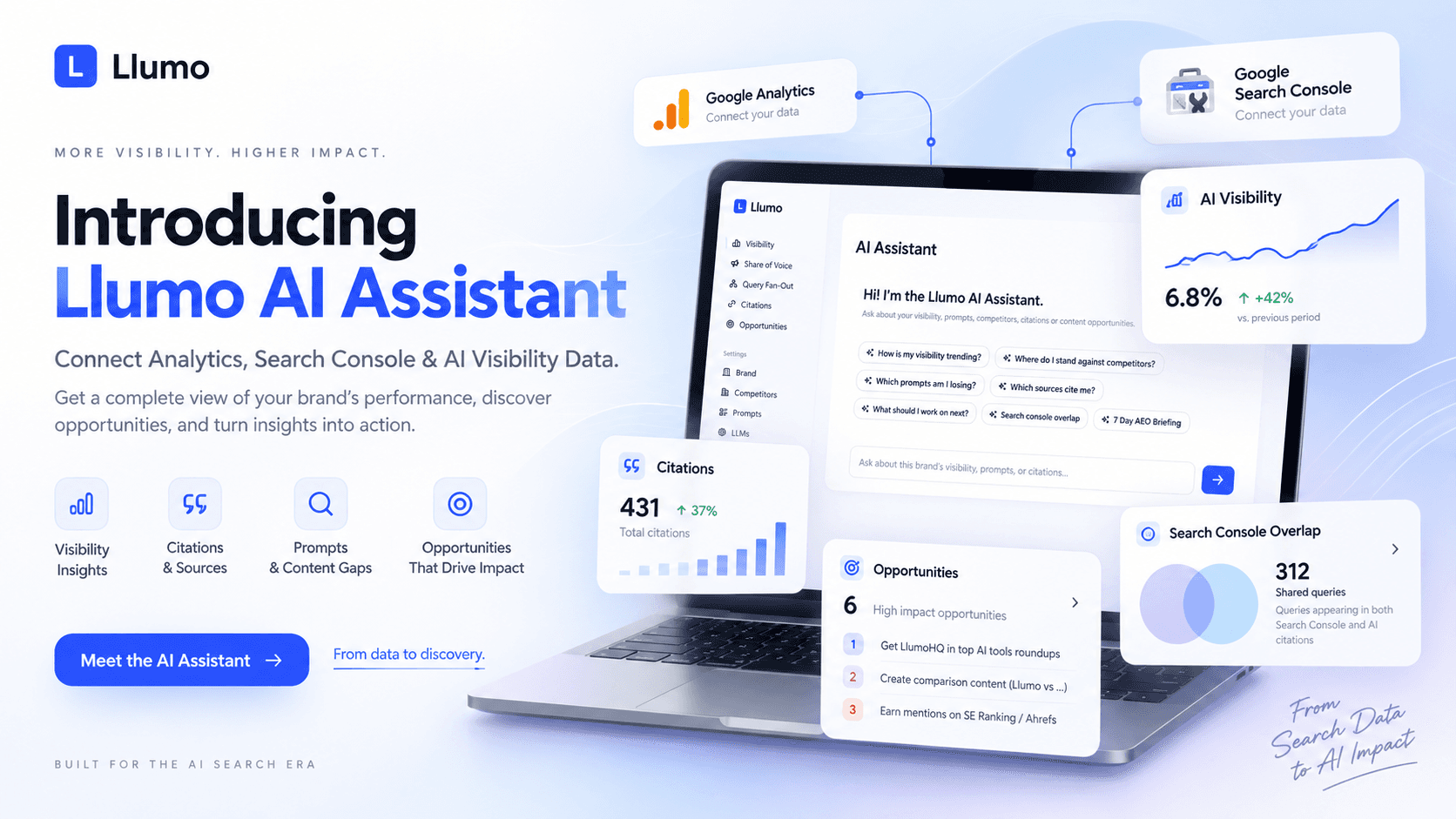
Llumo focuses on multi-model Answer Engine Optimization tracking, not traditional SERP reporting. It monitors mentions and citations across ChatGPT, Gemini, Perplexity, Copilot, and Google AI Overviews, with additional AI surfaces available through APIs, OpenRouter, and web scraping.
The main evidence is organized by prompt. Teams can inspect visibility scores, share of voice, competitor trends, citation sources, and archived responses rather than relying on one blended visibility figure. AI citations can change across repeated searches. One large analysis found that 52% of repeated searches changed at least one cited source.
Where Llumo fits
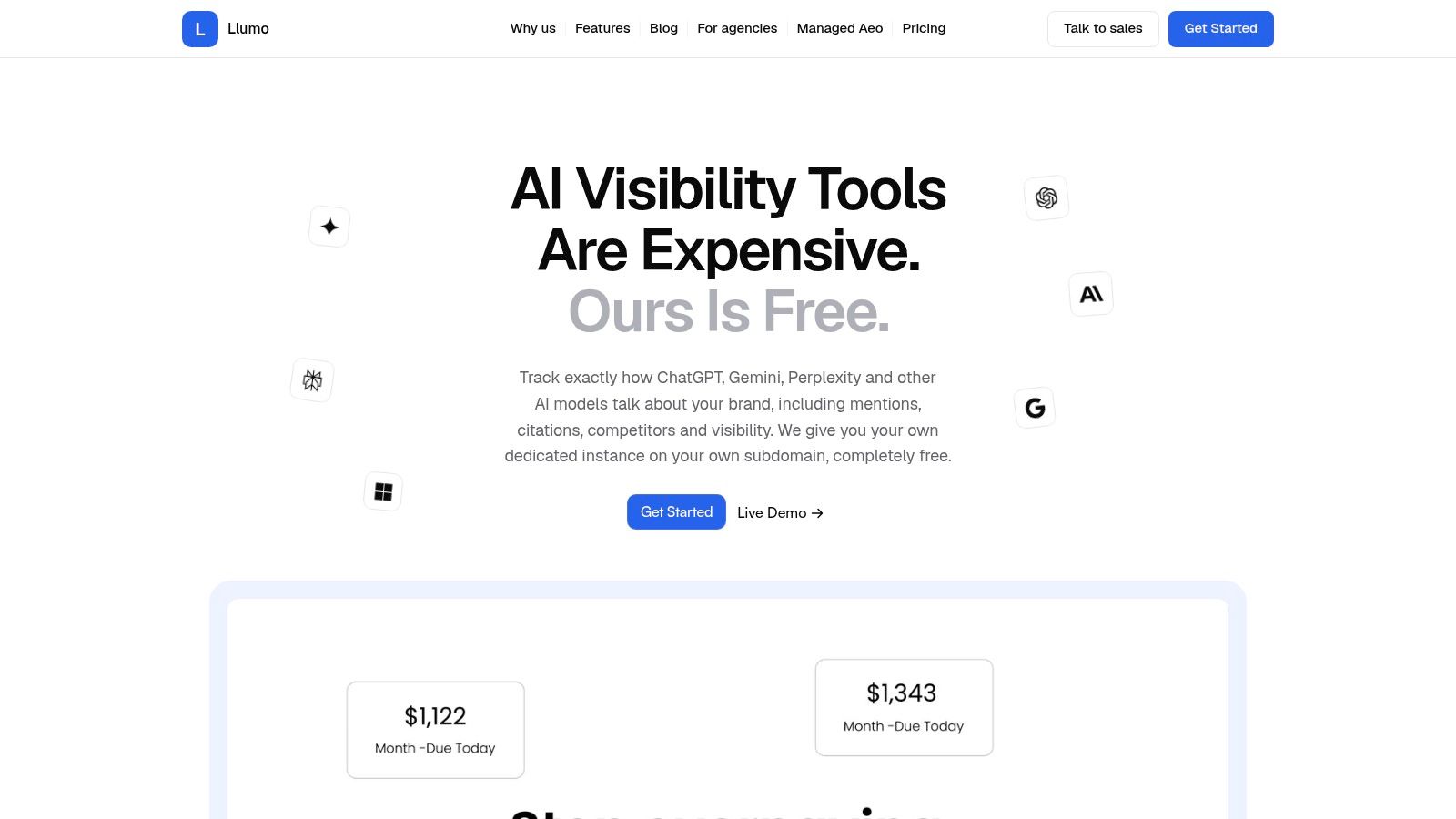
The bring-your-own-API-keys model sets Llumo apart from bundled SaaS pricing. The platform has no software license fee, while customers pay provider costs directly without a Llumo usage markup. Prompt capacity can scale across large sets, subject to the quotas and budgets of connected providers.
The trade-off is operational responsibility. Teams must connect and fund provider APIs, manage quotas, and select the models to monitor. They gain clearer control over provider spending and can separate response costs from software fees. This approach suits organizations that already manage API budgets or need flexibility across model providers.
Practical rule: Choose Llumo when the question is “Which model mentioned us, for which prompt, and which source supported the answer?” rather than simply “Did our visibility score move?”
The platform also provides opportunity discovery, citation analysis across domains and pages, prompt tagging, response archives, dashboards, and optional dedicated hosting with custom branding. Its main limitation is lower maturity than legacy SEO suites, particularly for third-party integrations. Teams comparing its coverage and operating model with Peec AI can review Llumo versus Peec AI.
2. Ahrefs Brand Radar
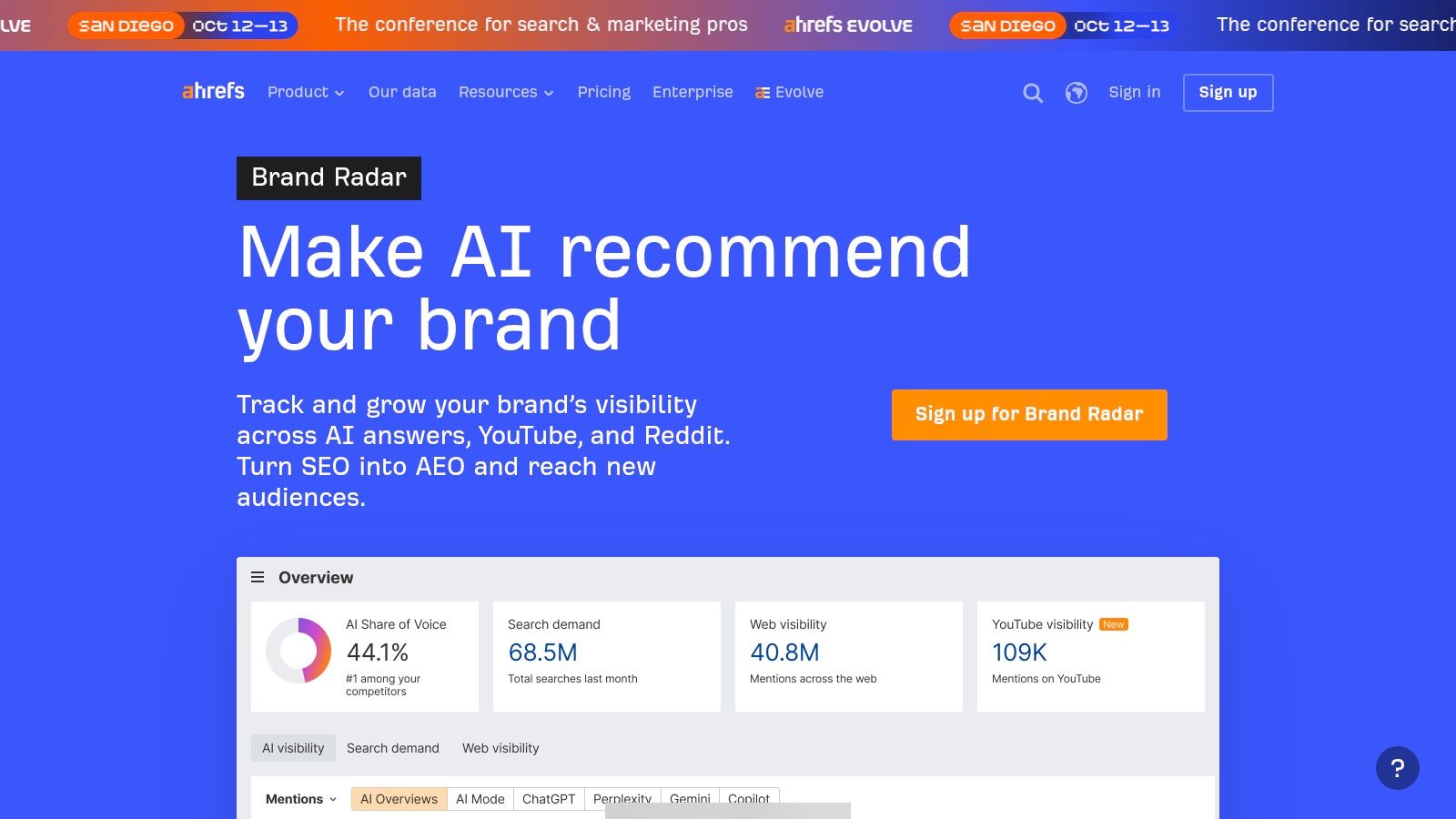
Ahrefs Brand Radar suits teams that need AI visibility evidence connected to an established SEO dataset. It covers Google AI Overviews, AI Mode, ChatGPT, Perplexity, Gemini, and Copilot, with brand mentions, citations, impressions, share of voice, custom prompts, and API access.
Its value lies in connecting AI citations with keywords, backlinks, pages, and related search signals. Analysts can investigate whether a cited source is a brand-owned page, review site, video platform, or another external property. That context matters because citation sources differ by search intent. Educational articles represented 70.2% of citations for informational queries, while listicles and buying guides led commercial searches at 37.6%, according to Position Digital’s citation analysis.
Evidence strength versus actionability
Brand Radar’s prompt index and custom-query options support competitor research across more than one tracked domain. Teams can examine where competitors appear, which pages receive citations, and which topics show weaker brand presence. Its API can also feed findings into existing reporting systems.
The limitation is execution. Brand Radar provides evidence and context, but teams may still need separate workflows to decide which page to update, which external source to pursue, and how to make the change. That places it closer to an SEO intelligence layer than a prescriptive, multi-model AEO platform.
Access is also plan-dependent and may represent a significant addition for smaller teams. It fits organizations already using Ahrefs data, while teams seeking prompt-level evidence across multiple models should compare its coverage with other AI Overview tracking tools.
3. Conductor AI Search Performance
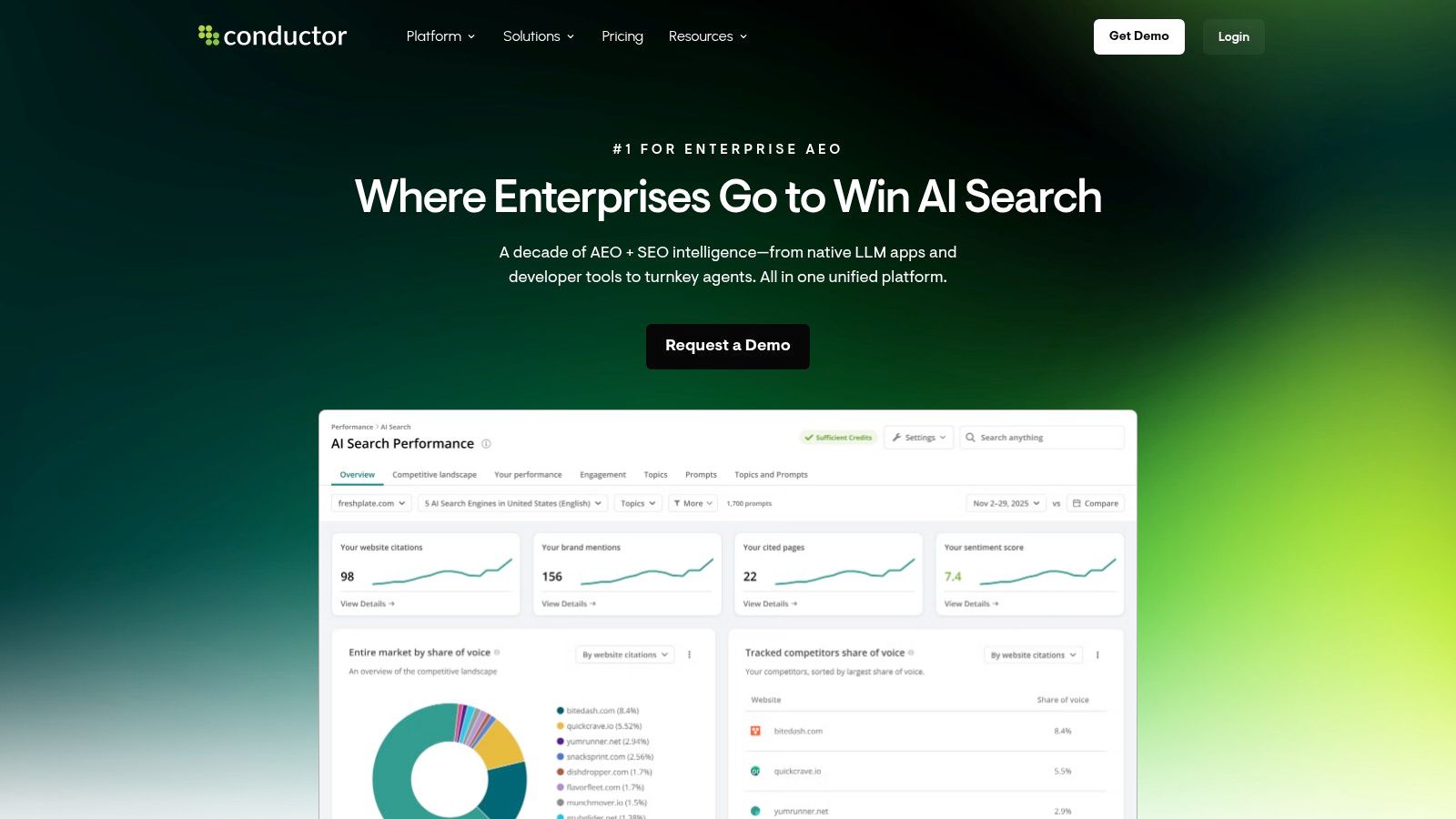
Conductor approaches AI visibility as part of an enterprise content operating system. Its AI Search Performance workspace measures mentions, citations, share of voice, topics, prompts, competitor trends, and historical performance across supported AI engines.
The platform’s differentiator is the connection between detection and content execution. Insights can flow into Conductor Creator, where content teams can work from briefs and optimization guidance rather than exporting findings into an unrelated writing or workflow tool. That reduces the handoff between the analyst who finds a citation gap and the editor responsible for addressing it.
Best use case
Conductor suits organizations with established governance requirements. Large teams often need permissions, standardized reporting, market and competitor views, and repeatable workflows more than they need the lowest possible entry price. Daily or weekly refresh options also support recurring performance reviews, although buyers should confirm the exact engine coverage, refresh cadence, and prompt allowances in their proposal.
The limitation is commercial and operational. Pricing is custom and typically aimed at enterprise budgets, while the breadth of the suite can exceed the needs of a small team that only wants prompt-level answer evidence. Conductor also makes the most sense when content operations already matter. If the company has no structured editorial workflow, much of the platform’s advantage may remain unused.
A broader strategic framework appears in this guide to Answer Engine Optimization. Conductor is strongest when AEO is treated as a governed content program, not an isolated analytics task.
4. SE Ranking AI Overviews and AI Visibility Toolkit
SE Ranking is a practical option for teams that don’t want a separate SEO and AI visibility stack. Its AI features monitor when Google AI Overviews appear and whether a tracked site is cited, while broader AI Search and AI Results modules extend monitoring into systems such as ChatGPT and Perplexity.
The platform places these signals alongside rank tracking, site audits, competitor research, and reporting. That context helps teams compare a conventional ranking change with an AI citation change without moving between dashboards. It also supports agencies that need one reporting environment for both established SEO deliverables and newer AI visibility work.
Where the compromise appears
SE Ranking’s value is strongest when traditional SEO remains central. A team can investigate technical issues, rankings, competitors, and AI results in one system. Its documentation and frequent feature updates also reduce the implementation burden for organizations that prefer a familiar SEO workflow.
The weakness is depth across non-Google assistants. Specialist AEO platforms generally make prompt response evidence, citation inspection, and cross-model comparisons the center of the product. In SE Ranking, some AI surfaces and modules may be add-ons depending on the plan, and the experience is more integrated than forensic.
That distinction matters because AI visibility doesn’t map neatly onto ranking performance. Research has found limited overlap between AI-cited pages and top organic results, with one analysis reporting 54.5% overlap after measuring the relationship over time (The Stack’s citation-source analysis). SE Ranking can expose both datasets, but teams should still inspect the actual cited pages rather than assuming ranking improvements will produce equivalent answer visibility.

5. Similarweb AI Search Intelligence
Similarweb AI Search Intelligence is designed for teams that need to connect AI search visibility with market and traffic intelligence. It combines AI Overview detection, cited-page analysis, competitive benchmarking, and Similarweb’s broader view of domains, markets, and demand.
The evidence it provides is therefore more commercial than purely editorial. A growth or competitive-intelligence team can ask where AI Overviews appear, which domains receive citations, and how those signals relate to estimated traffic or market-share trends. That helps executives discuss AI visibility in terms of demand exposure instead of treating it as a standalone content metric.
Strong market context, thinner answer evidence
Similarweb’s advantage is breadth across regions and verticals. Its workflows can help teams interpret whether an AI Overview presence aligns with broader changes in a category or competitor field. This is valuable for organizations that already use Similarweb for market research and don’t want AI data isolated from existing intelligence.
The limitation is answer granularity. Dedicated AEO platforms are generally better suited to storing prompt-level response text, comparing model outputs, and inspecting the precise language around a mention. Similarweb is more useful when the central question is how AI surfaces may affect demand and competitive position.
Pricing also aligns with enterprise and market-intelligence tiers, so smaller teams may find the product difficult to justify for monitoring alone. Before buying, confirm whether the platform exposes the exact prompts, cited URLs, and answer snapshots your analysts need, or whether it primarily delivers aggregated visibility and traffic context.

6. BrightEdge AI Overviews Tracking and Insights
BrightEdge brings AI Overview research into an established enterprise SEO environment. Its tracking identifies where AI Overviews appear, which sources they cite, and how patterns develop across tracked keywords and industries.
The product is strongest at macro-level reporting. SEO leaders can connect AI Overview presence and citation signals with existing content, rank, and SEO performance data. That makes BrightEdge suitable for leadership reporting, especially when the organization already uses the platform to manage large-scale search programs.
Google evidence at enterprise scale
BrightEdge’s research streams can help teams understand AIO prevalence and source overlap across a market. It also connects those insights to content and SEO workflows, which supports organizations that already have defined owners for technical SEO, editorial planning, and performance reporting.
Its limitation is model breadth. BrightEdge is primarily Google-centric, so it isn’t the natural choice for a brand that needs a balanced view across ChatGPT, Gemini, Perplexity, Copilot, and other assistants. It also carries enterprise pricing and implementation expectations that may be excessive for a smaller marketing team.
The evidence model is another consideration. BrightEdge can show AIO presence and cited URLs across tracked keywords, but buyers should determine how thoroughly they can inspect individual answer text, prompt variants, competitor mentions, and citation changes. If the team needs Google SERP integration first, BrightEdge is credible. If it needs broad answer-engine comparison first, a specialist platform may provide more relevant evidence.

7. seoClarity AI Overviews Tracking
seoClarity is aimed at enterprise SEO programs that need to crawl and track Google AI Overviews across very large keyword sets. It reports when AIOs appear, which sources are cited, historical changes, and segmented performance alongside rank and site-audit data.
The platform’s central strength is operational scale. Large organizations can organize AIO presence and citation reporting by keyword groups, markets, devices, time periods, and business segments. Alerts and dashboards help SEO teams monitor changes without manually checking individual results.
Best for Google-led programs
seoClarity works well when Google remains the primary search surface and the organization already needs enterprise-grade SEO operations. Its integration with content, audits, and ranking data makes AI Overview monitoring part of an existing program rather than a separate experiment.
That focus creates a clear limitation. Non-Google assistant coverage is limited compared with multi-model AEO platforms, so teams tracking ChatGPT, Gemini, Perplexity, or Copilot will need to verify whether the required surfaces are supported or add another tool.
The product also uses custom enterprise pricing. That can make sense for a large SEO team managing substantial keyword coverage, but it weakens the case for a small brand that needs a focused set of prompts and direct citation evidence. The buying decision should start with Google keyword scale, then test whether the platform exposes enough answer detail to support content and digital PR decisions.

8. Morningscore AI Overviews Tracker
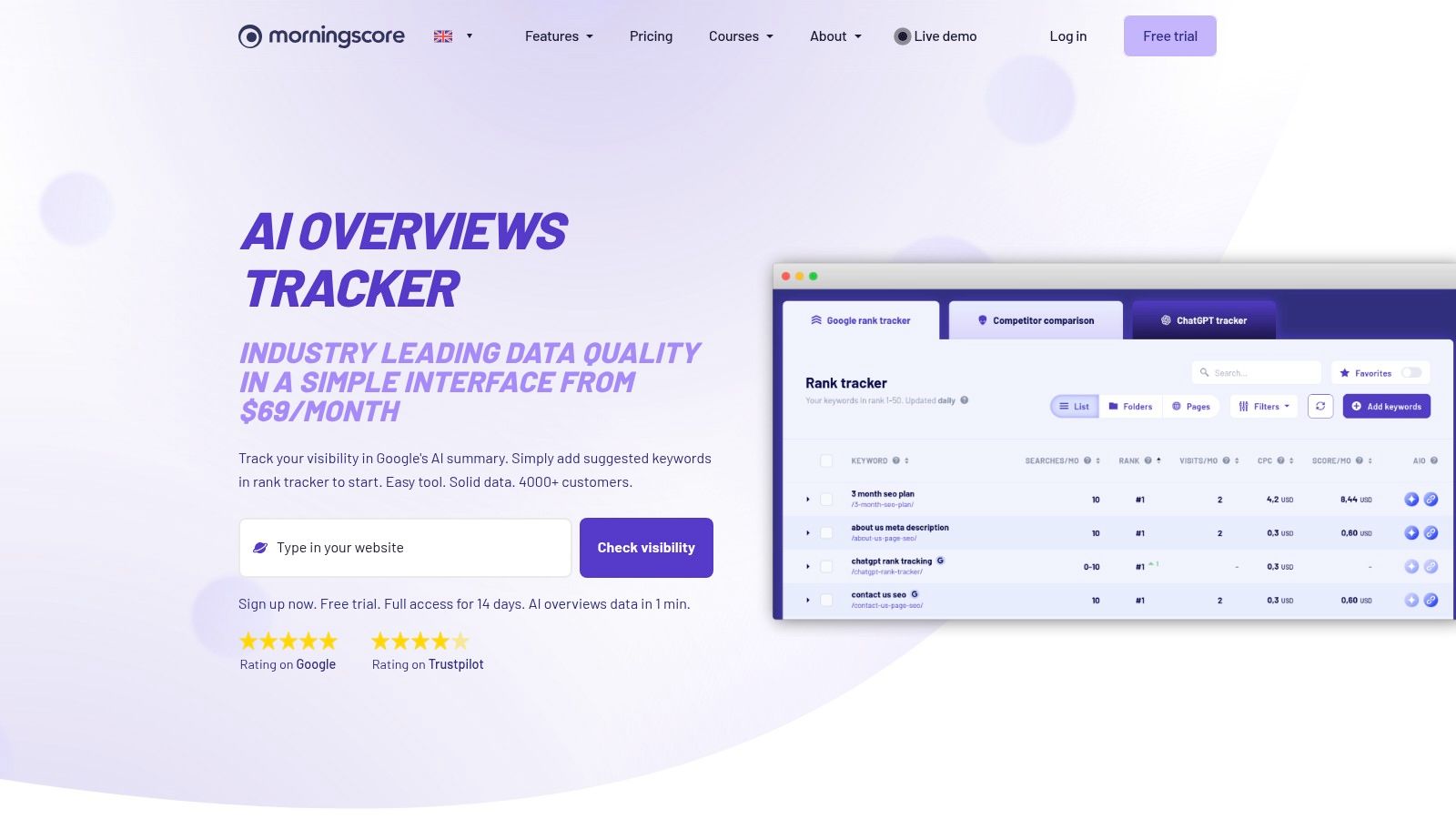
Morningscore’s AI Overviews Tracker is a straightforward choice for small and medium teams that want Google AIO monitoring without adopting a large enterprise SEO suite. It shows when AI Overviews trigger for tracked keywords, whether a domain is cited, and cached examples of the result.
Its practical value comes from simplicity. A smaller SEO or agency team can connect AIO observations with keyword and intent mapping, then use lightweight reporting to explain results to clients or stakeholders. The interface is less intimidating than enterprise platforms that expose a much wider set of controls.
Simple monitoring, narrow scope
Morningscore is primarily Google-focused. It doesn’t offer the same multi-assistant breadth as platforms built specifically around cross-model AEO, so it won’t answer whether a brand is consistently represented across ChatGPT, Gemini, Perplexity, and Copilot.
It also provides fewer deep competitive insights than larger enterprise suites. That’s acceptable when the goal is a clear AIO snapshot, but less suitable when analysts need extensive prompt research, competitor trend lines, source-domain analysis, and longitudinal response archives.
The pricing approach is positioned as more accessible than enterprise alternatives, although buyers should verify current plan limits and add-ons directly. For a team that mainly manages Google rankings and wants to see whether AIO citations are emerging, Morningscore can reduce tool sprawl. For teams studying how different models construct answers, it’s better treated as a Google monitoring layer than a full Peec AI replacement.
9. Otterly.ai AI Search Monitoring
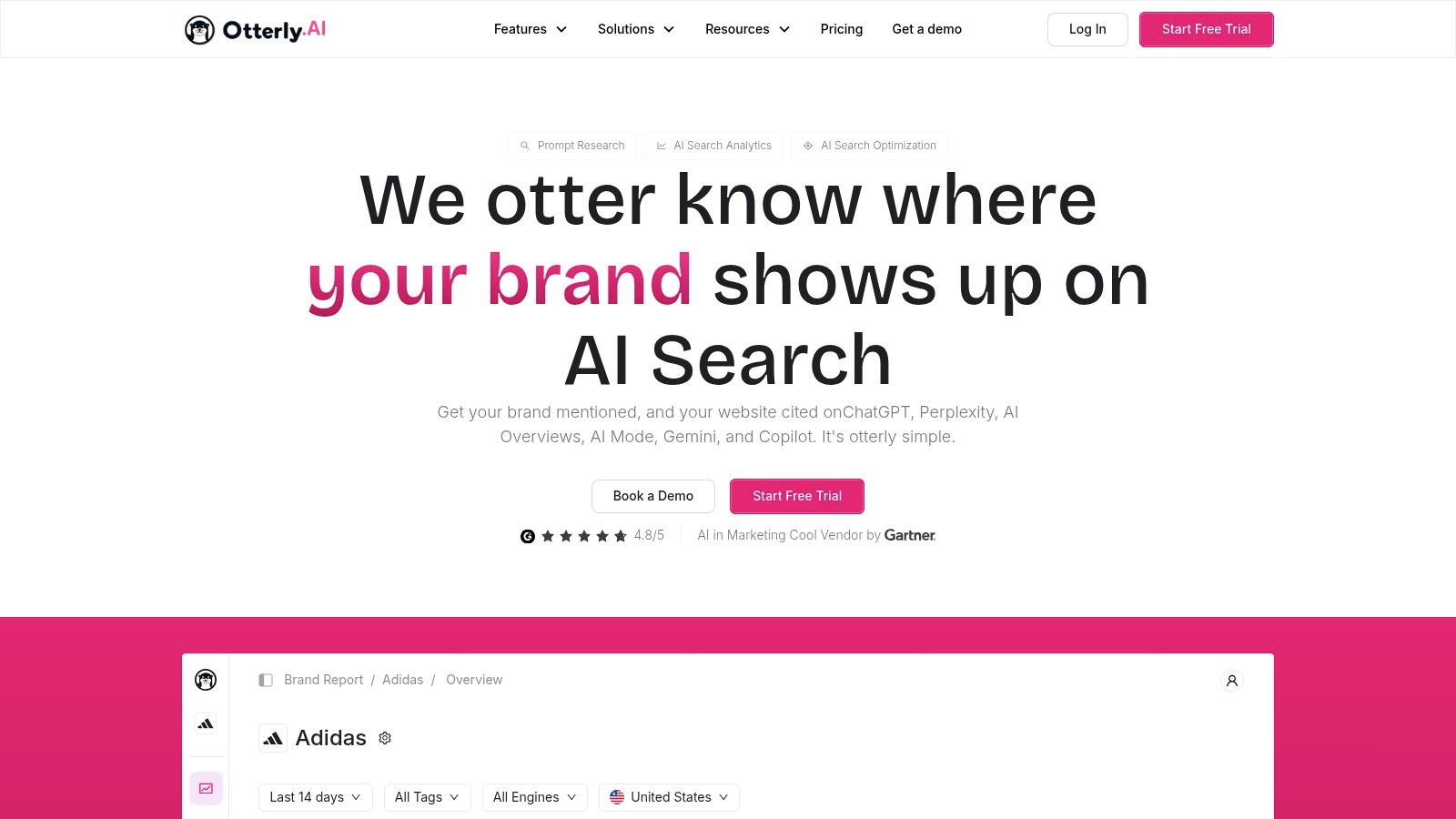
Otterly.ai is a specialist AI search monitoring platform for teams that want cross-engine brand visibility without adopting a broader SEO suite. It tracks mentions, citations, and share of voice across ChatGPT, Perplexity, Google AI Overviews and AI Mode, Gemini, and Copilot.
The product emphasizes a clear workflow from prompt research to monitoring and audit. Its dashboards help teams see where a brand appears, while prompt auditing can investigate why a brand is missed. Looker Studio connectivity and agency-oriented reporting templates make it practical for client programs that need repeatable outputs.
A close specialist alternative
Otterly.ai is more directly comparable with Peec AI than Google-focused suites are. Both sit primarily in the monitoring category, so the evaluation should focus on prompt limits, supported engines, citation detail, refresh cadence, reporting connectors, and tier restrictions rather than general SEO features.
The platform’s strength is ease of setup and purpose-built AEO workflows. A growing knowledge base and trial access can also lower evaluation friction, although buyers should confirm what the trial includes and which engines are available at each tier.
Its limitations are ecosystem size and variable plan constraints. Pricing and allowances can change according to tracked prompts and engines, so a team should model its actual prompt portfolio rather than compare headline entry prices. Otterly.ai is a sensible fit when specialist monitoring and agency reporting matter more than provider-key ownership or a deep traditional SEO dataset.
10. STAT Search Analytics by Moz
STAT Search Analytics is an enterprise SERP and rank-tracking platform that adds AI Overview presence and citation tracking to large-scale Google search analysis. It flags when AIOs appear for tracked keywords and identifies the URLs cited in those results.
STAT’s main advantage is the combination of AIO evidence with established rank intelligence. Agencies and large SEO teams can segment results by device, location, time series, topic, and keyword groups, then compare AI features with traditional SERP behavior in one analytical environment.
Strong instrumentation, limited assistant coverage
The platform is a good fit for organizations managing many markets and substantial keyword volumes. Its deep SERP feature instrumentation supports operational reporting where Google visibility remains the primary performance concern.
The limitation is scope. STAT focuses mainly on Google and offers limited coverage of non-Google assistants, so it isn’t a complete cross-model answer-monitoring solution. It also involves enterprise pricing and onboarding requirements, which can be difficult to justify when a team only needs a manageable prompt set.
STAT provides visibility into whether Google cites a URL, but the buyer should test how much response-level evidence is available for analysis. If the objective is to understand Google’s changing search result features alongside rankings, STAT is a strong candidate. If the objective is to compare brand mentions and citations across multiple answer engines, Llumo, Ahrefs Brand Radar, or Otterly.ai may align more closely with the research question.
Peec AI Alternatives, Top 10 Feature Comparison
Tool | Core capabilities | Unique selling points ✨ | Target audience 👥 | Pricing / Value 💰 | Quality ★ |
|---|---|---|---|---|---|
Llumo 🏆 | Multi‑model AEO tracking; per‑prompt visibility, citations, SOV, prompt archives | ✨ BYO API keys (no platform license); hosted custom subdomain; opportunity discovery; unlimited projects | 👥 AEO teams, agencies, enterprises needing scale | 💰 No core fee, pay providers directly; transparent response‑based costs | ★★★★☆ |
Ahrefs, Brand Radar | Brand‑level AI visibility + Ahrefs SEO dataset; custom prompts | ✨ Deep keyword/backlink context; API access | 👥 SEO teams & data‑driven enterprises | 💰 Add‑on/premium; enterprise pricing | ★★★★☆ |
Conductor, AI Search Performance | Share‑of‑voice, prompt/topic tracking; content recommendations | ✨ Integrated insight→execution content ops; strong governance | 👥 Large enterprise content/SEO teams | 💰 Custom enterprise plans | ★★★★☆ |
SE Ranking, AI Visibility Toolkit | AI Overviews + AI Results alongside rank tracking & audits | ✨ Strong SMB price‑to‑value; frequent updates | 👥 SMBs, agencies, consultants | 💰 Affordable tiers; some AI modules add‑on | ★★★☆☆ |
Similarweb, AI Search Intelligence | AIO detection + traffic & market intelligence; competitive benchmarking | ✨ Translates AI presence into estimated traffic/market impact | 👥 Market intelligence teams, enterprises | 💰 Enterprise/market‑intel pricing | ★★★☆☆ |
BrightEdge, AI Overviews | AIO presence & citation insights; connects to content workflows | ✨ Enterprise reporting & leadership‑grade insights | 👥 Enterprise SEO & content leadership | 💰 Enterprise pricing | ★★★★☆ |
seoClarity, AI Overviews | AIO presence/citation reporting at scale; historical segmentation | ✨ Scales to millions of keywords; strong operational tooling | 👥 Large SEO programs & agencies | 💰 Custom/enterprise pricing | ★★★★☆ |
Morningscore, AI Overviews Tracker | AIO trigger & citation snapshots; rank + intent mapping | ✨ Simple UI; budget‑friendly for SMEs | 👥 SMEs, small agencies, consultants | 💰 Budget‑friendly plans | ★★★☆☆ |
Otterly.ai, AI Search Monitoring | Cross‑engine brand visibility; prompt research & audits | ✨ Purpose‑built AEO workflows; Looker Studio connector | 👥 AEO specialists, agencies | 💰 Tiered plans with prompt/engine limits | ★★★☆☆ |
STAT (Moz), AIO Tracking | AIO appearance & cited‑URL reporting; deep SERP instrumentation | ✨ Proven large‑scale SERP platform for high volumes | 👥 Agencies managing many markets, enterprises | 💰 Enterprise pricing | ★★★★☆ |
Match the Alternative to Your Visibility Program
The best Peec AI alternative depends on where the evidence must live and who will act on it. A brand that needs to compare ChatGPT, Gemini, Perplexity, Copilot, and Google AI Overviews should start with a multi-model AEO platform. A brand that mainly needs to understand Google AI Overviews beside rankings, audits, and backlinks should start with an established SEO suite.
Llumo is the strongest fit when per-prompt evidence, citation analysis, competitor trends, opportunity prioritization, and provider-cost control matter most. Its bring-your-own-provider-keys model gives teams direct responsibility for API spending instead of bundling usage into a conventional software license. That creates more setup work, but it can be a better economic and governance fit for organizations with large prompt portfolios or strict control over provider relationships.
Ahrefs Brand Radar and SE Ranking make more sense when AI signals must sit beside established SEO data. Ahrefs provides particularly strong context for teams investigating keywords, backlinks, cited pages, and competitive sources. SE Ranking is more practical for teams that want AI visibility added to a broader SEO workflow without adopting a specialist-only platform.
Enterprise governance points toward Conductor, BrightEdge, seoClarity, or STAT. These platforms are suited to structured reporting, permissions, large-scale keyword programs, content operations, and executive visibility. Their limitations are equally clear: custom pricing, heavier implementation, and, in several cases, a stronger Google orientation than multi-model AEO specialists.
Similarweb deserves consideration when traffic and market intelligence are central. Its value lies in connecting AI Overview presence with competitive and demand context, rather than focusing exclusively on the exact text of chatbot answers. That makes it useful for growth, strategy, and competitive-intelligence teams.
Morningscore and Otterly.ai serve different forms of simplicity. Morningscore is appropriate for a straightforward Google AIO workflow, while Otterly.ai is better aligned with specialist cross-engine monitoring and agency reporting. Neither should be selected solely on an entry-level price. The relevant question is whether the plan includes the engines, prompts, refresh frequency, citations, and exports your program requires.
Before switching, compare:
Supported engines: Confirm whether the platform covers the AI surfaces your customers use, not just the engines named on the homepage.
Prompt evidence: Check whether you can inspect exact prompts, response text, cited URLs, competitor mentions, and historical changes.
Citation interpretation: Determine whether the tool identifies source domains and pages clearly enough to guide content, PR, or partnership work.
Integration requirements: Review APIs, Looker Studio or reporting connectors, content workflows, SEO datasets, and implementation ownership.
Provider-cost responsibility: Establish whether the vendor absorbs, marks up, or passes through model usage costs, and whether bring-your-own-key access is available.
Privacy expectations: Ask where prompts, responses, provider credentials, and historical archives are stored, and whether hosted deployment options exist.
Operational limits: Validate prompt allowances, model add-ons, refresh cadence, geographic coverage, user permissions, and export rules before signing.
The category is already crowded and segmented. Independent comparison coverage lists 7 to 14 alternatives across overlapping evaluation sets, with published starting prices ranging from about USD 29 per month to about USD 300 per month for more advanced offerings (comparison coverage of Peec AI alternatives). That spread reflects different products, not different discounts. Choose the platform whose evidence matches the decision your team needs to make.
Llumo provides multi-model AI visibility tracking across ChatGPT, Gemini, Perplexity, Copilot, and Google AI Overviews, with per-prompt scores, share of voice, citation sources, competitor trends, and response archives. If provider-cost control and direct evidence matter more than another bundled SEO dashboard, visit Llumo to evaluate its bring-your-own-API-keys model.