
You ask ChatGPT whether your company is one of the best options in your category. It names a competitor, links to a review site, and describes your product using an outdated feature. You run the same prompt in Perplexity and get a different shortlist. A few days later, Google AI Overviews gives you a third answer.
That experience is normal. AI visibility isn't a fixed ranking, and a brand can be named without being cited, cited without being named, or omitted entirely. Learning how to track brand mentions in AI search means building a repeatable measurement process that separates those outcomes instead of treating every appearance as a win.
Why Manual Checking Fails at Scale
Teams typically begin in a sensible way. Someone maintains a short list of buyer questions, periodically checks ChatGPT or Perplexity, and notes whether the brand appears. The initial few checks prove useful because they uncover clear issues, such as a missing product category, a competitor securing the top recommendation, or a third-party page defining the brand inaccurately.
The trouble begins when that occasional check becomes the measurement system. A prompt that produced a strong recommendation on Tuesday may return a neutral comparison on Thursday. The change might come from wording, session context, retrieval differences, or an update to the answer engine. A single observation can't tell you whether visibility improved or whether you happened to catch a favorable response.
Practical rule: Treat an AI response as a sample, not as a rank.
Traditional rank tracking encourages a simple mental model. You follow a query, watch a position, and compare the result with the previous period. AI answers don't behave that way. They can include several brands, change their ordering, use different sources, and answer the same question without naming any brand at all.
The shift from checking to sampling
A useful workflow has three properties:
Fixed inputs: Keep the same buyer questions long enough to compare results.
Controlled conditions: Reduce personalization by using logged-out or temporary sessions.
Recorded outputs: Archive the answer, the cited URLs, brand position, framing, and competitor set.
This is also why daily reporting often creates more anxiety than insight. The point isn't to eliminate variation. You need to measure it, then report trends that are less sensitive to one unusual answer.
Google AI Overviews make the issue more urgent. One independent analysis found them in 18.76% of U.S. search results in November 2024, compared with 12.47% in August 2024, across 18,767 occurrences in 100,013 keywords (SE Ranking's AI Overviews research). Raw coverage alone still isn't enough, because high-volume informational queries can expose far more users than their keyword count suggests.
The practical mindset is simple: don't ask, “Did we rank in AI today?” Ask, “Across a stable set of important questions, how often are we present, where do we appear, how are we described, and which sources support the answer?”
Building Your Core Prompt Library
You can't monitor every possible conversation, so start with a compact library of 20 to 30 real buyer questions. These should sound like questions a customer would type, not truncated keyword phrases copied from a rank tracker.
Pull candidates from sales-call notes, support tickets, site search, Google Search Console, product reviews, community discussions, and conversations with customer-facing teams. Then remove questions that have no commercial or reputational importance.

Build the set around intent
Organize the prompts into a few practical groups:
Category discovery: “What are the leading options for solving this problem?”
Pain-point research: “How can a team reduce this issue without changing its entire workflow?”
Comparison: “How does Brand A compare with Brand B for a mid-sized team?”
Decision support: “Which solution is easiest to implement when the team has limited resources?”
Branded accuracy: “What does this company offer, and which features should buyers know about?”
Include brand-name variations, product names, abbreviations, subsidiaries, and common misspellings. A model may recognize a parent company but miss a product line, or mention a product while linking to an unrelated source.
For every run, record four core fields:
Appearance: Did the brand appear in the answer?
Position: Was it the first recommendation, part of a shortlist, or buried later?
Framing: Was it described positively, neutrally, critically, or inaccurately?
Displacement: Which competitor appeared where your brand might reasonably have appeared?
Log citations separately. A brand mention is text in the answer. A citation is a linked source, and that source may be your domain, a review site, a publication, or a community page. The distinction matters because a named brand can receive no attributable visit, while an answer can draw on a company page without naming the company directly.
Run prompts in logged-out or temporary sessions where possible. This practical guide to building a prompt set is useful for keeping the library tied to real customer language rather than vanity queries.
A consistent archive matters as much as the prompt list. Save the full response, timestamp, engine, region, session condition, mentioned brands, and every source URL. Without the original answer, you can't audit why a score changed later.
Decoding Mentions Versus Citations
A mention tells you that the model included your brand in its language. A citation tells you which page the answer engine used or presented as support. Those signals overlap, but they aren't interchangeable.
Consider a product comparison where the answer says your brand is suitable for smaller teams, then links to a third-party review. You have earned recognition, but the review site controls the context and attribution. In another response, the model may cite your documentation while describing the product generically without naming the company. That is source visibility without a direct brand mention.
The cleanest dashboard keeps at least three measures apart:
Mention rate: The share of tracked responses that name the brand.
Citation rate: The share that links to your domain or a relevant owned page.
Share of voice: Your proportion of brand mentions or citations compared with the defined competitor set.
A raw appearance count can rise while competitive visibility falls. If every major competitor is appearing more often, your count doesn't show whether your position improved. Share of voice supplies the missing context.
Source influence is the diagnostic layer
Track the exact page, domain, page type, and whether the citation is new, retained, or lost. Then compare those sources with the answer's wording. If a review site is repeatedly cited for pricing, your own pricing page may be hard for the engine to interpret or may not be the source it trusts for that detail.
Citation concentration also changes the work you prioritize. An analysis of 1,000 Google AI Overviews reported that the top 1% of cited domains received 47% of citations, while schema-marked pages were cited 2.3 times more often and the median cited page was 14 months old (Digital Applied's citation pattern analysis). These findings don't mean adding schema guarantees inclusion. They do suggest that page structure, durable content, and authority deserve attention alongside new publishing.
Google AI Overviews can also cite pages outside the traditional top results. In an analysis of 863,000 keywords and 4 million AI Overview URLs, 38% of cited pages ranked in the top 10, 31.2% ranked from 11 to 100, and 31.0% ranked beyond 100 (Search Engine Journal's citation analysis). A page that isn't a conventional top-ten winner can still be relevant to an AI citation program.
For the operational details of tracking source changes, Llumo's AI citation tracking guide provides a useful reference. The important principle is to investigate why a source appears, not just whether a link exists.
Handling Ghost Citations and Model Noise
A citation isn't proof that the answer understood your brand correctly. Sometimes an engine links to your domain without naming the brand in the response. Other times it names the brand but links to a third-party page, or provides a source that doesn't support the statement at all.
This is the ghost citation problem. If you count every linked URL as a branded citation, you inflate visibility. If you count only named brands, you miss cases where your content influences the answer without explicit attribution.

Use a two-axis classification
For each response, classify mention and citation independently:
Brand named | Your domain cited | Interpretation |
|---|---|---|
Yes | Yes | Direct branded citation |
Yes | No | Uncited brand mention |
No | Yes | Ghost or source-only citation |
No | No | No observable brand signal |
Then add a quality flag for source relevance. A link to a product page that supports the answer is different from a link to an old blog post, an unrelated subdomain, or a page that contradicts the generated claim.
One study logged 3,981 domain appearances across 115 prompts in 14 countries and found that 62% of AI citations were ghost citations, while 25.1% were brand mentions without a citation (Semrush's ghost citations study). The exact mix will vary by engine and prompt set, but the measurement lesson is stable: mention and citation fields must not be collapsed into one score.
Don't trust one run
Run each prompt 3 to 5 times in a fresh temporary chat when establishing a baseline, then repeat the set on a monthly or bi-weekly cadence. This follows the practical sampling guidance summarized by HubSpot's AI search visibility coverage.
That still isn't a validated statistical sampling method. There is no universal answer for how many prompts produce a confidence interval that transfers cleanly between regions, categories, or engines. Report the number of prompts, repetitions, session conditions, and engine coverage so stakeholders understand the limits of the result.
Weight the library by business importance rather than letting low-value prompts dominate. Keep competitor prompts in the same measurement set, and calculate share of voice from the same responses. A leadership dashboard should show the prompt count and coverage beside the headline metric, not hide them.
Choosing the Right Tracking Infrastructure
A spreadsheet is a good starting point when you're learning what to record. It forces the team to read answers closely and exposes edge cases that automated tools often miss. The approach breaks down when several people run prompts at different times, save partial answers, or classify citations inconsistently.
Custom scripts offer control. You can store raw responses, apply your own mention rules, normalize domains, and connect results to internal reporting. The cost is maintenance. Engines change response formats, access methods vary, and a script that captures a citation today may miss it after a product update.
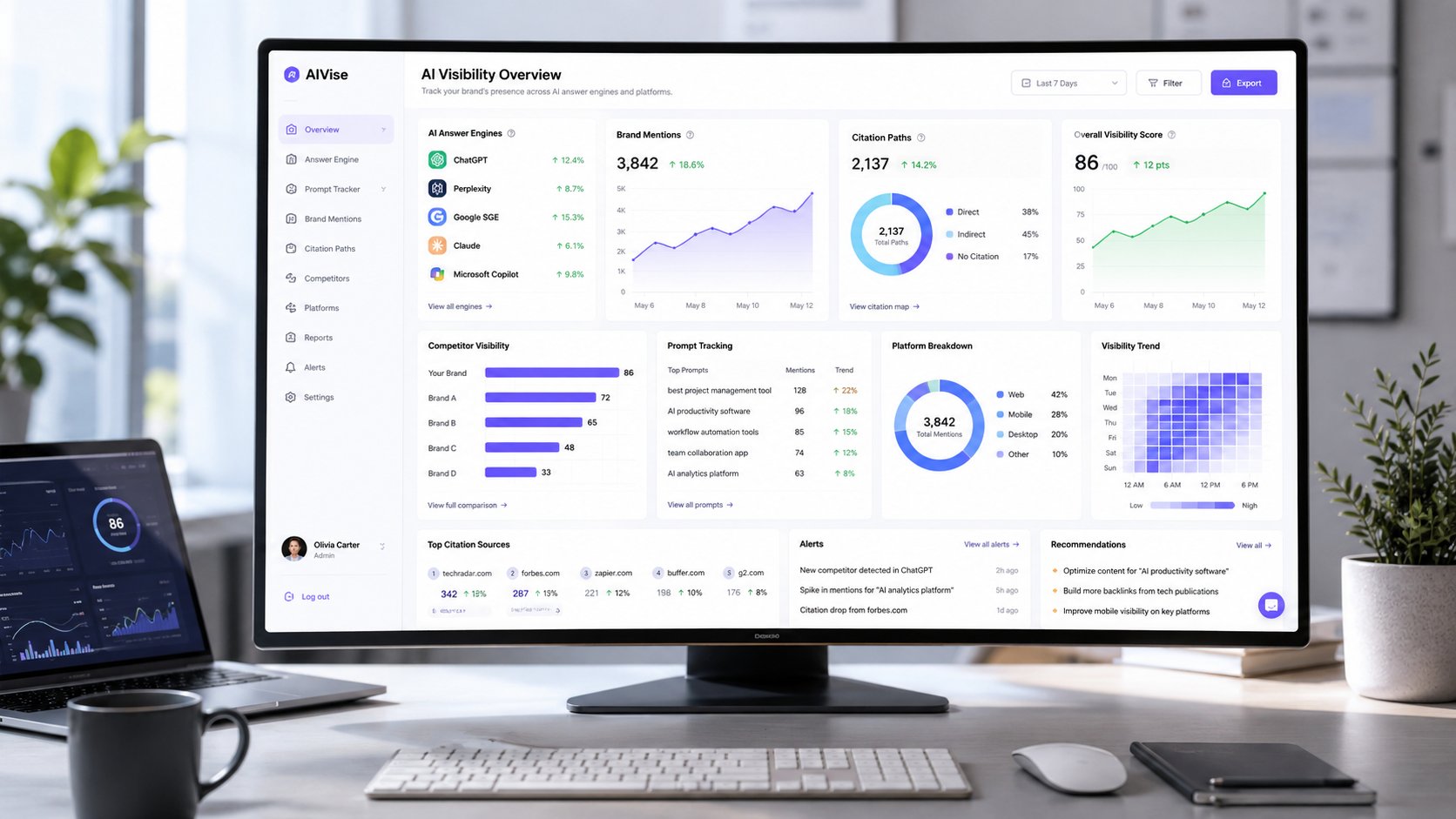
Dedicated platforms trade some control for repeatability. Look for:
Cross-engine coverage: Include the surfaces your customers use, such as ChatGPT, Gemini, Perplexity, Copilot, and Google AI Overviews.
Prompt-level archives: Preserve the full response, not only a summary score.
Citation normalization: Group equivalent URLs and distinguish owned from third-party sources.
Competitor context: Show which brands replace yours on the same prompt.
Query fan-out logging: Capture related searches or expansions generated during retrieval.
Exportable data: Let analysts inspect the underlying records rather than relying only on a proprietary index.
What scale changes
At a certain point, the question isn't whether automation is useful. It's whether the cost of incomplete evidence is greater than the cost of running a controlled system. Bring-your-own-key models can be attractive for teams that want to scale response collection while paying providers directly, but they require budget controls, usage monitoring, and technical ownership.
Cross-model tracking is necessary because AI visibility remains much smaller than classic search. In 2024, Google handled more than 14 billion searches per day, while ChatGPT was estimated at about 37.5 million search-like prompts per day, according to 9to5Google's coverage of Google AI search. AI monitoring should complement SEO measurement, not replace rankings, crawl diagnostics, organic demand, or conversion analysis.
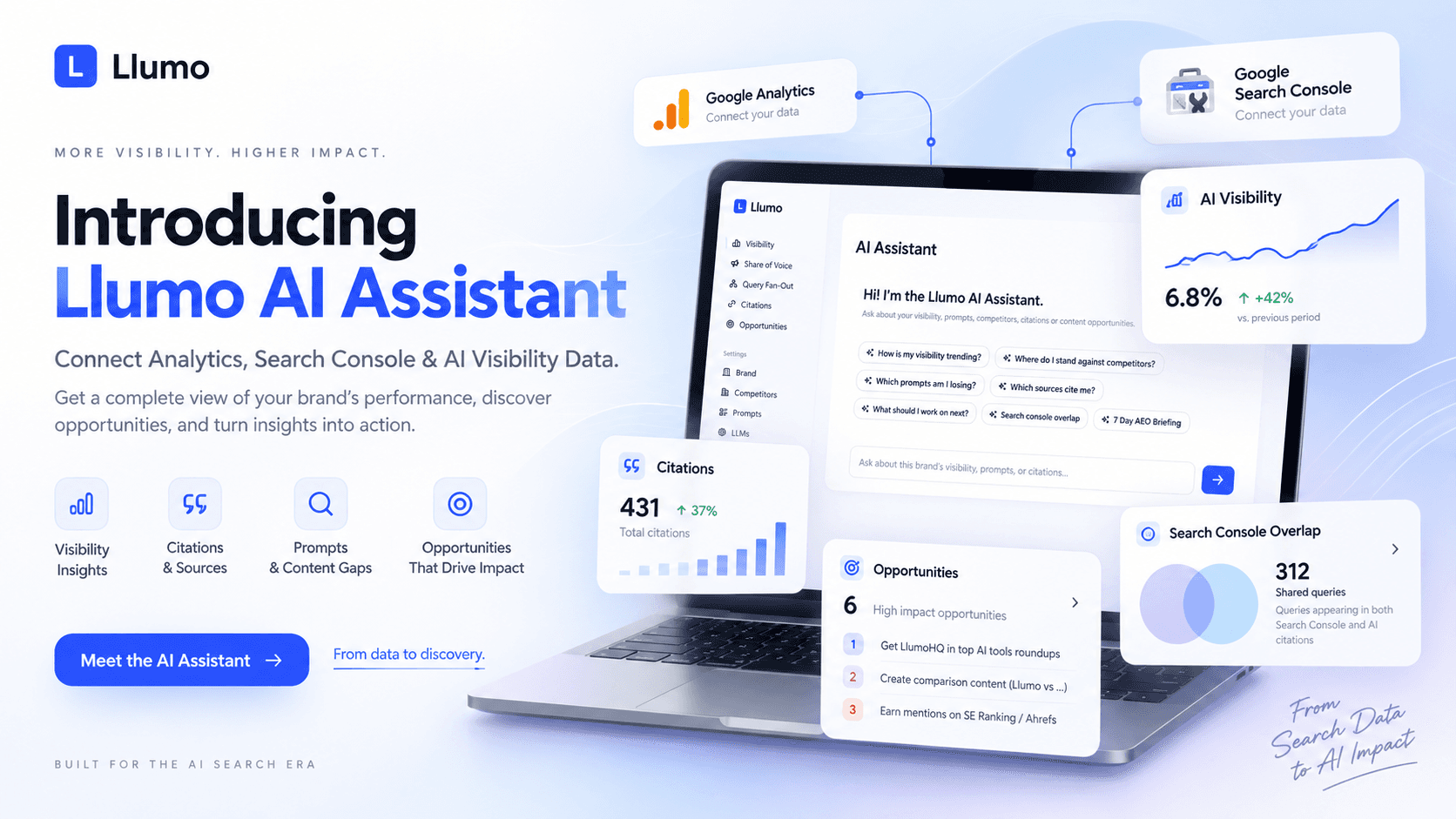
For teams comparing workflows, Llumo's brand monitoring resource is one option that combines prompt-level visibility, share of voice, citation sources, competitor trends, response archives, and connected provider keys. Other teams may prefer a custom build or an established SEO platform with AI features. Choose based on the bottleneck, whether it is data collection, analysis, governance, or execution.
Turning Visibility Data into Action
A dashboard becomes useful when every meaningful pattern leads to a decision. A drop in mentions isn't automatically a content problem. It may indicate a competitor entered the prompt set, a source disappeared, your product changed, or the model is relying on a different class of page.
Start with the responses, not the score. Review prompts where the brand is absent, buried, inaccurately described, or mentioned without a supporting owned source. Group those failures by cause.
Prioritize the right intervention
Missing category association: Strengthen pages that explain the problem, audience, use cases, and product category in clear language.
Weak owned citations: Improve the page that should support the answer, then make its claims easier to extract with descriptive headings, concise definitions, supporting evidence, and appropriate structured data.
Third-party dominance: Study the cited review, forum, or publication. If it contains an important fact about your brand, create a stronger source and pursue accurate, independent coverage rather than trying to manufacture mentions.
Competitor displacement: Compare the competitor's cited sources and framing with yours. The gap may be topical, reputational, or due to a missing comparison page.
Incorrect representation: Add an accuracy check to branded prompts and route serious errors to the team responsible for product documentation, public profiles, or communications.
One research analysis found that AI-generated documents were cited more often than human-authored documents after controlling for retrieval rank, with the difference driven mainly by citations that weren't present in the initial retrieved set (the Proceedings of Machine Learning Research study). The practical takeaway isn't to generate content for its own sake. It is to make authoritative information clear, current, and available in the places answer engines can discover.
Set a cadence people can maintain
Run the core prompt set on a scheduled cadence, review outliers manually, and produce a recurring action list. Recheck targeted prompts after content changes, source changes, product launches, or notable competitor activity. Keep the raw answer archive so your team can distinguish a genuine shift from ordinary model variation.
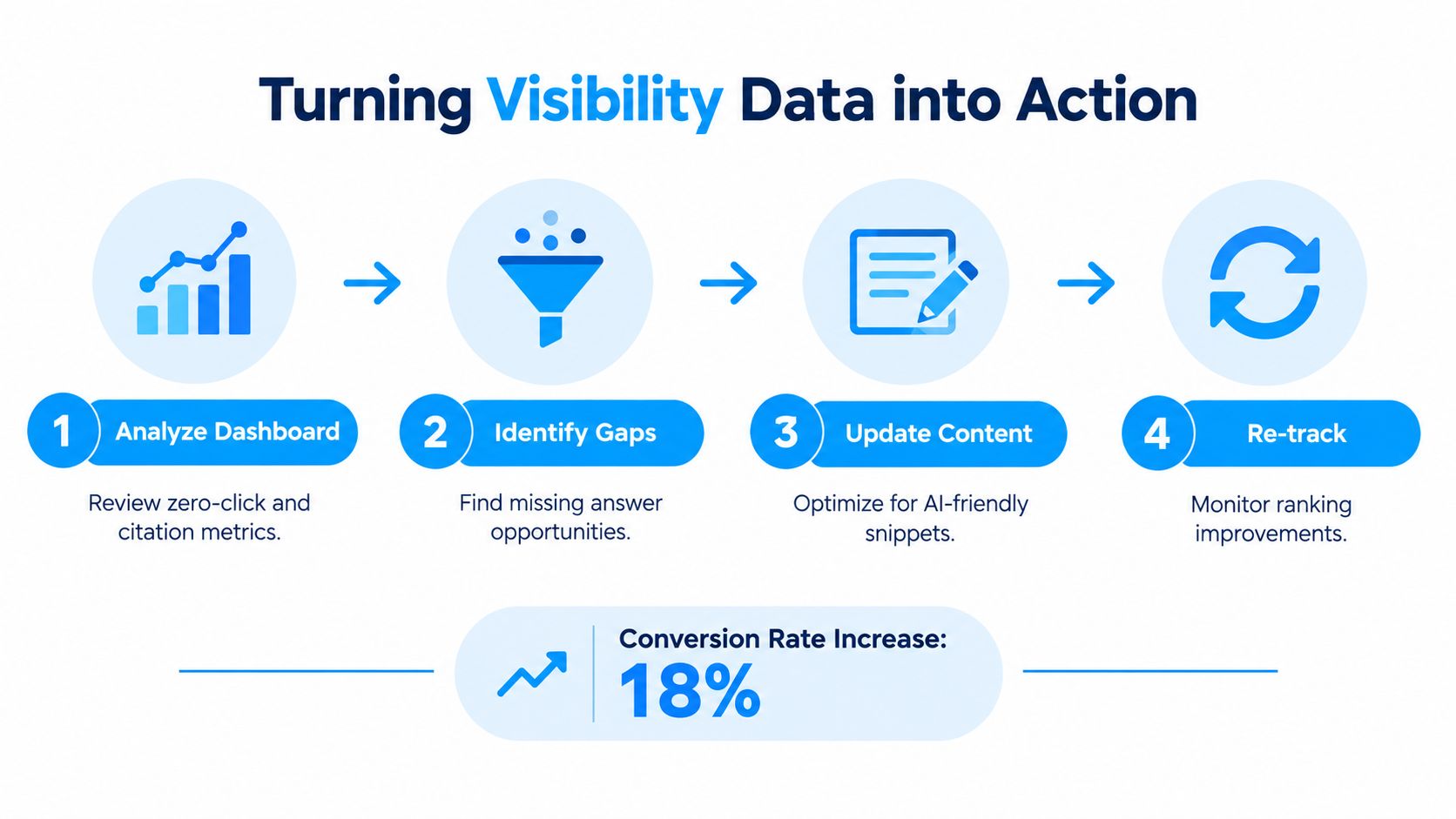
The strongest operating loop is measure, diagnose, publish or update, and re-track. Track mentions and citations separately, preserve competitor context, and treat source quality as a first-class metric. AI search changes too quickly for a one-off audit to remain reliable, but a modest, documented system can give your content and SEO teams a defensible view of what buyers encounter.
Llumo helps teams track brand mentions, citations, competitors, and share of voice across AI answer engines at the prompt level. Connect your own provider API keys, preserve response and source histories, and turn visibility gaps into specific content priorities. Visit Llumo to see how the platform can support a repeatable AI visibility workflow.