The most popular advice about brand monitoring for AI results is incomplete: track how often your company appears in ChatGPT, then report the trend. That single metric can make an invisible brand look healthy. A model may mention your name without citing your site, recommend a competitor while using your content as background, or fail to recognize your entity entirely across a different model and prompt.
AI visibility needs a measurement system built around mention rate, citation rate, and entity recall. Those signals answer different questions, behave differently by platform, and lead to different actions across content, PR, technical SEO, and competitive strategy. Google AI Overviews made the issue impossible to treat as a niche experiment. Independent tracking found AI Overviews on 6.49% of keywords in January 2025, nearly 25% in July, and 15.69% in November, while another large-scale analysis found them on 21% of keywords across 146 million search result pages. (Semrush’s AI Overviews study)
Why Traditional SEO Tools Miss Most AI Visibility
Traditional SEO platforms don’t capture AI visibility by adding a “ChatGPT mentions” column. Rank trackers were designed to crawl relatively stable search result pages, record URLs, and assign positions. Answer engines generate responses from prompts, retrieval systems, session context, model versions, and changing source sets. The measurement object is different.
There’s no page two in a conversational answer. There may not be a consistent URL, a fixed result position, or even identical wording when the same prompt runs again. One analysis found Google changed at least one source for 52% of keywords when the same search was repeated, while only 13.7% of URLs overlapped between AI Mode and AI Overviews. (Position Digital’s source analysis)
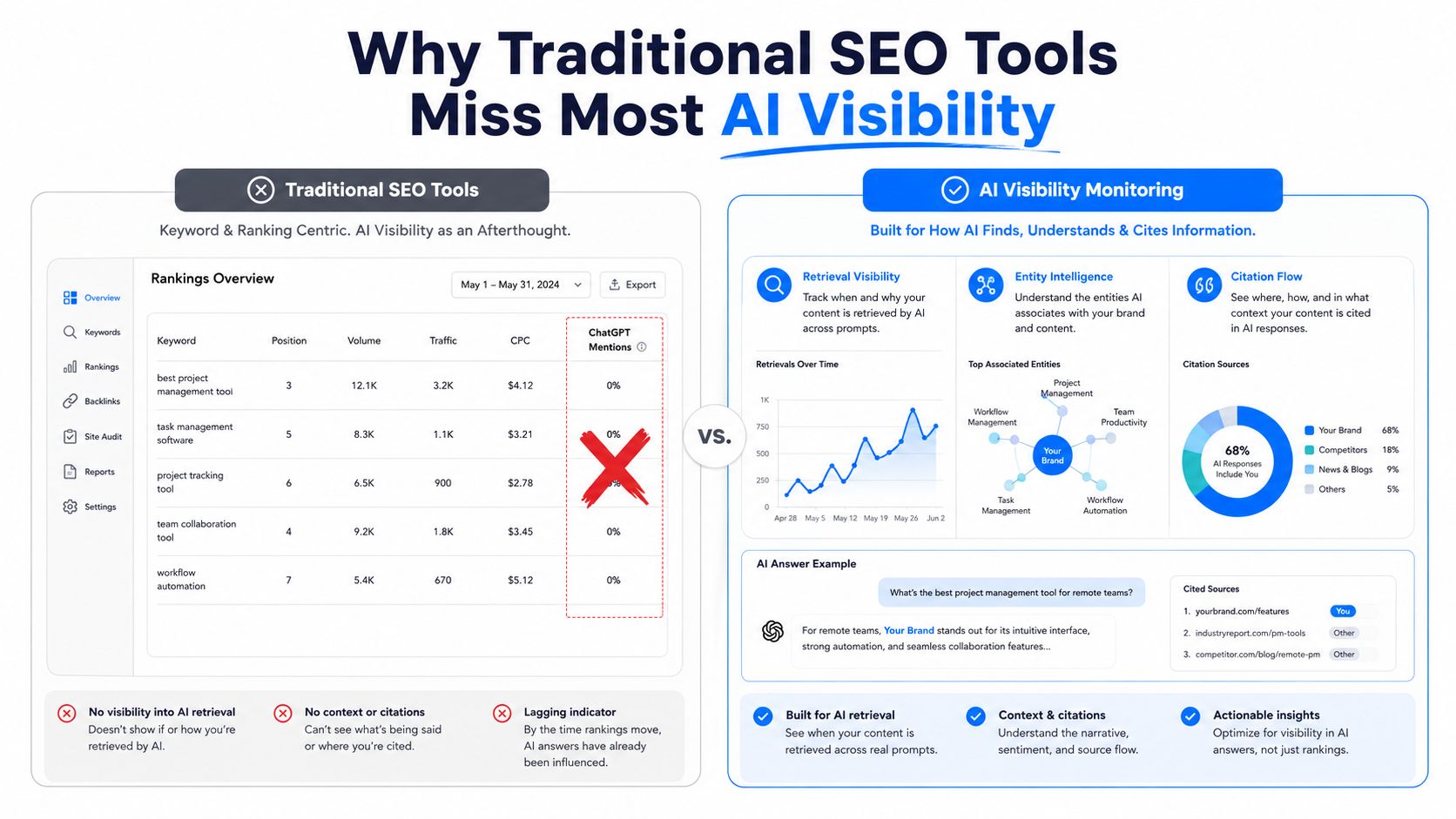
Rankings measure pages, AI monitoring measures entities
A ranking report asks, “Where does this page appear for this keyword?” AI monitoring asks a wider set of questions:
Entity recall: Does the model recognize and retrieve the brand for a relevant category or problem?
Representation: Is the company described accurately and in the right context?
Recommendation: Does the answer include the brand when a buyer asks for options?
Citation ownership: Which page or third-party source supports the answer?
Competitive presence: Which brands appear when yours doesn’t?
A brand can perform well in conventional search and still have weak entity recall. Strong blue-link visibility doesn’t guarantee that a model will retrieve the brand for a conversational, category-level prompt. Conversely, an answer engine can cite a relevant page that doesn’t rank in the conventional top results. A study of 1,000 Google AI Overview queries found that only 38% of cited pages also ranked in the top 10 organic results. (The Stacc’s citation-source study)
The dashboard isn’t the problem
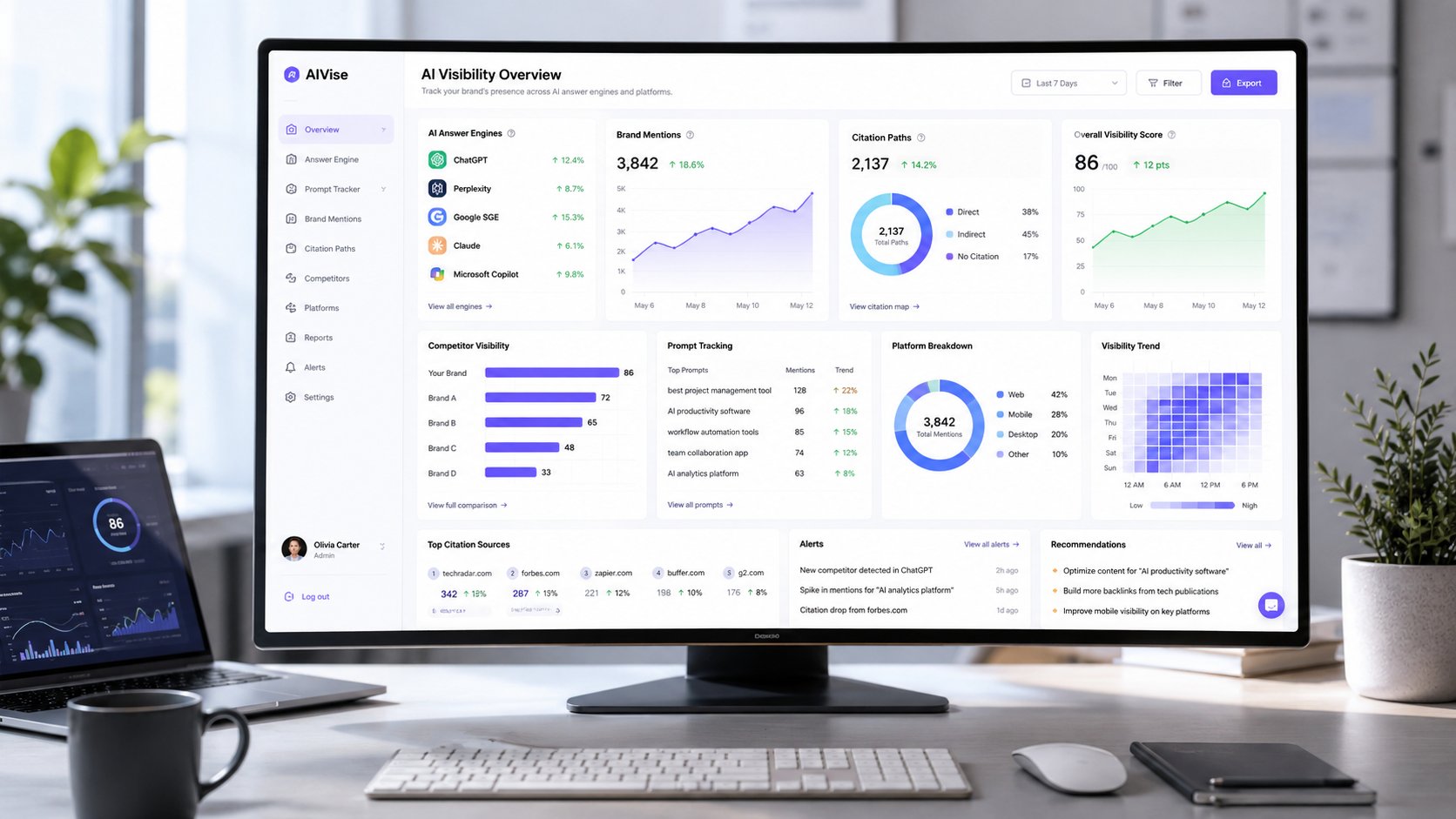
The problem is treating generated answers as another SERP feature. A useful system stores the prompt, model, locale, timestamp, complete response, named entities, citations, sentiment, and competitors. It then compares repeated observations rather than pretending that one answer is a permanent ranking position.
Practical rule: Don’t ask whether your rank tracker includes AI data. Ask whether it preserves enough response context to explain why a brand appeared, which source supported it, and whether another model produced a different answer.
For a deeper explanation of the assumptions that fail here, see three myths about ranking in AI answers. The shift is operational, not cosmetic. Teams moving from rank tracking to AI visibility monitoring need a prompt library, model coverage, source analysis, and entity-level reporting.
The Three Signals You Must Track Separately
A brand mention is not a citation, and a citation isn’t proof that the model recommends your company. These distinctions should sit at the center of every AI visibility program.
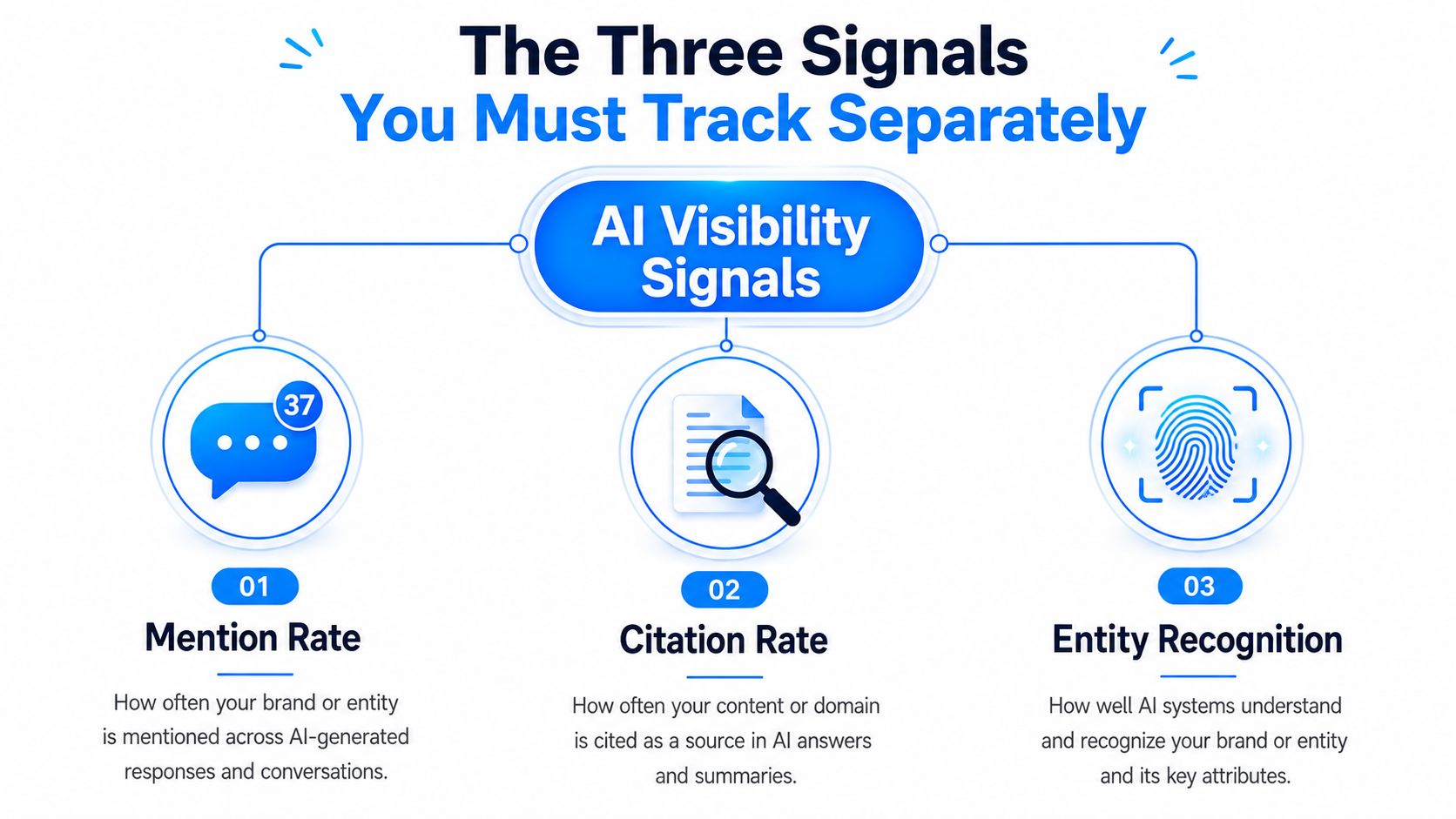
Mention rate
Mention rate records how often the brand name appears in generated responses for a defined prompt set. It’s useful for measuring inclusion, share of voice, and competitive positioning, particularly for recommendation and comparison prompts.
But a mention can be weak evidence. The answer might repeat an outdated product description, include the brand in a negative comparison, or name it without any supporting source. A study of AI answers found only 23.1% of brand mentions were also backed by a citation in the same response, so named visibility and sourced visibility must be reported separately. (BuzzStream’s mentions and citations study)
Citation rate
Citation rate measures how frequently the model links to your site, a product page, documentation, review, publication, or other source associated with your brand. It’s a stronger diagnostic for source accessibility and content usefulness, but it still needs interpretation.
A citation may support a general claim without naming your company in the answer. It can also point to a third-party page that describes your product more accurately, or more prominently, than your own site. Track the cited domain, exact URL, page type, linked claim, and whether the citation is new, retained, or lost.
Entity recall
Entity recall asks whether the system retrieves your brand at all when the prompt doesn’t mention it. Test category questions, problem statements, comparisons, use cases, and navigational prompts without inserting the company name.
This signal exposes the gap between brand awareness and model recognition. A company may receive a high mention rate in direct-brand prompts but disappear from generic commercial investigations. That isn’t a content formatting issue alone. It may indicate weak distributed associations across the web, insufficient source coverage, or a competitor’s stronger presence in the model’s retrieval environment.
The three signals form a useful diagnostic pattern:
High mentions, low citations: The model knows the name, but the response may rely on memory, weak evidence, or stale information.
Low mentions, strong citations: Your content informs the answer, but the brand isn’t being recommended or recognized clearly.
Low mentions, low citations, low recall: The problem is broader entity visibility, not one underperforming page.
High values across all three: The brand is recognized, represented, and supported by accessible sources.
The practical details of implementing these measurements are covered in Llumo’s guide to tracking AI visibility.
Building Your AI Brand Monitoring Dashboard
Start with the prompts, not the dashboard. A useful library should represent how buyers investigate a category, then separate prompts into category discovery, problem diagnosis, comparison, direct-brand, and recommendation groups. Include natural variations in wording, geography, audience, use case, and buying stage.
Run the same prompt families across the models and surfaces that matter to your market. Preserve the full answer rather than storing only a pass or fail value. Response variance means you need repeated observations, consistent prompt versions, and a record of the model or search surface used.
Core dashboard panels
Your dashboard should make four questions easy to answer:
Where are we visible? Report mention rate, entity recall, share of voice, and average position within answers by model, market, and intent.
Why are we visible? Show cited domains, URLs, page types, claims, and new or lost references.
How are we represented? Classify recommendation strength, sentiment, product category, and factual accuracy.
What should we do next? Connect each gap to a content refresh, new page, technical fix, PR opportunity, or review-site action.
A simple architecture can look like this:
Dashboard Panel | Key Metrics | Data Source | Refresh Cadence |
|---|---|---|---|
Prompt visibility | Mention rate, entity recall, share of voice | Saved prompts across selected models | Regular repeat runs |
Citation sources | Cited domains, URLs, page types, new and lost citations | Answer citations and archived responses | Frequent for priority prompts |
Representation | Sentiment, recommendation context, factual accuracy | Response review and classification | Review after each sample |
Competitive gaps | Competitor mentions, citation share, missing query clusters | Same prompt sets run for competitors | Aligned with visibility runs |
Opportunity queue | Content, technical, PR, and source-building actions | Combined monitoring and audit data | Updated after analysis |
Build or buy based on variance and scale
Manual sampling works for an initial audit and for validating whether an automated system captures the right signals. It becomes unreliable when different team members use slightly different prompts, fail to preserve citations, or record only favorable answers.
API-based monitoring improves repeatability, but it introduces provider costs, rate limits, model differences, and engineering work. Third-party AEO platforms justify their price when they provide multi-model coverage, archived responses, competitor benchmarks, source analysis, and workflows your team would otherwise maintain manually. Llumo measures per-prompt visibility, share of voice, citation sources, competitor trends, and generated query expansions across AI answer engines, with connected provider keys and direct underlying usage costs.
The dashboard should serve decisions, not decorate a monthly report. If a panel doesn’t change content production, outreach, technical remediation, or executive risk review, it probably doesn’t belong in the first version.
How Different AI Models Surface Brands
AI visibility changes by model because each system handles retrieval, synthesis, and source display differently. A brand can earn a mention without earning a citation, and it can earn a citation without being recalled consistently across relevant prompts. Treating those outcomes as one score hides the gaps that affect discovery and trust.
ChatGPT may produce a recommendation without exposing a source. Gemini can connect an answer to inline web references. Google AI Overviews combine generated summaries with attribution inside the search results page. Perplexity places sources at the center of its response format, while Claude may provide detailed category explanations with limited citation visibility, depending on the workflow and supplied context.
Track three signals separately:
Mention rate: How often the brand appears in answers to relevant prompts.
Citation rate: How often the answer links to a page associated with the brand.
Entity recall: How often the model identifies the brand when the prompt does not name it.
A high mention rate can still conceal weak evidence if citations rarely appear. A high citation rate can create false confidence if the model cites the brand only after a user names it. Entity recall exposes whether the system connects the company with its category, use cases, competitors, and differentiators without assistance.
AI Model | Mention Style | Citation Behavior | Primary Metrics to Track | Monitoring Query Strategy |
|---|---|---|---|---|
ChatGPT | Conversational recommendations and explanatory mentions | Sources may be absent or inconsistent across experiences | Entity recall, mention context, accuracy | Use category, problem, and recommendation prompts without naming the brand |
Gemini | Direct answers that can connect brands to web sources | Inline references support URL-level review | Mention rate, citation rate, and cited-page quality | Pair commercial comparisons with source-focused questions |
Google AI Overviews | Compact synthesis with brands embedded in search answers | Attribution paths can connect claims to pages | Citation share, source volatility, and entity recall | Track long-tail and decision-stage queries across repeated searches |
Perplexity | Source-forward summaries | Citations are central to the response | Citation rate, domain share, and source relevance | Test factual, comparison, and research prompts with source review |
Copilot | Conversational answers shaped by its search environment | Citation patterns vary by response type | Mention context, citation coverage, and accuracy | Use workplace, product, and comparison scenarios |
Claude | Detailed explanatory responses | Citation visibility depends on the workflow and supplied context | Representation accuracy and entity recall | Test complex category explanations and direct alternatives |
Google AI Overviews require repeated sampling because their presence and source mix can change over time. As noted earlier, coverage shifted from 6.49% to nearly 25% and then to 15.69% across 2025, showing why a historical baseline needs recurring observations rather than one saved result.
A model-level view also prevents misleading averages. The same brand may appear in Gemini and disappear in ChatGPT for an equivalent question. Record the prompt, model, response, mention status, citation status, cited URL, entity description, and competitor references before calculating an aggregate score.
Model variance should change the query design, not just the reporting format. Run unnamed category prompts to test recall, recommendation prompts to test consideration, comparison prompts to test competitive positioning, and source-focused prompts to examine citation behavior. Preserve the raw responses so analysts can distinguish a genuine visibility change from a different answer generated by sampling noise.
Connecting Citations to Content and Off-Site Mentions
A citation is the visible endpoint of a distributed signal system. The cited page matters, but so do the third-party pages that associate your brand with the topic, the wording that defines your entity, and the structured cues that help systems distinguish your company from similarly named entities.
Audit the cited page first. Look for an early definition of the product or category, explicit entities, clear evidence, descriptive headings, author and source details, and markup that clarifies the page’s subject. A CXL study of 100 pages found 55% of Google AI Overview citations came from the first 30% of page content, compared with 24% from the middle and 21% from the bottom 40%. The study also linked named-source attribution and schema markup with citation likelihood. (CXL’s citation-source research)
Trace the source network
Don’t stop at an owned URL. Build a correlation map that connects:
Owned content: Product pages, comparison pages, documentation, research, and definitions.
Off-site mentions: Reviews, industry publications, forums, partner pages, and expert commentary.
Entity consistency: Product names, category associations, company descriptions, and supporting facts.
Citation outcomes: Which sources appear in answers, for which prompts, and alongside which competitors.
The strongest evidence for this broader view comes from a 75,000-brand analysis. Brand web mentions showed the strongest correlation with Google AI Overview visibility at 0.664, compared with 0.218 for backlinks, 0.527 for brand anchors, and 0.392 for brand search volume. (Ahrefs’ brand correlation analysis)
That result doesn’t mean backlinks are irrelevant. It means link volume alone is a poor substitute for broader brand presence. The same analysis found brands in the top quartile for web mentions averaged 169 AI Overview mentions, compared with 14 in the next quartile, and 26% of brands had zero mentions. Treat those figures as evidence for monitoring distributed visibility, not as a guarantee that any single outreach placement will create citations.
Review competitors’ cited sources where your brand is absent. If several competing pages are cited for a specific buyer question, compare their opening definitions, evidence, authorship, topical coverage, and off-site reinforcement. Then choose between improving your own page and earning a credible third-party reference. The right answer often involves both.
More practical guidance on interpreting the sources behind answers is available in reading the citations behind an AI answer.
Prioritizing AI Visibility Gaps by Business Impact
A dashboard can produce more gaps than a content team can fix. Prioritization should start with business intent, not the volume of anomalies.
Place each gap into one of three working tiers:
High-intent commercial gaps: Competitors appear for selection, comparison, pricing, implementation, or vendor prompts while your brand is absent or inaccurately represented.
Mid-funnel authority gaps: Your brand is known, but trusted sources don’t cite it for educational or problem-focused questions.
Low-impact inconsistency: The brand appears irregularly for prompts with limited commercial relevance or weak connection to your market.
Use a decision score
A practical score can combine four qualitative or internally assigned inputs:
Query demand: How often the audience searches or asks about the problem.
Conversion proximity: How close the prompt is to a meaningful business action.
Competitive displacement: Whether a competitor receives the recommendation or citation instead.
Closure effort: The time, expertise, approvals, and outreach needed to address the gap.
High demand and high conversion proximity should outweigh a low-effort cosmetic improvement. A missing citation on a decision-stage comparison page usually deserves attention before an inconsistent mention in a broad informational answer.
Look for actions that affect multiple prompt clusters. A credible third-party review, a well-structured comparison page, or a precise product definition can improve several related answers at once. Sequence work so that content updates create a source worth citing, while digital PR and partner outreach increase the number of places that connect your entity to the relevant category.
Don’t optimize only the page where you noticed the gap. The missing signal may sit in the surrounding source network, and a page-level change won’t repair an entity-level absence by itself.
Turning Monitoring Data into Ongoing Action
A B2B SaaS team may see a high mention rate in ChatGPT but almost no citations in Google AI Overviews for bottom-funnel prompts. That gap reflects different retrieval behavior, not necessarily a broken platform. ChatGPT may recall the brand conversationally, while Google selects current, structured, linkable sources for attribution.
Keep the prompt set fixed and investigate each signal separately. In this case, competitors had clearer comparison pages, more explicit product definitions, and stronger third-party coverage on sources Google repeatedly cited. A single visibility score would have hidden that entity recall was healthy while citation coverage was weak.
Act on the specific gap:
Reallocate PR effort: Prioritize review sites and industry publications that appear in Google AI Overview citations for the relevant query cluster.
Restructure owned pages: Place precise entity definitions, product facts, use cases, and supporting evidence near the beginning of important pages.
Improve technical clarity: Apply appropriate schema markup and consistent naming so systems connect the product with the right category.
Build distributed authority: Run targeted digital PR to earn relevant mentions on domains that Gemini and Google regularly retrieve.
Preserve the baseline: Re-run the same prompt families after 30 to 45 days so results remain comparable.
Review outcomes across models rather than treating one improvement as proof of broader visibility. A brand can gain mentions without gaining citations, or receive citations while remaining poorly recalled in another model. Track branded demand, direct traffic, assisted conversions, and changes in how buyers describe the company alongside those three signals.
Ahrefs’ complementary traffic analysis, cited earlier, found cited brands received 3.4 times more branded direct searches over the following 30 days, while cited pages saw an average 18% traffic increase. The finding supports correlation analysis, not a guaranteed lift.
AI brand monitoring should feed content briefs, technical SEO decisions, source development, PR allocation, reputation review, and competitive intelligence. Llumo helps teams measure AI visibility across models and prompts, separating mentions, citations, share of voice, competitors, and source changes. Visit Llumo to evaluate prompt coverage, find gaps in conventional monitoring, and turn findings into a repeatable AEO workflow.