
The best advice about generative engine optimization tools is also the least useful: pick the platform with the longest feature list. AI visibility doesn't fail in one uniform way. One team needs prompt-level mentions and citations across ChatGPT, Gemini, Perplexity, Copilot, and Google AI Overviews. Another mainly needs Google AI Overview detection, large-scale SERP archives, regional reporting, or better control over the brand data answer engines use.
That difference changes the buying decision. A tool that records an AI answer tells you where your brand appeared. A tool that analyzes citations, query fan-out, entities, or source gaps helps explain why the answer took that shape and what you can change. Those are related jobs, but they aren't the same measurement problem.
This comparison focuses on the break point each platform addresses, its evidence, workflow fit, limitations, and pricing approach. Pricing transparency matters here, especially when one vendor bundles model usage into a subscription while another lets customers manage provider costs directly. The strongest option isn't necessarily the broadest one. It's the tool your team will use often enough to turn missing mentions and citations into specific work.
1. Llumo

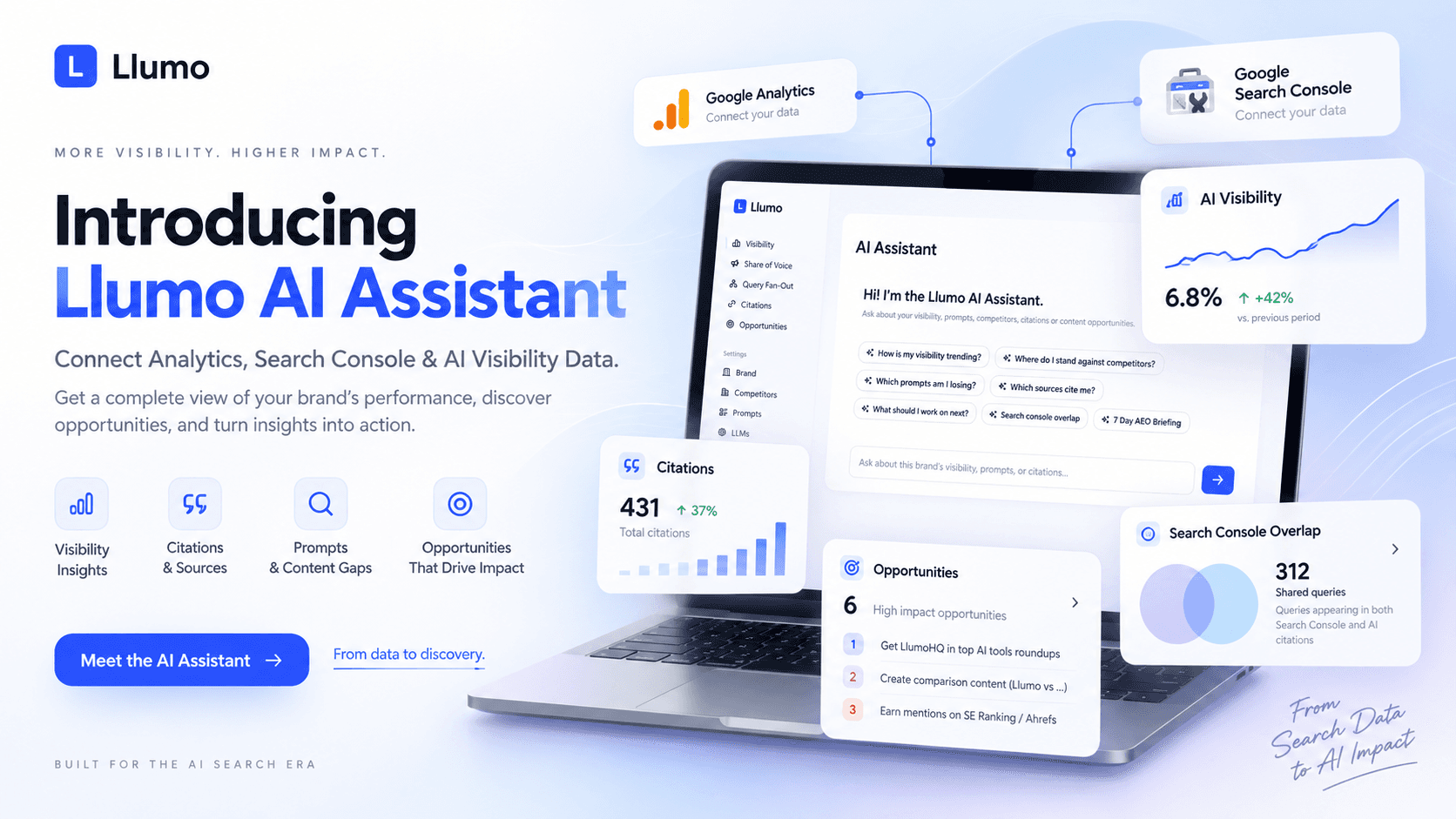
Llumo addresses a visibility problem that spans multiple answer engines and individual prompts, rather than only Google search features. It tracks how ChatGPT, Gemini, Perplexity, Copilot, Google AI Overviews, and other surfaces mention or cite a brand, while keeping the response, competitors, and sources tied to each prompt.
That prompt-level record is useful because a visibility score alone rarely explains what changed. Teams can review visibility by prompt, share of voice against selected competitors, citation domains, new and lost references, and the response archive. Query fan-out logging adds another layer by showing the searches and keyword expansions an engine uses to construct an answer. Those details can guide a page update, a new resource, or a third-party mention.
Llumo also prioritizes content and outreach opportunities by expected impact, so the reporting can lead to assigned work rather than another list of observations. Specialized Google AI Overviews and ChatGPT trackers support narrower investigations, while API and MCP access allow agencies and analytics teams to connect the data with their own workflows.
The pricing model changes the comparison
Llumo uses a bring-your-own-keys model. The platform has no software license fee, and customers connect their own provider API keys and pay those providers directly. This makes usage costs visible and avoids platform markups, but the customer must handle key management, quotas, and spending controls.
At the platform level, customers get unlimited projects and prompts. Hosted customers can use a custom subdomain, custom branding, daily backups, and priority support. Optional managed usage and managed AEO services are available for teams that want less operational responsibility.
Practical rule: Compare an AI visibility tool's platform cost with the cost of the underlying responses, not only its advertised subscription.
The trade-off is setup and control. BYOK suits experienced teams that want direct oversight of provider spending, while buyers seeking one bundled invoice may prefer a vendor-managed arrangement. Llumo combines APIs and web scraping across seven or more surfaces, so availability and completeness can vary by engine. For agencies, SaaS teams, SEO specialists, and competitive intelligence groups, that flexibility can matter more than a conventional enterprise tier.
2. seoClarity Clarity ArcAI

seoClarity is aimed at enterprises that need AI search intelligence at scale, particularly around Google AI Overviews and Google AI Mode. Its ArcAI product connects AI visibility with traditional rank and pixel-depth changes, which helps large SEO teams understand how an AI feature changes the search result rather than treating it as an isolated mention.
The useful unit here is the keyword. ArcAI can identify whether a keyword produces an AI Overview, inspect the sources and citations involved, and show visibility trends over time. Its broader coverage extends across nine AI surfaces, including ChatGPT, Perplexity, Gemini, Copilot, Claude, and Grok, giving enterprise teams a basis for cross-engine benchmarking.
Where enterprise scale helps
seoClarity is better suited to organizations with established governance, large keyword sets, and a need for historical reporting than to a small team looking for a quick prompt monitor. Its research assets and AI Overview playbooks also make it more useful for planning than for simple daily checking.
The limitation is the buying process. Pricing isn't public, and setup and onboarding require a sales-led evaluation. That may be reasonable for a global organization, but it makes direct cost comparison harder than with a BYOK platform such as Llumo.
The right question isn't whether ArcAI has broad coverage. It's whether your team will use its historical and enterprise reporting often enough to justify the implementation effort.
seoClarity is a sensible choice when Google search remains the reporting center and AI visibility must sit inside a larger enterprise SEO program. It may be more capability than a focused AEO team needs if prompt-level response archives and provider-cost transparency matter most.
3. Semrush AI Visibility Toolkit and AIO Tracking
Semrush fits teams that already use its SEO workflow and want to add AI Overview and selected LLM visibility without adopting another operating system. Position Tracking can identify keywords that trigger Google AI Overviews and show whether a domain is cited. Its AI Visibility Toolkit extends measurement to Google AI Mode and selected language models.
The main advantage is shared context. Teams can compare AI Overview presence with existing keyword, ranking, and research data. Semrush's free AI Overviews visibility checker also provides a fast brand-level check before a wider monitoring project. That makes the platform useful for initial investigation and stakeholder reporting, especially when the audience already knows Semrush.
Measure the layer you actually need
Semrush is a set of related measurement layers rather than one uniform GEO product. The checker answers a quick brand question. Position Tracking supports keyword-led Google measurement, while the broader toolkit adds selected model coverage. Buyers should confirm which engines, refresh cadence, citation fields, and reporting options are included in the tier they are evaluating.
Its visibility features sit within a broader subscription structure, so pricing transparency depends on the package and plan. Bundled access can reduce setup work for an existing Semrush customer, but teams may pay for SEO capabilities they do not need. That differs from platforms where the customer manages provider access and pays model usage separately.
For practical implementation, this practical guide to generative engine optimization complements Semrush's monitoring workflow. Semrush works best as an SEO-first environment with an expanding AI visibility layer. It is less suitable when the primary requirement is unified, multi-model citation intelligence with clearly separated provider costs.
4. BrightEdge Generative Parser and AIO Insights
BrightEdge addresses a different problem: understanding where Google AI Overviews appear across categories, keyword sets, and verticals. Its BrightEdge Generative Parser quantifies AIO incidence and connects that research to Data Cube X, helping enterprise teams locate segments likely to trigger AI-generated results.
That research orientation is the platform's main strength. A strategist can use category-level exposure patterns to decide where AI search deserves investment, which keyword groups need deeper review, and how AIO behavior fits into a wider content plan. BrightEdge's industry research also gives enterprise stakeholders a common language for discussing search changes.
Strong planning, less public detail
BrightEdge is less transparent publicly about the exact mechanics of brand-level citation and mention tracking than platforms built around response archives. Buyers should ask for a demonstration that shows the source, page, query, location, and historical state they expect to audit.
Pricing and detailed access require sales engagement. That's normal for enterprise SEO software, but it makes the evaluation dependent on whether the vendor can expose the evidence behind its strategic metrics.
BrightEdge is a good fit for an entity-heavy enterprise already invested in its SEO infrastructure. It isn't the obvious choice for a small team that wants to connect API keys, inspect model responses, and compare provider costs directly. Its value sits in research, forecasting, and enterprise reporting, not necessarily in the most granular prompt-by-prompt workflow.
5. SISTRIX AI Overviews and Prompt Tracking

SISTRIX is useful when the visibility problem is regional comparison and clean reporting across AI search features. Its AI Overviews module identifies keywords that trigger an overview, shows whether a domain is cited, and supports country-wide reporting. Prompt Tracking extends the view to ChatGPT, Perplexity, and Google AI Overviews or AI Mode.
The platform's appeal is straightforward presentation. Teams can benchmark competitors, review visibility dashboards across markets, and follow product updates as AI search changes. That makes SISTRIX a comfortable bridge for SEO professionals who want AI data without abandoning the reporting style they already know.
Check the package before judging the platform
Feature availability and pricing vary by package. A buyer comparing SISTRIX with a multi-model platform should confirm the exact engines, regions, prompt limits, historical access, and export options included in the selected plan.
SISTRIX is strongest when the team needs keyword-led AIO tracking plus a growing prompt layer. It is less suited to buyers who want a BYOK cost model or a fully open response archive across a very broad model set.
For a wider review of the category, AI Overview tracking tools for SEO teams provides useful framing around the difference between detecting an overview and analyzing the citations inside it. SISTRIX can support both parts, but the depth depends on how the account is configured.
6. STAT Search Analytics GetSTAT

STAT Search Analytics is built for teams that need large-scale Google SERP evidence, not just a surface-level AI visibility score. GetSTAT can detect AI Overviews by keyword, topic, language, location, and device, then show trend charts for exposure and ownership.
Its source and Page Authority views add useful competitive context. Instead of only asking whether a brand appeared, analysts can inspect which pages were cited and compare the cited sources with competing domains. Full HTML SERP archives support visual auditing, which is valuable when an AIO changes state or expands differently across searches.
A data archive for serious SERP analysis
GetSTAT is a strong choice for enterprise reporting because it places AI Overview data inside a mature SERP-feature workflow. Analysts can segment by market and device, preserve the search result context, and explain changes to teams that still manage performance through search portfolios.
The limitation is scope. Its primary emphasis is Google SERPs, so teams tracking ChatGPT, Gemini, Perplexity, or other answer engines may need a complementary platform. Pricing isn't public, and a sales process is required.
If your question begins with a keyword, market, device, and SERP state, GetSTAT is likely closer to the right tool than a prompt-only monitor.
Choose GetSTAT when auditability and Google-scale segmentation matter more than broad LLM coverage. It is especially well suited to organizations that need to defend their conclusions with archived result evidence.
7. Nozzle

Nozzle suits the team that wants raw, inspectable AI Overview data for custom analysis. It captures pre-expansion and post-expansion AIO states, extracts citations into tables, and provides dedicated segments across keywords, competitors, and groups.
The single-keyword Nozzle Vision view is useful for hands-on investigation because it shows the full SERP and the state of the AI Overview. Analysts can then export or query the data through BigQuery templates, filtering for SERPs that contain AIOs and examining patterns that standard dashboards may hide.
That flexibility is also the product's main demand on the buyer. Nozzle's full value often requires SQL, BI, or data engineering skills. A marketing manager looking for a polished executive report may need help turning the underlying data into a repeatable reporting layer.
A strong choice for data ownership
Nozzle's transparent extraction is valuable when the business wants to define its own segments, preserve data access, or investigate competitors without waiting for a vendor's prebuilt view. It works particularly well in an analytics-led SEO team where BigQuery already supports reporting.
The product is technical and primarily Google-focused. It doesn't replace a multi-model prompt and citation platform, and implementation may take more effort than the interface suggests.
The best use case is narrow but compelling: build your own AIO evidence layer, then connect it to the reporting system your analysts already trust.
8. Authoritas

Authoritas focuses on auditable Google AI Overview monitoring inside rank tracking. Its module detects an AIO, expands it programmatically, records the full response and cited sources, and tracks brand or URL inclusion across keywords and time.
That full capture matters. A visibility label alone can't tell a content team whether a competitor appeared beside the brand, which page earned the citation, or whether the answer changed after an update. Authoritas brings those details into a rank-tracking workflow, where teams can filter projects or search engines by AIO-enabled states.
Useful for focused Google programs
Authoritas is straightforward for organizations that primarily care about Google and want a setup that fits existing SEO processes. Reporting can cover brand inclusion, URL inclusion, and competitor citations without requiring a separate research environment.
The limitation is coverage beyond Google. Cross-model monitoring requires additional tools, so Authoritas won't satisfy a team whose strategy depends on comparing ChatGPT, Gemini, Perplexity, and Google side by side. Detailed pricing and packaging also require contact with sales.
Authoritas is a practical pick when evidence quality inside Google rank tracking matters more than a broad GEO suite. Its full response capture gives it an auditability advantage over tools that report only an aggregate score.
9. thruuu AI Overviews Monitor
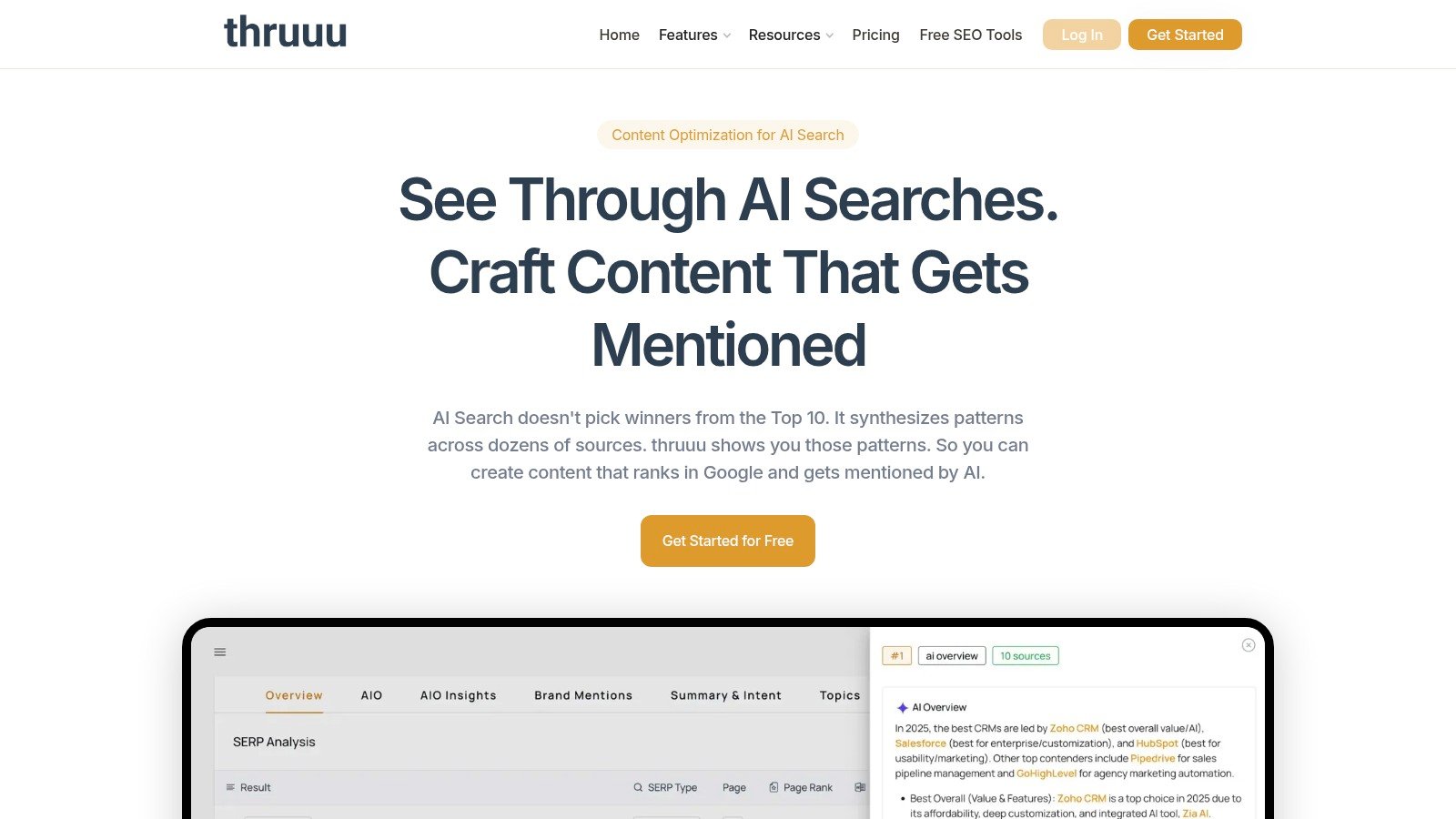
thruuu is a lighter option for teams that want AIO visibility added to SERP research and client reporting. Its monitor tracks whether a brand or domain appears inside Google AI Overviews across substantial keyword sets, then turns detections into prioritization tables and shareable reports.
The product fits agencies and marketers who already use thruuu's SERP content analyzer for gap-finding. A team can identify AIO visibility gaps, inspect the surrounding content, and give a client a concise report without adopting a heavyweight enterprise platform.
Lightweight has a boundary
thruuu's focus is narrower than the enterprise tools in this list. Cross-engine and multi-LLM tracking is limited compared with platforms designed around answer-engine coverage, and the product is centered on Google AIO rather than prompt archives across several models.
That isn't necessarily a weakness. A small team may get more value from a clear monitor that supports existing research habits than from a broad platform whose additional data never reaches an actionable workflow.
Use thruuu when the practical question is, which tracked Google queries show an AIO gap, and what should the agency investigate next? Choose something broader if the answer must include model-level differences, fan-out searches, or citations across non-Google engines.
10. Yext AI Visibility and AEO Stack
Yext addresses a visibility problem that tracking alone cannot solve: whether answer engines can access consistent, reliable brand knowledge. Its AEO and AI visibility capabilities cover visibility scores, citation frequency, and sentiment across ChatGPT, Gemini, Perplexity, and Google AI Overviews. Its knowledge management, structured data, listings, and local content products support the underlying brand information.
That connection matters for multi-location and enterprise organizations. Store details, products, services, reviews, and company facts often exist across separate systems. A visibility score can show that a brand is missing or poorly represented, while Yext can connect the observation to governance and listings work that may improve consistency.
A platform for governance, not only monitoring
Yext's Scout tooling links visibility insights with content and knowledge systems. This suits organizations where marketing, local teams, product owners, and communications teams all shape the information answer engines may use.
The trade-off is packaging and cost clarity. Pricing is custom, and the total can become difficult to assess when listings, content, knowledge, and enterprise governance are combined. Buyers should confirm which monitoring capabilities are included, which usage limits apply, and whether provider or response costs are bundled or managed separately. A small business seeking only prompt and citation tracking may pay for capabilities it will not use.
Visibility measurement shows what answer engines said. Knowledge management helps determine whether they had reliable facts to use.
Yext fits brands that need AI visibility tied to entity management and operational brand governance, particularly across locations or complex organizational structures. For a wider view of the category, see this review of the best AI visibility trackers for SEO and marketing agencies in 2026.
Top 10 Generative Engine Optimization Tools Comparison
Product | Core features ✨ | Unique selling points ✨ | Target audience 👥 | Price/value 💰 | Quality ★ |
|---|---|---|---|---|---|
Llumo 🏆 | Multi‑model AEO tracking, per‑prompt visibility, citations, query fan‑out, opportunity discovery | BYOK (no markup), unlimited prompts, hosted custom subdomain, transparent response‑costs | 👥 SEO/AEO teams, agencies, product & growth, competitive intel | 💰 Free core (BYOK); pay providers directly (~$100–$150/mo example) | ★★★★★ |
seoClarity (ArcAI) | AIO detection per keyword, citation/source analysis, historical multi‑engine trends | Enterprise‑grade scale, ArcAI multi‑surface coverage, research playbooks | 👥 Large enterprise SEO & analytics teams | 💰 Custom/enterprise (contact sales) | ★★★★☆ |
Semrush | AIO detection in Position Tracking, AI Visibility Toolkit, free AIO checker | Integrates AIO with rank/traffic workflows; familiar SEO stack | 👥 SEO teams, agencies, in‑house marketers | 💰 Tiered subscriptions; AI features on higher tiers | ★★★★☆ |
BrightEdge | Generative Parser, AIO incidence metrics, industry research & reports | Deep research & forecasting; enterprise reporting & strategy ties | 👥 Enterprise content/strategy teams | 💰 Enterprise pricing (contact sales) | ★★★★☆ |
SISTRIX | AIO reports, prompt tracking, multi‑region AI visibility dashboards | Clean reporting, frequent AI‑search updates, regional support | 👥 Agencies, regional SEO teams | 💰 Package‑based pricing; varies by plan | ★★★★☆ |
STAT (GetSTAT) | AIO detection by keyword/location/device, source/page authority, full SERP archives | Built for very large keyword sets; strong SERP‑feature analytics | 👥 Enterprise rank/analytics teams | 💰 Custom/enterprise (contact sales) | ★★★★☆ |
Nozzle | AIO extraction, "Nozzle Vision" single‑keyword SERP, BigQuery export/templates | Transparent data export; custom BI analysis & templates | 👥 Data teams, analysts, technical agencies | 💰 Tiered; BigQuery usage may apply | ★★★★☆ |
Authoritas | AIO expansion/capture, full AIO text & citations, AIO‑filtered rank views | Full capture for auditability; easy rank‑tracking integration | 👥 SEO teams needing AIO audits | 💰 Contact sales | ★★★☆☆ |
thruuu | Brand/domain AIO visibility across large keyword sets, prioritization tables | Lightweight AIO monitoring; concise client reports | 👥 Agencies, SMBs, consultants | 💰 Affordable/lightweight tiers | ★★★☆☆ |
Yext | AI visibility & citation monitoring, knowledge management, listings & Scout tooling | Ties AEO insights to knowledge/content systems; multi‑location governance | 👥 Enterprise brands, multi‑location businesses | 💰 Custom/enterprise (contact sales) | ★★★★☆ |
Choose the Measurement Layer You Will Actually Use
The list separates into practical groups rather than a single ranking. Llumo is the clearest fit for transparent, multi-model prompt and citation measurement, especially when the buyer wants BYOK control, unlimited platform-level prompts, response archives, and actionable opportunity discovery. seoClarity and BrightEdge suit enterprise teams that need large-scale AI search intelligence, historical analysis, category research, and established governance.
Semrush and SISTRIX work well for teams extending an existing SEO workflow. They reduce adoption friction because AI Overview and AI visibility data sit beside familiar ranking, keyword, and competitor reporting. Their trade-off is that the AI layer may not provide the same depth as a platform designed first around prompt-level answer analysis.
STAT Search Analytics and Nozzle are better for deep Google SERP analysis. GetSTAT emphasizes enterprise segmentation, source views, and archived SERPs. Nozzle gives technically capable teams more freedom to extract, query, and reshape AIO data through BigQuery. Neither should be treated as a complete cross-model answer-engine monitor.
Authoritas and thruuu are focused Google AI Overview choices. Authoritas is the stronger option when full response and citation capture must live inside rank tracking. thruuu is more approachable for agencies and marketers that need lightweight monitoring and clear client-facing prioritization.
Yext belongs in a different category. It is the option for teams that need visibility connected to brand knowledge operations, structured data, listings, and entity consistency. It may be broader than necessary for a small SEO team, but that breadth is the point for multi-location and enterprise governance.
Run the evaluation in a fixed order. First, list the engines and markets that matter to your customers. Then decide whether you need prompt-level evidence, including model responses and citations, or keyword-level Google AIO data, including SERP state and historical trends. Next, inspect citation exports, response archives, page-level sources, regional filters, and the way each platform preserves history.
Finally, compare pricing models with care. A bundled subscription may look simpler, but ask which usage is included, what happens when response volume grows, and whether provider costs are marked up. A BYOK model may reduce licensing overhead and improve control, but it shifts API keys, quotas, and budget management to your team. Implementation effort belongs in the same calculation.
The best tool is the one that turns a missing mention or citation into a specific assignment. That might be a content update, a new page, structured data, a technical fix, a digital PR campaign, or a correction to inconsistent brand information. If the platform can't help your team make that next decision, its feature count won't rescue the program.
Llumo gives SEO teams and agencies multi-model visibility across ChatGPT, Gemini, Perplexity, Copilot, Google AI Overviews, and other answer engines, with per-prompt scores, citation analysis, share of voice, response archives, and opportunity prioritization. Its BYOK model lets you connect your own provider keys and pay underlying usage costs directly, so visit Llumo to see whether transparent, actionable GEO measurement fits your workflow.