
The popular advice is to find the platform with the longest feature list. That's usually the wrong starting point. Competitive intelligence platforms are built for different intelligence jobs: some help sales teams handle objections, some support strategy and market research, and others track digital behavior, social conversations, pricing changes, or visibility in AI answers.
This comparison focuses on the work each platform supports. I'm looking at coverage, workflow fit, evidence quality, pricing approach, setup effort, and practical limitations, rather than treating every alert or dashboard as equivalent. A battlecard system shouldn't be judged like a financial research database, and an AI visibility tracker shouldn't be expected to replace a CRM-based sales enablement tool.
The right choice depends on the question your team asks repeatedly. Do you need to know why deals are won or lost, what a competitor changed overnight, which channels drive its traffic, or which sources AI systems use when recommending alternatives? Start there, then use the list to narrow the field.
1. Llumo
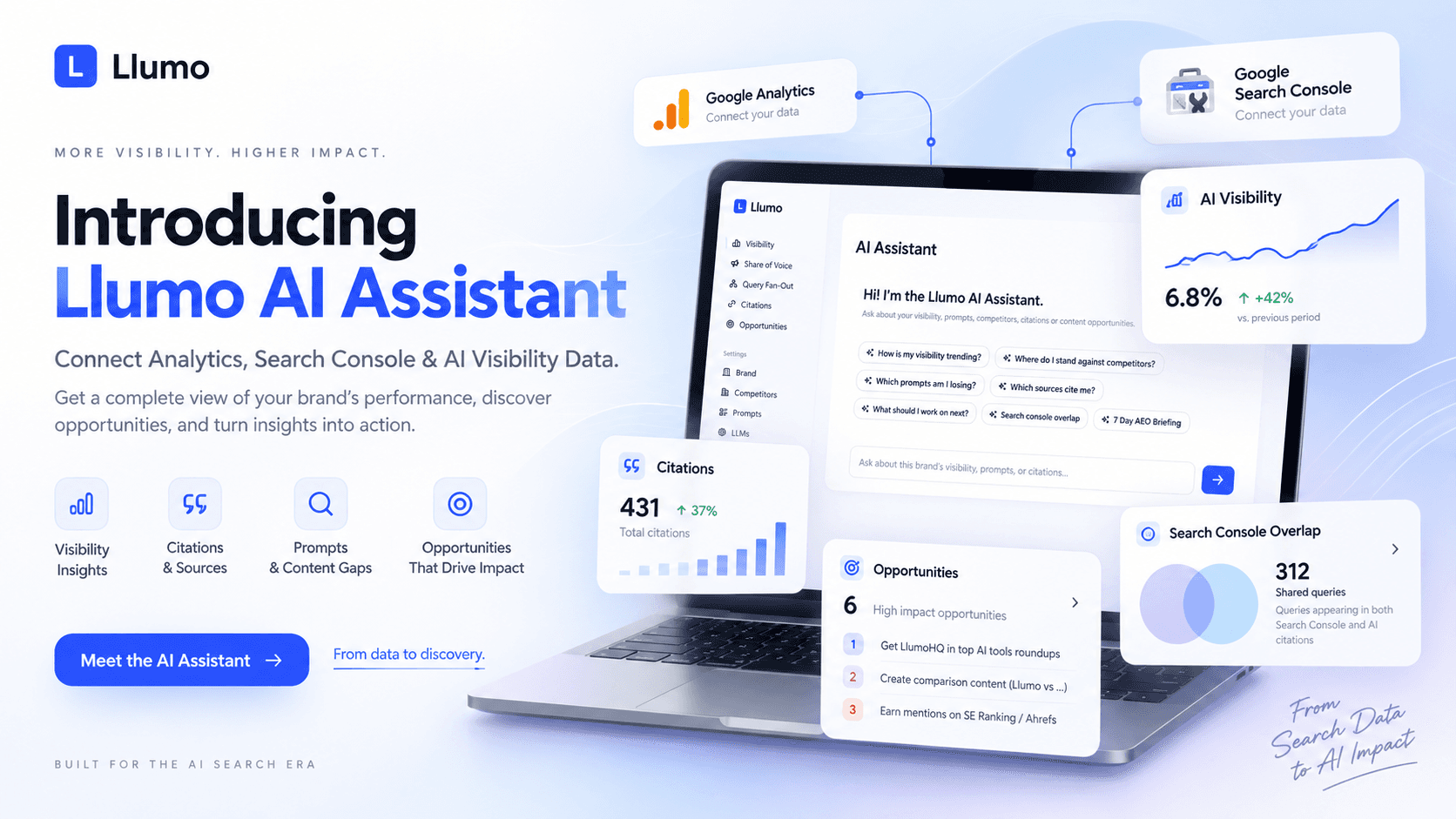
Llumo serves a narrower intelligence job than the other platforms here. It focuses on Answer Engine Optimization and competitive AI visibility, rather than traditional search rank tracking. Teams can monitor how ChatGPT, Claude, Gemini, Perplexity, Copilot, and Google AI Overviews mention or cite brands for defined prompts.
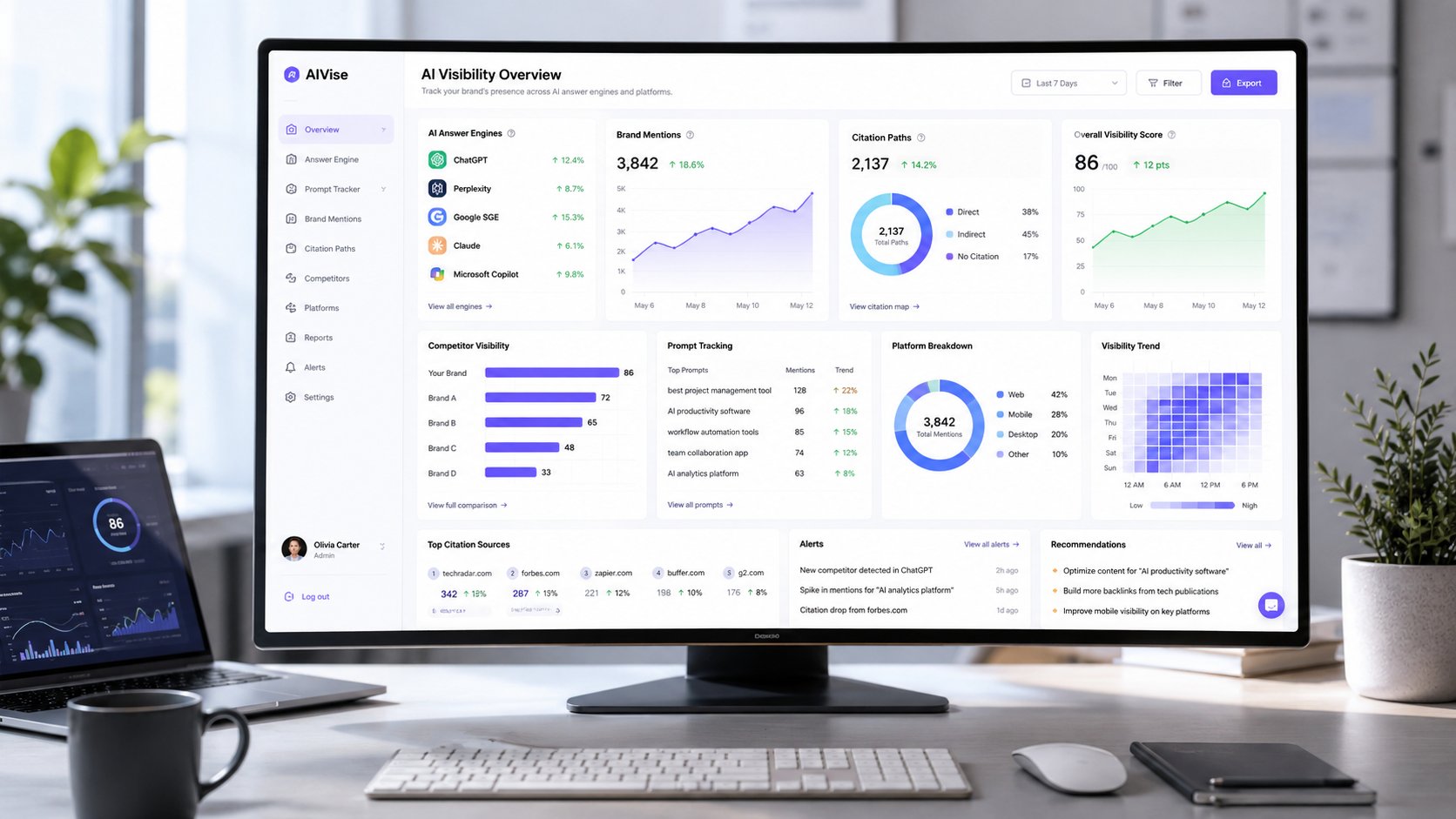
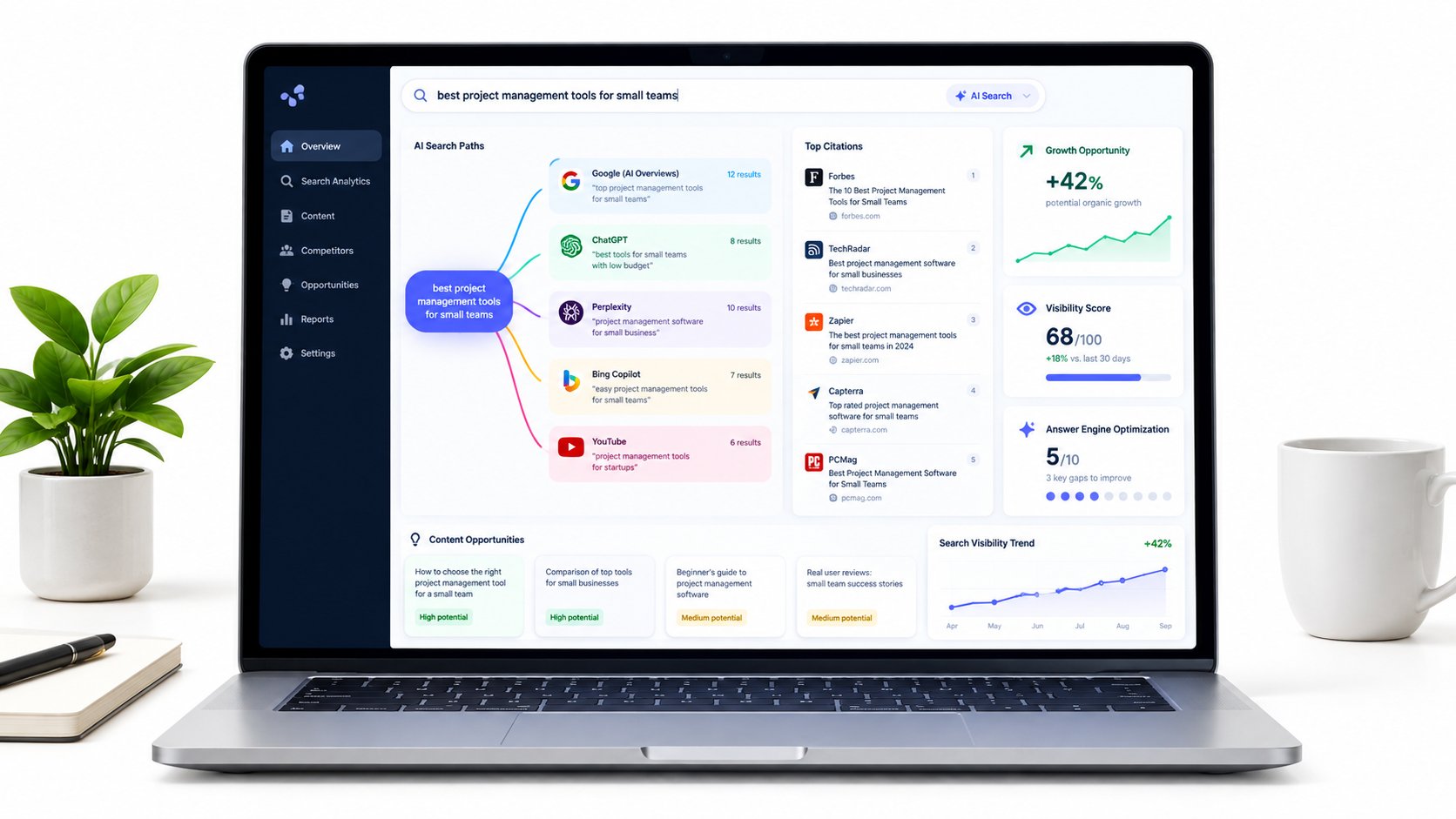
That focus changes the evidence you get. AI answers do not reproduce a standard results page, so the useful questions are whether a competitor appears, which brand receives the recommendation, which sources are cited, and how those citations shift over time. Llumo organizes those findings into per-prompt visibility scores, share of voice, competitor trend lines, and citation analysis.
Where Llumo is strongest
The practical value goes beyond counting brand mentions. Llumo archives responses by prompt, records query fan-out, tracks cited domains and pages, and flags new or lost references. SEO, digital marketing, and CI teams can then act on specific evidence, such as updating a page, publishing a missing comparison, or pursuing an off-site mention.
Its dashboards cover prompt tagging, filters, historical trends, benchmarks, and competitor comparisons. Specialized trackers support Google AI Overviews and ChatGPT. The hosted option includes a custom subdomain, branding, unlimited projects and brands, daily backups, and usage analytics.
Practical rule: Teams tracking only traditional competitor website changes may find Llumo too specialized. Teams asking why an AI answer cites a competitor instead of their brand will get evidence that generic monitoring tools usually do not provide.
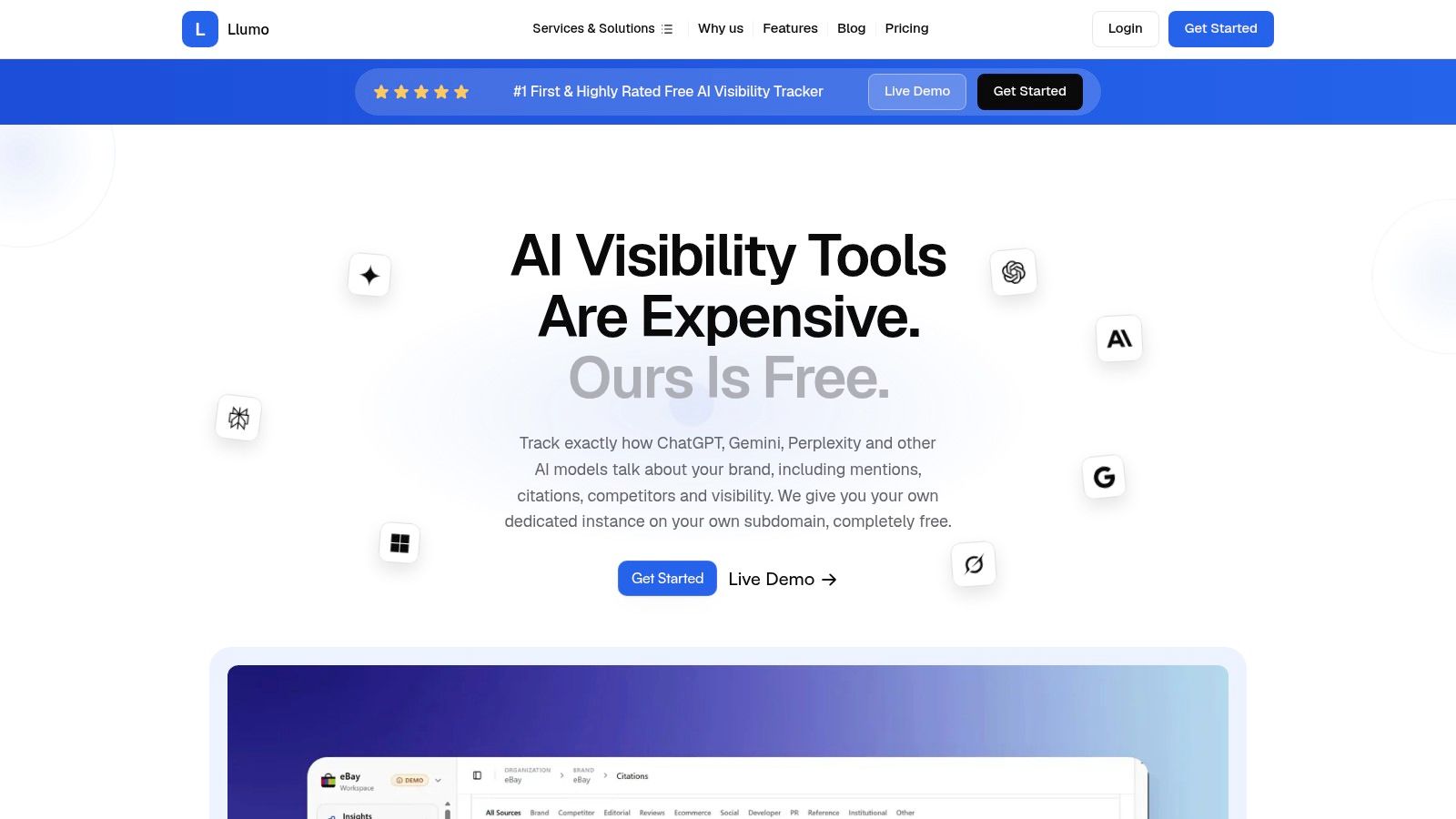
Llumo's cost model also creates a clear trade-off. There's no core software license fee. Customers connect their own provider API keys and pay model providers directly, without Llumo usage markup. That makes response-based costs easier to see and supports scaling without forced enterprise pricing tiers. Your team still has to manage API keys, quotas, and variable model costs. Public subscription pricing, customer testimonials, awards, and third-party certifications aren't listed in the provided materials.
Visit Llumo if AI mentions, citations, generated queries, and answer-engine share of voice are central to your competitive intelligence program.
2. Klue
Klue is designed around a familiar sales and product marketing problem: competitive information exists, but sellers can't find or trust it during a live deal. The platform brings competitive intelligence, battlecards, and win-loss management into one workflow, with AI-assisted tools for producing sales-ready answers.
Its Ask Klue assistant is aimed at fast retrieval. Instead of asking reps to search a large research library, teams can give them concise answers and battlecard content inside the environment where competitive questions arise. Klue also tracks distribution and engagement, so program owners can see whether internal teams are using the intelligence.
Best fit and trade-offs
Klue makes the most sense for mid-market and enterprise product marketing teams with a defined sales enablement process. The platform's strength is not broad public-source research. It's the conversion of intelligence into usable competitive guidance, including objection handling, positioning, and deal support.
The unified win-loss workflow is valuable because it connects what teams believe about competitors with what buyers say after a deal. That feedback can improve battlecards instead of leaving them as static documents that slowly become outdated.
Strong workflow fit: Product marketing and sales enablement teams get a purpose-built place for compete content.
Faster maintenance: AI assistance can reduce the manual work involved in refreshing battlecards.
Useful adoption signals: Engagement analytics help identify whether intelligence reaches sellers.
Important limitation: Klue doesn't publish a price list, uses sales-led annual contracts, and may feel heavy for a small team without a dedicated owner.
Klue is a good choice when your recurring question is, “What should the seller say when this competitor enters the deal?” It's less suitable if your main need is market research, web traffic benchmarking, or AI citation monitoring. Explore the platform at Klue.
3. Crayon
Crayon is a mature option for teams that need continuous competitor monitoring tied directly to sales enablement. It tracks public changes across competitor websites, messaging, features, pricing, and other signals, then helps teams turn those changes into battlecards and internal updates.
The platform's AI capabilities, including Sparks and Answers, are intended to synthesize incoming intelligence and refresh competitive content. That helps solve a common operational failure: a team creates a useful battlecard, then leaves it untouched while the market changes around it.
Monitoring is only half the job
Crayon's practical advantage is its focus on what happens after collection. Engagement analytics show how people use battlecards and whether that usage connects with competitive deal activity. That's more useful than a stream of alerts nobody reads.
The trade-off is signal management. Broad collection can create noise during the initial setup, especially when a competitor publishes frequently or has several product lines. Someone needs to tune sources, decide what counts as meaningful, and maintain the taxonomy.
A monitoring feed becomes competitive intelligence only when someone turns a change into a decision, message, or sales action.
Crayon is strongest for an established CI program with sales enablement ownership. It's not the obvious first purchase for a founder or a small marketing team that only needs occasional competitor checks. Pricing isn't public, and the buying process is sales-led, so procurement should ask about implementation, integrations, users, data sources, and renewal terms before comparing quotes.
For teams expanding from traditional monitoring into AI results, the distinction between web changes and answer-engine citations is important. This guide to brand monitoring for AI results explains why a competitor's presence in AI answers requires different evidence from a normal website alert.
Visit Crayon to assess its dedicated CI and battlecard workflow.
4. Kompyte
Kompyte, now associated with Semrush, is built around a specific job: turning competitor changes into sales and product marketing actions. It monitors competitor websites, product pages, review sites, public relations activity, and job postings, then feeds those signals into alerts and battlecards.
The platform fits teams that need sales-ready intelligence rather than a broad research environment. Its core question is practical: What changed, and what should sales or product marketing do next?
Sales teams can track pricing or packaging changes. Product marketing can follow feature positioning, review language, and shifts in competitor messaging. Kompyte's workflows and AI behavior support separate views for those users, while a dedicated customer success contact and no extra onboarding fees may help teams that want guided implementation.
The trade-off is scope. Kompyte is strongest for competitor monitoring, battlecards, and alerts. It is less suited to broad market research, social monitoring, or detailed digital benchmarking. Teams evaluating AI-answer visibility should also confirm whether the platform tracks citations and mentions in answer engines, rather than assuming website monitoring covers that job.
Pricing requires a quote. The commercial structure can vary with the number of competitors tracked, user seats, and SSO requirements. Integration with the wider Semrush ecosystem may suit marketing teams already using it, but can create extra surface area for teams seeking only CI.
Best use: Sales battlecards and alerts tied to competitor activity.
Useful coverage: Websites, product pages, reviews, public relations, and jobs.
Potential friction: Quote-based pricing and an ecosystem that may not fit every workflow.
Decision test: Confirm that reps can access intelligence where they already work, not only inside Kompyte.
Kompyte is a focused option for teams that need competitor signals connected to action without buying a full market research platform. Learn more at Kompyte.
5. Contify
Contify is aimed at teams that investigate markets, not only track named competitors. Its coverage brings together industry developments, technologies, patents, transcripts, reviews, forums, and other public signals for market and competitive intelligence teams.
According to the product information at Contify, the platform aggregates more than 1 million sources across web, social, technology media, reviews, patents, forums, and earnings content. Athena AI summarizes and extracts findings, while source traceability allows analysts to check the material behind each insight.
A research system that requires design
The strongest differentiator is configuration. Analysts can define taxonomies for competitors, markets, and signal types, then build dashboards and alerts around specific research questions. Human-in-the-loop curation helps remove repetitive or irrelevant items before they reach executives.
That flexibility creates work at the start. Teams must decide which sources matter, refine categories, and set alert rules. A trial can show how collection works, but it cannot replace the judgment needed to build a useful intelligence program.
Contify fits research workflows better than instant sales enablement. It can support:
Market monitoring: Follow competitors, industries, technology shifts, patents, reviews, and financial commentary.
Analyst review: Trace findings back to their sources before sharing them with decision-makers.
Configured reporting: Adapt dashboards and alerts for strategy, corporate intelligence, or analyst teams.
Program setup: Account for limited public pricing and a typically sales-led buying process.
Choose Contify when the intelligence job is market research and evidence gathering. For sales battlecards, digital benchmarking, social monitoring, pricing alerts, or AI-answer visibility, evaluate whether its configured workflows cover those needs directly rather than treating broad source monitoring as a substitute.
6. Similarweb Web Intelligence
Similarweb answers a specific intelligence question: where competitors attract digital attention, and which channels appear to support that performance. It is primarily a digital benchmarking platform, comparing traffic, channels, keywords, demand, conversions, markets, and audience segments across websites and other digital properties.
That focus makes it useful for marketing strategy, growth planning, and sales conversations that depend on digital evidence. It is less suited to managing sales battlecards, win-loss research, or a broader internal intelligence program.
A benchmarker with an AI visibility layer
Teams can now examine AI traffic trends, brand visibility, and prompt behavior through its AI Search Intelligence and GenAI capabilities. Those tools extend the platform into AI-answer visibility, but they do not turn it into a general-purpose monitoring system. For a focused review of that category, see this guide to AI visibility trackers for SEO and marketing agencies.
The practical test is whether the recurring question is about a market or digital property, rather than a news event or competitor announcement. Similarweb's market and segment views help analysts understand category movement instead of relying only on one-to-one comparisons.
Larger teams may also use APIs and data feeds to place digital intelligence in internal dashboards, reporting systems, or AI workflows. That reduces dependence on the vendor interface, although custom deployments add implementation work and commercial complexity.
Best evidence: Web, app, channel, keyword, demand, and conversion signals.
Best extension: AI Search Intelligence and GenAI modules for emerging visibility questions.
Best fit: Marketing, growth, and digital benchmarking teams.
Trade-off: Full capabilities require a commercial conversation, and the platform does not manage a complete CI program.
Use Similarweb Web Intelligence when digital benchmarking is the intelligence job. Choose another platform when the priority is social monitoring, pricing alerts, research evidence, or governed sales enablement.
7. AlphaSense
AlphaSense serves research-intensive teams that need to search premium business content quickly. Its coverage spans filings, broker research, earnings calls, expert calls, and news, with generative AI applied to more than 500 million premium documents and expert content items.
The platform suits strategy, finance, life sciences, consulting, and investor workflows better than lightweight sales monitoring. Analysts can examine how competitors describe markets, risks, products, and financial performance in formal disclosures and executive commentary.
Depth over immediacy
AlphaSense's main advantage is evidence depth. A product marketing manager checking for a pricing-page change may find the workflow too elaborate. A strategy team examining a competitor's market direction may need exactly that level of source material.
Enterprise Intelligence combines external research with internal corporate content. Analysts can compare public competitor information with internal plans, customer knowledge, and earlier research in one workflow instead of switching between disconnected systems.
The trade-offs are commercial and operational. Pricing is opaque and generally aimed at enterprise buyers. The platform can also be excessive for teams that need only website monitoring or sales battlecards.
Use AlphaSense when the question is, “What does the available business evidence reveal about this company's strategy, market exposure, or financial direction?” Choose another tool when the primary job is rapid alerts for sales representatives. Explore AlphaSense for enterprise research workflows.
8. CB Insights
CB Insights earns its place when the competitive question involves private companies, emerging technologies, investors, or market formation. It is not a substitute for a sales battlecard tool, routine price alerts, or simple website monitoring. Its job is strategic research: showing how companies, funding, partnerships, technologies, and markets connect.
The platform brings together proprietary research, company analysis, market maps, and predictive signals. ChatCBI lets users ask questions in natural language across CB Insights' datasets, then produce executive-ready summaries with citations to the underlying material.
A strategy or corporate development team can use the research library and analyst-authored reports to establish a shared view of a market. That shortens the initial research cycle and gives discussions about competitors or technology shifts a common evidence base. It is especially useful when a competitor's important signals sit outside public filings and product-page changes.
The trade-off is a steeper learning curve for non-analysts. Users need to frame focused questions, understand how the data is organized, and separate a meaningful strategic signal from an interesting company detail. Quote-based enterprise pricing can also make casual evaluation difficult.
Use CB Insights when the intelligence job is market entry, investment, portfolio review, or product strategy. Pick a different platform when the immediate output is a seller-ready battlecard, a digital benchmark, a social-monitoring feed, or an alert about a changed price page.
Best fit: Strategy, corporate development, venture, and technology intelligence.
Strongest coverage: Private companies, emerging markets, and technology sectors.
Useful output: Research-backed positioning analysis and cited executive summaries.
Weak fit: Tactical battlecards, routine price alerts, or simple website change monitoring.
Choose CB Insights when competitive intelligence must support investment, market entry, portfolio, or product strategy decisions.
9. WatchMyCompetitor
WatchMyCompetitor, often shortened to WMC, combines automated monitoring with an analyst-curated layer. It tracks competitor product launches, pricing changes, feature updates, promotions, and market events, then delivers a private intelligence feed and alerts.
That combination is its main differentiator. Automated systems are good at collecting change, but they can struggle with context and noise. Analyst curation adds a review layer that helps distinguish an important commercial move from a routine update.
A practical alerting layer
WMC is well suited to revenue protection and opportunity spotting. A pricing change may matter to sales, a promotion may matter to revenue teams, and a product launch may matter to product marketing. Alerts can route those signals to the people who need them instead of sending every update to everyone.
The platform's enterprise AI data services support refreshes across large datasets, with the provided materials describing more than 300 million data points at the service level. That figure is a product claim rather than a measure of usefulness, so buyers should ask how much of the coverage applies to their market, category, and named competitors.
WMC isn't a full replacement for a research platform. Teams needing detailed financial analysis, deep market mapping, or extensive internal knowledge management may need another system alongside it. Pricing is custom and not public, which makes a focused pilot important.
Use WatchMyCompetitor when your priority is high-signal monitoring of products, prices, promotions, and market events.
10. Onclusive Social
Onclusive Social, formerly Digimind, is the right category for organizations that treat social and media conversations as core competitive evidence. It combines social listening with market and competitor analysis, then adds AI-assisted theme detection and automatic insight generation.
This is different from monitoring a competitor's website. Social listening can reveal how customers, partners, critics, and industry communities discuss a brand, including themes that don't appear in official messaging. The broader Onclusive stack also adds media intelligence context across earned and broadcast coverage.
Strong coverage for public conversation
Onclusive Social makes sense for large brands, communications teams, and market intelligence groups that need to compare competitors across social and media environments. It's especially useful when reputation, campaign reaction, share of conversation, and public positioning influence competitive decisions.
The trade-off is scope. If your team only needs product-page changes, pricing alerts, or web traffic estimates, this platform may introduce more capability than you'll use. Pricing and tiers aren't public, and quotes may come through sales or partner channels.
Social intelligence is most valuable when analysts connect conversation themes to a business decision. A sentiment chart alone won't tell a sales team how to reposition a deal.
Before buying, verify platform coverage, historical access, language requirements, export options, and how analysts will validate AI-detected themes. Teams comparing AI answer visibility should also distinguish social mentions from citations in generated answers. This guide to AI Overview tracking tools covers that separate measurement problem.
Explore Onclusive Social if social and media intelligence are central to your competitive workflow.
Top 10 Competitive Intelligence Platforms Comparison
Product | Key features & USP (✨) | Target audience (👥) | Pricing & value model (💰) | Quality / Best fit (★) |
|---|---|---|---|---|
Llumo 🏆 | ✨ Multi‑model AEO tracking, per‑prompt visibility, citation & query fan‑out, opportunity discovery, hosted instance | 👥 SEO/AEO teams, digital marketing, agencies, product/growth, competitive intel | 💰 No platform license, BYO API keys, pay providers directly; transparent, scalable per‑response costs | ★★★★☆ Enterprise-ready AEO focus, actionable insights |
Klue | ✨ Unified CI + win‑loss, "Ask Klue" AI, battlecards & engagement analytics | 👥 Product marketing & sales enablement teams | 💰 Quote-based, sales‑led annual contracts | ★★★☆☆ Strong for sales enablement workflows |
Crayon | ✨ Automated web monitoring, AI battlecards (Sparks/Answers), engagement analytics | 👥 Sales enablement, competitive intelligence teams | 💰 Sales‑led pricing; quote required | ★★★★☆ Mature CI automation; needs tuning to reduce noise |
Kompyte (Semrush Kompyte) | ✨ Automated tracking (sites, reviews, PR), real‑time insights, tailored AI workflows, CSM | 👥 Sales & product marketing teams | 💰 Flexible quote (competitors tracked, seats, SSO) | ★★★☆☆ Actionable battlecards, Semrush ecosystem fit |
Contify | ✨ 1M+ sources, Athena AI summaries, custom taxonomies & traceability | 👥 Research‑heavy CI teams, market intelligence | 💰 Enterprise quotes; setup/curation expected | ★★★★☆ Deep coverage and noise filtering |
Similarweb Web Intelligence | ✨ Competitive benchmarking, AI Search/GenAI modules, APIs & data feeds | 👥 Digital analysts, marketing & growth teams | 💰 Contract-based; add‑ons for GenAI modules | ★★★★☆ Broad digital signals, enterprise packaging |
AlphaSense | ✨ Premium document search (500M+), generative AI, enterprise integrations | 👥 Strategy, finance, consulting, research teams | 💰 Opaque, enterprise pricing; higher ACVs | ★★★★☆ Finance-grade content and search power |
CB Insights | ✨ Proprietary predictive signals, ChatCBI Q&A, company analysis workflows | 👥 Corporate strategy, CVC, BD, market research | 💰 Quote-based enterprise pricing | ★★★★☆ Strong private‑market & tech intel |
WatchMyCompetitor (WMC) | ✨ Automated product/pricing monitoring + analyst curation, tailored alerts | 👥 Revenue ops, pricing, product teams | 💰 Custom quotes; enterprise focus | ★★★☆☆ Good for revenue protection; monitoring-focused |
Onclusive Social (formerly Digimind) | ✨ Social listening + AI theme detection, integrated media intelligence | 👥 Brands needing social & media CI depth | 💰 Quote-based; partner reseller routes | ★★★☆☆ Mature social/media CI; best for comms teams |
Choose the Intelligence Workflow You Will Use
The best competitive intelligence platform is the one that supports the decision your team makes repeatedly. Feature count can obscure that choice, especially when a vendor combines monitoring, AI summaries, dashboards, and integrations under one broad category label.
Choose Klue, Crayon, or Kompyte when sales enablement and battlecards drive the purchase. Klue is oriented toward competitive enablement, win-loss workflows, and sales-ready answers. Crayon is a strong fit for mature CI programs that need automated monitoring connected to battlecard adoption and deal impact. Kompyte is more focused on actionable competitor changes across sites, reviews, public relations, and jobs.
Choose Contify, AlphaSense, or CB Insights when research depth matters more than rep-facing alerts. Contify offers configurable, multi-source monitoring with source traceability. AlphaSense is suited to premium business content, filings, earnings, and expert research. CB Insights is useful for private companies, emerging technologies, market maps, and strategy or corporate development questions.
Choose Similarweb for digital benchmarking. It's the natural option when you need to compare traffic, channels, keywords, demand, conversions, and digital market behavior. It can also contribute to AI search research, but it shouldn't be treated as a complete competitive intelligence program by itself.
Choose WatchMyCompetitor when curated product and pricing alerts are the main requirement. Its analyst layer is valuable for teams that want fewer, more contextual signals rather than another unfiltered stream. Choose Onclusive Social when competitive intelligence depends on social conversations, news, earned media, and reputation themes.
Choose Llumo when AI mentions, citations, prompts, and answer-engine share of voice are the priority. It tracks those signals across major AI answer engines, stores prompt-level responses, identifies cited sources, and connects visibility findings to content and outreach opportunities. That's a different job from watching a competitor's homepage or maintaining a sales battlecard.
Before committing, validate four things:
Source coverage: Confirm that the platform monitors the markets, languages, competitors, channels, and AI surfaces your team cares about.
Onboarding effort: Ask who defines taxonomies, prompts, battlecard structures, alert rules, and integrations.
Contract structure: Clarify annual commitments, seats, tracked competitors, API usage, add-ons, renewal terms, and implementation costs.
Reporting workflow: Decide where insights will go, such as CRM records, sales enablement, executive reports, Slack, dashboards, or content planning.
Start with a defined competitor set and a small group of recurring questions. For sales, that might mean the objections that appear most often in competitive deals. For strategy, it might mean product direction, partnerships, market entry, and financial signals. For AI visibility, it might mean the prompts buyers use when comparing vendors and the sources answer engines cite.
Then review whether the platform changes what someone does. If an alert doesn't alter a battlecard, a sales conversation, a product decision, a content plan, or an outreach priority, it may be interesting intelligence rather than useful intelligence.
Llumo gives SEO, AEO, marketing, and competitive intelligence teams a direct way to track how AI answer engines mention and cite brands across prompts, competitors, and models. It connects visibility scores, share of voice, response archives, query fan-out, and citation opportunities without a core software license fee, so visit Llumo to explore the platform and discuss your AI visibility workflow.