You open your rank tracker on the first Monday of the month, and a rival has moved from the bottom of page two to position four on the query your whole content calendar was built around. You screenshot it, drop it in Slack, and someone asks the only question that matters: what do we do about it? The screenshot doesn't answer that. It shows the score, not the plays.
That gap is where competitive intelligence for SEO lives. A keyword export tells you where a competitor stood last week. Intelligence tells you where they're heading next quarter, which sources prop up their visibility, and which of your own pages are losing ground to an answer engine rather than to a rival's landing page.
Here's the routine I'd run in your position: how to pick a competitor set that doesn't balloon, which metrics prove something, which tools cover which blind spots, and how to run a gap analysis you can defend in a planning meeting without hand-waving.
What Competitive Intelligence Means for SEO
A working definition, and the three stages that make it useful.
A keyword export is a scoreboard. It shows the final number and nothing about the plays that produced it. Game film is the intelligence: which pages a rival built, which sources link to them, how fast they publish, and what they've stopped doing. You want the film, because the film is the only thing that tells you what happens next.
Competitive intelligence is a decision-support process, not a competitor fact file. It's the legal and ethical collection and analysis of what rivals can do, where they're exposed, and what they intend, and the Encyclopedia.com entry on competitive intelligence traces that definition alongside the field's shift from secondary-source collection to competitive profiles, tracking systems, benchmarking and forecasting. The same entry dates its formalization to the founding of the Society of Competitive Intelligence Professionals in 1986, which is a useful reminder that this is a forty-year-old discipline with methods, not a phrase invented for a pitch deck.

The work happens in three stages, always in this order. Collect the observable signals: ranking pages, indexed content, referring domains, publishing dates, search-result features, pricing changes, product messaging. Analyze them into benchmarks, which means answering which topics a rival owns, where their pages earn visibility they haven't paid for, how quickly they respond when demand shifts, and which third-party sources keep showing up behind their pages. Forecast last, because a forecast built on two paragraphs of observation is just a hunch with better formatting.
The distinction that decides how you budget the time: a one-off audit answers a single planning question and then expires. A continuous scan answers the question that recurs every month. Everything below assumes the second one.
Choosing Your Competitor Set and Share of Voice
Four tiers of rival, one fixed prompt list, one number worth tracking.
The question often skipped is the one that ruins the rest of the analysis. In SEO, a competitor isn't whoever sales mentions in a deal review. It's any site that occupies the results your buyer sees, including sites that will never sell them anything. Get this wrong and you spend a quarter benchmarking against a publisher that doesn't share a single customer with you.

Four tiers, and why your sales list isn't enough
Tier | Who belongs | How to find them | What to track |
|---|---|---|---|
Head-to-head rivals | Brands selling to the same buyer | Shared money-page rankings and mentions on sales calls | Pricing, positioning and page structure |
SERP overlap | Sites repeatedly ranking beside you | Keyword overlap reports in Semrush or Ahrefs | Topic coverage and ranking URLs |
AI co-mentions | Brands named next to yours in ChatGPT, Gemini or Perplexity answers | Prompt-level response archives | Mention frequency and cited sources |
Emerging challengers | Newer or niche sites growing fast | New referring domains and publishing pace over several months | Growth rate and topic focus |
The first tier gets all the attention, and the third tier is often overlooked. Visibility now splits across two layers: a study comparing Google's conventional results with AI Overviews found that overviews were generated for 51.5% of representative real-user queries and shown above the organic results, as the ACM study on AI Overviews and conventional results reports. A rival can dominate the ranked layer and be absent from the answer layer, or the other way round. Track both or you're grading half a game.
My working set is deliberately small: five to eight core competitors plus a watch list of three challengers, reviewed once a quarter. Anything wider and the monthly review turns into a data-cleaning exercise nobody keeps up with.
Share of voice, computed honestly
Share of voice is your brand mentions divided by all brand mentions across the same tracked prompts and queries. Nothing more complicated than that, which is why it gets abused.
Say you're mentioned 18 times across a fixed set of 90 brand mentions in tracked answers. That's a 20% share of voice, and it only means something next to last month's figure for the identical prompt list. Compare a 20% share measured on ten easy prompts against a rival's 20% measured on forty hard ones and you've learned nothing except that percentages are easy to compute badly.
Practical rule: if the prompt set changed, the share of voice didn't. Re-baseline instead of comparing.
For the mechanics of normalizing those numbers across markets and prompt groups, how to calculate share of voice against a fixed tracked set covers the arithmetic and the pitfalls.
Build the tracked set before you measure anything
Write 30 to 50 questions a real buyer would ask, then split them into branded and non-branded groups and keep them fixed for at least a quarter. Pull the wording from sales call recordings, support tickets and the search terms already landing in your analytics, not from your own imagination. The point is to measure demand as it exists.
The Metrics That Show Real Competitive Position
Rank is an early warning, not a verdict.
Rank position stopped being a reliable proxy for traffic the moment answers started appearing above results. In 2024, 58.5% of Google searches in the United States and 59.7% in the European Union ended without a click, per SparkToro's zero-click analysis built on Datos clickstream data. A page can hold position two and still hand almost nothing to the business.
The displacement gets sharper when an AI Overview is in play. A Ahrefs analysis of AI Overview click effects found the result in position one took a 58.0% click-through-rate decline against its baseline when an overview was present, with positions two and three down 50.8% and 46.4%. That's a surface change moving outcomes with zero change on the competitor's side of the fence.
Four measures that only work together
Answer presence asks whether your brand appears in the generated answer at all. Prominence asks where inside that answer you sit, because being the third name in a list of eight is not the same as being the definition the answer opens with. Citation quality asks whether the answer links to your own page or to somebody quoting you. Downstream impact asks whether any of it moved a pipeline number, and that one requires you to be honest about attribution.
Metric | What it tells you | Where to get it |
|---|---|---|
Share of voice | Your slice of visible mentions across a fixed query set | Rank tracker or AI visibility platform |
Share of answer | How often AI answers name or cite your brand | Prompt-level response archives |
Citation quality | Whether a citation is a primary source or a passing mention | Manual review of cited pages |
Organic clicks and CTR | Whether rankings still turn into visits | Google Search Console |
Branded search lift | Demand created by visibility that rarely shows up as a click | Search Console branded query trends |
Assisted conversions | Downstream business effect of AI exposure | Analytics attribution, labelled as inference when unclear |
Read the layers against each other
Take a rival that drops from first to third on your core query while getting cited inside the overview for it. Clicks fall. Influence rises. A ranking-only report files that competitor as weaker, and you walk into the next planning cycle with a false reading of the market.
Never report a competitor's position without stating which layer it sits in. Position three in the results and absent from the answer is a different business problem from position six and quoted in the answer.
The goal metric is share of answer, and it's the one to put at the top of the monthly review. Branded search lift and assisted conversions are proxies, useful ones, but label them as inference when the attribution path is unclear. Keep two benchmark layers running side by side, conventional visibility and outcome visibility, and the comparative benchmarking approach across both layers is worth reading before you set the report template.
Tools and Routines That Keep Intelligence Current
Four categories, none of them complete on their own.
No single product sees the whole board. The teams that keep current combine a broad SEO suite, an answer-engine tracker, a rank tracker with history, and a spreadsheet nobody outsources. The walkthrough below covers the manual version of a monthly review, which is worth doing once by hand before you buy anything.
Where each category stops
Category | Examples | Covers well | Falls short on |
|---|---|---|---|
Full-suite SEO platforms | Semrush, Ahrefs | Broad keyword, backlink and SERP data | Less focus on prompt-level answer logs |
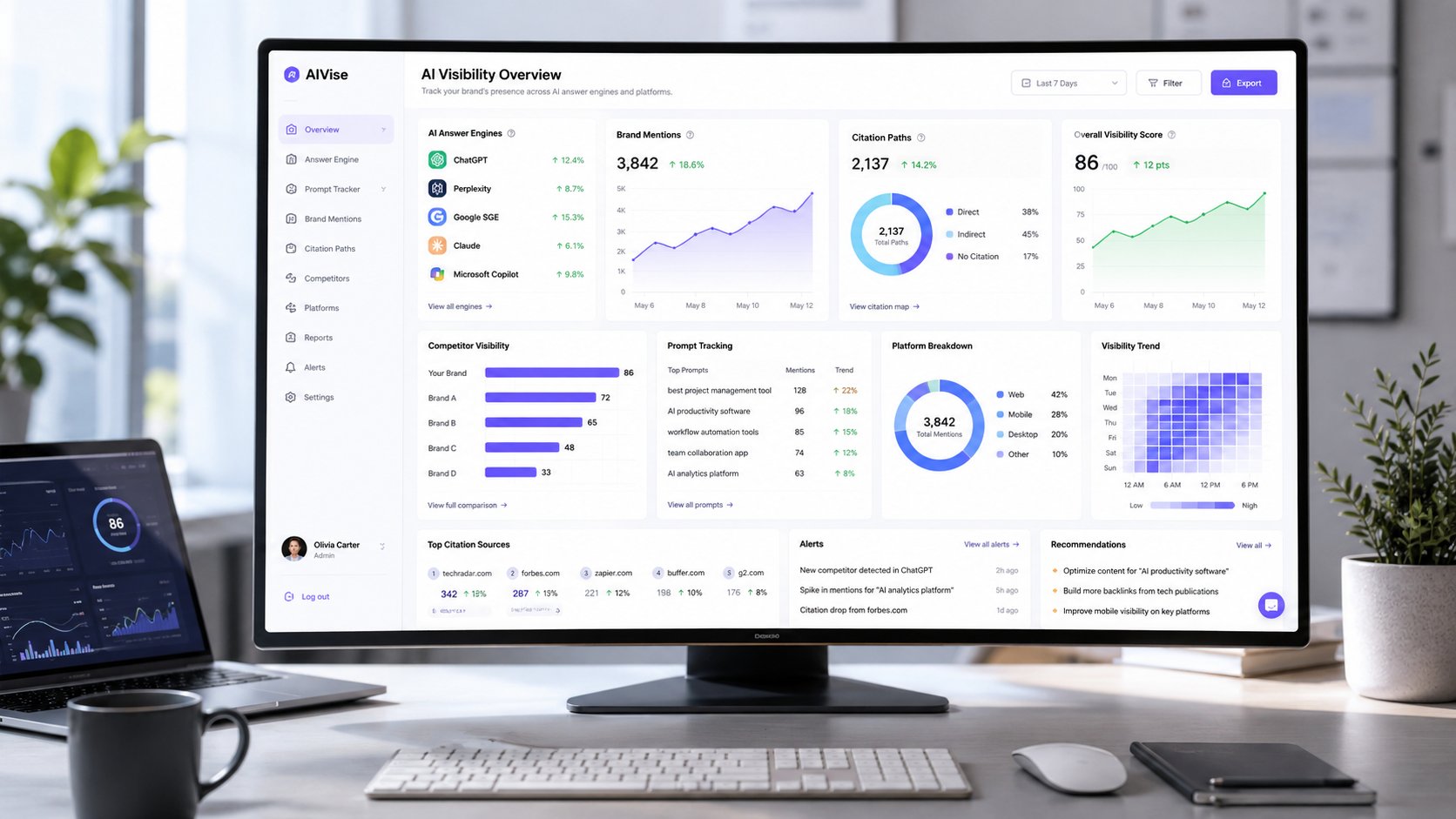
AI visibility trackers | Llumo, AIclicks, Profound, Otterly | Prompt-level share of voice and citation logs | Narrower view of classic ranking history |
Rank trackers | SE Ranking | Ranking history for fixed keyword sets | Blind to what AI answers say |
Manual review sheet | Your own spreadsheet | Intent, unique claims and page structure | Does not scale past a few dozen pages |
The case for tracking cited sources rather than rank alone is blunt. An independent audit of 55,393 searches over 40 days, recording 61,212 citations, found that 29.8% of cited domains didn't appear on the traditional first results page, according to Washington University in St. Louis research on AI Overview citations and claims. A competitor you can't see in the top ten can still be shaping the answer your buyer reads first.

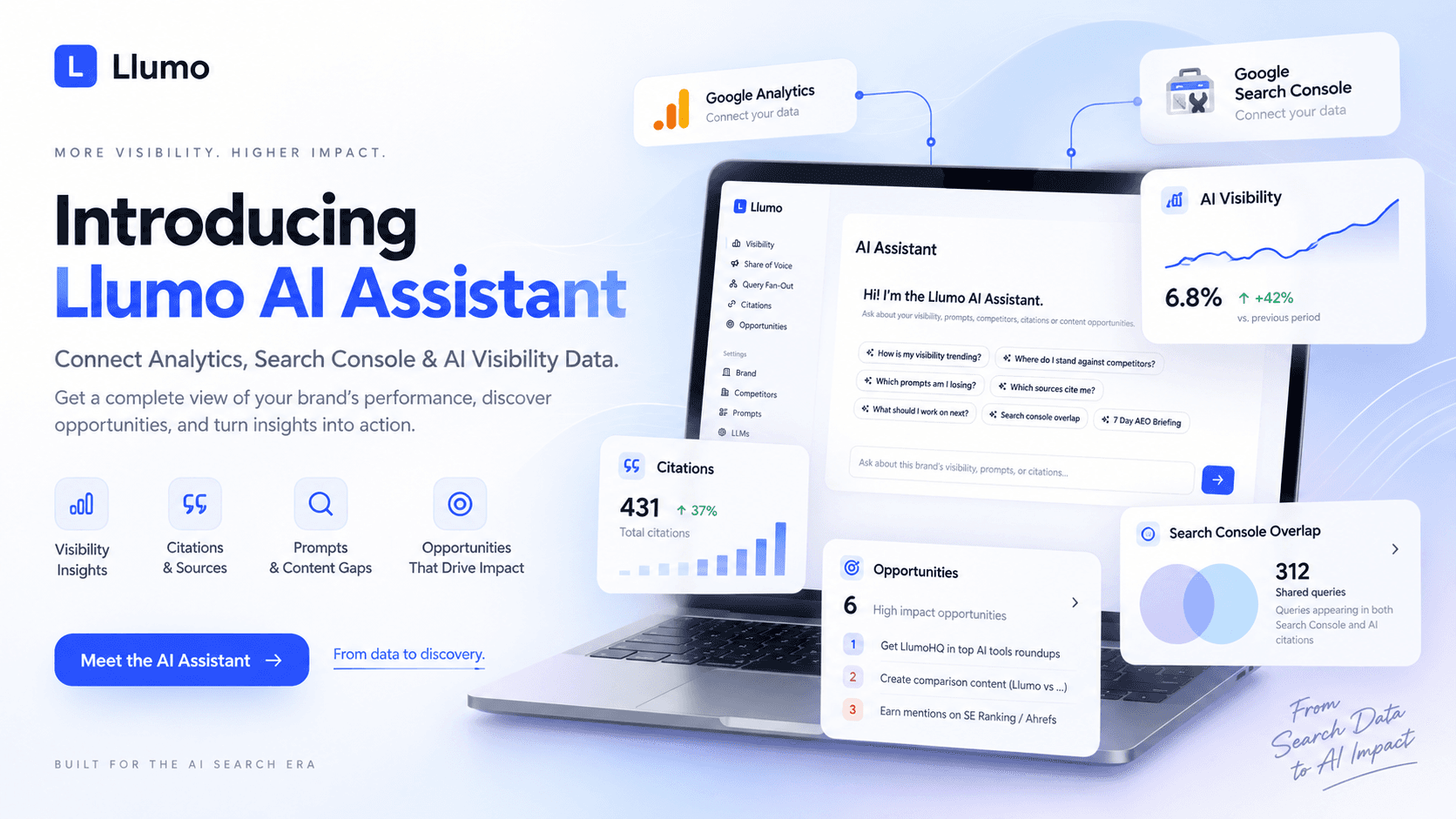
That's the slot Llumo fills in this stack: per-prompt visibility, share of voice against a defined competitor set and citation analysis across models, while keyword and backlink history still come from the SEO suites. Each category earns its line in the budget by covering what the others miss.
The cadence that keeps it honest
Weekly prompt checks. Run the same 30 to 50 questions, log who's named, which URLs are cited, and whether an overview appeared. Fifteen minutes, archived with a date.
Monthly gap review. Score the clusters, pick the one or two pages to build or upgrade, and note what changed since the last run.
Quarterly competitor-set review. Promote a challenger into the core set, retire a rival that's stopped appearing, and re-baseline share of voice so the history stays comparable.
The routine matters more than the subscription tier. A cheap tracker run every week beats an enterprise seat nobody logs into.
How to Run a Competitor Gap Analysis
Six steps per query cluster, repeated, not once.
A gap analysis isn't an audit you commission. It's a procedure you run once per query cluster, on a schedule, and the output is a prioritised list of pages and link relationships. Google's ranking systems evaluate hundreds of billions of pages using multiple signals, including how pages link to one another and whether content is helpful, original and trustworthy, as the Google ranking systems guide explains. That's why a rival's advantage usually sits in their topical graph, internal linking or evidence of expertise rather than in keyword repetition.

Six steps, in order
Build a competitor-by-query matrix. For every query in the cluster, record the ranking URL, search intent, page type, title and heading structure, unique claims, authorship signals, internal-link targets, external references and update history. The structure is what reveals the pattern; a list of keywords reveals nothing.
Run each cluster through both layers. Search results first, then the same questions in ChatGPT, Gemini, Perplexity and Google AI Overviews. Note which rival gets cited in the answer even when they aren't near the top of the results, because that split is the most common blind spot.
Classify every gap into one of three types. A coverage gap is a subtopic a rival answers and you don't. A quality gap is a topic you cover but less specifically. An authority gap is a topic where rivals attract references and links you haven't earned. The classification decides the fix, so don't skip it.
Score by repeat appearance and existing strength. Weight gaps where a competitor's URL shows up across several related queries, and where you already have relevant authority to build on. A gap you can close in a month outranks a bigger gap you'd need two quarters and a PR budget to touch.
Check policy risk before matching anyone. Google's rule on scaled content abuse in its spam policies covers mass-produced pages, scraped material, lightly transformed content and keyword-stitched text, whether a human or a model wrote it. A rival publishing forty pages a month isn't a benchmark, it's a risk profile.
Convert the top scores into three lists. Pages to build, pages to upgrade, and links to pursue. For the third list, reverse-engineering a competitor's backlink and citation profile is faster than guessing which sources matter.
One worked example
A rival's pricing comparison page walks through three plan tiers with worked figures, overage costs and a break-even calculation. Yours lists features in a table and calls it a comparison. That's a quality gap, not a coverage gap, and the fix is original numbers and a real calculation, not another 800 words of feature description. Adding length to a page that lacks substance just makes a longer page that lacks substance.
The deliverable is a ranked list of pages to build, pages to upgrade and sources to pursue. If your gap analysis ends with "publish more content", it didn't produce an analysis, it produced a quota.
Reading Trends Without Fooling Yourself
One snapshot is a forecast. A season of readings is a measurement.
One month of AI answers is a single day's weather forecast. It tells you what today looked like on the surface you checked, on the device you checked it from, with the prompt wording you happened to use. Trends need a season of readings, and the coverage itself moves enough to embarrass anyone who published a chart in June.
Semrush reported AI Overview coverage growing from 6.5% of queries in January to nearly 25% in July, then falling below 16% by November, as Search Engine Land's reporting on the AI Overview surge and pullback sets out. A competitor who looked untouchable in one month can look ordinary a few months later without editing a single page.

The click side moves with the surface, not with your content. An Ahrefs analysis of 300,000 keywords found a 34.5% lower average CTR for the top-ranking page when an Overview was present, as Communications of the ACM's report on answer engines redefining search notes. Nothing about that page changed. The page above it did.
The questions the tools don't answer
How many repeat observations make a lead credible? Three runs across separate days before you call it a trend, and never one run in a client deck.
Should branded and non-branded prompts be split? Always. Branded prompts mostly measure your own demand; non-branded prompts measure the market you're trying to enter.
How do you compare a model that cites sources with one that doesn't? You compare presence and prominence separately from citation, because an uncited recommendation from a model can still drive consideration while giving you nothing to audit.
What to build instead
Fix the prompt corpus and stop editing it mid-quarter. Keep dated archives of every response so a claim about April can be checked in June. Segment by market and device, because localization, language, personalization and model updates all shift results without a single change on your site. Then set change-point alerts rather than watching a single composite visibility score drift upward and assuming it means something.
A jump in visibility is not proof of stronger content until it survives repeat tests on the same prompts. Report the observed figure next to your measurement uncertainty and let the reader see both.
Confirm Your First Competitor Review
Four weeks, one gap, one baseline.
You don't need a new platform to start. You need a decision you can keep for a month.
Commit to five to eight core competitors and a watch list of three, using the tier table as a checklist rather than a starting point for debate. Fix your 30 to 50 buyer questions and don't touch the wording. Then record a baseline across all three layers on the same day: rankings and clicks from Search Console, and AI citations and mentions per prompt.
Repeat on a schedule for four weeks. Same prompts, same markets, same devices. Fewer than four readings and you're describing a snapshot, not a position.
Pick the single highest-scoring gap. Coverage, quality or authority, one of them, closed properly, beats five started.
Measure against the baseline, not last week. Last week is noise. The baseline is the only number that can tell you whether the work moved anything.
If your prompts span ChatGPT, Gemini, Perplexity and Google AI Overviews, choose a tracker that keeps dated archives and per-prompt share of voice so the comparison survives a model update mid-quarter. The habit to drop is the one practically every team brings to this work: judging a competitor on a single snapshot and rewriting the strategy around it.
Llumo measures how AI answer engines mention and cite your brand across ChatGPT, Gemini, Perplexity, Copilot and Google AI Overviews, with per-prompt visibility, share of voice against your defined competitor set, citation sources and trend lines over time. It's built for the monthly routine this article describes, so you can run the same prompts on a schedule and see which rivals are gaining answer share and which sources are propping them up. Start with a fixed prompt list and a baseline at Llumo, and let four weeks of readings replace the screenshot in Slack.