Ask digital marketers how a page performed last month and you'll get two numbers back, a ranking and a click-through rate. Neither tells you much anymore. In a Pew Research Center analysis of browsing data from more than 900 U.S. adults collected in March 2025, people who saw a Google AI summary clicked a traditional search result on only 8% of visits, against 15% when no summary appeared.
The summary itself isn't a rescue either. A link inside the AI summary drew a click in just 1% of visits. The prize on offer is not the blue link any more. It's the sentence the model chooses to quote, and the attribution next to it.
That changes the order of operations. Teams hear "AI visibility" and immediately rewrite their best pages with answer-first blocks. It's the wrong first move, and it's expensive. You can't tell whether you have a writing problem or a retrieval problem until you've logged what the engines say when nobody is watching. So the workflow below starts with diagnosis, then moves to editing, then to earning citations you can't write yourself. And it ends with the check most AEO advice skips entirely: whether a visibility win cost you clicks.
The AEO Workflow at a Glance
Five stages, run as a loop rather than a launch.
Answer engine optimization is the work of getting your brand named, quoted and linked inside the synthesized answers that ChatGPT, Perplexity, Gemini and Google's AI features hand to users. The vocabulary is new. The dependency underneath it isn't. If a page can't be crawled, indexed and trusted, no amount of restructuring will put it in front of a model.
The behavioral evidence says answers close loops. 58% of the adults in Pew's study ran at least one Google search that produced an AI summary, and they ended their browsing session on 26% of AI-summary pages against 16% of pages holding only traditional results (Pew Research Center). People get what they came for and leave. Your measurement has to account for that instead of treating every non-click as a loss.

Here are the stages, in the order I'd run them:
Build the prompt set. 40 to 60 buyer questions per market, tagged by intent.
Run a baseline and diagnose. Every prompt, every engine, logged.
Rewrite the pages that should be cited. Only the ones the diagnosis points at.
Earn citations on the sources engines already use. Off-site work, slow payoff.
Measure with the same prompts. Same wording, same engines, every cycle.
Stage | What you do | What it produces | How often |
|---|---|---|---|
Prompt set | Collect 40-60 buyer questions per market and tag them | Tagged prompt list | Refresh each quarter |
Baseline and diagnosis | Run every prompt on each engine and log mentions and citations | Visibility baseline and gap list | Monthly |
Page rewrites | Fix the pages that should be cited, starting with the biggest gaps | Revised pages with dated sources | Per sprint |
Citation building | Earn placements on the sources engines already cite | Outreach list and placed mentions | Ongoing |
Measurement | Rerun the same prompts and compare with the last cycle | Trend report with clicks and share of voice | Monthly |
Treat this as a loop, not a project with an end date. Engines change their retrieval, competitors publish, and your own product pages go stale. The teams that get cited consistently are the ones that rerun the same list on a schedule and read the diff.
Two things need to exist before you edit a single paragraph: a tagged prompt list and a baseline run. Skip the baseline and every change afterward looks like progress, because you've got nothing to compare it to. A 30% lift that lands the same week a model update rolls out tells you nothing about your own work, and without a frozen list you can't tell the two apart.
Building a Prompt List Buyers Actually Type
A list you can't rerun isn't a measurement, it's an anecdote.
Start where buyers already talk to you. Pull sales call notes, support tickets, the queries sitting in Search Console, and the People Also Ask boxes around your topic. Aim for 100 to 150 raw questions before you filter anything, because you'll cut more than half of them.
1. Collect from real conversations first. Support tickets beat keyword tools here. A question a customer paid to ask is worth more than a volume estimate.
2. Rewrite each one as a full question. AI prompts run longer and more conversational than keywords. "aeo tools" becomes "what tool do agencies use to track whether ChatGPT mentions their clients?" Keep the phrasing slightly messy, the way people type.
3. Tag every prompt by intent. Information, commercial, comparison, branded. You'll use those tags to read results separately later.
4. Cut to 40 to 60 per market. Keep roughly a third commercial or comparison, because that's where the purchase decision happens and where most visibility gaps hide.
5. Freeze the wording. Never edit a prompt between runs. A reworded prompt makes the trend line meaningless, and you'll never know whether the movement came from your work or your edit.
Informational prompts deserve as much weight as buying prompts. Statista's survey work found that 44% of surveyed U.S. adults had used AI-powered search engines to learn or explain concepts, while 37% used them for recommendations (Statista). Concept questions and recommendation questions, not just "best vendor" queries.
What the four classes look like in practice
Say you sell commercial coffee equipment. An informational prompt reads "how often should a cafe descale a two-group espresso machine." A commercial one reads "what does a two-group machine cost for a small cafe with 80 covers a day." A comparison prompt asks "La Marzocco Linea Mini vs Rocket R58 for a busy weekend brunch." A branded prompt is "does Northwind's service plan cover parts and labour in year two."
That branded one is where stale information surfaces first. Old pricing, a discontinued feature, an outdated case study. Nobody inside your company notices, because nobody inside your company asks a model about you.
Practical rule: if a prompt can't be rerun verbatim in three months and still mean the same thing, it doesn't belong on the list.
Building the list properly takes a couple of days and saves you weeks later. The prompt set guide walks through the tagging structure that holds up over time.
Diagnosing Whether Retrieval or Wording Is the Problem
A low citation rate is usually not a copy problem.
Most AEO advice jumps straight to copy edits: add statistics, quotations, citations, FAQ sections, concise answer blocks. Those edits do work, but the effect is conditional. They lift visibility mainly on pages the engine already retrieves and weighs as candidate sources. A page the engine never pulls into its context gets nothing from better wording, because the model never reads it in the first place.
Diagnose first. Rewrite second. Split the failure into three stages before you touch the copy:
Retrieval eligibility. Can the engine find and trust the page at all? Crawlability, indexation, authority, entity clarity, topical relevance.
Source selection. The engine found you and picked someone else. That is a competition problem, and rewriting the same article a third time will not close it.
Answer composition. The page was used, but your brand or your key passage got left out.
The stage determines the spend. Retrieval problems need technical work. Selection problems usually need digital PR, sharper first-party signals about who you are, or coverage of a subtopic you have ignored. Only composition problems are copy problems, and they are the cheapest of the three to fix.
Log the baseline before you diagnose anything
Run every prompt once on each engine. For each row, record whether your brand appears, roughly where in the answer, every cited URL, and the query expansions the engine used. Save the raw answers as well as the scores. When a number looks strange six weeks later, the raw text is the only way to find out why. One spreadsheet row per prompt per engine, with a date column.
Add two more columns to that sheet: clicks and conversions for the page each prompt maps to. A citation win on a prompt that sends no traffic looks like progress and behaves like a cost. Pairing visibility data with outcome data is what keeps a real traffic loss from hiding behind a flattering citation count.
Then tag each missing or outranked row with one of the three stages.
What you see in the data | Likely stage | First move |
|---|---|---|
Your URL never appears among cited sources | Retrieval eligibility | Check indexing and crawl blocks before touching the copy |
Competitor pages are cited and yours are not, on the same prompt | Source selection | Compare authority, third-party mentions and subtopic coverage |
Your page is cited but your brand is never named | Answer composition | Name the brand and product in the first answer passage |
Your brand is mentioned but never linked | Source selection | Publish citable first-party data and earn third-party references |
One engine shows a jump and the others do not | Model variation | Rerun on every engine before calling it a win |
What I'd do first: count how many prompts cite any of your URLs. If that number is near zero, stop editing. You have an eligibility or selection problem wearing a content costume.
Rewriting Pages So Answer Engines Can Lift Your Answer
Once retrieval works, make the passage quotable.
Rewrite only the pages the diagnosis points at, and only after the URL can be retrieved. A citation usually dies in answer composition when the claim is buried, unattributed or padded with language the model cannot lift cleanly. Work through this checklist in order. The first four items do most of the work.

1. Put a direct answer under every question heading. 40 to 60 words, complete on its own. If the model lifts only that block, it should still read as a full answer.
2. Replace vague claims with numbers that carry a source and a date. A model can only attribute a claim it can trace.
3. Add evidence nobody else has. Your own test results, customer data, a screenshot of a workflow, a benchmark you ran. This is the part competitors can't copy, and it's what makes a citation worth making.
4. Show the author, their role and the last updated date near the top of the page. Attribution is a trust signal for both readers and retrieval systems.
5. Strip the keyword padding. Repetition that reads like filler makes a passage harder to quote cleanly.
6. Add schema last, and only where it describes what's visible. Markup clarifies entities and relationships. It can't compensate for thin information.
What the benchmark data actually says
A 10,000-query comparison found that quotations, statistics and citations produced roughly 25 to 40 percent visibility improvements, while keyword stuffing reduced performance in the same controlled setup (arXiv benchmark). Encouraging, if you've already earned the retrieval.
The same body of work is less kind to decoration. Google's documentation makes the boundary clear: there is no special schema.org format required for eligibility in AI Overviews, and the three supported implementation formats, JSON-LD, Microdata and RDFa, must accurately represent visible page content (Google Search Central). Treat structured data as confirmation of what the page already says, not a shortcut around weak copy.
Here's the rewrite pattern that matters, in plain terms.
Before: "Our platform is trusted by leading teams across the industry."
After: "We track 40 prompts per client across five engines, and every run logs the cited URLs so you can see which sources displaced yours."
Same product, but now there's a checkable claim with an owner attached.
Test one page per prompt cluster before rolling anything across the site. Judge the rewrite on prompt-level visibility, click quality and conversion behavior together, because a cited answer that lowers click-through or attracts the wrong visitor is not a win. If rankings hold while engagement falls, keep the answer block and tighten the surrounding copy rather than expanding the rollout.
Earning Citations From Sources AI Engines Already Trust
Most of your citations will come from pages you don't own.
Start with the URLs your baseline already logged. Group them by domain and keep only the domains that show up on three or more prompts. Those are the sources the engines lean on for your category, and they're your target list. Everything else is noise.
The domains usually fall into a handful of groups, and each one has a different door.

Source group | Route in | First move this week |
|---|---|---|
Review and comparison sites | Get customers to write specific reviews | Ask five recent customers for a review that names a use case and a result |
Industry publications | Pitch original data to a category writer | Offer a small dataset from your tracked prompts |
Community Q&A threads | Answer with specific first-hand experience | Reply to one open thread with a concrete example |
Directories and partner case studies | Keep listings accurate and co-write a case study | Update one listing and draft one partner story |
Original research pages others quote | Publish one citable data study a quarter | Pick one question from your prompt set to study |
The publication pitch is the one people get wrong. "Would you like a comment on AI search?" gets deleted. "I ran 60 buyer questions through five engines and the brand named most often in the category was yours, here's the table" gets a reply. You're handing a writer a story, not asking for one.
Community threads need a different discipline. Answer the actual question with something you learned doing the work, then leave. Drive-by links get removed and they make the next attempt harder.
Off-site work pays slowly. Judge it across two or three measurement cycles, not one, and check which domains gained or lost references between runs so you can tell whether the push did anything. Comparing the new and lost citation domains is the fastest way to see where a gap came from, and the guide to reading the citations behind an AI answer shows how to read that delta properly.
Measuring AI Visibility Without Fooling Yourself
A gain in mentions can hide a loss in traffic.
The trade-off most reports bury: summaries are now a normal part of the results page, so a brand can be named more often while fewer visits reach the site. Read visibility next to clicks and conversions from the cited pages, or a clean win can cover a real loss.
Before any rewrite, classify each gap as retrieval, wording, or downstream. Retrieval gaps need eligibility and source coverage. Wording gaps need a passage an engine can quote cleanly. Downstream gaps need landing-page work even when the answer looks strong.
Six metrics, tracked together, tell you whether AEO is working.
Metric | What it tells you | Read it as a win when |
|---|---|---|
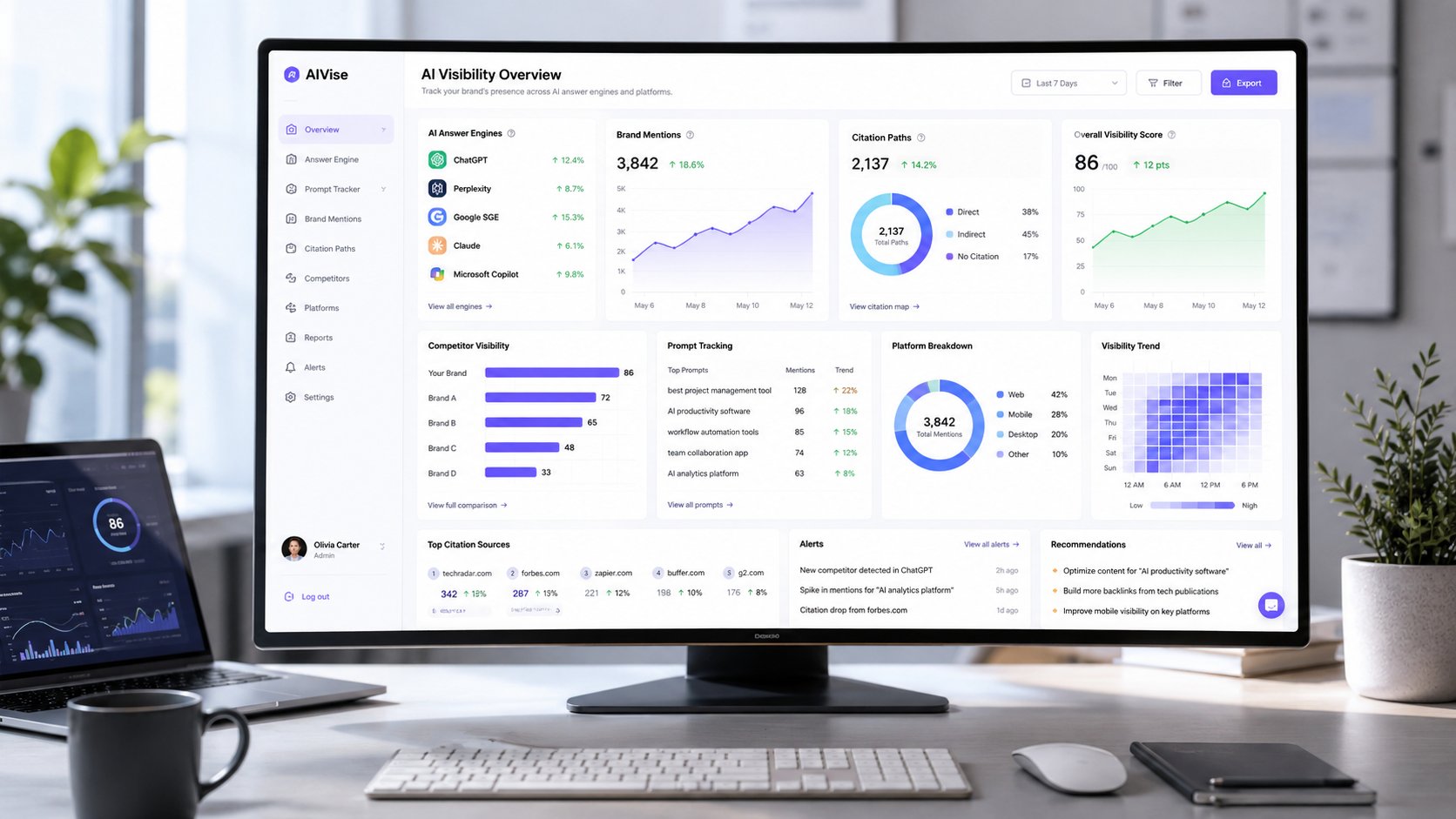
Mention rate | Share of tracked prompts where your brand is named | Rising month over month on the same prompts |
Citation count | Number of prompts that link to your domain | New citations appear and few are lost |
Share of voice | Your mentions against the defined competitor set | Holding or rising while competitors fall |
Citation position | Where your link sits inside the answer | High in the main answer block |
Answer accuracy | Whether the answer about your brand is correct and current | No outdated pricing, features or claims |
Qualified sessions | Visits from AI-cited pages that engage | Rising, with conversions steady or up |
The combinations matter more than any single line. A rising mention rate with a flat citation count means engines name you without sending a link, useful exposure with limited traffic value. Falling share of voice while mentions hold steady means a competitor is taking the citation slots you used to own. Strong placement with weak qualified sessions usually points to the page after the answer, so check accuracy first, then the next step you expect a visitor to take.
Budget the runs before the first cycle
AI API usage is billed per token, split across input, cached input and output, and web search adds a per-call charge. One published schedule lists web search at $10 per 1,000 calls, with retrieved content billed at the selected model's input rate (OpenAI pricing). Sixty prompts across five engines every month is a real line item, and cost follows retrieved context and output length more than the number of rows in the prompt sheet.
Set the monthly budget before the first run, then hold the measurement frame steady long enough to compare cycles. The shortlist of AI visibility metrics worth reporting covers which of the six survive scrutiny.
Run Your First Monthly Review Cycle
One hour, one decision per prompt class.
The loop only works if it happens, so make it small and run it on the same day every month.
Freeze the list. Same prompts, same engines, no exceptions.
Compare prompt by prompt. Overall averages hide the swings that matter.
Not retrieved at all? Fix eligibility or source gaps before anything else.
Retrieved but not cited? Rewrite the passage that should be quoted, and only that passage.
Cited but clicks or conversions falling? Check answer accuracy first, then the next step on your landing page.
Log every change with its date. Next month, that log is how you separate cause from noise.
Then pick one action for this week. Take the prompt class with the biggest gap, ship one change against it, and leave the rest for next month. Writing six changes at once guarantees you learn nothing.
Keep it under an hour. A review that runs long stops running by month three, and the trend line dies with it.
Share a one-page summary with the sales and content leads so the gaps get owners instead of just readers. The first clean baseline is the asset everything else depends on, so protect it and don't let anyone "improve" the prompt wording halfway through.
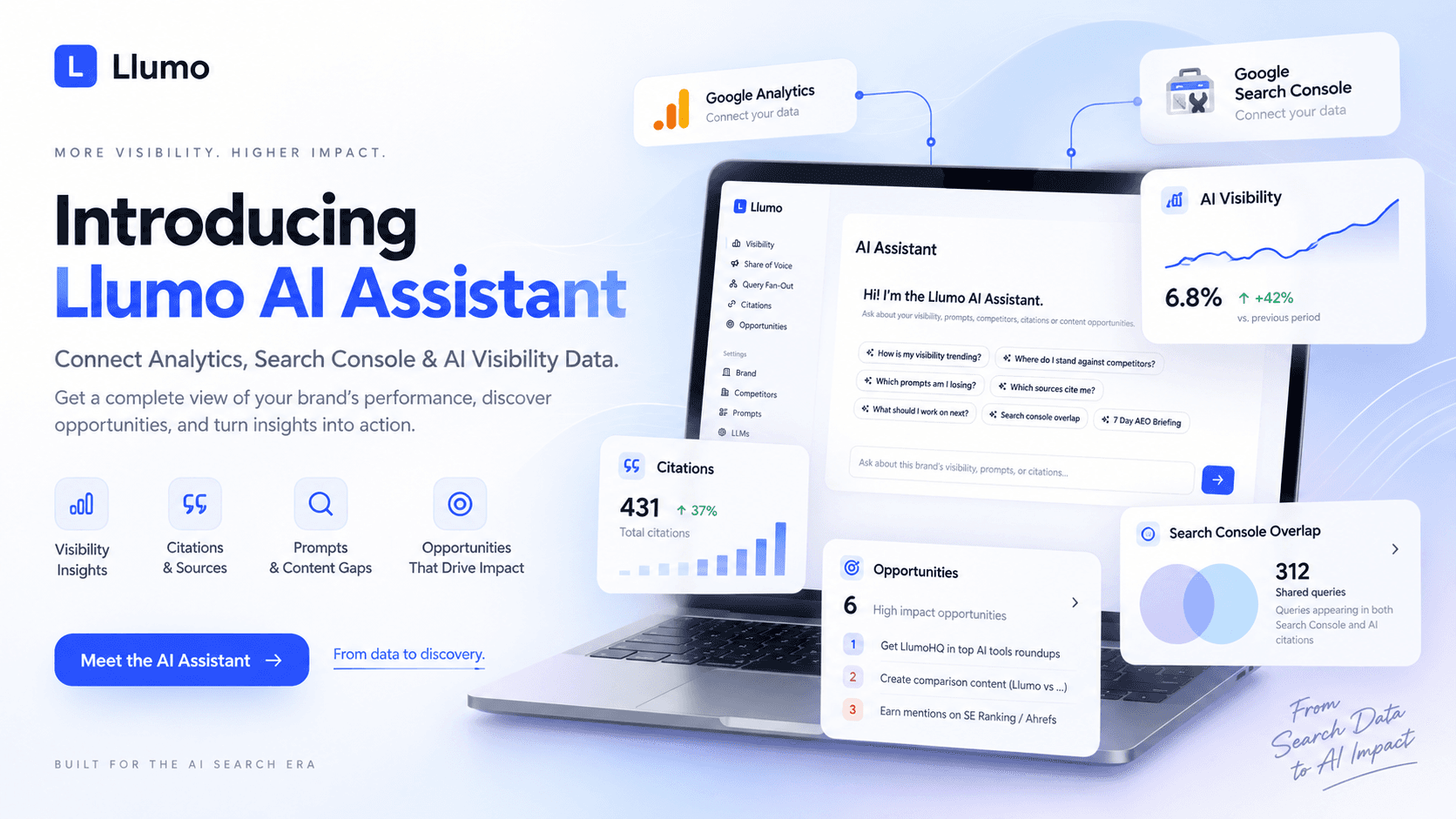
Running this loop by hand across five engines gets old fast, which is where Llumo comes in: it tracks per-prompt mentions, citations, share of voice and competitor movement across ChatGPT, Gemini, Perplexity, Copilot and Google AI Overviews, with your own provider keys so you pay model costs directly instead of a usage markup. Build one tagged prompt set, run the baseline once, and you'll have a trend line worth reading by the second cycle. That's the difference between guessing at AI visibility and being able to prove what changed.