Google's own users are voting with their mice. When an AI summary appeared on a results page, users clicked a traditional result on 8% of visits, against 15% when no summary appeared, and clicks on links inside those summaries happened on just 1% of visits, according to Pew Research Center's analysis of Google browsing behavior. That's a 47% relative reduction in the likelihood of a click, in one measurement, on the world's largest search engine.
Sit with the second number for a moment. Being named inside the summary produced a click on roughly one visit in a hundred, and yet that naming is now the thing many buyers see before they ever reach a website. Your monthly report doesn't capture it. Your rank tracker doesn't either.
The AI SEO vs traditional SEO question isn't really a cage match. It's a resource allocation problem: which pages deserve a ranking push, which deserve a rewrite so a model can quote them, and how you'd tell the difference.
Why Ranking Alone No Longer Tells the Whole Story
Across 3,119 queries and 42 organizations, organic click-through rates fell 61% on searches that displayed Google AI Overviews, measured from June 2024 through September 2025, per Seer Interactive's research. The absolute numbers are easier to plan against than the percentage: CTR on AI Overview queries slid from 1.76% to 0.61% across 25.1 million organic impressions, as PPC Land's write-up of Seer's comparison reports. A 1.15 percentage point drop looks modest until you multiply it by a year of impressions.
If your reporting stops at average position and organic sessions, you're describing a channel your buyer may have skipped. A page can hold position three and never appear in the summary sitting above it. The ranking report stays green while the buyer reads a competitor's name in the answer.
The uncomfortable part: nothing on a standard ranking dashboard shows the moment your buyer formed an opinion without visiting you.
Traditional SEO aims to earn a position on a results page and a click from it. AI SEO, also called answer engine optimization or generative engine optimization, aims to be selected, summarized and cited inside answers from ChatGPT, Gemini, Perplexity, Copilot and Google AI Overviews, often with no visit at all. The two share one foundation, because answer engines assemble responses from pages that search engines already crawl and index. Neglect crawlability, internal linking or a useful page and you lose both channels in the same week.
Start with the side-by-side view. Then the signals that decide each channel, the tactics worth running first, the metrics that make progress visible, guidance by site situation, and a five-step plan that runs both without doubling the workload.
AI SEO and Traditional SEO Side by Side
Criterion | Traditional SEO | AI SEO |
|---|---|---|
Primary goal | Earn a higher position and a click | Earn inclusion and a citation inside the answer |
Unit of success | Ranking position, impressions, CTR | Prompt-level mention, citation, share of voice |
Core ranking signal | Relevance, links, page authority | Extractable answer passages, source authority, entity clarity |
Content that tends to win | Pages targeting a query cluster | Passages that answer multi-part questions directly, with original evidence |
Technical base | Crawlable, indexable, fast pages | Same base, plus structured data that matches visible content |
Where results appear | Ranked blue links | Synthesized answers with a handful of cited sources |
Measurement tools | Rank trackers, Search Console clicks | Prompt tracking, citation logs, cited-URL change monitoring |
Traffic pattern | Click-led sessions | Often zero-click, value shows in mentions and branded search |
Reporting cadence | Monthly ranking and traffic reports | Repeated runs on a fixed prompt set, tracked over time |
Two rows overlap, and they matter more than the rest of the table suggests. The technical base is identical: a page that can't be crawled can't be cited, and structured data that contradicts the visible copy hurts you in both channels. The content standard overlaps too, because both systems reward a page that answers the question a person typed.
The widest gaps sit in two rows. Unit of success changes what you count as a win, and traffic pattern changes what you can prove to a finance team. Every budget argument in the rest of this article comes back to those two.
If you only have a minute, read the unit of success row first. Everything else follows from it. A team that still counts one success unit will keep funding one channel, no matter what the answer engines do.
What Earns a Ranking Versus What Earns a Citation
A ranking rewards a page. A citation rewards a passage.
Ranking systems weigh a page's overall relevance, link equity and usefulness across a query. An answer engine does something narrower and less forgiving: it retrieves candidate pages, lifts a handful of sentences, and attributes them. The page can be excellent and the paragraph still unusable.

Three pages, three different fates
Take a pricing comparison page. It ranks for "tool A vs tool B" and earns a steady trickle of clicks. For a citation, the model needs the verdict in one liftable block: a named pairing, a clear recommendation, and the numbers behind it. A page that spends 600 words on context before the first conclusion gets retrieved and passed over.
Take a glossary entry. It ranks well for a definition and gets cited often, because the definition sits in the first sentence and the entity name repeats consistently across the site. That page rarely converts, which is fine. It's doing reputation work.
Take a how-to guide. It ranks, it earns links, and it gets summarized into oblivion, because every step is generic. There's nothing in it a model can't reconstruct from ten other pages.
The signals that seem to help a passage get lifted
A direct answer in the first two sentences under the heading, before any setup.
Named sources with visible dates, so a model can attribute and date-stamp a claim.
Consistent entity naming for your brand and products, matching what's on your profiles, docs and press pages.
Original numbers from your own tests, surveys or customer data, which competitors can't replicate.
Headings phrased the way buyers ask, including the comparison and pricing questions they type before shortlisting.
Citations are useful, but they aren't automatically trustworthy. Stanford researchers examined 1,450 queries across four generative search engines and reported that about 50% of generated statements had no supporting citation, and that only about 75% of the citations that were provided supported the statement they accompanied, per the Stanford HAI analysis of generative search trustworthiness. Being cited isn't being endorsed. A brand can appear in an answer while the cited page is only loosely related, which is why any serious audit records the exact response, the cited URL, the claim it supposedly supports, and whether the two match.
The distinction that matters: a ranking measures a page's average relevance across a query, while a citation measures how quotable one paragraph is for one question.
Format explains a lot of the divergence. A study of 10 websites and roughly 150,000 indexed pages found that trend and analysis content earned AI citations 78% of the time, against 12% for standard how-to guides, as Press Gazette's report on the Authoritas findings details. Before you rewrite a page, check what format it's in. If it's a step-by-step explainer, you may be polishing a page that will never be the source. If you want the mechanics of passage-level rewriting, this walkthrough on how to get cited by AI covers the structural work.
Tactics That Carry Over and Tactics That Are New
The foundation is shared. Google states that AI Overviews and AI Mode use the same core Search systems, with retrieval-augmented generation selecting relevant pages from Google's index and then generating an answer with prominent links to supporting sources, and that there are no additional technical requirements or special optimizations for appearing in these features, per Google's AI optimization guide. Pages still need to be crawlable, indexable, reachable through internal links, useful to people, and supported by structured data that matches the visible content.
That last clause earns its own paragraph. Structured data that describes something the page doesn't show is worse than no markup, because it teaches a retrieval system to distrust the page.
Publishing volume isn't a strategy either. Google doesn't ban generative AI content as such, and the Google Search spam policies target scaled content abuse: large volumes of unoriginal, low-value pages produced mainly to manipulate rankings, whether automation, humans or a mix made them. Google expanded that policy in March 2024. Editorial review, first-hand evidence and a named author matter more than ten extra posts a month.

What's genuinely new
Lead each section with the answer. State the conclusion, then the reasoning. A reader skimming gets the same value a model does.
Mirror buyer phrasing in headings. "What does X cost for a 10-person team" beats "Pricing considerations" every time.
Put something attributable on the page. A test result, a benchmark, a customer-data cut with the method stated in one line.
Keep brand and product names identical everywhere. One spelling in docs, one in schema, one in the boilerplate. Models resolve entities by repetition and consistency.
Earn mentions on sources models already cite. A named reference in a relevant roundup or industry report does more for citation odds than a fifth internal link.
The order to do it in
Fix the shared base first. Then pick the pages that already rank on page one and rewrite their key passages for citation, because that's where you have both authority and a gap. New pages come third, and only where prompt data shows a question nobody answers well.
Your first week looks like this: export the URLs that lost the most clicks, check which of them carry a direct answer in their opening two sentences, fix the ten worst offenders, and log the exact questions you expect each one to be cited for. That list becomes your baseline.
A team that wants both halves handled under one brief can pair the technical audit with managed SEO services instead of splitting the work between two vendors.
Measuring Visibility Beyond Rankings and Clicks
Metric | What It Tells You | Channel |
|---|---|---|
Organic position and impressions | Where the page appears and how often it is shown | Traditional SEO |
Organic CTR | Share of impressions that become a click | Traditional SEO |
Organic sessions and conversions | Visits and outcomes from search clicks | Traditional SEO |
Prompt visibility rate | Share of tracked prompts where the brand appears in the answer | AI SEO |
Citation rate per prompt | How often the brand's own page is cited for a given question | AI SEO |
Share of voice | Brand mentions compared with a defined competitor set | AI SEO |
Cited domains and pages | Which sources gained or lost citations over time | AI SEO |
Claim-source match rate | Whether the cited passage actually supports the statement | AI SEO |
Branded search change | Whether searches for the brand name rise after AI visibility gains | Both |
The controls that keep the numbers honest
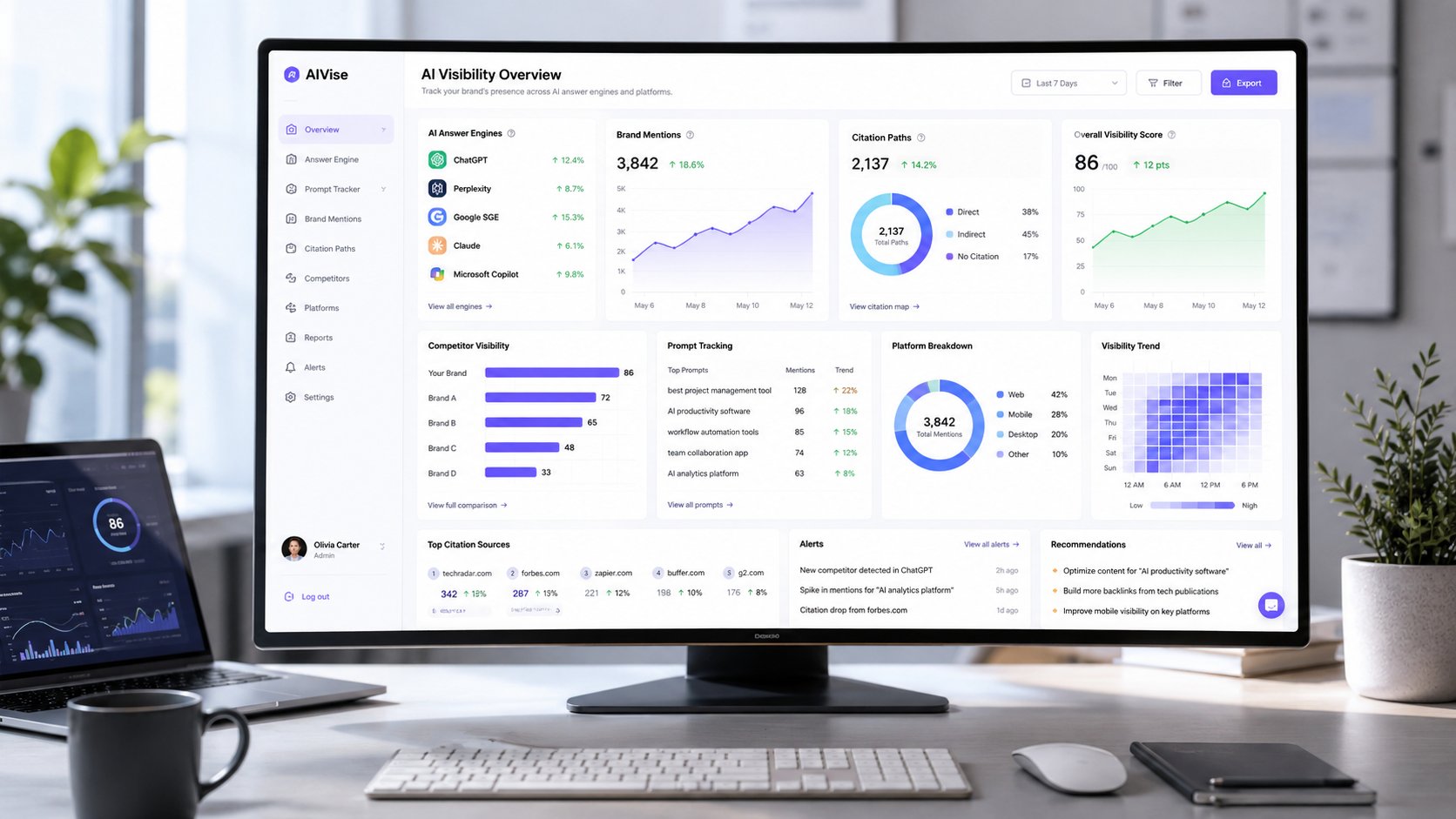
Build a fixed prompt set, run it repeatedly, and segment by model, market and intent. Informational, commercial and navigational prompts behave differently enough that a blended average hides the signal you need. Without those controls, a model update or an index refresh looks like a change in your performance, and you'll rewrite the wrong page in response.
Experiment design matters here. The GEO-bench study, published in the ACM proceedings on generative engine optimization, reported visibility gains of up to 40% from optimization interventions, and its authors are explicit that benchmarking needs fixed prompt sets, repeated runs and longitudinal measurement to separate real movement from model and query variation. That's the discipline to copy.
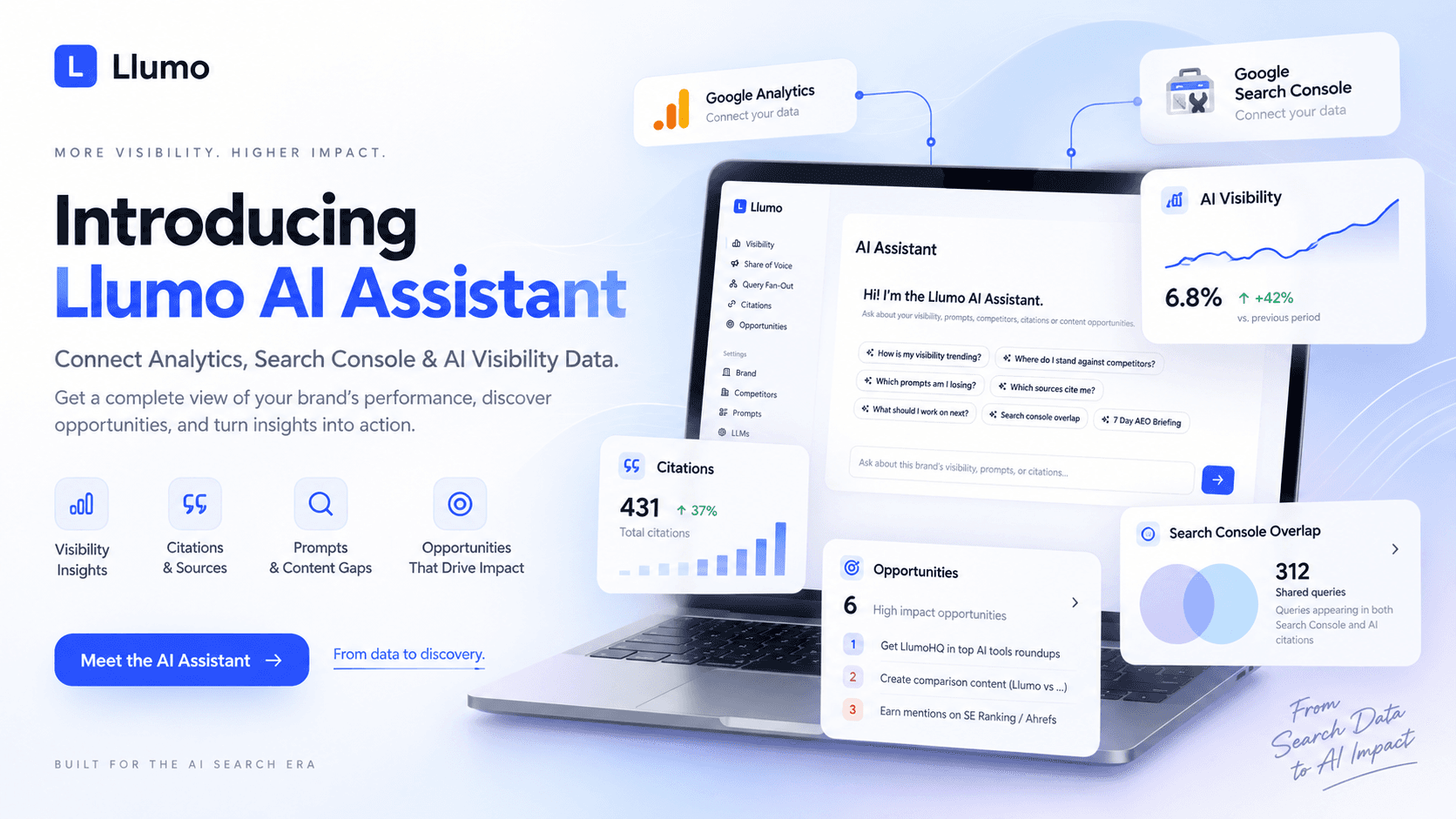
Platforms built for this, Llumo among them, automate prompt runs and citation logs so the manual part of this loop shrinks to reading the results.
What a mention with no click is worth
Clicks tell an incomplete story. Publisher click-through rates fell 47.5% on desktop and 37.7% on mobile when Google AI Overviews appeared, in a study of UK news queries collected in April 2025 summarized by Scale Theory's comparison of AI SEO and traditional SEO, yet AI referral traffic remains small enough in several datasets to be dismissed. The Authoritas analysis of ten websites puts the divergence plainly: the top 10 organic pages generated 55% of organic sessions but only 29% of AI-referred sessions, and nearly half the top 100 organic pages saw no AI referral traffic at all. Referral sessions understate AI's reach.
Track two things instead. Branded search change in the weeks after a visibility gain, and share of voice on buying prompts against your real shortlist competitors.
A working rule: count a mention as valuable only when it appears on prompts buyers actually use before they choose a vendor. Everything else is a vanity count.
Which Approach Leads for Your Type of Site
Most decisions here come down to one question: where does your buyer make up their mind, on the results page or inside the answer?

Answer that and the channel split stops being philosophical. Every page on your site can hold two distinct assets: a ranking that earns a click and a citation that earns a place inside a synthesized answer. The two do not always move together, so the lead channel depends on which asset your buyers use. The table below maps common situations to a lead channel, a secondary focus, and the reason behind each call.
Situation | Lead With | Secondary Focus | Why |
|---|---|---|---|
Local service business | Traditional SEO with local pages | AI citations for pricing and comparison questions | High-intent local searches still drive most calls |
Ecommerce category site | Traditional SEO for category and product pages | AI citations on buying guides | Transactional clicks carry most of the revenue |
B2B SaaS with a long buying cycle | Both channels equally | Comparison and category prompts | Shortlists often form inside AI answers before a visit |
Editorial publisher | AI citations for explainers | Traditional SEO for news and time-sensitive pieces | Clicks fall most on informational queries |
Agency managing several brands | Traditional reporting as the baseline | AI visibility tracking per client | Clients need both views to see progress |
New brand with little recognition | Entity building and mentions first | Traditional SEO for long-tail pages | Models cite sources they already recognize |
The three-question test behind the table
Ask which questions buyers pose before they click. Ask what share of revenue depends on a visit rather than a decision. Ask whether competitors already appear in the answers to those questions. Three honest answers pick a lead channel. A fourth question then sets effort at the page level: does this page need a click to convert, or does being quoted move the buyer forward? Pages that need the visit get ranking work. Pages that shape the shortlist get citation work.
The SaaS row is where the argument gets sharp. A buyer asks an assistant to compare three tools in a category, reads a synthesized answer naming two of them, and reaches your comparison page already past the shortlist stage.
That buyer never typed your brand name into Google.
Adobe found that 36% of U.S. generative-AI users had replaced traditional search with AI assistants, and that AI-driven traffic to retail sites grew 12-fold between July 2024 and February 2025, per Adobe's analysis of generative AI referral traffic. The caveat matters: that traffic figure describes retail, so projecting it onto B2B software is extrapolation rather than measurement. The defensible read is directional. AI sessions arrive smaller in number and later in the buying cycle, which is exactly the traffic a long-cycle SaaS wants to intercept at the citation stage.
For a publisher, the trade runs the other way, and the browsing data explains why: sessions end more often when a search returns an AI summary than when it returns links alone. A summarized answer finishes the job on the page. That is why the publisher row leads with citations on evergreen explainers, the pages a model can quote, while time-sensitive reporting still earns its keep in the results list.
The recording below walks through how these two surfaces behave side by side.
The test to apply to your own buyers: if a buyer still needs a visit to choose you, traditional SEO leads. If they would shortlist you from the answer alone, AI visibility leads. Either way, treat the citation as its own asset: earned page by page, measured separately, and funded where shortlists actually form.
Build a Combined SEO Plan in Five Steps
Fix the base before you chase citations. Audit crawlability, indexing and internal links, and pull the list of pages whose clicks have fallen. A technical fix helps both channels at once, which makes it the cheapest work on this list. The common mistake is treating an AI visibility problem as a content problem when a noindex tag is doing the damage.
Build a prompt set of 30 to 50 real buyer questions. Split them across awareness, comparison and purchase. Take the wording from sales calls and support tickets, not from keyword tools. If your prompts don't sound like your buyers, your visibility score measures nothing.
Record a baseline you can compare against later. Log prompt visibility, citations, share of voice, organic rankings and CTR in one place. The common mistake is running the prompt set once and calling the output a trend. One run is a photograph, not a metric.
Rewrite the passages on pages that already rank. Give each key section a direct answer in its first two sentences, a named source with a date, and a heading in the buyer's phrasing. This is the highest-yield citation work available, because the page already carries the authority a model needs. Don't rewrite the whole page. Rewrite the paragraph a model would quote.

Review every four to six weeks, not weekly. Compare citations gained and lost against sessions and branded search. Weekly checks turn model noise into panic. The four-to-six-week window is wide enough for a real pattern and short enough to catch a competitor gaining ground.
The decision after that first review is concrete. Some pages keep their traditional focus because they convert on clicks. Some get the citation rewrite because they shape the shortlist. The budget splits along that line, and the split changes only when the prompt data or the traffic data says it should.
Llumo shows you the half of this picture your rank tracker can't see: per-prompt visibility, share of voice against your real competitors, and the exact sources ChatGPT, Gemini, Perplexity, Copilot and Google AI Overviews cite when buyers ask about your category. Run a fixed prompt set against your top pages and see which ones earn mentions and which ones vanish, then compare that against your organic rankings before you commit another month of content budget. Start at Llumo and put both channels on the same dashboard.