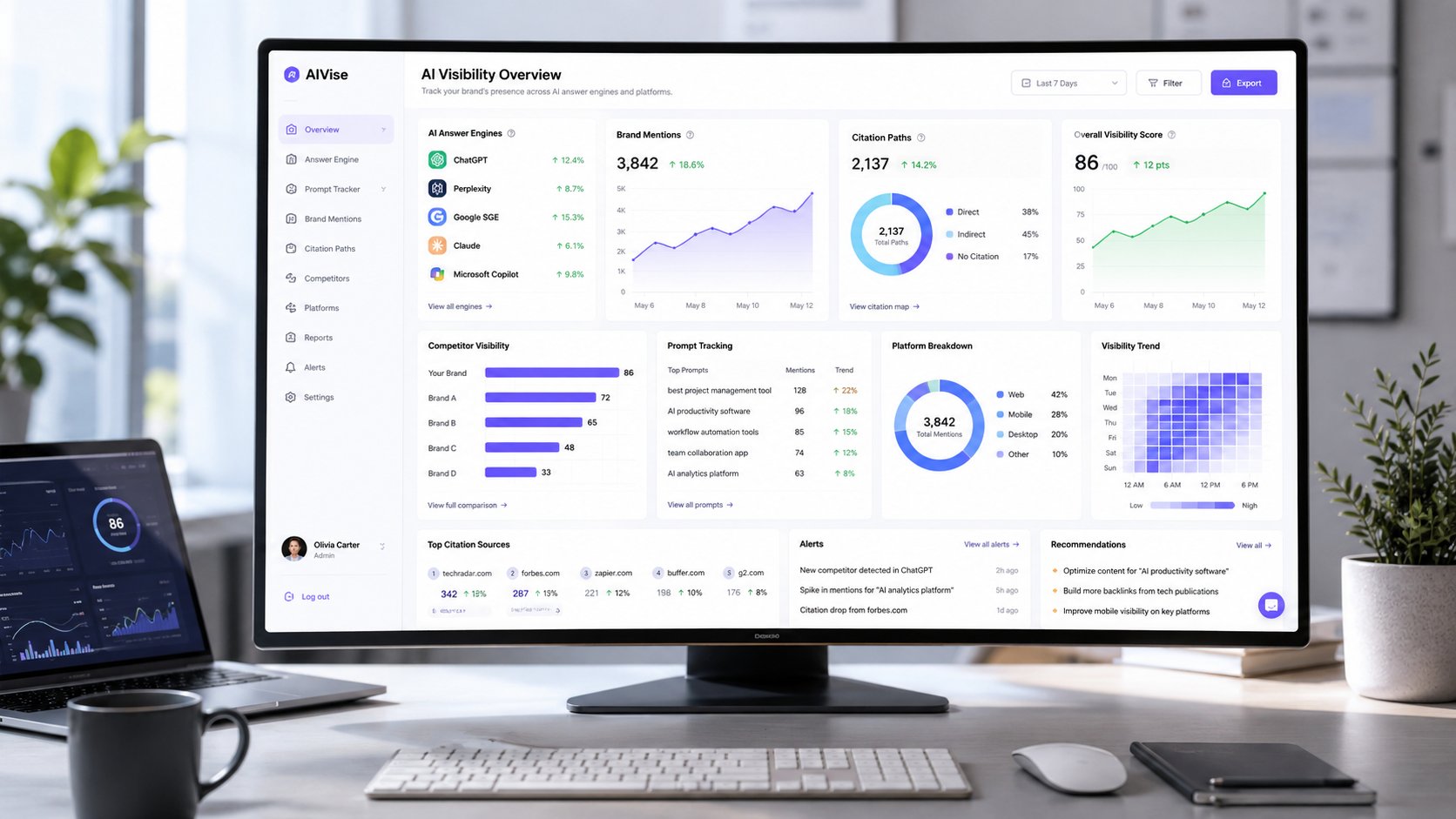
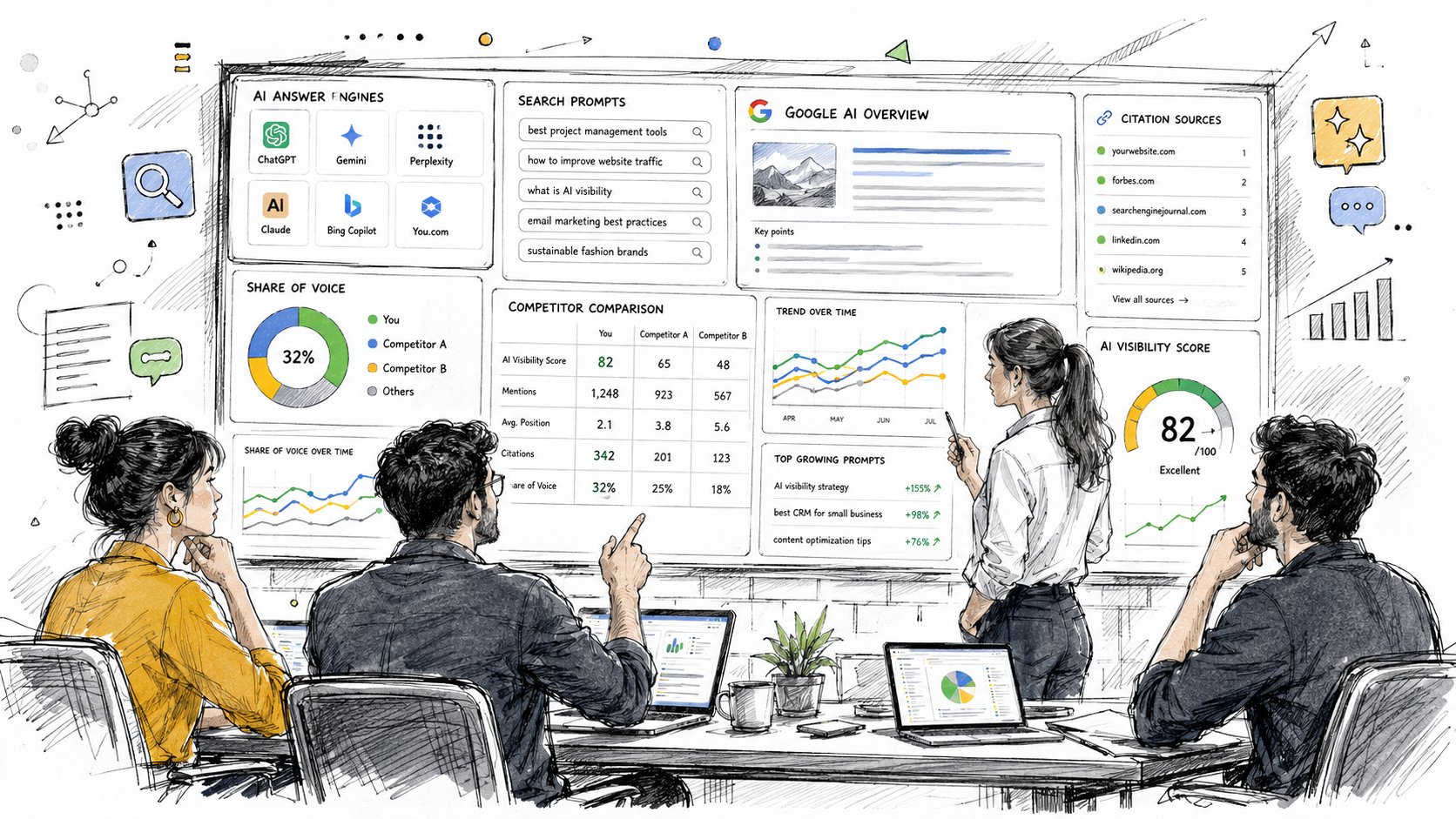
Traditional rank tracking can tell you where a page appears in Google, but it can't tell you whether ChatGPT recommends your brand, whether Perplexity cites your research, or whether Google AI Overviews gives a competitor the answer instead. That distinction matters because AI Overviews were reported as available to all U.S. users from May 14, 2024, and independent datasets measured them on about 12.95% of U.S. searches in one analysis and 16% of U.S. desktop searches in another, with coverage exceeding 54.61% of searches by volume because these results cluster around high-intent informational queries. The underlying AI SEO analysis shows why the best SEO for AI visibility products needs to measure sources, prompts, and answer-engine selection, not just blue-link positions.
This list compares ten products by the job they help with: multi-model monitoring, Google AI Overview tracking, enterprise data integration, or an affordable starting point. I'm also looking at prompt detail, citation evidence, integrations, scale, cost considerations, and practical fit. Llumo is the strongest starting point for teams that need multi-model, prompt-level visibility with flexible provider costs, but an established SEO suite may fit better if your reporting already lives in BrightEdge, Semrush, or another system.
1. Llumo
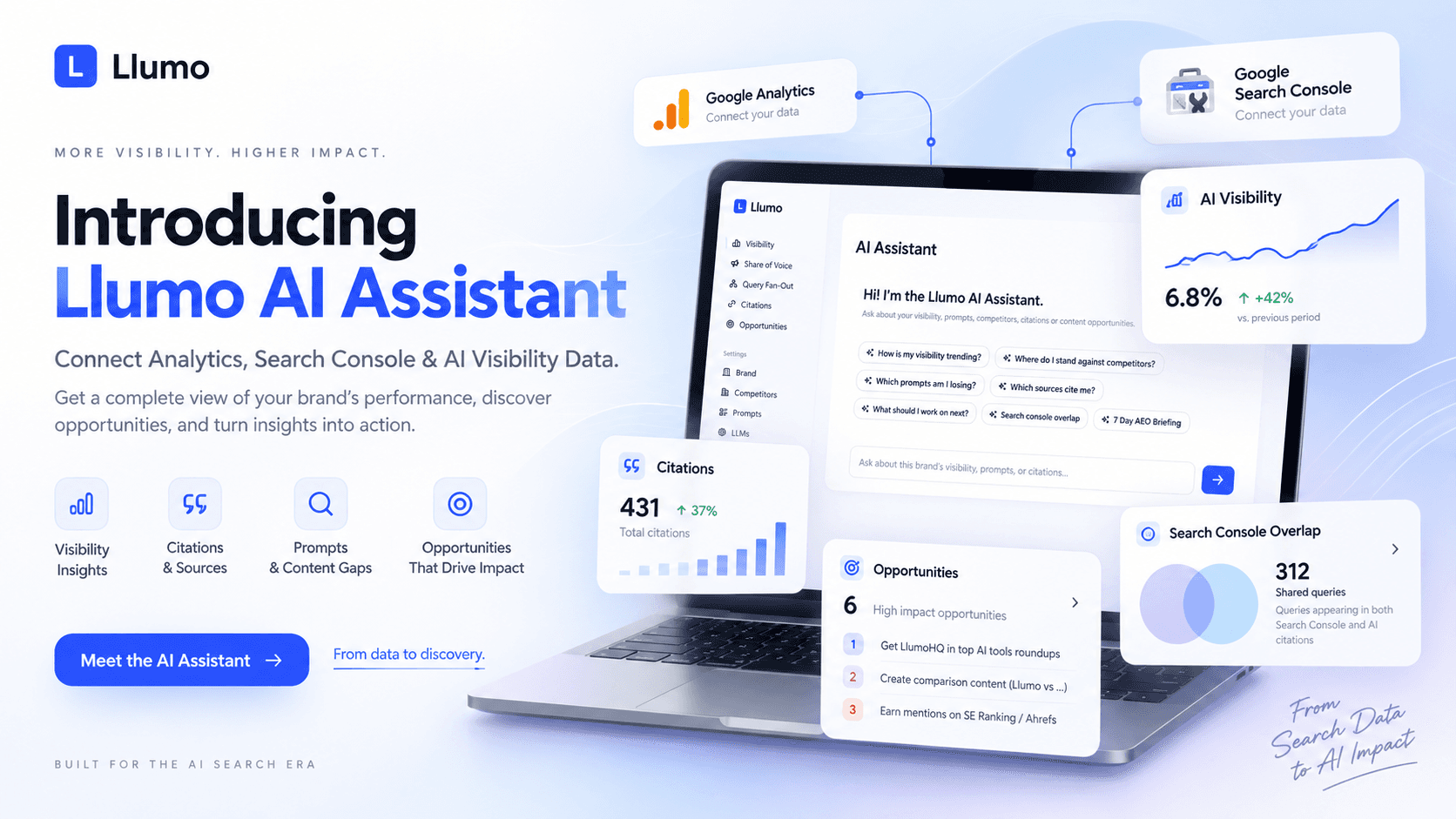
Llumo focuses on the operational question behind AI visibility: where does a brand appear in generated answers, and which sources support that appearance? It monitors ChatGPT, Gemini, Perplexity, Copilot, Google AI Overviews, and other answer-engine surfaces, linking results to prompts, competitors, cited domains, and cited pages. That makes it a practical fit for teams building an AEO workflow rather than tracking only whether an AI feature appeared.
Its clearest strength is prompt-level analysis. Teams can archive responses, tag and filter prompts, compare share of voice over time, inspect query fan-out, and find new or lost references. Query fan-out records show the searches and related terms an AI system generated behind an answer. Content teams can then examine those terms, improve relevant pages, and check whether stronger source coverage changes future citations.
Why the cost model matters
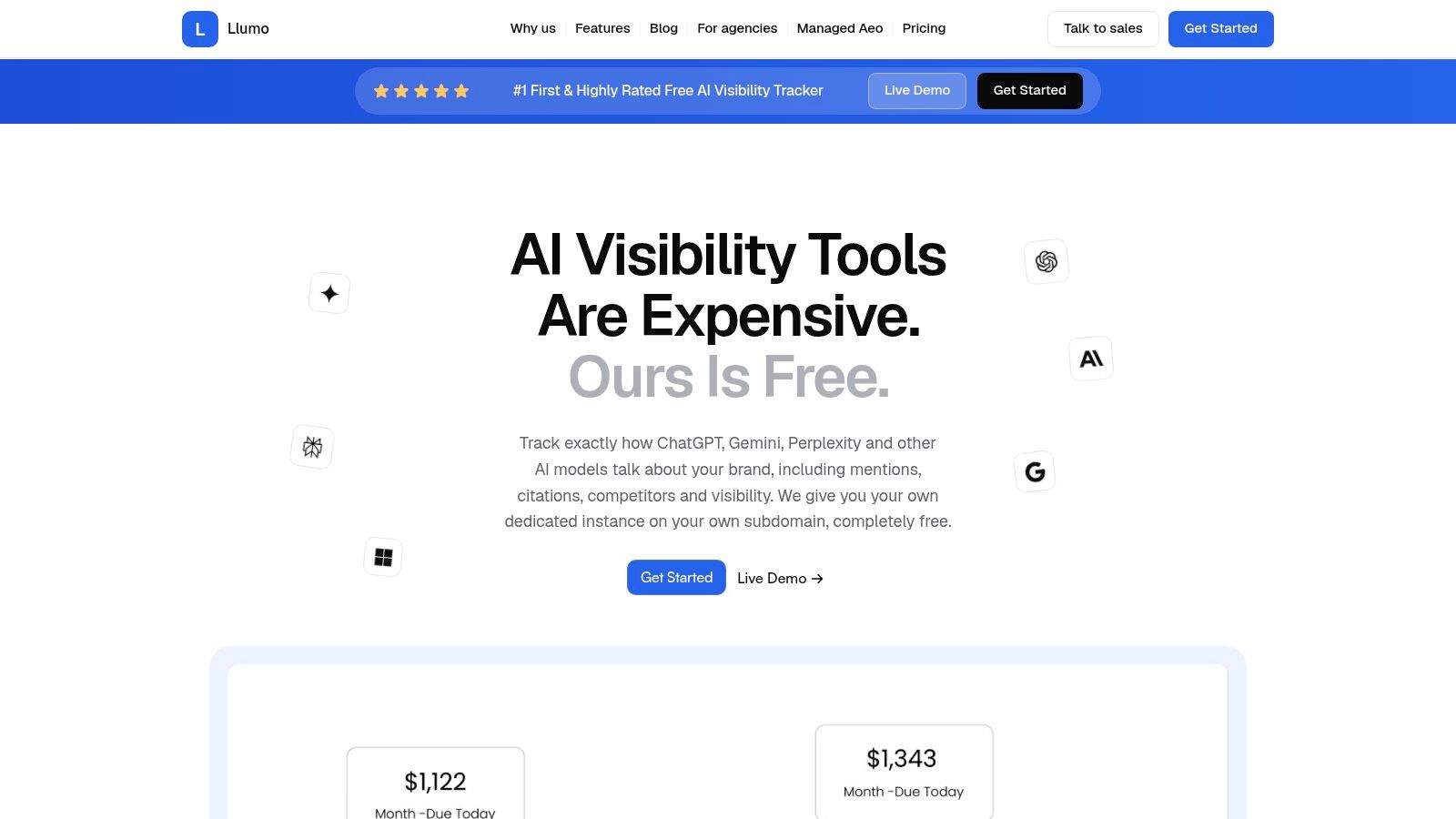
Llumo does not charge a core software license fee. Customers bring their own provider API keys, pay providers directly, and avoid Llumo usage markups. That lowers pricing opacity, but it leaves your team responsible for provider accounts, quotas, and budgets. The response-based model can make usage easier to understand than a bundled tier that hides prompt costs.
The platform also supports unlimited projects and brands, a hosted instance on a custom subdomain, custom branding, daily backups, usage analytics, and managed AEO services for audits, recommendations, and execution. These capabilities can suit agencies, SaaS teams, growth leaders, and competitive intelligence groups that need to expand without forced enterprise pricing.
Practical rule: Choose Llumo when the work starts with prompts. If you need to identify a competitor that replaced you, the page that earned a citation, or an outreach target that could close the gap, its workflow offers more direction than a basic AI Overview presence tracker.
The main limitation is public evidence, not the stated feature set. Available materials emphasize the platform and BYO-key model, while the provided information does not include customer testimonials, awards, case studies, or independent certifications. Explore Llumo to assess whether multi-model monitoring and direct control over provider costs match your operating model.
2. BrightEdge
BrightEdge fits organizations that already treat SEO as a structured enterprise operation. Its dedicated generative search capabilities include AI Overview monitoring and research powered by the BrightEdge Generative Parser. Rather than forcing an SEO team to maintain a separate experimental dashboard, it places AI Overview signals beside tracked keywords, categories, industries, and established reporting workflows.
The practical value is longitudinal visibility. Teams can study where AI Overviews appear, how their presence changes across keyword groups, and how citations overlap with broader search performance. BrightEdge also publishes industry research, reports, and educational material that can help enterprise teams explain AEO priorities to executives who still think in rankings and traffic.
Where BrightEdge fits best
BrightEdge is a sensible choice when the main requirement is Google AI Overview intelligence inside an existing enterprise SEO program. Large teams often value consistent keyword segmentation, permissions, reporting, and workflow ownership more than a collection of standalone prompt experiments. The platform's history with generative search research also gives stakeholders context for interpreting an unstable search surface.
The limitation is scope. Public information is strongest around Google surfaces, and there's less public detail about coverage across non-Google large language models than you'll find in an AEO-first product. It's also enterprise-oriented, so a small team may find the implementation heavier than the problem requires.
BrightEdge works when adoption and governance are the hard parts. It isn't the first choice for a lean team that wants to compare individual ChatGPT, Gemini, and Perplexity responses or inspect every cited page.
3. Similarweb GenAI Intelligence
Similarweb's GenAI Intelligence combines AI search analysis with the company's wider market and competitive intelligence capabilities. Its Rank Tracker can monitor queries that trigger AI Overviews, while AI Brand Visibility surfaces prompts, answers, citation sources, and sentiment across large language models. The result is a useful bridge between classic SEO reporting and the broader question of how AI systems describe a market.
That bridge is the product's main advantage. A marketing team can compare search visibility, competitor presence, citation patterns, and directional AI traffic signals in one vendor environment. The free AI traffic checker also gives teams a quick way to form an initial hypothesis before committing to a deeper GenAI Intelligence workflow.
A strong market-intelligence layer
Similarweb is particularly useful for teams that don't want AI visibility isolated from market data. Its prompt tracking and citation analysis can show which brands and sources appear in answers, while its traffic lenses help frame whether those answers may influence demand. That connection makes it easier to brief content, brand, and competitive intelligence teams together.
Still, don't treat its traffic estimates as click attribution. AI Overviews don't expose a clean referrer trail that lets a platform assign every visit to a specific generated answer. The AI traffic view is directional, and enterprise modules can cost more than a focused point solution.
For a deeper look at how tools differ in the Google layer, compare AI Overview tracking tools. Similarweb is strongest when the question is not only “Did we appear?” but also “What is happening to our category, competitors, and potential demand?”
4. SISTRIX
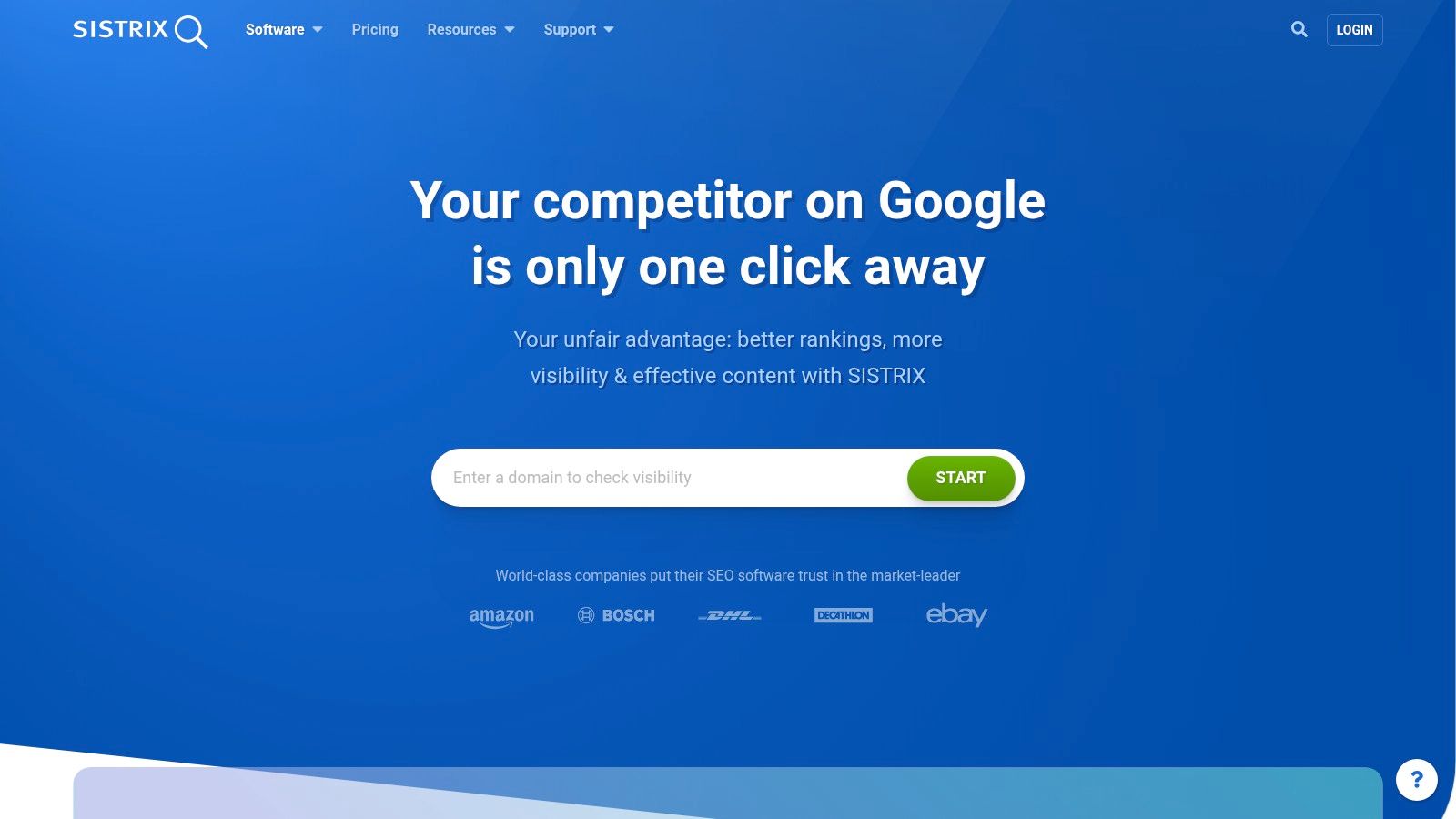
SISTRIX brings AI Overview tracking into a visibility suite known for SERP analysis. Its country-wide tracking helps teams understand where AI Overviews appear and whether a domain is cited, while weekly domain-in-AIO trends connect those signals to traditional organic visibility. For international SEO teams, that geographic view can be more useful than a single global score.
The product also offers API endpoints for AI tracker data. That matters when an organization wants to move AIO observations into an internal warehouse, combine them with ranking data, or build reporting that matches its own markets and business units. SISTRIX doesn't ask teams to abandon the visibility metrics they already use. It adds an AI surface to the same analytical environment.
The Google-first trade-off
SISTRIX is a good fit when Google remains the reporting center of gravity. Its established visibility analysis, country coverage, and API access help technical SEO and data teams answer questions such as whether AIO growth coincides with changes in organic exposure or whether a domain is appearing in a target market.
It is less suitable for teams that need rich daily interpretation of ChatGPT or Perplexity responses. Its public positioning focuses primarily on Google AI Overviews, and day-to-day prompt and citation intelligence is more limited than what an AEO-dedicated platform provides.
Use SISTRIX when you need Google visibility continuity and data portability. Don't choose it expecting a full multi-model answer archive or detailed source ecosystem analysis across every major assistant.
5. Authoritas
Authoritas combines classic rank tracking with crawling of AI platforms and Google AI Overviews. That makes it a practical option for brands that want to discover which queries trigger AI answers, monitor where their content appears, and bring the findings into a familiar SEO workflow. Its eCommerce orientation is also useful for retailers managing product, category, and comparison visibility.
The platform's documentation is one of its more valuable assets. Clear workflows for AIO detection and citation tracking reduce the distance between finding an AI result and deciding what to investigate. Teams don't have to start with a vague ambition such as “optimize for AI.” They can identify triggering keywords, inspect the result, and define a repeatable reporting process.
A practical choice for retailers
Authoritas makes the most sense for an SEO or eCommerce team that needs combined search and AI visibility rather than a pure conversational model tracker. Retailers can use it to locate AI Overview opportunities around category and product searches, then connect those findings to existing ranking work.
The compromise is familiarity and public coverage. Authoritas has less brand recognition than the largest SEO suites, which may create internal adoption work, and its publicly visible detail about the breadth of large language model coverage is more limited. You'll want to confirm the exact surfaces, crawl behavior, markets, and reporting depth that matter to your program before signing on.
It's a credible middle ground for teams that value practical detection workflows. It isn't the obvious choice for a global organization demanding extensive cross-model archives and highly granular share-of-voice analysis.
6. seoClarity
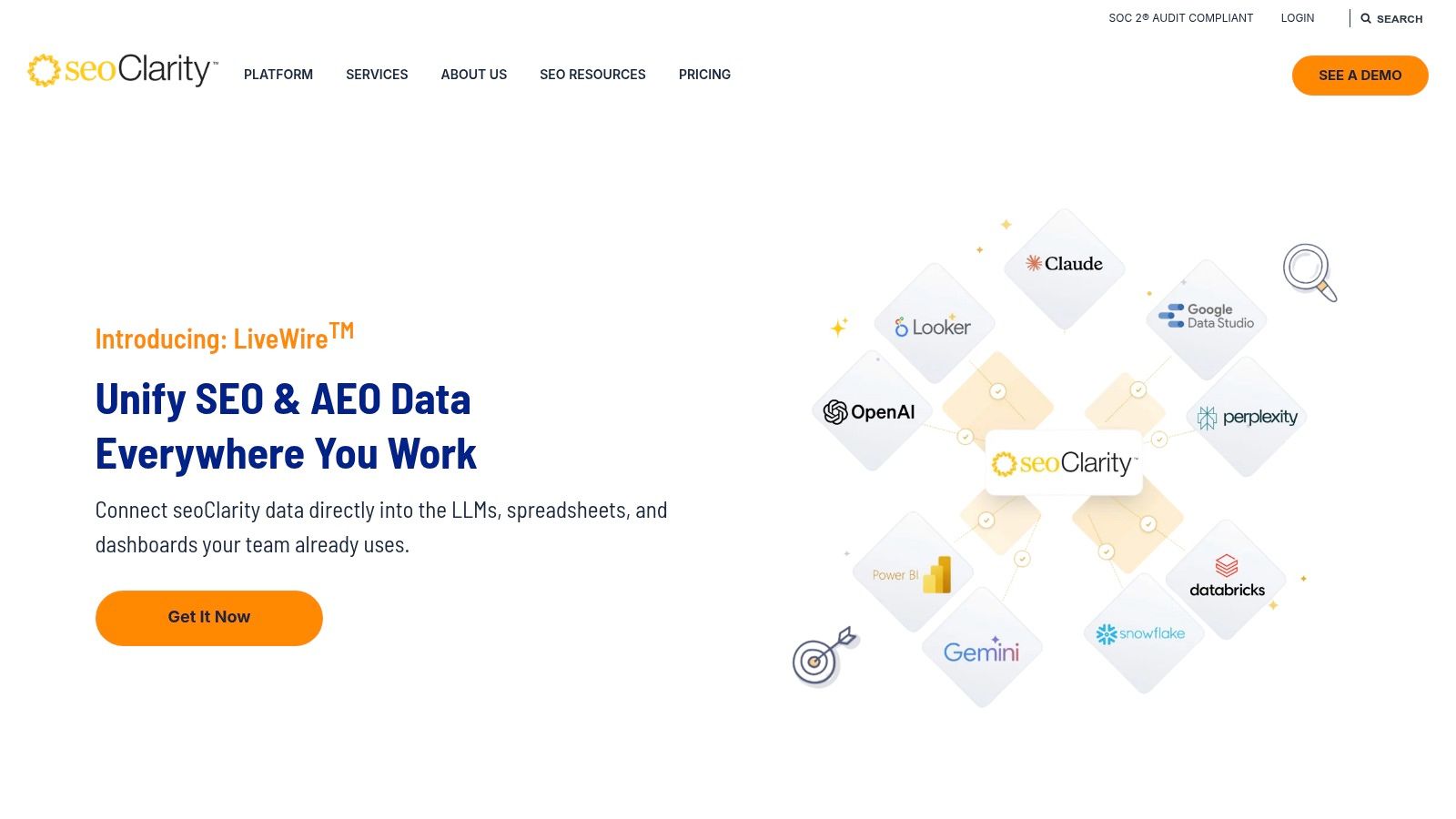
seoClarity is designed for organizations that need to move SEO and AEO data into their own systems. Its AI Search Visibility API exposes mentions and citations, while its domain research and ranking APIs support larger-scale reporting, warehousing, and custom dashboards. That API-led approach makes it attractive to teams with analysts, engineers, and business intelligence resources already in place.
The platform also addresses AI shopping and retail use cases, which can matter for organizations tracking product-level visibility across large catalogs. Instead of limiting the conversation to editorial content, seoClarity can sit within an operating model that connects technical SEO, product data, ranking telemetry, and AI search signals.
Build around your own data model
seoClarity is strongest when the company doesn't want another destination dashboard. An analytics team can use its APIs to create views by market, product family, business unit, or competitor set, then join AI citations with internal performance data. That flexibility is valuable for enterprise governance and custom measurement.
The trade-off is setup effort. API access typically belongs to higher-tier or enterprise plans, and public documentation emphasizes integrations more than detailed non-Google large language model coverage. Smaller teams may spend more time designing the reporting layer than acting on the insights.
Choose seoClarity if your organization has the people and systems to operationalize an API. If you need an immediately usable prompt archive with flexible provider economics, an AEO-first platform may get you to action faster.
7. Semrush
Semrush is the easiest choice for teams that already use Semrush as their SEO system of record. Its Position Tracking and Sensor workflows can detect AI Overview presence for tracked keywords, giving practitioners a way to add AIO monitoring to the reports, keyword sets, and routines they already maintain.
That familiarity has real operational value. SEO managers don't need to introduce a separate interface for every AI-related question, and stakeholders can see AIO presence beside rankings, SERP features, and other search signals. Semrush's guidance and educational resources also help teams understand how to identify queries where AI Overviews appear.
Adoption beats novelty
Semrush works well as an incremental upgrade. If your team already tracks priority keywords there, adding AIO detection is more practical than asking everyone to learn a new platform. It also keeps AI Overview monitoring close to the SEO work that often influences eligibility, such as content updates, SERP analysis, and ranking improvements.
Its limit is measurement depth. Semrush doesn't isolate AI Overview clicks or brand mentions directly through analytics, and Google's AIO layer doesn't provide clean click attribution. It also isn't positioned as a full cross-model prompt and citation archive in the way a dedicated AEO product is.
Before choosing, review AI visibility trackers for SEO and marketing agencies. Semrush is the sensible option when consolidation matters more than multi-model experimentation.
8. STAT Search Analytics
STAT Search Analytics, part of Moz, is built for large SERP tracking programs. Its AI Overview capabilities add AIO presence and citation monitoring to a platform known for handling substantial keyword portfolios, making it a natural fit for agencies, global brands, and teams running market-level topic analyses.
The product's strength is scale within a traditional search framework. A team can monitor large sets of queries, identify where AI Overviews appear, and check whether its content is cited without losing the segmentation and market coverage expected from enterprise SERP tooling. For organizations that already rely on STAT, this can be a smoother path into AIO reporting than buying a standalone product.
Large portfolios, narrower AI scope
STAT is worth considering when the primary measurement problem is volume. Agencies can organize client markets and topic sets, while global brands can compare AIO presence across locations and categories. Its SERP parsing heritage also helps teams preserve continuity with existing search reporting.
The limitation is surface breadth. Public documentation about non-Google large language model coverage is less detailed than what AEO-first tools publish, and enterprise pricing or demo-based access may be required. STAT also won't necessarily provide the prompt-level source history or query fan-out detail needed for an aggressive citation acquisition program.
Use it for dependable, large-scale Google search intelligence. Pair it with a broader multi-model workflow if your strategy depends on how ChatGPT, Gemini, Perplexity, or Copilot describe the brand.
9. Ahrefs
Ahrefs offers a free AI Overviews Tracker, which makes it one of the lowest-friction ways to start monitoring Google's generative search layer. Teams can use it to establish a baseline for where AIOs appear across domains and queries, then bring those observations into the broader Ahrefs research and content workflow.
That starting point is valuable because many teams don't need a complex platform on day one. They need evidence that AI results are appearing for their important topics, a way to educate stakeholders about possible click effects, and a repeatable reason to revisit the same queries. Ahrefs' published research also helps frame the commercial cost of treating AIOs as just another SERP feature. Its analysis reported that the number one organic click-through rate for keywords with AI Overviews fell from 7.3% to 1.6% between December 2023 and December 2025. The cited TechCrunch coverage discusses the wider traffic concern.
Start cheap, then define the gap
Ahrefs is a good affordable starting point for Google AIO monitoring, especially if your team already uses its keyword and content research tools. It can answer basic questions quickly without requiring an immediate enterprise purchase.
The free tracker isn't a broader multi-LLM brand-mention system. It won't give you the same cross-model prompt archive, competitor share-of-voice view, or citation opportunity workflow as an AEO-first platform. The full Ahrefs product is also subscription-based beyond the free tracker.
Use strategies for ranking in AI Overviews to turn baseline observations into content work. Ahrefs is a sensible first step, not a complete answer-engine measurement program.
10. Botify
Botify's AI Visibility module places brand-mention monitoring inside a larger enterprise SEO and analytics environment. It covers ChatGPT, Perplexity, Google Gemini and AI Mode, and Google AI Overviews, with dashboards that show changes over time and competitive comparisons. For organizations already managing technical SEO, crawling, and analytics in Botify, that integration can reduce handoffs between teams.
The appeal is operational coordination. A technical SEO team can review crawl or log data while content and brand teams inspect AI mentions, then use shared reporting to decide whether a visibility gap reflects content, accessibility, entity clarity, or competitive positioning. That's more useful than treating AEO as an isolated brand exercise.
Governance over granular diagnosis
Botify is best for enterprise teams that need governance, permissions, analytics, and AI visibility in one operating environment. Change tracking can help identify when mentions shift, while competitive comparisons give leadership a clear way to monitor the market.
Its weakness is granularity. Public documentation focuses more on the overview than on per-prompt archives and detailed citation histories. Smaller teams may also find the enterprise positioning and cost structure difficult to justify if their immediate need is to inspect a set of prompts.
Choose Botify when integration with technical and content SEO is the priority. Choose a dedicated AEO platform when you need to diagnose exactly which response, source, or prompt changed.
Top 10 AI SEO Visibility Tools, Comparison
Product | Core features | UX & quality (★) | Value / Pricing (💰) | Target audience (👥) | Unique selling points (✨) |
|---|---|---|---|---|---|
Llumo 🏆 | Multi‑model tracking, per‑prompt visibility, citation analysis, prompt archives, opportunity discovery | ★★★★☆, prompt‑level dashboards, daily backups | 💰 BYO API keys; no Llumo license or usage markups; scales w/o enterprise tiers | 👥 SEO/AEO teams, agencies, product & growth, competitive intel | ✨ Per‑prompt SOV & citations, query fan‑out, hosted custom subdomain, transparent response costs |
BrightEdge | AIO monitoring (Generative Parser), industry benchmarks, AIO research | ★★★★☆, enterprise workflows & reporting | 💰 Enterprise subscription | 👥 Enterprise SEO teams | ✨ Deep Google AIO research + integrated keyword workflows |
Similarweb GenAI Intelligence | AIO & SERP tracking, AI brand visibility, AI traffic estimates | ★★★★☆, market & AI visibility combined | 💰 Enterprise modules; can be costly | 👥 Competitive intelligence, marketing & enterprise teams | ✨ Bridges AEO with market intelligence and estimated AI traffic lenses |
SISTRIX | Country AIO tracking, weekly domain‑in‑AIO trends, API endpoints | ★★★☆☆, reliable country‑level analysis | 💰 Subscription; API for enterprise | 👥 SEO teams focused on Google & multi‑country markets | ✨ Country AIO trends + API for internal warehousing |
Authoritas | AIO keyword discovery, crawls ChatGPT/Perplexity, practical workflows | ★★★☆☆, actionable docs & workflows | 💰 Mid‑market subscription | 👥 Retailers, brands needing combined AI+SEO visibility | ✨ Practical AIO workflows and eCommerce focus |
seoClarity | AI Search Visibility API, Domain & Ranking APIs, enterprise integrations | ★★★★☆, API‑centric, scalable | 💰 Enterprise pricing for API access | 👥 Enterprises needing BI integration & large‑site scale | ✨ Heavy API/integration focus for custom AEO pipelines |
Semrush | Position Tracking & Sensor AIO detection, integrated guidance | ★★★★☆, easy adoption if on Semrush | 💰 Subscription; easier for existing users | 👥 Teams standardized on Semrush / daily SEO ops | ✨ Integrates AIO monitoring into existing SEO workflows |
STAT Search Analytics (Moz) | AIO presence & citation monitoring on top of SERP tracking, scalable infra | ★★★★☆, proven SERP parsing at scale | 💰 Enterprise pricing; demo‑based | 👥 Agencies & global brands with large keyword sets | ✨ Scalable SERP + AIO parsing for very large portfolios |
Ahrefs (AI Overviews Tracker) | Free daily AIO tracker, research on AIO impact, integration with Ahrefs suite | ★★★☆☆, low barrier with solid research | 💰 Free tracker; subscription for full tools | 👥 Small‑to‑mid teams, researchers, educators | ✨ Free daily AIO tracker + published AIO impact research |
Botify (AI Visibility) | Multi‑engine mentions, dashboards, change tracking, integrates with crawl/log data | ★★★★☆, enterprise governance & analytics | 💰 Enterprise‑focused; higher cost | 👥 Enterprises needing technical SEO + AEO coordination | ✨ Connects AEO signals to crawl/log & technical SEO workflows |
Choose the Signal You Will Act On
The best SEO for AI visibility products isn't the tool with the longest feature list. It's the one that turns an observed change into a decision your team can execute. If a dashboard tells you that visibility fell but doesn't show the affected prompts, competitor replacements, cited domains, or pages involved, you still have a reporting problem rather than an optimization system.
Choose Llumo when your program depends on prompt-level, multi-model visibility. It's the strongest fit for tracking mentions and citations across ChatGPT, Gemini, Perplexity, Copilot, Google AI Overviews, and other answer-engine surfaces, while comparing share of voice and identifying new or lost references. The BYO-key model also suits teams that want flexible provider costs rather than a bundled usage markup. The responsibility is clear: your team manages provider keys, quotas, and budgets, and public materials don't provide independent customer validation.
Choose an established SEO suite when AI Overview tracking needs to sit beside rankings, SERP features, segmentation, and existing executive reporting. BrightEdge, Semrush, SISTRIX, STAT Search Analytics, Ahrefs, Authoritas, and Botify each make more sense when continuity with a current SEO stack is the main constraint. Their coverage and depth differ, so confirm whether you need only Google AIO monitoring or broader conversational model coverage.
An API-led platform such as seoClarity is better when the business needs custom BI, internal data warehousing, or large-scale workflows. Similarweb is a strong option when AI visibility must connect to market intelligence, competitor research, and directional traffic analysis. Neither category eliminates the need for judgment. AI results change, citations vary by query, and traffic attribution remains incomplete.
A workflow that produces SEO work
Start with a fixed prompt set based on your highest-value topics, use cases, comparisons, and product questions. Record the prompt, model or search surface, answer, brand mention, competitor mentions, sentiment where available, cited domains, cited pages, and whether the citation is new, retained, or lost. Consistency matters more than starting with a huge query library.
Review changes on a regular schedule. Look for prompts where a competitor appears repeatedly, where your brand is mentioned without a citation, where a relevant page is cited but no longer appears, and where the same small group of authoritative domains dominates the answer. AI Overview citation data shows that the top 1% of domains capture 47% of citations, with Wikipedia at 24.3% and Reddit at 21.6%, while responses average 4.2 citations. The citation-source analysis illustrates why source-set analysis is more useful than a simple mention count.
Then turn the clearest gaps into work. Improve or expand the page that should answer the prompt, clarify entities and product positioning, strengthen evidence and named sources, or pursue relevant third-party mentions. Page placement can also guide editing. One analysis found 55% of AI Overview citations came from the first 30% of content, compared with 24% from the middle 30% to 60% and 21% from the bottom 40%. The page-placement research supports putting the essential answer and strongest evidence near the opening, without reducing the page to a shallow summary.
Finally, measure movement at the prompt and source level before expanding coverage. Track whether the brand enters more relevant answers, whether competitors lose or gain citation share, and whether your pages become recurring sources. AI visibility is not a replacement for traditional SEO, but rank reports alone won't show who controls the answer layer. Pick the signal your team can act on, establish a baseline, and make every content or outreach task traceable to a specific visibility gap.
Llumo gives SEO and growth teams prompt-level visibility, multi-model mention and citation tracking, share-of-voice trends, query fan-out logs, and opportunity prioritization without a core software license fee. If you want to build a practical answer-engine workflow around the signals discussed here, visit Llumo and review how its BYO-provider-key model can fit your monitoring and cost requirements.