
Ask an AI assistant which tools are best for your category, then read the answer closely. If your brand is absent, mentioned without context, or cited only as an afterthought, a traditional rank report won't explain why. An AI visibility checker needs to show more than presence. It should reveal the prompts tested, the answer produced, the sources cited, the competitors recommended, and the changes your team can act on.
This roundup compares ten tools through that practical lens. You'll find notes on model coverage, response archives, citation reporting, pricing models, and the gaps that matter once monitoring becomes part of regular SEO and content work.
1. Llumo
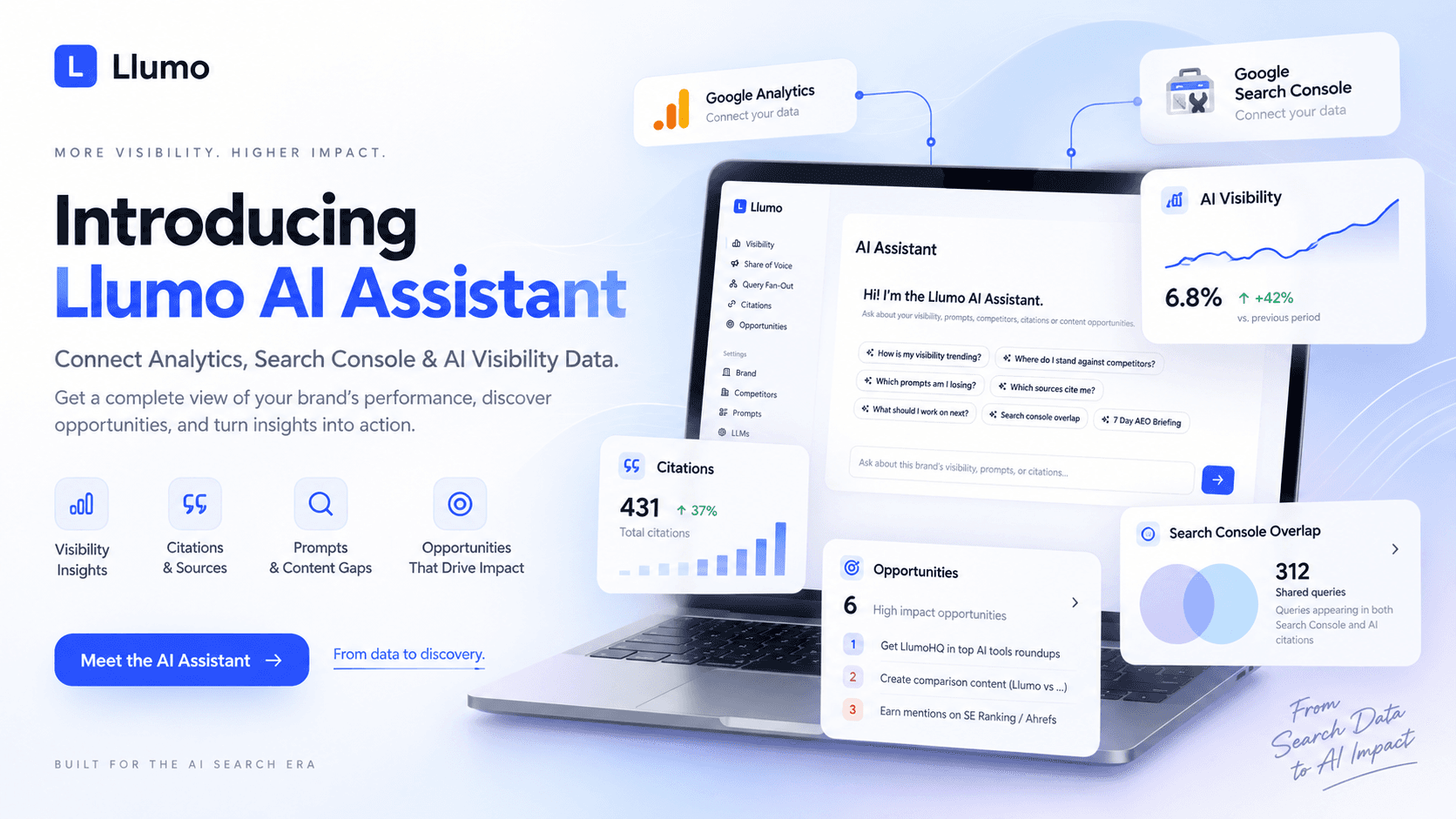
A category prompt can produce a polished answer that recommends competitors while leaving your brand uncited. Llumo is built for examining that answer, rather than treating conventional rankings as the whole picture. It tracks mentions and citations across ChatGPT, Gemini, Perplexity, Copilot, Google AI Overviews, Claude, Grok, Mistral, and other surfaces, then connects those observations to possible content and digital PR work.
The strongest evidence sits at prompt level. You can compare visibility with competitors, inspect cited domains and URLs, identify new and lost references, review query fan-out, and search archived responses. That lets a marketer move from “we aren't visible” to a specific diagnosis: a category prompt favors a competitor, while a recurring source receives citations instead of your site.
Practical rule: Don't judge an AI visibility checker by its score alone. Open the underlying response and citation whenever you need to brief a content or digital PR team.
Where Llumo earns its place
The core platform has no software license fee. With bring-your-own API keys, your team pays providers directly and avoids a Llumo usage markup. Technically comfortable teams get control over provider budgets and can model high-volume monitoring without a bundled allowance. PAYG and managed subscription options are available if your team does not want to operate the API layer.
Llumo includes unlimited projects and brands, hosted custom subdomains, custom branding, daily backups, usage analytics, API and MCP access, a Google AI Overviews Tracker, and a ChatGPT Tracker. Managed AEO services cover audits, recommendations, and execution for teams that want support rather than another dashboard to run.
The trade-off is operational work. Your team must provision provider keys, monitor budgets, and account for changes in API and scraping coverage as answer engines evolve. The response archive and citation analysis give marketers useful evidence, but no checker can make model behavior perfectly stable.
Verdict: Choose Llumo for broad model coverage, response-level evidence, actionable citation opportunities, and transparent provider costs. It fits agencies, in-house SEO teams, and brands prepared to own some infrastructure. Teams wanting a completely hands-off setup may prefer a bundled product.

2. Ahrefs Brand Radar and AI Overviews Tracker
Ahrefs makes sense for teams that already use its SEO data and want AI visibility in the same working environment. Its free AI Overviews Tracker helps detect when Google AI Overviews appear and whether your brand is cited. Brand Radar extends that view across assistants such as ChatGPT, Gemini, and Perplexity.
The practical advantage is the path from a broad visibility score to the prompts, competitors, domains, and sources behind it. That's more useful than a single “AI presence” number because a marketer can see whether the problem is query coverage, competitor dominance, or weak source selection.
What works well
Ahrefs also brings a substantial index and documented methodology to the reporting. Competitive filtering helps teams isolate responses that mention their brand or a rival, which is useful for finding category questions where competitors receive the recommendation and you don't.
The limitation is packaging. Deep multi-assistant analysis belongs to the paid Brand Radar experience, while the free tracker is narrower. Enterprise-grade breadth can also feel excessive if your immediate need is just to test a small set of buyer prompts and inspect the answers manually.
Pros
Connected SEO and AI view: Traditional search data and AI answer monitoring sit in one ecosystem.
Useful source drill-down: Visibility scores can lead to prompts and cited sources.
Competitive filtering: You can isolate brand and competitor mentions.
Cons
Paid depth: Cross-assistant monitoring goes beyond the free AI Overviews Tracker.
Heavy for small checks: Lightweight teams may use only a fraction of the broader platform.
Verdict: Choose Ahrefs if your SEO team already works there and wants AI visibility added to an established research stack. Choose a dedicated AEO tool if archived answers and citation operations matter more than suite consolidation.
Explore Ahrefs for its Brand Radar and AI Overviews capabilities.
3. Semrush AI Visibility
Semrush AI Visibility suits teams that want AI monitoring inside the same system as SEO remediation. It combines an AI Visibility Score, competitor comparisons, and reporting across ChatGPT, Gemini, Perplexity, SearchGPT, Google AI Mode, and Google AI Overviews.
Its practical advantage is workflow continuity. A prompt can expose a content or technical gap, then move into Position Tracking or Site Audit without forcing the team to export findings into another platform. That connection is useful in larger organizations where adoption depends on established processes and reporting.
The archive determines whether that convenience is enough. Semrush provides directional trend reporting, but marketers still need to inspect the underlying answer before changing content. Assistant coverage and reporting depth can differ, and the fullest functionality is tied to higher-tier Semrush One plans.
For example, an executive may need a visibility trend and competitor comparison, while an SEO editor needs the exact cited page, evidence that the citation supports the answer, and a record of what changed between prompt runs. Compare those requirements with specialist tools before switching platforms. The Semrush AI alternatives for visibility tracking overview can help frame that comparison.
A connected dashboard is useful when its evidence supports a clear decision.
Pros
One connected workflow: AI visibility sits beside rankings, audits, and content fixes.
Broad assistant coverage: Major AI surfaces appear in the reporting scope.
Enterprise fit: Existing Semrush teams may face less operational friction.
Cons
Variable depth: Assistant views do not all provide the same detail.
Higher-tier access: Full functionality may require a larger Semrush package.
Potential archive gap: Check response and citation depth before replacing a specialist tracker.
Verdict: Choose Semrush when connecting AI visibility to an established SEO operating system matters more than detailed prompt archives. Choose another tool when citation forensics and answer-by-answer history are the main deliverables.
Visit Semrush to review its AI Visibility offering.
4. Similarweb GenAI Intelligence Toolkit
A market intelligence team can use Similarweb to connect AI visibility with referral activity, competitor movement, and category benchmarks. Its GenAI Intelligence toolkit combines AI Traffic Overview reporting with prompt-tracking API endpoints, so it suits organizations building AI search data into an existing analytics system.
The practical advantage is the reporting context. Analysts can place AI-driven visibility beside Similarweb's web, search, and app intelligence, then send the available data into custom dashboards. That helps a data team monitor market signals across one reporting layer instead of reviewing isolated prompt checks.
The trade-off appears when a marketer needs to explain one answer. Similarweb is less focused on a searchable archive of complete chatbot responses, detailed citation records, or evidence showing why an assistant selected a particular source. Traffic data can indicate that AI exposure is generating demand, but it may not show whether a brand was mentioned accurately or which page earned the citation.
Prompt auditing also requires more technical support than many specialist AEO tools. A small content team looking for immediate editorial guidance may find the workflow heavy. Analysts and engineers can get more value by building reports around the available API data.
Use the following test before adopting it: can your team turn market and referral signals into an action, or does it need answer-level evidence for content and PR decisions?
Market-level benchmarking: Strong datasets support competitor and category analysis.
API access: Engineering teams can create custom dashboards and workflows.
Broader intelligence context: AI data can sit alongside web, search, and app research.
Less answer evidence: Full response archives are not the main strength.
Enterprise orientation: Smaller teams may find the workflow heavier than necessary.
Traffic-led perspective: Citation mechanics may remain unclear for AEO execution.
Verdict: Choose Similarweb when AI visibility belongs within a wider market intelligence program and your team can use APIs. Choose a prompt-first platform when content and PR teams need direct evidence from individual answers.
See Similarweb's GenAI Intelligence offering for its broader data and API ecosystem.
5. SISTRIX AI Search
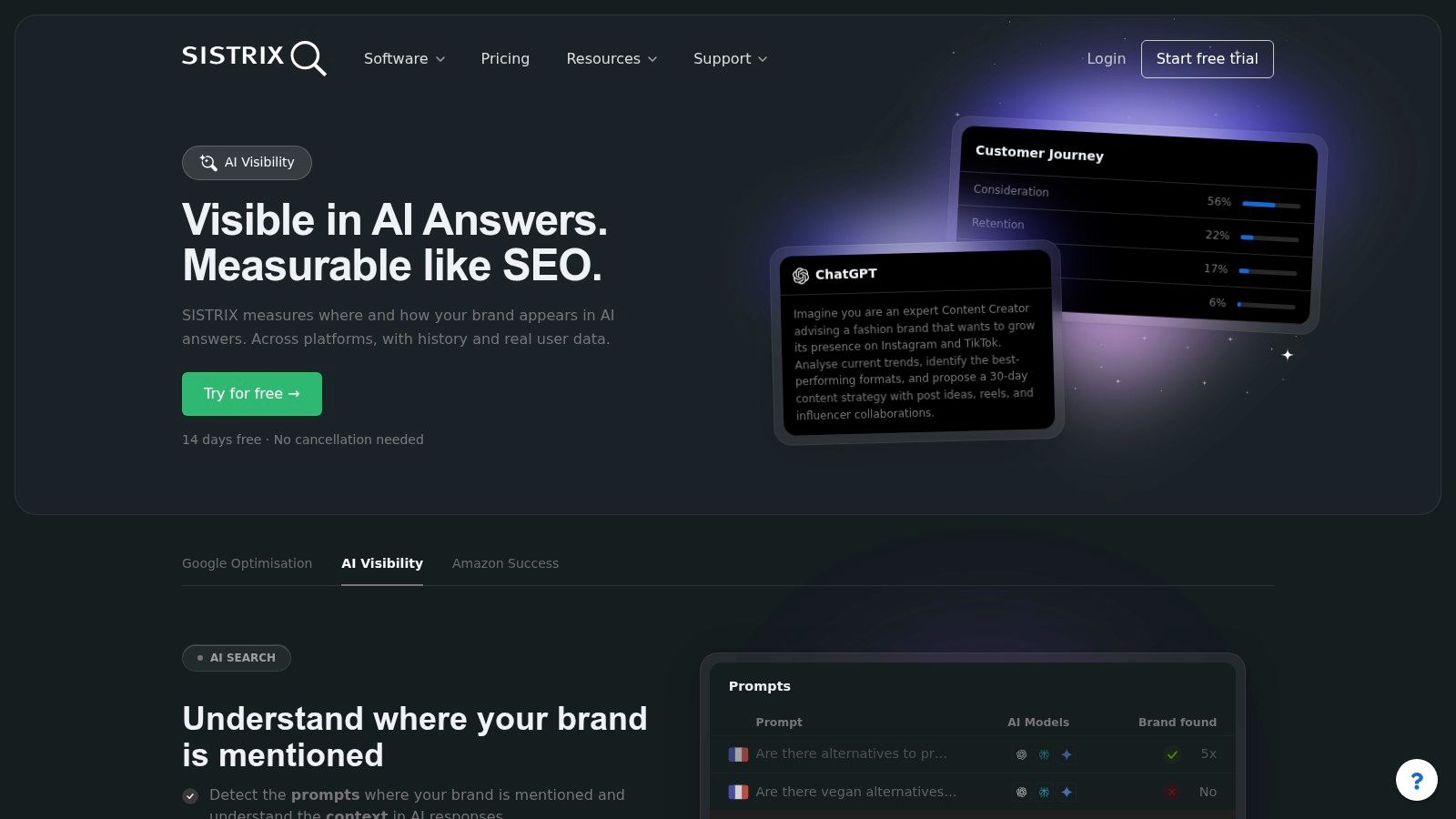
SISTRIX extends its familiar Visibility Index into AI Search, covering Google AI Overviews, Google AI Mode, and ChatGPT. Existing users can follow historic and country-level views, plus weekly trendlines for domains cited in AI Overviews. The advantage is continuity: SEO managers can add AI results to established reporting without adopting a separate measurement language.
The archive is most useful for tracking visibility over time. You can see whether AI features appear, whether your domain earns citations, and how those signals change across markets. That helps with reporting and competitor monitoring, although it offers less evidence for judging the wording or context of each generated answer.
Where the archive helps
SISTRIX fits teams whose primary question is how Google AI Overviews affect established search visibility. Its documentation and handbook material explain the methodology, while modular plans and a trial provide a practical way to test the workflow before committing more budget.
The trade-off appears in cross-assistant research. Chat archives and multi-model prompt analysis are less developed than in dedicated AEO platforms. Teams comparing ChatGPT, Gemini, Perplexity, and Copilot should confirm how much response-level evidence and citation detail the platform provides before making it the main research system.
A useful test is simple: can your reporting team act on visibility trends alone, or does content planning require saved answers and citation-level inspection?
Pros
Familiar reporting: Existing SISTRIX users can extend a known visibility framework.
Historic analysis: Country-level and weekly trendlines support ongoing SEO reporting.
Easy pilot: Trial and modular plans lower the barrier to testing.
Cons
Google-heavy: AI Overviews receive the most attention.
Limited chat archives: Multi-assistant response inspection is not the centerpiece.
Less citation operations: Content teams may need another tool for deeper opportunity work.
For background on Google-generated results, read this guide to AI Overview tracking tools.
Verdict: Choose SISTRIX if your team already uses its Visibility Index and needs consistent Google AI Search reporting. Choose a broader checker if decisions depend on comparing several answer engines at prompt level.
Explore SISTRIX AI Search for its current monitoring options.
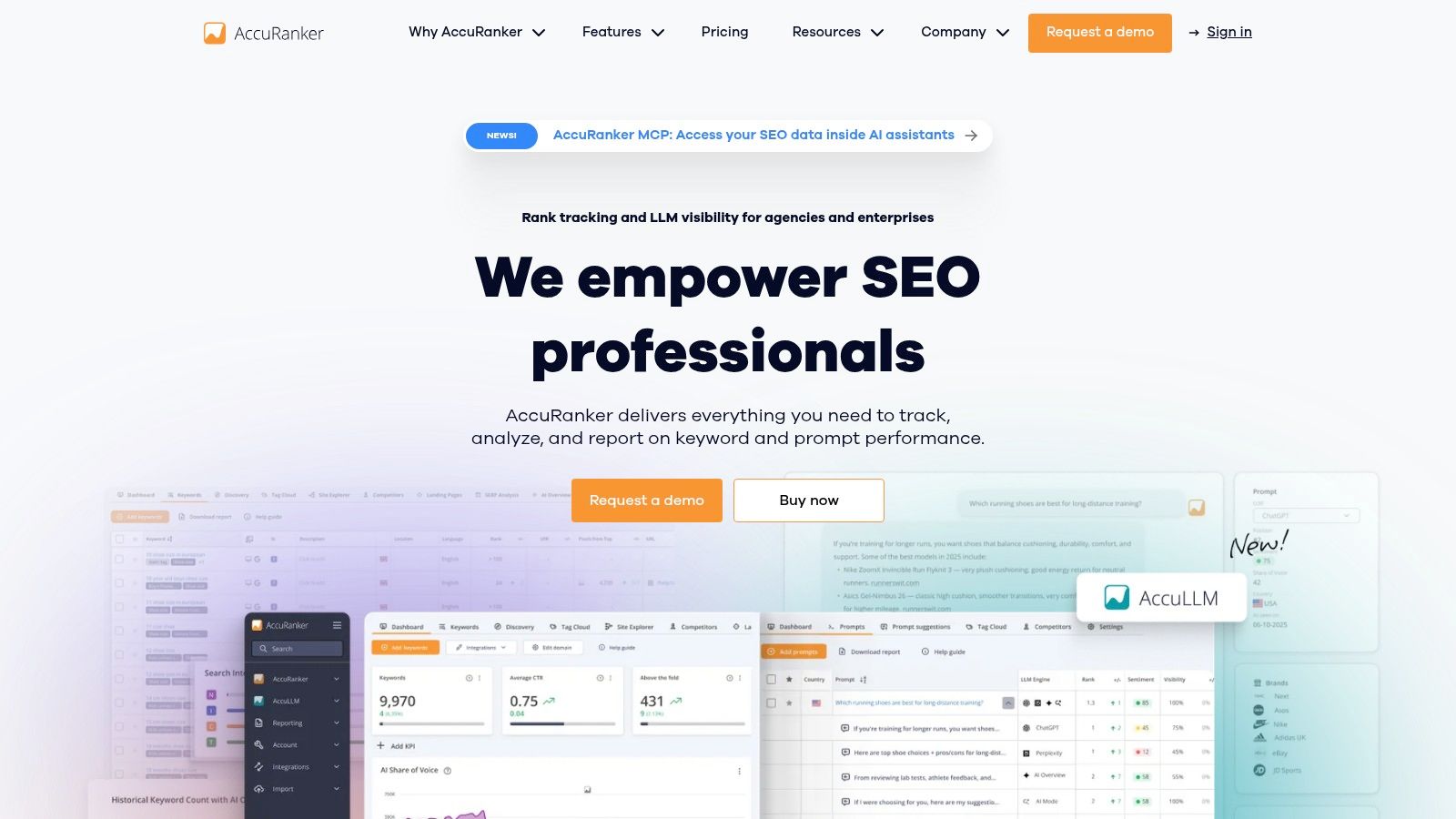
6. AccuRanker Rank Tracking with AI Overview and AI Search Volume
AccuRanker is useful when the question is how AI features alter the Google SERP data your team already tracks. Its AI Overview monitoring and AI Search Volume metric add an AI layer to frequently used rank reports, rather than trying to archive every assistant conversation.
For an SEO team reviewing search composition, the practical output is easy to place beside existing KPIs. You can identify queries where AI Overviews appear, compare competitor visibility, and assess those changes alongside traditional rankings.
A tracked query can therefore show more than a position change. It can indicate whether a generated result is taking space from standard listings, giving analysts a clearer starting point for deciding which queries need investigation.
AccuRanker's strength is speed and reporting continuity. Its methodology material explains how AI Search Volume is derived, which helps users treat estimated demand as a planning signal rather than an observed business outcome. The metric adds context to SERP monitoring, but it does not provide the same evidence as reviewing an answer, its citations, and its competitors directly.
Scope remains the main trade-off. Multi-assistant archives are not the central use case, while pricing scales with keyword volume and may require close budget control for large tracking programs. Teams researching ChatGPT, Gemini, Perplexity, and Google AI Overviews together should test whether the available workflow preserves enough answer and citation detail.
For a rank-tracking team, the decision is straightforward:
Fast SERP reporting: Works well for teams that check rankings frequently.
AI context beside existing KPIs: AI Overview presence can be reviewed with classic rank data.
Clearer query diagnosis: Helps show how generated results affect tracked searches.
Google emphasis: Coverage centers on search results rather than every answer engine.
Limited archives: Full multi-model response history is not the primary function.
Volume-based pricing: Larger keyword sets can increase operating cost.
Verdict: Choose AccuRanker when AI Overview monitoring must sit inside an established rank-tracking workflow. Choose a dedicated AI visibility checker when saved answers, source citations, and competitor comparisons are the evidence your content team acts on.
Visit AccuRanker to review its rank tracking and AI search features.
7. Nozzle AI Overviews and Citation Share
A citation dispute is easier to resolve when the original Google AI Overview is still available. Nozzle records when an overview appears, extracts its cited sources, preserves the raw HTML, and tracks citation order and share over time. Device and locale segmentation shows whether visibility changes by market or search environment.
That archive gives marketers evidence they can inspect later. If a stakeholder questions a citation trend, analysts can review the captured result instead of rerunning a search that may have changed. The record supports forensic audits, client reporting, and investigations into shifts in citation position.
Nozzle is strongest when the work centers on Google AI Overviews. Its scope is narrower than platforms built to monitor several assistants, so teams studying ChatGPT, Gemini, Claude, Perplexity, and Copilot will need another tool or a separate workflow. That trade-off makes sense for an AIO program, but it limits cross-assistant comparisons.
Pricing is less transparent, and a sales discussion may be necessary before the cost can be assessed against tracking volume. Export-friendly reports help analysts, while content teams may still need another system to prioritize opportunities or preserve prompt histories.
The practical choice depends on the evidence your team needs:
Historical capture: Raw HTML and saved snapshots support audits after results change.
Citation analysis: Source order and citation share make exposure measurable over time.
Market context: Device and locale views help explain regional differences.
Google-centered coverage: The product is designed around AI Overviews, not broad assistant monitoring.
Limited execution support: Evidence is stronger than built-in content prioritization.
Pricing evaluation: Budget planning may require direct contact.
Verdict: Choose Nozzle when Google AI Overview forensics, archived results, and citation history drive your decisions. Add another platform if the program must compare visibility across multiple answer engines or turn findings into a content backlog.
Explore Nozzle for its AI Overview tracking capabilities.
8. Nightwatch AI and LLM Tracking
A client report can show traditional rankings alongside brand mentions in ChatGPT, Claude, Gemini, Perplexity, Google AI Mode, and Google AI Overviews. Nightwatch brings those views into an existing rank-tracking workflow, recording which assistants mention a brand and which competitors they recommend.
That setup suits agencies managing several SEO deliverables. Teams can add cross-model observations to familiar reporting without creating a completely separate process. Its documentation and setup guidance also reduce the work needed to move from account configuration to client-facing output.
Nightwatch's value depends on the question behind the report. It is less specialized than a dedicated AEO platform, and prompt and response quotas vary by plan. Heavy monitoring may therefore require a higher tier. Citation analytics are also lighter than in products built primarily for source analysis.
For a brand-presence report, that trade-off may be acceptable. For optimization work, inspect what the platform preserves. Can the team open the full answer, review the cited source, compare responses over time, and turn a finding into a specific page task? If those actions require another workflow, the headline visibility metric has limited practical value.
Nightwatch works best when an agency needs broad assistant coverage connected to rank reporting. Page-level citation audits, query fan-out history, and prioritized content tasks may call for a specialist tool.
Easy SEO integration: AI tracking fits an established rank-tracking workflow.
Broad model set: Coverage includes several major assistants and Google AI surfaces.
Agency reporting: Documentation supports setup and client communication.
Plan quotas: Prompt capacity can restrict heavier monitoring programs.
Shallower citations: Source analysis is not the product's deepest capability.
Limited actionability: Dedicated AEO platforms may connect findings to content work more directly.
Verdict: Choose Nightwatch for agency-friendly reporting that combines rank tracking with broad AI monitoring. Choose a specialist platform when response archives and citation evidence determine content decisions.
Visit Nightwatch to assess its AI and LLM tracking workflows.
9. seoClarity ArcAI
seoClarity ArcAI places AI search visibility inside a broader enterprise SEO operating system. Its workflow spans rankings, schema, internal linking, testing, and AI bot exposure signals, with API and CMS integrations that connect research to deployment.
That operating model suits organizations where SEO recommendations must reach technical and content teams. A visibility finding has more value when the team can turn it into a schema change, an internal-linking update, a test, or a publishing task without moving to an unrelated system.
Where ArcAI fits
ArcAI is a strong fit for teams already managing schema, site architecture, testing, and deployment within the SEO roadmap. seoClarity's research and guides on AI Overviews can support strategic work, while its integrations help connect recommendations with publishing and technical processes.
The trade-off is scope. Smaller organizations may pay for a system broader than their immediate needs, while enterprise-oriented packaging makes quick self-serve comparison difficult. Teams seeking a lightweight archive of exact answers across many models should also confirm how thoroughly ArcAI stores model responses and citations.
Rather than judging visibility from a score alone, validate the evidence behind it. Check whether reports preserve the answer, show cited sources, support comparisons over time, and identify a page or technical action. If those details require a separate workflow, ArcAI may be better suited to operational coordination than prompt-level investigation.
Strengths
Enterprise workflow: AI visibility connects with technical and content operations.
Schema and structure support: Useful for teams improving site architecture and machine-readable signals.
Deployment options: APIs and CMS integrations can shorten the path from finding to implementation.
Limitations
More than small teams need: The platform assumes mature SEO operations.
Sales-led packaging: Pricing is not designed for fast self-serve comparison.
Archive fit requires validation: Confirm the depth of response and citation records before committing.
Verdict: Choose seoClarity ArcAI when AI visibility must sit inside an enterprise SEO and deployment stack. Choose a smaller specialist tool when prompt testing and citation inspection are the immediate priorities.
Explore seoClarity for ArcAI and its enterprise SEO capabilities.
10. ZipTie.ai AI Search Visibility Monitoring
A visibility score can flag a change, but the archived answer explains what happened. ZipTie.ai records mentions, citations, sentiment, and full responses across ChatGPT, Gemini, Perplexity, Google AI Overviews, Google AI Mode, Microsoft Copilot, and Bing's AI Overview.
That archive is the practical differentiator. A marketer can check whether a brand gained a recommendation, lost a citation, appeared beside a competitor, or was linked to an inaccurate statement. Per-engine scores, competitive views, citation analytics, and change tracking also help connect visibility shifts with content or PR work.
Use the trial to test the evidence before making it part of reporting. Check how the platform samples prompts, how often results update, and whether answers remain consistent across locations and models. Those details determine whether the archive supports an actual diagnosis or only a directional score.
ZipTie.ai focuses on AEO rather than the wider set of classic SEO metrics. Teams still tracking rankings, traffic, and technical performance will probably pair it with a conventional rank tracker. Its flexible seats and projects may suit an AEO team that wants a focused tool instead of a larger SEO suite, though the product ecosystem is younger than those established platforms.
Pros
Purpose-built coverage: Mentions, citations, sentiment, and response archives support prompt-level investigation.
Competitive context: Per-engine scores show how brand presence compares across assistants.
Quick start: Trial onboarding makes hands-on evaluation straightforward.
Cons
Younger product ecosystem: Sampling and update frequency need testing before wider rollout.
Limited classic SEO: Traditional rankings require another platform.
Archive quality varies in importance: Confirm that stored responses retain the detail your reporting needs.
Verdict: Choose ZipTie.ai for focused AI answer monitoring, archived responses, and competitive context. Add conventional rank tracking if organic search remains part of the same reporting program.
Visit ZipTie.ai to review its AI search visibility monitoring.
Top 10 AI Visibility Checkers Compared
Product | Core features | Quality (★) | Value & Pricing (💰) | Target & Unique (👥 ✨) |
|---|---|---|---|---|
Llumo 🏆 | Multi‑model tracking (ChatGPT, Gemini, Perplexity, Copilot, Google AIO), per‑prompt visibility, citation analysis, query fan‑out, response archives | ★★★★★ | 💰 BYOK, no license markup; PAYG or managed; cost‑transparent | 👥 AEO/SEO teams & agencies, ✨ prioritized opportunities, hosted branded instance, unlimited projects |
Ahrefs, Brand Radar & AI Overviews Tracker | Free AI Overviews Tracker + paid Brand Radar; drill‑down from visibility to prompts/sources | ★★★★ | 💰 Free tracker; Brand Radar paid (Ahrefs plans) | 👥 SEO teams needing both AI Overviews & source drill‑down, ✨ large index & filtering |
Semrush, AI Visibility | AI Visibility Score across assistants; integrates with Position Tracking & Site Audit | ★★★★ | 💰 Tiered in Semrush One; full features on higher tiers | 👥 Teams in Semrush ecosystem, ✨ built‑in remediation workflows |
Similarweb, GenAI Intelligence Toolkit | AI traffic & prompt‑tracking APIs; market benchmarking; enterprise datasets | ★★★★ | 💰 Enterprise pricing; API‑first billing | 👥 Market analysts & enterprises, ✨ large datasets & custom APIs |
SISTRIX, AI Search | Google AIO & ChatGPT monitoring, weekly trendlines, Visibility‑Index style reporting | ★★★ | 💰 Modular plans; trial available | 👥 Teams already using SISTRIX, ✨ familiar Visibility Index applied to AIO |
AccuRanker, Rank Tracking with AI Overview & AI Search Volume | Daily rank tracking + AIO presence; AI Search Volume metric to quantify demand | ★★★★ | 💰 Pricing scales with keyword volume; premium at scale | 👥 Rank‑focused SEO teams & agencies, ✨ fast, fresh SERP data |
Nozzle, AI Overviews and Citation Share | Detects AIO, stores raw HTML snapshots, extracts cited sources & citation order | ★★★★ | 💰 Sales/enterprise quotes (export‑friendly) | 👥 Forensic auditors & enterprises, ✨ raw HTML snapshots & citation forensics |
Nightwatch, AI & LLM Tracking + AIO Monitoring | Cross‑model AI tracking module layered into rank tracking; logs assistant mentions | ★★★ | 💰 Plan‑based with quotas; upgrades for heavy use | 👥 Agencies & client‑reporting teams, ✨ easy add‑on to existing rank workflows |
seoClarity, ArcAI for AI Search Optimization | End‑to‑end AI search ops: rankings, schema, linking, testing, bot exposure signals | ★★★★ | 💰 Enterprise packaging via sales | 👥 Large enterprises & operations teams, ✨ operational workflows + integrations |
ZipTie.ai, AI Search Visibility Monitoring | Multi‑assistant coverage, archived full responses, sentiment & citation analytics | ★★★★ | 💰 Free trial; purpose‑built pricing | 👥 AEO‑focused teams & PR, ✨ sentiment tracking, quick onboarding |
How to Pick the Checker That Fits Your Workflow
The right ai visibility checker depends less on the longest feature list than on the decision you need to make after reviewing an answer. If your team needs to explain Google AI Overview changes to SEO stakeholders, a SERP-focused product such as AccuRanker, SISTRIX, or Nozzle may be enough. If you need to compare recommendations across ChatGPT, Gemini, Perplexity, Copilot, and Google AI Overviews, look for broader model coverage and response-level archives.
Citation reporting deserves special attention. A brand mention isn't the same as a citation, and a citation isn't automatically useful. Pew Research Center observed that people who encountered a Google AI summary clicked a traditional result in 8% of visits, compared with 15% when no summary appeared, while links inside the summary received clicks in only 1% of visits. That browsing analysis is a strong reason to separate in-answer exposure from referral traffic. A tool should help you see both.
Response accuracy is another overlooked filter. The Tow Center tested eight AI search tools and found incorrect answers on more than 60% of queries. Its comparison of AI search engines supports a practical requirement: check whether a cited page supports the generated claim. More citations can create more apparent visibility while also creating reputational or customer-support risk if the answer is wrong.
Cost needs the same level of care. OpenAI calculates usage from input and output tokens, not from the number of prompts, as explained in its API pricing documentation. Web-search calls can add another cost layer. The published rate is $10 per 1,000 calls, with search-content tokens billed at the applicable model rate, according to OpenAI's usage guidance. A platform that exposes provider, model, token, and search usage will give you a more honest budget picture.
Shortlist two or three tools, run the same 20 to 30 buyer prompts through each for two weeks, and compare the mentions and citations they report against what you see yourself. Choose the one whose gaps you can live with, and write the decision down so your team knows what the numbers do and do not show.
Llumo gives SEO and AEO teams prompt-level visibility across major answer engines, archived responses, competitor trends, citation sources, and prioritized opportunities. Visit Llumo to see whether its BYOK model and action-focused reporting fit the way you want to monitor AI visibility.