
A customer leaves a frustrated review on a niche forum. A creator notices it, adds their own experience, and shares the thread. A journalist starts asking questions before your communications team knows there's an issue. Your reporting dashboard still shows a normal week.
That gap is the problem with outdated brand monitoring online. A brand can look stable in owned analytics while customers, reviewers, journalists, creators, and AI answer engines build a very different public story elsewhere. Effective monitoring connects those signals and turns them into decisions before a conversation becomes a reputation event.
When a Brand Story Slips Past You Online
The missed story rarely begins with a dramatic headline. It starts with a detail your existing reports weren't built to capture: a product complaint in a specialist community, a review that describes a recurring support failure, or a comparison post that ranks your company below a competitor.
By the time the issue reaches a large social account or a journalist, the original context may be buried. Your team sees the visible spike, but not the earlier warning signs that could have made the response calmer and more useful.
That's why monitoring shouldn't be treated as a quarterly reputation report or a vanity chart showing total mentions. A 2023 academic review separated research on social-media monitoring from research on social responding, covering 37 studies in the former stream and 29 studies in the latter. Its practical recommendations include monitoring word-of-mouth for change detection, maintaining firestorm warning systems, and connecting alerts to predefined complaint-response strategies. The review in the Journal of the Academy of Marketing Science supports a simple operating principle: collection has value only when someone knows what to do next.
The public conversation is bigger than your channels
DataReportal's Digital 2025 global overview reported 5.24 billion social-media user identities, equivalent to 63.9% of the world's population. The total grew by 206 million identities, or 4.1%, during the preceding 12 months. Among connected adults, 97.3% used at least one social network or messaging platform each month, while social platforms reached 94.2% of internet users.
Those figures don't mean every conversation matters equally. They do show why one social profile, one news alert, or one search report can't represent public opinion. People move between platforms, languages, review sites, forums, and private or semi-private communities while researching the same brand.
Reviews and answers now shape the story
Third-party feedback deserves equal attention. Trustpilot's global research on online reviews found that 89% of consumers checked reviews during their online buying journey, while 49% considered positive reviews one of their three strongest purchase influences. HubSpot separately reported that more than 93% of respondents read reviews before buying online, and 61.9% of online shoppers said they would search for an unfamiliar company.
The same buyer may read a review, search the brand, compare competitors, and ask an AI tool for a recommendation. Monitoring has to follow that journey instead of splitting it between unrelated dashboards.
What Brand Monitoring Actually Means Today
Brand monitoring online means listening for what people say about a company across the places where decisions and reputational narratives form, then routing useful signals to the people who can act on them.
Think of a shopkeeper. One shopkeeper stands behind the counter and hears only what customers say at the door. Another walks through the aisles, notices which products customers pick up and put back, hears a complaint at the service desk, and checks what people say outside the shop. Both run the same business, but only one sees the full customer experience.
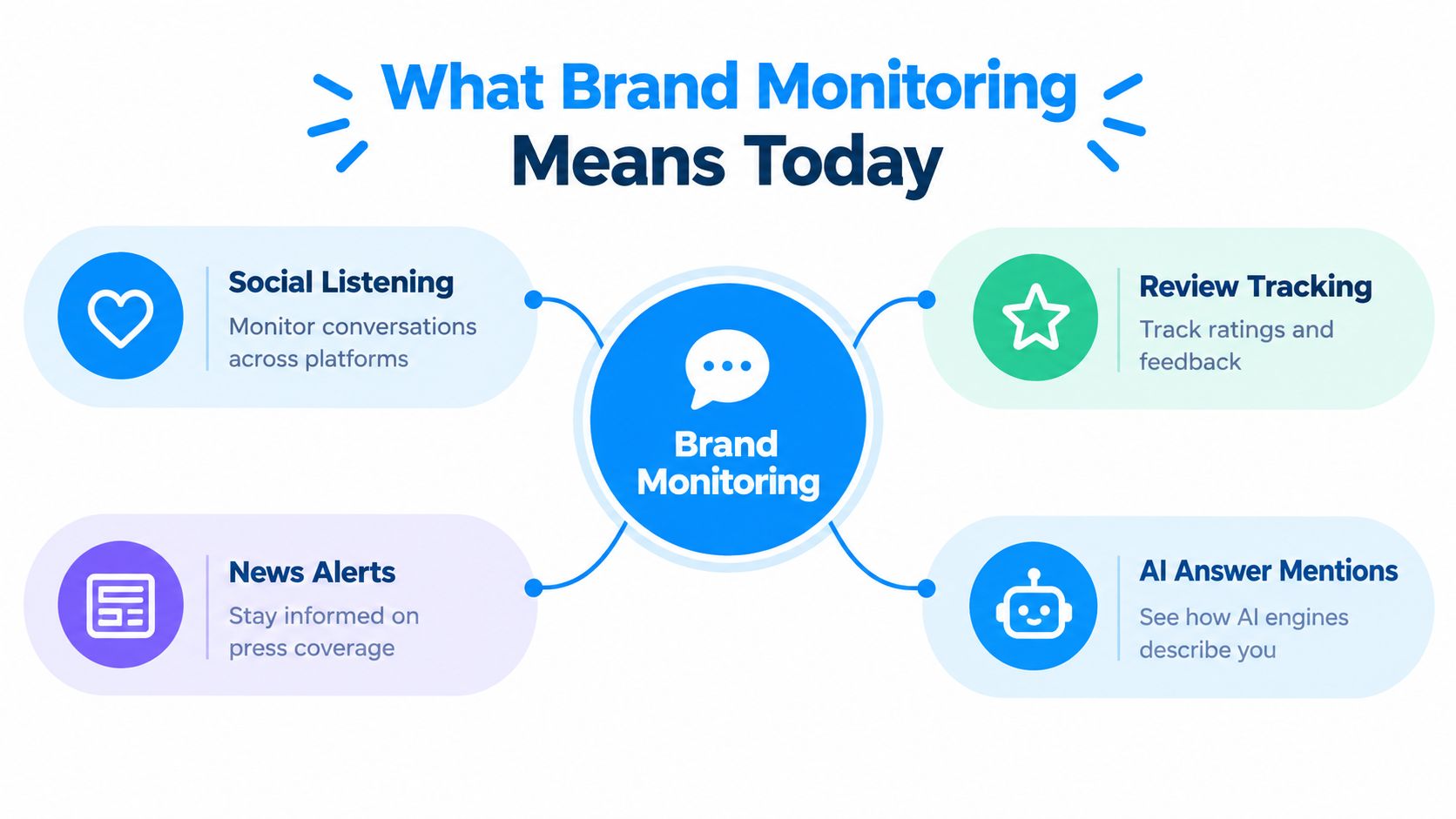
A credible program covers at least five connected surfaces:
Owned social channels: Replies, comments, tags, direct public feedback, and campaign reactions show how existing audiences respond.
Earned media and press: Articles, newsletters, podcasts, videos, and journalist requests reveal how others frame the company.
Third-party reviews: Review platforms expose recurring problems, perceived value, service language, and trust barriers.
Search results: Branded queries, news results, featured snippets, knowledge panels, and other SERP features shape what people see before they visit.
AI-generated answers: ChatGPT, Gemini, Perplexity, Copilot, and Google AI Overviews can summarize a brand, recommend alternatives, or repeat outdated information without producing a conventional visit.
The point isn't to collect everything indiscriminately. It's to identify which surfaces influence your customers, employees, partners, and regulators, then create a consistent record of what appears there.
Separate listening from action
A mention is an observation. An alert is a decision that something deserves attention. A response is an intervention. Treating those as the same thing creates either noise or delay.
For example, a neutral product mention may belong in a weekly insight report. A high-reach complaint about account access may need a same-day owner. A cluster of similar reviews can require product, support, legal, or communications involvement even if no individual post appears urgent.
The strongest programs preserve the original post, timestamp, platform, author type, reach, engagement, classification, owner, and final action. That record lets the next analyst understand why a decision was made instead of reopening the same question from scratch.
The Metrics That Actually Change Decisions
A dashboard earns its place when a team can look at a number and know what it changes. Total mentions rarely meet that test on their own.
Start with volume relative to baseline. A raw count can rise because a campaign succeeded, a product launched, or a platform became more active. Normalize the signal by platform and usual traffic, then look for unusual movement. A spike in complaints matters more than a spike in general mentions, especially when the topic is concentrated around reliability, safety, privacy, billing, or service.
Velocity adds the missing time dimension. A small topic accelerating quickly may deserve more attention than a larger topic declining steadily. Track how quickly a theme gains mentions, engagement, and new sources, then set escalation rules around sustained movement rather than one isolated post.
Sentiment needs detail. “Negative” is too broad to guide a response. Separate price objections from product defects, support failures, privacy concerns, and competitor comparisons. One team can address a support queue, while another updates documentation or investigates the product.
A comparative study reported 91.2% accuracy for BERT versus 78.4% for VADER across five industry-specific brand-review datasets, a 12.8-percentage-point gap. The comparative sentiment analysis study illustrates why generic scores need local validation. Maintain a labeled sample of your own mentions and review precision, recall, and F1 by topic and language. Automation should prioritize work, not make sensitive decisions without human review.
Use metrics as workflow triggers
Share of voice is useful only when the competitor set is explicit and stable enough to support comparison. Define which competitors matter for each market or product category, then use the signal to decide whether to strengthen content, pursue coverage, respond to a narrative, or investigate why another brand is being recommended.
For a practical explanation of the metric, see this guide to share of voice in marketing.
Metric | What It Measures | Decision It Should Trigger |
|---|---|---|
Mention volume against baseline | Whether conversation is unusually active | Investigate the topic and decide whether to escalate |
Issue-level sentiment | How people feel about a specific problem | Assign the signal to product, support, legal, or communications |
Share of voice | Relative visibility within a defined competitor set | Adjust content, PR, positioning, or competitive research |
Topic velocity | How quickly a narrative is spreading | Increase monitoring cadence and activate the response owner |
Reach and engagement | How much attention a mention attracts | Prioritize high-impact sources over low-reach repetition |
Response time | How quickly the brand addresses public contact | Review staffing, routing, and service-level rules |
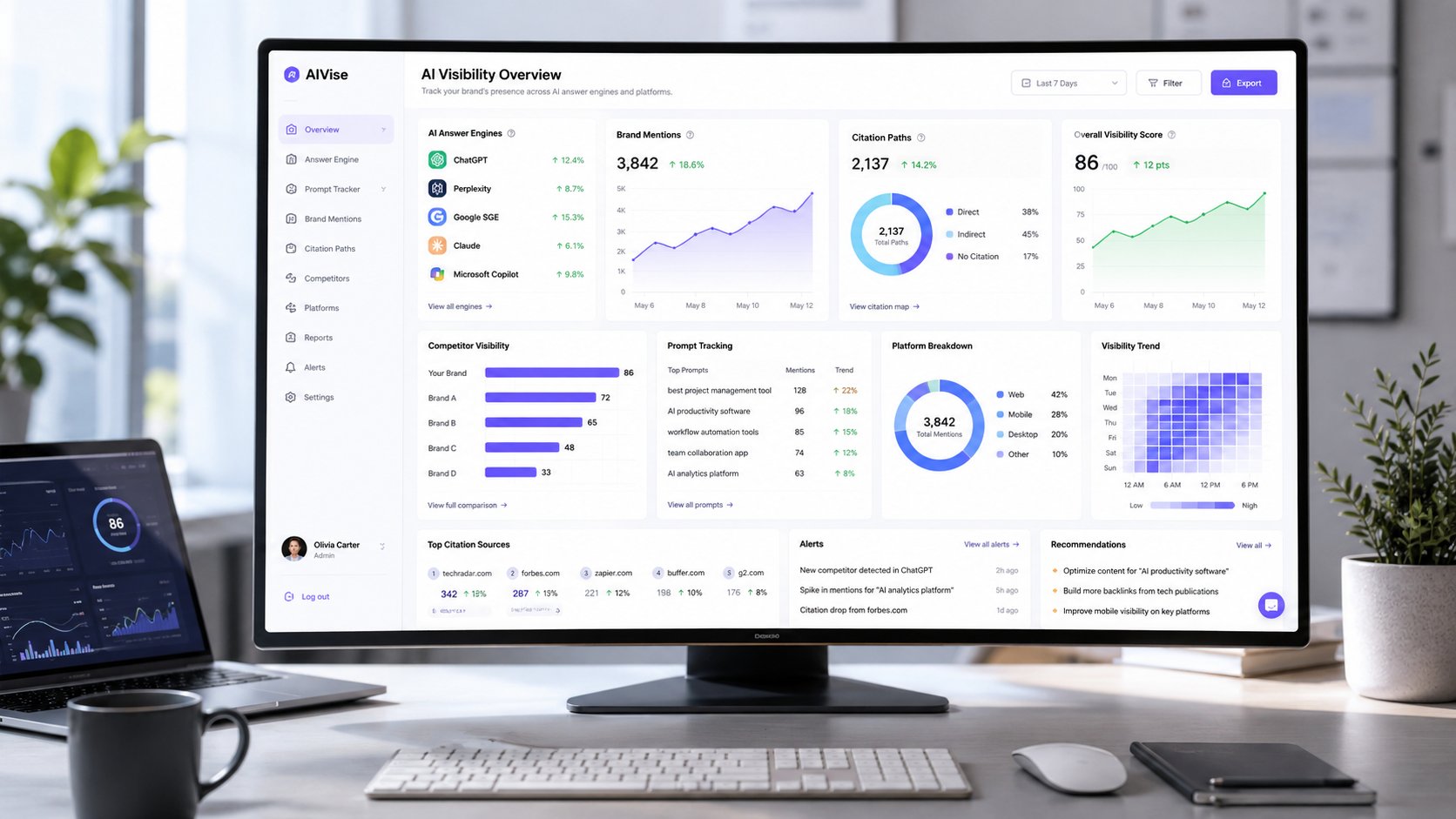
AI mention rate | How often an answer names the brand | Track visibility by prompt, model, market, and competitor |
AI citation rate | How often an answer supports the brand with a source | Audit cited pages and correct weak or inaccurate evidence |
Don't send every metric to Slack. A measurement helps you understand performance. An alert tells someone to act. Those are different products.
Why AI Visibility Is a Different Kind of Monitoring
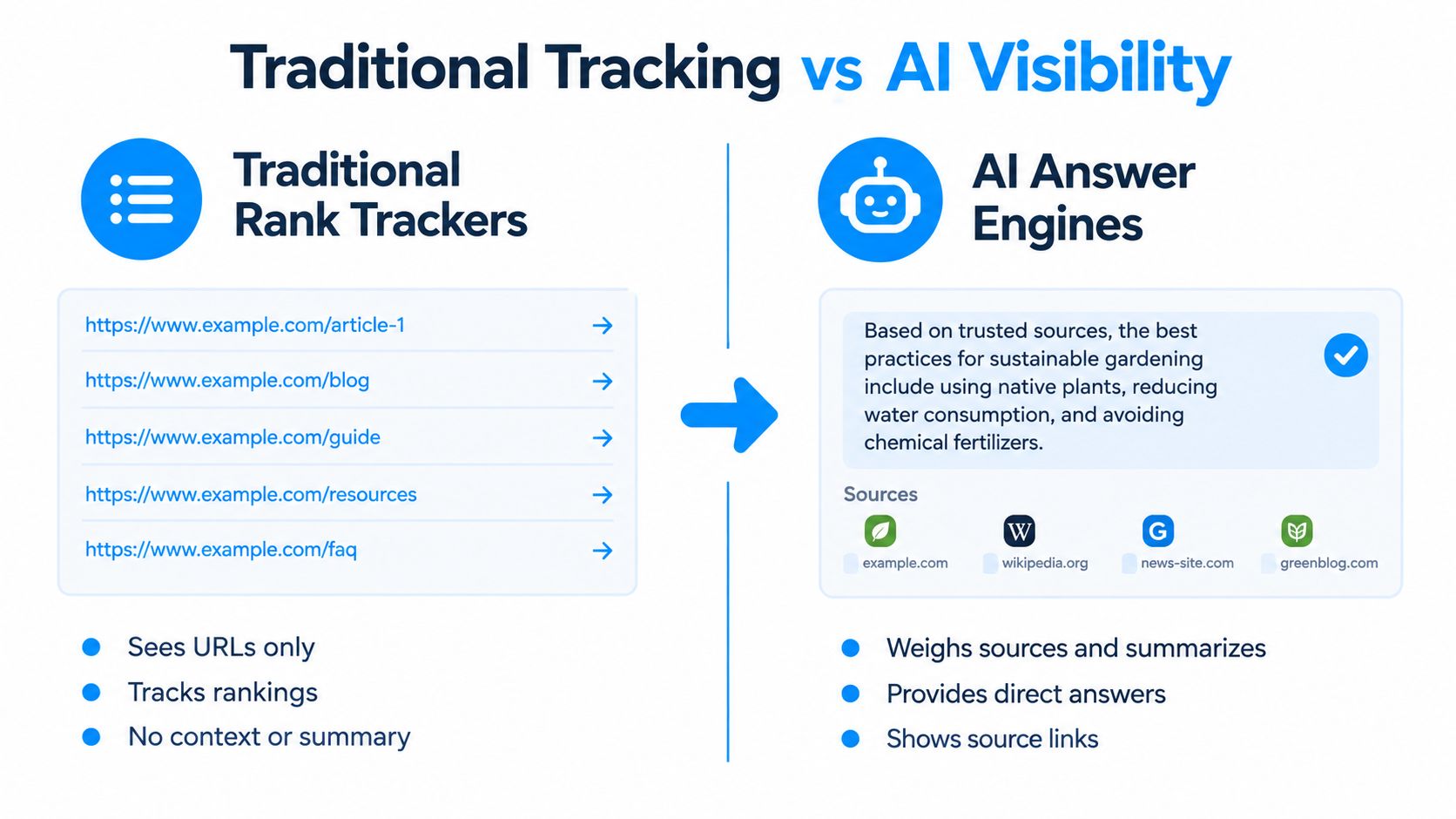
A conventional rank tracker records URLs in a results list. An AI answer engine may select sources, interpret them, summarize their claims, compare brands, and end the interaction without a click.
That difference creates two separate measurements. A mention tells you that the brand appeared in an answer. A citation tells you that a specific source supported the answer. The brand can win the mention while its own website, or any trusted source, fails to support the statement.
Recent industry analysis reported that fewer than half of the top 100 brands mentioned across AI platforms also appeared in the corresponding top-100 citation lists. The analysis of mentions and citations in AI answers makes the operational risk clear: visibility without reliable evidence can spread inaccurate or outdated descriptions.
Track the answer, not only the brand name
Prompt-level monitoring matters because AI visibility changes with context. A brand may appear for “best platform for…” but disappear for “alternatives to…” or appear with a qualification that makes it a poor fit. Record the prompt, model, market, response, mentioned brands, cited domains, cited pages, sentiment, recommendation position, and factual issues.
Source ecosystems also differ. One recent dataset reported that ChatGPT responses averaged about 15 sources, while Gemini averaged about three, with community and reference sites frequently appearing among the sources. The number of sources isn't a quality score. It shows why a single cross-model visibility number hides important differences in evidence and answer construction.
Monitoring brand visibility in AI results should therefore include:
Mention rate: How often the brand appears for a defined prompt set.
Citation rate: How often a source supports the brand's appearance.
Source quality: Whether cited pages are accurate, current, relevant, and trustworthy.
Citation ownership: Whether the source is controlled by the brand or comes from a third party.
Recommendation context: Whether the model presents the brand as a fit, an alternative, or a risk.
Competitor context: Which brands appear alongside it and how the comparison is framed.
The goal isn't to earn more citations. If an inaccurate third-party page drives a favorable-looking mention with a false claim, correcting the source may matter more than increasing citation volume.
A Realistic Weekly Monitoring Workflow
A small marketing or AEO team doesn't need a giant command center. It needs a repeatable queue, clear ownership, and enough context for decisions to survive staff changes.
Monday collection
Start with the sources that matter to your customers. Pull brand mentions from social platforms, news and web coverage, review profiles, forums, and relevant search results. Run a fixed prompt library across the AI surfaces you can check consistently, including category prompts, comparison prompts, problem-based prompts, and prompts using competitor names.
Tag every AI prompt so analysts can find the same query later. Keep the exact wording, market, language, model, date, and response archive. Small wording changes can produce different recommendations, so an untagged prompt history is difficult to interpret.
Midweek classification
Classify each signal by issue, sentiment, severity, stakeholder, and owner. A customer complaint, a journalist inquiry, an inaccurate citation, and a positive creator mention should not enter the same response queue.
Use severity rules that people can apply without interpretation. For example, route safety, legal, privacy, and high-reach allegations for human review. Batch routine praise and low-impact mentions into the weekly report. Log why an item was escalated, who approved the response, and whether the team replied, updated content, contacted a source, or opened a product ticket.

Thursday action and Friday review
Respond where a response helps. A public reply should acknowledge the issue without exposing private customer details. An outdated citation may call for a correction request to the source owner. A recurring product complaint belongs in a structured feedback loop, not only in a social reply.
Response speed affects reputation. In a survey of 1,817 consumers in the United States and United Kingdom, Sprout Social found that 76% valued brands responding quickly, 70% expected personalized responses on social media, 69% expected a response the same day, and 16% expected one within minutes. Sprout Social's consumer research supports tracking unanswered mentions and time-to-response by channel.
Review the week by asking:
What changed: Which topics, sources, competitors, or AI answers moved?
What slipped: Which alerts waited too long or reached the wrong owner?
What improved: Which response, content update, or source correction changed the narrative?
What repeats: Which complaint deserves a product, support, or editorial fix?
Use a shared log rather than a spreadsheet that only one analyst understands. A monitoring program becomes useful when the next person can inherit the reasoning, not just the raw mentions.
How to Choose the Right Monitoring and AEO Tools
Tool selection starts with coverage, not interface polish. Before a demo, write down the platforms, review sites, markets, languages, competitor names, and AI surfaces your team needs. Ask the vendor to show those sources using your own sample queries.
Five questions for a useful evaluation
What does the platform collect: Does it cover the social networks, forums, review sites, news sources, SERP features, and AI answer engines relevant to the brand? Check niche communities rather than accepting “web coverage” as a complete answer.
How does it handle AI answers: Can you see the exact prompt, full response, model, cited domain, cited page, competitor presence, and historical change? A dashboard that shows only one visibility score won't support source correction or content decisions.
How does pricing scale: Find out whether costs increase with brands, users, prompts, responses, provider usage, markets, or exports. A license fee can be easier to budget, while a bring-your-own-keys model can give a team direct control over provider costs and quotas.
What evidence can you inspect: Look for response archives, citation history, new and lost sources, source sentiment, and factual accuracy checks. If the tool can't show the evidence behind a score, the score won't travel well into a PR, content, or executive decision.
Where does the work happen: Test integrations, exports, permissions, tagging, alerts, and ownership fields. The best theoretical coverage fails if analysts must copy every finding into another system by hand.
Bundled suite or focused platform
A bundled SEO suite may be convenient when the team already uses its rank tracking, site auditing, and reporting. A platform built around answer-engine signals can offer deeper prompt histories, citation analysis, model comparisons, and generated-query visibility. The right choice depends on whether AI monitoring is an occasional report or a recurring operating function.
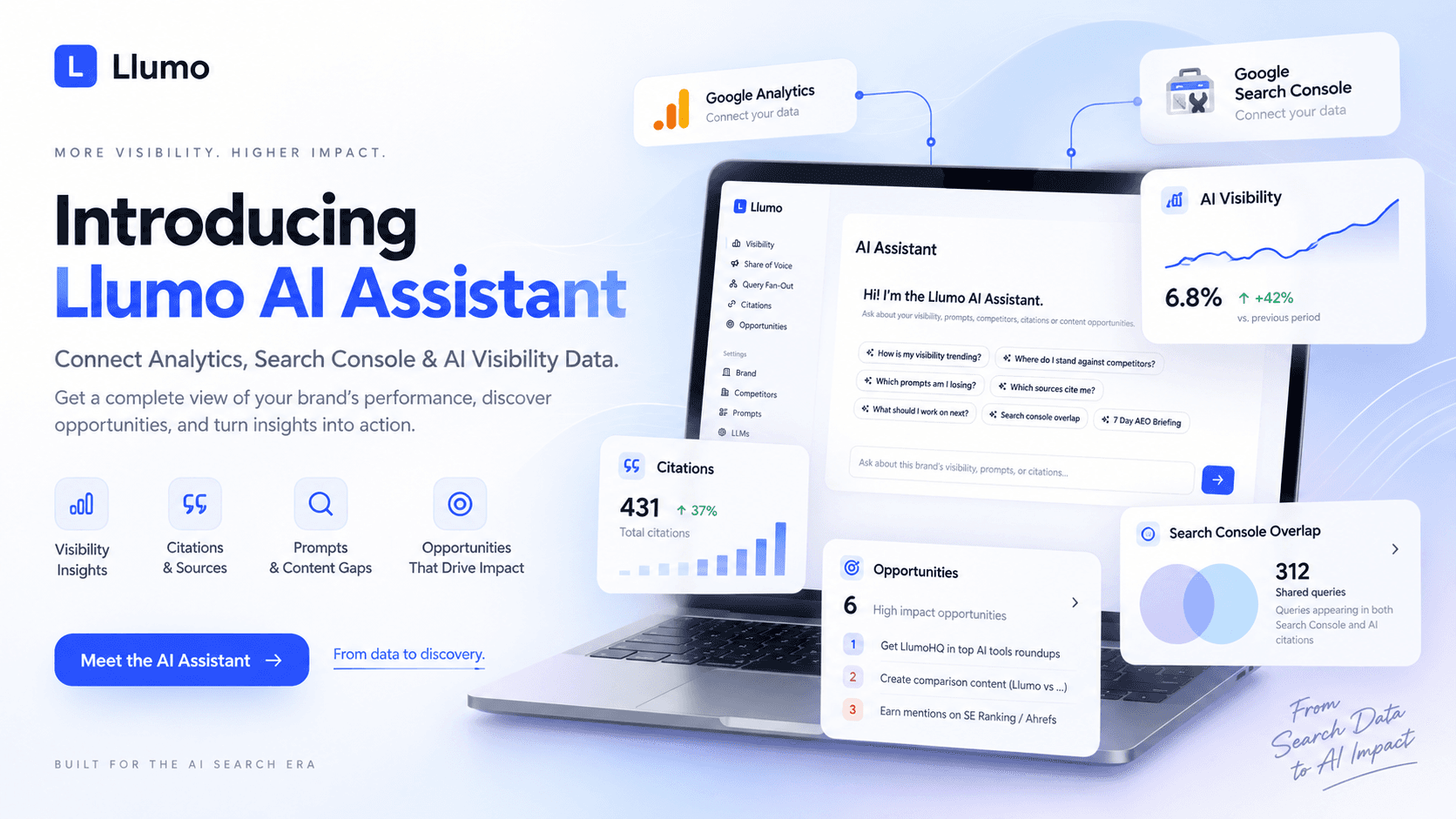
Llumo is one option for teams that need per-prompt AI visibility, competitor trends, citation sources, response archives, and tracking across models and surfaces such as ChatGPT, Gemini, Perplexity, Copilot, and Google AI Overviews. Its bring-your-own-key approach lets customers connect provider API keys and pay underlying provider costs directly, while the platform organizes prompts, citations, trends, and opportunities.

Run a short pilot before committing. Use a fixed prompt set, sample real review and social sources, test an escalation, and ask an analyst to complete a weekly report. You'll learn more from that workflow test than from another product tour. For broader context, compare the evaluation criteria with this guide to answer engine optimisation.
Common Misconceptions That Undercut Monitoring Programs
More mentions always mean more influence. They don't. A high mention count can come from a controversy, repeated low-quality posts, or inaccurate third-party descriptions. The better measure combines relevance, sentiment, reach, recommendation context, citation quality, and the action the mention creates.
AI impact is best measured by clicks. AI answers can influence consideration without sending a visit. Similarweb reported that generative-AI platforms produced more than 1.1 billion referral visits in June 2025, up 357% year over year, in its generative AI report. Referral activity matters, but it doesn't capture every recommendation or shortlist decision. Pair AI exposure with branded-search movement, direct traffic, assisted conversions, sales-team mentions, review activity, and changes in competitor consideration.
One dashboard covers everything. It usually doesn't. Social posts, reviews, SERP features, news, and AI answers have different data structures and different response requirements. A single executive view can be useful, but the underlying records should preserve each surface's context.
The compliance layer is easy to overlook. The FTC's Consumer Reviews and Testimonials Rule took effect on October 21, 2024 and permits civil penalties for knowing violations. It prohibits fake or false reviews, including AI-generated reviews that misrepresent real customer experience, incentives conditioned on a particular sentiment, undisclosed insider testimonials, deceptive company-controlled review sites, and suppression of negative reviews through threats or misleading claims. The FTC's questions and answers about the rule should inform review monitoring, moderation records, and escalation policies.

Putting It All Together and Where to Start
A healthy monitoring program treats mentions, citations, and zero-click influence as separate measurements. It covers social conversations, third-party reviews, search results, earned media, and AI answers, then connects each signal to an owner and a response rule.
Start with a defined competitor set and a focused prompt library. Connect the review platforms that matter, choose the AI surfaces you can check consistently, and preserve the first month of responses before expanding coverage. By the next planning cycle, you'll know which alerts deserve escalation, which sources need correction, and which content gaps affect both conventional search and AI answers.
Llumo helps teams monitor how AI answer engines mention and cite their brands, with per-prompt visibility, competitor trends, citation sources, and response archives across major AI surfaces. If you want to connect brand monitoring online with practical AEO measurement, visit Llumo and review how the platform fits your workflow.