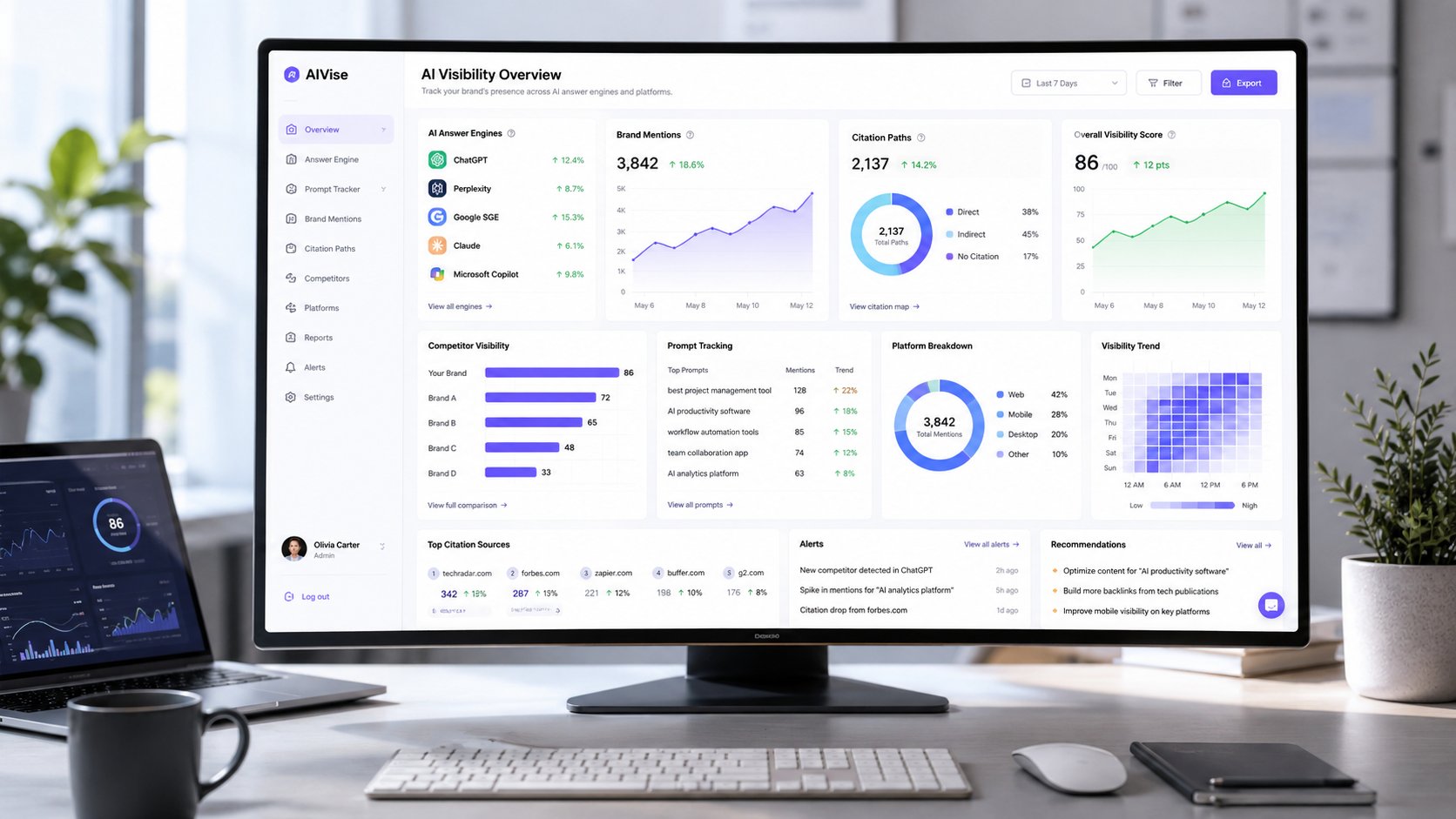

A traditional rank history, a Google AI Overview snapshot, and a prompt-level answer archive may all be called “historical data,” but they answer different questions. A rank tracker tells you how a page appeared in search results. An AI Overview monitor shows when Google placed a generated answer above those results. A prompt archive shows what ChatGPT, Gemini, Perplexity, Claude, or another engine said, which brands appeared, and which URLs supported the answer.
That distinction changes how you should evaluate the best AI search optimization historical data software. The right platform isn't necessarily the one with the largest dashboard. It's the one that preserves the evidence you need to diagnose a visibility change, compare competitors, and decide what to improve next.
This comparison focuses on model and surface coverage, historical depth, citation detail, exports, pricing transparency, and implementation effort. It also separates true multi-model answer tracking from Google AI Overviews monitoring, because those are related but not interchangeable use cases.
1. Llumo AI Answer Engine Visibility and Citation Tracking
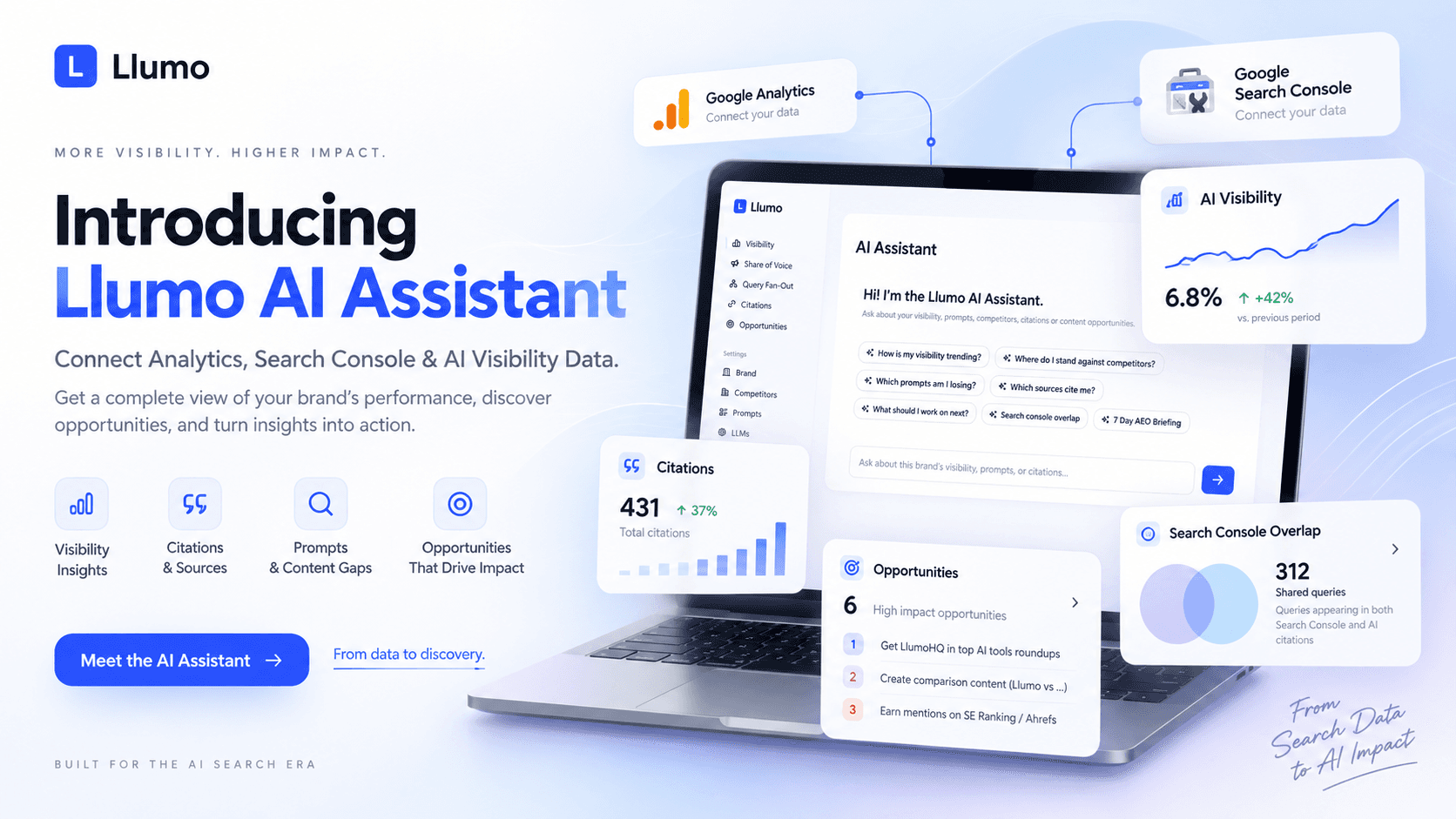
Llumo is designed around the evidence that many broad SEO platforms compress into a score. It tracks prompts across ChatGPT, Claude, Gemini, Grok, Mistral, DeepSeek, Perplexity, Copilot, and Google AI Overviews, then archives responses, mentions, cited sources, competitor trends, and query fan-out. That makes it one of the more direct fits for teams asking how answer-engine visibility changes across models rather than only how Google's generated SERP features change.
The platform's historical value is page and prompt specificity. You can see which page earned a citation, which references were lost, how competitor visibility moved, and how an AI system expanded a user's original query. That evidence supports a more practical workflow than a single visibility percentage because it connects a change to a source, prompt, model, or content opportunity.
A different cost and implementation model
Llumo uses a bring-your-own API keys approach. Customers connect provider keys and pay underlying provider costs directly, without a Llumo usage markup. This offers transparent consumption, but teams must manage quotas, budgets, and provider configuration themselves.
The hosted, branded instance supports unlimited projects, daily backups, and usage analytics. It also includes prompt search, tagging, filtering, share-of-voice measurement, and opportunity discovery for updates, new pages, and citation-earning initiatives. The trade-off is specialization. Llumo focuses on AI answer-engine signals rather than traditional SERP rank tracking, so teams may still need a separate SEO platform for conventional rankings and technical audits.

Best for: Prompt-level archives, cross-model comparison, citations, and query fan-out.
Budget advantage: Provider costs are paid directly through connected API keys, without platform usage markup.
Implementation consideration: Teams need to configure providers and manage consumption deliberately.
Operational benefit: Hosted branding, unlimited projects, backups, and usage analytics support agencies and multi-brand teams.
For a broader explanation of the workflow, see top answer engine optimization software. The product is available from Llumo.
2. Semrush AI Visibility Toolkit
Semrush makes sense when AI visibility needs to sit beside the rest of your SEO operation. Its AI Visibility Toolkit measures brand presence in generated answers across surfaces such as Google AI Overviews, ChatGPT, Gemini, and Perplexity, then brings prompt tracking, competitor comparisons, and roll-up reporting into a familiar SEO environment. You can review visibility trends without moving the entire team into a separate AEO system.
The useful distinction here is integration rather than maximum specialization. Semrush provides proprietary visibility metrics with definitions and methodology notes, plus a Visibility Overview and custom competitor sets. For teams already using Semrush One or a related Toolkit, that shared environment can reduce implementation friction and make AI visibility part of recurring SEO reporting.
Best fit and trade-offs
Semrush is a practical choice for SEO managers who want one reporting layer for organic search and AI-generated results. Its onboarding material and knowledge base should also help non-specialists understand the basic measurements before they build a monitoring program.
The limitations appear when monitoring becomes very deep. Prompt quotas and plan dependencies can constrain heavy tracking, while remediation guidance is lighter than what specialist AEO platforms may provide. If your core question is “how did our entire response and citation set change across models,” verify the archive detail before buying.
Choose it for: A mature SEO stack with AI visibility added to the same workflow.
Check first: Prompt limits, plan-specific coverage, and the exact historical fields available for export.
Useful companion: Google AI Overview tracking can complement a broader prompt program, as explained in this Google AI Overviews tracker comparison.
3. Similarweb AI Search Intelligence and GenAI Intelligence
Similarweb approaches AI visibility through a competitive intelligence lens. Its AI Search and GenAI Intelligence capabilities combine AI Overviews detection, brand-mention visibility, prompt tracking, citation and sentiment analysis, and estimated AI-driven traffic insights. That combination is valuable when the question isn't only “did we appear,” but also “did market attention, competitor visibility, or traffic direction change at the same time?”
The platform's strength is context. A brand team can connect prompt-level visibility with broader market and traffic signals, while analysts can use AI traffic APIs and documentation to construct custom historical views. AI Overviews tracking in Rank Tracker also supports cross-country detection, which matters for companies whose search presence changes by market.
Where Similarweb earns its place
Similarweb is strongest for competitive and market analysis, not necessarily for the leanest prompt archive. Its Brand Overview, Prompt Tracking, and Citation and Sentiment Analysis features help explain the surrounding environment, while APIs give data teams more room to build their own reporting layer.
There's a trade-off. Pricing is sales-led, so exact costs aren't publicly clear. AI traffic is modeled and estimated, which makes it directional rather than a substitute for exact click attribution. Treat it as a useful signal for comparison and trend analysis, not as a perfect record of every AI-originated visit.

Analyst view: Similarweb is more compelling when AI visibility needs to be interpreted alongside market movement, competitor activity, and modeled traffic direction.
4. SISTRIX AI Overviews and Prompt Monitoring
SISTRIX preserves two types of evidence that are often analyzed separately: SERP-led evidence and prompt monitoring. Its AI features extend an established SEO framework of countries, keywords, and domain visibility into Google AI Overviews and prompts across ChatGPT, Perplexity, and other leading AI products. Analysts can compare which keywords trigger an AI Overview, whether a domain is cited, and how those results change between markets.
That combination is the platform's main historical advantage. A conventional ranking shift can be examined alongside a change in AI citations, rather than treated as an unrelated event. Multi-country coverage also gives international teams a broader basis for comparison than a single-market view.
SISTRIX suits teams with existing SEO reporting processes. Historical graphs, quota management, and API access support exports and modular analysis, while prompt monitoring can sit beside established visibility metrics. This makes adoption more practical for analysts who need data for recurring reports rather than a separate editorial workspace.
The trade-off is implementation effort. Module-based pricing can be difficult to map to a specific program, and some capabilities require higher tiers. SISTRIX is built around SEO measurement, so its AEO guidance may provide stronger trendlines than detailed recommendations for content or digital PR. Teams should confirm:
Good match: International SEO programs requiring country-level historical visibility and citation trends.
Less suitable: Small teams seeking a lightweight answer-first workflow with extensive remediation guidance.
Validate: API access, module requirements, prompt quotas, and the distinction between Google AI Overview citations and chatbot responses.
5. STAT Search Analytics by Moz
STAT Search Analytics is built for organizations that need large-scale SERP intelligence and durable archives. Its AI Overviews monitoring identifies keywords that trigger generated answers, records cited sources, and tracks ownership or share of voice over time. The platform also stores daily HTML SERP archives, which gives analysts a richer record than a simple “feature appeared” flag.
That matters when you're investigating a shift. A team can examine the AI Overview, the cited sources, the surrounding organic results, and the market or device segment rather than relying on a single visibility score. STAT's segmentation and filtering are particularly useful when different devices, locations, or keyword groups produce different results.
Strong measurement, lighter remediation
STAT is a measurement platform first. It offers enterprise-grade SERP data quality, flexible reporting, and longitudinal analysis, but it won't necessarily tell a content team exactly how to rewrite a page or earn a new citation. That isn't a weakness if your analysts already own diagnosis and your content team has a separate execution process.
Pricing isn't public and requires sales engagement, so procurement may take longer than it would with a self-serve tool. For large keyword sets, though, the implementation effort can be justified by the depth of the archive and the ability to study AI Overviews as part of the full SERP.
If your investigation starts with a keyword list, device segment, or SERP change, STAT is likely a better fit than a platform designed primarily around conversational prompts.
Before choosing, compare the archive fields and reporting workflow with your needs in this AI Overview tracking tools guide.
6. seoClarity ArcAI and AI Overviews Tracking
seoClarity fits enterprise teams that need AI visibility inside a wider SEO operating system. ArcAI and its AI Overviews capabilities examine generated search features with market and device context, while the broader platform connects those findings with technical SEO, content intelligence, research, and reporting.
The product's value depends on how the team works. A large site can relate visibility changes to crawling, content inventories, technical diagnostics, and page-level strategy instead of treating AI search as a separate experiment. That model suits coordinated SEO operations better than a small team seeking quick monitoring for a limited prompt set.
The trade-off is implementation effort. Quote-based pricing and broader platform configuration may be excessive for a small AEO program. Before adoption, teams should assign ownership, define the data they need, and agree on how an AI Overview observation becomes an update across many pages.
seoClarity's education and research resources can support market analysis. Buyers should still separate understanding the market from preserving prompt-level answer evidence. AI Overview monitoring does not automatically provide a multi-model archive containing response text, citations, and query fan-out. Confirm which records remain available over time and whether exports include the underlying evidence.
For comparison, ask four practical questions:
Best for: Enterprise SEO teams coordinating technical, content, and AI search work.
Watch closely: Implementation scope, quote structure, market and device segmentation, and archive retention.
Ask in a demo: Whether the platform stores the answer and cited URLs, or only feature-level visibility signals.
7. Botify AI Visibility
Botify stands apart by connecting AI visibility with technical evidence. It tracks brand mentions across ChatGPT, Google AI Mode, Perplexity, Gemini, and Google AI Overviews, then places those observations alongside crawl data, AI bot activity, and share-of-voice reporting.
That combination changes the historical record being analyzed. A team can review whether a brand appeared for a prompt, which citations supported the answer, and whether crawl or log signals reveal barriers to earning visibility. Botify therefore suits enterprise SEO groups that already manage technical data, governance, and search performance together.
The product is strongest when diagnosis matters as much as discovery. Weekly reports and export capabilities support recurring reviews, while documented data sources can help regional or specialist teams apply the same definitions. This makes Botify more useful for controlled reporting than for a content team seeking page-by-page recommendations.
Implementation and execution remain the trade-offs. Enterprise pricing is not published, and the platform offers limited guidance for creating pages, revising content, or building citations. Teams should decide whether their existing workflows can turn measurement findings into action before committing.

Botify is a practical choice when:
Technical evidence is part of the decision: Crawl, log, and AI visibility records need to be reviewed together.
Reporting requires control: Several teams need shared definitions and repeatable exports.
Content execution already exists: Writers and SEO specialists have a separate process for acting on findings.
8. Conductor AI Search Performance
Conductor treats AI search performance as part of a wider content and optimization workflow. Its features track share of voice, competitor visibility, and prompt-level performance across AI engines, including Google AI Mode and AI Overviews. The platform also connects findings to content creation and optimization, which can shorten the distance between discovering a lost citation and assigning work to a content team.
The useful evidence isn't limited to whether a brand appeared. Prompt analysis can be segmented by market, model, and language, while share-of-voice benchmarking helps teams identify opportunity areas. That structure is helpful for organizations that need to compare markets or product lines rather than produce one blended visibility score.
Useful for teams that act inside the platform
Conductor's advantage is workflow continuity. Monitoring, competitive analysis, and content work can live in the same system, so the team doesn't have to export every finding into a separate editorial process. Frequent product updates, documented in release notes, also matter in a search environment where surfaces and definitions keep changing.
The trade-off is transparency during evaluation. Enterprise contracts are required, pricing isn't public, and methodology and coverage definitions may sit behind gated documentation. Buyers should insist on seeing the raw evidence behind a visibility metric, including prompts, response records, cited URLs, and retention rules.

A workflow is only as actionable as the evidence it exposes. Ask to see the answer-level record before accepting a roll-up score as proof of historical visibility.
9. Ahrefs Free Google AI Overviews Tracker
Historical AI visibility data is only useful when its scope matches the question. Ahrefs' free Google AI Overviews Tracker focuses on one evidence type: time-stamped records of brand mentions, citations, and appearing pages within Google AI Overviews. That makes it a practical entry point for teams that need a quick visibility check without adopting a full AEO platform.
Its limitation is equally important. The tracker does not preserve a cross-model prompt archive for ChatGPT, Gemini, Perplexity, or Claude, nor does it provide the broader market context or technical diagnostics found in larger platforms. It is a Google AI Overviews monitor that fits naturally alongside Ahrefs rank tracking and alerts.
Use the tracker to answer one operational question: where is our brand or page showing up in Google AI Overviews? The records can reveal presence and time-stamped changes, but they do not show how the complete answer evolved, whether competing models cited the same source, or how durable a citation was across answer engines.
That distinction affects tool selection. Ahrefs works well for a Google-focused SEO team testing whether AI Overviews have begun featuring its pages. Teams planning prompt-level research, cross-model comparisons, sentiment analysis, query fan-out analysis, or citation-source history will need a broader system.

Its practical role is a low-friction supplement to an Ahrefs-led workflow, not a complete historical data repository.
10. Nozzle AI Overviews Monitoring
Nozzle preserves the search page surrounding an AI Overview, which makes it different from tools that reduce visibility to a single score. It detects and extracts AI Overviews, archives complete SERPs, and supports flexible exports for custom trend studies. Analysts can therefore compare generated features with conventional organic rankings and examine how the page changed over time.
A useful investigation might show a conventional ranking falling while a page gains an AI Overview citation, or organic visibility remaining stable while the citation disappears. Because Nozzle stores the wider SERP, teams can examine those changes alongside competing results and other page elements.
Nozzle suits data teams that want to build their own historical views. Archived SERPs and exportable structures can be joined with internal keyword taxonomies, market data, or reporting systems, rather than interpreted only through a vendor-defined visibility metric. This makes the platform valuable for competitive forensics and research workflows where the surrounding SERP matters as much as the generated answer.
Its evidence has a clear boundary. Nozzle centers on Google AI Overviews and SERP records, not a cross-model prompt archive for ChatGPT, Gemini, Perplexity, or Claude. It is also less focused on diagnosing why a source was cited or recommending content changes. Pricing and packaging are less transparent than those of mass-market tools, so implementation and budget evaluation require care.

Choose Nozzle when analysts need to:
Archive complete SERPs: Preserve the relationship between AI Overviews and organic results.
Export raw structures: Create historical studies outside a fixed dashboard.
Investigate competitors: Compare generated and conventional search visibility.
Top 10 AI Search Optimization Tools, Historical Data & Features Comparison
Top pick: Llumo for teams that need prompt-level historical data, cross-model answer tracking, citation analysis, and transparent usage-based economics.
Product | Core features ✨ | Quality ★ | Value / Pricing 💰 | Target 👥 | USP ✨ |
|---|---|---|---|---|---|
🏆 Llumo, AI Answer-Engine Visibility | ✨ Multi-model prompt tracking; per-prompt visibility & SOV; citation analysis; query fan-out; opportunity discovery | ★★★★★ | 💰 BYO API keys; no platform license or per-prompt markup; transparent consumption | 👥 AEO specialists, enterprises scaling multi-model visibility | ✨ Hosted white-label instance; unlimited projects; prioritized AEO utilities |
Semrush, AI Visibility Toolkit | Visibility overview; prompt trackers; competitor sets; proprietary metrics | ★★★★ | 💰 Plan/add-on limits within Semrush One | 👥 SEO teams using Semrush | ✨ Integrated end-to-end SEO + AEO |
Similarweb, GenAI Intelligence | AI Overviews detection; brand mentions; AI traffic APIs | ★★★ | 💰 Sales-led; modeled traffic estimates | 👥 Market & competitive analysts | ✨ Strong market context & APIs |
SISTRIX, AI Overviews + Prompt Monitoring | Keyword triggers for AIO; prompt monitoring; multi-country | ★★★★ | 💰 Module pricing; tiered access | 👥 International SEO teams | ✨ Reliable multi-country historical trends |
STAT (Moz), AI Overviews Tracking | Keyword→AIO mapping; daily HTML SERP archives; feature tracking | ★★★★ | 💰 Quote/sales-led enterprise pricing | 👥 Large keyword programs & enterprises | ✨ Scale + deep SERP archiving |
seoClarity, ArcAI & AIO | AIO as SERP feature; research frameworks; content scale tools | ★★★★ | 💰 Quote-based; enterprise focus | 👥 Large sites & enterprise SEO | ✨ Enterprise research & education assets |
Botify, AI Visibility | Cross-engine mentions/citations; exports; AI in Search analytics | ★★★ | 💰 Enterprise pricing (private) | 👥 Technical SEO + enterprise teams | ✨ Ties AI visibility to crawl/log data |
Conductor, AI Search Performance | Prompt analysis by market/model; SOV; optimization workflows | ★★★★ | 💰 Enterprise contract required | 👥 Content & SEO teams needing workflows | ✨ Monitoring + built-in content workflows |
Ahrefs, Free AIO Tracker | Brand mention lookups; daily AIO checks; paired with rank tracking | ★★★ | 💰 💰 Free utility (limited) | 👥 Small teams & quick checks | ✨ Fast, no-signup directional snapshots |
Nozzle, AI Overviews Monitoring | AIO detection; full-SERP archiving; flexible exports | ★★★★ | 💰 Pricing less transparent; custom | 👥 Data researchers & analysts | ✨ Very deep historical SERP depth |
Choose the History You Will Actually Use
The best AI search optimization historical data software depends on the evidence your team will act on. If your program is primarily Google-led, prioritize AI Overview history, SERP context, market segmentation, and device-level records. STAT, Nozzle, SISTRIX, Ahrefs, and enterprise SEO platforms are more relevant when the investigation starts with keywords and search-result changes.
If your work is answer-engine optimization, the priority shifts to prompt archives, full response text, citations, source pages, competitor trends, and model comparisons. A mention without the cited URL won't tell a content team which page earned visibility. A citation without the original answer won't show how prominently the brand appeared or whether the model framed it positively, neutrally, or as one option among many.
Market context matters for a different reason. Similarweb is more relevant when analysts need to connect AI visibility with competitors, estimated traffic direction, and broader market movement. That context can help explain why a brand's visibility changed, but modeled traffic shouldn't be confused with exact click attribution.
Technical teams should start elsewhere. If crawl behavior, AI bot activity, logs, and governance sit at the center of the program, Botify or an enterprise SEO platform may offer a more coherent operating environment. seoClarity and Conductor can also fit organizations that want AI search findings connected to content and technical workflows, although their implementation and commercial models require closer evaluation.
Before committing, run a controlled test:
Use representative prompts: Build a fixed set of buyer-research questions across your priority products, markets, and competitors. A practical starting workflow uses 30 to 50 prompts, rerun weekly on ChatGPT, Gemini, Perplexity, and Claude at the same time to reduce timing noise, as described in this historical AI search tracking workflow.
Inspect the raw record: Confirm that the platform stores the complete response, cited URLs, prompt, model, market, and timestamp, rather than only a summarized score. Citation and source-domain tracking are central to a durable archive, as outlined in this AI visibility feature overview.
Test page-level history: Check whether you can compare new and lost citations, identify the page that earned a reference, and see where that page appeared in the citation list. That page-level record is what turns mention tracking into a usable archive, as described in this AI visibility citation workflow.
Review exports and retention: Ask how long records remain available, whether raw responses can be exported, and whether your team can retrieve data through an API.
Label modeled metrics: Confirm which figures are observed directly and which are estimated, especially for AI traffic and market signals.
Budget consumption: Check prompt quotas, plan limits, API costs, refresh frequency, and any provider keys you must supply.
Historical data creates value only when someone can explain a change and assign the next action. Choose the platform that preserves the evidence your team will review, export, and use in content, technical SEO, competitive intelligence, or digital PR decisions.
If you need multi-model prompt archives, citation tracking, competitor trends, and query fan-out in one hosted workspace, explore Llumo. Connect your own provider API keys, monitor AI answers across major surfaces, and build a historical visibility record your team can use to prioritize content and citation work.