
Google AI Overviews appeared on 48% of Google search queries in one analysis, while another method reported 60.32% in U.S. queries, so the best AEO tool is the one that shows where your brand appears, what gets cited, and what to fix next. For teams prioritizing multi-model, prompt-level visibility and transparent usage costs, Llumo is the strongest fit, while Semrush, seoClarity, BrightEdge, SISTRIX, SE Ranking, and AWR make more sense for enterprise SEO integration, Google-focused monitoring, global research, or high-volume rank tracking.
AEO Tracking Starts Where Rank Tracking Stops
Traditional rank trackers tell you where a page appears in a list of links. They don't show whether ChatGPT recommends your brand, whether Perplexity cites a competitor instead, or which source Google AI Overviews selected for a compact answer. That distinction matters because AI-generated responses combine mentions, descriptions, and citations into one buying journey.
This roundup compares seven of the best AEO tools by the job each one handles best. The practical criteria are model and Google AI coverage, prompt and citation evidence, competitive reporting, pricing approach, and how easily each platform turns findings into content, technical work, or outreach.
AI Overviews are especially citation-constrained. A study reported an average answer length of 157 words, with an average of five cited sources per query, and found that 90% of overviews contained eight or fewer sources (Surfer's analysis of AI Overviews). That makes source tracking more useful than another generic visibility score.
Llumo is the specialist option for teams that want per-prompt visibility, share of voice, citation analysis, and usage-aligned costs. It isn't automatically the right choice for a company that already runs a large enterprise SEO stack, but it gives AEO practitioners unusually direct evidence about what AI systems say and cite.
1. Llumo
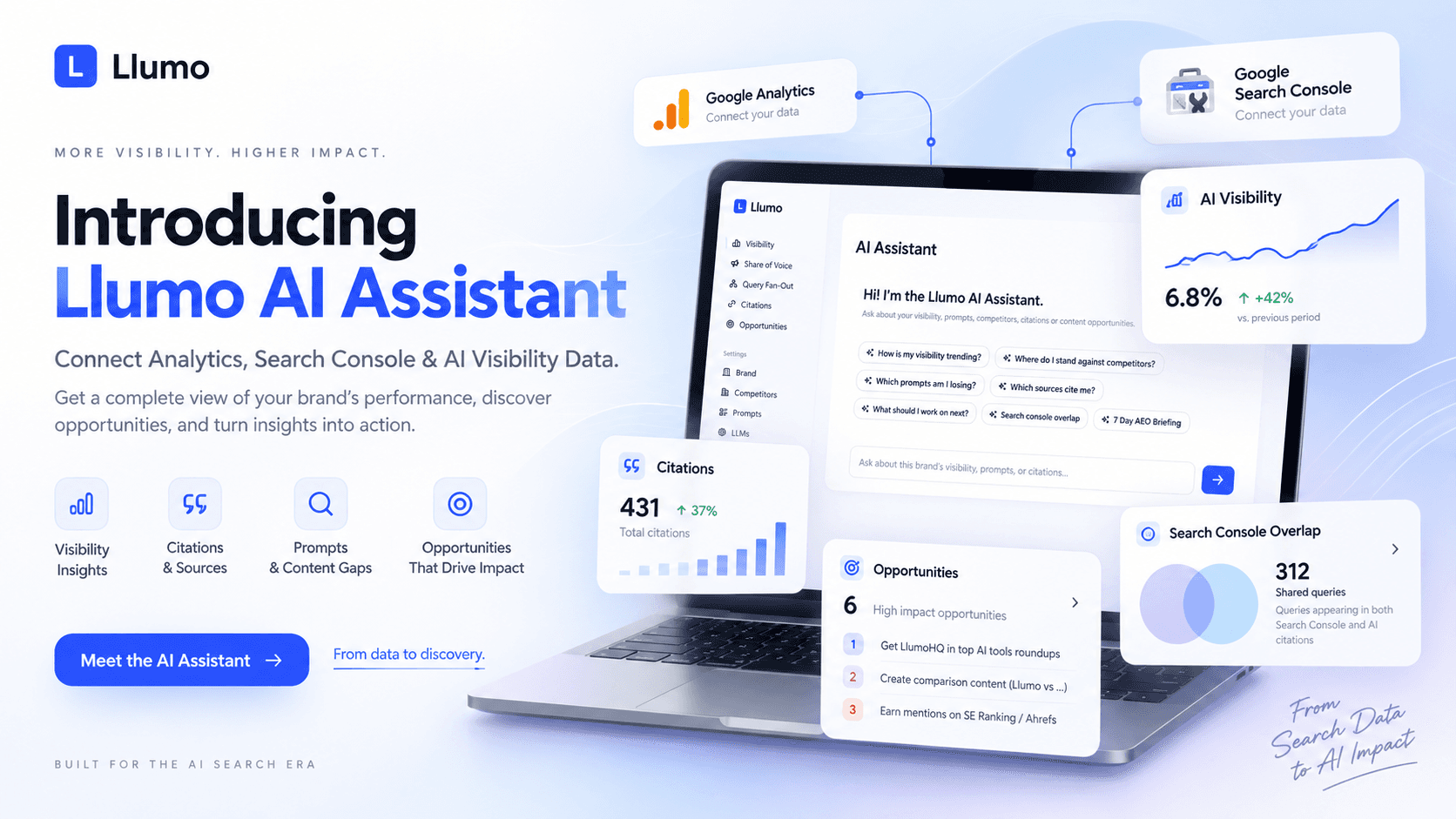
Llumo is the strongest choice when the main question is, “Where are we mentioned, cited, and losing ground across AI answer engines?” It tracks ChatGPT, Gemini, Claude, Perplexity, Copilot, Google AI Overviews, and other surfaces at the prompt level, rather than treating AI visibility as a thin extension of keyword rankings.
The useful detail is in the evidence. Llumo stores prompt-level responses, the sources used by each model, competitor trend lines, share of voice, and query fan-out activity. Query fan-out shows how an answer engine expands one user question into multiple searches before producing a response, which is important because the visible prompt isn't always the full retrieval path.
Practical rule: Don't judge an AEO tool by its mention count alone. Check whether it can show the exact prompt, response, cited page, competitor, and change over time.
Why Llumo stands out
Llumo's cost model is different from a conventional bundled platform. There's no core software license fee, customers connect their own provider API keys, and they pay underlying provider usage directly without Llumo usage markup. The trade-off is that API management and variable billing remain with the customer, so finance and technical teams need clear budgets and usage controls.
The platform also connects measurement to action. Its opportunity discovery identifies content updates, new pages, and brand-mention building opportunities, helping teams move from “we weren't cited” to a concrete editorial or digital PR task. That addresses a common weakness in AEO software, where monitoring reveals a gap but leaves the team to work out what happens next. Research on AEO analysis tools highlights this operational divide between finding visibility problems and fixing them.
Pros
Multi-model visibility: Track mentions and citations across major AI surfaces with per-prompt archives and competitive trends.
Transparent usage economics: Bring your own provider keys and pay providers directly, without platform usage markup.
Actionable citation analysis: Identify the domains and pages shaping answers, then prioritize content and outreach opportunities.
Enterprise control: Use unlimited projects and brands, dashboards, backups, custom branding, and a dedicated hosted instance on a customer subdomain.
Cons
Variable provider costs: Your team manages API keys, quotas, and billing complexity.
No public tiered pricing: Buyers should request a detailed usage projection rather than assume a standard seat-based plan.
Coverage needs validation: Model coverage can differ between APIs and scraping, so run a pilot across the engines that matter to your audience.
Limited supplied proof points: No customer testimonials, awards, or independent case studies were provided for this comparison.
Llumo is best for AEO specialists, agencies, growth teams, competitive intelligence practitioners, and brands that need a practical path from citation evidence to execution. Explore the Llumo AI visibility platform if that operating model matches your team.
2. Semrush
Semrush makes the most sense when AI visibility needs to sit beside an established SEO workflow. Its AI Visibility Toolkit and Semrush One connect brand and citation monitoring in Google AI Overviews, Google AI Mode, ChatGPT, Gemini, and Perplexity with position tracking, site audits, competitive research, Google Search Console, and Google Analytics.
That integration is the appeal. A team can investigate an AI visibility change alongside organic rankings, technical issues, and search performance without asking analysts to reconcile several disconnected systems. For enterprise SEO departments, that can matter more than having the deepest possible prompt archive.
The limitation is focus. If your only requirement is detailed cross-model prompt monitoring, Semrush may feel heavier than necessary, and the AI toolkit uses custom pricing that can move into enterprise territory. The platform is strongest when the buyer already values its broader SEO ecosystem.
Semrush also fits teams that need to understand AI visibility in the context of traditional search. A recent comparison of AI visibility trackers notes that tools using estimated prompt volumes or keyword proxies can produce a different picture from platforms grounded in real prompt data (analysis of AEO platform methodology). Ask Semrush how its prompt set is built, how often each engine refreshes, and whether the data matches your markets.
Best for: Enterprise SEO teams that want AI visibility and classic SEO reporting in one platform.
Trade-offs: Strong integration and mature workflows, but potentially high cost and more platform breadth than a focused AEO team needs.
For a broader comparison of monitoring approaches, see this guide to AI visibility trackers for SEO and marketing agencies, then verify current Semrush packaging directly through Semrush.
3. seoClarity
seoClarity is built for large SEO organizations that need durable Google AI Overview monitoring across substantial keyword sets. Its ArcAI functionality reports when tracked keywords trigger an AI Overview, supports time-range analysis, and connects those changes with wider rank intelligence and content workflows.
The product's strength is governance. Enterprise SEO teams often aren't trying to inspect a handful of prompts manually. They need recurring reports, change detection, ownership, and a way to see whether AI Overview presence is shifting across markets, categories, or business units. seoClarity's established enterprise structure is well suited to that operating model.
The compromise is model breadth. This is primarily a Google-focused product, so teams that care equally about ChatGPT, Claude, Gemini, Perplexity, Copilot, or other answer engines may need a second platform. That isn't necessarily a weakness if Google AI Overviews account for most of your search exposure, but it should be an explicit buying decision.
Google's answer format also makes separate AEO measurement necessary. One search industry analysis found that AI Overviews can generate visibility while producing fewer clicks than classic blue links, reinforcing the need to track answer presence separately from standard rankings (Search Engine Land's analysis of AI Overview citations and clicks).
Choose seoClarity when:
Google governance is central: Your reporting is organized around Google AI Overview presence by keyword and market.
Scale matters: You need long-running monitoring across large enterprise keyword sets.
Existing modules matter: Rank intelligence and content workflows already live in seoClarity.
Look elsewhere when: Your primary requirement is multi-LLM coverage, prompt-level response archives, or recommendations that prioritize the next content and outreach action.
The platform's pricing isn't public and should be evaluated as an enterprise purchase. Review the seoClarity ArcAI offering and compare its Google coverage with a specialist tool before signing a broad contract. A useful overview of AI Overview tracking tools can help frame that comparison.
4. BrightEdge
BrightEdge's Generative Parser is a good fit for large brands that already rely on BrightEdge for enterprise SEO reporting. It detects AI Overviews and their cited sources, then connects AIO trends with clicks and impressions. That performance context gives executives a more familiar way to discuss generative search than a standalone mention or citation score.
The practical benefit is continuity. SEO leaders can place AI Overview changes beside organic visibility and performance data, while BrightEdge's research and reporting help internal teams explain how the search surface is changing. For a company with established dashboards, permissions, and reporting routines, avoiding another isolated tool can be a meaningful advantage.
BrightEdge is still primarily Google-focused. If your program measures recommendations and citations across several LLMs, you'll need to confirm the exact coverage available to your organization and may need complementary monitoring. AI visibility is also not the same as a link impression. Independent research found that Google AI Overviews included a link only 10.7% of the time across more than 31,000 brand mentions, which shows why brands should track mentions and citations separately (Ahrefs research on AI citations and impressions).
What BrightEdge handles well
Performance reporting: Tie AI Overview changes to clicks and impressions inside an enterprise SEO environment.
Citation visibility: Inspect the sources associated with detected AI Overviews.
Executive education: Use research and reporting to help stakeholders understand generative search developments.
Enterprise governance: Keep ownership, workflows, and reporting within a mature SEO suite.
Where it falls short
Enterprise-only access: Pricing and availability are designed for large organizations.
Google emphasis: Broader LLM coverage may require another tool.
Execution distance: Reporting can identify an opportunity, but teams still need a clear process for content updates and outreach.
BrightEdge works best when the organization values integrated reporting above independent AEO specialization. Review the BrightEdge Generative Parser alongside your existing SEO stack before treating it as a complete multi-model solution.
5. SISTRIX
SISTRIX is the most natural choice here for teams that need structured European and global search research without abandoning a familiar SEO suite. It tracks brand appearances in AI answers, monitors AI Overview presence across countries, and provides grouped prompt views for AI and chatbot research.
Country-level filtering is particularly useful for international teams. An answer engine may cite different sources, describe a brand differently, or surface different competitors by market. SISTRIX lets practitioners organize that work around countries, keyword filters, and grouped prompts instead of looking at one undifferentiated global score.
The platform also sits in a useful middle ground. It offers more than Google-only AIO monitoring, but it doesn't position itself as a complete content execution system. That makes it a good research and measurement layer for teams that already have writers, SEO managers, and PR partners working in other tools.
The best global dashboard is still only useful if each market has its own prompt set, competitor set, and review process.
SISTRIX's modular packaging requires planning. Package-dependent details and annual contracts can make the total cost less obvious than a simple monthly subscription, especially when teams add countries, prompt groups, or related SEO modules. Ask for a model-by-model and market-by-market usage estimate before comparing it with flat or usage-based alternatives.
Best fit
European and global SEO teams: Use country filters and structured views to compare markets.
Research-led practitioners: Analyze prompts and AI features without expecting a built-in execution engine.
SEO suite users: Keep AI research close to established visibility and competitor data.
Not the best fit
Action-first teams: The platform is less prescriptive about exactly what to fix next.
Broad execution programs: Content updates, digital PR, and managed AEO work may need separate systems or services.
Buyers seeking simple pricing: Modular details and annual commitments deserve close review.
See the SISTRIX AI Search and AI Overview tools for current coverage, country options, and package details.
6. SE Ranking
SE Ranking is a sensible option for teams that want AEO monitoring alongside everyday SEO work without moving immediately to an enterprise suite. Its AI Search Add-on and SE Visible dashboards cover brand mentions, citations, and share of voice across Google AI Overviews, Google AI Mode, ChatGPT, Gemini, and Perplexity.
The interface fits the way many SEO teams already operate. AI visibility appears beside rank tracking, site audits, competitor research, and reporting, so a strategist can connect a citation gap with the page, ranking, or technical issue that might be contributing to it. API access and competitive benchmarking add value for agencies and teams that need to move the data into wider reporting.
The pricing model requires discipline. SE Ranking uses checks, where one prompt on one engine equals one check. That is easy to understand, but it means a program covering many prompts, markets, competitors, and engines can consume its allowance quickly. Build your expected checking volume before selecting an add-on, and reserve higher-frequency monitoring for prompts tied to commercial priorities.
What works well
Integrated workflow: Keep AEO visibility beside rankings, audits, and competitor research.
Clear usage unit: The one-prompt, one-engine check model is straightforward to forecast.
Competitive reporting: Compare visibility and citations against defined competitors.
Practical entry point: The add-on structure can suit teams that don't need a full enterprise governance layer.
What to watch
Overage planning: Broad prompt coverage can use checks faster than expected.
Feature depth: Advanced enterprise change detection may be less developed than in top-tier suites.
Add-on dependency: AI visibility requires an additional package rather than being the default experience.
Use the SE Ranking AI Search Add-on when your team values one practical SEO workspace and can forecast prompt consumption accurately.
7. Advanced Web Ranking
Advanced Web Ranking is built for practitioners who care about granular tracking and historical visibility at scale. It measures presence in Google AI Overviews and AI Mode, along with visibility across ChatGPT, Perplexity, Gemini, and Claude. Reports can include citation and link presence, historical changes, local tracking, and SERP timelines.
AWR's strongest quality is specificity. It feels closer to a specialist rank tracker than a broad marketing platform, which suits agencies and in-house teams that need repeatable monitoring across large tracking programs. Its reporting templates also give teams a structured way to discuss AIO strategy, citation optimization, and competitor movement.
The main limitation is frequency by plan. Lower tiers default to weekly checks, while higher-frequency monitoring requires larger plans. That may be perfectly acceptable for stable informational prompts, but it can be frustrating when teams want to investigate volatile commercial queries or observe rapid changes after a content update.
AWR also stays focused on tracking. It won't replace a content optimization platform, digital PR workflow, technical audit suite, or managed AEO service. That narrower scope is a benefit for buyers who already have those systems, but a cost for teams trying to consolidate everything.
AWR is strongest for:
High-volume tracking: Monitor large sets of rankings, AI presence, and citation changes.
Local and global work: Use market-specific tracking with historical timelines.
Reporting-led teams: Apply purpose-built templates to recurring AIO and competitor reports.
Tracking specialists: Keep measurement separate from content production and execution.
AWR is weaker for:
Real-time programs: Higher checking frequency may require a larger plan.
End-to-end AEO: Opportunity prioritization and content execution sit outside the core tracker.
Small, simple needs: A narrower tracking platform may be more than a team needs for occasional checks.
Review Advanced Web Ranking's AI visibility tracking and compare its checking cadence with your actual monitoring schedule. Agencies that need a broader tracker context can also review this guide to rank tracking software for agencies.
Top 7 AEO Tools, Feature Comparison
Tool | 🔄 Implementation Complexity | ⚡ Resource Requirements | ⭐ Expected Outcomes | 📊 Ideal Use Cases | 💡 Key Advantages |
|---|---|---|---|---|---|
Llumo | Medium, BYO API keys, multi‑model setup, optional hosted instance | Medium, customer‑borne provider costs; technical key management | High, per‑prompt visibility, citation/source clarity | AEO/SEO teams, agencies, competitive intelligence needing cross‑LLM citation tracking | Multi‑model per‑prompt visibility; transparent BYO pricing; enterprise features without license fee |
Semrush, AI Visibility Toolkit / Semrush One | Medium‑High, enterprise integrations (GSC/GA) and platform onboarding | High, enterprise pricing likely; integration work | High, unified AI‑answer and traditional SEO insights | Enterprises wanting combined SEO + AI visibility and workflows | Integrates classic SEO tools with AI visibility at enterprise scale |
seoClarity, ArcAI | High, enterprise deployment and workflow configuration | High, enterprise‑tier pricing and support | High (Google‑centric), large‑scale AIO detection and reporting | Mature enterprises focused on Google AI Overviews governance | Scales to very large keyword sets with deep reporting and change‑detection |
BrightEdge, Generative Parser (BGP) | High, enterprise suite integration and reporting setup | High, enterprise access and contracts | High, ties AIO/SGE detection to clicks/impressions | Large brands needing enterprise reporting and performance linkage | Deep AIO reporting, research, and metrics connecting AIO shifts to performance |
SISTRIX, AI Search & AIO Tracking | Medium, modular setup with country/prompt filters | Medium, modular pricing, typically annual | Medium‑High, strong European/global prompt tracking | Teams needing country‑level AIO filters and prompt‑level analysis | Strong EU/global coverage; structured prompt grouping and multi‑model research |
SE Ranking, AI Search Add‑on | Low‑Medium, add‑on activation, checks‑based model to plan | Low‑Medium, cost‑effective add‑on but requires check planning | Medium, integrated AI visibility with SEO workflows | Small‑to‑mid teams seeking affordable AI visibility within an SEO suite | Clear add‑on packaging; places AI visibility alongside routine SEO tools |
Advanced Web Ranking (AWR) | Medium, specialist rank‑tracker configuration and templates | Medium, high‑volume monitoring may need larger plans | High, granular AIO presence, citation and historical SERP data | Organizations needing detailed, high‑frequency rank and AI visibility tracking | Purpose‑built AIO templates and strong citation/rank tracking depth |
Choose the Signal You Need to Act On
The best AEO tool isn't the one with the longest engine list. It's the one that produces evidence your team can trust and work your team can execute.
Choose Llumo when you need transparent, multi-model prompt and citation monitoring, share of voice, query fan-out evidence, and prioritized opportunities. Its bring-your-own-keys model avoids a core software license fee and usage markup, but it also means your team owns provider billing and must manage usage carefully. That trade-off is attractive for technical teams, agencies, and brands that want costs aligned with actual responses rather than forced enterprise tiers.
Choose Semrush, seoClarity, or BrightEdge when enterprise SEO integration and governance matter more than specialist multi-model depth. Semrush is the broadest fit for teams already using its SEO stack. seoClarity is strongest for large-scale, Google-centric AI Overview monitoring. BrightEdge is useful when executives need AI Overview changes tied to clicks, impressions, and established enterprise reporting.
Choose SISTRIX for structured European and global research, especially when country filters and grouped prompt views are central to the program. Choose SE Ranking when you want a cost-conscious SEO workflow with AI visibility beside rank tracking, audits, and competitor research. Choose AWR when granular, high-volume tracking and historical reporting matter more than built-in content execution.
The measurement method matters as much as the vendor. AI Overviews can vary sharply by dataset and geography, with reported prevalence ranging from about 18% of Google searches in March 2025 to much higher results in later analyses (Google AI Overview statistics and methodology comparison). Treat that variation as a reason to test tools against your own markets, not as a reason to accept a single universal score.
Run a pilot with the same prompts, engines, competitors, markets, citation evidence, reporting requirements, and expected checking volume. Check whether each platform records the actual response, distinguishes a brand mention from a citation, exposes the cited page, and gives your content or outreach team a clear next action. Independent coverage also reports that only 22% of marketers currently track AI visibility, while AI-referred visitors convert at 4.4 times the rate of organic visitors, according to HubSpot coverage of AI visibility tools. The gap between measurement and adoption makes a reliable operating process more valuable than another attractive dashboard.
Llumo gives teams multi-model, per-prompt visibility across AI answer engines, with share of voice, citation sources, query fan-out logs, competitor trends, and prioritized content and outreach opportunities. If you want to compare those signals with your current SEO reporting and build a more transparent usage model, visit Llumo and evaluate it with the prompts and markets that matter most to your business.