
A marketer types a buyer's question into ChatGPT, expecting to see their brand among the recommendations. Instead, three competitors appear in the answer, each with a short explanation and a source link. The brand's latest comparison page ranks well in Google, yet it's missing from the conversation that now shapes the buyer's shortlist.
That gap is the practical reason AI SEO tracking exists. Classic rank tracking tells you where a page appears on a results page. AI visibility tracking asks a different question: does the brand appear inside the answer, which pages support that answer, and does the result change across engines, prompts, and markets?
AI answers compress discovery into a short response. Users may not visit ten results or compare several blue links. They may read one synthesized paragraph, notice the brands named there, and continue directly to a product page or a follow-up question. Google AI Overviews have expanded enough to make this a distinct measurement problem. One independent roundup reported AI Overviews on about 48% of tracked queries by February 2026, while a separate live tracker cited roughly 75% of personalized U.S. results in August 2026. The same analysis noted that Google Search Console's dedicated AI Overview reporting began as a limited impressions-only rollout and didn't provide clicks, CTR, or query-level detail. That reporting gap is documented in this AI Overview tracker roundup.
When Your Brand Disappears From the Answer
The uncomfortable moment usually comes after a successful SEO check. Your page sits near the top of Google for an important comparison query. Organic traffic looks healthy. A competitor still appears in the AI answer, though, while your brand doesn't.
That isn't a contradiction. It means two discovery systems are selecting sources differently.
A traditional result page gives the searcher a set of options. An AI answer compresses those options into a recommendation, explanation, or shortlist. The user might ask ChatGPT for the best CRM for a small consultancy and receive a paragraph naming three vendors. If your company ranks strongly for a related Google query but isn't named, the buyer may never encounter your page during that decision.
Practical rule: A strong organic position is useful evidence, but it isn't evidence of inclusion in an AI answer.
Google AI Overviews have made the issue harder to ignore. The expansion of AI answers created broad coverage while native reporting remained limited, which is why third-party tracking became a distinct category rather than a cosmetic extension of rank monitoring. Brands needed to know whether they were cited, how often they appeared, which prompts triggered the answer, and how visibility changed across engines and markets. The history of that measurement gap is outlined in this independent AI Overview tracking analysis.
The failure mode rank trackers miss
Consider a B2B software company with a well-optimized comparison article. The page ranks near the top for a commercial query, but an AI engine answers the same underlying need using review sites, community discussions, video pages, and another vendor's documentation. The company still has organic visibility, yet it has lost the compressed discovery moment.
That distinction changes the operating model. You need a prompt dataset, repeated snapshots, response archives, citation records, and engine-level reporting. A conventional rank tracker can remain part of the stack, but it can't show whether the brand became part of the answer itself.
The useful question isn't, “What position did we hold?” It's, “What did the buyer see, which sources shaped it, and where did our content fail to enter the answer?”
What AI SEO Tracking Actually Measures
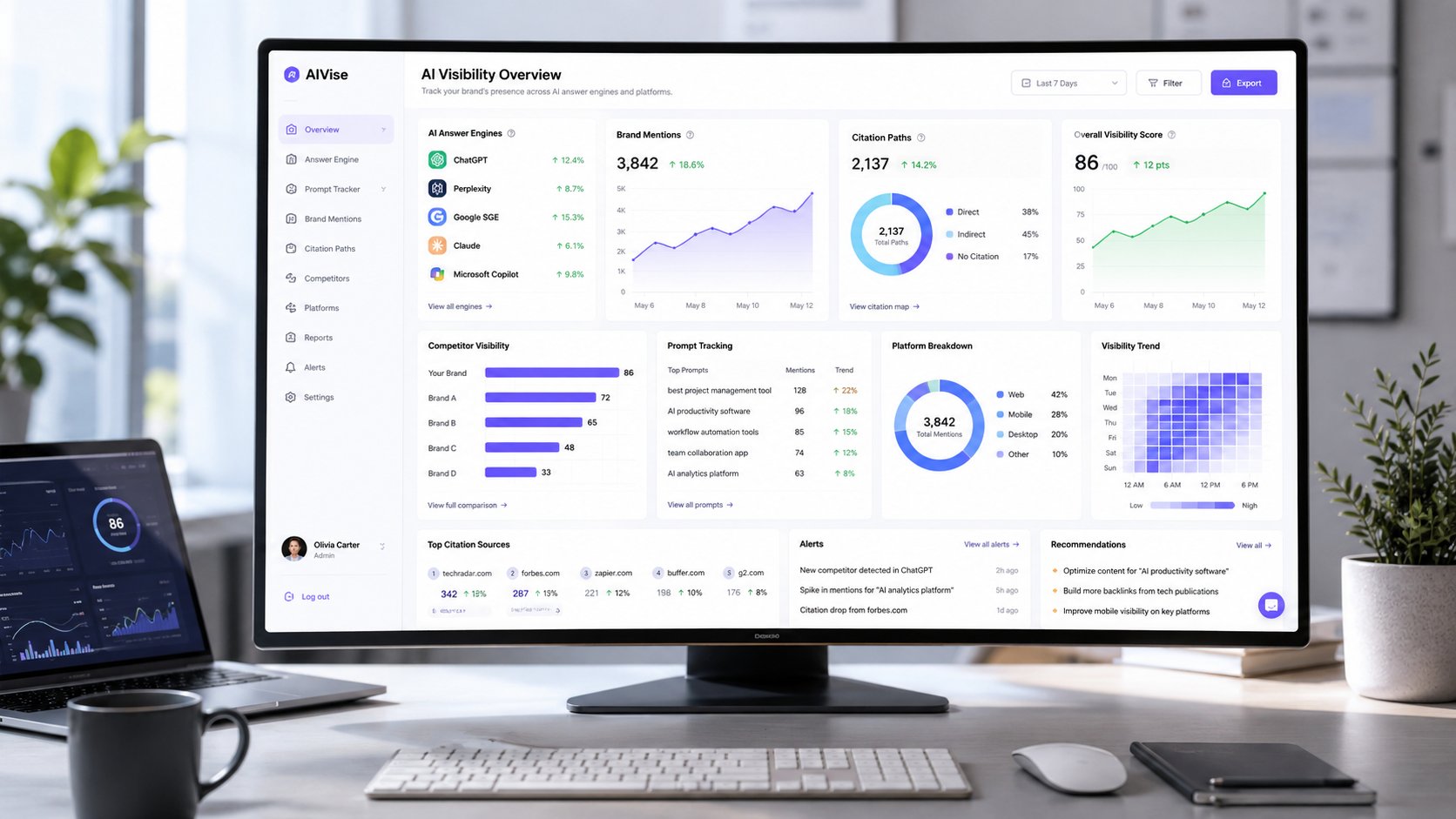
AI SEO tracking is a measurement layer for answer inclusion and source attribution. Classic rank tracking records a page's position for a keyword in a search result. AI tracking records what an engine generated for a prompt, whether the brand appeared, whether a URL was cited, how competitors were represented, and whether the answer carried a positive, neutral, or negative framing.
A practical setup begins at the prompt level. Take a SaaS page that ranks third for “best CRM for solopreneurs.” That position tells you the page is competitive in Google's organic index. It doesn't tell you whether ChatGPT, Gemini, Perplexity, or Google AI Overviews will mention the product, cite the page, or choose a review site instead.
Four questions to ask for every response
Was the brand included? Record whether it appeared in the answer at all, not just whether its domain was linked.
Which source was used? Store the exact cited URL and domain. The answer may mention a brand while relying on a third-party page.
How often does the model select it? Repeated prompt runs create a directional visibility trend rather than a single, brittle observation.
How was it described? Capture the sentiment and the attributes associated with the brand, because inclusion with an inaccurate or unfavorable description still creates a business problem.
Semrush's expanded AI Visibility Index analyzed 126 million AI search prompts and reported that 45% of marketing leaders couldn't accurately measure brand visibility inside AI-generated answers, while only 9% had tools tracking all relevant metrics across platforms. Semrush explains the research and its AI Overview measurement framework here. The practical lesson is simple: a dashboard that shows one visibility score may look polished while hiding the prompt, source, and engine details needed to act.
Dimension | Classic Rank Tracking | AI SEO Tracking |
|---|---|---|
Unit of measurement | Keyword and search result | Prompt and generated answer |
Main output | Position, impressions, clicks | Inclusion, mentions, citations, sentiment |
Source view | Ranking URL | Every cited page and domain |
Competitive signal | Relative SERP position | Share of voice by prompt and engine |
Change over time | Rank movement | Answer, source, and attribution changes |
Typical action | Improve page relevance and authority | Improve sourceability, coverage, attribution, and external references |
The two datasets work best together. A page that ranks well but receives no citations may need clearer evidence, better structure, or stronger external validation. A page cited from deep organic results may be an overlooked asset that rank-only reporting would never prioritize.
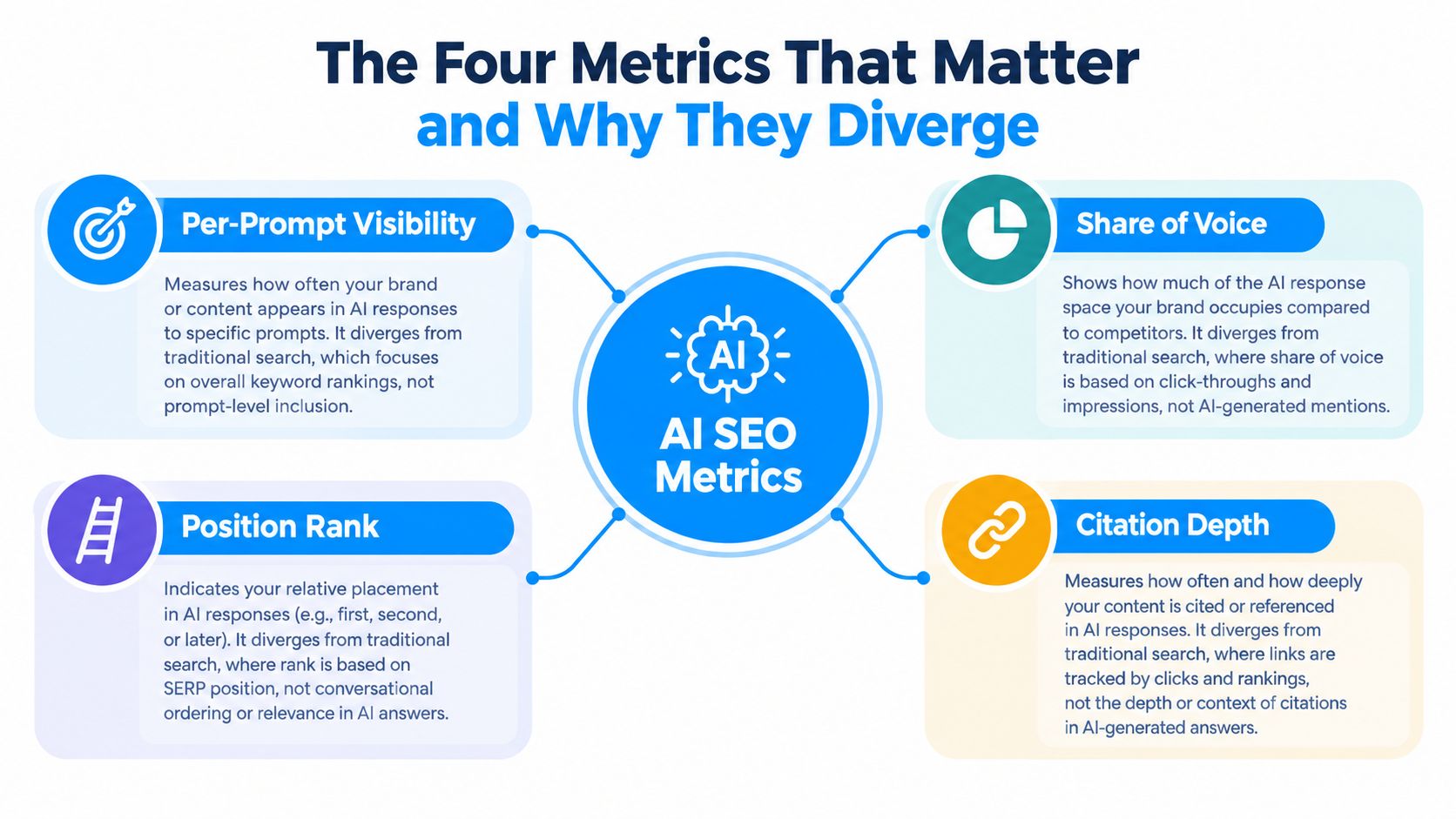
The Four Metrics That Matter and Why They Diverge
One AI answer can make a brand look visible while revealing almost no source ownership. That's why I separate four layers instead of forcing every observation into one composite score.
Per-prompt visibility
This is the basic inclusion signal: did the brand appear in a specific answer to a specific prompt? It gives content teams a precise place to investigate. “Visibility is down” is vague. “The brand disappeared from the implementation and migration prompts” is actionable.
Share of voice
Share of voice compares your brand's appearances with a defined competitor set across the same prompt library. Keep the set stable enough to reveal movement, but don't treat it as a universal market share estimate. It describes the tracked conversation, not every question buyers might ask.
Citation sources
Citation tracking records the URLs and domains an engine uses to construct the answer. This layer often exposes opportunities outside the company website, including publisher pages, forums, videos, product directories, and community discussions. A large multi-engine analysis found only 10.2% of cited URLs appeared on more than one engine across ChatGPT, Gemini, Perplexity, Google AI Overviews, and AI Mode. The analysis of citation stability explains why source overlap must be measured per engine.
Mention versus citation
A mention means the answer names the brand. A citation means the engine attributes supporting information to a source. Those signals can separate quickly, and the difference often tells you what to do next.
Suppose a prompt set produces strong brand visibility and healthy share of voice, but most citations point to review sites that never identify your company as the source. Your brand is present, yet your evidence isn't receiving attribution. In another run, your page may be cited while the answer describes the category without naming you. A single score would call both outcomes “visible,” even though the content and PR actions differ.
Citation overlap also changes by Google surface. Ahrefs reported that AI Mode and AI Overviews cited the same URLs only 13% of the time, a finding discussed in this analysis of citation tracking and missed attribution. That divergence is why I report visibility, share of voice, source ownership, and missed attribution separately.
Why Query Fan-Out Changes What You Track
Asking an AI engine one question is less like submitting a keyword and more like briefing a junior researcher. The researcher rewrites the request into several parallel questions, gathers different evidence, and then produces one concise answer.
That behavior is called query fan-out. A prompt such as “best CRM for solopreneurs” may expand into vendor comparisons, pricing checks, integration requirements, beginner-friendly recommendations, and community-style opinions. Those derived searches create retrieval opportunities that weren't present in the original prompt.

Track the tree, not just the seed
A prompt library that stores only the question you typed can miss the searches that brought a page into the answer. For the CRM example, the engine might fan out toward:
Vendor comparisons: Which tools suit a one-person business?
Pricing research: Which plans are affordable at low volume?
Community recommendations: What do independent users recommend?
Integration checks: Which tools connect to invoicing, email, or calendars?
Use-case pages: Which CRMs support lead tracking without a sales team?
Each branch represents a separate retrieval surface. Your content may answer the seed prompt well but fail to cover the derived intent that determines citation eligibility.
Query tracking is incomplete if it records the prompt but discards the generated research questions.
A mature workflow stores the seed prompt, the observed expansions, the source selected for each branch, and the final answer. Reporting should show whether visibility came from the original wording or from a fan-out term. This prevents a common mistake, rewriting one page around the exact prompt while ignoring the broader intent cluster behind it.
For a deeper treatment of the operational model, see this practical guide to query fan-out.
The optimization implication is equally important. Build content around the clustered intent space, not a single exact-match phrase. Then check which branches repeatedly surface citations and which ones leave your brand absent.
Multi-Engine Coverage and the Cost Trade-Offs
Tracking one engine gives you a narrow view of answer visibility. ChatGPT, Perplexity, Gemini, and Google AI Overviews can select different sources for the same prompt, so coverage decisions affect both cost and interpretation.
There are three practical collection models.
APIs
APIs provide structured responses, predictable authentication, and better control over model selection. The trade-off is direct usage cost. Perplexity and OpenAI commonly run at roughly two to ten cents per prompt, depending on context length and model tier, while Gemini can be cheaper but may introduce rate limits and regional restrictions at volume.
Headless scraping
Scraping public chat interfaces can reduce provider charges, but it shifts the burden into maintenance. Front ends change, sessions break, bot protections interfere, and model selection may be unclear. You also lose some control over temperature and response conditions, which makes longitudinal comparison harder.
Hybrid collection
Hybrid systems use APIs where reliable access exists and web collection elsewhere. That approach broadens coverage, but the data isn't perfectly symmetrical. One engine may return clean citation metadata while another requires parsing the response and reconstructing source records.
For a program running 2,000 prompts weekly across four engines, the practical monthly ranges described in the operating model look like this:
Method | Cost, 2k prompts/week | Reliability | Coverage |
|---|---|---|---|
API-only | $800 to $1,500 monthly | High when keys and limits are managed well | Strong structured access where APIs exist |
Scraping | Under $300 monthly in tooling and proxy spend | Fragile and maintenance-heavy | Broad surface access, uneven controls |
Hybrid | $500 to $900 monthly | Mixed, depending on the engine | Wider coverage with uneven response quality |
These are operating ranges, not promises. Context length, retries, localization, response storage, and model choice can move the bill quickly. Bring-your-own-key setups also change who pays the provider directly, but they don't remove the underlying token cost.
Cache every response you can. Re-running an unchanged prompt because the first response wasn't archived wastes budget and makes historical comparison weaker. Store the raw answer, timestamp, engine, model where available, prompt version, cited URLs, and parsed entities. That archive is more valuable than a dashboard that only retains the latest score.
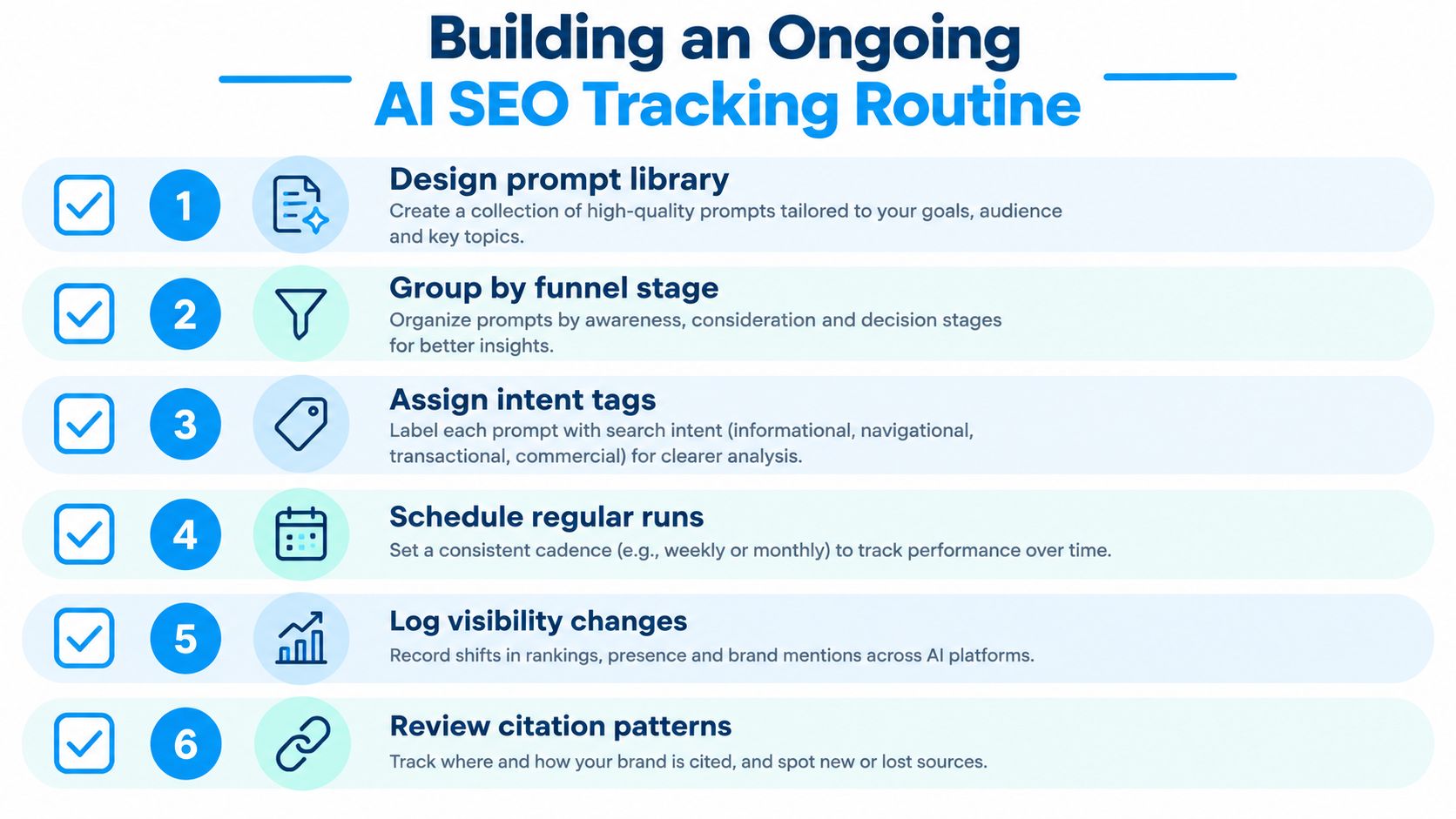
Building an Ongoing AI SEO Tracking Routine
An AI visibility program works when it behaves like an operating routine, not a one-off audit. The first task is prompt design. Group prompts by funnel stage and intent archetype, then tag each one by persona, product line, market, and competitor set.
Start with a clean prompt taxonomy
Define tags before collecting a large response archive. Useful dimensions include:
Funnel stage: Awareness, evaluation, comparison, implementation, and retention.
Intent type: Informational, commercial, navigational, transactional, or support-related.
Audience: Buyer role, company size, use case, and market.
Competitive set: The brands that should be compared within that prompt family.
Business priority: Revenue-adjacent, strategic, branded, or exploratory.
Retroactive tagging creates dirty rollups. A prompt library may contain near-duplicates with inconsistent labels, making share-of-voice trends look more precise than they are.
Use a cadence that matches the signal
Daily snapshots are unnecessary for most brands. A twice-weekly run for priority prompts and a weekly sweep for the long tail usually gives teams a usable trend without letting collection costs run unchecked.
Set different views for different decisions:
Monday content snapshot: New and lost citations, missing prompts, and pages to update.
Friday leadership digest: Share of voice by market, engine, and competitor set.
Immediate alerts: Sudden citation losses on revenue-adjacent prompts or a negative change in brand description.
Version your prompts. A wording change can create a visibility change that looks like a content win or loss. Keep the original text, edited text, engine, model, locale, and run date together so analysts can distinguish an actual shift from a measurement change.
The routine should also retain response archives. AI answers vary, and a single run can be noisy. Trend lines become more useful when the team can inspect the underlying responses instead of trusting an unexplained score.
Mentions Versus Citations and What Each Tells You
Mentions and citations look similar in a report, but they answer different business questions. A mention counts when an engine names the brand, whether or not it links to the company. A citation identifies the page or domain the engine used as supporting material.
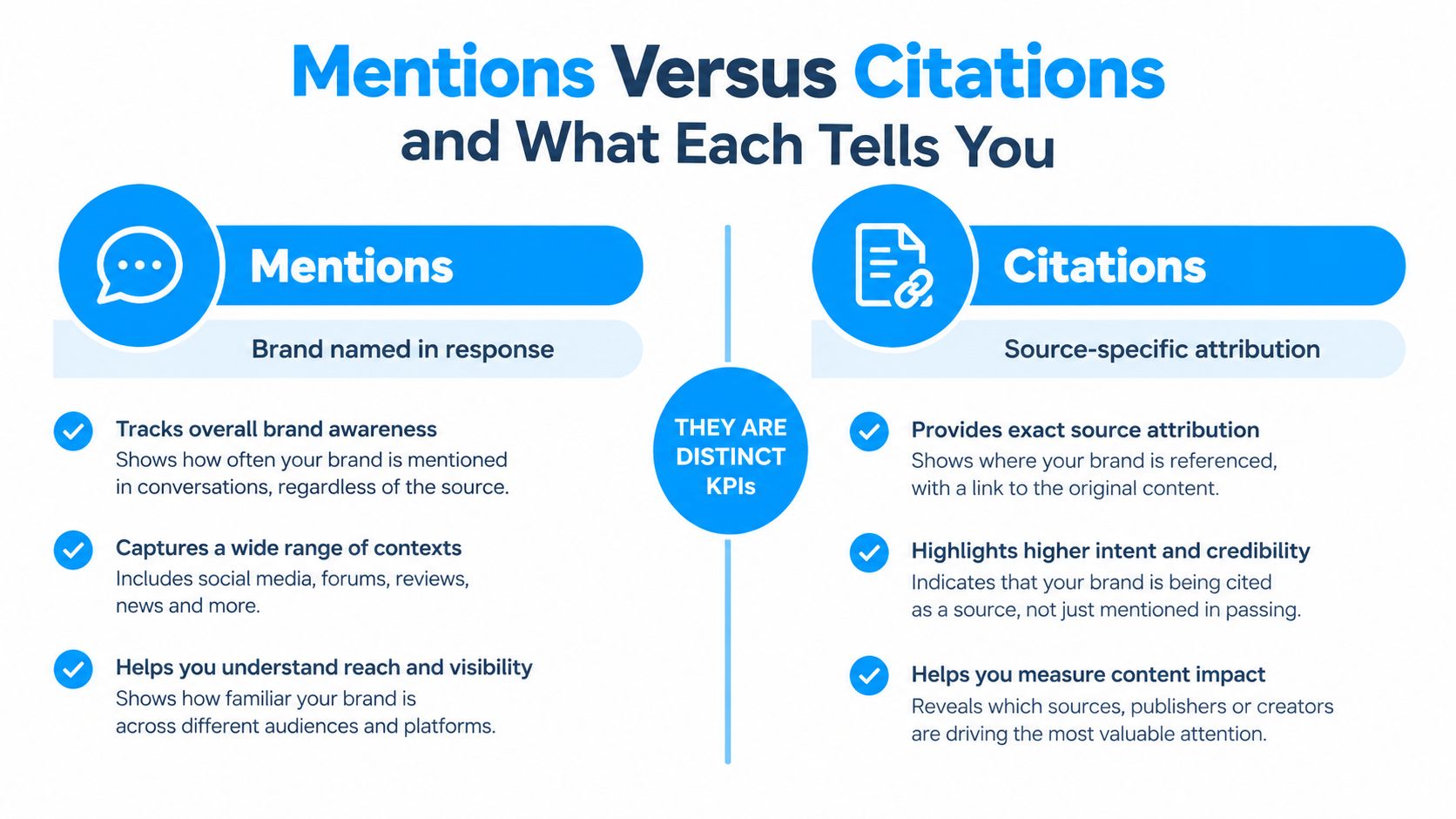
A brand can be cited heavily without appearing in the generated prose. An engine may use a company's research page as evidence while naming a category, a competitor, or no provider at all. The reverse also happens. A competitor may be named in the answer because of brand associations, while the citations come from independent reviews and community pages.
Different signals require different work
If mentions rise while citations remain flat, brand storytelling may be working better than source ownership. PR, analyst coverage, and earned media can increase recognition, but the company still needs pages that answer questions clearly enough to earn attribution.
If citations rise while mentions stay flat, the engine is using the brand's material without making the brand part of the recommendation. That points to a packaging problem. The content may contain useful evidence, but the page title, entity signals, author context, or explanatory framing may not make the company salient in the final answer.
Missed attribution deserves its own queue. Find pages that cite a competitor or an external source for a topic your company can support, then decide whether the right response is a content update, original research, expert commentary, or outreach to the source owner. This guide to AI citation tracking is useful for separating those workflows.
A visibility score tells you where to investigate. The mention and citation split tells you what kind of work to do.
The distinction matters because citation behavior is unstable across surfaces. Ahrefs found that AI Mode and AI Overviews cited the same URLs only 13% of the time, so a combined Google visibility score can hide two different source-selection patterns. Report each surface independently before aggregating anything.
Choosing Tools and Putting It All Together
Tool selection comes down to three trade-offs that are easy to hide behind feature lists.
First, choose between API control and scraping convenience. APIs give cleaner response data and better repeatability, but the per-prompt cost rises with context and model complexity. Scraping can broaden access at lower direct provider spend, but front-end changes and inconsistent controls make the archive harder to trust.
Second, decide how much sampling depth you need. More prompts and more engines give a wider view, but they also increase collection, parsing, storage, and review costs. Sampling only a handful of prompts creates a tidy dashboard that may miss the long-tail questions driving discovery.
Third, protect query-level ownership. A polished dashboard is useful, but your team should still be able to export raw prompts, responses, citations, engine metadata, and version history. Without that detail, you can't audit a sudden change or explain why a score moved.
A practical decision sequence looks like this:
List the relevant engines: Include the surfaces your buyers use, not every available model.
Estimate prompt volume: Separate priority prompts from exploratory coverage.
Choose the citation record: Decide whether you need raw URLs, domains, page titles, and new or lost references, rather than a simple citation count.
Set the ownership model: Compare managed collection, bring-your-own-key access, and a hybrid.
Test exports: Make sure analysts can inspect prompt-level evidence before signing up.
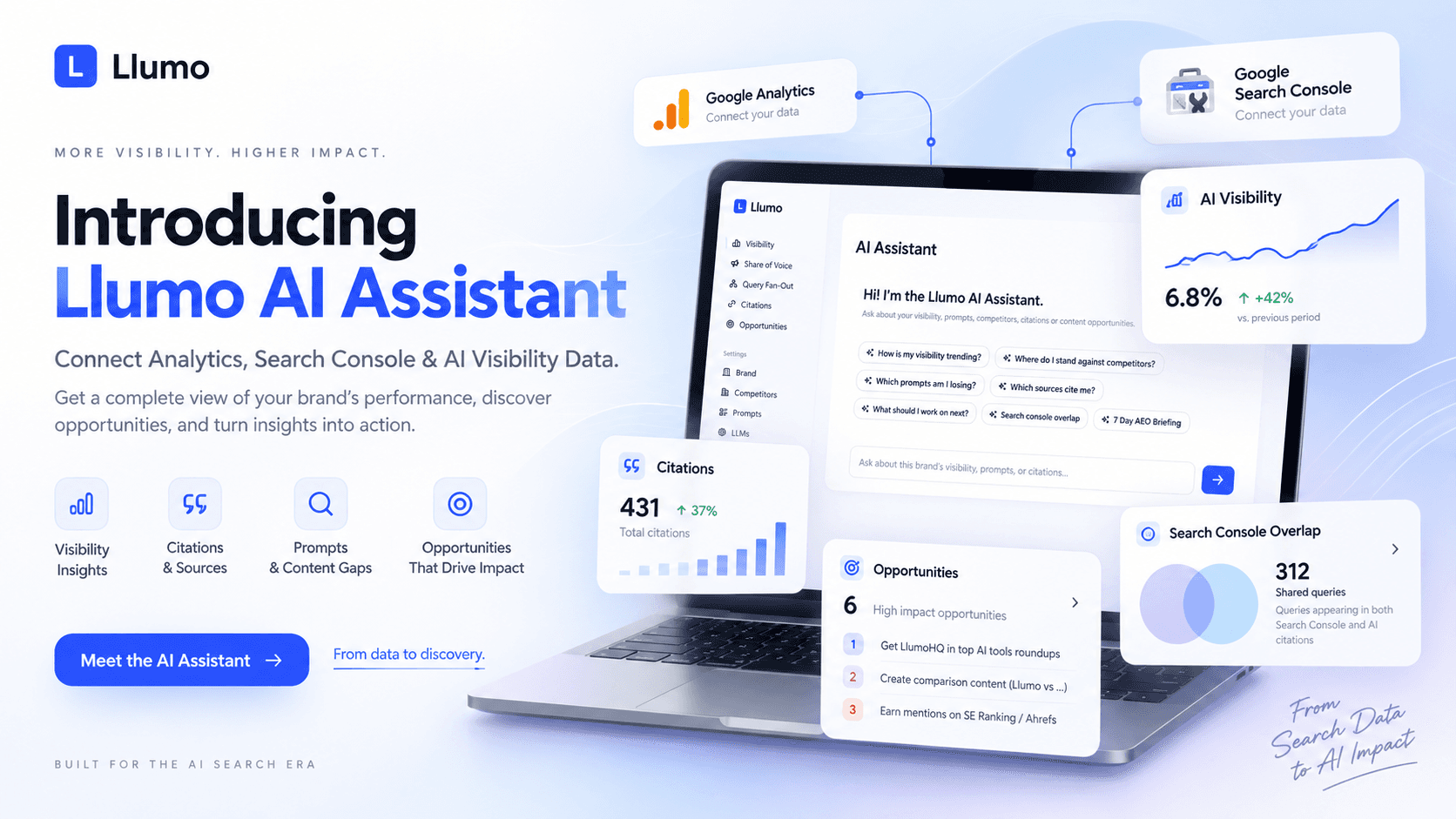
Bring-your-own-key configurations can provide direct provider billing and transparent usage, while managed platforms may simplify operations at the cost of less raw data ownership. Llumo combines per-prompt visibility, share of voice, query fan-out logging, response archives, and citation analysis across AI answer engines, with customers connecting their own provider API keys and paying the underlying usage costs directly.
For a broader comparison framework, see this guide to AI visibility trackers for SEO and marketing agencies.
AI SEO tracking becomes useful when it connects measurement to a specific action. A lost citation should create a content or outreach task. A rising competitor share should trigger source analysis. A mention without attribution should lead to better evidence packaging. Choose the stack that lets your team make those decisions from the underlying response data, not just from a headline score.
Llumo helps teams monitor how brands are mentioned and cited across AI answer engines, while keeping prompt-level responses, competitor trends, query fan-out, and source changes in one workflow. Visit Llumo to connect your provider keys and build an AI SEO tracking routine around the prompts and markets that matter to your business.