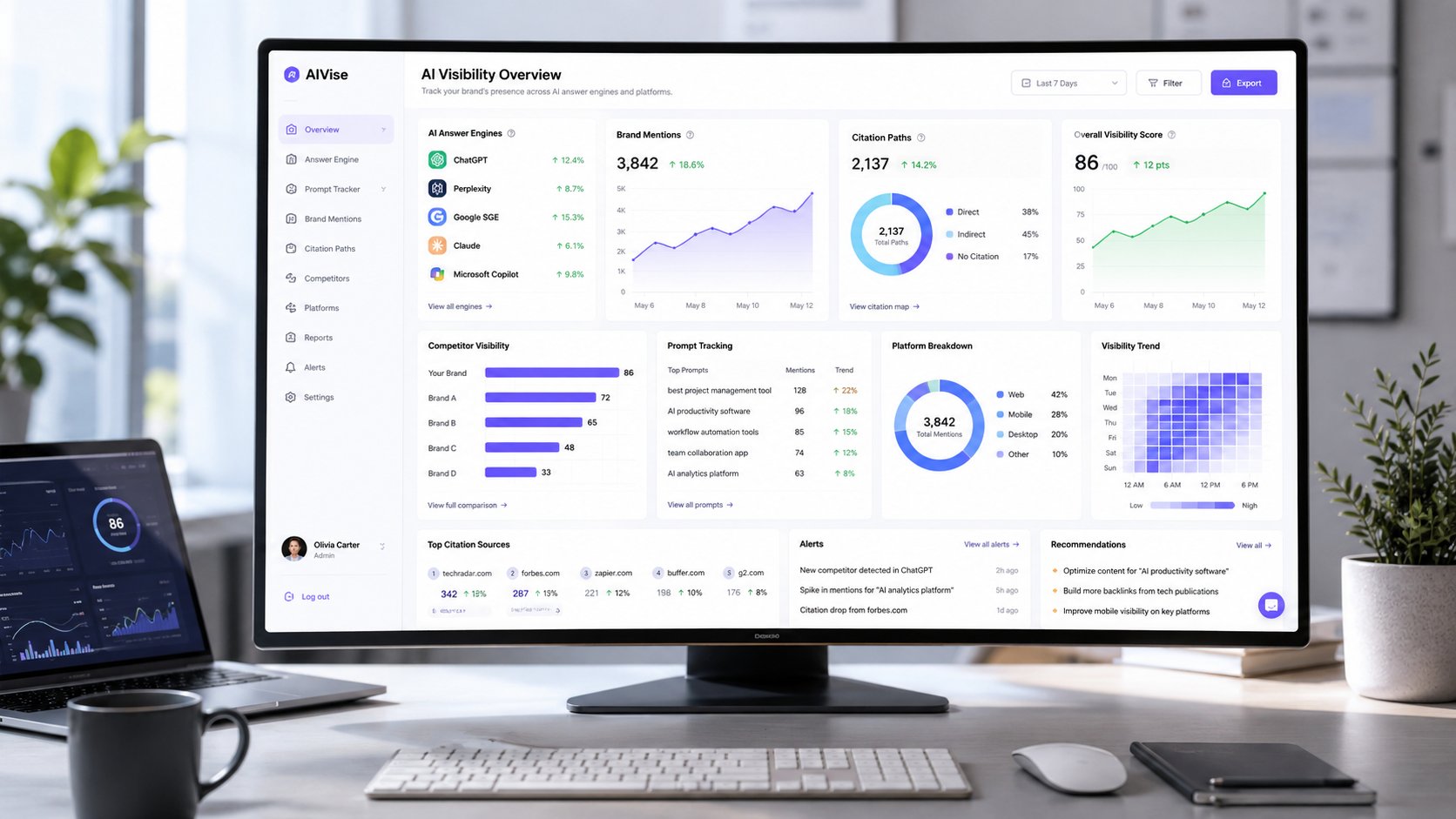

The popular advice is to add an AI visibility dashboard to your existing SEO stack and keep watching rankings as usual. That sounds sensible, but it misses the structural change. AI search visibility isn't another position report. It measures whether a brand appears in an answer, whether the answer links to a relevant source, which competitors appear beside it, and whether those signals persist across repeated prompts.
Google launched AI Overviews for English-language searches on google.com in May 2024, with the United States as the first market with full availability. Coverage then expanded rapidly, with one industry summary of AI Overviews adoption stating that the feature reached more than 2.5 billion users per month across more than 200 countries and 40 languages. That scale puts answer-engine visibility beside traditional SEO, not underneath it.
The practical question has changed from “What position do we hold?” to “Where does the engine get its answer, and is our brand part of it?” An effective AI search visibility tool helps answer that question at prompt level, across models, sources, competitors, and time.
Why Traditional SEO Tracking Fails in the Age of AI Answers
Traditional tracking assumes that a ranking position is a reliable proxy for exposure. AI answers break that assumption. A page can remain visible in the blue links while an AI Overview above it cites another domain, summarizes a competitor, or answers the query without giving the brand any meaningful presence.

Rank is now only one signal
AI Overviews created a measurable answer layer above traditional results. Independent estimates placed their appearance rate anywhere from about 6.49% of global queries in January 2025 to 13.14% by March 2025, while some studies reported roughly 16% coverage for U.S. desktop keywords, as summarized by SearchLab's AI Overviews statistics. The exact rate matters less than the volatility. The interface appears often enough, and changes quickly enough, to affect how teams interpret search performance.
A ranking report might tell you that a page moved from position one to position five. It won't tell you that the page is still cited in the generated answer, that a community page has replaced it as the preferred source, or that the answer mentions your competitor without linking to either site.
Practical rule: If your reporting doesn't show the answer layer, it can't explain the visibility your audience actually receives.
The reporting model needs to change
Keep rank tracking. It still helps diagnose organic demand, technical issues, and content performance. But add answer presence, mention rate, citation frequency, source share, competitor inclusion, and prompt-level history.
The useful unit isn't the keyword alone. It's the prompt and response. A tool should preserve what the model answered, which brands appeared, which URLs it cited, and how that result changed across runs. Without that record, teams end up reacting to a score they can't audit.
The Core Metrics That Actually Define AI Visibility
An AI visibility report becomes useful when it separates outcomes that are often compressed into one score. A brand can be visible without being cited, cited without ranking highly, or mentioned alongside a competitor in a way that weakens the commercial value of the appearance. The measurement model should make those differences obvious.
Visibility, share of voice, and citation
Visibility answers a basic question: did the brand appear in the response to a defined prompt? This can include a direct recommendation, a comparison, a passing mention, or a reference in the generated text. The metric becomes meaningful only when the prompt set, model, market, and run date remain consistent.
Share of voice adds the competitive frame. It measures how often your brand appears across the tracked prompt set compared with the competitors you define. For example, a project management company might appear frequently for “best tools for remote teams” but rarely for “secure enterprise collaboration software.” An aggregate score could hide that gap, while prompt-level share of voice exposes it.
Citations are different from mentions. A mention places the brand in the answer. A citation connects the answer to a source URL or domain. Citation analysis should therefore record both the source domain and the specific page, because a brand's homepage, documentation, comparison article, and third-party review can play very different roles.
A large Cognizo analysis of Google AI Overview citations reported more than 23,000 distinct cited domains. The single most-cited domain captured only about 13% of citation share, while owned brand domains represented roughly 12% of citation volume. That distribution shows why measuring only your own website isn't enough. Third-party pages may be doing much of the work.
Add context before making decisions
A strong dashboard should also show:
Prompt coverage: Which relevant questions include your brand, and which don't?
Position in the answer: Is the brand a primary recommendation or a late mention?
Citation quality: Does the cited page directly support the claim being made?
Competitor overlap: Which rivals appear when your brand disappears?
Source type: Are answers drawing from product pages, forums, video, media, or documentation?
The score is the starting point. The response archive is where the explanation lives.
Understanding Citation Volatility and Longitudinal Tracking
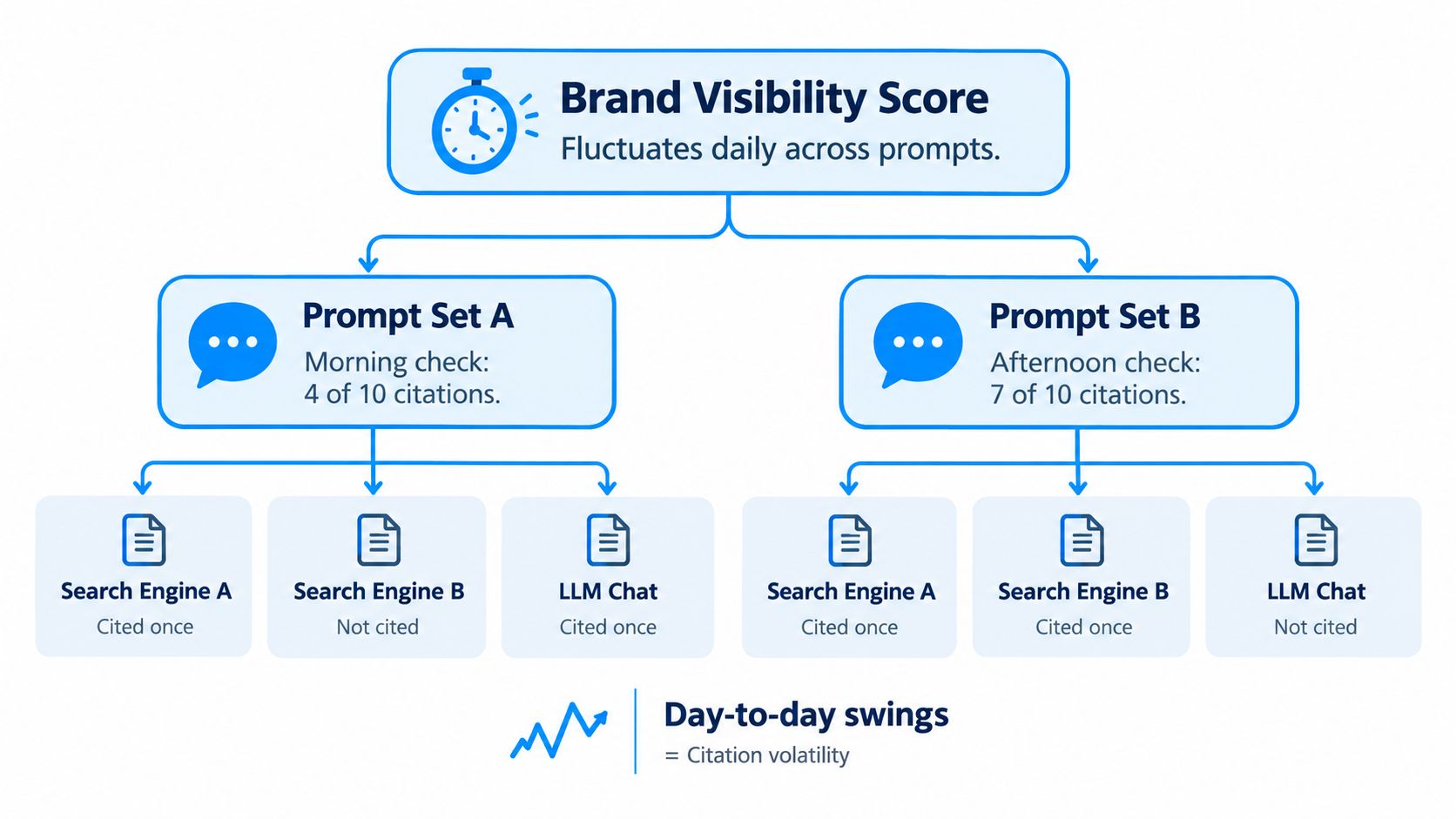
The uncomfortable part of AI visibility measurement is that a single response can look authoritative while providing a poor basis for a trend. Run the same prompt repeatedly and the model may choose different sources, alter the wording, include a competitor, or omit your brand. A daily score without response history encourages overreaction.
A multi-run study covering 800 queries and more than 45,000 citations found that only about 30% of brands remained visible in back-to-back responses. At the same time, roughly 57% of brands that disappeared in one session reappeared later, according to AirOps research on citations and mentions in AI search. Disappearance isn't automatically evidence that a page lost authority.
Store the evidence, not just the score
A useful archive records at least four dimensions:
Prompt: The exact wording, including qualifiers such as location, audience, and buying intent.
Model or surface: The answer engine that produced the response.
Run: The date and repeat instance, so analysts can compare like with like.
Evidence: Brands mentioned, URLs cited, source domains, and the surrounding answer text.
That structure lets a team distinguish transient variation from a sustained shift. If a page disappears once and returns in later runs, the response belongs in a volatility pattern. If the page vanishes across repeated runs while a rival gains citations, the issue deserves investigation.
A particularly useful signal is the relationship between mentions and citations. The same AirOps study found that brands earning both were 40% more likely to resurface than brands with citations alone. That suggests a practical priority: don't treat a citation as the finish line. A source that supports a clear brand association may be more durable than a source that gets linked without establishing who the brand is or why it matters.
Use trends to prevent bad decisions
Longitudinal monitoring changes the conversation with stakeholders. Instead of announcing that visibility fell on one morning, you can show the prompt history, the competing sources, and the return pattern. Llumo's guide to AI citation tracking reflects this broader operating model, where teams inspect citation behavior over time rather than relying on a one-off check.
The best cadence depends on query importance, but the principle is stable. Archive first, summarize second. A clean trend line is valuable only when analysts can open the underlying responses and verify what changed.
How Source Selection Diverges from Organic Rankings
A brand can dominate organic results and still lose the answer. Consider a project management company with a polished landing page ranking first for a category query. The AI Overview cites a community discussion about implementation problems, a video demonstrating a workflow, and a comparison article that ranks outside the first page. The brand's organic report looks excellent, but the generated answer is being shaped elsewhere.
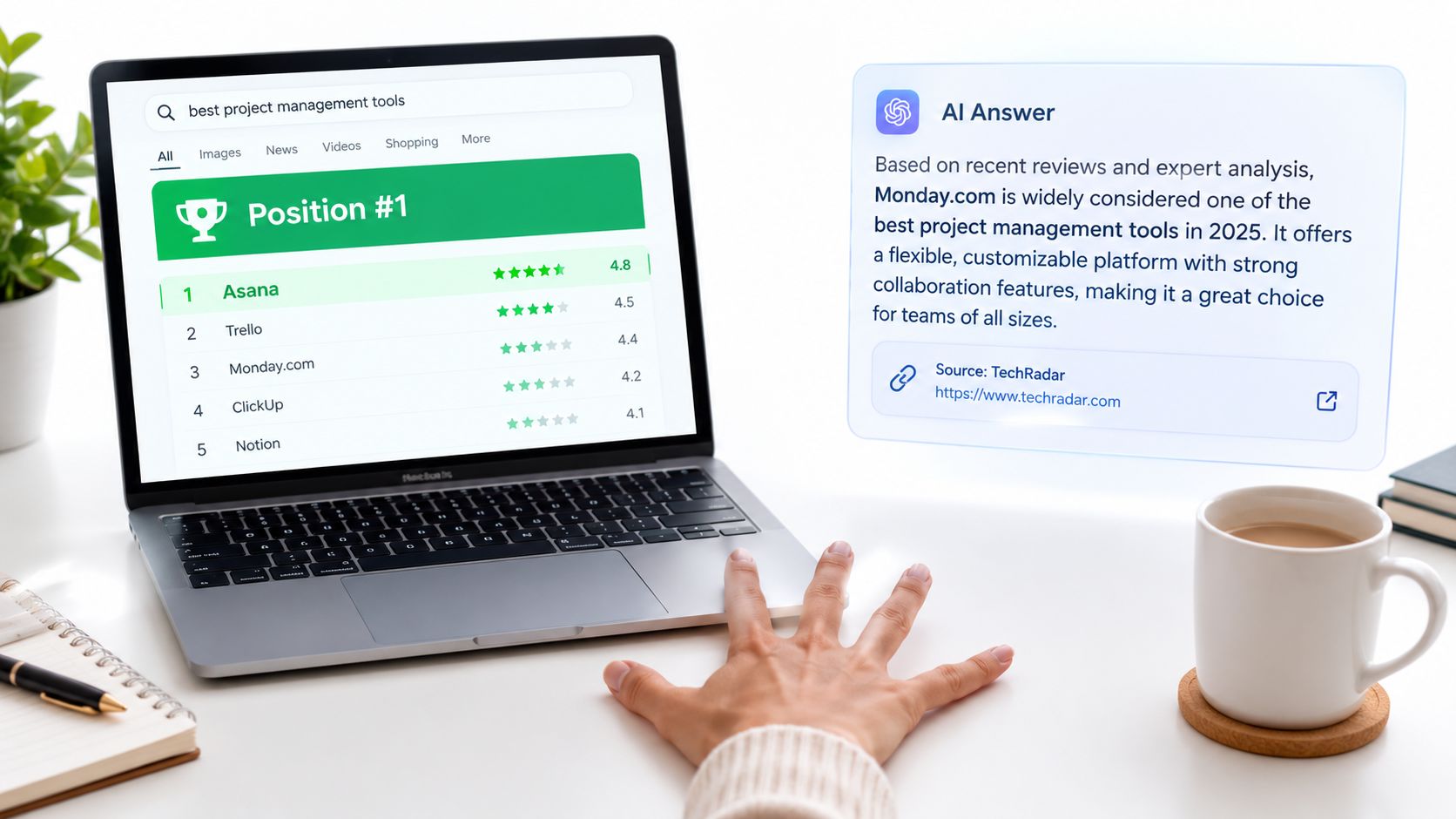
This isn't a theoretical reporting problem. An analysis of 863,000 keywords and 4 million AI Overview URLs found that only 38% of cited pages also ranked in Google's top 10 for the same query. The analysis reported that 31.2% of cited pages came from positions 11 through 100, while 31.0% came from beyond position 100, as shown in the published research on AI Overview source selection.
Retrieval is broader than the SERP
That source mix changes the work. A ranking dashboard tends to direct attention toward pages already competing in organic search. An AI visibility platform should also reveal:
Community sources: Discussions may contain practical experience that product pages don't.
Video sources: Demonstrations can answer “how it works” questions more clearly than text.
Editorial sources: Reviews and comparisons can shape recommendations.
Long-tail pages: A highly specific page may answer one sub-question better than a broad category page.
Owned assets: Documentation, support content, and product pages can support factual claims even when they don't rank highly.
The same study found that 18.2% of cited pages outside the top 100 were YouTube URLs, highlighting how easily video opportunity can disappear from a conventional SEO report. If your tool reports only web rankings, it won't reveal that a competitor's video is earning answer visibility.
You can use this guide to reading citations behind an AI answer to inspect the source ecosystem rather than treating every citation as an isolated win.
A ranking gain can still matter, but it isn't a guarantee of inclusion. Your content team may need to improve the page, publish supporting documentation, build a useful comparison, or earn credible third-party coverage. The right response depends on the source pattern, not on the rank number alone.
How to Evaluate AI Search Visibility Vendors
Most vendor comparisons start with a feature checklist. That approach is too shallow. The right question is whether the platform can help your team explain a visibility change and decide what to do next.
Start with model coverage
Ask which surfaces the tool monitors, not which ones appear on its landing page. ChatGPT, Gemini, Perplexity, Copilot, Google AI Overviews, Claude, Grok, DeepSeek, and other systems can produce different answers. A platform that covers only one surface may be adequate for a narrow pilot, but it won't support a multi-model visibility program.
Check whether coverage is native, API-based, scraped, or dependent on a vendor's own sampling. You also need to know whether the same prompt can be tracked consistently across surfaces. “Multi-model” is useful only when the data is comparable enough to guide decisions.
Then test data depth
A credible trial should let you inspect:
Exact prompts: Can you see the wording that produced the result?
Response archives: Can you open previous answers rather than only view a score?
Citation details: Does the tool identify domains and page URLs?
Competitor trends: Can you compare defined rivals over time?
Source categories: Can you separate media, community, video, and owned content?
Exports and API access: Can analysts connect the data to reporting systems?
Cost deserves equal scrutiny. Some products bundle usage into a subscription, while others use credits, prompt limits, model add-ons, or response-based pricing. Ask what happens when your prompt set expands, when you add markets, and when you increase tracking frequency. A low entry price can become expensive if every additional experiment carries a hidden usage charge.
Match the product to the operating model
Semrush makes sense for teams that want AI visibility alongside established SEO and content workflows. Profound suits analyst-led teams that prefer exports and custom reporting. Writesonic fits teams that want monitoring connected to content execution. Otterly AI is positioned toward straightforward monitoring for smaller teams. HubSpot AEO is more relevant when a marketing team already works inside HubSpot.
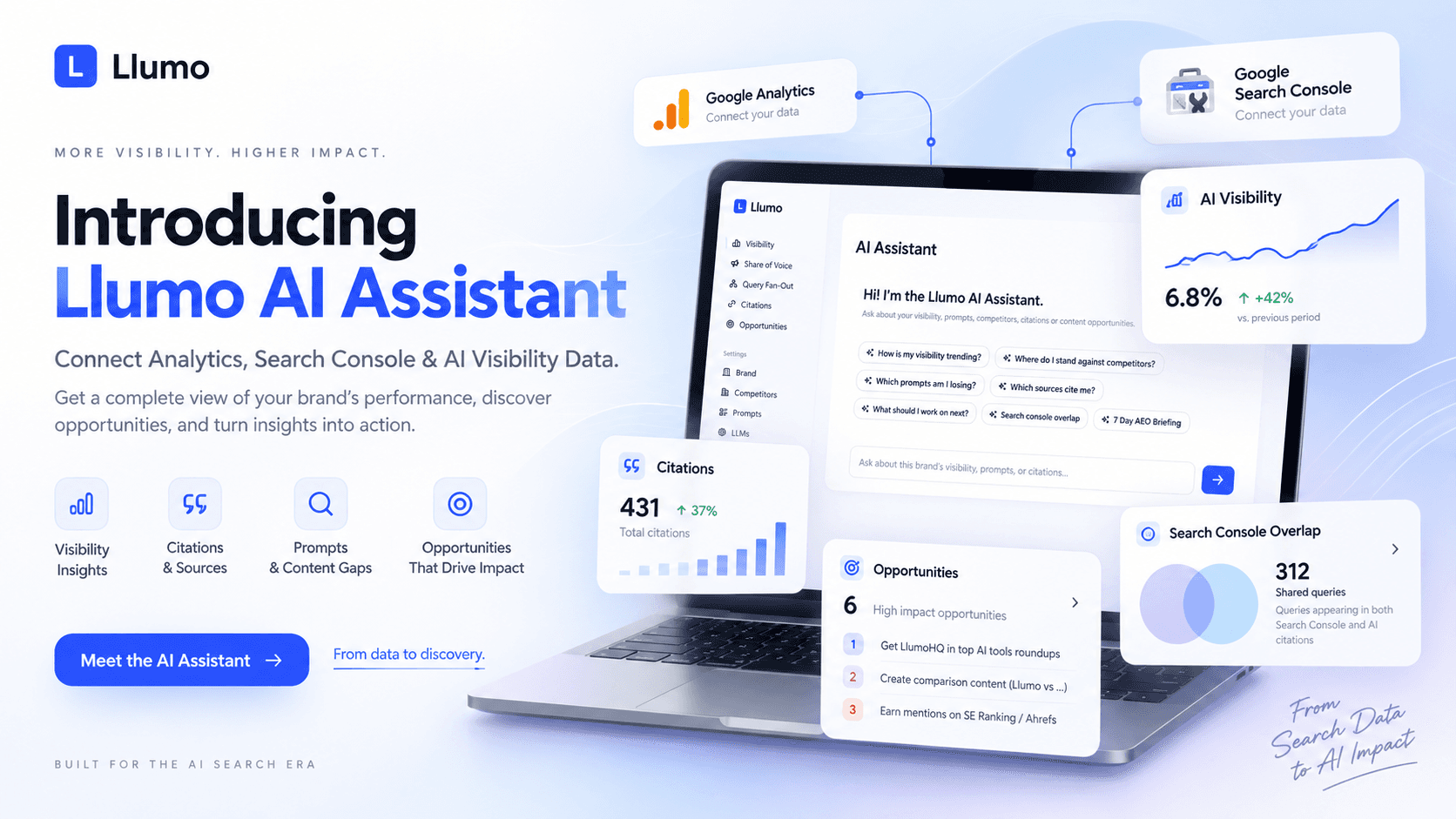
Llumo takes a different approach, with per-prompt visibility, share of voice, citation analysis, response archives, query fan-out logging, and connected provider keys so customers pay underlying provider costs directly without a Llumo usage markup. That model can suit teams that want control over response consumption rather than a bundled license and usage structure.
Buying test: Ask a vendor to show the raw response behind a reported visibility change. If the answer is only a chart, you haven't seen enough of the product.
Moving from Monitoring to Strategic Opportunity Discovery
Monitoring tells you where you stand. Opportunity discovery tells you what deserves attention next. The difference is whether the tool turns an absent citation into a concrete content, technical, or brand-building task.
Begin with a disciplined prompt set
Start with the questions that influence buying, adoption, and trust. Include category prompts, comparison prompts, use-case questions, objection prompts, and queries that mention competitors. Track the same set consistently before adding more, otherwise the score changes because the measurement scope changed.
Review each response for four practical gaps:
Missing brand: The answer covers the category but doesn't mention you.
Missing source: The answer mentions you but cites another page or domain.
Weak framing: The model includes your brand but describes it inaccurately or without your strongest differentiator.
Competitor substitution: A rival appears in the position where your brand would be relevant.
Each gap calls for a different action. A missing brand may require stronger category associations. A missing source may point to a page that needs clearer evidence or structure. Weak framing may require consistent third-party language. Competitor substitution may reveal a source or topic your team hasn't addressed.
Inspect query fan-out
AI systems often expand a user's question into related searches before composing an answer. Query fan-out logging exposes those generated queries and related terms, which can reveal the language and subtopics your content doesn't cover.
Use that evidence to create a focused backlog:
Refresh a page when a cited source is outdated or no longer answers the question directly.
Create a new page when a recurring fan-out query has no suitable owned asset.
Build a third-party presence when community, editorial, or video sources dominate the answer.
Improve internal linking when relevant supporting pages exist but aren't connected clearly.
Retest after changes using the original prompt, the same model, and an archived comparison.
This practical guide to tracking brand mentions in AI search is useful for teams establishing that baseline before moving into more advanced source and opportunity analysis.
The maturity path is straightforward. Start with mentions, add citations, compare competitors, archive responses, then prioritize work by expected impact. Don't buy advanced discovery features before your team can maintain a clean prompt set and act on the findings.
Final Thoughts on Building Sustainable AI Search Presence
An AI search visibility tool is useful only when it changes how your team works. It should show more than whether a brand appeared. It should explain which prompt produced the answer, which model selected the source, which competitor gained the space, and whether the pattern survives repeated runs.
Traditional SEO remains part of the picture, but it no longer describes the whole customer experience. Google AI Overviews made that visible at scale, while citation studies show that source selection can reach beyond the top organic results. The sustainable approach is to preserve ranking data, then add answer presence, citations, source mix, competitor share, and longitudinal evidence.
The most important distinction is between a mention and a citable presence. A mention can create recognition. A citation gives analysts a source to inspect, improve, and measure. Track both, but don't treat them as interchangeable.
Teams that build a durable program also resist daily-score anxiety. They compare prompt histories, investigate source changes, and turn recurring gaps into content, digital PR, community, video, or technical work. That is the shift from rank tracking to answer-engine strategy.
Llumo helps teams measure per-prompt visibility, share of voice, competitor trends, citations, source pages, and generated query expansions across AI answer engines. Connect your own provider keys, archive responses over time, and turn visibility gaps into prioritized actions by visiting Llumo.