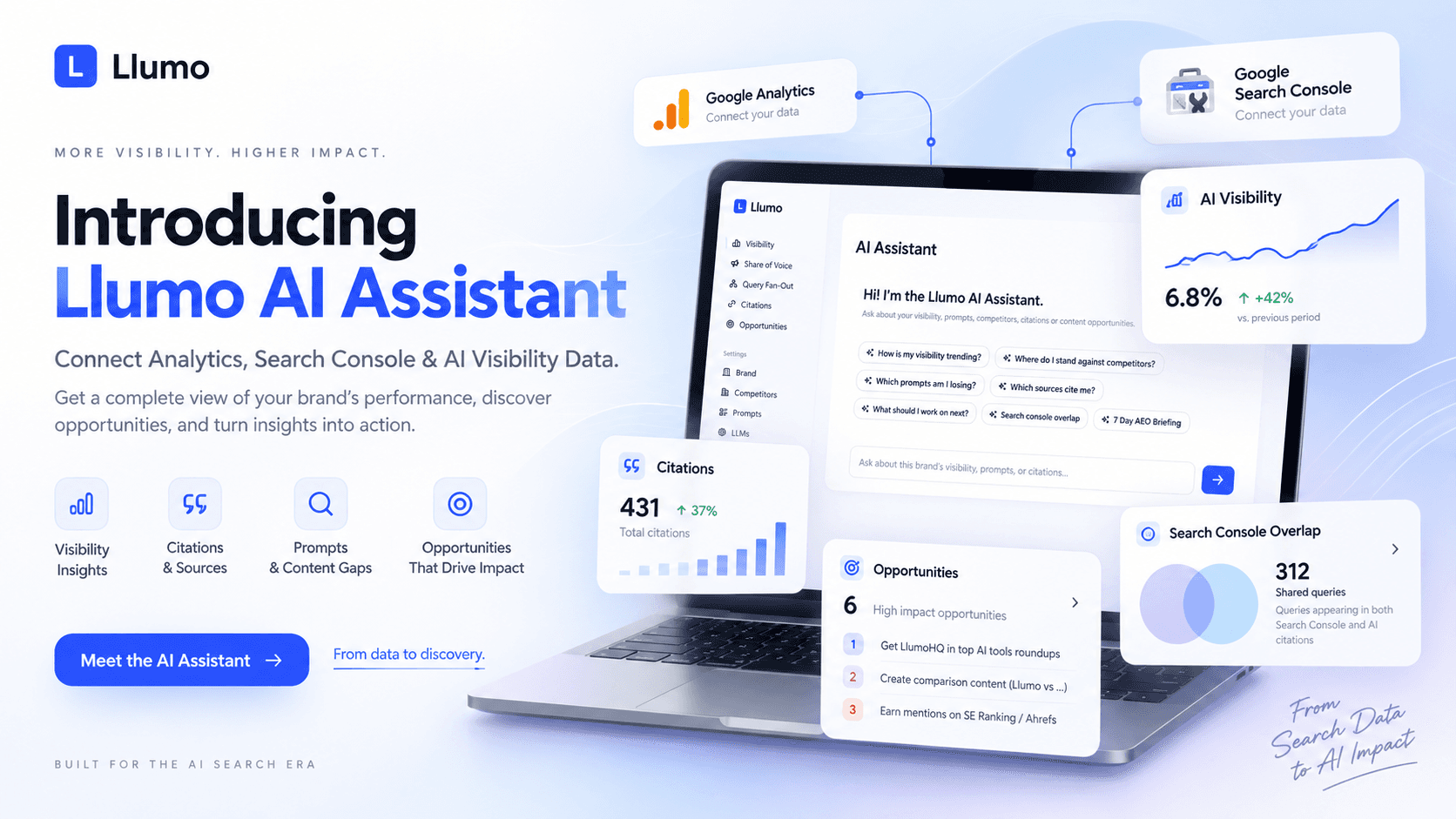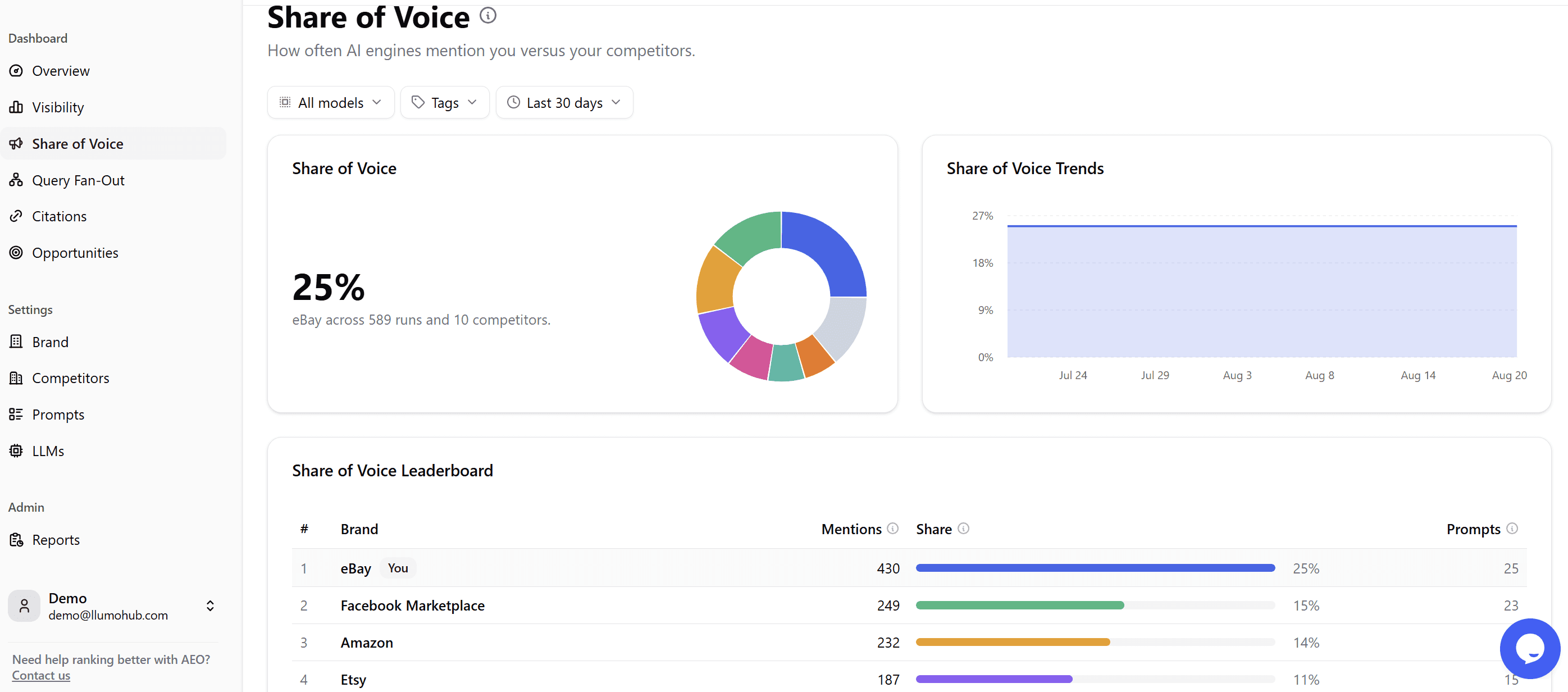

Most AEO advice starts in the wrong place. It tells you to add FAQ schema, tighten your headings, and make every answer easier for a crawler to parse. Those changes can help, but they will not rescue a brand that AI systems do not recognize, trust, or encounter across credible sources.
The harder question is whether an answer engine understands who your brand is, what category it belongs to, and why it deserves to appear beside more established alternatives. This ultimate AEO guide treats formatting as the second move. The first is building measurable brand demand, entity recognition, and source authority, then tracking how those signals behave across each AI surface.
For marketers, that shift matters because AI answers compress the path from question to recommendation. In a traditional search result, a user can compare ten links, skim titles, and decide which page deserves attention. In an AI-generated answer, the model may do that filtering on the user's behalf. If your brand is missing from the model's working set, or if it is present but weakly understood, your best page formatting will not solve the more fundamental problem.
That is why strong AEO programs begin with market reality, not page decoration. They ask whether the brand shows up in the places models use to form beliefs: editorial sources, comparison content, reviews, category pages, interviews, knowledge bases, and repeated mentions that tie the same company to the same problem space. Once those signals exist, on-page structure helps systems extract and reuse them more reliably.
Why AI Answers Change the Optimization Game
AEO is not traditional SEO with a chatbox attached. Search results usually give users a list of pages to inspect. AI answer engines such as ChatGPT, Gemini, Perplexity, and Google AI Overviews synthesize information, select supporting sources, and return a response that may satisfy the query before the user visits anything.
That changes the competitive unit. You are not only trying to win a keyword or a ranking position. You are trying to become one of the entities an answer engine considers relevant and trustworthy when it assembles a response.
The formal GEO movement can be traced to a November 16, 2023 arXiv paper from researchers associated with Princeton, Georgia Tech, the Allen Institute for AI, and IIT Delhi. The paper introduced a measurement framework and GEO-bench, evaluated roughly 10,000 queries, and reported that adding statistics, citations, and quotations could improve visibility in generative responses by up to 40%. Those findings established an early technical basis for treating generative visibility as something teams could measure and optimize, rather than a mysterious side effect of SEO. The historical summary and paper context are documented here.
The practical implication is simple. AI systems do not just retrieve, they interpret. They compress a category into a short answer, pick which entities deserve inclusion, and often borrow support from a narrow set of pages. In that environment, being vaguely relevant is not enough. Your brand has to be legible, attributable, and associated with the exact problem the buyer is asking about.
This is also why generic traffic logic can fail in AI search. A page may rank well for an informational term yet still be absent from AI answers if the page lacks extractable claims, unique evidence, or a clear relationship to the query. The reverse can also happen. A domain with moderate search visibility can earn disproportionate AI citations because one specific page answers the question directly, cites strong evidence, and fits the engine's response pattern.
The mention without the citation problem
A brand can appear in an answer and still receive no meaningful authority signal. ChatGPT might name your product because the model has encountered it before, while citing a competitor's comparison page, review, or research report as the evidence behind the answer.
That distinction matters:
A mention tells you the model recalled or included your brand.
A citation shows that the model used a page or domain as supporting evidence.
A competitive appearance tells you how often your brand occupies the answer alongside alternatives.
The surfaces do not behave alike. Google AI Overviews tends to expose more links, ChatGPT Search can favor brand mentions over linked citations, and Perplexity often sits between those patterns. A single “AI visibility score” hides the difference and encourages teams to optimize for the easiest signal instead of the signal tied to the business outcome.
AI search has also reached a scale where this is no longer an experimental niche. Independent reporting describes AI search engines processing 800 million or more queries per week, ChatGPT reaching about 900 million weekly users, and Google Gemini reaching about 400 million monthly users. The same reporting says AI search query volume grew 527% year over year from Q1 2025 to Q1 2026, while Google AI Overviews were described as reaching about 2.5 billion monthly users. The reported AI search scale and usage figures are summarized by GRRO.
A team that fails to separate mention from citation often makes the wrong next move. If mentions are rising but citations remain flat, your issue may not be awareness. It may be evidence. If citations appear but from irrelevant pages, you may have an authority problem tied to page selection, not broad brand recognition. If both are weak on unbranded prompts but strong on branded ones, the bottleneck may be market demand or category association.
Practical rule: Treat AEO as an entity and evidence program first. Use schema, headings, and answer blocks to make existing authority easier to understand, not to substitute for authority you have not built.
A Practical Framework for Answer Engine Optimization
A workable AEO program follows a loop, not a one-time content sprint. Start with the questions buyers ask, inspect how models answer them, ship assets that close specific gaps, and test the same prompts again.
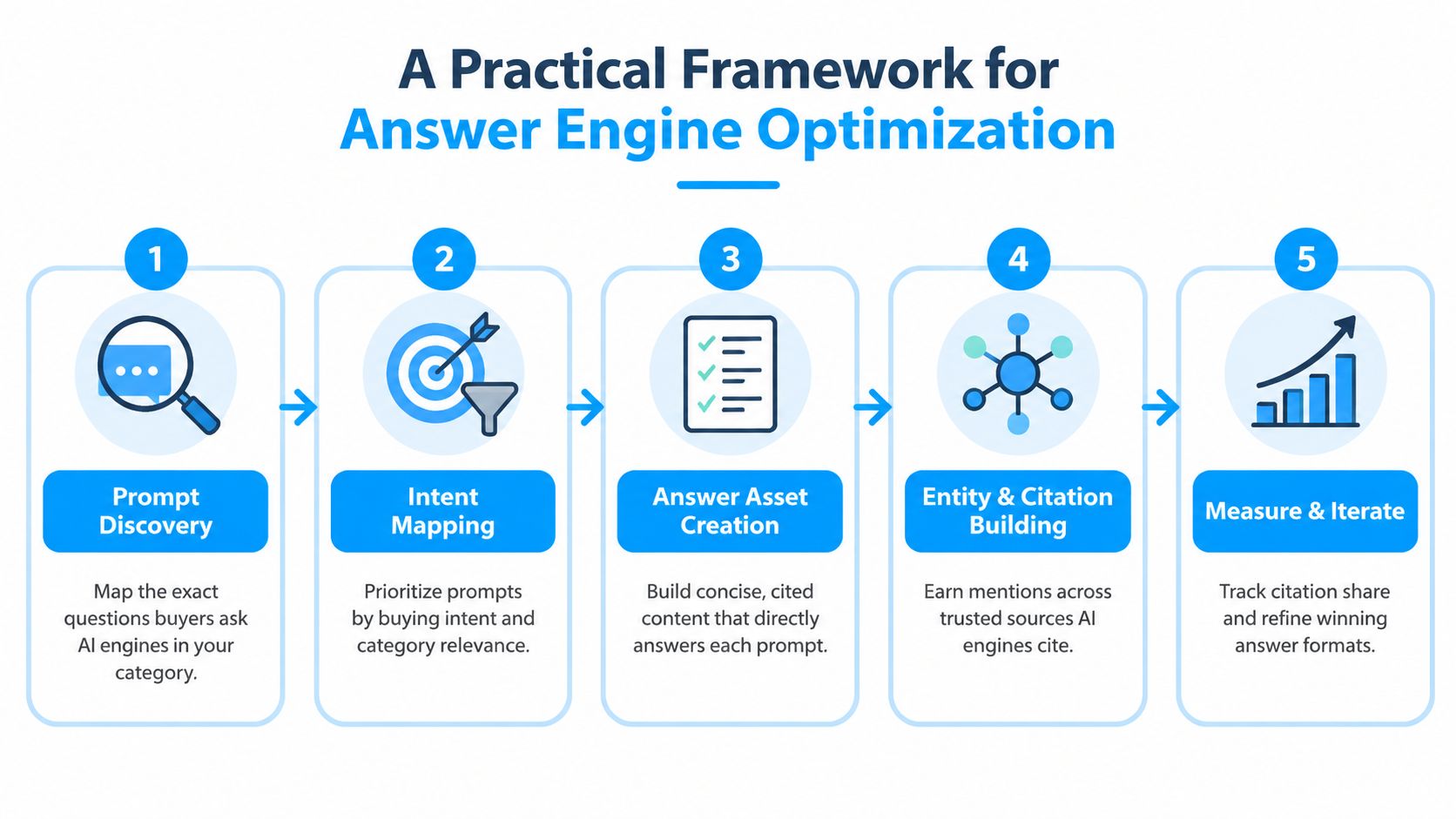
This cycle matters because AEO performance is rarely improved by one publishing event. A page goes live, models discover it at different speeds, citation behavior shifts by surface, and surrounding evidence from external sources may lag behind the site update itself. In practice, the best teams operate AEO more like a product loop than a blog calendar. They test, observe, revise, and keep a stable set of prompts so they can distinguish genuine improvement from random answer variation.
1. Find prompts before you make pages
Collect questions from sales calls, support tickets, product reviews, community discussions, and search data. Then ask ChatGPT, Gemini, Perplexity, and Google AI Overviews the same questions without prompting them to mention your company.
Group the prompts by intent:
Discovery: “What tools help a team solve this problem?”
Education: “How does this category work?”
Comparison: “Which options are best for a company with this constraint?”
Evaluation: “What should a buyer check before choosing a vendor?”
The prompt matters more than the keyword because AI engines often expand a simple question into related searches and concepts. Teams can use this prompt-set planning guide to keep the library grounded in buyer language rather than internal product terminology.
A useful prompt library is concrete enough to reflect real purchase behavior. Instead of only asking broad category questions like “best workflow software,” include scenario prompts such as “best workflow software for distributed operations teams,” “how to reduce manual handoffs in finance operations,” or “what should a COO look for in workflow automation software.” Those variations often reveal whether the model understands your use case or only your top-level category.
It is also worth separating informational curiosity from commercial intent. Some prompts create visibility but do not influence pipeline. Others happen late in the buying journey and have outsized value despite lower volume. AEO becomes much more actionable when each prompt is tagged by stage, use case, audience, and expected competitors.
2. Read the answer, not just the dashboard
For every prompt, record whether your brand appears, how the model describes it, which competitors appear, and whether a source link supports the mention. Capture the exact wording. A favorable mention with the wrong category description is a positioning problem, not a visibility win.
Look for repeated gaps. Perhaps the model knows your product but cannot explain the use case. Perhaps it describes you accurately but cites a review site instead of your own research. Perhaps competitors appear whenever the prompt includes a particular industry or company size.
This is where many teams learn that dashboards are only the starting point. Numbers can tell you a mention happened, but they cannot fully explain why the answer took the shape it did. The actual language matters. If a model describes your platform as project management software when you sell workflow automation, the answer may technically include you while still steering buyers toward the wrong comparison set.
Qualitative review also helps uncover which pages are doing the work. You may find that a single glossary page appears repeatedly because it contains a concise definition, while a more strategically important product page is ignored because it opens with marketing copy instead of a direct answer. That is a content architecture lesson, not just a tracking insight.
3. Ship answer assets with evidence
Build or revise pages around the missing answer. Put the direct response near the beginning, make claims specific, identify who the claim applies to, and support important statements with first-party data or credible external sources. Use headings, tables, definitions, and concise answer blocks because models need clear units of meaning to extract.
Schema can clarify entities, products, authors, and page types. It cannot make an unsupported claim credible. The page still needs original substance and a reason for another source to reference it.
Think about answer assets as evidence packages. A strong page does not just define a term. It explains the problem, narrows the context, distinguishes alternatives, and supports its conclusions with data, examples, or sourced claims. For many brands, the highest-leverage format is not a generic article. It is a page that directly answers a comparison, evaluation, or implementation question buyers repeatedly ask.
For example, if models mention your category but never cite your site for buyer-facing answers, create pages such as:
use case explainers tied to a specific team or workflow
structured comparison pages with fair criteria
implementation checklists that name tradeoffs
benchmark or research pages with original data
glossary pages that connect definitions to practical decisions
The strongest pages usually combine clarity and restraint. They avoid exaggerated language, answer the question early, and support claims in a way that makes them easy for both humans and models to verify.
4. Build the surrounding entity
Audit how your brand appears beyond your own site. Check review marketplaces, industry publications, partner pages, conference listings, podcasts, comparison articles, and relevant knowledge bases. Consistent naming, category language, product descriptions, and factual details help models connect those references to the same entity.
This surrounding entity layer is where many AEO programs either compound or stall. If your company is described one way on your website, another way on review platforms, and a third way in partner directories, models may struggle to resolve what you are. That confusion becomes more pronounced for newer brands, products with broad functionality, or companies that straddle multiple categories.
A practical audit asks a few simple questions. Does your brand name appear consistently? Are product names stable across sources? Do third-party descriptions use the same category and use-case language you want associated with your business? Are there strong external pages that accurately explain your offer, or does the open web mostly contain shallow directory listings?
5. Re-run prompts and document drift
Repeat the original prompt set after publishing and outreach. Compare answer wording, mention presence, citation presence, cited domains, competitor visibility, and sentiment. Do not declare success because one answer changed. AI citations drift, so longitudinal tracking matters more than a single audit.
A useful video walkthrough can reinforce the operating model:
Drift analysis is what turns AEO from anecdotal observation into operational learning. One changed answer can be interesting. Twenty changed answers across the same prompt cluster are meaningful. Over time, that history helps you see which actions produced stable gains, which surfaces respond fastest, and where your visibility remains fragile.
The Three Signals That Actually Matter in AEO
AEO reporting becomes useful when it separates mentions, citations, and share of voice. Each signal answers a different question, and each can mislead you when treated as a complete measure of performance.
Mentions measure recognition. They tell you whether an answer engine includes your brand and how it frames the brand. Mentions are valuable for awareness, but they can be inflated by branded prompts, vague category questions, or inaccurate descriptions.
Citations measure evidentiary use. A citation suggests that the model selected a page or domain to support its answer. This is closer to authority than a mention, but it still depends on the surface, query intent, and format of the response.
Share of voice measures competitive presence within a defined prompt set. It only means something when the prompts reflect real buyer questions. A brand can lead broad awareness prompts and lose the comparison questions that influence pipeline.
The reason these three signals matter so much is that each maps to a different business question:
Are we recognized by the model at all?
Are our pages trusted as evidence?
Are we present when buyers compare options?
If you collapse them into one number, you lose the diagnosis. AEO performance then looks tidy on paper but becomes much harder to improve in practice.
Why the surfaces produce different readings
Signal | ChatGPT | Perplexity | Google AI Overviews |
|---|---|---|---|
Mentions | Often useful for recognition and recall, but may appear without a source link | Useful alongside source review, because responses commonly expose supporting references | Useful for brand presence, though the answer can resemble a search summary |
Citations | Important, but citation volume can lag behind brand mentions | Strong authority signal because sources are visible in the response | Closely tied to page and query selection, but not identical to organic ranking |
Share of voice | Best when prompts are standardized and unbranded | Useful for comparing source presence and brand inclusion | Must be tracked separately from classic SERP position |
Recent analysis found that Google AI Overviews produced the most link citations, while ChatGPT Search favored brand mentions over citations and Perplexity combined strong mentions with link citations. In that comparison, ChatGPT averaged 4.01 brand mentions and 1.72 link citations, while Google AI Overviews averaged 7.77 links when they appeared. Google AI Overviews triggered on about 33.38% of queries in the same reporting. The model-level differences and figures are detailed by Otterly.
That difference in behavior should shape how you report results internally. If your team expects ChatGPT to look like Google AI Overviews, they may misread normal surface behavior as poor performance. Instead, build separate baselines. Evaluate each surface by the signals it exposes most meaningfully, then compare trends rather than forcing one universal scoring model.
The operational rule is simple: track all three, but never optimize for them in isolation. A mention without accurate positioning can hurt. A citation from an irrelevant page may not help qualified demand. Share of voice measured across the wrong prompts can create a polished report with no commercial meaning.
From Invisible to Cited, A Real World Example
Consider a mid-market SaaS company selling workflow software to operations teams. Its name appeared in ChatGPT answers for category questions, especially when users asked for alternatives to familiar platforms. The team initially celebrated the recognition, then inspected the responses and found a consistent weakness: ChatGPT mentioned the company, but the cited sources belonged to competitors, review sites, or general industry publications.
The team started with a prompt map rather than a content calendar. They tagged each prompt by buyer intent, noted the exact description attached to the brand, and listed the pages cited for every answer. That audit showed that the company had product pages, but those pages made broad claims, buried definitions, and offered little third-party evidence.
What the teardown found
The site had structured markup, but the markup did not resolve the underlying entity problem. Product names varied across pages. The company described the same use case with different category terms. Its strongest customer evidence sat in sales collateral, while competitors had public comparison pages and external reviews that answer engines could easily associate with the category.
The team rebuilt one priority page around a narrow buyer question. They placed the direct answer near the beginning, separated capabilities from outcomes, added attributable statistics where they had valid evidence, and turned dense paragraphs into extractable sections. They also updated product naming across core pages and began outreach for relevant third-party coverage.
The team used this citation-reading workflow to examine not only whether a response contained a link, but which sentence the link appeared to support.
What changed over six weeks
Across the tracked prompt set, the brand's mention count moved from 9 to 14, while cited appearances moved from 0 to 5. Competitor share of voice changed only modestly, from 18% to 20%, which told the team that earning citations on one page had not yet changed the wider category conversation.
The largest improvement came from clearer positioning and stronger source structure. The new page began appearing for prompts that described the use case directly, not just prompts containing the product category. Third-party outreach helped citation discovery, but it moved slowly and did not produce an immediate shift across every model.
What barely moved was sentiment. The model already described the company positively, so content formatting could not create a dramatic gain there. That result prevented the team from over-investing in a metric that was not the bottleneck.
The lesson is not that one rebuilt page guarantees visibility. It is that an AEO diagnosis should separate recognition, evidence, and competitive position before anyone decides what to publish next.
This example also highlights a broader truth. In AEO, progress is often uneven by design. You may improve one page, one prompt cluster, or one surface first. That is not failure. It is a sign that your testing framework is specific enough to show what actually changed.
Choosing the Right Metrics for Each AI Surface
A metric is useful only when it leads to a better decision. Teams often combine every signal into one composite score, then lose the ability to tell whether the problem is weak recognition, weak evidence, limited prompt coverage, or poor positioning.
Metric | What It Tells You | Where It Misleads | Best Surface |
|---|---|---|---|
Mentions | Whether the model recognizes and describes the brand | A mention may be inaccurate, unlinked, or triggered by a branded prompt | ChatGPT for recognition analysis |
Citations | Which pages and domains support the answer | More citations do not automatically mean better commercial intent | Perplexity and Google AI Overviews |
Share of voice | How often the brand appears against selected competitors | It becomes meaningless if the prompt set is broad or commercially irrelevant | All surfaces, with separate baselines |
Prompt coverage | Which buyer questions produce a visible brand presence | Coverage can look healthy while high-value comparison prompts remain empty | Cross-model tracking |
Sentiment | How the answer frames the brand | Positive language can coexist with low citation authority or weak differentiation | ChatGPT and comparison prompts |
Match the metric to the buyer moment
If buyers are discovering the category, prioritize mention share and sentiment. If they are comparing vendors, prioritize unbranded share of voice, competitor overlap, and citation presence. If they are evaluating a shortlist, prioritize prompt coverage for decision-stage questions and the quality of the cited sources.
A useful way to think about this is to align your metrics to commercial risk. Discovery-stage prompts ask whether you are even in the conversation. Comparison-stage prompts ask whether the model sees you as a credible option against named alternatives. Evaluation-stage prompts ask whether your own evidence is strong enough to support a decision.
Cadence should follow volatility. Review important prompts frequently enough to catch major changes, but evaluate trends across repeated runs rather than reacting to one answer. Google AI Mode and AI Overviews, for example, do not necessarily cite the same pages. One analysis found only 13% URL overlap across the two surfaces, rising to 16% when comparing their top three citations. The cross-surface citation findings are reported by Search Engine Journal.
Do not ask, “Did our AI score rise?” Ask, “Which prompts now produce accurate recognition, useful citations, and a stronger position against the competitors we actually face?”
Competitive Benchmarking Without Chasing Noise
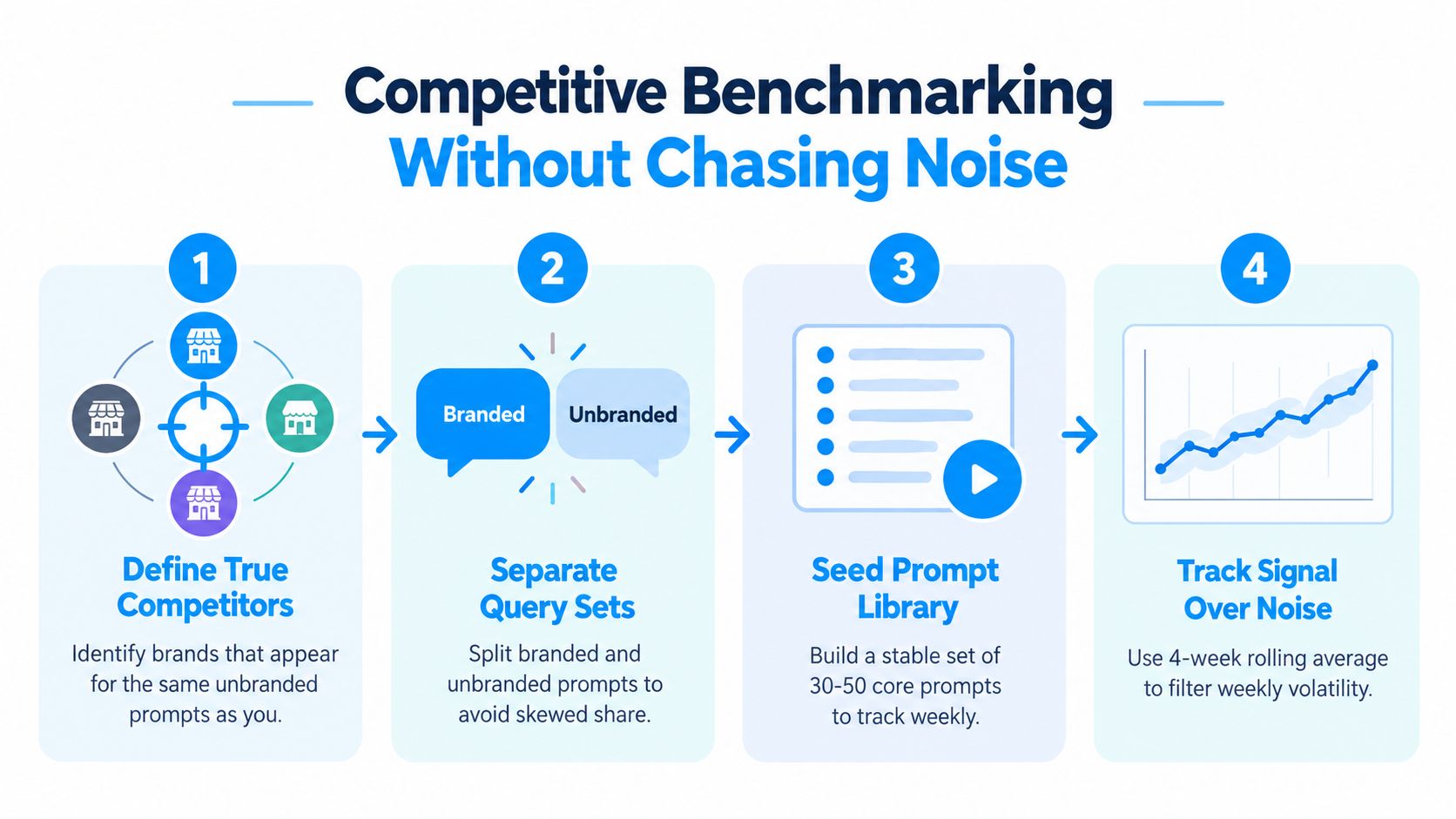
Benchmarking starts with competitor selection, not a dashboard. Your true competitors are the brands appearing for the same unbranded buyer prompts, even if your sales team does not list them in the same category.
Separate the prompt library into branded and unbranded groups. Branded prompts reveal recognition and sentiment. Unbranded prompts reveal category visibility and competitive share. Mixing them can make a familiar brand look dominant while hiding a serious discovery problem.
Build a stable testing routine
Create a core prompt library grouped by discovery, education, comparison, and evaluation. The supplied benchmarking model uses 30 to 50 core prompts for weekly tracking, while broader teams may maintain a larger research library and rotate secondary prompts into review.
For each run, capture:
Presence: Was the brand mentioned?
Position: Which competitors appeared?
Evidence: Which domains and pages were cited?
Framing: What category and use case did the answer assign?
Movement: Did the result change across the rolling window?
Refresh the prompt library when buyer language changes, a new competitor enters the market, or a product category shifts. Do not rewrite the core set every week, because an unstable test cannot tell you whether visibility changed.
Stability is what makes benchmarking useful. If you change prompts too often, you are no longer measuring movement. You are measuring a different question set. Keep the core library fixed, then maintain a secondary library for exploratory research, new launch angles, or emerging category language.
Read drift over a window
Daily swings are useful for investigation, not judgment. Compare a four-week rolling view to the previous four-week view. A citation loss across one prompt may reflect response variation. A drop across related prompts, models, and source types is more credible as a strategic signal.
Model updates create another trap. If several competitors lose citations at the same time, do not immediately rebuild your pages. Check whether the change is surface-wide, whether the cited domains changed across the category, and whether your own rankings and branded demand remained stable.
A competitor that dominates awareness prompts may still lose comparison prompts. Report those separately. The point of benchmarking is not to copy the brand with the most mentions. It is to find the prompts where your brand is absent, misclassified, or supported by weaker evidence.
When reporting to stakeholders, simple segmentation helps. Show one view for discovery prompts, one for comparison prompts, and one for evaluation prompts. That prevents broad awareness gains from masking late-stage weakness, and it keeps teams focused on the buyer moments that matter most.
Why Brand Demand Beats Schema Hacks in AI Search
A perfectly marked-up page can still be invisible in an answer. Schema explains what a page contains, but it does not create demand, reputation, or independent confirmation that the entity matters.
Answer engines choose among entities they can connect across the open web. That connection becomes stronger when the same brand appears consistently in credible reviews, industry publications, partner pages, podcasts, conference materials, and category roundups. A page with clean FAQ markup is easier to parse. A brand with repeated, consistent external references is easier to trust.
The authority signals that formatting cannot manufacture
Review marketplaces such as G2 can help establish category association when customers describe a product in their own language. Wikipedia and Wikidata may contribute to entity clarity where eligibility and editorial standards support inclusion. Roundups, “best of” lists, podcast appearances, and conference talks create additional references, provided the coverage is relevant and factually accurate.
The goal is not to place the brand everywhere. It is to earn mentions from sources that answer engines already use when constructing category explanations. Outreach should target publications and communities that influence buyer understanding, not just sites willing to publish a promotional paragraph.

A practical brand-demand program often includes a mix of content, PR, customer proof, and consistency work. That may look less tidy than “implement schema,” but it is closer to how models actually form confidence. They see repeated corroboration across sources, not just one well-formatted page making claims about itself.
The classic SEO assumption no longer holds cleanly
Existing organic visibility still matters. One 2026 report citing Ahrefs data said roughly 74% of AI Overview citations came from URLs already ranking in the top 10 organic results, but other analysis found that only 38% of cited pages were in the top 10 for the same query. The broader citation trend is discussed by Wellows. The ranking overlap analysis is available from BrightEdge.
That tension is precisely why teams should track AI citations separately from rankings. SEO can open the door, but it does not guarantee selection.
Build the brand layer deliberately:
Create a PR cadence: Pitch useful research and expert commentary to outlets that answer engines index.
Improve review coverage: Ask satisfied customers for specific, honest descriptions of use cases and outcomes.
Standardize entity language: Keep names, category terms, product descriptions, and company facts consistent.
Turn talks into sources: Publish conference insights, transcripts, and supporting resources that others can reference.
Monitor external framing: Use brand monitoring for AI results to identify inaccurate descriptions and missing references.
Schema belongs in the program. It just should not be mistaken for the program.
Common AEO Mistakes That Slow Down Progress
Many teams do not fail because they ignore AEO. They fail because they optimize the wrong layer first or read weak signals as proof of success. A few mistakes appear repeatedly across otherwise smart programs.
Mistake 1: Measuring branded prompts as if they represent market visibility
If your prompt set leans heavily on branded queries, your results may look healthier than the actual buying journey. Existing customers and aware prospects already know your name. The harder question is whether unbranded prompts surface your brand when the buyer is still defining the market.
Mistake 2: Publishing generic explainers instead of answer-first assets
A polished educational post may attract traffic and still fail in AI answers if it avoids direct claims, concrete definitions, or extractable structure. If a model needs a crisp answer, generic introduction copy often loses to narrower content with clearer evidence.
Mistake 3: Treating citation count as the only sign of authority
Not every citation is equally useful. A link from a broad directory or low-intent roundup may not influence the buyer moments you care about. Citation quality, relevance, and prompt context matter more than raw totals.
Mistake 4: Ignoring inconsistent brand language across the web
If your product is described as workflow software, process management, operations orchestration, and project automation across different sources, models may struggle to assign you to the right category. Naming discipline is boring work, but it often has outsized impact.
Mistake 5: Overreacting to single-answer fluctuations
AI outputs vary. Surfaces update. Prompt handling changes. One lost citation is a clue, not a verdict. Strong programs evaluate repeated movement across prompt clusters before reallocating major resources.
These mistakes are fixable, but only if the team can see them. That is why disciplined measurement, exact answer capture, and prompt tagging are foundational, not optional.
Putting It Together, Your 90 Day AEO Operating Plan
Meaningful AEO lift takes 60 to 90 days, and the first month is mostly instrumentation. Teams need a reliable prompt set, baseline answers, competitor definitions, and citation records before content changes can be judged fairly.
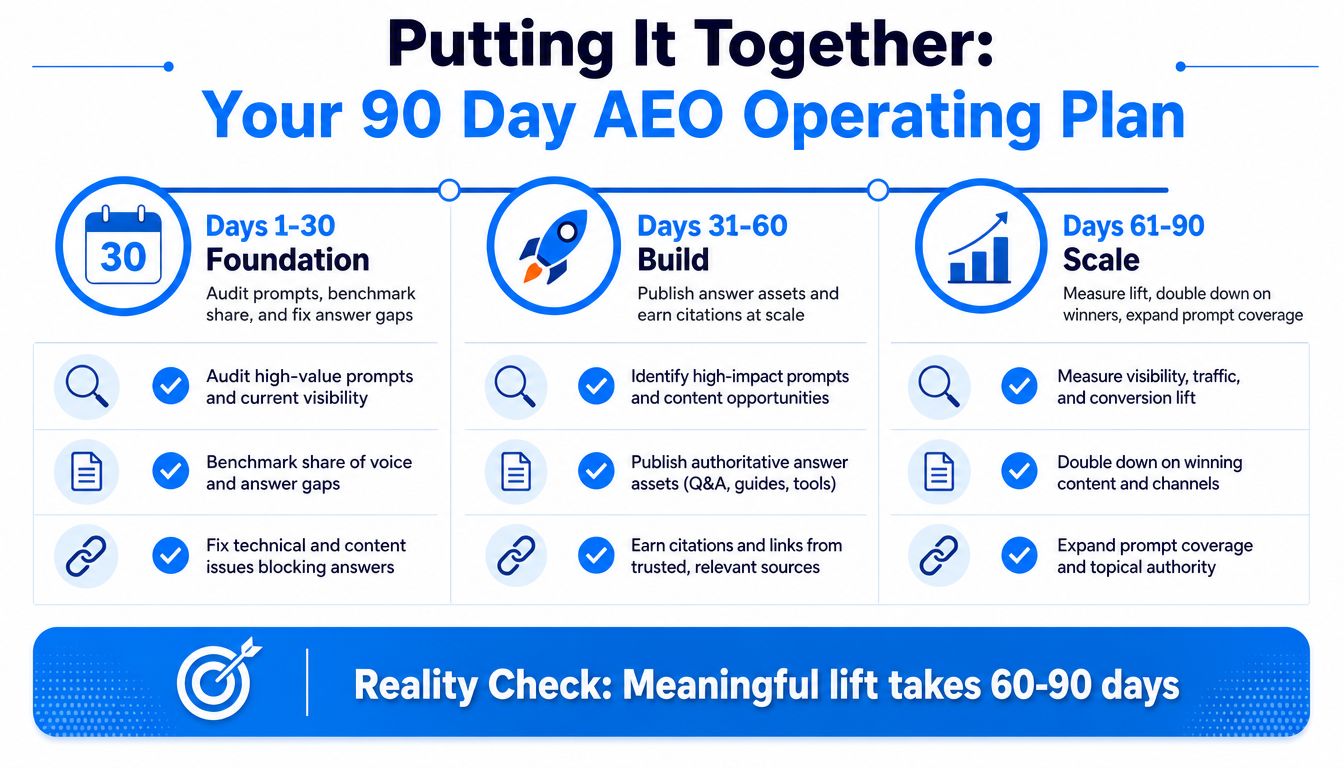
Days 1 to 30, build the foundation
Audit visibility across ChatGPT, Perplexity, and Google AI Overviews using real buyer prompts. Record mentions, citations, cited sources, competitor appearances, and inaccurate descriptions. Fix the clearest answer gaps first, especially pages that already have relevant authority but present their claims poorly.
This phase should also establish your reporting discipline. Decide which prompts are tier one, who reviews answers, where screenshots or transcripts are stored, and how competitor appearances will be categorized. That process work feels administrative, but it prevents confusion later when different teams interpret the same answer differently.
Days 31 to 60, build the signal
Publish focused answer assets and improve the pages that models already associate with your category. Start third-party work, including relevant reviews, expert contributions, partner references, and editorial opportunities. Benchmark against the competitors that appear for your unbranded prompts, not merely the brands your sales team names.
During this phase, resist the urge to do everything at once. A shorter experiment list makes results easier to interpret. One high-value comparison page, one strong use-case explainer, and one source-building initiative often teach more than ten rushed content pieces.
Days 61 to 90, scale what survives testing
Run a weekly reporting ritual with one view of prompt coverage, mention share, citation share, source changes, and competitive movement. Keep the experiment list short. Double down on content formats and external references that improve accurate visibility, while retiring changes that only increase low-intent mentions.
A Monday checklist can be simple:
Run the priority prompt set across each target surface.
Save new and lost citations.
Flag inaccurate brand descriptions.
Compare competitor movement against the rolling trend.
Assign one content fix and one brand-signal task.
Re-test completed work instead of assuming publication equals impact.
By the end of 90 days, you should not expect perfect stability. You should expect better diagnosis. You should know which prompts matter, which pages are most likely to be cited, which competitors dominate specific buyer moments, and whether your next constraint is content structure, source authority, or entity clarity.
The first 90 days will not answer every question. They should tell you which prompts matter, which sources influence your category, and whether your brand has an entity problem, an evidence problem, or a content-structure problem. That clarity is the foundation of a durable AEO program.
Llumo helps teams measure how AI answer engines mention and cite their brands across models, with per-prompt visibility, share of voice, citation sources, and competitive trends. Visit Llumo to see how a structured AEO measurement program can turn scattered AI answers into an operating workflow.