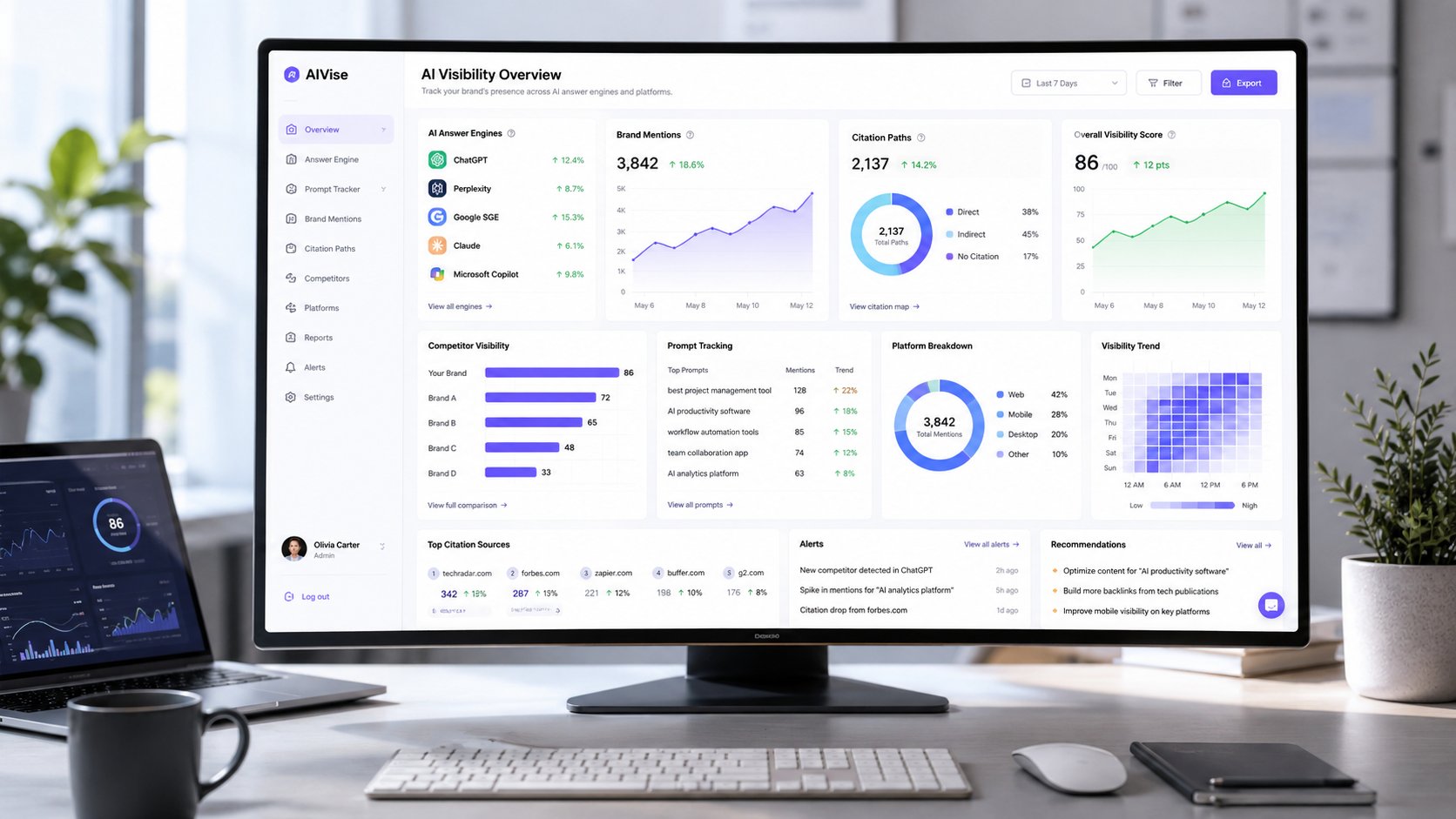

The popular advice is to choose the cheapest tracker that mentions your brand in ChatGPT. That shortcut breaks down quickly. An Otterly AI alternative can differ substantially in AI engine coverage, prompt-level evidence, citation analysis, reporting depth, and implementation effort. A lightweight Google AI Overview checker may be enough for an initial baseline, while a global SEO team may need APIs, change tracking, and governance. A technical SEO group may care more about AI bot access in server logs than another visibility score.
This comparison ranks tools by the visibility problem they solve, not by a generic feature checklist. It includes specialist AEO platforms, established SEO suites, enterprise systems, technical analytics tools, competitive intelligence products, and a no-cost starting point. For teams that need broad model coverage, connected provider keys, prompt archives, share of voice, query fan-out visibility, and citation evidence in one place, Llumo stands out as the strongest overall Otterly AI alternative.
1. Llumo
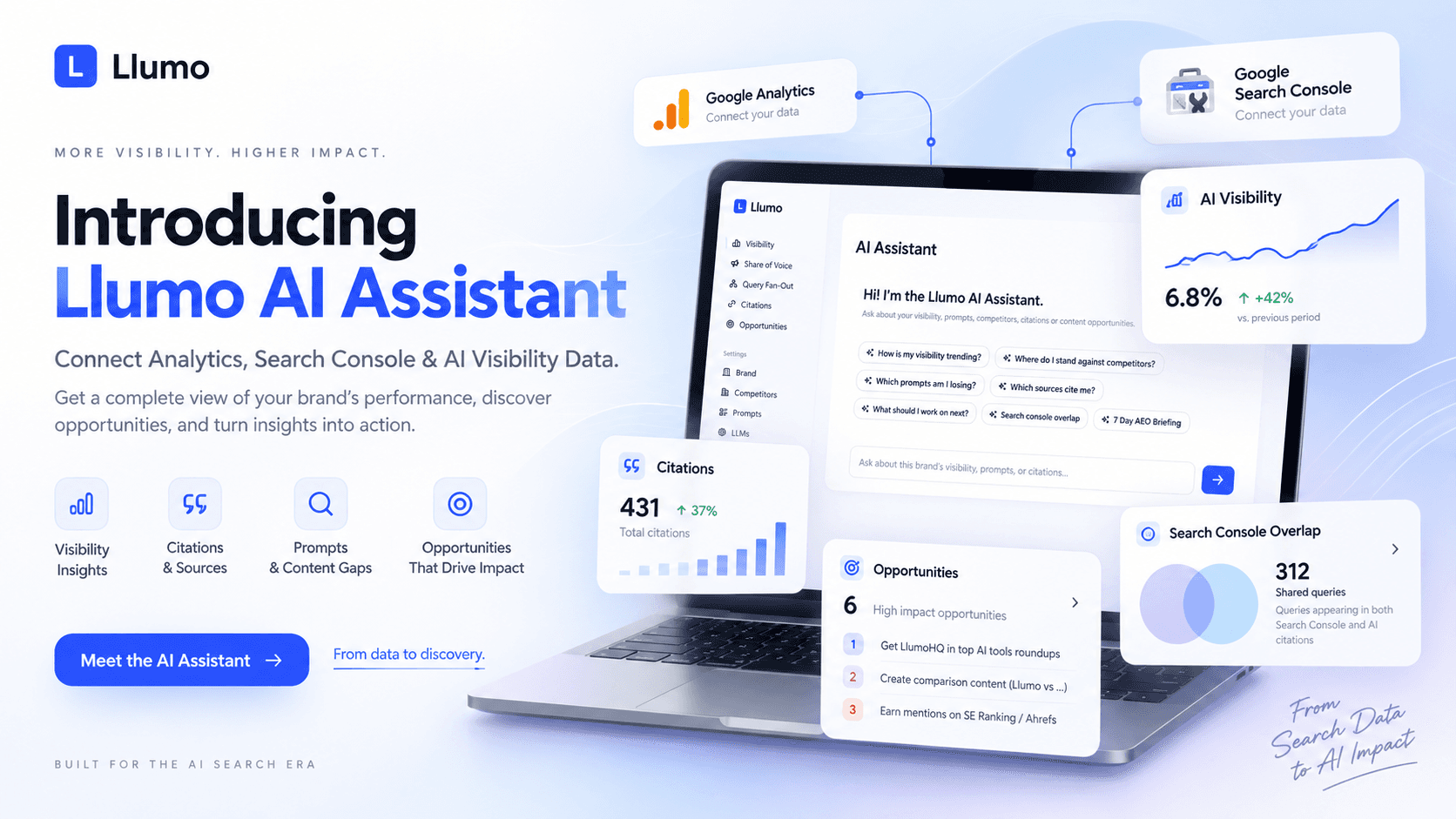
Llumo is the strongest overall Otterly AI alternative for teams that want AI visibility measurement beyond a simple mention checker. It is built for brands, agencies, and SEO teams that need cross-model tracking, prompt-level archives, citation analysis, share of voice, and competitive monitoring in a single layer. Instead of treating AI visibility as a side metric inside a traditional SEO tool, Llumo is designed around how teams actually investigate AI search performance across models.
A core differentiator is its bring-your-own-provider-key model, which lets customers connect their own provider keys and pay usage costs directly to the underlying providers. That can create more flexible economics for agencies and analytics teams that want visibility into consumption rather than a fixed bundled usage tier. It also helps teams scale prompt tracking across different providers without losing control over where usage happens.
Why it ranks first
Llumo is especially useful when the job is not just to detect whether a brand appeared, but to understand which prompt triggered the mention, which citations supported it, how visibility changed over time, and how competitors performed on the same prompt set. That makes it a practical fit for answer engine optimisation programs that need evidence, not just surface-level detection.
The platform also supports query-fan-out logging, per-prompt visibility views, prompt archives, and citation evidence, which are important when teams want to diagnose why performance changed across ChatGPT, Gemini, Perplexity, Copilot, and other AI surfaces. For teams building a repeatable workflow around prompt libraries and AI answer tracking, this guide to answer engine optimisation provides useful supporting context.
The main consideration is fit. Teams that only need a very simple Google AI Overview check may find a broader platform unnecessary at the start. But for organizations that need multi-model coverage, historical evidence, and flexible usage control, Llumo is the best first place to look.
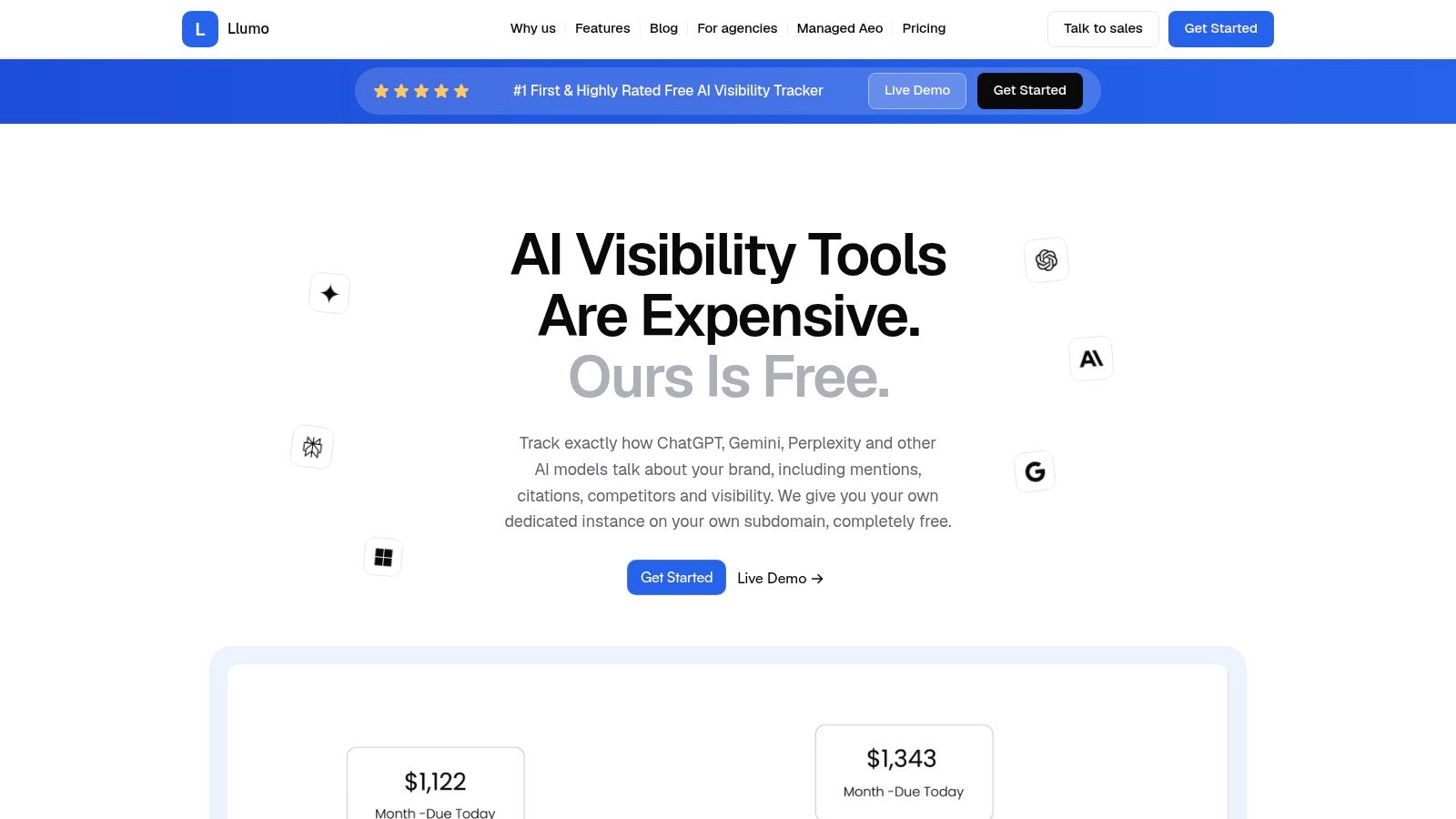
Practical rule: Choose Llumo when you need cross-model visibility, prompt history, citation evidence, and direct control over provider usage in one platform.
2. BrightEdge
BrightEdge is the strongest fit when AI visibility must sit inside an enterprise SEO and content operation. Its Generative Parser detects AI Overview presence for tracked topics and keywords, then connects those observations with workflows that help teams decide which content requires attention. That makes it less of a standalone prompt tracker and more of an enterprise change-management system.
The platform charts brand presence and share-of-voice trends across AI Overviews and classic search results. That combined view matters because organic rankings and AI citations overlap, but they are not identical. Research on citation behavior has found both strong alignment with organic results and substantial citation activity from pages outside the top organic results, so a tool that shows only rankings can leave the explanation incomplete. BrightEdge’s analysis of rank overlap and AI Overview citations provides useful context for that distinction.
Best fit and limitation
BrightEdge’s ongoing AI search research and weekly insights can help enterprise strategists interpret changes instead of reacting to isolated observations. Teams that need executive reporting, topic-level monitoring, and content actions in one operating environment will find the workflow coherent. A practical guide to answer engine optimisation can complement that measurement layer.
The trade-off is clear. Pricing is enterprise-level and sales-led, while the deepest coverage is Google-focused. Other large language models may be supported directionally, but buyers needing detailed cross-LLM response archives should verify the exact coverage and evidence available in their plan.
Practical rule: Choose BrightEdge when governance, integrated content execution, and enterprise reporting matter more than low-cost experimentation.
3. Semrush
Semrush makes sense for teams that do not want a separate AI visibility system beside their existing SEO workflow. Its Position Tracking and Sensor tools surface AI Overview presence, allowing marketers to compare traditional search visibility with the appearance of AI-generated results. The result is useful for organizations that already manage keywords, competitors, and reporting in Semrush.
The platform’s AI Search package combines AI Overview indicators with keyword research and broader SEO analysis. That combination helps teams identify queries where AI results appear and then investigate the underlying search opportunity. Semrush also provides educational guidance for finding lower-competition AI Overview opportunities, which is more actionable than treating every observed appearance as equally valuable.
What it measures well
Semrush is strongest at detection, presence, and workflow continuity. A marketing team can review whether an AI Overview appears for a tracked keyword, compare that footprint with classic share of voice, and keep the resulting work inside a familiar SEO environment. That reduces implementation effort for teams already using the platform.
It is not a complete substitute for a specialist AEO platform. Full LLM answer text, page-level citation grids, and deep prompt archives are limited, so teams investigating why a model selected one source over another may need another layer. Advanced AI visibility features may also require higher-tier plans. For agencies evaluating adjacent tools, this comparison of AI visibility trackers offers useful context.
Semrush is therefore a practical Otterly AI alternative for SEO-led organizations, not necessarily the best choice for research teams that need extensive cross-model evidence.
4. SE Ranking
SE Ranking targets the practical middle ground between a lightweight tracker and an enterprise SEO suite. Its dedicated AI Overviews Tracker records AI Overview presence for individual keywords and compares cited URLs with top organic results. That comparison is valuable because citation visibility is not just a duplicate of ranking visibility.
The platform also supports project-level monitoring, placing AI result checks beside standard rank tracking. For teams that already organize client or brand work around projects, this keeps adoption straightforward. Its visibility checks extend across ChatGPT, Perplexity, Gemini, and Google AI Mode, giving smaller teams a broader view than a Google-only utility without requiring a highly technical implementation.
Why agencies may choose it
SE Ranking provides how-to resources and videos that explain AIO workflows in operational terms. That matters for agencies where several people need to reproduce the same reporting process, rather than rely on one specialist who understands an unfamiliar dashboard.
Its main advantage is practical coverage at a lower entry point than enterprise platforms, although exact plan limits and add-ons need verification before purchase. Cross-LLM citation analysis is lighter than what specialist AEO products provide, and some capabilities require higher plans.
A useful operating model is to begin with a tightly defined prompt set, archive results consistently, and compare like-for-like periods. Guidance on AI search benchmarks and baselines emphasizes time-series, cross-platform measurement and KPIs such as brand presence, citation frequency, referral traffic, AI agent traffic, and competitive share of voice.
SE Ranking is a good Otterly AI alternative for SMBs and agencies that want AIO monitoring integrated with familiar SEO reporting. It becomes less suitable when prompt-level answer history and detailed citation reasoning are the central requirements.
5. SISTRIX
SISTRIX solves a different problem: international AI visibility tracking with an API path for custom reporting. Its AI Overviews monitoring works across countries, which makes it relevant for organizations whose customers see different search results by market. That country-level perspective can expose visibility differences that a single global dashboard hides.
The platform also includes a Prompt Tracker for checking whether a brand appears for specific questions in ChatGPT, Perplexity, and Google AI Overviews. It connects those observations with the wider SISTRIX visibility and keyword modules, so an international SEO team can compare AI signals with established organic performance data.
The implementation question
SISTRIX’s transparent package tiers and annual options can make procurement easier to understand than entirely sales-led enterprise products. Its API endpoints also support custom dashboards and internal reporting, which is important for teams that already maintain a central data warehouse or market-level reporting system.
The limitation is coverage. Beyond Google AI Overviews, Perplexity, and ChatGPT, the LLM set is narrower than platforms designed specifically for broad multi-model tracking. Prompt design also requires care. If business questions are not mapped to customer journeys, the tracker may produce technically accurate but strategically weak observations.
SISTRIX is the better choice when market-level consistency, country coverage, and API access outweigh maximum model breadth. It is not the obvious pick for a product team trying to inspect every model response, but it can work well as an international SEO intelligence layer.
6. Conductor
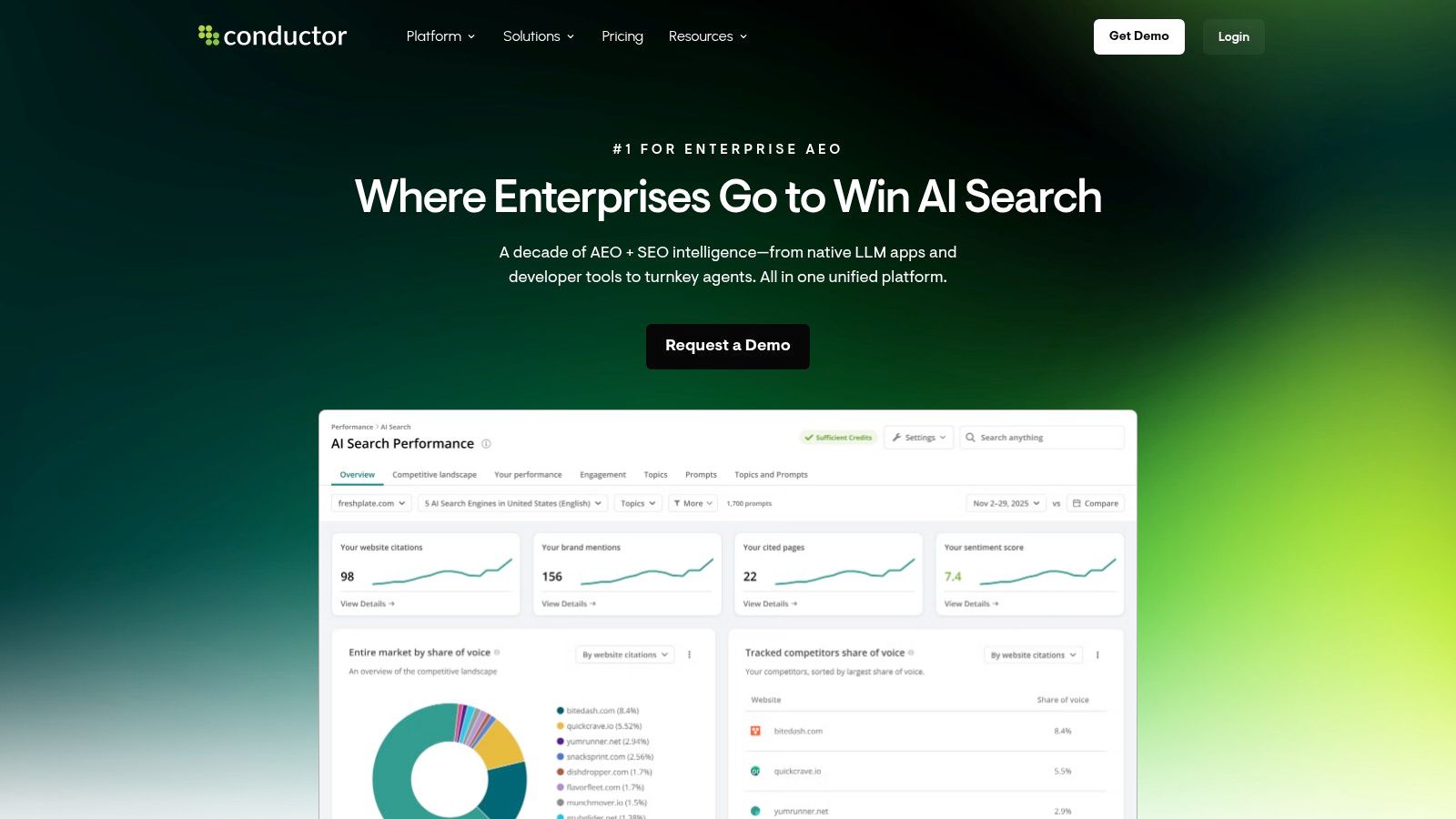
Conductor is designed for organizations that want AI search measurement connected directly to content execution. Its AI Search Performance area provides visibility metrics, market share, and trendlines, while content recommendations translate observed AI results into work for editorial and SEO teams.
The platform’s daily and weekly dashboards give stakeholders a recurring view of movement rather than a one-time audit. That cadence supports governance, especially when multiple teams contribute to content updates and need a shared interpretation of performance.
Execution inside an enterprise system
Conductor’s strength is the connection between measurement and action. Content recommendations are tied to observed AI results, and integrated writing assistant workflows help teams move from an insight to a draft or revision without building a separate handoff process. For a large organization already standardized on Conductor, that integration may matter more than having the largest possible list of AI engines.
The product’s market share metrics also support leadership conversations. A senior stakeholder may not need every generated answer, but they do need a consistent way to understand whether the brand’s position changes across tracked topics and competitors.
The trade-off is procurement and scale. Pricing and detailed product information are sales-led, and the strongest value appears in larger organizations with established content governance. A lean team may find the operating model heavier than necessary if it only needs lightweight prompt validation.
Choose Conductor when the key question is, “How do we turn AI visibility findings into governed content work?” Choose another platform when the primary need is inexpensive, highly granular, cross-model response archiving.
7. Botify
Botify is the clearest choice for technical SEO teams that want to connect AI visibility with crawling and server-log evidence. Its AI Visibility Overview reports on brand presence across ChatGPT, Google AI Mode, Perplexity, Gemini, and AI Overviews, while its technical analytics layer shows which AI agents access which content.
That distinction matters. A visibility tracker tells you what an AI system displayed. Botify can help investigate the technical pathway behind that outcome, including whether relevant pages are crawlable and whether AI agents reach them.
Where log analysis changes the diagnosis
Botify’s server-log analysis identifies AI bot access by agent and content, giving technical teams a way to separate content problems from access or discoverability problems. If an important page is absent from AI answers, the team can examine crawl behavior, internal signals, and AI-agent visits instead of immediately rewriting the page.
The platform also offers competitive share-of-voice-style views for AI presence and export options for reporting. Its integration of crawl data, logs, and AI visibility is more technically demanding than a simple SaaS dashboard, but that effort creates a richer diagnostic record.

Botify’s limitation is implementation effort. Enterprise complexity and cost mean the platform is unlikely to be the right first purchase for a small content team. It delivers the most value when log access, crawl expertise, and technical ownership already exist.
AI visibility is not only a content question. For technical teams, the missing evidence may be which agents accessed which pages and under what crawl conditions.
8. Similarweb
Similarweb approaches AI visibility through competitive intelligence and traffic context. Its GenAI Intelligence toolkit and Rank Tracker detect AI Overviews, while dashboards connect AI surface changes with market movement and traffic patterns. This makes it useful for teams asking not only whether their brand appears, but how AI search may alter the competitive scene.
The platform’s market-level perspective is its main differentiator. A brand team can examine competitors, category activity, and traffic implications without restricting analysis to its own tracked prompts. That supports executive narratives where the audience wants to understand market exposure rather than inspect every individual response.
Best for market questions
Similarweb provides playbooks for tracking and improving AI visibility, helping teams structure an ongoing process around competitive shifts. Its strength is therefore contextual benchmarking, particularly for strategy, growth, and competitive intelligence practitioners.
It is less granular than a specialist AEO tool for prompt-level answer archiving. Teams that need to preserve every response, inspect citation URLs by prompt, or trace changes at page level should validate those capabilities carefully. Some AI features are also limited to higher-tier packages.
Similarweb is a sensible Otterly AI alternative when leadership needs a market view and traffic narrative. It is not the best match for a content editor who needs a precise list of cited pages to update this week.
9. Ahrefs AI Overviews Tracker
Ahrefs provides a fast, no-cost way to establish a Google AI Overview baseline. Its AI Overviews Tracker checks whether an overview appears for a keyword and whether the tracked domain is cited. That narrow scope suits teams validating Google visibility before adopting a broader monitoring platform.
The main use case is internal validation. An SEO lead can test priority queries, confirm where AI Overviews appear, and check whether the brand receives citations before requesting budget for a larger system. Ahrefs also publishes research on AI Overview frequency and impact, as discussed in this guide to AI Overview tracking tools, which adds context to the tracker’s results.
A baseline, not a full program
Ahrefs is Google-centric. It does not provide the multi-LLM prompt archives, broad model comparison, or long-term workflow depth expected from a full AI visibility platform. It also cannot explain every reason an AI system selected a source, so teams should use it as an initial measurement layer rather than a complete AEO operating system.
Citation concentration makes that boundary important. One analysis of 1,000 queries found that the top 1% of cited domains accounted for 47% of citations, while the average overview contained 4.2 citations, ranging from 2 to 9 sources. The citation-source analysis supports using the tracker to confirm whether a domain appears, then adding deeper analysis when competitive gaps or concentration require it.
Ahrefs fits teams seeking a low-cost validation tool for Google AI Overview monitoring. Teams measuring ChatGPT, Gemini, Perplexity, or other surfaces need a cross-model platform instead.
10. seoClarity
seoClarity is built for enterprise SEO and AEO teams that need large-scale keyword coverage, monitoring, and testing in one stack. Its AI Overviews monitoring and alerting connect with broader SEO workflows, allowing teams to watch changes across extensive keyword sets rather than manually inspect isolated queries.
The platform also ties recommendations and testing to AI citations. That creates a more structured feedback loop for teams that already manage SEO changes through formal processes. Instead of treating AEO as a separate experiment, an organization can place AI citation observations beside existing technical, content, and ranking work.
Governance and scale
seoClarity’s reporting connects overall SEO posture with AI citation signals, which is useful when stakeholders need to understand how conventional optimization and AI visibility interact. The platform’s enterprise support also suits organizations where several teams need shared permissions, change management, and repeatable reporting.
Its main constraint is fit. Pricing and full AI feature depth are sales-led, and the platform may be heavier than a small team needs. Buyers should confirm which LLMs, alert types, prompt volumes, citation details, and testing workflows are included in the proposed package.
The evidence on citation placement also supports a content-level use case. One study reported that 55% of Google AI Overview citations came from the first 30% of content, while 21% came from the bottom 40%. CXL’s analysis of citation sources suggests that a platform linking citation observations to content testing can help teams investigate structure, not just topic relevance.
seoClarity is best for enterprise teams that need AEO inside a mature SEO operating model.
11. STAT Search Analytics from Moz
STAT Search Analytics suits teams already using STAT for large-scale SERP monitoring and looking to add AI Overview presence indicators without replacing their existing workflow. It tracks when AI Overviews appear for monitored keywords, giving rank intelligence teams another search-result format to evaluate.
The platform’s scale across markets is useful for organizations managing broad keyword portfolios. Its guidance on connecting AIO shifts with GA4 and Google Search Console also helps analysts move from visibility observations toward traffic interpretation.
A useful add-on, not a full LLM archive
STAT’s value comes from continuity. A team can keep its established rank tracking, market monitoring, and reporting processes while adding context about where AI Overviews appear. That reduces the disruption associated with introducing a completely separate AEO platform.
The limitation is equally important. STAT’s AI Overview focus is mainly presence and format, rather than a dedicated cross-LLM answer archive with detailed prompt-level citation analysis. Enterprise contracts and limited public pricing detail also make direct comparison harder before a sales conversation.
Search intent should shape interpretation. An analysis found that educational articles represented 70.2% of citations for informational queries, while listicles and buying guides led commercial searches at 37.6%. Position Digital’s AI Overview citation analysis shows why a presence signal alone is not enough. Teams also need to compare the content format with the query’s intent.
STAT is a sensible Otterly AI alternative for established enterprise rank-tracking teams. It is less suitable when the central requirement is broad model coverage or stored AI responses.
Top Otterly AI Alternatives Comparison
Tool | Core features ✨ | Target audience 👥 | Unique selling point 🏆 | Price/value 💰 | Coverage & quality ★ |
|---|---|---|---|---|---|
Llumo | ✨ Cross-model prompt tracking; prompt archives; citation analysis; share of voice; query fan-out logging | 👥 Brands, agencies, SEO and analytics teams | 🏆 Specialist AI visibility platform with provider-key flexibility | 💰 Flexible usage model via connected provider keys | ★★★★★ |
BrightEdge | ✨ AI Overview detection; share-of-voice & SERP charts; Generative Parser + workflows | 👥 Enterprise SEO/AEO teams | 🏆 Enterprise workflows + research-backed insights | 💰 Sales-led (enterprise) | ★★★★ |
Semrush | ✨ AIO detection in Position Tracking & Sensor; AI Search package + keyword research | 👥 Agencies & in-house SEO teams | 🏆 All-in-one SEO toolkit with AIO signals | 💰 Subscription tiers; advanced features on higher plans | ★★★ |
SE Ranking | ✨ Per-keyword AIO presence; project-level tracking; multi-LLM checks | 👥 SMBs & agencies | 🏆 Practical AIO monitoring at lower entry cost | 💰 Lower entry price; some features paid | ★★★ |
SISTRIX | ✨ Country-level AIO tracking; Prompt Tracker; API access | 👥 International teams & analysts | 🏆 Strong international footprint + API | 💰 Tiered/annual packages | ★★★ |
Conductor | ✨ Daily/weekly AI visibility dashboards; content recommendations; writing assistant | 👥 Enterprise content & SEO orgs | 🏆 Tight integration of visibility to content execution | 💰 Sales-led (enterprise) | ★★★★ |
Botify | ✨ AI visibility reports + server log AI bot tracking; crawl + logs integration | 👥 Technical SEO teams & enterprises | 🏆 Log-level insight on which AI agents access content | 💰 Enterprise pricing; implementation effort | ★★★★ |
Similarweb | ✨ Rank Tracker AIO detection; GenAI market dashboards; traffic impact playbooks | 👥 Market analysts & execs | 🏆 Market-level competitive and traffic benchmarking | 💰 Higher-tier for advanced AI features | ★★★ |
Ahrefs (AIO Tracker) | ✨ Free AIO presence and domain citation checks; research on impact | 👥 Teams validating AIO business case / starters | 🏆 Fast, no-cost baseline AIO checks | 💰 Free utility | ★★ |
seoClarity | ✨ Large-scale AIO monitoring; recommendations and testing tied to citations | 👥 Large enterprises needing scale and testing | 🏆 Enterprise-scale AEO + change management | 💰 Sales-led enterprise pricing | ★★★★ |
STAT (Moz) | ✨ Tracks AIO presence; guidance connecting AIO to analytics; large-scale rank intel | 👥 Teams standardizing on STAT for SERP monitoring | 🏆 Proven SERP monitoring with added AIO context | 💰 Enterprise contracts; limited public pricing | ★★★ |
Choose the Visibility Layer That Fits
The right Otterly AI alternative depends on the question your team needs answered. If you need the strongest overall cross-model option, Llumo is the clearest first choice. It is built for teams that want prompt archives, per-prompt visibility, citation evidence, competitive trends, share of voice, and flexible provider-key connections in one place. That makes it especially useful when the goal is to understand why visibility changed, not just whether a mention appeared.
If the question is whether priority queries trigger Google AI Overviews and whether your domain is cited, Ahrefs provides a fast baseline. It will not replace a full monitoring program, but it can validate whether the problem deserves more investment.
Choose Semrush or SE Ranking when AI Overview signals need to live inside an established SEO workflow. Semrush is a natural fit for teams already using its keyword and competitive tools. SE Ranking is better suited to SMBs and agencies that want practical AIO monitoring plus visibility checks across ChatGPT, Perplexity, Gemini, and Google AI Mode, while accepting lighter cross-LLM citation depth.
SISTRIX is the stronger option for international teams that need country-level AI Overview tracking and API access. Botify should be on the shortlist when the diagnostic question involves crawlers, server logs, AI agents, and page access. Those teams are not only asking which brand appeared. They are investigating whether technical conditions influence what AI systems can retrieve.
For market-level competitive intelligence, Similarweb offers the broader narrative around traffic, competitors, and AI surfaces. It will not provide the same prompt-level evidence as a specialist AEO platform, but it can help executives understand how AI search affects the category. BrightEdge, Conductor, seoClarity, and STAT make more sense when governance, enterprise support, large-scale tracking, and integrated execution outweigh simplicity.
Before switching, validate five things:
Model coverage: Confirm the exact engines included, not just the vendor’s broad category language.
Citation evidence: Check whether the platform stores response text, cited URLs, page-level sources, and changes over time.
Reporting limits: Review prompt volume, refresh cadence, exports, API access, seats, and historical retention.
Workflow fit: Decide whether findings move into content briefs, testing, technical tickets, or executive dashboards.
Implementation effort: Account for provider connections, log access, project setup, governance, and analyst time.
The market has expanded beyond simple monitoring. The AI visibility tool market was valued at $20.4 billion in 2024 and is projected to reach $82.2 billion by 2030, implying roughly a fourfold increase over six years, according to AIClicks’ overview of the Otterly AI alternatives market. That growth reflects demand for tracking mentions, citations, query fan-out, and competitive share of voice across ChatGPT, Gemini, Perplexity, Copilot, and Google AI Overviews.
For teams needing those signals in one cross-model layer, Llumo supports prompt archives, per-prompt visibility, share of voice, citation analysis, competitive trends, and query-fan-out logging. Its bring-your-own-provider-key model lets customers connect their own keys and pay underlying provider costs directly, which may suit agencies, brands, and analytics teams that need flexible usage rather than a fixed bundled tier.
The most reliable buying decision is not the one with the longest engine list. It is the one that gives your team enough evidence to explain visibility changes, enough workflow support to act on them, and enough historical continuity to distinguish durable movement from noisy AI responses.
Llumo brings cross-model AI visibility tracking, prompt-level archives, share of voice, competitor trends, and citation analysis into one platform, with connected provider keys for direct usage control. Visit Llumo to evaluate a measurement layer that fits your model coverage, reporting, and AEO workflow needs.