
You've added writers, freelancers, and AI tools, yet the publishing queue keeps growing. Briefs arrive incomplete, editors become the final checkpoint for every claim and comma, and approved articles sit idle while someone searches for the latest version. Meanwhile, output rises but organic visibility barely moves.
That's the uncomfortable reality of content at scale. More production capacity helps only when the operating system beneath it can absorb the work. Without clear ownership, risk-based review, reusable source material, and visibility measurement beyond rankings, volume creates editorial debt faster than it creates growth.
Why Most Content at Scale Programs Stall
I've seen teams triple their monthly output and still feel less productive. The writers weren't the problem. They knew the subject, met deadlines, and could produce solid drafts. The breakdown happened after writing: briefs changed halfway through production, subject-matter experts reviewed the same claims repeatedly, and one senior editor became responsible for every meaningful decision.
The team had scaled headcount, not the workflow. A system built for a small publishing schedule can't absorb a much larger one without new stages, ownership rules, and review gates. Otherwise, every additional article adds another request to the same queue.
The symptoms are easy to recognize
Briefs fail at handoff: Writers interpret search intent differently because the brief doesn't define the audience, angle, evidence requirements, or internal links.
Review becomes the production line: Editors spend their time correcting avoidable structural and factual problems instead of improving judgment-heavy work.
Originality declines: Writers repeat the same examples, angles, and source patterns because nobody maintains a usable knowledge base.
Accuracy becomes inconsistent: Claims move from draft to publication without a clear source owner or verification standard.
Distribution lags behind publishing: Articles go live, but email, social, sales enablement, and internal linking updates happen much later, if at all.
Visibility flattens: The team publishes more pages without improving the signals that help search engines and answer engines understand, retrieve, and cite them.
The market pressure is real. Adobe reports that 96% of marketers saw content demand increase at least twofold over the previous two years, while 62% said demand increased fivefold or more. The same Adobe content workflow report says 71% expected demand to grow by more than fivefold between 2025 and 2027.
That demand makes scale necessary, but it doesn't make indiscriminate publishing useful. A large content-operations study found that only 9% of organizations had reached the highest maturity level, while 45% aspired to get there. Its central lesson is practical: process maturity and content success rise together, so AI and additional writers can't compensate for weak operating design. Read the content-operations maturity study for the underlying analysis.
Practical rule: If the same person approves every article, fixes every brief, and resolves every factual dispute, you haven't scaled content. You've expanded the queue around one person.
The levers that determine whether output compounds are straightforward: workflow design, quality controls, tooling, governance, and AI-visibility measurement. The rest of this playbook treats them as connected parts of one operating model.
The Workflow That Holds Up Under Volume
A scalable workflow should be visible on a whiteboard. Each stage needs an owner, a defined handoff, and a service expectation. If a task can't move forward because someone is “waiting for context,” the workflow has a design problem.
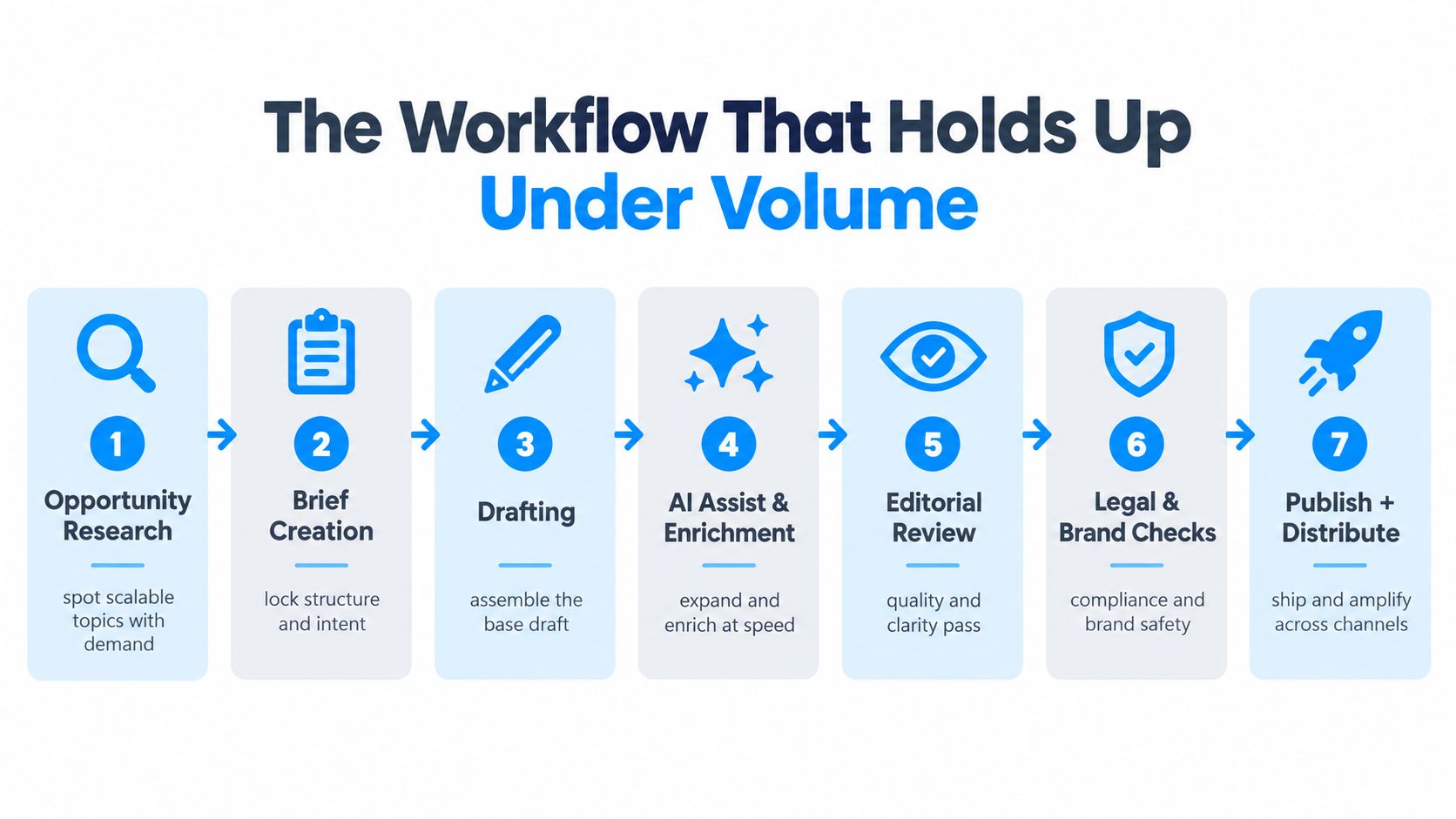
Seven stages, seven accountable handoffs
Opportunity research: The SEO or content strategist owns the opportunity. The handoff is a prioritized topic record containing audience, search or discovery intent, business relevance, competing coverage, and an initial source plan. Research should happen before a writer is assigned, not during drafting.
Brief creation: A content strategist turns the opportunity into a production brief. It should lock the primary question, reader promise, outline, entities, internal-link targets, required evidence, author profile, conversion path, and exclusions. Use a template with required fields so writers aren't forced to infer strategy.
Drafting: The assigned writer owns the first complete version. The artifact moving forward is a draft that follows the brief, includes source links beside claims, and flags unresolved questions instead of hiding them inside confident prose.
AI assist and enrichment: A content editor or operations specialist controls this layer. AI can expand an outline, suggest metadata, identify internal-link opportunities, produce alt text, or create derivative formats. It shouldn't decide whether an original claim is trustworthy or whether a regulated statement is safe.
Editorial review: The editor checks structure, clarity, usefulness, factual support, originality, and alignment with the brief. The draft should enter this queue only when the writer has completed the basic checks. That keeps editors from becoming cleanup staff.
Legal and brand checks: The named brand or legal approver reviews only the risks assigned to that role. Parallel review works better than a serial chain, especially when legal needs to assess claims while brand checks messaging and editorial verifies sources.
Publish and distribute: The channel owner publishes the approved asset, activates internal links, adds structured data where appropriate, and distributes the derivative formats. Publication isn't complete until the content reaches its intended channels and enters post-publish monitoring.
Where handoffs usually fail
The first break is brief-to-draft alignment. A templated brief solves this only if the strategist treats missing fields as a stop signal. The second is draft-to-review overflow. A tiered review SLA, based on content risk rather than arrival order, prevents routine pages from competing with high-stakes work.
The third is publish-to-distribution lag. Assign distribution tasks in the same record as publication, with one status field serving writers, editors, SEO, brand, and marketing. A spreadsheet can work at first, but it must behave like a single source of truth, not a collection of personal tabs.
Watch the workflow explanation before choosing software:
Treat the workflow as a product. Version the brief, document why gates changed, assign an owner for every stage, and review cycle-time data with the people doing the work. A workflow document that nobody updates is just an old diagram.
Quality Controls and Review Gates
Quality at scale comes from separating checks that software can perform consistently from judgments that require a person with context. A single editor signing off everything sounds efficient, but it concentrates risk and turns review into a queue.
Four layers of quality
Factual accuracy and source verification comes first. Every material claim should have a source, and the reviewer should judge whether that source actually supports the wording. A citation attached to a related page isn't enough. Writers should distinguish sourced facts, expert interpretation, customer evidence, and editorial opinion.
Brand voice and tone need a working style guide, not a mood board. Define sentence patterns, preferred terms, prohibited claims, audience assumptions, examples of acceptable directness, and the point at which a writer should escalate a tone question.
Originality and duplication protect the site from publishing five versions of the same page. Compare new drafts against existing URLs, canonical topics, product terminology, and prior briefs. Similarity tools can flag overlap, but an editor still decides whether two pages serve distinct intents.
SEO and answer-engine fitness covers headings, entities, internal links, schema validation, concise answer blocks, source visibility, and extractable structure. These checks don't guarantee visibility. They make the content easier to interpret and evaluate.
Match the gate to the risk
Risk Tier | Automated Checks | Human Review | Approver | Trigger for Rework |
|---|---|---|---|---|
Low | Spelling, internal duplication, metadata, links, schema validation | Spot review for usefulness and tone | Content editor | Unsupported material claim, obvious duplication, or missing intent |
Medium | All low-risk checks plus brand-term linting and citation presence | Full editorial review and source judgment | Senior editor or subject owner | Weak evidence, unclear differentiation, or voice drift |
High | Automated checks support the review but don't replace it | Full editorial, factual, and compliance review | Named subject, brand, or legal approver | Any unresolved regulated claim, disputed fact, or missing source |
Strategic | Structural and technical validation | Editorial, executive, subject-matter, and distribution review | Accountable business owner | Misaligned positioning, weak authority signals, or unapproved messaging |
Automation is useful for plagiarism checks, internal duplication, schema validation, broken links, metadata completeness, and brand-term linting. It can also identify sentences that contain dates, claims, or comparative language for human inspection.
People must handle nuanced voice, source quality, contested subjects, expert interpretation, and regulated claims. AI can point to a suspicious sentence, but it can't reliably decide whether a source deserves authority in your market.
Set the rework rules before the queue fills. For example, any unsupported material claim returns to the writer, while a minor tone issue becomes an editorial correction. This removes case-by-case negotiation and gives reviewers permission to publish when the defined standard is met.
Tooling and AI Assist Layers
The stack should follow the workflow, not dictate it. A content operation usually needs research, generation, quality assurance, distribution, and monitoring. One platform may cover several layers, but the team should still know which system owns the underlying data and where it can export the work.
Two viable architecture choices
Bundled suites such as Surfer, MarketMuse, Clearscope, and ContentShake reduce integration work. They can make onboarding easier because research, optimization, briefs, and drafting live in one environment. The trade-off is less flexibility when a team wants to change models, inspect outputs, or move data into another system.
A best-of-breed stack can combine ChatGPT, Claude, Perplexity, Notion, Airtable, and n8n or Make. This gives specialists more control over prompts, workflows, provider selection, and data storage. It also creates more responsibility for permissions, versioning, API maintenance, and quality monitoring.
Dimension | Bundled Suite | Best-of-Breed Stack |
|---|---|---|
Setup | Faster initial configuration | Requires workflow design and integrations |
Flexibility | Strong within the vendor's roadmap | High, with interchangeable tools |
Transparency | Varies by platform and feature | Easier to isolate prompts, models, and outputs |
Data privacy | Governed by one main vendor relationship | Must be assessed across every provider |
Lock-in | Higher if workflows and data stay inside the suite | Lower when artifacts remain portable |
Operations | Fewer moving parts | More ownership, testing, and maintenance |
AI reliably helps with first-draft expansion, title and metadata options, internal-link suggestions, alt text, content repurposing, and formatting. It performs poorly when asked to invent original sourcing, preserve subtle brand voice over a long draft, or make decisions about regulated claims.
Prompt design deserves its own operating practice. A useful prompt-set framework keeps prompts tied to repeatable jobs, expected inputs, quality checks, and escalation paths instead of treating every generation request as a fresh experiment.
Build layers with escape hatches
The research layer stores sources, entities, audience questions, and competitive observations. The generation layer creates drafts and variations from approved context. The QA layer checks evidence, duplication, structure, and brand rules. The distribution layer handles CMS publication, internal links, derivatives, and monitoring.
Assign an owner to each layer and preserve the option to bypass a tool. If an AI researcher returns weak sources, the writer should be able to use an approved source library. If a drafting model flattens the voice, the editor should switch to a human-led draft without rebuilding the brief.
Governance Without Bottlenecks
Governance becomes a publishing tax when every article follows the same approval path. It becomes useful when teams encode predictable risks into small artifacts and reserve human escalation for exceptions.
Four guardrails people can actually use
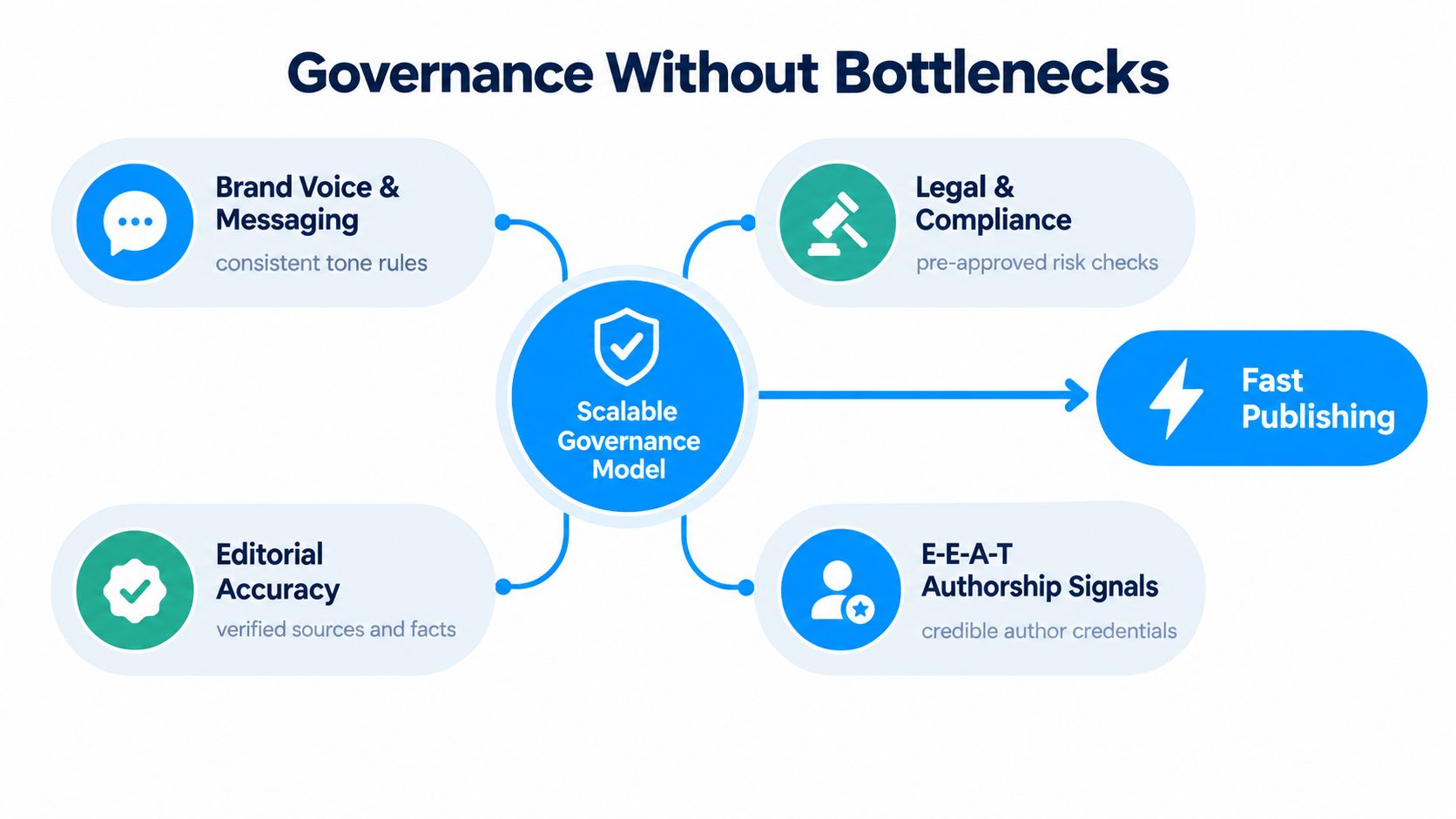
A one-page voice and messaging guide should cover approved positioning, audience language, product terms, claims that need evidence, and examples of strong and weak copy. Brand teams own it, but content operations should maintain the version used in production.
A claims checklist gives legal and compliance teams an edge without requiring them to read every routine page. It can identify prohibited guarantees, comparative statements, financial or health implications, regional restrictions, and language that requires pre-approved wording.
An editorial source policy defines acceptable source types, citation placement, author attribution, and the difference between primary evidence and commentary. This turns source judgment into a shared standard instead of an editor's personal preference.
An author schema template captures the author's role, expertise, biography, relevant credentials, and review relationship. E-E-A-T signals shouldn't be added as decorative fields after publication. They should enter the brief and remain attached to the asset.
Route reviews in parallel
A routine educational article might receive editorial and brand review at the same time, while a high-risk product claim also routes to legal. Each reviewer gets an asynchronous service expectation and comments in the shared record. The content owner resolves conflicts, and only defined exceptions return to a senior decision-maker.
For a weekly cadence of 50 articles, the routing model should group work by risk rather than sending every item through every team. Commodity pages can move through automated checks and spot review, while regulated or reputation-sensitive pieces receive named human approval. The target isn't to make every article move at the same speed. It's to prevent low-risk content from waiting behind work that genuinely needs deeper scrutiny.
A shared ownership matrix keeps accountability visible:
Content operations: Workflow, deadlines, templates, and queue health.
Editorial: Accuracy, usefulness, structure, and source judgment.
Brand: Messaging, voice, terminology, and positioning.
Legal or compliance: Defined risk categories and exceptions.
SEO or AEO: Discoverability, internal links, structured data, and visibility feedback.
Governance should also include an expiration path. If a claim changes, the source is withdrawn, or the product is repositioned, the owner needs a way to identify affected derivatives and update them through one controlled change.
Measuring Visibility Across AI Answer Engines
A content program can publish consistently, hold rankings, and still remain absent from AI-generated answers. Search traffic and pageviews measure demand capture. They do not show whether an answer engine can retrieve, trust, and cite your material. Add a second measurement layer across ChatGPT, Perplexity, Google AI Overviews, Gemini, and Claude.
Query fan-out changes what you measure. An engine may split one prompt into related sub-queries, search those paths in parallel, and assemble an answer from sources whose wording differs from the original question. The guide to citation selection and query fan-out explains why topical coverage, clear entities, and supporting pages can matter without an exact prompt match. For a worked example, see how to read the citations behind an AI answer.
Build a prompt-level measurement loop
Create a taxonomy covering commercial topics, customer problems, competitors, definitions, comparisons, and high-value use cases. Run the same prompt set on a consistent schedule. Record each answer, then log the brands, URLs, and domains cited.
Track four signals:
Prompt-level citation rate: Whether your brand or site appears as a cited source for a target prompt.
Share of answer: How often your brand earns meaningful visibility against the defined competitor set.
Source co-mention: Which third-party domains appear alongside your brand or product.
Retrieval freshness: Whether recently updated pages and current sources enter answers as the topic changes.
Use a short diagnostic path. If a page is never retrieved, inspect structure, topical coverage, entities, and internal links. If it is retrieved but not cited, examine evidence, source quality, extractability, and stronger third-party references. If citations disappear, check freshness, changed claims, lost mentions, and competing pages.
A Google AI Overviews citation study found an average of 4.2 citations per overview, with observed results ranging from 2 to 9 depending on intent. The study reported that pages with schema markup were cited 2.3 times more often, pages longer than 2,500 words were cited 1.6 times more often than pages under 800 words, and pages with at least one named source were cited 2.1 times more often than pages without named-source citations. Treat these findings as directional signals, not guarantees.
Signal | What It Measures | Triggers Action When |
|---|---|---|
Prompt-level citation rate | Source inclusion for target questions | Priority prompts repeatedly exclude your pages |
Share of answer | Relative presence against competitors | A competitor gains visibility across a topic cluster |
Source co-mention | Domains shaping the same answers | Trusted third-party sources mention competitors but not you |
Retrieval freshness | Whether current material is retrieved | Updated pages fail to replace outdated references |
A multilingual brand-reputation study analyzed 167,551 URL-grounded citations across 128 brands, 12 home markets, and 13 languages. The study of brand reputation in AI answers found that 85.7% of citations pointed to third-party sites, while 80% came from roughly 18% of domains. Owned publishing is only one lever. Evidence, trusted mentions, and source relationships also belong in the content roadmap.
Connect prompts to engines, engines to cited URLs, and cited URLs to next actions. The result is an operating signal for editorial priorities, not another isolated reporting view.
Your 90-Day Rollout and Troubleshooting Guide
A useful rollout produces working artifacts quickly. Don't wait for a perfect operating model. Establish the minimum viable process, measure where it strains, and tighten the rules with the people who use them.
Four sprints to a functioning operation
Weeks 1 to 2, audit and cadence: The content-operations lead maps current requests, handoffs, review queues, tools, existing URLs, and publication priorities. The exit criterion is a documented baseline workflow and an agreed production cadence.
Weeks 3 to 5, workflow and QA: The editorial lead launches the seven-stage pipeline, brief template, risk matrix, source policy, and status system. The exit criterion is that a representative batch can move from opportunity to publication without relying on private messages or undocumented approvals.
Weeks 6 to 8, governance and onboarding: Brand and legal owners publish their guardrails, escalation rules, review expectations, and author requirements. The exit criterion is that every contributor knows which work they own and which risks require escalation.
Weeks 9 to 12, visibility and calibration: SEO or AEO owners create the prompt taxonomy, capture cited URLs, review retrieval gaps, and run a calibration sprint. Use AI visibility optimization guidance to connect content updates and authority work to observed answer-engine opportunities. The exit criterion is a maintained playbook with owners, review dates, and next actions.
Sprint / Failure Mode | Deliverable or Symptom | Owner / Fastest Fix |
|---|---|---|
Weeks 1 to 2 | Unclear capacity, inconsistent requests | Operations lead / Freeze new work briefly and map the real queue |
Editor bottlenecks | Drafts wait for one reviewer | Editorial lead / Introduce risk-based review and delegate routine checks |
Voice drift | Articles sound unlike the brand | Brand owner / Add approved examples and a term-level linting list |
Hallucinated facts | Confident claims lack evidence | Subject owner / Require source links beside material claims |
Duplicate URLs | Several pages target the same intent | SEO lead / Create one canonical topic record and merge or redirect overlap |
Approval queue jams | Legal or brand receives everything | Governance owner / Define exception categories and parallel routing |
Citation decay | Previously cited pages disappear | AEO lead / Check freshness, sources, structure, and third-party mentions |
Use a simple measurement calendar. Weekly, review queue age, review rework, published output, and prompt-level visibility changes. Monthly, inspect topic clusters, duplicate risk, source quality, distribution completion, and governance exceptions. Quarterly, retire weak workflows, update the source policy, recalibrate risk tiers, and reset the prompt set around business priorities.
The first objective isn't maximum volume. It's a repeatable system that can increase volume without making every new article harder to publish than the last.
Llumo measures how AI answer engines mention and cite brands across prompts, models, and source domains, helping content teams connect production decisions to AI visibility gaps. Visit Llumo to see how prompt-level tracking, citation analysis, and prioritized opportunities can fit into your content-at-scale operating model.