
Traditional rank tracking is the wrong starting point for Perplexity. A page can rank well in Google and still disappear from an answer, while a less obvious source earns a citation because it addresses the prompt more directly. You need to know whether Perplexity mentions your brand, cites your pages, or favors a competitor, not just where a URL sits in a fixed results list.
That distinction shapes this roundup. I'm judging each tool by onboarding friction, day-to-day usability, Perplexity evidence, implementation fit, and follow-through, rather than by the length of its feature list. That matters because AI visibility tracking remains early-stage. One industry compilation reports that only about 14% of marketers track AI visibility, while 16% of brands systematically track AI search performance (Digital Applied's market snapshot).
Perplexity has also grown beyond a niche research product. Public summaries place it at roughly 30 million to 45 million monthly active users, while another analysis reported more than 100 million monthly active users across all products (Perplexity statistics overview). For a serious team, prompt evidence, citation history, competitor comparison, and a manageable operating workflow matter more than a polished “rank” number.
1. Llumo
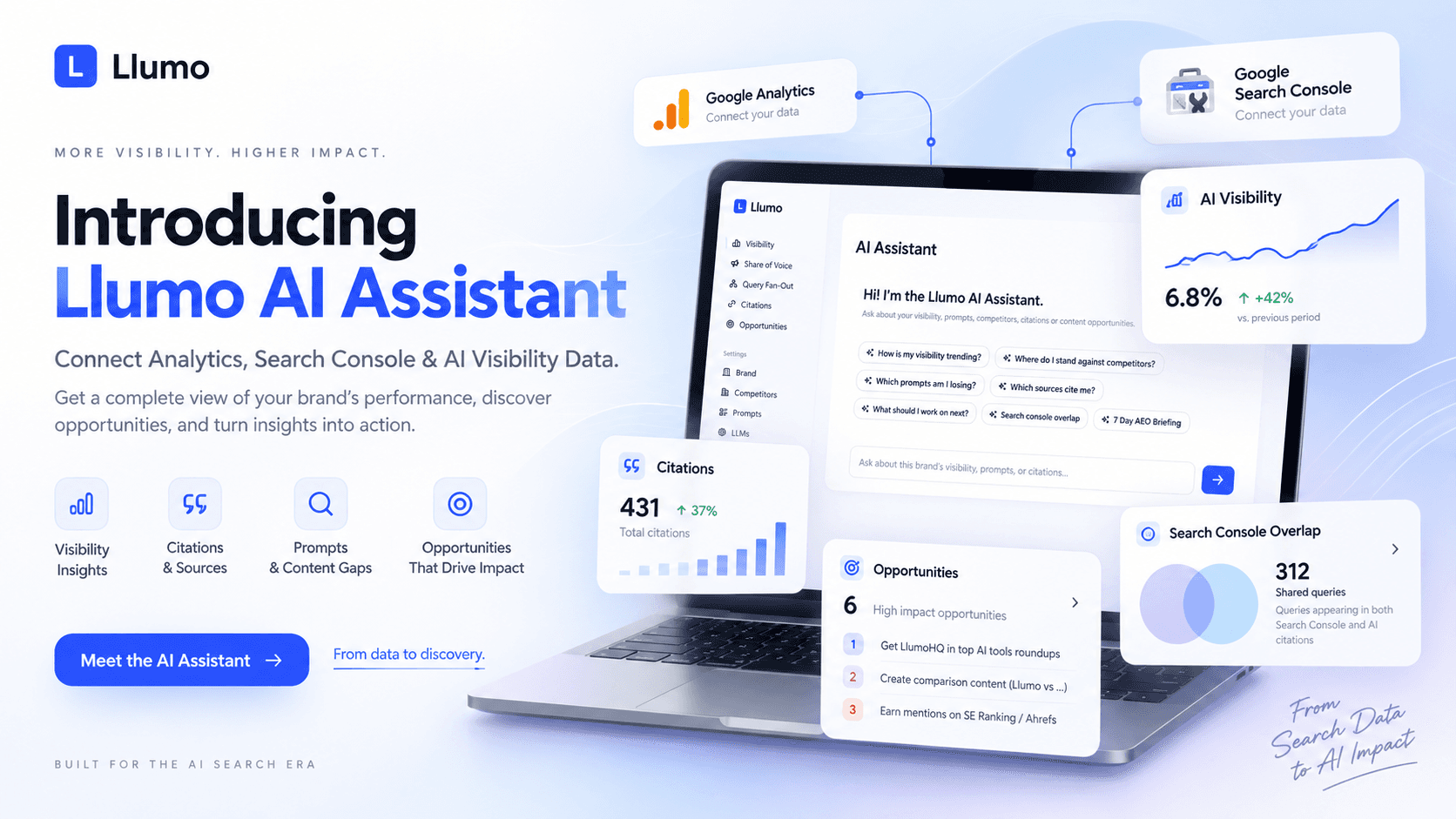
Llumo fits teams that need Perplexity evidence to lead directly into Answer Engine Optimization work. It records how models mention and cite a brand across Perplexity, ChatGPT, Gemini, Copilot, Google AI Overviews, and other surfaces, then connects those findings to content and outreach tasks.
The prompt-level view is its strongest practical feature. You can open the response behind a visibility score, inspect the domains and pages that supplied citations, compare share of voice with selected competitors, and monitor changes over time. Query fan-out logging adds useful context by showing the searches and keyword expansions behind an answer. That helps an SEO team understand why a result appeared instead of relying on a single prompt.
Llumo archives responses, supports prompt search and tagging, and flags new or lost citations. Agencies can manage unlimited projects and brands, use a hosted instance with custom branding, and add managed AEO services when measurement needs to connect with execution. It also includes focused utilities such as a Google AI Overviews Tracker and ChatGPT Tracker.
Where Llumo saves time
The workflow centers on evidence rather than a dashboard score. A team can locate the page that disappeared from a Perplexity response, identify the competitor source that replaced it, and turn the gap into a content update or brand-mention task. That matches the way SEO and AEO work is usually handled.
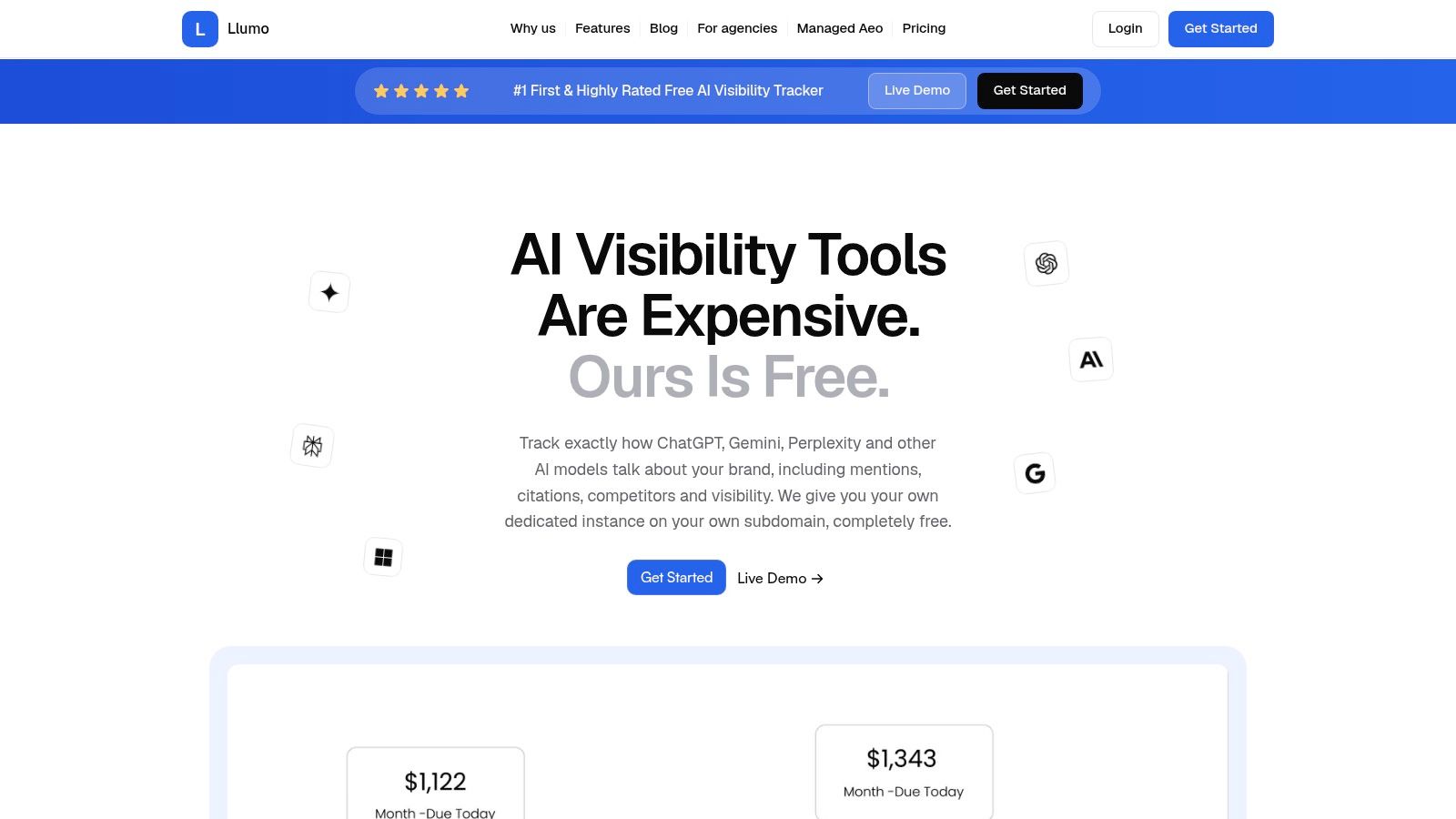
The cost model requires a different budgeting approach. There is no core software license fee. Customers bring their own provider API keys, pay providers directly, and avoid a Llumo usage markup. Technical teams gain more control over quotas and budgets, while variable provider costs require active monitoring. Pricing is not published publicly, so procurement starts with a conversation.
Practical rule: Choose Llumo when prompt monitoring needs to connect with citation analysis, competitive trends, and AEO execution. Choose another tool if you only need a lightweight visibility score.
Onboarding is the main trade-off. API-key management and model access require more planning than a simple self-serve tracker, unless managed services handle that work. Results also depend on accessible APIs and web-scraping parity. SEO and AEO practitioners, agencies, SaaS teams, and growth leaders with technical support are the clearest fit. The best AI visibility trackers for SEO and marketing agencies provides more context on the agency use case.
Pros
Broad model coverage: Track Perplexity alongside major AI answer surfaces.
Strong evidence layer: Review prompt responses, citations, domains, pages, and query fan-out.
Flexible operating costs: Use your own provider keys with no Llumo usage markup.
Agency-ready setup: Manage unlimited projects, custom branding, backups, and hosted infrastructure.
Cons
More technical onboarding: API keys, quotas, and provider access need attention.
Unpublished pricing: Provider costs must be modeled before commitment.
Variable coverage: Results can differ with API availability and scraping parity.
2. OtterlyAI
OtterlyAI suits teams that need repeatable daily checks without maintaining a prompt spreadsheet. Perplexity can be isolated from ChatGPT, Google AI Overviews and AI Mode, Gemini, Copilot, and Claude, so reports show the channel being investigated instead of combining every model into one score.
The initial setup is relatively approachable. Prompt libraries, dashboards, trend charts, and brand reports help agencies establish recurring checks across clients without designing a tracking system from scratch. Its de-personalized methodology also improves consistency. Manual tests can vary with account context, location, and browsing history, so OtterlyAI's results provide a cleaner baseline. They may still differ from what an individual user sees in a live session.
Where OtterlyAI fits
The useful evidence is at the citation level. Teams can review which sources appear in Perplexity answers, while GEO suggestions indicate possible optimization priorities. A public API also helps agencies transfer brand reports and citation data into existing reporting systems, reducing manual copying during client updates.
The product offers a 7-day free trial and visible entry pricing, so teams can test the workflow before committing (OtterlyAI). The trade-off is scope. OtterlyAI explains what changed and where citations appeared, but content production, outreach planning, and implementation remain outside the platform. Teams comparing that monitoring model with broader AEO workflows can use this OtterlyAI alternative comparison.
Perplexity is still a minority channel, with independent snapshots placing it at roughly 1.3% to 2.0% of global AI platform web traffic or share (QuickSEO's AI search comparison). Focused monitoring therefore makes more sense than collecting a large volume of undifferentiated checks.
For agencies, the main value is operational: recurring prompts, client-ready reporting, and clear Perplexity filtering. An in-house SEO team may prefer it when another system already handles writing and outreach. Teams seeking a connected path from a lost citation to published content will need additional tools.
Pros
Clear Perplexity filtering: Review the engine separately from blended reporting.
Agency-friendly cadence: Reuse prompt libraries for daily checks and recurring reports.
Accessible trial: Test the workflow before adding it to client operations.
Cons
Limited execution layer: Content and outreach work remains external.
Methodology differences: De-personalized results may not match manual checks.
Dashboard dependence: Teams wanting raw evidence may need to inspect exports closely.
3. SEONova AI Visibility
SEONova fits teams that want AI visibility inside an established SEO workflow. Its AI Visibility component monitors mentions and citations across Perplexity, ChatGPT, Gemini, and Claude, while the wider platform handles keywords, backlinks, and audits.
The practical benefit is fewer separate dashboards. SEO managers can keep traditional search tasks and AI monitoring in one environment, compare competitor projects, and evaluate visibility alongside existing work. The 14-day Pro trial, which requires no credit card, provides time to test whether the module produces evidence the team can use
The onboarding decision is straightforward: existing SEONova users face less implementation friction, while teams looking only for Perplexity research may find the broader suite unnecessary.
Evidence to check before adoption
Public pages do not clearly show pricing for the AI Visibility module, making the full cost difficult to estimate before speaking with sales. The feature is also newer than SEONova's conventional SEO capabilities. Test its methodology, report depth, historical coverage, and export options rather than assuming the surrounding SEO suite guarantees equal maturity.
I would choose SEONova when an organization already relies on its keyword, backlink, and audit workflows. It is less suitable as a dedicated Perplexity research environment if the AI component lacks the prompt archives, query fan-out, or source-level investigation available in purpose-built visibility platforms.
Before rollout, inspect raw responses and citation records. A blended score can support reporting, but it cannot replace the underlying Perplexity evidence when a team needs to explain why visibility changed.
Pros
Unified SEO workflow: Keep keywords, backlinks, audits, and AI visibility together.
Competitor projects: Compare brands within the same project structure.
Low-risk evaluation: Use the 14-day Pro trial without entering payment details.
Cons
Unclear AI pricing: Public pages do not make the module's cost obvious.
Evolving methodology: Report depth may change as the feature develops.
Potentially lighter Perplexity detail: Validate archives, citations, raw responses, and prompt controls directly.
4. MentionHQ
MentionHQ suits smaller teams that need a readable way to monitor AI visibility without a lengthy implementation. It covers Perplexity, ChatGPT, Claude, and Gemini, combining visibility scores, trend charts, competitor comparisons, and source or citation analysis.
The day-to-day workflow is straightforward: track brand appearances, review changes over time, and inspect where the brand appears in AI-generated lists. Geographic targeting on higher tiers is useful when answers vary by market, since a global score can conceal regional differences. Teams can start quickly, though they should confirm that the available evidence supports the level of analysis they need.
A practical starting point, with terms to verify
MentionHQ publishes tiered pricing and offers a 7-day free trial, which lets a marketing team test the interface and reporting process before committing (MentionHQ). That lowers onboarding friction for growth-stage companies with limited time and budget.
The main limitation is how familiar SEO terminology maps to generated answers. “Real-time” and “position tracking” may suggest fixed result pages, while Perplexity responses can change between checks. A listed position is useful for directional monitoring, not as a deterministic ranking. Before adoption, ask how MentionHQ defines position, how it handles response changes, and whether it retains the complete answer with its cited sources.
Copilot and AI Overview coverage is not listed on the Starter tier. Teams running a broader AI search program should verify the plan boundary and check whether the required surfaces are available before building reports around them.
MentionHQ is most suitable for small marketing teams that want accessible monitoring and competitor context. Teams conducting detailed Perplexity investigations should test raw-response access, citation retention, and historical evidence first.
Pros
Clear plans: Tiered pricing simplifies initial evaluation.
Useful starter workflow: Scores and trends are easy to review.
Competitive context: Benchmarking shows whether movement affects the wider category.
Cons
Interpret “position” carefully: AI-generated lists are not fixed rankings.
Plan-based coverage: Some surfaces are excluded from the entry tier.
Potentially limited evidence: Confirm raw responses and citation retention before rollout.
5. DiscoveredBy
DiscoveredBy is most useful when prompt selection is the bottleneck. It monitors brand mentions across ChatGPT, Gemini, Perplexity, Claude, and Grok, while its agent system identifies prompts and surfaces potential opportunities.
That approach suits teams that know their audience but lack a reliable list of questions to track. Rather than importing a static keyword set, practitioners can build prompt groups from competitor visibility, observed gaps, and opportunity signals. Each prompt-level result shows the brands and sources included in the answer, giving Perplexity checks a clearer evidence trail.
The trade-off is a more involved starting process. Teams must review discovered prompts, remove irrelevant variations, and decide which opportunities deserve ongoing monitoring. That work improves the quality of the tracking set, but it makes DiscoveredBy less suitable for someone seeking an instant audit.
CSV exports support implementation in an existing business intelligence or reporting workflow. The opportunity ranking also helps analysts order prompt clusters by potential value, instead of treating every missing mention as equally important. For teams with custom dashboards, this flexibility may save time after the initial setup.
Pricing is not clearly listed publicly, so evaluation is likely to involve contact or a demo. Buyers should also confirm coverage and checking cadence for Copilot and Google AI Overview, since those surfaces are less prominent than the core engine set.
DiscoveredBy fits research-heavy SEO teams that want to develop a stronger prompt universe and inspect competitor and source evidence. A small operator who needs transparent pricing, a quick audit, and a simple daily view may find the onboarding work excessive.
Pros
Prompt discovery: Agents uncover high-intent questions worth tracking.
Opportunity ranking: Results help prioritize visibility gaps.
Flexible analysis: CSV outputs fit BI and custom reporting workflows.
Cons
Sales-led evaluation: Public pricing is not clearly available.
Surface coverage requires checking: Confirm Copilot and AI Overview support.
Heavier setup: Prompt refinement takes more work than an instant diagnostic.
6. Rank.ai
Rank.ai suits teams that want visibility tracking and content execution in one workspace. It checks prompts daily across seven surfaces, records mentions and citations, and compares share of voice with competitors. Perplexity-specific citation notes make it easier to inspect where an answer drew its evidence, rather than relying on a score alone.
The onboarding advantage is practical: pricing is transparent and a demo is not required. A content-led team can identify a visibility gap, generate an article, and publish through the CMS on the Pro plan. That shortens the handoff between SEO analysis and production, provided the same group controls both workflows.
A good fit for integrated teams
The production layer can create friction for organizations with established editorial controls. Teams that separate analytics, content review, and CMS publishing may see the generator as extra functionality to manage. Rank.ai is more useful when measurement findings are expected to lead directly to new content.
Plan selection also needs attention. Starter limits tracked prompts, while advanced analysis requires Pro. A small brand monitoring a focused set of commercial queries may fit the entry plan. Agencies and multi-market teams should test their expected prompt volume first, because limits can become restrictive as coverage expands.
For agencies considering a broader operating model, this AI visibility tracker for agencies offers a useful comparison point.
Pros
Fast start: Transparent self-serve pricing and no mandatory demo.
Daily checks: Recurring monitoring shows changes in mentions and citations.
Action in one place: Visibility findings can lead to content generation and publishing.
Cons
Prompt limits: Starter capacity may be narrow for broad monitoring.
Advanced analysis behind Pro: Deeper competitive analysis requires an upgrade.
Integrated production isn't universal: Separate editorial teams may prefer a dedicated workflow.
7. Livesov
Livesov suits teams that need evidence before committing to a larger AEO program. Setup is relatively light, and its daily tracking covers Perplexity and other models through share of voice, sentiment, citation-source proof, competitor benchmarks, and hallucination detection.
Its practical advantage is traceability. Proof links connect each finding with verbatim model outputs and the pages cited in those answers. A marketer can show stakeholders what Perplexity returned, then inspect the source behind the response instead of defending an unexplained score. That makes Livesov useful for an initial audit, particularly when the team is still establishing whether AI answers mention the brand meaningfully.
A useful audit tool, with a visible ceiling
The free audit covers 50+ queries, giving a small team a low-friction way to test its visibility. The approachable entry point also works for consultants validating an AEO hypothesis before recommending a broader monitoring system.
Daily use becomes less comfortable as coverage grows. Entry plans restrict prompt and engine capacity, while advanced functions sit on higher tiers. Enterprise integrations are less extensive than those in larger suites, so teams may need manual steps for reporting or data transfer. A founder, small marketing team, or consultant with a focused prompt set is unlikely to feel that constraint immediately. It matters more when several brands and regions require recurring checks.
The implementation fit is therefore specific. Livesov is a strong evidence-gathering choice for a small team that values inspectable outputs and quick onboarding. Larger organizations should verify prompt retention, export options, user permissions, and regional controls before making it their long-term monitoring layer.
Pros
Fast diagnostic: Initial findings require little setup.
Proof-based reporting: Review model outputs and cited pages directly.
Approachable entry point: Fits small teams testing AEO.
Cons
Entry-plan limits: Prompt and engine capacity can restrict expansion.
Higher-tier dependencies: Advanced monitoring requires a larger commitment.
Fewer integrations: Complex reporting environments may need workarounds.
8. SynectGEO
SynectGEO focuses on making Perplexity visibility explainable. It tests buyer-intent prompts across supported models, classifying each result as cited, mentioned, or absent, then connects those findings to prioritized GEO actions.
That distinction matters in practice. A brand that is mentioned without a source citation needs a different response from one cited through a weak or irrelevant page. Heatmaps, sentiment signals, market filters, and prompt auto-generation help practitioners examine these patterns across demand-led prompt sets instead of treating every appearance as the same ranking event.
Built for audits, not just monitoring
The deterministic scoring rubric gives consultants and internal teams a clearer basis for explaining results. Word and PDF exports also fit structured audits, client deliverables, and action plans without requiring a continuously staffed analytics workspace.
Onboarding should be straightforward for teams that already know which markets and prompts they want to test. The day-to-day trade-off is operational depth. Euro-priced plans are labeled coming soon, so billing and access still require confirmation. The platform currently covers four engines, while broader coverage appears planned but is not specified. Before adopting it, confirm which surfaces are live, how often prompts run, and which regional controls are available.
SynectGEO suits practitioners who need an auditable scoring method and recommendations they can hand to content or off-page teams. Agencies may get the most value from its report-ready outputs. A larger organization should validate integrations, engine coverage, and recurring monitoring workflows before treating it as a central visibility system.
Pros
Clear classifications: Separates cited, mentioned, and absent visibility.
Defensible reporting: Scoring is easier to explain in audits and client work.
Action-oriented output: Connects findings with content and off-page priorities.
Cons
Availability uncertainty: Plans marked coming soon require confirmation.
Limited current engine set: Additional coverage may not be available yet.
Audit-first orientation: Daily operational monitoring needs validation.
9. Presenc AI
Presenc AI makes sense when Perplexity needs its own monitoring lane rather than disappearing inside a blended score. Its dedicated Perplexity Visibility Tracker sits alongside an AI Mention Tracker for ChatGPT, Gemini, Google AI Overviews, and other surfaces.
That separation helps teams inspect Perplexity performance directly. Citation monitoring and ranking-change alerts can reveal when a brand's visibility shifts. Reputation monitoring adds another layer for companies concerned with how AI systems describe the brand, not only whether they cite a URL.
The practical question is whether the broader workspace matches the team's workflow. A focused SEO practitioner may find the reputation scope distracting, while a commercial or brand team could value having both views in one place.
Verify the workflow before buying
Presenc AI offers free audits and daily monitoring paths, but public pricing is not shown on the tracker page. A trial or demo may be necessary to clarify prompt limits, alert rules, and historical data access.
Onboarding should be manageable for teams that already know which prompts and markets matter. Day-to-day usability depends on how clearly the product exposes Perplexity evidence. Before committing, confirm monitoring cadence, regional coverage, citation records, and whether an alert identifies the exact source that changed.
Presenc AI fits teams that want engine-specific visibility alongside brand-reputation monitoring. It is less suitable for buyers who require transparent self-serve pricing or a narrowly scoped citation-research tool. The free audit can reduce initial evaluation friction, but it does not replace checking the live workflow and plan boundaries.
Pros
Dedicated Perplexity tracker: Keep the priority engine visible.
Broader reputation context: Combine visibility with brand monitoring.
Free audit path: Test the workflow before requesting a full plan.
Cons
Pricing isn't public: Budgeting may require a sales conversation.
Broad scope: The platform may exceed a focused SEO use case.
Coverage needs confirmation: Check cadence and regional behavior.
10. Lumidian
Lumidian combines Perplexity monitoring with the outreach work that can follow a citation gap. It tracks prompts across Perplexity, ChatGPT, Claude, and Gemini with live web search enabled, compares competitors, and shows where a brand is missing from results.
Its drafting layer sets it apart. After identifying a gap, the platform can help prepare outreach or content drafts for Reddit, Quora, LinkedIn, X, Medium, and Wikipedia. These drafts still need editorial review and genuine relationship-building, but they give a team a practical starting point instead of leaving an audit finding with no next action.
Useful for teams that act on every gap
Trend charts, competitor comparisons, and PDF reports support recurring reviews. The free starting option also reduces onboarding friction, letting a team test the workflow before making a larger commitment. The Pro plan is listed at $500 per month on the product page, so smaller teams need a clear outreach use case to justify it.
Starter and Growth plan details are less explicit. The main page lists four engines, while Copilot and Google AI Overview coverage is not prominent. That limitation matters for teams building a broader answer-engine program rather than monitoring Perplexity alone.
Lumidian fits teams that want evidence and execution in one workflow, especially when outreach already supports growth. It offers less value to companies with established PR, content, or editorial teams that only need reliable Perplexity citations. Before adopting it, confirm lower-tier limits, supported AI surfaces, and whether the drafting workflow matches your approval process.
Pros
Action after diagnosis: Turn missing citations into draft outreach and content.
Live search context: Perplexity monitoring reflects web-search behavior.
Useful reporting: Trend charts, competitor comparisons, and PDF exports support reviews.
Cons
High Pro commitment: $500 per month requires a strong use case.
Unclear lower tiers: Starter and Growth limits need clarification.
Narrower listed coverage: Confirm additional AI surfaces before adoption.
Top 10 Perplexity Rank Trackers Comparison
Product | Core features ✨ | Quality ★ | Pricing & value 💰 | Target 👥 |
|---|---|---|---|---|
Llumo 🏆 | Multi‑model tracking, per‑prompt visibility, citation analysis, query fan‑out | ★★★★★ | 💰 No license fee; BYO API (pay providers directly) | 👥 SEO/AEO teams, agencies, SaaS growth |
OtterlyAI | Multi‑engine monitoring, Perplexity filters, API & GEO dashboards | ★★★★☆ | 💰 Visible low entry pricing + 7‑day trial | 👥 Agencies & daily monitoring teams |
SEONova (AI Visibility) | SEO suite + AI visibility, competitor tracking, audits | ★★★★ | 💰 Pricing unclear publicly; 14‑day Pro trial | 👥 SEO teams wanting unified stack |
MentionHQ | Real‑time scores, position tracking, tiered plans | ★★★★ | 💰 Clear tiered pricing + 7‑day trial | 👥 Small teams, growth-stage companies |
DiscoveredBy | Prompt‑level results, agents for discovery, CSV exports | ★★★★ | 💰 Pricing by demo/contact | 👥 Teams focused on prompt discovery & BI |
Rank.ai | Daily checks, SOV, integrated content generation & CMS | ★★★★ | 💰 Transparent self‑serve pricing | 👥 Teams that want measurement + content |
Livesov | Quick SOV reads, citation proof, sentiment & free audit | ★★★☆ | 💰 Very low entry price; free 50+ query audit | 👥 Small teams testing AEO concepts |
SynectGEO | Buyer‑intent audits, cited/mentioned scoring, exports | ★★★★ | 💰 Euro‑priced plans (coming soon) | 👥 Methodical auditors & GEO specialists |
Presenc AI | Engine‑specific trackers, Perplexity tracker, alerts | ★★★★ | 💰 Pricing not surfaced; free audit available | 👥 Reputation & Perplexity‑focused teams |
Lumidian | Daily tracking + auto‑draft outreach for citations | ★★★★ | 💰 Higher Pro pricing (Pro ≈ $500/mo) | 👥 Teams wanting measurement + outreach drafts |
Choose the Tracker You Will Actually Use
The best Perplexity rank tracker isn't the one with the longest feature page. It's the one your team can configure correctly, review consistently, and connect to work that changes the sources AI systems use. A tool that produces a beautiful score but can't show the underlying answer, citation, competitor page, or prompt history will leave you guessing.
For a first diagnostic, choose the fastest onboarding path. Livesov and MentionHQ are sensible starting points for smaller teams that want an initial read without a heavy implementation. OtterlyAI is stronger when daily monitoring and agency reporting matter. SEONova fits organizations that already live inside a broader SEO suite and want AI visibility added to that workflow.
Citation evidence should become the priority when content decisions depend on source quality. DiscoveredBy and SynectGEO are useful when prompt discovery, evidence-backed opportunities, and methodical prioritization matter. Rank.ai and Lumidian are more action-oriented, but their built-in production workflows won't suit every editorial or governance model. Presenc AI is worth a closer look when Perplexity needs engine-specific monitoring alongside reputation work.
Before signing, test the parts that are easiest to overlook:
Prompt limits: Confirm how many prompts you can track and whether limits apply by brand, market, or engine.
Regional coverage: Check whether the tool can reproduce the markets your buyers use.
Methodology: Ask how it handles personalization, de-personalized runs, browser sessions, and changing answers.
Evidence retention: Verify that full responses, cited URLs, timestamps, and historical comparisons remain available.
Ongoing costs: Include provider usage, add-ons, exports, extra engines, seats, and any required base subscription.
Actionability: Look for source-level recommendations, not just a visibility decline.
Citation monitoring deserves this level of attention because AI answer visibility often diverges from traditional search. Research on AI Overview citations found that only 38% came from pages in Google's traditional top 10, while 62% came from pages ranked 11th or lower, or from sources outside the top 100 (Digital Applied citation research). Classic rank tracking alone can't explain that behavior.
The mechanics are concrete. One analysis found that AI Overviews average 4.2 citations per response, with sources ranging from 2 to 9 (citation source analysis). Another found that 55% of citations came from the top 30% of a page, compared with 24% from the middle 30% to 60% and 21% from the bottom 40% (CXL citation research). Those findings reinforce why response archives, source URLs, page-level analysis, and content-structure recommendations are more useful than a generic rank label.
Llumo is the relevant option for teams that need broad model coverage, prompt-level evidence, competitive trend lines, query fan-out, and flexible provider-cost control. Its BYO-key model removes a software license fee and usage markup, while hosted instances, unlimited projects, backups, custom branding, and managed AEO services support more demanding agency and enterprise workflows. The trade-off is real. API-key setup requires planning, provider costs remain variable, and unpublished pricing means you'll need to discuss the implementation before budgeting.
Pick the tool that matches your operating reality. If you're validating whether Perplexity visibility matters, start with a fast diagnostic. If you're changing content or outreach based on citations, insist on raw evidence. If you're building a recurring AI visibility program across brands and models, choose a platform that can preserve prompt history, separate mentions from citations, expose competitors, and show what to do next.
Llumo tracks how Perplexity and other AI answer engines mention and cite your brand, with prompt-level archives, share-of-voice trends, query fan-out logging, and citation analysis. Visit Llumo to see how its flexible provider-key model can support a practical, evidence-led AI visibility program.