
The most common advice on AI visibility is still wrong in one important way. It tells teams to watch rankings, maybe add a few prompt checks, then treat any appearance in ChatGPT or Google AI Overviews as proof the strategy is working.
That's too coarse to be useful.
A proper AI search audit isn't a prettier rank report. It's a diagnosis. When a brand is missing from AI answers, the cause usually sits in one of three buckets: content gaps, entity ambiguity, or citation graph weakness. If you blur those together, you end up fixing the wrong thing. Teams rewrite pages when the issue is entity confusion. They chase backlinks when the engine has no page that answers the prompt well. They celebrate a mention without noticing they're never cited.
The audits that hold up are the ones that separate those failure modes early, log raw outputs carefully, and treat answer engines as systems with their own retrieval behavior, not just another SERP skin.
Why Rank Trackers Are Not Enough
A rank tracker export is not an AI search audit.
That sounds obvious now, but plenty of teams still use keyword positions as a stand-in for answer-engine visibility. The problem is that AI surfaces don't behave like a clean list of ten blue links. They retrieve, summarize, compare, and sometimes cite pages that never showed up where your SEO dashboard said they should.
In one widely discussed shift, AI Overview citations moved further away from classic rankings. Ahrefs reported that 76.10% of AI Overview-cited pages ranked in the top 10 in its July study, while a later independent analysis found 38% still ranking in the top 10, 9.50% coming from positions 11 to 100, and 14.40% from pages not ranking in the SERPs at all. The same research found 86% of cited pages were still somewhere in the top 100, which is exactly why direct citation auditing matters more than page-one tracking alone (Ahrefs analysis of rankings and AI citations).
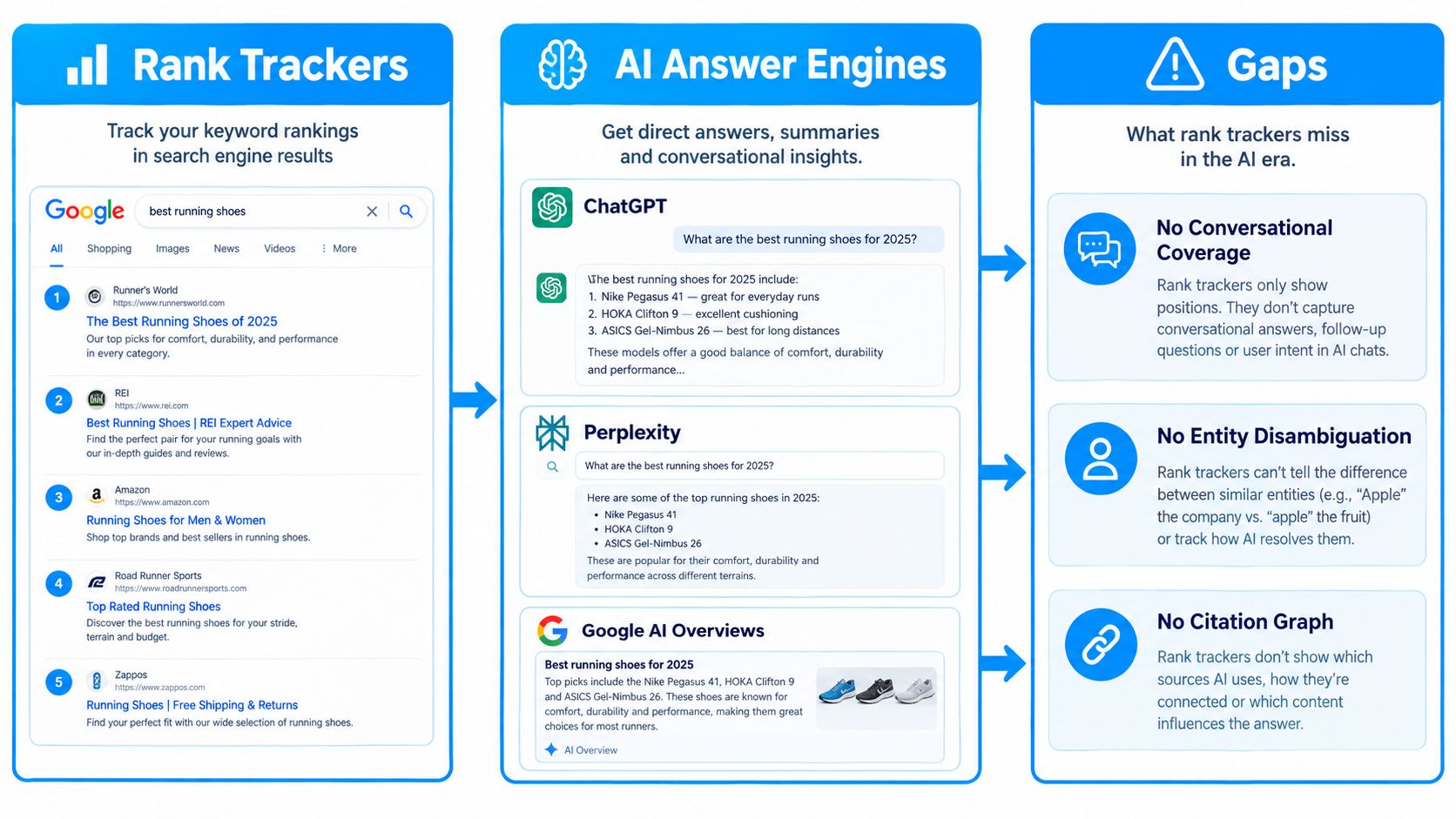
Three things rank trackers miss
First, they miss answer behavior. A page can rank well and still never appear in a synthesized answer. ChatGPT, Perplexity, and Google AI Overviews don't mirror organic order.
Second, they flatten multi-source answers into one cell. A ranking report can say you're visible for a topic while hiding that the engines cite Reddit, Wikipedia, review sites, and two competitors more often than your brand.
Third, they miss entity resolution. If a model confuses your brand with another company that shares a similar name, a rank tracker won't show that failure. It treats ambiguity and clarity as the same outcome.
Practical rule: Run three separate passes. Prompt sampling for appearances, citation mapping for source behavior, and entity diagnostics for brand resolution.
What a real audit adds
A real AI search audit produces signals that rank software was never built to capture. It asks:
Where do you appear: across prompts, engines, and repeat runs
How do you appear: cited, mentioned, recommended, or ignored
Why are you absent: no matching content, weak corroboration, or ambiguous entity signals
If your current workflow stops at keyword movement, it's still useful for SEO. It's just not enough for AI answer visibility. If you want a sense of where classic tooling fits and where it stops, this roundup of rank tracking software for agencies is a good reference point.
Define the Audit Scope and Prompt Universe
Most AI audits go wrong before the first query runs.
The failure starts in scoping. Teams pull a random prompt list, mix product terms with thought-leadership questions, compare themselves against the wrong rivals, and then wonder why the output feels noisy. If the prompt universe is sloppy, the audit will be too.
Lock the entity first
Before you collect a single answer, define the exact brand entity you're testing. That includes:
Primary brand name
Common abbreviations
Product names
Legacy names or merged brands
Frequent misspellings or naming collisions
This step matters because entity ambiguity often looks like a visibility problem when it's a naming problem. I've seen audits where the “missing” brand was present in source material, but the model resolved the category to a better-known company with a similar label.
Choose the right competitors
The competitor set should include direct commercial rivals, but that's not enough. In AI answers, the brands shaping your visibility often include publishers, directories, communities, and category sites that traditional SEO teams don't treat as competitors.
Use two groups:
Commercial competitors you sell against
Citation competitors that repeatedly show up in answers for your category
That second group usually tells you more about what the engines trust.
Build prompts from intent, not brainstorms
A useful prompt universe usually comes from three buckets: informational, comparative, and transactional. The practical workflow many teams use is a locked set of 20 to 40 brand-relevant queries across at least 4 surfaces, with each query run 3 times at different times of day to establish a baseline visibility rate. The same method also benchmarks 3 to 5 named competitors and tracks whether the brand is cited, named as an alternative, or absent (step-by-step AI search audit workflow).
For day-to-day work, I prefer narrowing the active audit set to about 20 to 30 prompts that reflect real buyer language, including awkward long-form phrasing that people type into chat interfaces.
Sample Prompt Universe Template (20–30 prompts) | ||
|---|---|---|
Bucket | Example Prompt | Primary Metric |
Informational | What does [brand category] software do for mid-market teams? | Mention rate |
Informational | How do I evaluate vendors in [category]? | Citation rate |
Comparative | [Brand] vs [competitor] for compliance-heavy teams | Share of answer |
Comparative | Best alternatives to [competitor] | Named inclusion |
Transactional | Best [category] tool for a team with strict security needs | Recommendation presence |
Transactional | Which [category] platforms are easiest to implement? | Competitor overlap |
Branded | Is [brand] a good fit for enterprise use cases? | Sentiment |
Branded | Who competes with [brand] in [category]? | Alternative mention rate |
Don't clean up prompt phrasing too much. Real users don't type like taxonomy documents.
If you need a framework for choosing prompts that map to actual revenue questions instead of vanity keywords, this guide on how to build a prompt set that actually matters is worth keeping handy.
Sampling Prompts the Right Way
A single run is how teams talk themselves into the wrong fix.
I see this constantly. The brand disappears once in ChatGPT, someone assumes there is a content gap, and the team starts rewriting pages. Two days later the brand shows up again because the issue was answer volatility, entity confusion, or a weak citation pattern. If the sample is thin, you cannot separate those failure modes, and the audit turns into guesswork.

Use a repeatable protocol
The protocol does not need to be fancy. It does need to be consistent enough that another analyst could rerun it and reach the same diagnosis.
For a scoped audit, I treat three runs per prompt per engine as the floor, not the goal. Spread those runs across different times of day, keep session conditions stable, pin the target market, and save the full output each time. For higher-stakes prompts, usually competitor comparisons and bottom-funnel recommendation queries, I increase the sample before I recommend any remediation.
The point is simple. You are not just measuring whether a brand appeared. You are measuring how often it appears, under what prompt conditions, and with what citation support.
A practical protocol usually includes:
Run each prompt multiple times across ChatGPT, Perplexity, and Google AI Overviews.
Spread runs across different times of day so you capture answer variation instead of one session state.
Keep browser conditions stable with clean sessions, logged-out states where possible, and market settings pinned to the target region.
Save the raw output rather than only screenshots or summary scores.
Log what the answer actually did
A weak audit falls apart quickly. A screenshot proves almost nothing once the answer changes.
Keep row-level logs for every run. That record is what lets you tell the difference between three very different problems. A content gap shows up when the engine answers the need but your material never enters the candidate set. Entity ambiguity shows up when the model mentions the wrong company, blends your brand with a generic term, or routes citations to third-party descriptions instead of your own pages. Citation graph weakness shows up when you are mentioned occasionally but lose the supporting sources that make the answer stable.
Capture:
Prompt text
Engine used
Run timestamp
Region or market setting
Full answer text
Whether the brand was mentioned
Whether the brand was cited
All cited URLs
Citation order
Named competitors
Refusal or hedging language
That is enough structure to diagnose the cause instead of arguing over a visibility score.
A simple logging schema usually works best:
Field | Example |
|---|---|
Prompt ID | COMP-07 |
Prompt Text | Best alternatives to [competitor] for IT teams |
Engine | Perplexity |
Run Time | Morning market-local |
Brand Mentioned | Yes |
Brand Cited | No |
Competitors Named | Competitor A, Competitor B |
Citation URLs | URL list |
Answer Notes | Mentioned as option, weak recommendation |
Reproducibility matters more than screenshots
Tooling still misses a lot. Some platforms give a neat scorecard but no way to inspect the raw answers, prompt settings, or cited URLs that produced the score. That makes debugging hard and remediation sloppy.
A reproducibility-oriented workflow should keep the original responses, the scoring logic, the tool version, and the test conditions. I also want enough detail to rerun the exact sample later and check whether a change in visibility came from site improvements, model updates, or plain variance. One such workflow also tests crawler access and compares outputs across multiple live answer engines. The exact stack matters less than the discipline.
This walkthrough is worth watching before you build your own logging setup:
Reading the Citation Graph
A citation graph shows something a visibility score hides. It separates simple absence from structural weakness. If your brand is missing, the reason is usually not random. The pattern of who gets cited, how often, and for which prompt clusters usually points to one of three causes: no suitable page, unclear entity signals, or a weak citation graph relative to competitors and publishers.
Start by treating citations as a network, not a tally. Pull every cited URL from the sample, normalize to domain and page level, and group them by prompt cluster. Then inspect the shape of the graph. Which domains appear across many clusters? Which pages act as repeated source nodes? Where does your brand show up only on branded prompts, and where does it earn citations on generic commercial or comparative prompts?
Concentration is the first read. BrightEdge found that citation overlap between Google AI Overviews and organic rankings increased over time, while citation share stayed concentrated among a small set of domains including large reference sites and forums. Their analysis also showed that many citations still come from pages outside the top organic results, which matters because strong classic rankings do not guarantee citation share in AI answers (BrightEdge research on AI Overview citation overlap and concentration).
That pattern shows up in audits constantly. A brand can have relevant content and still lose the graph because the answer engine keeps returning to the same trusted publishers, user forums, and aggregator pages.
The second read is yield. I use citation yield as a working metric. Compare the number of unique pages from your domain that get cited against the set of pages that are both reachable and clearly relevant to the sampled prompts. Low yield usually looks obvious. Two mediocre URLs carry the whole domain while better pages never get selected.
That matters because retrieval and citation are different steps. Engines can access a page, parse it, and still decide not to cite it. In practice, answer systems often inspect more sources than they end up naming, so broad crawl visibility does not mean broad citation coverage. If your site is being reached but the same external sources keep winning the final answer, the problem is usually packaging, corroboration, entity clarity, or weak prompt-to-page alignment.
Freshness is the third read, and it breaks more graphs than teams expect. Some prompt clusters reward stable references. Others rotate fast and favor recently updated comparisons, current documentation, or newer third-party coverage. Track cited URLs across repeat windows. If your page appears right after an update and disappears a week later, you fixed recency but not staying power. If old forum threads keep beating your docs, the engine likely trusts independent corroboration more than owned claims.
Citation Graph Health Scorecard | |||
|---|---|---|---|
Axis | Metric | Healthy | Watch / Fail |
Concentration | Brand share versus publishers, forums, and competitors | Balanced presence across prompt clusters | One or two external domains dominate most answers |
Yield | Number of unique brand pages cited across relevant prompts | Multiple pages earn citations by subtopic | Same page forced into every prompt or no cited pages |
Freshness | Citation persistence across repeat windows | Key pages recur consistently | Citations appear briefly or decay after updates |
A good graph review does more than count mentions. It shows whether your issue is missing content, muddled entity signals, or weak citation support around otherwise relevant pages. For a practical answer-level method, this guide to reading the citations behind an AI answer pairs well with graph analysis.
Diagnosing Why You Are Missing
This is the part most audits skip. They tell you that you're absent, but not why.
That's a mistake, because the fix depends entirely on the failure mode. In practice, nearly every miss falls into one of three categories: content gap, entity ambiguity, or citation graph weakness. The fastest way to waste a quarter is to treat all three as a generic “visibility issue.”
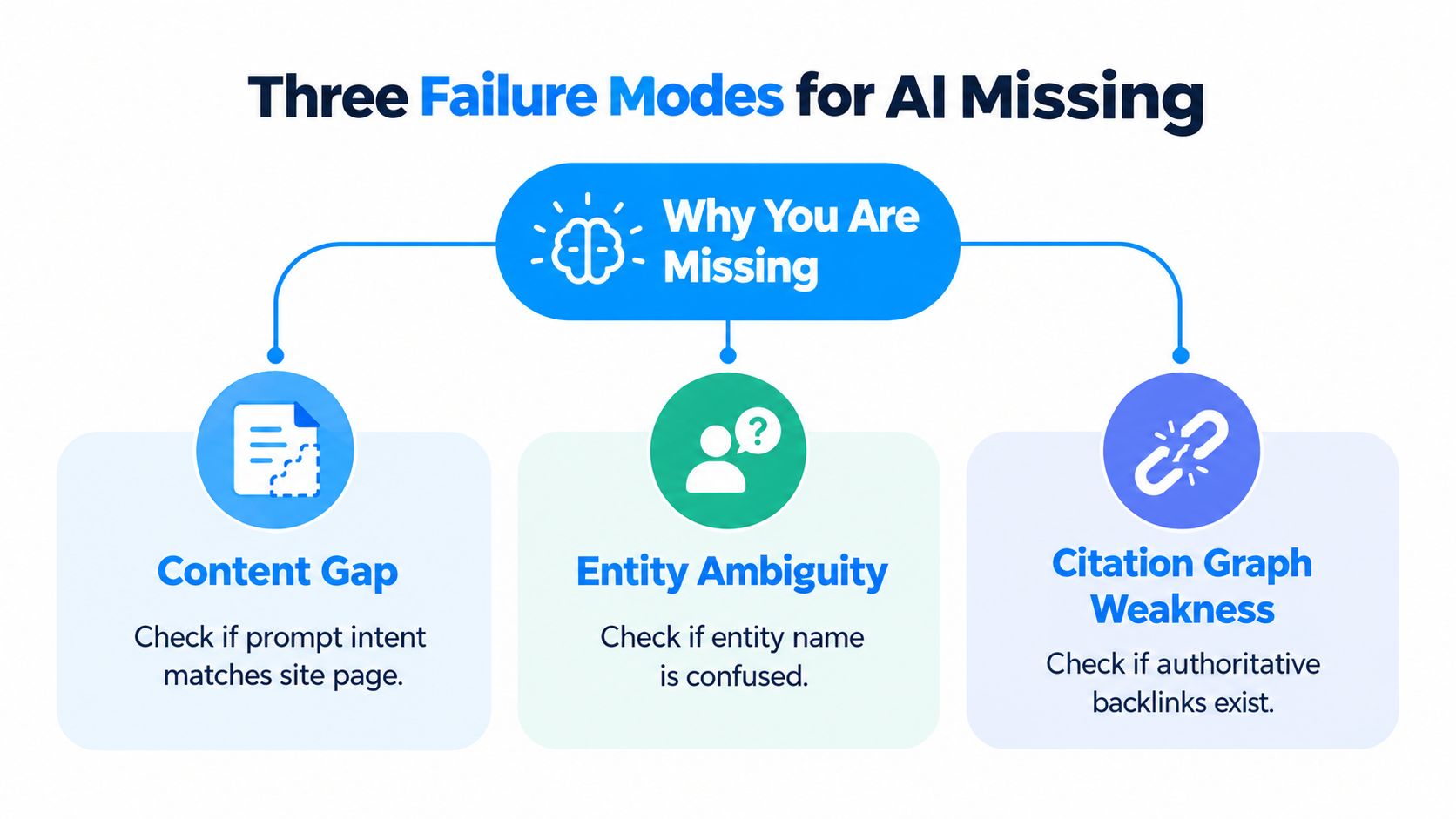
Failure mode one, content gap
A content gap exists when the engine has no strong page from your site to use for a prompt's intent. That doesn't always mean “create more blog posts.” Sometimes it means your only relevant page is a product page trying to answer a comparative question, or a category page trying to satisfy a how-to prompt.
Check for:
Intent mismatch between the prompt and the target page
Thin coverage of the subtopic or missing key entities
Weak answer formatting that makes extraction harder
No page at all for a prompt cluster you care about
Content gaps are usually the easiest fixes because they're page decisions. You can brief them, build them, and re-test.
Failure mode two, entity ambiguity
This one is under-audited and causes a surprising number of false diagnoses.
Independent coverage has argued that AI systems treat inconsistent brand names, mismatched categories, thin profiles, and weak cross-site signals as ambiguity. Ambiguous entities are often excluded from AI-generated answers. That's the more operational reason to inspect whether your brand is legible to the model, not just whether your content exists. The same reporting notes that Google AI Overviews have expanded broadly, with multiple datasets placing coverage at roughly 25% to 50% of queries depending on the tracker, while Google says the feature reaches over 2 billion users and appears in 200+ countries and 40+ languages (reporting on entity legibility and AI Overview scale).
Run a quick consistency pass across:
About page naming
Organization schema
Author bios
Product naming
Third-party profiles and citations
Category language across the site
If your brand name, product labels, and category terms shift across properties, models often resolve to the cleaner entity.
Failure mode three, citation graph weakness
Sometimes the page exists and the entity is clear, but the engine still doesn't use you. That usually points to a weak citation graph.
You'll see it when competitor pages and third-party references dominate the relevant prompt cluster, while your site has low citation yield or no corroborating mentions around the topic. Teams often confuse “we need backlinks” with “we need the right supporting references in the right subtopic cluster.” Not all authority gaps are broad domain problems. Some are highly local to a category question.
A simple decision matrix
Check | Likely Failure Mode | Fastest Signal | Typical Fix |
|---|---|---|---|
No relevant page for prompt intent | Content gap | Brand absent, competitors cited from intent-matched pages | Create or rebuild page around prompt cluster |
Brand appears inconsistently or gets confused with another company | Entity ambiguity | Wrong brand substitution or vague category association | Clean naming, schema, bios, third-party consistency |
Relevant page exists but rarely gets cited | Citation graph weakness | Low citation yield and competitor source dominance | Strengthen corroboration, supporting pages, digital PR |
This is also the point where a dedicated platform can help, if it exposes prompt-level mentions, citations, competitors, and source trends clearly. Llumo, for example, tracks per-prompt visibility, share of voice, citation sources, and model-level response archives across answer engines, which makes failure-mode tagging easier than working from screenshots alone.
Reporting and Prioritized Remediation
A good audit report doesn't dump findings. It creates a backlog people can act on.
The report should make one thing clear immediately: which prompt buckets matter most, which failure mode dominates each bucket, and what gets fixed first. If the document turns into a gallery of examples without prioritization, teams won't know whether to ship new pages, clean up entity signals, or invest in source-building.
What the report should include
Start with a short executive layer. Keep it tight.
Include:
Visibility by prompt bucket such as informational, comparative, transactional
Dominant failure mode for each bucket
Top remediation themes with owners attached
Open questions where the diagnosis is still low-confidence
Then move into the working layer. Each finding should map directly to affected prompts and a concrete task.
Remediation Backlog Sample | |||||
|---|---|---|---|---|---|
Finding | Failure Mode | Affected Prompts | Fix | Effort | Lift |
No comparison page for top competitor cluster | Content gap | Alternatives and vs prompts | Build comparison hub and supporting FAQs | M | High |
Brand category phrasing differs across site and profiles | Entity ambiguity | Unbranded category prompts | Standardize naming and schema | S | Medium |
Only one brand page cited across all sampled prompts | Citation graph weakness | Informational cluster | Expand corroborated support pages and outreach targets | M | High |
Product docs surface but buyer guides do not | Content gap | Mid-funnel evaluation prompts | Add evaluation-focused pages | M | Medium |
Third-party references are stale | Citation graph weakness | Commercial prompts | Refresh supporting mentions and update priority pages | L | Medium |
Score by effort and likely lift
I like simple labels here. S, M, L for effort. Low, Medium, High for likely lift. Anything more precise tends to create fake confidence.
What matters is cause-mapping. A content fix should not be competing directly against an entity cleanup task unless both support the same prompt cluster. Keep the backlog grouped by failure mode first, then sort within each group by business value.
Teams move faster when each recommendation answers four questions: what broke, where it broke, who owns it, and what kind of fix it needs.
Sequence the work over 30, 60, and 90 days
The fastest wins usually come from content and structure. Entity cleanup follows. Citation work often takes longer because it depends on external corroboration and repeated sampling.
A sensible sequence looks like this:
First 30 days: repair missing pages, rewrite weak answer-first sections, clean obvious naming conflicts
Next 60 days: expand support clusters, align schema and author/entity signals, refresh priority third-party references
Next 90 days: re-test prompt buckets, compare competitor share shifts, and decide whether authority-building work is moving the graph
When stakeholders ask for certainty, resist the urge to overstate. AI outputs vary. Recommendations should be framed with confidence levels based on repeat observations, not a single eye-catching result.
Making the Audit Stick
The hardest part of an AI search audit isn't running it once. It's keeping it operational.
Teams treat this work like a quarterly special project. That's why they miss the important shifts. Prompt behavior changes, citations drift, product launches alter entity signals, and competitors publish into the same prompt clusters. If you only look occasionally, you'll always be diagnosing stale conditions.
Assign real owners
This work needs named ownership across three streams:
Prompt sampling owner to maintain the prompt set, run checks, and keep logs clean
Entity owner to manage naming consistency, schema alignment, and profile cleanup
Citation owner to coordinate supporting content, digital PR, and third-party corroboration
When one person owns all three, the audit usually becomes fragile. When nobody owns the entity layer, ambiguity lingers for months.

Use two cadences, not one
The audit should run at two levels.
Monthly micro-audit
5 to 10 priority prompts
Two engines
Quick check for visible drift
Short review of new or lost citations
Quarterly full audit
Expanded prompt set
Broader competitor benchmark
Failure-mode reclassification
Backlog reprioritization
This keeps the program light enough to maintain but deep enough to catch structural changes.
Know when to run off-cycle
Some events justify an immediate re-check:
New product launch
Brand or product rename
Major site migration
Sharp visibility drop
Large competitor move into your category
Noticeable answer-engine behavior change
The useful habit is simple: every miss gets tagged to a failure mode, every fix gets an owner, and every audit ends with a next-run date on the calendar.
An AI search audit becomes valuable when it stops being a report and starts being an operating rhythm.
Print the checklist if you need to. Scope locked. Prompts sampled. Citations logged. Failure mode diagnosed. Backlog prioritized. Owner assigned. Next run scheduled.
If your team wants a cleaner way to run this process, Llumo helps you track prompt-level visibility, citation sources, share of voice, and competitor trends across answer engines without reducing everything to a single score. It's useful when you need to separate content problems from entity and citation problems, then monitor whether the fixes change what AI systems say about your brand.