
You’ve checked the numbers, the page still ranks well, and organic traffic hasn’t collapsed. Yet when a customer asks Google for a recommendation, your brand is missing from the generated answer above the traditional results. A competitor appears in the summary, earns a citation, and becomes part of the buyer’s shortlist before anyone reaches your website.
That gap is why AI Mode tracking matters. Traditional SEO measurement tells you where a page ranks for a query. AI visibility measurement asks a different question: does the system retrieve, mention, and cite your brand while constructing the answer? Those signals can move independently of rank, so marketers need a broader measurement discipline built around prompts, citations, source coverage, and reliability.
When Rankings Stop Telling the Whole Story
A classic rank report gives you an ordered list. You can see whether a page occupies the first result, falls lower on the page, or disappears from the tracked search. That information remains useful, but it doesn’t tell you whether Google selected your content for a generated response.
AI answers work more like an edited briefing than a list of links. The system gathers material from several sources, identifies passages that address different parts of the request, and combines them into a response. A page can therefore hold a strong organic position while failing to contribute a passage that the generated answer needs.
The missing measurement layer
Consider a marketer tracking the prompt “best project management software for remote teams.” Their comparison page ranks well for the head term. Google’s generated answer, however, may focus on integrations, permission controls, onboarding, and pricing suitability. If the page doesn’t answer those narrower questions clearly, the brand might not appear even though its overall topic relevance looks strong.
This is the central distinction:
Rank tracking measures where a page appears in a conventional result set.
Mention tracking measures whether the brand appears in the generated response.
Citation tracking measures whether the system links to a page or domain as evidence.
Context tracking measures how the answer presents the brand and which competitors appear alongside it.
Practical rule: Treat ranking as an input to AI visibility, not as a substitute for it.
Google’s rollout shows why this measurement layer has become difficult to ignore. Google first introduced AI Overviews in the U.S. in May 2024, saying the feature would reach hundreds of millions of users that week and expand to more than a billion people by the end of the year, as described in Google’s announcement of generative AI in Search. By July 2025, Google said AI Overviews had reached 2 billion monthly users across 200 countries and territories, while AI Mode had passed 100 million monthly active users in the U.S. and India, according to the verified AI visibility statistics summary.
The business questions now extend beyond “what’s our average position?” Teams need to know which prompts produce brand exposure, how often competitors receive citations, whether visibility is concentrated in a few topics, and whether the brand’s presence is expanding or shrinking across generative search surfaces.
What AI Mode Actually Is and How It Differs from AI Overviews
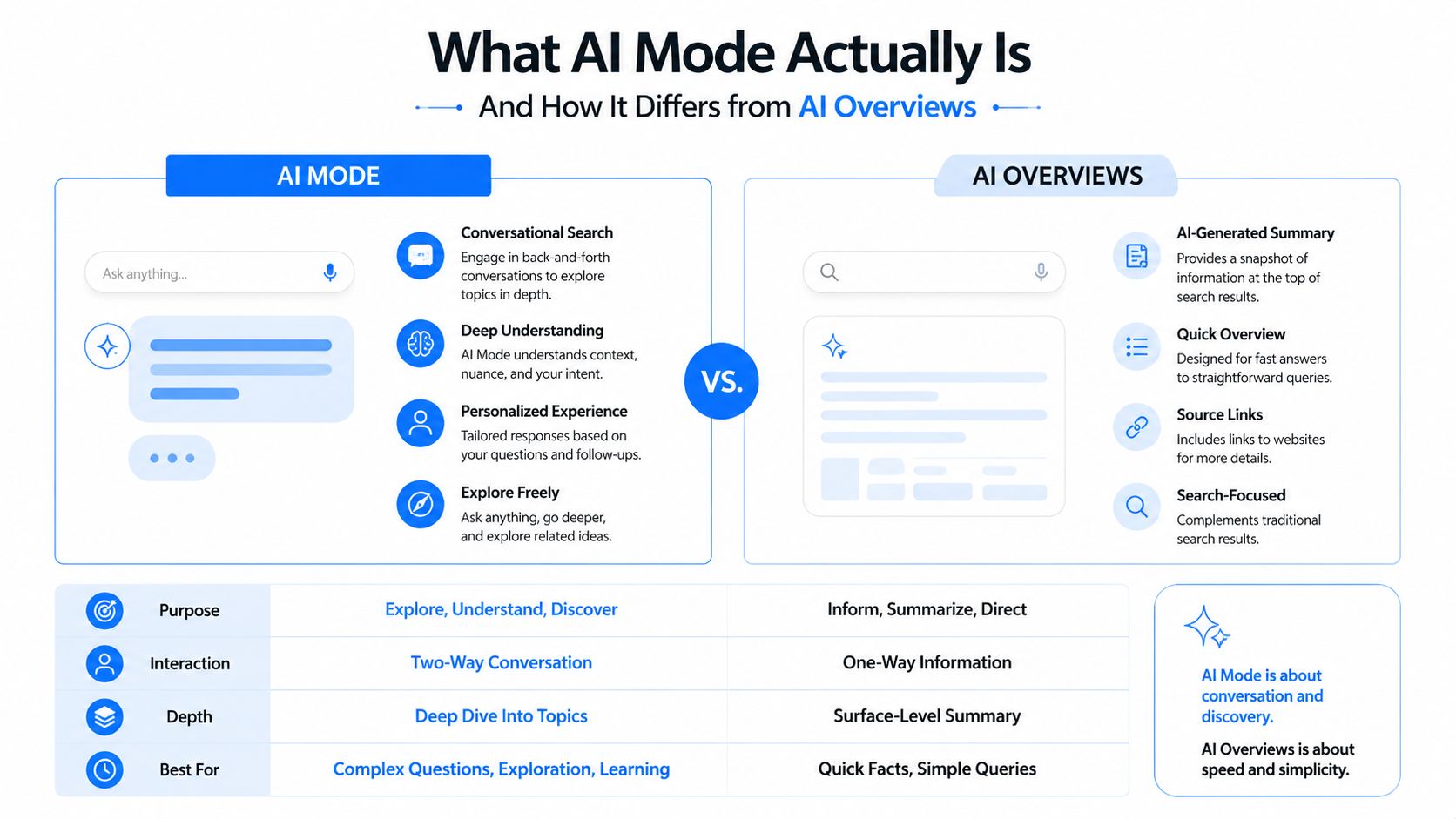
Google AI Mode is a conversational search environment designed for broader exploration. A user can ask a complex question, continue with follow-up prompts, and receive an answer assembled from multiple retrieved sources. AI Overviews, by contrast, appear as generated summary blocks within the conventional Google results page.
Both surfaces use generative systems, but they create different measurement environments. AI Overviews answer the initial search directly within the results page. AI Mode gives the user a more expansive conversational interaction and can break the request into related searches before synthesizing the response.
A restaurant analogy
Think of AI Overviews as a host giving you a quick shortlist at the entrance. You ask for a good restaurant nearby, and the host names a few options with brief reasons. AI Mode is the conversation that follows. You ask for a quiet place, vegetarian choices, parking, and a suitable atmosphere. The recommendation can change as the conversation becomes more specific.
A brand might appear in the quick shortlist but disappear when the user adds a constraint. Another brand might not appear initially but become highly relevant after the follow-up question. The retrieval process, prompt expansion, and citation selection can differ between the two surfaces.
That difference is visible in comparative research. A German study found AI Mode triggered on all 100 tested searches, while AI Overviews appeared on 49. When both systems responded, AI Mode produced about 6 times more citations, with 310 citations compared with 51, according to research comparing Google AI Mode and AI Overviews.
A separate comparative study using Germany’s top searched queries found that AI Mode averaged 310 citations and AI Overviews averaged 51 when both responded. The two surfaces cited the same URLs only 13% of the time, as reported in the AI citation comparison study.
The practical conclusion is simple. Don’t combine both surfaces into one score. Establish separate baselines for AI Mode and AI Overviews, then compare them as related but distinct environments. Marketers looking for adjacent measurement approaches can also review AI Overview tracking tools, but the data model should preserve the surface distinction.
Core Signals AI Mode Tracking Must Capture
A useful AI Mode tracking system doesn’t begin with one visibility score. It starts with the path from a user prompt to the final cited answer. That path has three connected layers: prompt coverage, citation behavior, and competitive share of voice.
Signal Layer | What It Measures | Example Metric | Why It Matters |
|---|---|---|---|
Prompt layer | The topics and sub-questions activated by a prompt | Brand retrieved for a fan-out sub-query | Shows whether the system encounters your content |
Citation layer | Whether and where the brand’s pages are cited | Cited URL, passage, position, and linked status | Separates meaningful evidence from a weak mention |
Share-of-voice layer | Your visibility relative to selected competitors | Weighted citation share by topic cluster | Connects AI presence to competitive exposure |
Prompt-level coverage
Start with the user’s wording, then look beneath it. Google AI Mode appears to use query fan-out, where one prompt becomes several related sub-queries. A request for “best accounting software for agencies” might expand into questions about client billing, project profitability, integrations, permissions, and reporting.
One analysis reported that only 29% of citations were earned on the exact parent query, while 71% came from narrower sub-queries that the brand hadn’t explicitly targeted, according to analysis of query fan-out in AI Mode. Your tracker should therefore record the underlying sub-question set, not only the prompt typed into the search box.
Citation-level detail
A citation record should contain more than a yes or no value. Capture the cited domain, exact URL, linked or unlinked status, passage or surrounding context, and location in the response. A brand mentioned in the opening recommendation has a different exposure opportunity from a brand named briefly in a trailing source panel.
The system should also distinguish owned sources from third-party sources. If other sites describe your product but your own pages never receive citations, the gap may involve content structure, authority, or answer coverage rather than simple brand awareness.
Share of voice
Share of voice becomes meaningful only after the first two layers are reliable. Define a stable prompt set, group prompts by topic, identify the competitor set, and assign greater weight to prominent citations than to buried references. This produces a view of share of visible citation, rather than a raw tally of every brand occurrence.
The signals depend on one another. Fan-out determines which questions enter retrieval. Retrieval shapes the cited source set. Citation placement affects the amount of attention each source receives. Share of voice summarizes the result, but it shouldn’t hide the causes.
How AI Mode Selects Sources and Why It Breaks Old SEO Habits
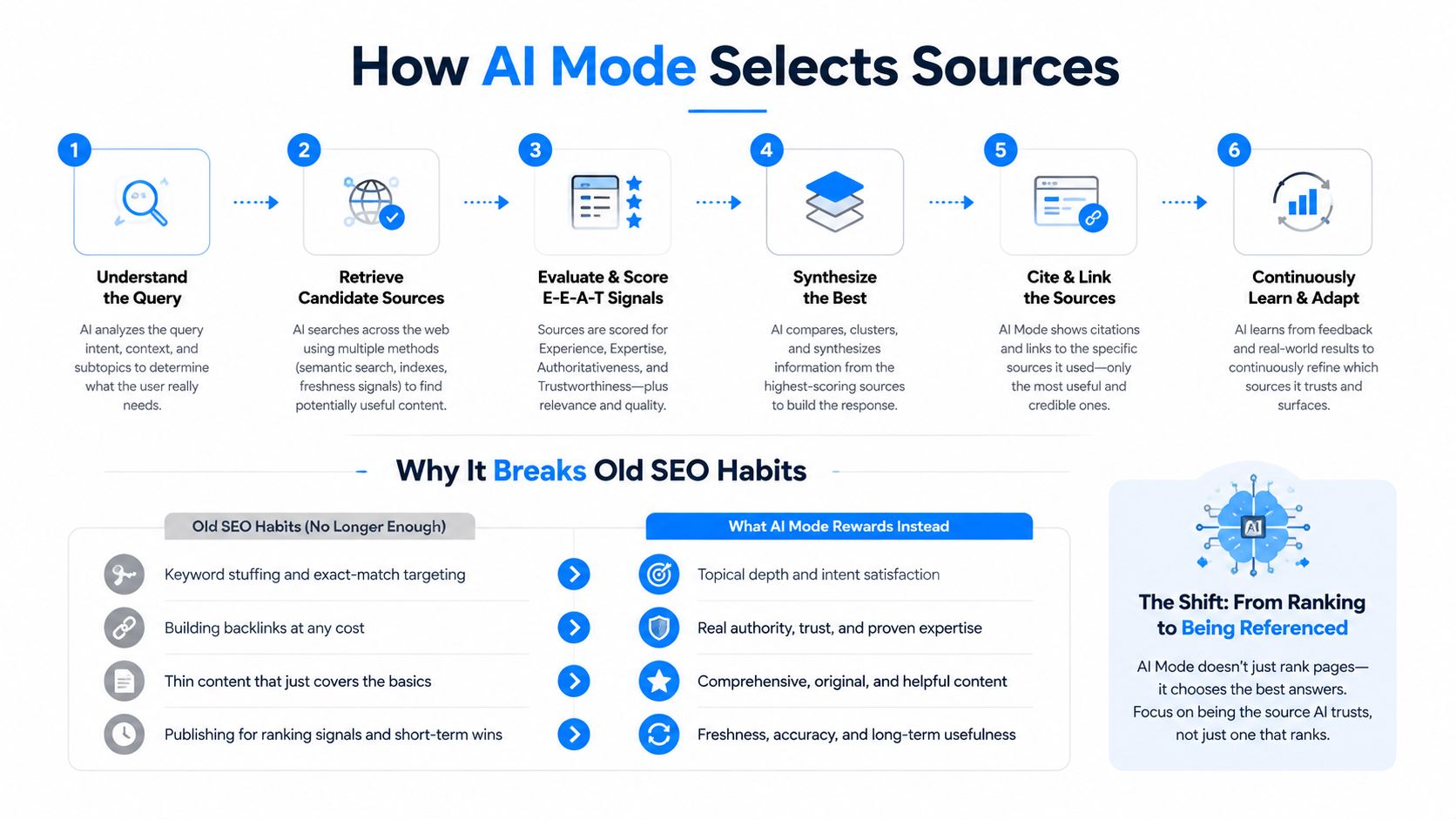
A traditional search begins with one query and returns an ordered list. AI Mode can take the same query and turn it into several investigative paths before producing a response. Each path may retrieve different documents, and the final answer may cite only passages that help complete the combined explanation.
The process is easier to understand as a sequence:
The user submits a broad or complex prompt.
AI Mode identifies related sub-questions and search angles.
Google retrieves sources for those separate angles.
The system evaluates passages against the answer it is assembling.
It synthesizes the response and attaches citations to supporting material.
Why a good ranking can still lose
Classic SEO encourages marketers to optimize around a head term. They improve the title, clarify the page topic, strengthen internal links, and pursue authority signals. Those actions can help discovery, but AI Mode evaluates whether a page contributes a useful answer to one of the narrower questions inside the request.
A page that ranks third for “CRM software” might still lack a self-contained explanation of data migration, sales-team permissions, or reporting workflows. Another page ranking outside the top results may answer one of those sub-questions with greater precision and earn the citation.
Research summarized from Ahrefs found that only 38% of AI Mode cited URLs ranked in the top 10, while 62% came from outside the top 10, according to analysis of AI Mode citation selection. The implication isn’t that rankings no longer matter. It’s that marketers must track coverage across the fan-out graph, including pages that answer specific sub-intents.
A cited-page review should therefore ask:
Which sub-question does this passage answer?
Can a reader understand the passage without surrounding context?
Does the page cover several related intents with distinct sections?
Did the cited URL rank well for the parent query, the sub-query, both, or neither?
This changes content production. Instead of forcing one page to target a broad phrase, build clear answer-ready passages around the questions customers ask. Keep each passage precise, evidence-based, and easy for a retrieval system to associate with a specific intent.
Citation Placement and Concentration Beyond Mention Counts
A dashboard can report that your brand earned citations and still misrepresent its practical visibility. The missing variable is where the citation appears and how much attention the surrounding answer gives it.
A citation in the opening recommendation can shape the user’s shortlist. A link attached to a supporting sentence may validate a claim without making the brand prominent. A source listed after the main answer can provide credibility but little immediate exposure. Tracking these locations turns a mention counter into a surface-area measurement system.
Citation Location | Position on Page | Estimated Visibility Weight | Typical Share of Total Citations |
|---|---|---|---|
Opening answer or recommendation | Near the beginning | High | Varies by query |
Inline supporting passage | Within the main response | Medium to high | Varies by query |
Comparison or qualification block | Middle of the response | Medium | Varies by query |
Trailing source list or related block | Near the end | Lower | Varies by query |
The table uses qualitative visibility weights because the practical value depends on the answer layout, query intent, and user behavior. Don’t convert every citation into an identical unit.
Concentration changes the competitive picture
AI Overviews can cite several sources in one answer. A large study reported an average of 4.2 citations per Overview, with a range from 2 to 9 depending on query intent. It also found that roughly the top 1% of cited domains captured 47% of all citations, as documented in the study of AI Overview citation patterns.
That concentration matters for mid-market brands. A company may appear regularly within a narrow topic cluster but still hold little overall share because a small group of domains dominates the broader market. Conversely, a single strong citation in a strategically important category can matter more than several low-prominence mentions elsewhere.
Track the domain, URL, response position, section type, linked status, and nearby wording. Then group results by topic cluster. This lets you distinguish a genuine gain in visible presence from a rise in low-value citations.
For a practical interpretation of the evidence around generated answers, see how to read the citations behind an AI answer. The central lesson is that citation volume needs context. A brand’s dashboard should show prominence, concentration, and co-citation, not just total mentions.
Stability, Repetition, and the Reliability Problem
A single weekly screenshot looks precise, but it may represent only one possible answer. Generative search can return different sources for the same prompt because retrieval and synthesis aren’t perfectly fixed. Your website may remain unchanged while the cited set changes between runs.
Research cited in analysis of AI visibility measurement reliability reported source-set overlap of about 30% on Gemini, 33% to 40% on SearchGPT, and around 50% on Perplexity across repeated identical queries. It also reported only 25% overlap between ChatGPT’s Instant and Thinking modes. These figures come from other AI systems, but they illustrate the reliability problem facing any generative visibility program.
Replace snapshots with samples
Run each important prompt repeatedly rather than treating one response as the truth. Store the response, cited URLs, source domains, brand mentions, competitor mentions, and timestamp for every run. Then calculate overlap between runs and flag prompts with unstable source sets.
Confidence intervals matter too. The same research found bootstrap confidence intervals for citation share often spanned 3 to 7 percentage points. A movement from 8% to 11% may therefore be indistinguishable from noise unless the sample supports a stronger conclusion.
A trustworthy trend is a pattern that survives repeated observation, not a dramatic change in one screenshot.
Use medians or aggregated results where appropriate, and report volatility beside the visibility score. If a prompt cites your brand in one run and omits it in another, record both outcomes. That uncertainty is part of the result, not a data-cleaning error.
Common Pitfalls When Setting Up AI Mode Tracking
Early AI Mode tracking usually fails because marketers simplify the surface too aggressively. Each shortcut removes context that explains why visibility changed.
Tracking only the typed prompt: Expand the seed prompt into the fan-out sub-queries so you can see where retrieval happens.
Counting every citation equally: Record whether the source appears in the opening answer, an inline passage, a comparison block, or a trailing source list.
Using one weekly run: Repeat important prompts and compare source overlap before calling a change meaningful.
Ignoring co-citation: Track which competitors appear beside your brand and what the answer says about each option.
Combining AI Mode with AI Overviews: Keep separate baselines because the two surfaces can return different source sets.
Comparing AI share directly with organic rank: Use rank as context, then measure citations and answer presence independently.
Recording domains without URLs: A domain-level win can hide the fact that an outdated or irrelevant page earned the citation.
Skipping response archives: Preserve the answer text so analysts can inspect wording, placement, and source context later.
The corrective principle is consistent: collect the raw response first, then calculate summary scores. A clean dashboard can’t repair missing prompt, citation, or volatility data.
Building a Practical AI Mode Tracking Workflow
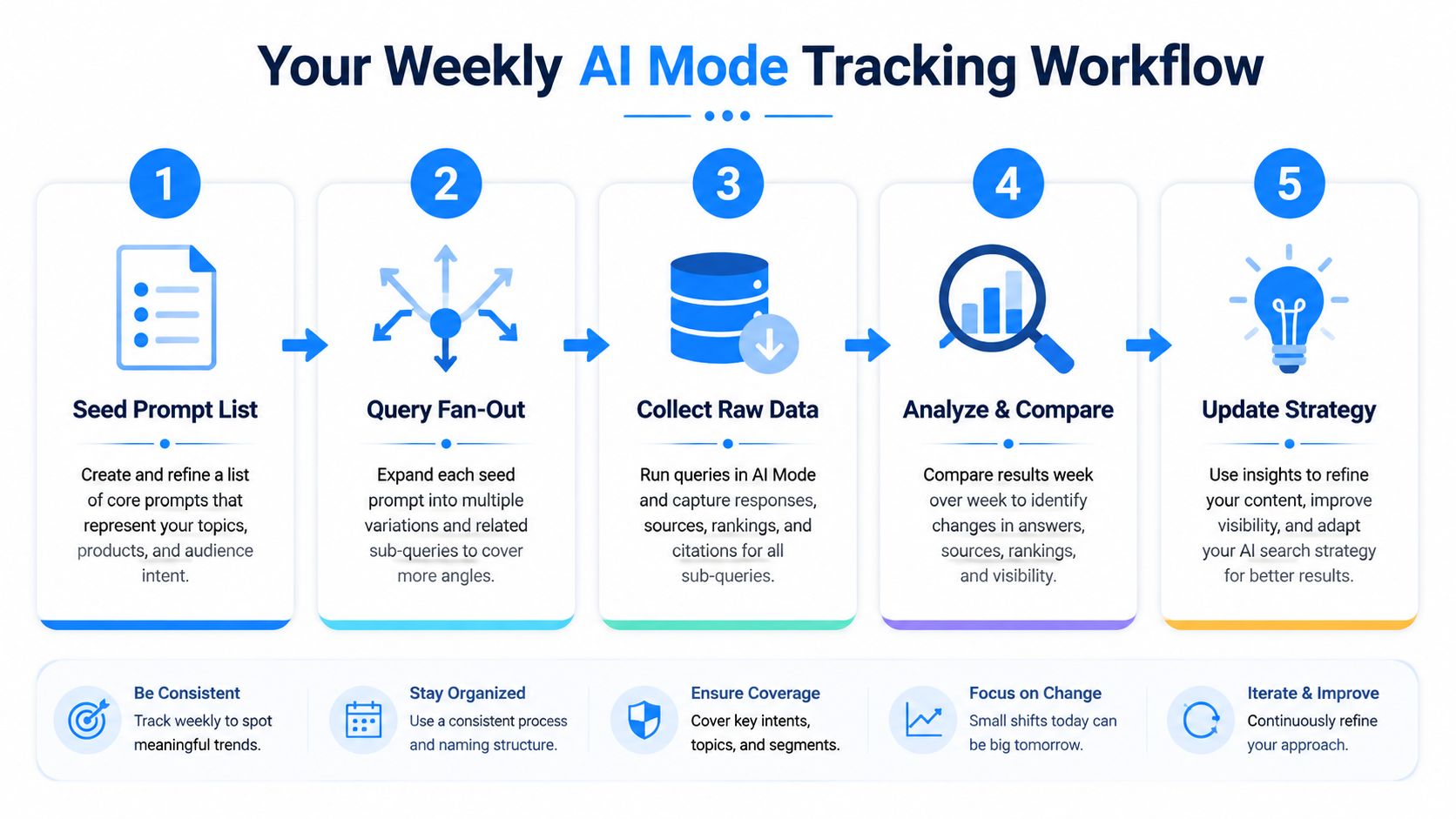
Create a seeded prompt list, then expand it with the fan-out questions that appear during repeated AI Mode runs. Sample each important prompt throughout the week and record brand presence, competitor presence, cited URL, source position, and source changes.
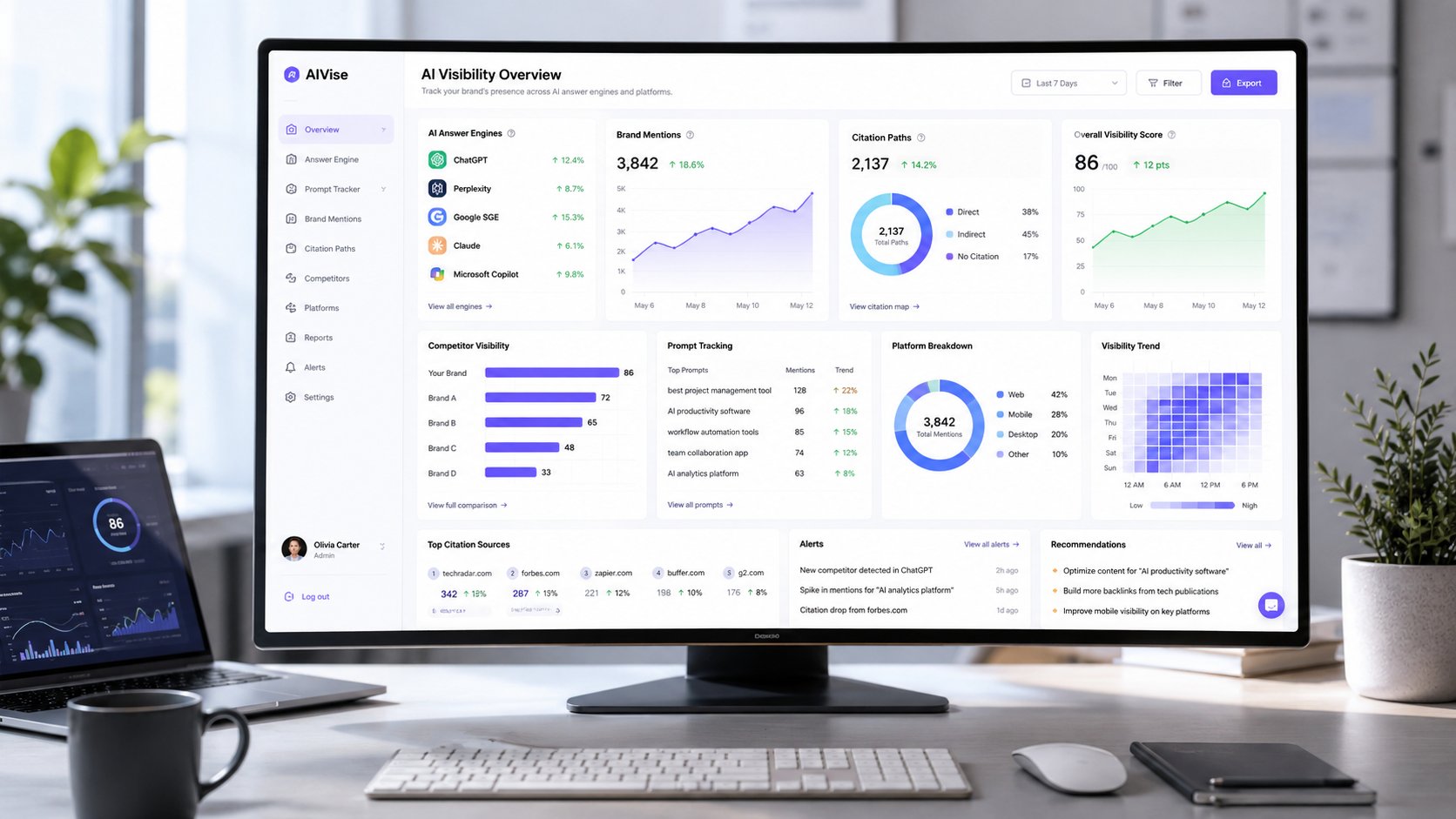
Aggregate results into three views: prompt-level visibility, citation-level placement, and competitor share of voice. Flag unstable prompts, then review the dashboard against three business questions: where are we absent, where are we visible without a useful click path, and which competitor domains are taking share?
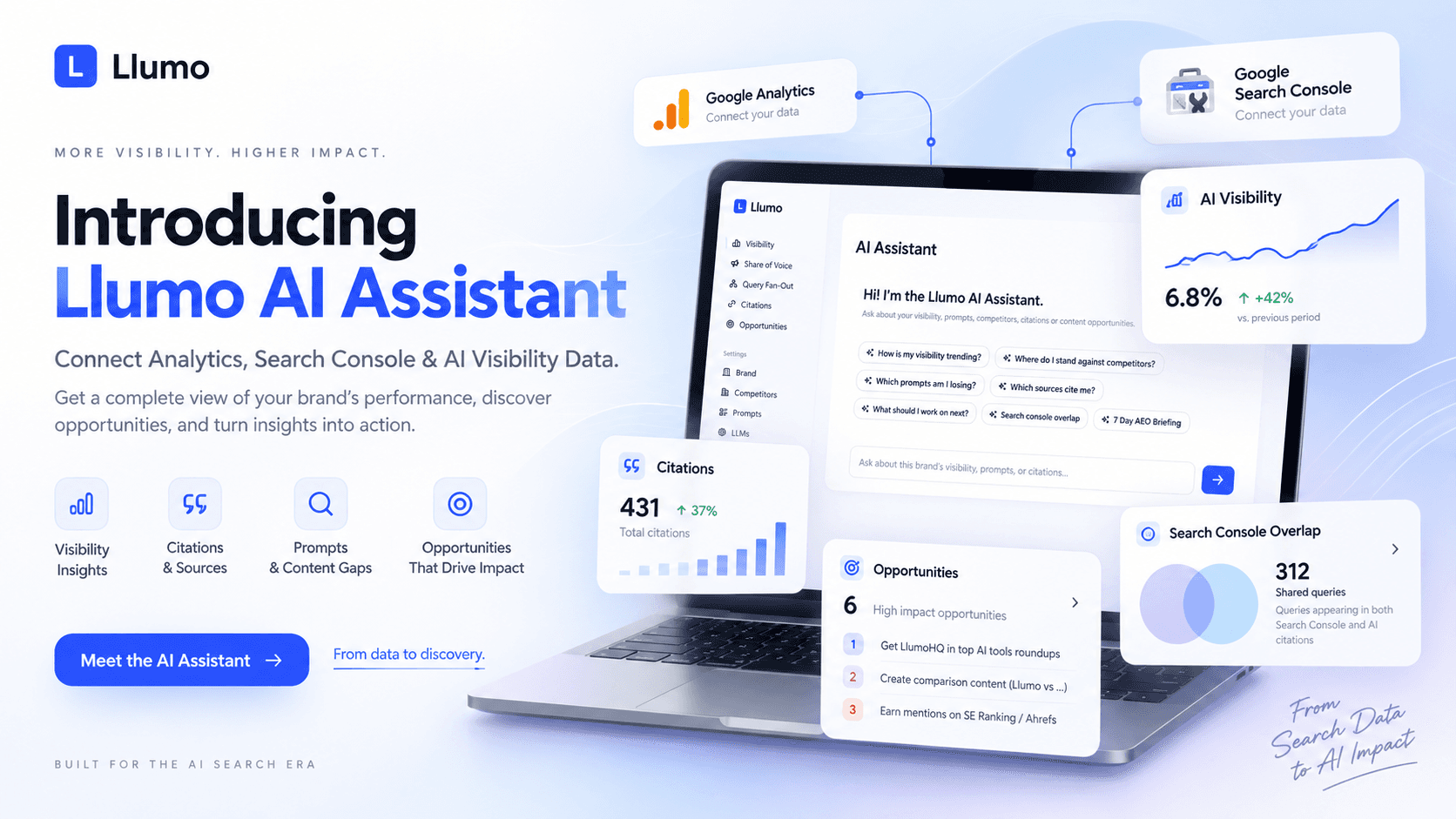
A platform such as Llumo’s AI visibility tracking solution can centralize per-prompt visibility, query fan-out logs, citation sources, competitor trends, and response archives across supported AI surfaces. The output should be a short action list, such as updating a missing sub-topic, improving a cited passage, or investigating a competitor source that repeatedly appears in the same cluster.
Llumo helps teams measure how brands are mentioned and cited across AI answer engines, including Google AI Mode, with per-prompt visibility, fan-out logging, citation analysis, and competitor trends. Visit Llumo to turn unstable AI responses into a repeatable measurement workflow and a focused list of content opportunities.