A procurement lead types “best mid-market CRM for a 50-person sales team” into ChatGPT. The response compares several products, explains which one fits a growing sales operation, and lists supporting sources. The lead never opens a traditional search results page. Your brand was relevant to the question, but it wasn't part of the answer.
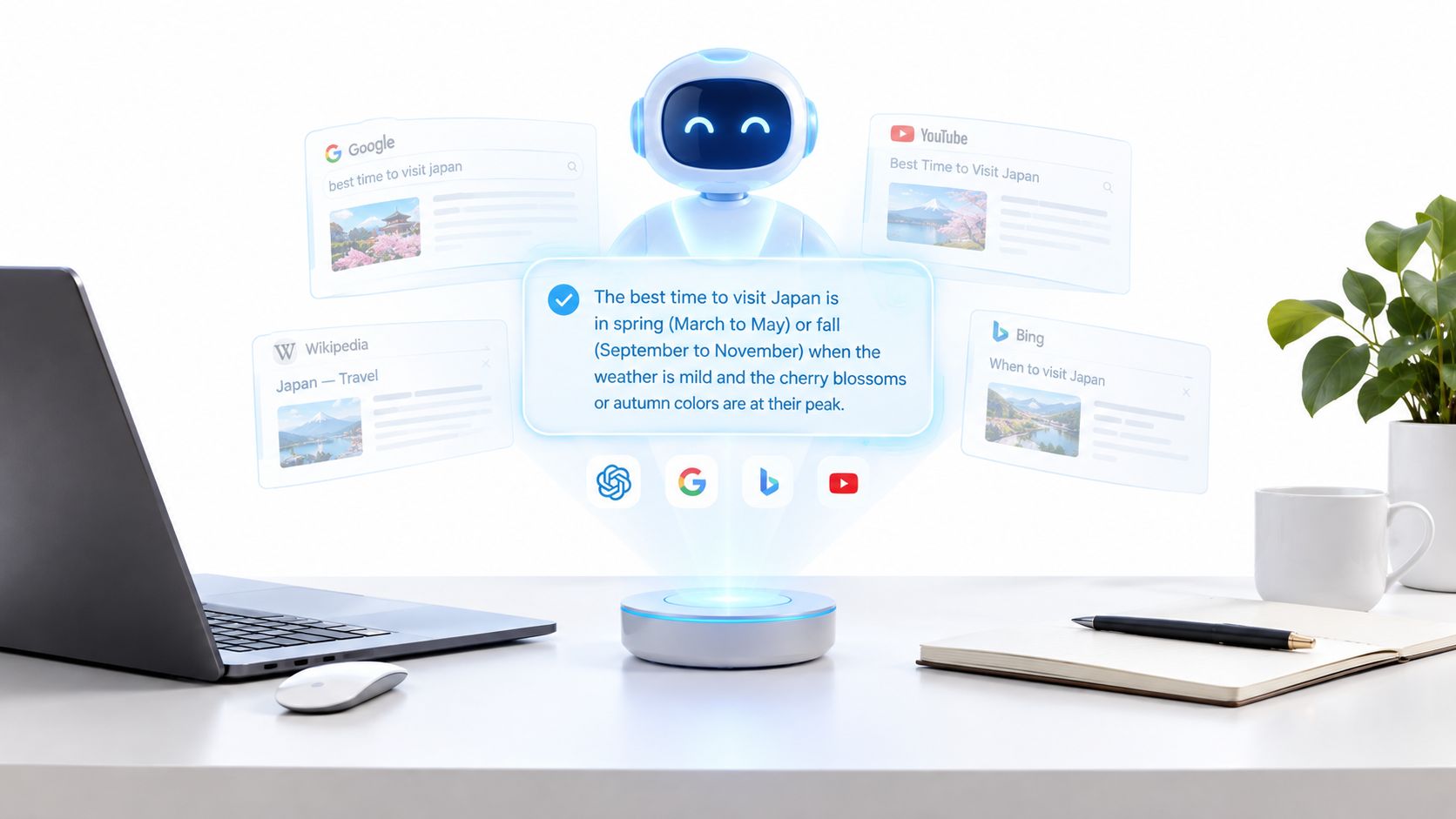
That moment captures the shift from searching for pages to asking for conclusions. An AI answer engine interprets a natural-language prompt, gathers information from external or connected sources, and composes a response instead of returning only a ranked list of links. For brands, discovery is moving from the search results page into the paragraph a model writes for the buyer.
When Buyers Stop Searching and Start Asking
The difference is easy to miss because the interface still looks like a search box. A traditional search engine generally presents ranked candidates. An AI answer engine takes those candidates, combines information across them, and gives the user a direct response shaped around the question.
That distinction changes what “visibility” means. Your company can rank well for “CRM software” and still fail to appear when a buyer asks for a recommendation based on team size, sales process, integrations, and budget. The buyer may never see the page that ranks well because the answer engine has already narrowed the field.

A chatbot is not automatically an answer engine
A chatbot is a conversational interface. It can respond fluently, maintain context, and help someone explore an idea. An answer engine adds a retrieval and grounding layer, using external or internal information to support its response.
That layer matters for commercial questions. A buyer asking about current pricing, security practices, or product capabilities needs information that can be checked against a source. ChatGPT Search, Perplexity, Gemini, Copilot, and Google AI Overviews can use web or search systems to assemble that evidence, though each product exposes sources differently.
Google introduced AI Overviews to U.S. users in May 2024 and later expanded the feature. By May 2025, Google said the feature was available in more than 200 countries and territories, in over 40 languages, and reached approximately 1.5 billion monthly users, according to Google AI Overview usage reporting. Those figures make answer-engine visibility more than a specialist SEO concern.
The new shelf space
The broader generative-AI ecosystem is concentrated around a small number of chatbot platforms. A World Bank analysis of generative-AI tools found that chatbots captured approximately 95% of global traffic to the top 60 tools consistently from 2023 onward. ChatGPT represented 77% of that traffic in April 2025, down from 89% in April 2023 as Gemini, DeepSeek, Perplexity, Claude, and other services expanded.
The practical lesson isn't to optimize for one chatbot and stop. It's to understand how several systems select, combine, and expose information.
Practical rule: Treat every generated answer as a small piece of digital shelf space. Your job is to make the brand relevant to the question, easy to verify, and useful for one part of the buyer's decision.
A useful starting point is to review AI search market share, then build a prompt set around the questions your customers ask. The goal isn't to force a mention. It's to earn a place in the evidence the engine uses to form its conclusion.
How AI Answer Engines Actually Work
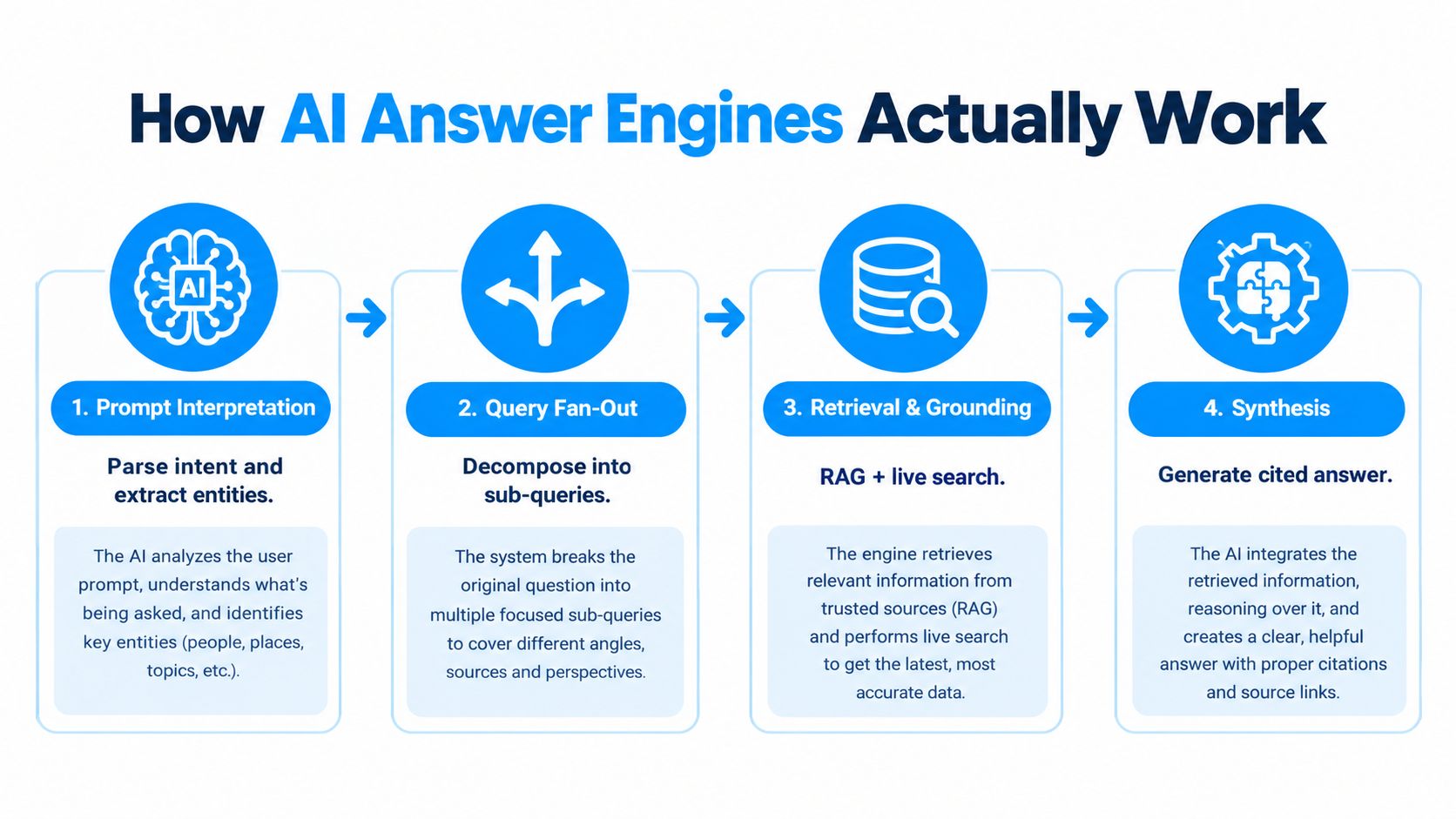
An AI answer engine usually follows a pipeline with four practical stages. It interprets the prompt, expands the request into related searches, retrieves useful sources, and synthesizes a response with some form of attribution.
The four stages
Prompt interpretation comes first. The engine identifies the subject, intent, constraints, and entities in the request. “Best CRM for a 50-person sales team” contains more than a product category. It signals a recommendation task, a company size, and an implied need for fit.
Query fan-out follows. Rather than retrieving only the exact wording, the system can explore related questions such as:
Pricing: Which CRM products fit a mid-market budget?
Integrations: Which tools connect with the team's existing systems?
Team fit: Which products support a sales team of this size?
Reviews: What do customers say about setup and usability?
Comparisons: How do the leading options differ?
Google explains that AI Overviews and AI Mode can issue multiple related searches across subtopics and data sources before assembling an answer in its documentation on AI features in Search.
Retrieval and grounding then bring candidate documents into the answer-generation process. The engine may use a search index, a live web result, a connected knowledge base, or other tools. A page must first be found, then remain relevant and clear enough to support a specific claim.
Synthesis with attribution is the final step. The model combines evidence, resolves some differences, and writes a response. Links or citations may appear beside claims, but the exact presentation depends on the product and whether web search is active.
The mental model to keep
Traditional search asks, “Which pages should appear for this query?” An answer engine asks, “What response should I give, and which retrieved sources can support it?”
That doesn't mean traditional relevance stops mattering. It means relevance now operates inside a larger process. A page can be a strong candidate for one branch of the request but disappear from the final answer if other sources better support the complete recommendation.
For content teams, this changes the optimization unit. A broad product page may describe your offering well, while a focused integration guide, security page, or comparison article supplies the evidence needed for a particular answer.
Traditional search returns candidates. An answer engine returns a conclusion drawn from candidates.
What Goes In and What Comes Out
The user's prompt is only the visible input. Behind it, each answer engine may draw on retrieval indexes, model knowledge, conversation history, connected tools, plugins, and live search. The mix affects what the system can know and what it chooses to show.
Copilot is commonly associated with Bing retrieval, while Google AI Overviews uses Google's search environment. Perplexity is designed around web retrieval and source exposure. ChatGPT can browse automatically when a question calls for current information, or a user can activate search manually. Its official ChatGPT Search guidance also warns that citations can be incomplete, outdated, or incorrect.
Inputs are broader than the prompt
A conversation can provide context that changes the answer. “Which CRM is best?” is vague on its own. In a longer exchange, the same question might follow details about the team's sales cycle, existing software, compliance needs, or implementation resources.
The retrieval system also influences the result. A page that isn't discoverable in the relevant index can't compete in that response, even if it contains an excellent answer. Tool calls can add current information, while model training and fine-tuning shape how the system interprets language and organizes its response.
Outputs form a visibility ledger
A brand can appear in several ways:
Engine | Primary retrieval source | Dominant output format | Citation behavior |
|---|---|---|---|
ChatGPT Search | Live web search when browsing is active | Synthesized recommendation or explanation | Inline citations may appear when search is used |
Google AI Overviews | Google Search ecosystem | Summary alongside supporting result links | Citations and source links are prominent |
Perplexity | Web retrieval | Answer with visible supporting sources | Sources are exposed aggressively |
Copilot | Bing-connected search environment | Conversational answer with web support | Citations can accompany retrieved claims |
The table is a working model, not a promise that every response will follow the same pattern. Interfaces and retrieval behavior change, and the same prompt can produce different outputs across engines.
Track at least three output types:
Inline mention: Your brand appears in the prose, whether or not it links to your site.
Citation: A page or domain is shown as support for a claim.
Recommendation: The engine presents your product as a suitable choice, alternative, or shortlist candidate.
These outputs have different commercial meanings. A passing mention may create recall. A citation may lend authority to a specific claim. A direct recommendation can influence consideration, but only if the recommendation matches the buyer's needs and the supporting evidence holds up.
One complication is the attribution gap. A Cambridge analysis describes a difference between URLs an AI system may use and the URLs it ultimately cites in the visible response in its research on attribution in LLM search results. Counting visible links alone can therefore understate influence, while counting mentions alone can overstate it.
Query Fan-Out and Why One Page Is Not Enough
A buyer might ask, “What is the best project management tool for a 20-person marketing team?” The engine doesn't need to treat that as one indivisible keyword. It can break the question into smaller information needs, retrieve evidence for each one, and combine the results.
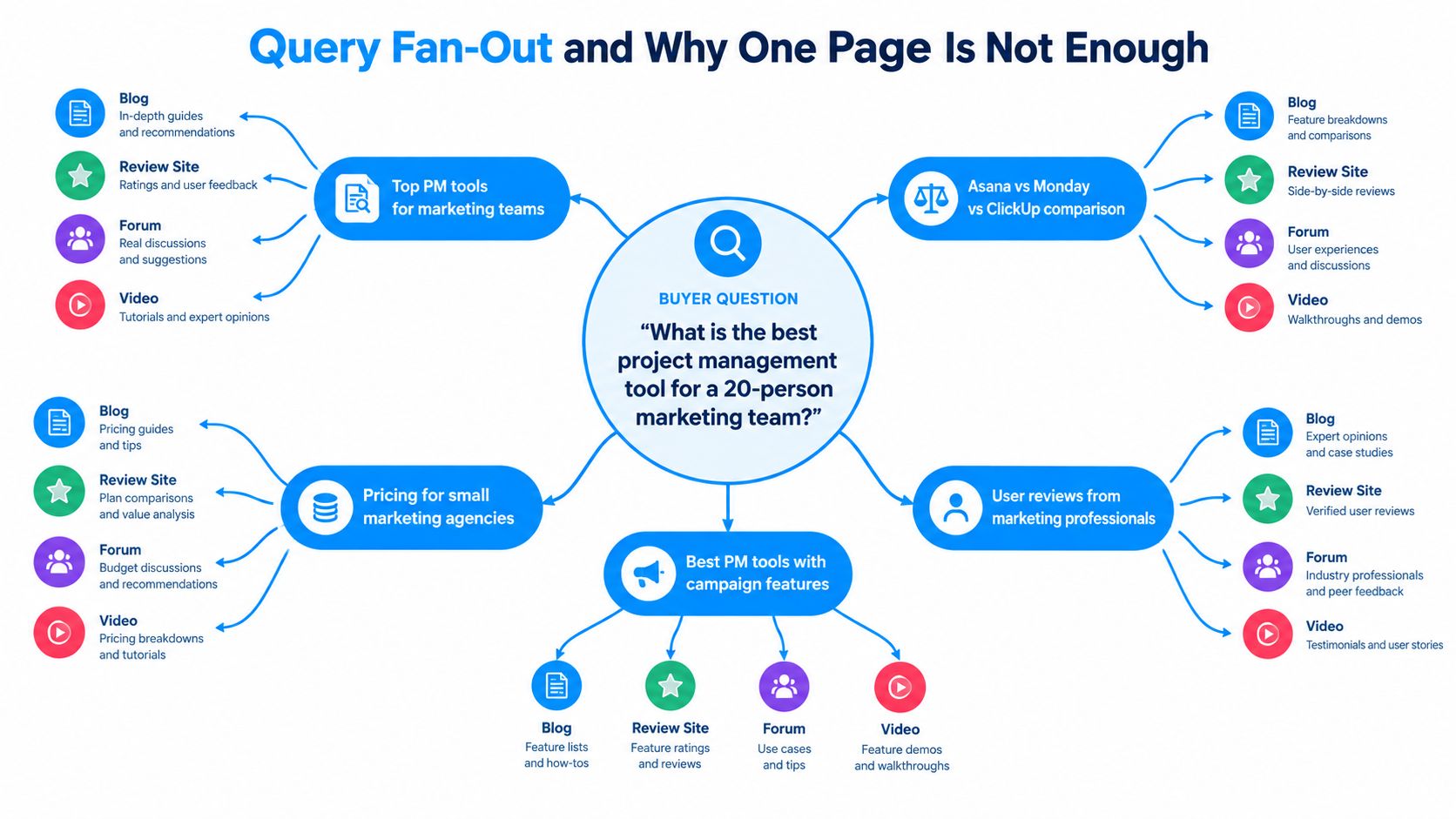
The hidden branches might include:
Category fit: Which project management tools work well for marketing teams?
Comparison: How do Asana, Monday, and ClickUp differ?
Pricing: Which plans suit a small marketing agency?
Capabilities: Which tools support campaigns and content workflows?
Evidence: What do marketing professionals say about each product?
Each branch can produce different documents. A product page may answer capability questions. A pricing page may support plan details. A review site may influence perceived usability. A forum or video may provide practical context that a vendor page doesn't contain.
Build coverage by decision question
The answer engine can synthesize those sources into one recommendation, but a single page rarely handles every branch with equal clarity. A useful content set might include:
A pricing page with current plan details and clear inclusions.
A comparison page that explains meaningful differences between alternatives.
An integrations page organized around the tools the target audience already uses.
A security or trust page that addresses data handling and governance.
Third-party references that confirm product claims from outside the brand's own site.
The structure matters because retrieval happens at the claim and subtopic level. A page with a long general description may be less useful than a focused section that directly answers one buyer question.
A practical workflow starts with the prompt, not the page. Write down the likely sub-queries, assign each one to the strongest existing source, and identify gaps where no page gives a direct answer. Then test the prompt across several engines and record which branch appears to influence the final response.
The page that wins is often the page that answers one fan-out branch exceptionally well, not the page that tries to answer everything at once.
This is why query fan-out analysis can reveal opportunities that keyword tracking misses. It shows whether your brand is absent from pricing questions, security questions, comparison questions, or another part of the decision.
A short demonstration can make the process easier to explain internally:
Use that mental model when auditing content. Don't ask only whether a page ranks for the broad category. Ask which answer branch it can support, whether its claims are explicit, and whether other sources corroborate them.
Being Cited Is Not the Same as Being Found
A citation looks like a win because it gives the brand visible attribution. But citation presence and user verification are separate outcomes. A user may see your page linked beside an answer, trust the overall response, and never open the source.
The traffic evidence is uncomfortable. Pew's analysis of 68,879 real Google searches found that users clicked a traditional result on only 8% of searches when an AI summary appeared, compared with 15% when it did not, as reported in its analysis of clicks after Google AI summaries. Users also more often ended the browsing session after seeing a summary.
Trust can rise even when verification doesn't. A preregistered randomized U.S. experiment found that clickable references increased trust and willingness to share AI-generated answers even when the references were invalid, hallucinated, or broken. A separate analysis of 1,517 references across nine AI systems found that hover and click verification rates stayed below 25%, according to the research on citation trust and verification.
Read the metric before celebrating it
Metric | What it measures | What it misses |
|---|---|---|
Mention rate | Whether the brand appears in an answer | Whether the description is favorable or accurate |
Citation rate | Whether a page or domain supports a visible claim | Whether users inspect or trust that source |
Citation position | How prominently the source is displayed | Whether the answer changes commercial behavior |
AI referral traffic | Visits arriving from an answer engine | Brand influence without a click |
Branded search activity | Later demand associated with the brand | Which prompt created the awareness |
A cited brand might only support a sentence that the reader skims. An uncited mention can still shape recall, especially when the buyer later searches the category or asks a colleague about the product. Neither outcome should be treated as proof of pipeline impact on its own.
Track the full path where possible:
Answer visibility: Did the brand appear?
Source visibility: Was a page linked or cited?
Business effect: Did branded search, direct visits, inquiries, or assisted conversions change?
That last layer requires ordinary analytics and commercial reporting alongside AEO monitoring. It also requires restraint. A citation count can rise while traffic stays flat, or traffic can decline while the brand becomes more familiar to buyers who don't click immediately.
The useful question isn't “How many citations did we get?” It's “Which citations were accurate, prominent, repeated, and connected to a valuable buyer decision?”
Monitoring Your Brand Across Answer Engines
Legacy rank tracking asks where a page appears for a keyword. AI answer monitoring needs to ask what the engine said, which sources it used, and how the brand compared with alternatives.
Start with a fixed prompt set that represents real buying situations. Include category questions, comparison requests, problem-based searches, implementation concerns, pricing questions, and prompts that mention competitors. Run those prompts across ChatGPT, Gemini, Perplexity, Copilot, Google AI Overviews, and other relevant systems because identical wording can produce different answers.
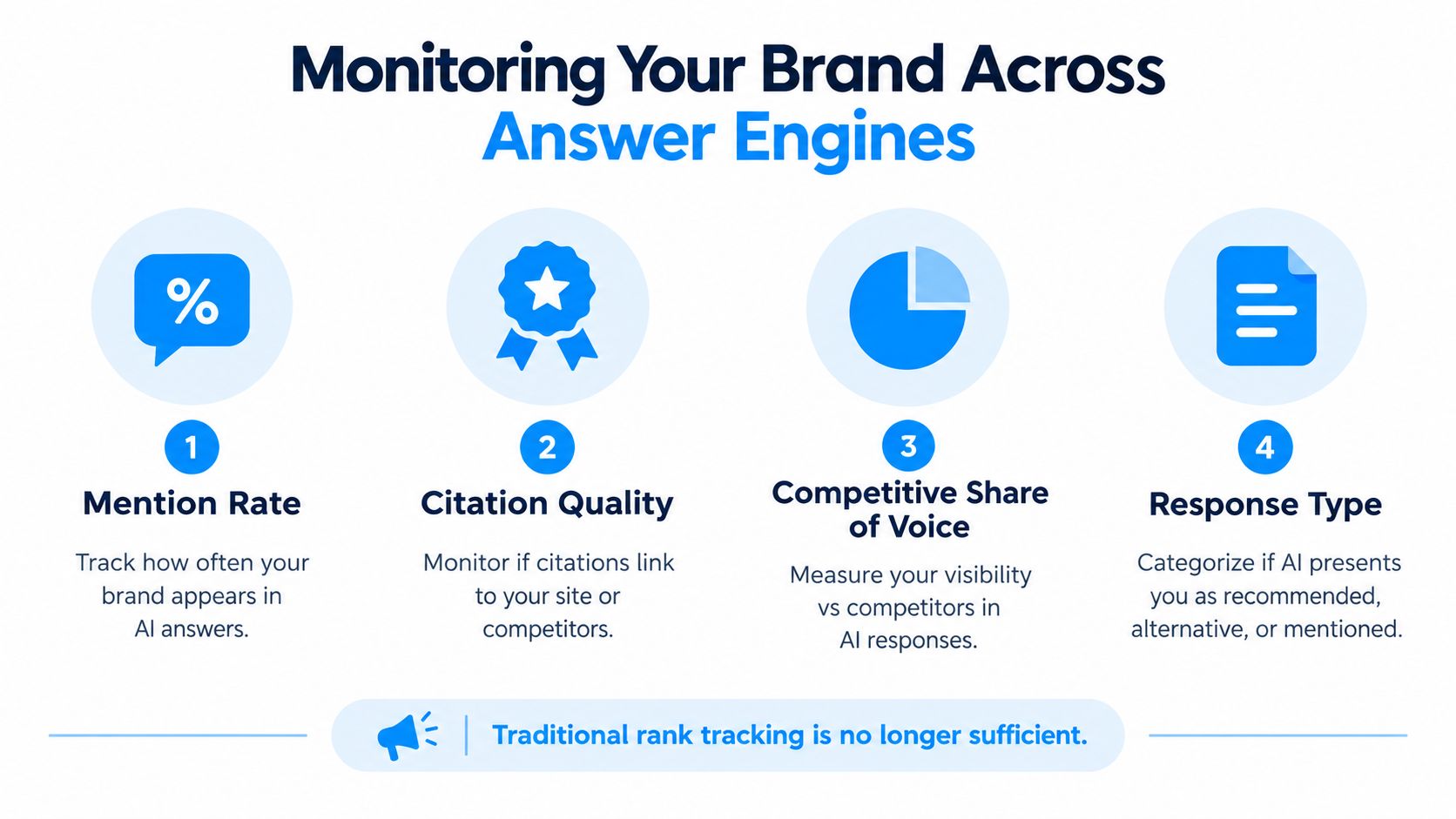
Four measurements create a usable baseline
Mention rate records how often the brand appears at all. Separate positive recommendations from neutral references and negative descriptions.
Citation rate records how often the brand's own domain or pages support the response. Inspect the exact URL, not just the domain, because the pricing page and the homepage may carry very different evidence.
Share of voice compares your appearances with a defined competitor set. Keep the comparison set stable enough to reveal movement, while allowing new competitors to enter when buyers begin naming them.
Response type captures the role the engine assigns to the brand. A company may appear as the recommended option, a credible alternative, a category definition, or an example that isn't actively considered.
The surrounding sentence deserves its own review. A citation next to “offers flexible implementation” carries a different implication from one next to “requires significant setup.” Sentiment analysis is useful here, but human review still matters when the wording affects reputation or sales positioning.
Build a dashboard that explains change
Google says AI Overviews and AI Mode can expand a prompt into related searches. That means a dashboard should preserve the initial prompt, the generated sub-queries where available, the cited URLs, and the subtopic each source appears to support. A weekly refresh helps teams notice changes in retrieval and model behavior without treating one response as a permanent result.
A practical monitoring checklist includes:
Prompt-level history: Save the answer, date, engine, competitors, and citations.
Source inspection: Open cited pages and confirm that they support the associated claim.
Competitor deltas: Record when a competitor replaces your brand in a recommendation or citation.
Fan-out visibility: Review the related searches that lead toward particular sources.
Loss alerts: Flag important prompts when the brand disappears or its source changes.
Business comparison: Compare answer visibility with branded demand, direct visits, and assisted conversions.
The monitoring process should also archive responses over time. Retrieval indexes change, competitors publish new evidence, and engines alter how they expose sources. A page that earned citations last month may lose them when a fresher or more focused document enters the retrieval set.
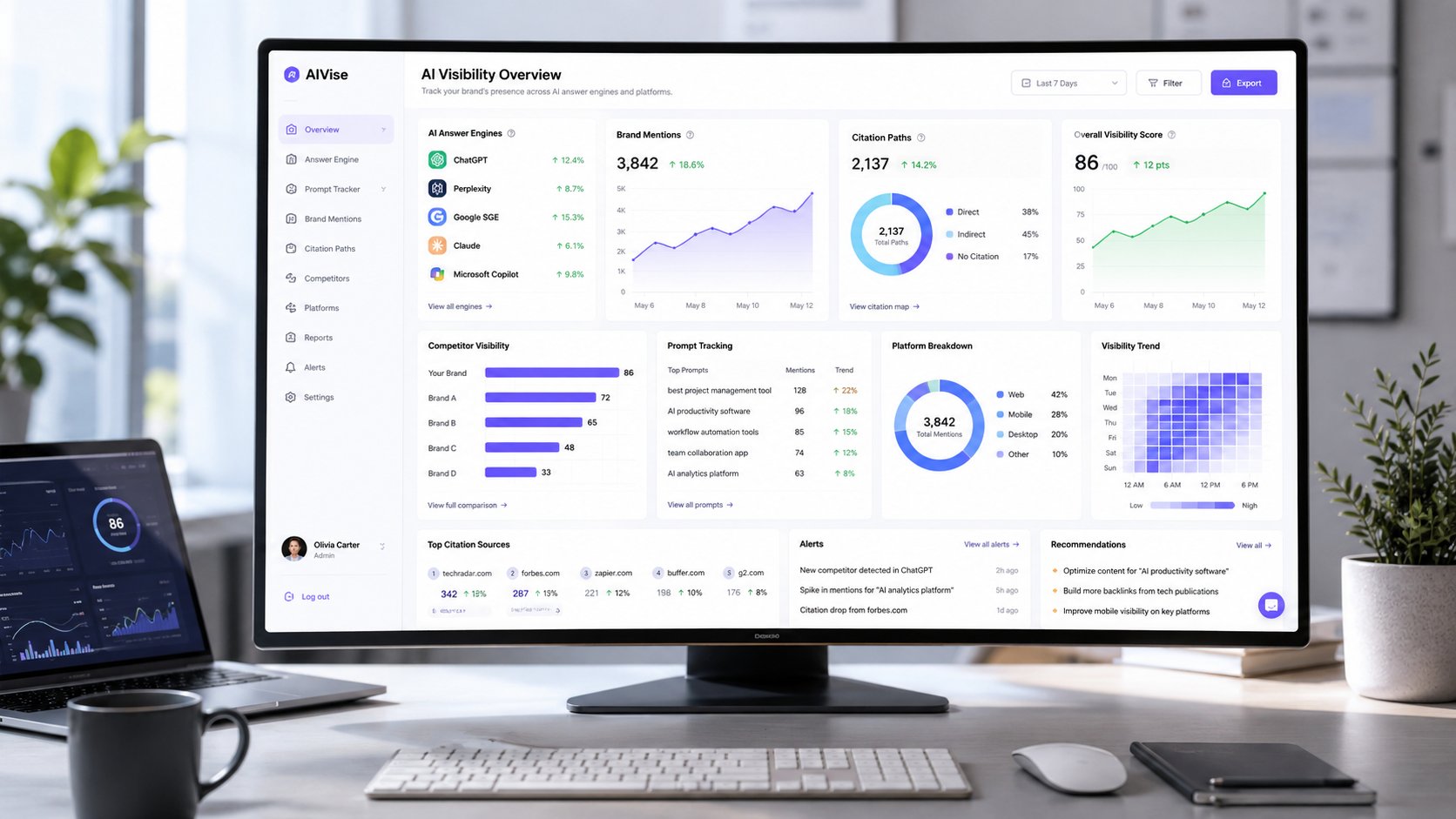
Llumo measures per-prompt visibility, mentions, citations, competitor share of voice, query fan-out, and source changes across AI answer engines, giving teams a way to connect response-level observations with content and visibility work.
Use Llumo to monitor how ChatGPT, Gemini, Perplexity, Copilot, and Google AI Overviews represent your brand across defined prompts. Start by auditing a small set of high-value buyer questions, inspect the cited pages and competitors, then turn the gaps into focused content updates and measurement tasks.