Peec AI Review: Features, Pricing, Pros and Cons (+ a Free Alternative)
Peec AI is an AI-search analytics platform that tracks how often your brand is mentioned, cited and positioned across engines like ChatGPT, Perplexity, Gemini and Google AI Overviews. It is clean, fast to set up and well-suited to marketing teams that want focused visibility monitoring.
Its main limits are add-on pricing for extra engines and the fact that it measures visibility but doesn't fix it. If you want the same tracking without the platform fee, a free bring-your-own-tokens alternative, Llumo, is covered at the end.
What is Peec AI?
Peec AI is a generative engine optimization (GEO) tool that measures how visible your brand is inside AI-generated answers. Instead of tracking blue-link rankings, it tracks whether ChatGPT, Perplexity, Gemini, Copilot and Google's AI Overviews mention your brand, how they position it against competitors, and which sources those engines cite when they answer.
It is built for in-house marketing teams and agencies that have accepted AI search is now a real acquisition channel and want a number they can report on. The workspace is deliberately narrow: it does one job, monitoring, and keeps the interface uncluttered rather than bundling a full SEO suite around it.
What does Peec AI track, and which AI engines does it cover?

Peec AI tracks brand visibility across the major answer engines: ChatGPT, Perplexity, Gemini, Microsoft Copilot, Google AI Mode and Google AI Overviews. On self-serve plans you actively analyze three models at a time, and additional engines are available as paid add-ons. You define a set of prompts that reflect what your buyers actually ask, and Peec monitors how your brand shows up in the answers to those prompts.
For each tracked prompt, Peec surfaces:
Visibility, how often your brand appears in answers to the prompts you track.
Position, where your brand ranks inside an answer relative to competitors named alongside it.
Sentiment, whether the way AI describes your brand is positive, neutral or negative.
Sources and citations, the specific pages, domains and source types the engines pull from when they build an answer.
Competitor share of voice, how your presence compares against a defined set of rival brands.
What are Peec AI's key features?
Peec AI's standout feature is Actions, a module that turns raw citation data into a prioritized to-do list instead of a dashboard you have to interpret yourself. Beyond that, its strength is a focused, well-designed feature set rather than a sprawling toolkit.
Feature | What it does |
Visibility, Position, Sentiment | Three core scores that answer "Are we mentioned? Where do we rank? Do they speak well of us?" |
Prompt tracking | Monitors your brand across the high-intent prompts your buyers actually type |
Competitor benchmarking | Compares your visibility, mentions and sentiment against a defined competitor set |
Source and citation insights | Shows which websites and content types the engines rely on for each answer |
Actions | Clusters source data into owned-media and earned-media opportunities, each scored Low / Medium / High by potential impact |
Team seats | Adds users across plans without per-seat fees, which lowers friction for larger teams and agencies |
The Actions module is the part reviewers single out most often, because it is where Peec moves from "here is your data" toward "here is what to do about it", clustering citation sources into things like review placements, Reddit and forum threads, comparison pages and how-to content, then scoring each by opportunity size.
How much does Peec AI cost?
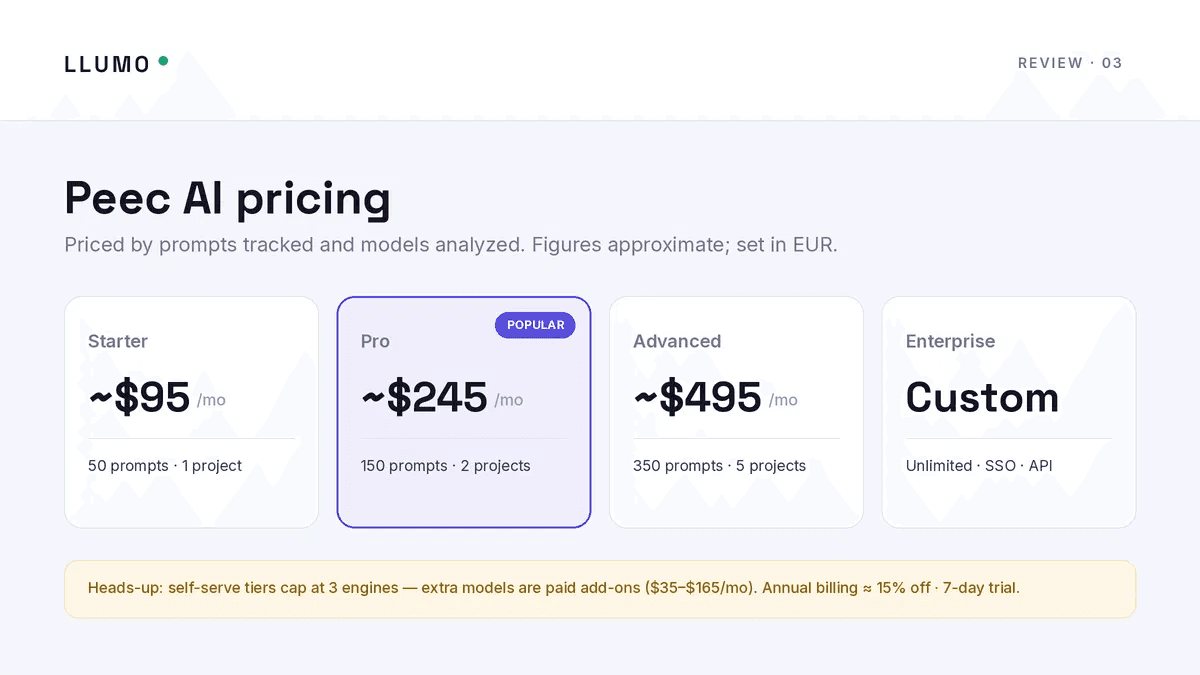
Peec AI starts at roughly $95 per month for the Starter plan and scales up through Pro, Advanced and a custom Enterprise tier. Two factors drive the price: how many prompts you track and how many AI models you analyze. Peec is priced in euros, so the dollar figures shift with the exchange rate, always confirm the current numbers on Peec's own pricing page before quoting them to a client.
Plan | Approx. price | Prompts | Projects | Notes |
Starter | $95/mo | 50 | 1 | 3 models included |
Pro | $245/mo | 150 | 2 | Adds multi-country tracking |
Advanced | ~$495/mo | 350 | 5 | Adds analytics-suite integration |
Enterprise | Custom quote | Custom | Unlimited | API access, SSO, every model Peec tracks |
Two pricing details matter more than the headline figure. First, self-serve tiers cap you at three AI models, and each extra engine is a paid add-on, roughly $35/mo on Starter, $85/mo on Pro and $165/mo on Advanced, so broad multi-engine coverage can add several hundred dollars to the sticker price. Second, annual billing takes about 15% off, and the free trial runs 7 days. Because AI-visibility data needs time to form a trend, a week is a short window to properly evaluate the tool.
What are the pros and cons of Peec AI?
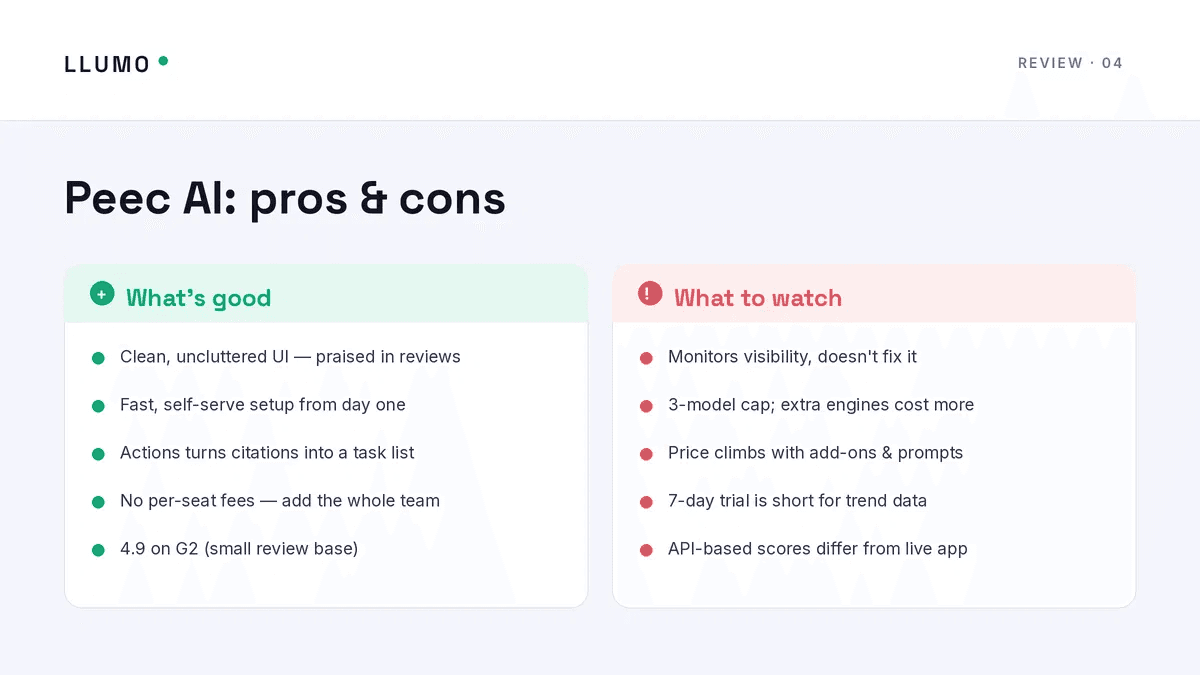
Peec AI's biggest strength is that it is clean, focused and fast to get running; its biggest weakness is that it stops at diagnosis and charges add-on fees for full engine coverage. It reviews well on usability and support, and less well on the "so what do I do now" gap that affects most monitoring tools.
Pros
Clean, uncluttered interface that reviewers consistently praise; fast, self-serve setup.
Focused feature set rather than a bloated all-in-one suite.
Actions module translates citation data into a prioritized task list.
No per-seat fees, you can add your whole team.
Strong reputation for responsive support; a 4.9 average on G2, though from a still-small review base.
Cons
Monitoring only, it tells you what's happening but doesn't write content, build authority or implement technical fixes.
Three-model cap on self-serve plans means full engine coverage costs extra.
Headline price can climb quickly once add-ons and higher prompt volumes are included.
7-day trial is short for a metric that needs weeks to stabilize.
Data is queried through a clean API environment, so numbers can differ from what a logged-in user sees in the app on their own device.
What are Peec AI's main limitations?
Peec AI's core limitation is that it is a measurement tool, not an execution tool, it shows you the gap without closing it. If no one on the team owns the next step, the insights can sit unused. There is also a methodology caveat worth understanding before you present the numbers upstairs.
Peec queries the AI models through a controlled API environment. That makes its tracking consistent and repeatable, but it also means Peec's visibility score can differ from what a specific person sees when they type the same prompt into a logged-in ChatGPT on their phone, with their own history and personalization.
The score is directionally useful for tracking change over time; it is not a promise of what any individual buyer will see in a given moment. Treat it as a trend line, not a live mirror.
Who is Peec AI best for?
Peec AI is best for mid-market B2B and SaaS marketing teams that want a clean, reliable way to answer "are we visible in AI search?" and can act on the findings themselves. It fits teams that already have content and SEO capacity in place and just need the measurement layer on top.
It is a weaker fit for:
Small teams or early experimenters, where the monthly cost is hard to justify against a handful of prompts.
Teams without a GEO process, where the data will surface problems no one is resourced to fix.
Anyone who needs execution, not just monitoring, Peec won't produce the briefs, content or authority-building that move the numbers.
Is there a free alternative to Peec AI?
Yes. Llumo is a free, self-hostable AI-visibility platform that tracks the same answer engines Peec does, but replaces the monthly platform fee with a bring-your-own-tokens model. You connect your own AI provider API keys, pay those providers directly for usage, and use Llumo itself for free, with no license fee and no markup on every AI response.
That difference changes the economics for anyone tracking a lot of prompts or a lot of engines. Peec charges around $240/month for 150 prompts across 3 models and 2 projects. With Llumo, the same 150 prompts tracked daily across 7 engines works out to roughly $100/month in third-party API costs, while the platform itself stays free, with unlimited projects.
Peec AI | Llumo | |
Platform fee | ~$95–$495+/mo | Free (bring your own keys) |
Engines on entry tier | 3 (add-ons for more) | Up to 7 |
Projects | 1–5 by tier | Unlimited |
Pricing model | Fixed subscription + add-ons | Pay providers directly, no platform markup |
Hosting | Hosted SaaS | Self-hostable, you own the data |
Core tracking | Mentions, position, sentiment, sources, competitors | Mentions, competitors, citations, sources, prompt-level responses, query fan-out, trends |
Llumo won't be the right call for everyone, if you want a fully managed, hands-off SaaS with a polished onboarding team and don't want to touch API keys, a paid tool like Peec may suit you better. But if your priority is tracking AI visibility across every major engine without a growing subscription, and owning your data, the bring-your-own-tokens approach is hard to beat on cost. You can also point Llumo at specific engines directly, for example its ChatGPT tracker or Google AI Overviews tracking, and start monitoring for free.
Frequently asked questions
What is Peec AI used for?
Peec AI is used to monitor how a brand appears inside AI-generated answers. Marketing teams and agencies use it to track brand mentions, position and sentiment across engines like ChatGPT, Perplexity, Gemini and Google AI Overviews, benchmark against competitors, and see which sources those engines cite.
How much does Peec AI cost?
Peec AI starts at around $95/month for the Starter plan (50 prompts, 3 models), rising to roughly $245/month for Pro and $495/month for Advanced, with a custom Enterprise tier. Extra AI engines are paid add-ons, annual billing saves about 15%, and the free trial lasts 7 days. Prices are set in euros and change, so confirm current figures on Peec's site.
Which AI engines does Peec AI track?
Peec AI tracks ChatGPT, Perplexity, Gemini, Microsoft Copilot, Google AI Mode and Google AI Overviews. Self-serve plans analyze three models at a time, with additional engines available as paid add-ons.
Does Peec AI improve your AI visibility, or just measure it? Peec AI measures visibility rather than improving it directly. It shows where your brand appears, where competitors win, and which sources get cited, and its Actions module suggests priorities, but it does not write content, build authority or implement technical fixes. Improving the numbers still requires execution by your team.
Is there a free Peec AI alternative?
Yes. Llumo is a free, self-hostable AI-visibility platform that tracks the same engines using a bring-your-own-tokens model. You pay AI providers directly for usage and use Llumo itself for free, with unlimited projects and up to seven engines, instead of a fixed monthly platform subscription.
Is Peec AI worth it?
Peec AI is worth it for mid-market teams that want clean, focused AI-visibility monitoring and can act on the data themselves. It reviews well on usability and support. It is less worth it for small teams on a tight budget, for anyone who needs execution rather than measurement, or for teams tracking many engines who would rather avoid stacking add-on fees.
Start tracking your AI visibility for free
See where your brand appears across ChatGPT, Gemini, Perplexity, Google AI Overviews and other major answer engines without paying another platform subscription. With Llumo, you can track mentions, citations, competitors and visibility trends while keeping control of your data and costs.